Once upon a time, not all that long ago, most people in the United States – even a few Republicans – still respected science and engineering and the earnest, hard-working people who studied and practiced in those fields. A seemingly brilliant and altruistic engineer named Elon Musk was well along in his admirable quest to build a world-class electric car company. With its high-tech American-built cars and extensive nationwide charging network, Tesla was the absolute best choice for anyone interested in abandoning an eco-unfriendly gasoline-powered car in favor of an EV capable of long-distance travel. When we purchased a 2020 Tesla Model Y in January of 2021, the shining, stylized “T” on the front of the car felt like a badge of honor. At that time, we still had an ICE (internal combustion engine) car for backup, but we primarily used the Tesla for the next several years.
Three years and 45,000 zero-emission miles later, we were still in love with our Tesla. Our youngest son’s fourteen-year-old Toyota Corolla was on its last legs and had to be replaced, so we transferred our backup ICE car to him, having decided to replace it with a second EV. Reviewing our needs at that time, it was clear that Tesla was still the best EV choice for us, with its advanced features, long range, and charging network needed for travel between Minneapolis and Grand Marais as well as for long distance travel around the US. In addition, the 2023 Inflation Reduction Act (IRA) had expanded the number of EVs eligible for Federal tax credits, and we believed that a 2024 Tesla Model 3 would meet the tax credit criteria. With enthusiasm, we purchased our second Tesla and began driving it all over the US – to the Great Smokey Mountains, back and forth to Grand Marais, to National Parks and Monuments in Utah, Colorado, Montana, and South Dakota.
However, even before buying the second car, black clouds had begun to gather. First, the formerly brilliant Musk had seemingly lost his mind with the purchase and wreckage of Twitter. Second, while the Model 3 was eventually added to the list of eligible IRA vehicles, since we hadn’t waited until the pronouncement was official, we got no tax credit. Finally, Musk has devolved even further into a completely despicable being, buying the presidency for Donald Trump and eagerly seizing upon his so-called mandate to destroy the US Government. His Gulf of Mexico sized ego seems to have driven him to abandon all pretense of what I had misinterpreted as altruism in favor of enriching himself to a level never seen before in human history. Instead of the man who created an eco-friendly American EV industry, he’ll now be forever known as the man who seized the opportunity to loot government coffers while pretending to champion “efficiency.” (Sometimes as I toss and turn at night, I dream that co-President Trump will become annoyed with playing second fiddle to Musk. After all, he has his own foray into Corruptocurrency to worry about. Perhaps he’ll send Pam Bondi and Kash Patel to arrest his former ally on some sort of presumably Trumped-up charges …)
But I digress. Given these tragic turns of events, that shining, stylized “T” has now become a scarlet letter of shame. So, what’s a once-proud Tesla owner to do? I hear many competing voices in my head. “Sell the cars? Donate them to Trump sycophants? Torch them in a grand, public display? Drive them off the rim of the Grand Canyon, ala Thelma and Louise? Replace them with VWs, Hyundais, Porsches, Volvos, or some other alternative?” Pat seems ready for one of those options, but none of them seems right to me.
I remind myself that there are many good, hard-working people still employed by the evil Muskrat, still working to produce high-quality, eco-friendly EVs. Surely many, if not most, of those people actually believe in the EV mission, even though Musk clearly doesn’t. Shouldn’t I still try to support them rather than abandoning ship and letting Musk have the last laugh?
So, I’ve at long last come up with a plan. I still love both cars and am proud to be driving zero emission vehicles (by now up to a total of more than 65,000 miles). I have purchased two bumper stickers which I will prominently display on both cars:
If people stop to engage me in conversation about these signs, I’ll text them a link to this diatribe. Although, if they seem to be Trumpites or Muskmen, I’ll probably rickroll them instead.
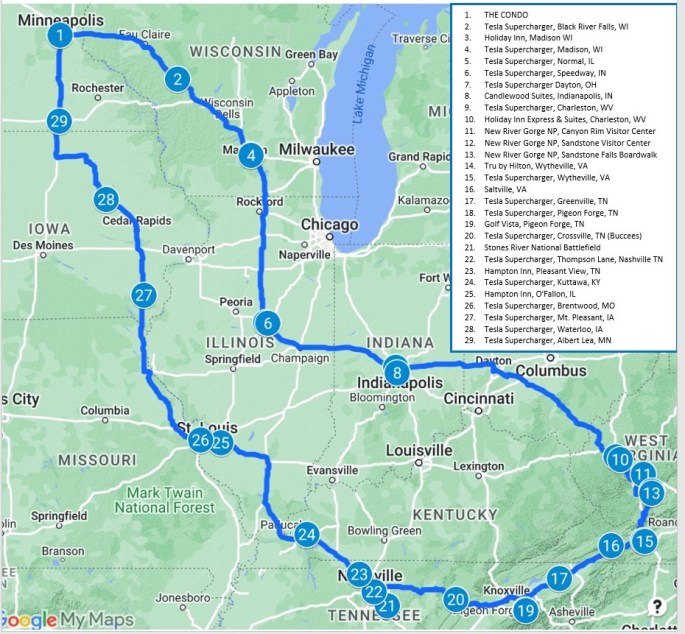
In Part 1 and Part 2 of this series, I described our travels from Minneapolis, MN to Pigeon Forge, TN, and our visits to two National Parks, New River Gorge NP in West Virginia and Great Smoky Mountains NP in Tennessee. This final episode provides a brief summary of our trip back home and some details of how our new EV performed on the road trip.
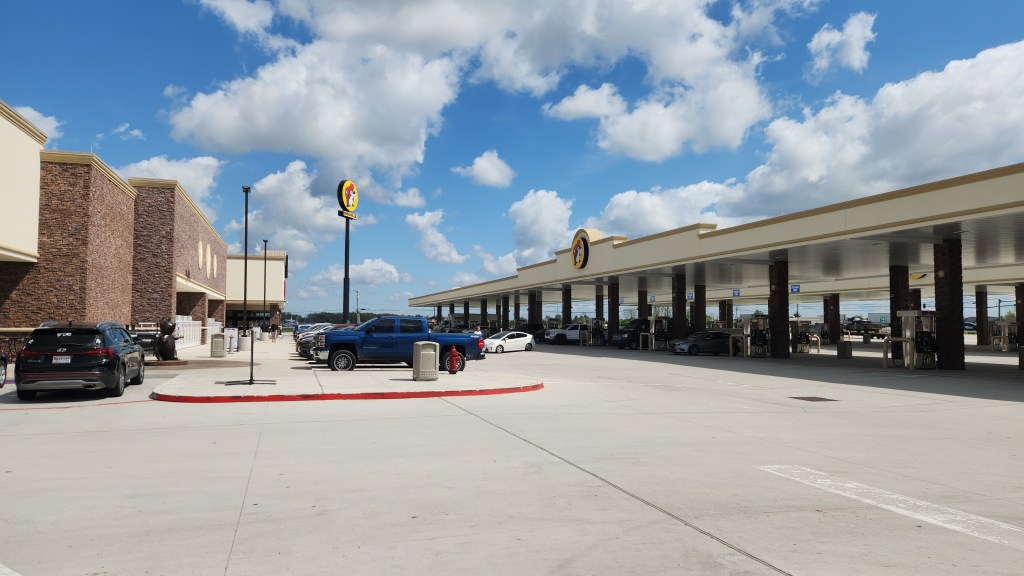
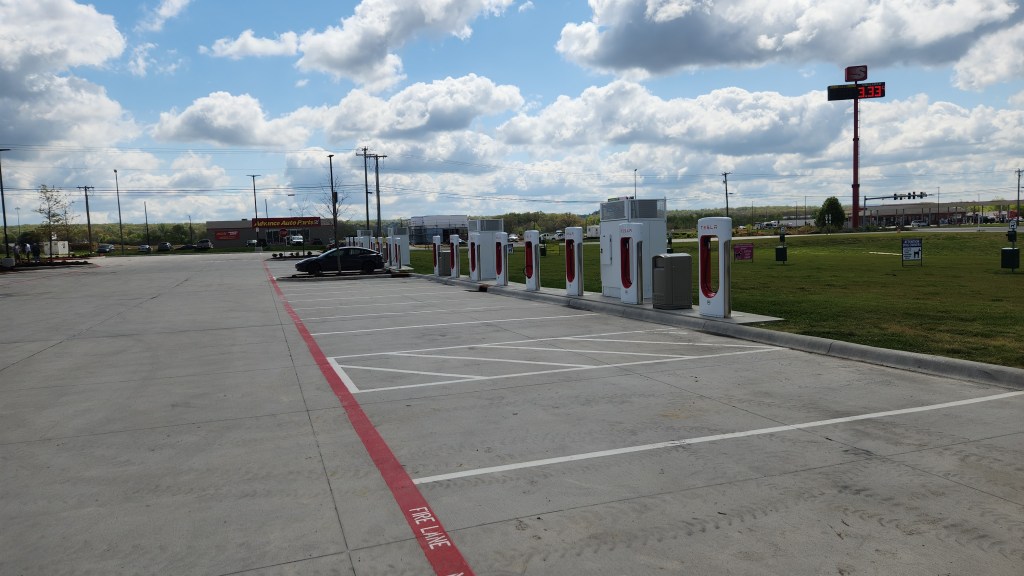
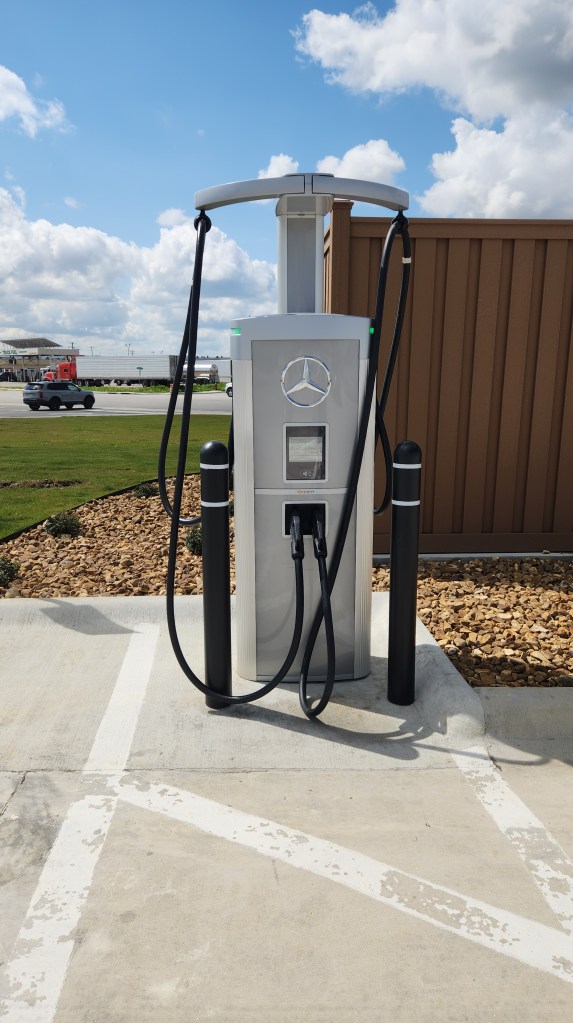
Wednesday, April 24, 2024: We left the Golf Vista on Dollywood Lane shortly after 9 AM and headed eastward, stopping to charge the car at a place called Buccees in Crossville, TN. We’d never heard of Buccees before, but it’s apparently a very popular fuel and convenience store chain in the southeastern US. We were absolutely amazed by the place. There had to be sixty or more gas pumps in addition to two charging stations – a Tesla Supercharger bank with 16 chargers and a ChargePoint station with four chargers (interestingly bearing Mercedes Benz logos). The convenience store was huge – easily as big as large truck stops such as Loves or Pilot – and was filled with an amazing array of ready-to-eat foods, groceries, gift items, and such. One especially unique feature was an array of about twenty or thirty different types of custom-made beef jerky. We bought a bag and it was delicious. I’d recommend Buccees as a welcome stop for travelers of all stripes.
The Amazing Buccees in Crosville, TN
Tesla Superchargers at Buccees — hardly anyone using it, as usual
ChargePoint Charger at Buccees
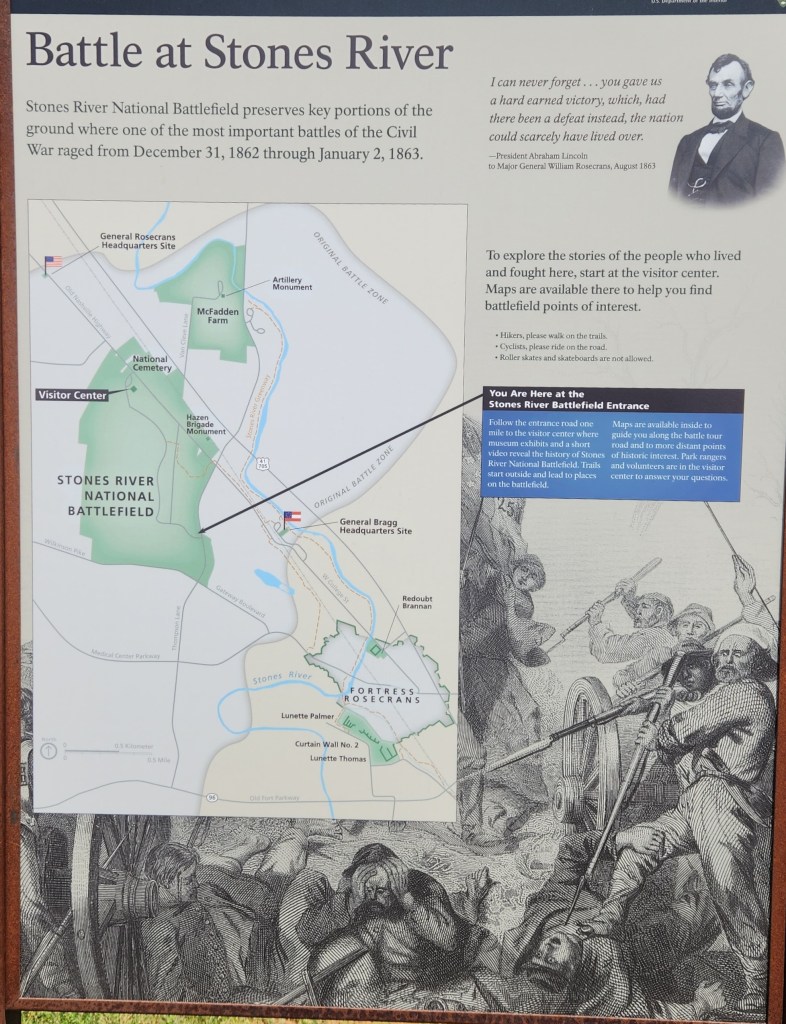
After charging the car, we drove to the Stones River National Battlefield in Murfreesboro, TN, for our final point of interest before sprinting for home. This site, operated by the National Park Service, memorializes the Battle of Stones River, which took place from December 31, 1862 through January 2, 1863. Union forces squeaked out a victory in a bloody conflict there, boosting morale in the North and gaining control of central Tennessee. Of the major battles in the Civil War, Stones River had the highest percentage of casualties on both sides.
We first stopped in at an impressive Visitors Center with interesting displays about the battle and its aftermath and then strolled around the 600-acre site to see several key battleground areas and the large National Cemetery in which more than 6,100 Union soldiers are buried, including more than 2,500 who were never identified. We left with a somber feeling, with a new appreciation for the immense toll that the Civil War took on the soldiers who fought in it and their surviving families and loved ones.
Stones River Battleground Sign
Stones River Battleground
Stones River National Cemetery
Then we headed off to another charging stop just southeast of Nashville and then on to the Hampton Inn in Pleasant View, TN. We enjoyed a meal at a little place called Firecracker Pizza near the hotel before turning in for the evening.
Thursday, April 25, and Friday, April 26, 2024: Our last two days were uneventful, including a drive to the Hampton Inn O’Fallon near St. Louis for our final night’s stay and then a long (for us) eleven-hour drive home as the weather turned cold and rainy. As we trundled our luggage up to our fifth-floor condo, we felt very satisfied with our Easy EV Road Trip. Here’s a recap:
EV Performance: Now for some information (hopefully not too nerdy) about how our new EV performed on the Road Trip. Hopefully this will be of interest to readers who may be considering purchasing an EV or who may feel hesitant about it due to perceived EV problems.
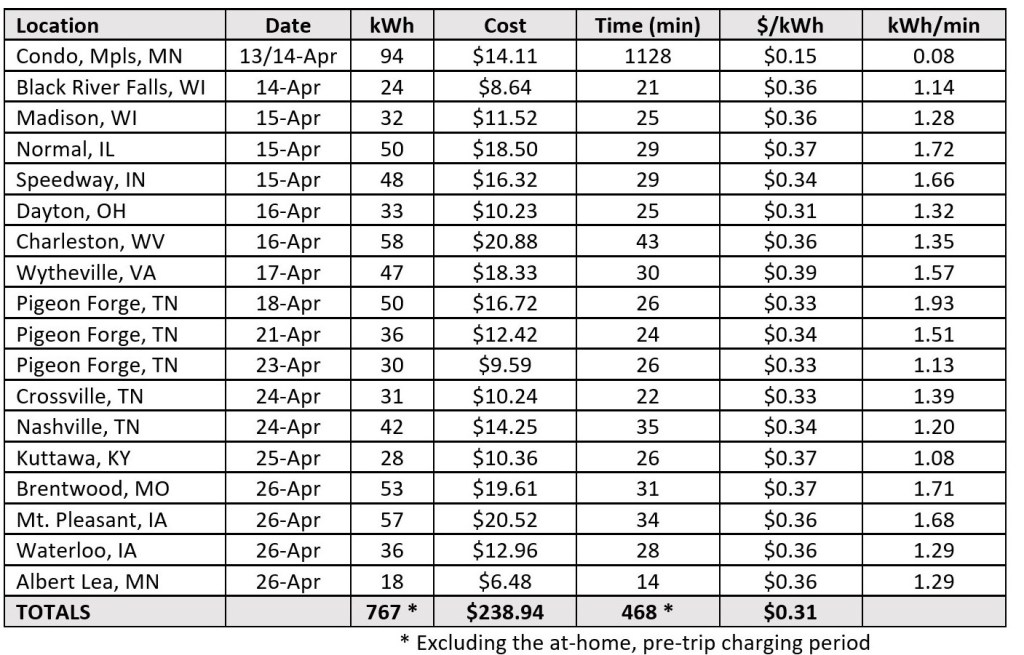
Many questions are related to charging an EV. How much does it cost? How long does it take? How hard is it to find chargers? I’ll answer these questions based on actual data from our Easy EV Road Trip. Details of our charging sessions during the trip are provided in this table:
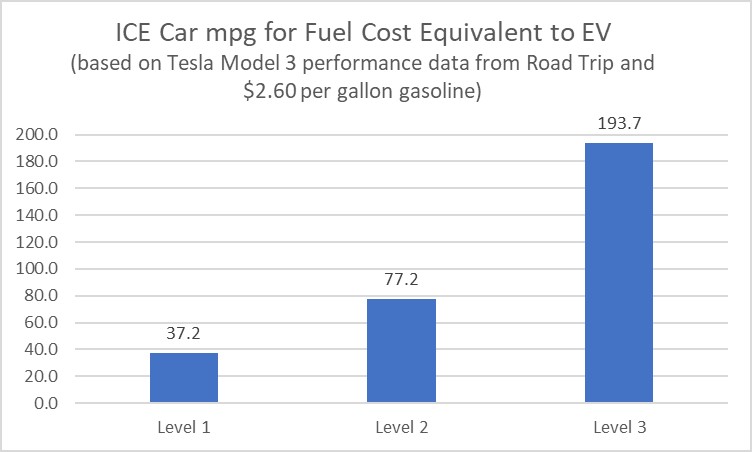
One thing I’ve heard from a number of people is that, with electric costs rising due to inflation, operating an EV is too expensive. So, what did we actually spend on electricity during this Road Trip? $238.94, including the pre-trip charging at home in the condo garage. How would that compare to the identical trip with an internal combustion engine (ICE) car? If we assume an average gas price of $2.60, based on what we observed on various gas station signs along the way, fueling an ICE car would cost the same as what we spent on charging the EV if it got 37.2 mpg. (If gasoline prices miraculously fell to $2.50, an ICE car would only need to get 29.1 mpg to break even with the EV, but if it spiked to $4.00, it would need to get 46.5 mpg for an equivalent fuel cost.) Put it this way – the plethora of large pickup trucks and SUVs we observed along the way are costing a lot more to take on a road trip, while a Toyota or Honda hybrid would cost a bit less.
It’s important to understand that using high-speed (Level 3) chargers (such as the Tesla Superchargers we used) is the absolute most expensive way to charge an EV. By comparison, slow (Level 1) charging at our condo with a simple 110V circuit costs less than half as much, or intermediate (Level 2) charging at our Lake Superior cabin, with a reduced off-peak rate, costs less than a fifth as much. Equivalent-cost ICE cars would need to get 77.2 mpg or 193.7 mpg to compete with these Level 1 and Level 2 chargers, and I can guarantee there are no such ICE cars in existence anywhere. So, if you consider that road trips probably represent a very small percentage of the total driving that any of us do, an EV with a Level 1 or Level 2 home charger is far less costly to operate than an ICE car.
Another issue for EV hesitance is the time required for charging stops on a road trip. So, just how long did we spend charging the car on our Easy EV Road Trip. As the table above shows, the total charging time for the 17 stops was 468 minutes (7.8 hours) with an average of 27.5 minutes per stop. We generally used that time for something more or less productive, such as eating lunch, buying groceries, using the rest room, watching a Netflix movie on the Tesla screen, etc., so it didn’t really feel like wasted time. However, if getting to your destination as fast as possible is a high priority, the time spent charging is a significant detriment.
To put it in perspective, the comparable time for fueling an ICE car depends on the size of its gas tank and the car’s mileage. Calculations I did based on a Honda Accord hybrid, a light-duty pickup, and a heavy-duty pickup showed minimum total time for fueling over a 2,777 mile Road Trip would be 49.7 minutes, 55.1 minutes, and 59.3 minutes, respectively (assuming ten minutes per fill up), for a saving of nearly 7 hours compared to our EV, although some of that time would be eaten up by the aforementioned eating, shopping, etc. This would easily allow the trip to be completed in a day less, although Pat and I – retirees both – don’t like to drive for more than 4 hours a day anyway, so the savings would be meaningless to us. A good deal of this aversion to long driving times comes from the stress induced by other drivers — huge pickups that tailgate menacingly, freeway mergers who insist on reaching their final merge point at exactly the same position as our car — or driving conditions such as endless stretches of road construction or heavy wind or rain, to name but a few.
Probably the biggest factor in EV hesitance is range anxiety – will an EV driver be able to get to the next charging station before running out of power? The new Tesla Model 3 proved to be excellent in this regard. The quoted range is 324 miles under ideal conditions, and we found that the actual distance traveled averaged 93.4% of the range estimated by the car during the Road Trip. We generally recharged the car when it dropped below 20% of battery capacity and charged it to 80-90% of full at each stop. A major reason we bought the Tesla is the large number of Superchargers that have been deployed all across the country, and we never had any anxiety about reaching one in time. Planning the stops was very easy; we used two methods. The simplest way was to give a voice command, e.g. “Navigate to Pigeon Forge, Tennessee,” and let the car map out recommended charging stops. Sometimes we used an app called ABRP (for ABetter Route Planner) to check out alternate routes – this app can be customized to use actual performance data from a specific car and/or to specify such things as minimum charging time, avoiding tolls, and the like.) Thus, the trip truly lived up to my claim as Pat and Daves Easy EV Road Trip. I can’t offer any insight regarding road trips in non-Tesla EVs, however.
One final note about the Tesla. Coincidentally, just before we left on the trip, Tesla decided to give all or most Teslas on the road a free month of what they call “Supervised Full Self Driving” capability, so we decided to try it out during the trip. The video below shows how it worked – quite well and rather fun.
Tesla “Supervised Full Self Driving” demonstration
It also included automatic parking in parking lots and automatic parallel parking on streets. However, neither of us was comfortable letting the car drive itself, and we also felt that the price for this feature — $ 99 per month or $4,000 dollars for the life of the car – was too steep, so we did not pick it up after the free trial. The car still has what Tesla calls “Autopilot,” which is adaptive cruise control, and “Autosteer,” which maintains the car within the driving lane and automatically steers around curves.
While the above considerations are all related to practical matters – cost, time, level of anxiety – they do not speak to the major reason to buy an EV, which is to help slow the inexorable advance of climate change. While I’m afraid that the drivers of those menacing, tailgating pickup trucks will merely scoff at that idea, I hope it can influence some readers; after all, doesn’t helping to save the planet seem more important than saving a little time on a road trip?
OK, that’s it! Thanks for reading, and please consider joining the EV universe!






 Dave Saari