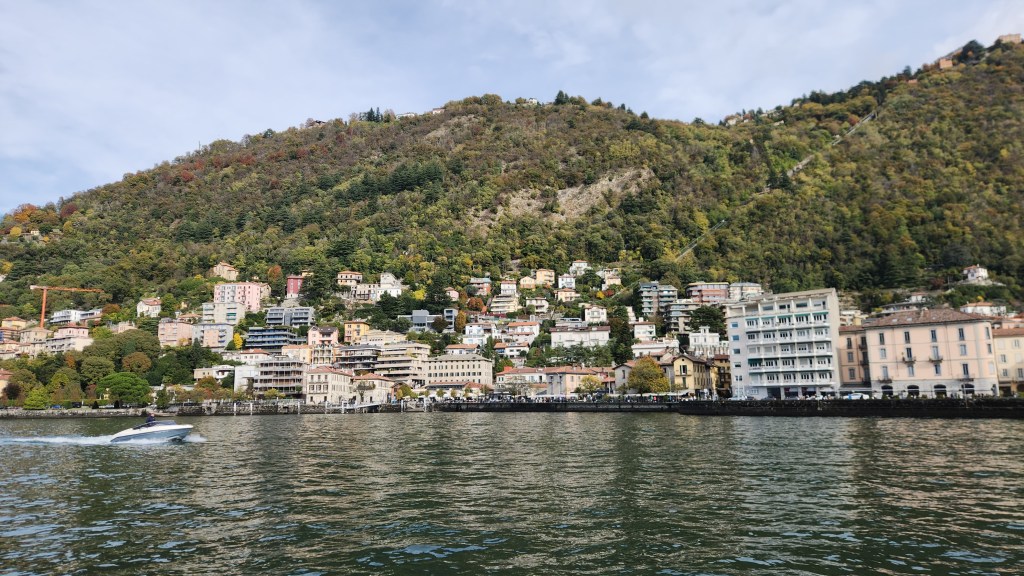
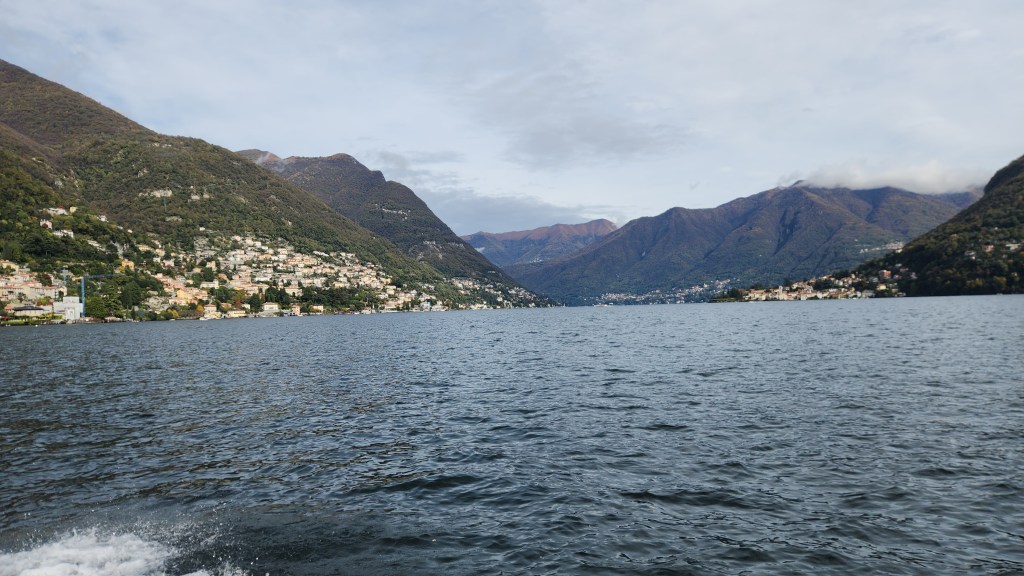
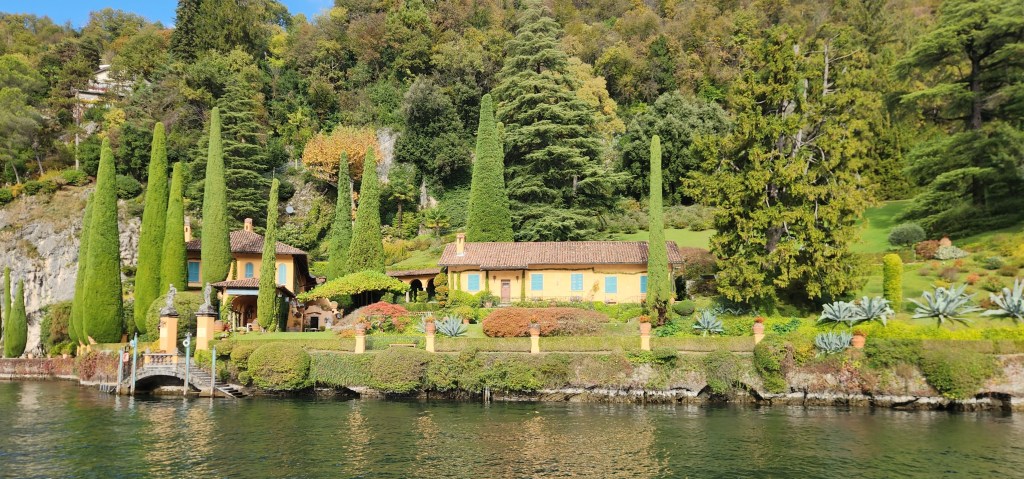
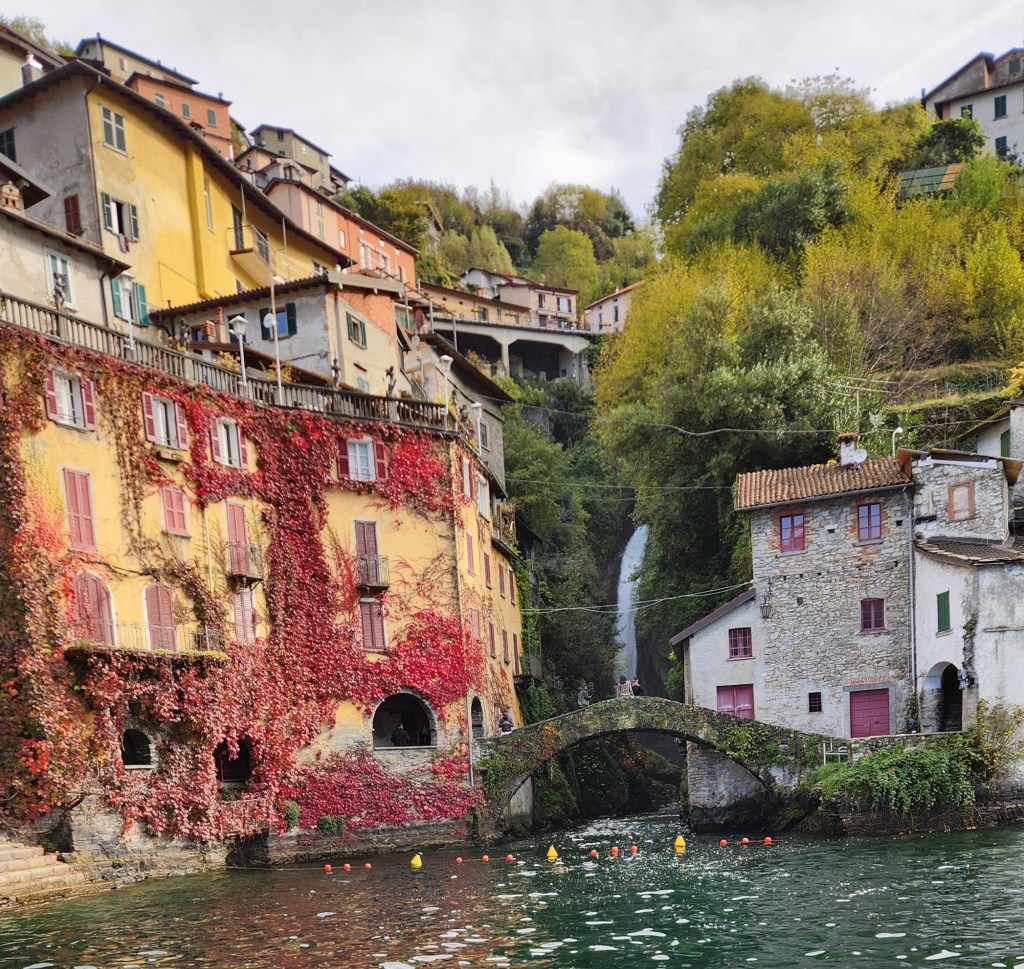
Pat and Dave’s Mediterranean Moments – PART 4: Athens and Classic Greece

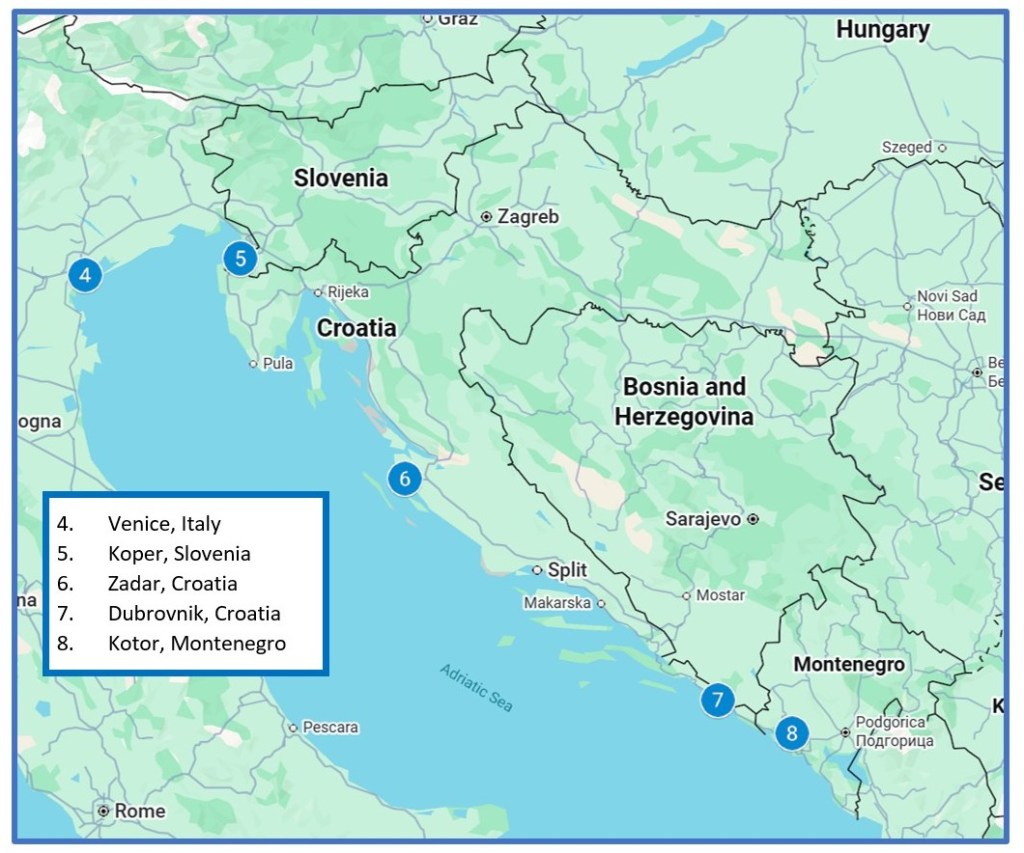
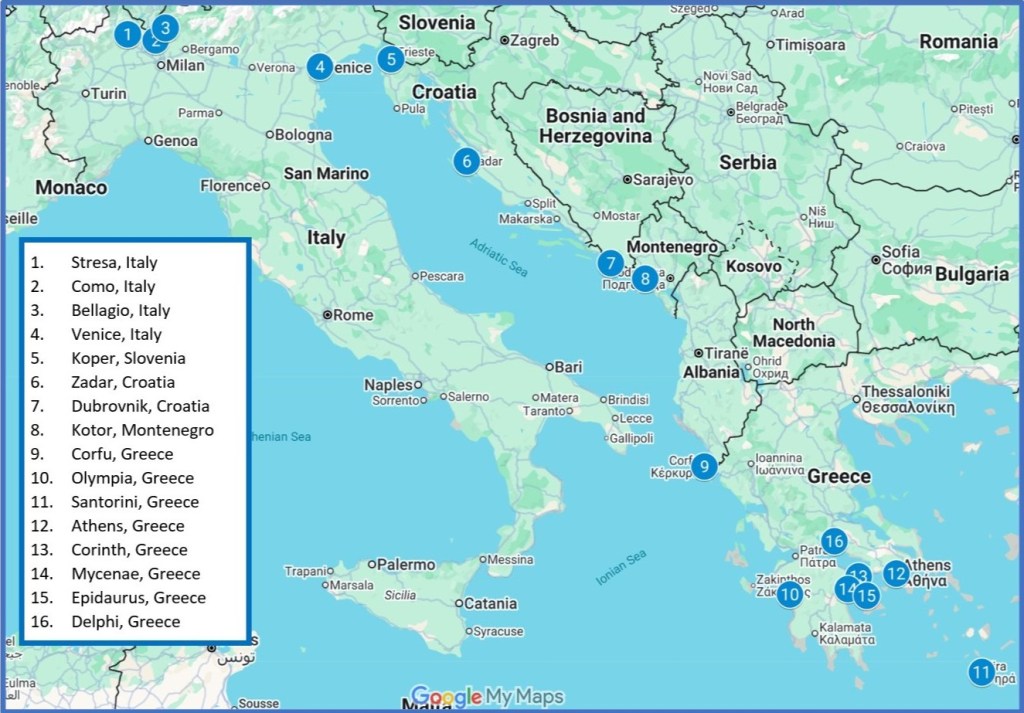
Welcome back for the concluding Part 4 of this travelogue series. Part 3 ended as we returned from our first tours of Athens for our final night abord the Viking Neptune, anchored in the Port of Piraeus. Here’s the final map of the journey, showing the places I’ll describe in this narrative.
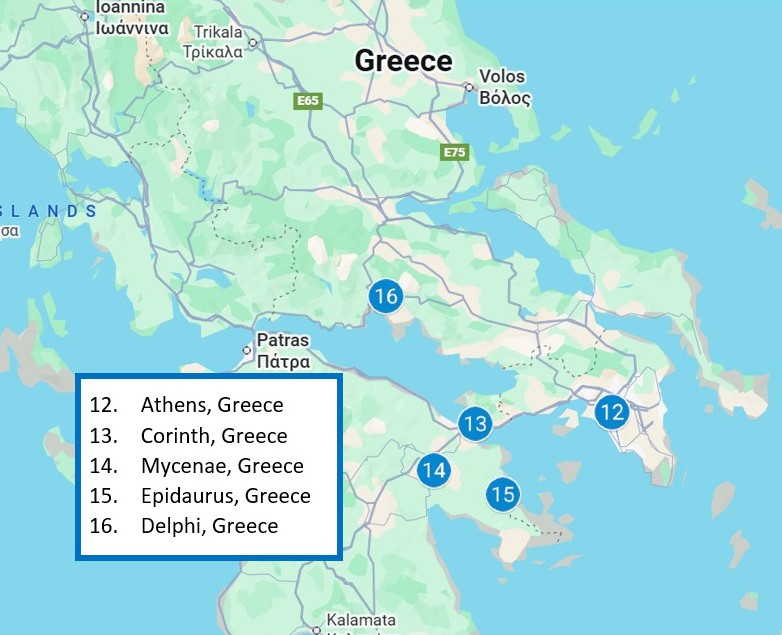
Now let’s continue the story …

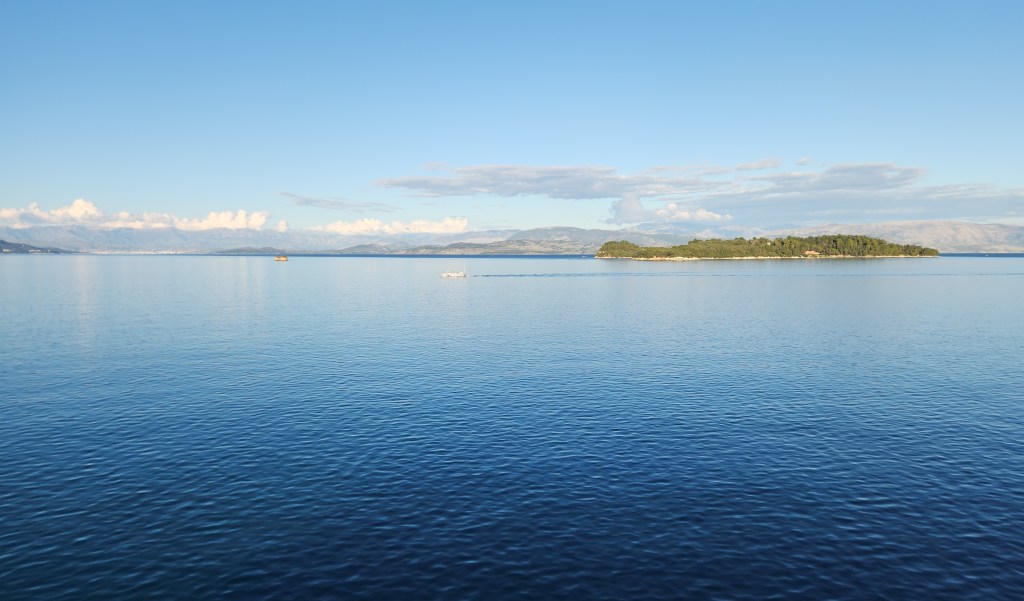
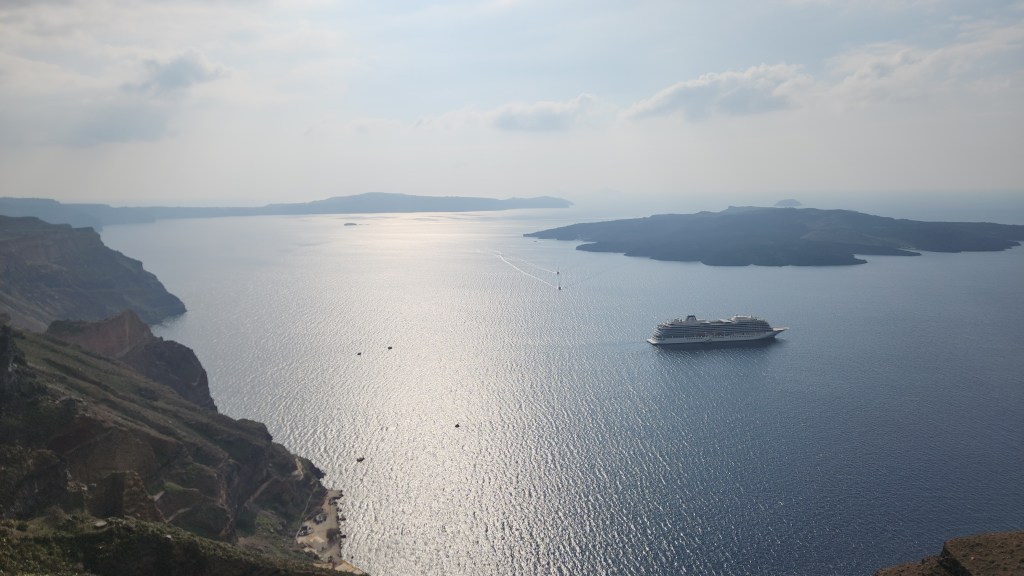
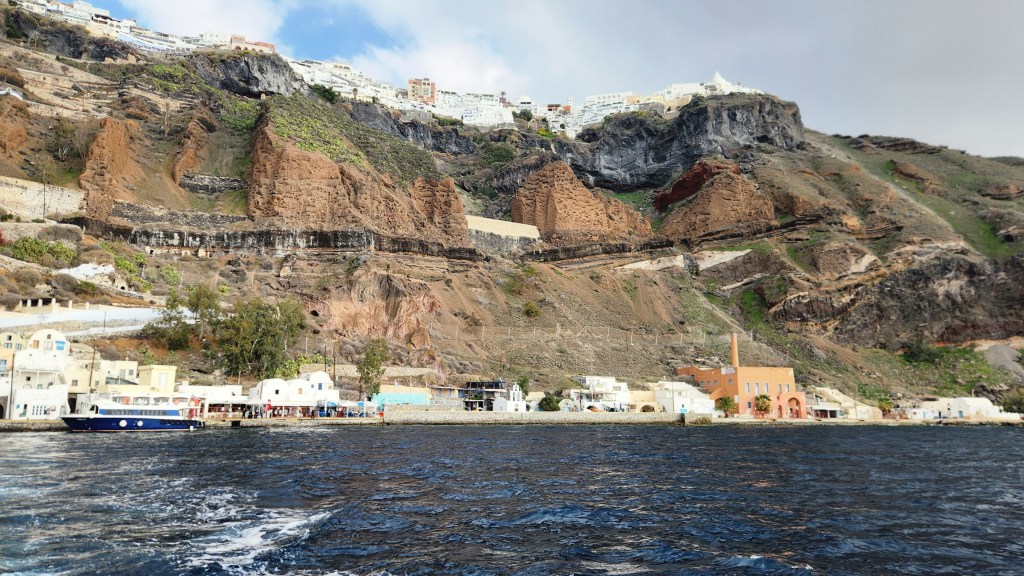
Athens, Greece (Sunday, November 9, 2025): Before we left the ship, I took one last photo of the port.
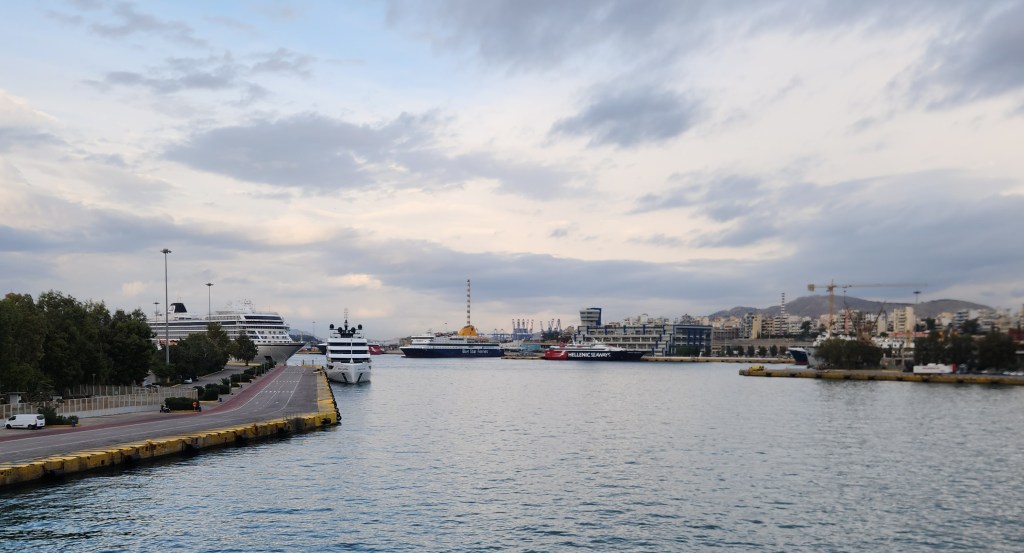
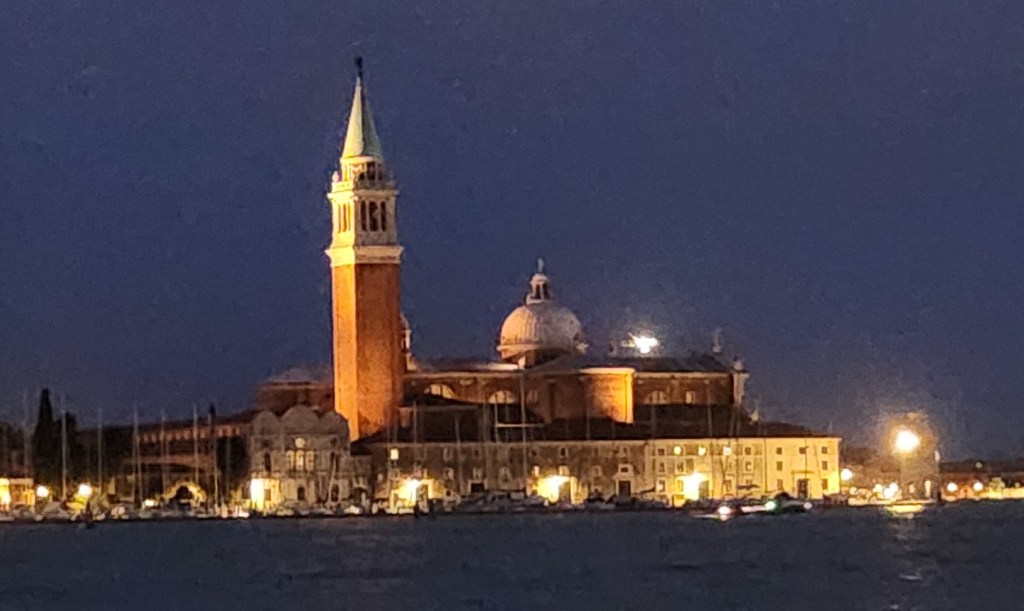
View from the Port of Piraeus

After breakfast, Pat and I and some 25 or so fellow travelers departed by bus for what the Viking itinerary called “The Full Acropolis Experience.” Before I describe that, here’s some very abbreviated history. Athens is one of the oldest named cities in the world, having been continuously inhabited for some 5,000 years. It became the leading city of ancient Greece in the first millennium BCE. The Acropolis (roughly translated as “high city”) sits on a rocky outcropping overlooking the city. Ancient Greeks built several impressive temples and monuments there, including the Parthenon, the Propylaea, the Erechtheion, and the Temple of Athena Nike, in the fifth century BCE. Over the following centuries, Athens fell under the control of various empires, including the Macedonians, Romans, Byzantines, Latins, Venetians, Florentines, and eventually the Ottomans, in the 15th century.

The Ottomans had little interest in ancient Greek cultural sites and began using the Parthenon as a storage site for gunpowder. During a siege by Venice in 1687, the Temple of Athena Nike was dismantled by the Ottomans and its materials used to fortify the Parthenon. Then, a Venetian mortar shell hit the gunpowder cache in the Parthenon, causing an explosion that severely damaged the structure. The Venetians briefly occupied the city before abandoning it once again to the Ottomans. Significant portions of the remaining structure were looted during the following years, and Athens lost much of its wealth and power. During the 18th century, the city began to regain its stature, but the ruling Ottomans still had no interest in ancient Greek culture.

Enter one Thomas Bruce, 7th Earl of Elgin, a rather shady British nobleman who became ambassador to the Ottoman Empire in 1798. Lord Elgin cut a controversial deal with the Ottomans under which he had about half the surviving Parthenon sculptures, as well as sculptures from the Erechtheion, the Temple of Athena Nike, and the Propylaea, removed and shipped to Britain in order to establish a private museum on his personal estate. However, the ship laden with these treasures sank in a storm off a Greek island shortly after sailing, and much of the cargo was lost. Elgin mounted a costly recovery effort, eventually bringing all of his booty back to England, but he incurred so much debt that he was forced to sell the entire collection to the British Museum in London in 1816, where they are proudly displayed to this day as the “Elgin Marbles.” (As a side note, Pat and I saw the impressive display at the British Museum back in 2016 during a Rick Steves tour of London, where our guide defended Elgin’s acquisition as a noble effort to save them from looting under the Ottomans, with no mention of his less-than-honorable intentions.)

In 1983, the Greek government formally asked the British government to return the collection to Greece and listed the dispute with UNESCO, but the British government and the British Museum declined UNESCO’s offer of mediation. In 2021, UNESCO called upon the British government to resolve the issue at the intergovernmental level, but so far nothing has been resolved. A large part of the British argument for retaining the collection has been that the Greeks had no suitable place to properly display them and did not have the capability to properly maintain them. Which finally brings me to the first stop on our “Full Acropolis Experience” tour – The Acropolis Museum in Athens.

The Acropolis Museum is a beautiful, modern structure located a short walk from the Acropolis hill. It was completed in 2009 to replace an older museum and to house all of the artifacts found on the Acropolis, specifically including the missing pieces of the Parthenon, Erechtheion, Temple of Athena Nike, and Propylaea that now reside in London. Here is a photo of one portion of the Parthenon display, with some of the original pieces alongside plaster models of the pieces that will hopefully be returned by the British Museum someday:
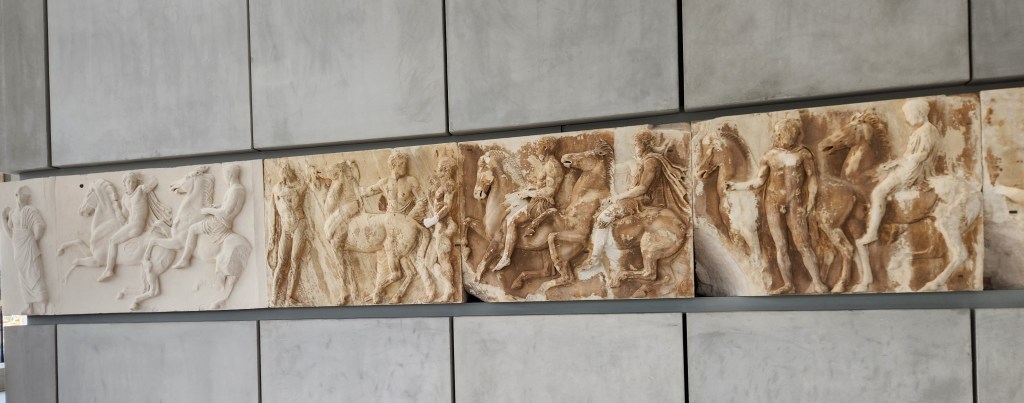
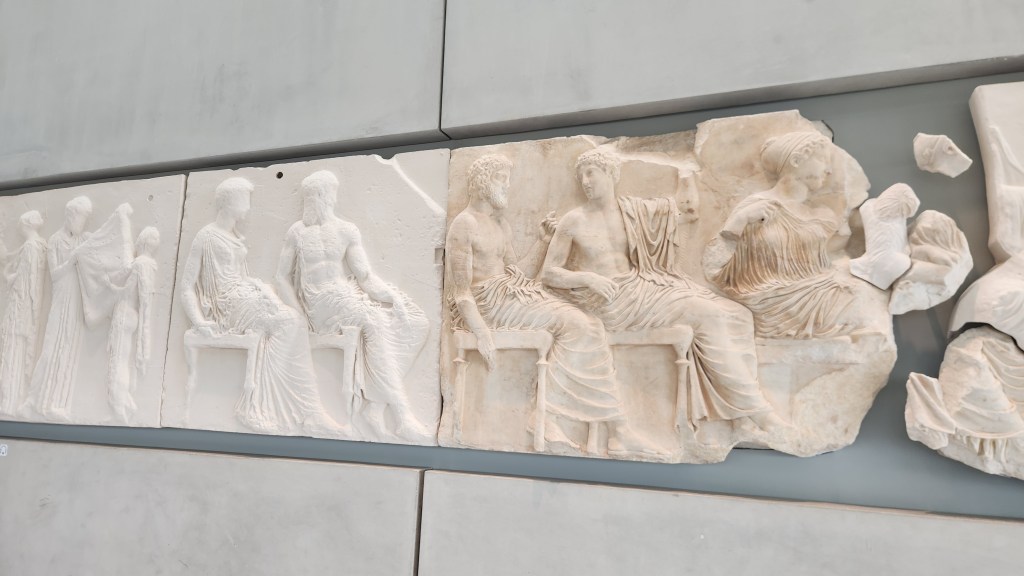
One of the Parthenon Statue Segments — Museum of the Acropolis
More Examples

It was hard not to believe that the original marbles belong here, in Greece, next to the Acropolis, and not in a London museum, no matter how hard the British may try to justify past ethical lapses.

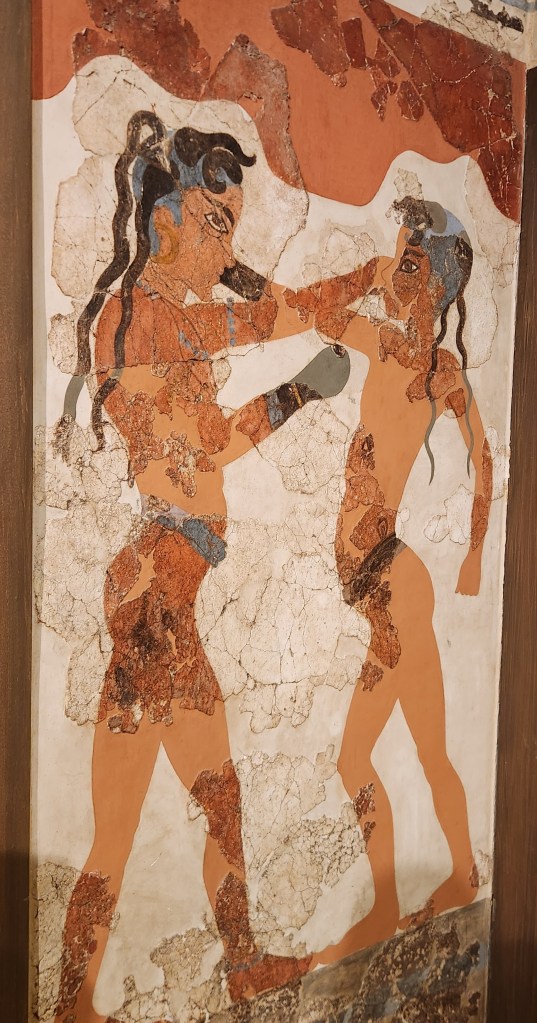
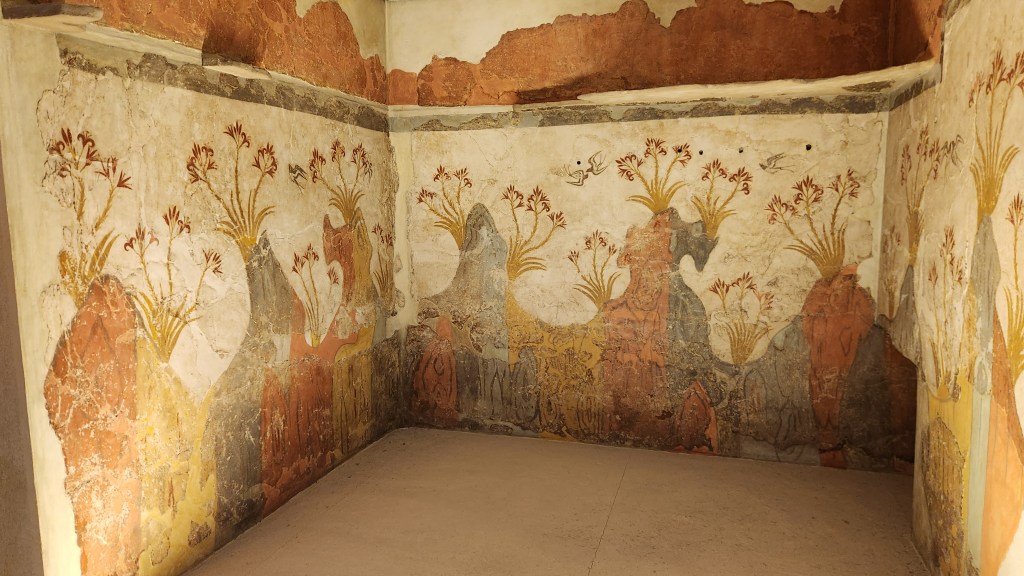
Moving on, the museum is also chock full of other gorgeous artifacts from the Acropolis, such as those below. (Unfortunately, I only managed to get these few photos due to the congestion, but hopefully you can get a feel for the place.)
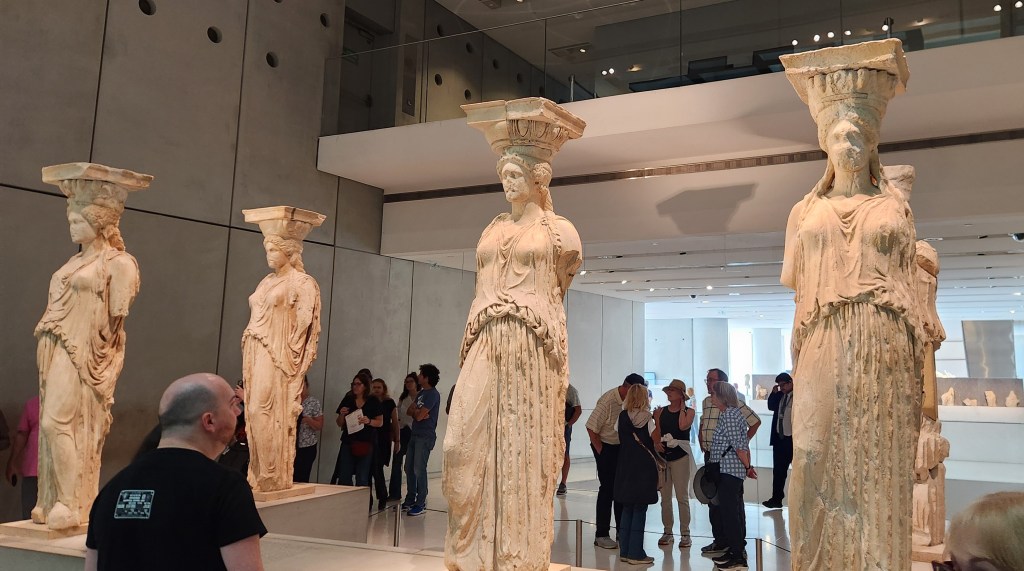
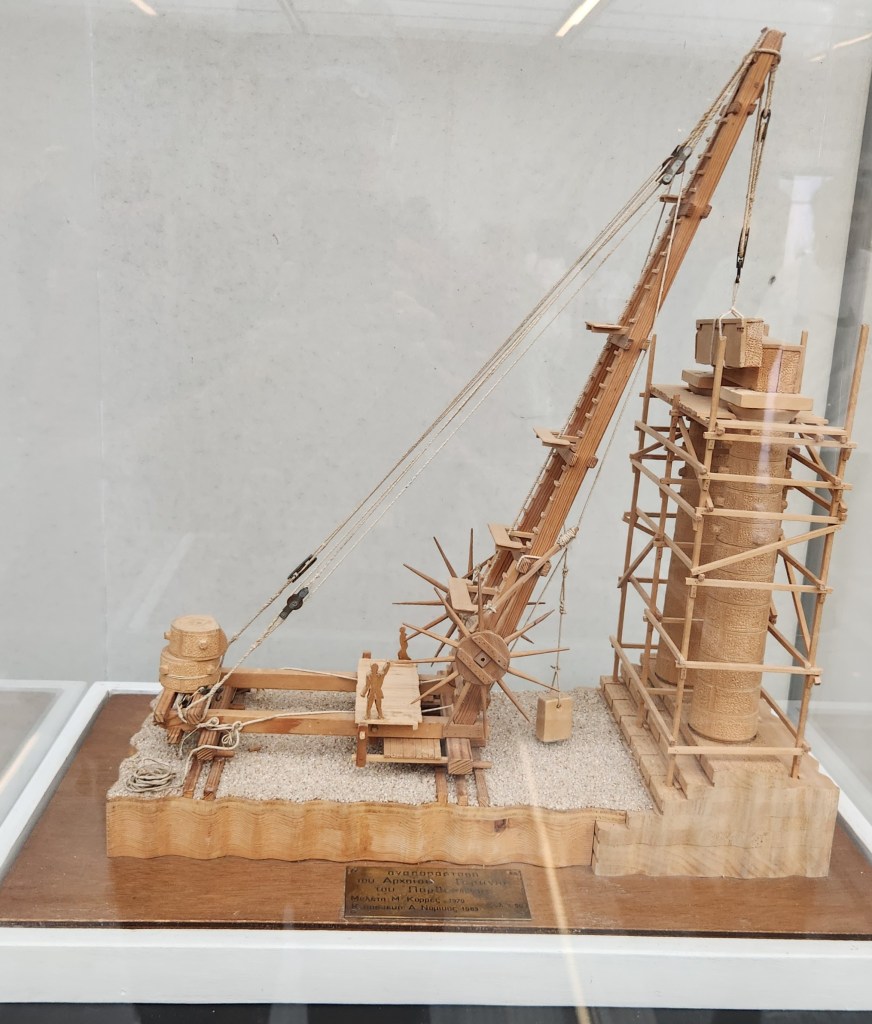
Column Bases — Museum of the Acropolis
Exhibit at the Acropolis Museum

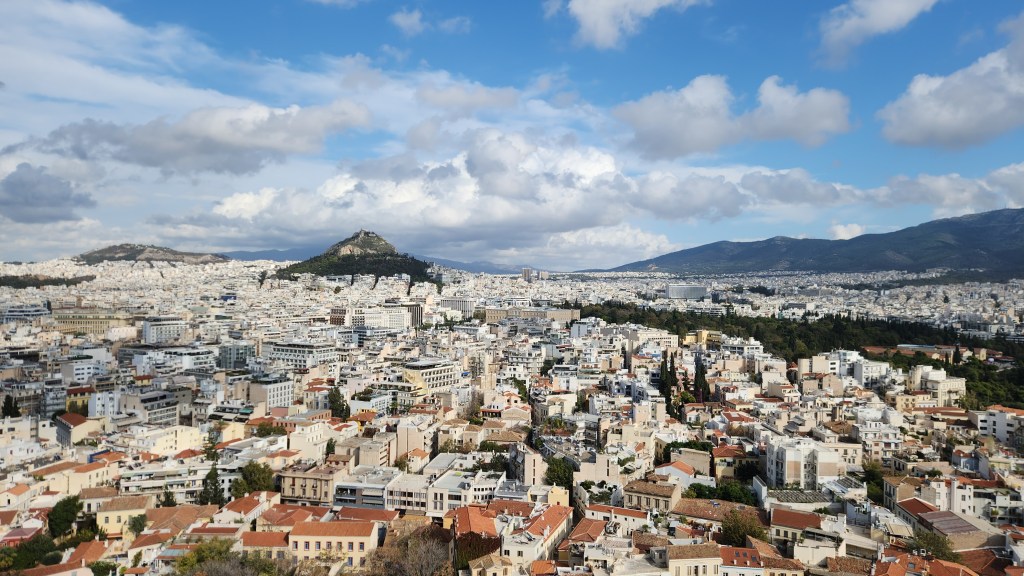
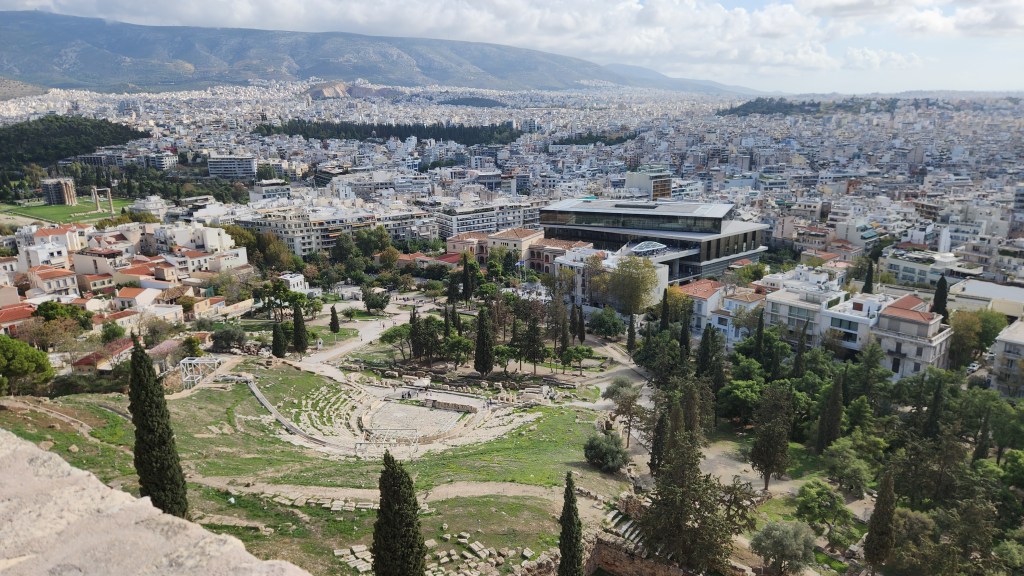
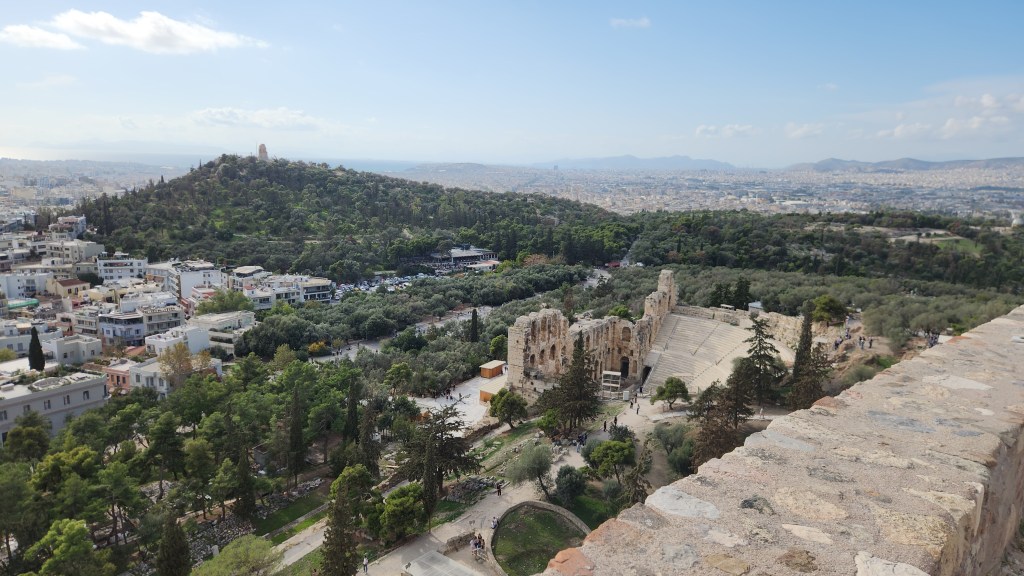
After the museum tour, our group walked up the hill to the Acropolis itself to marvel at the 3,000-year-old structures as well as stunning views of Athens and its surroundings. Since I’ve already written more words than I had originally intended, I’ll simply show the photos, which as we all know are worth a thousand words each.
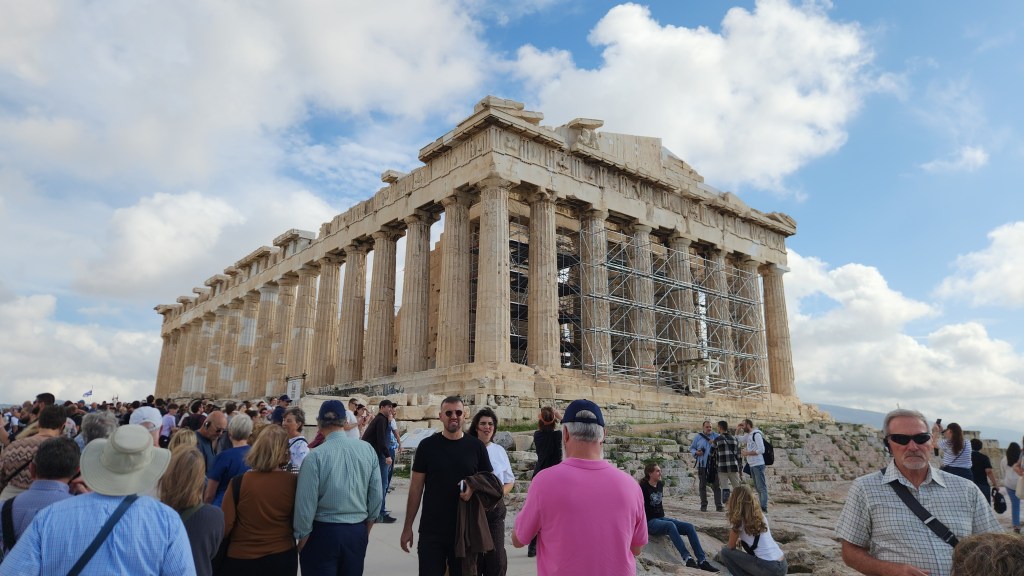
The Parthenon
The Erechtheion
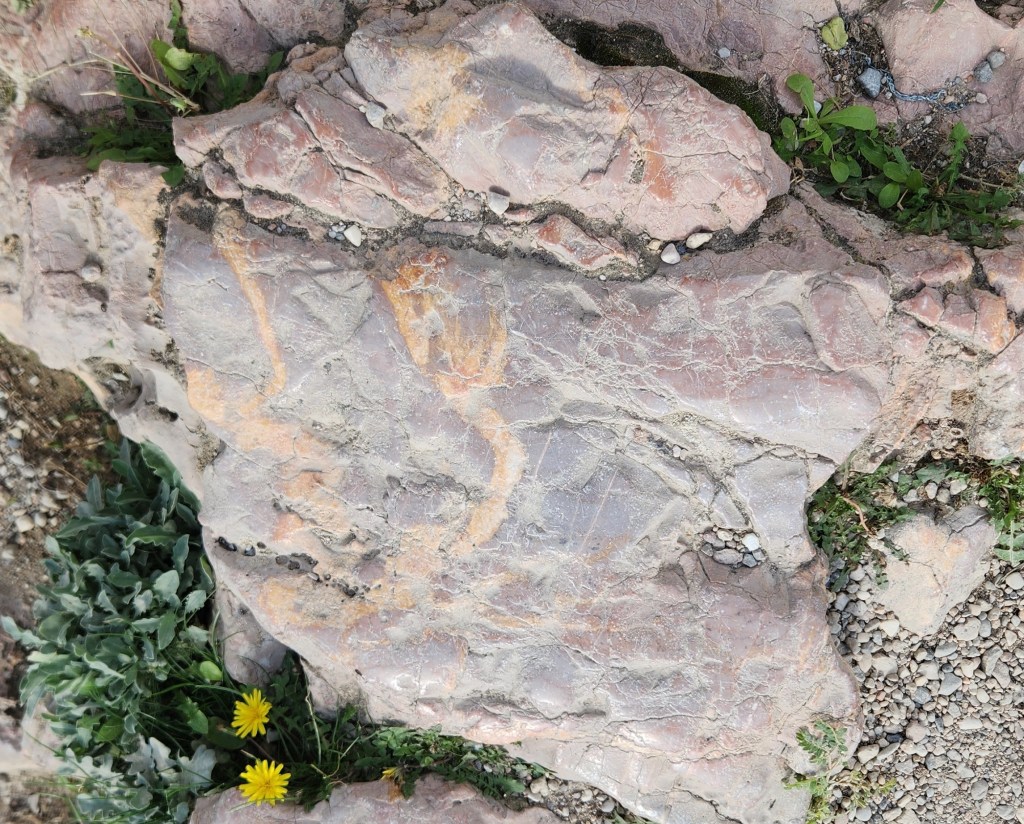
Ancient Stones on the Acropolis
View of Athens from Acropolis Hill
View from Acropolis Hill, including Theater of Dionysus and Museum of the Acropolis
View of the Herodion Odeon from the Acropolis

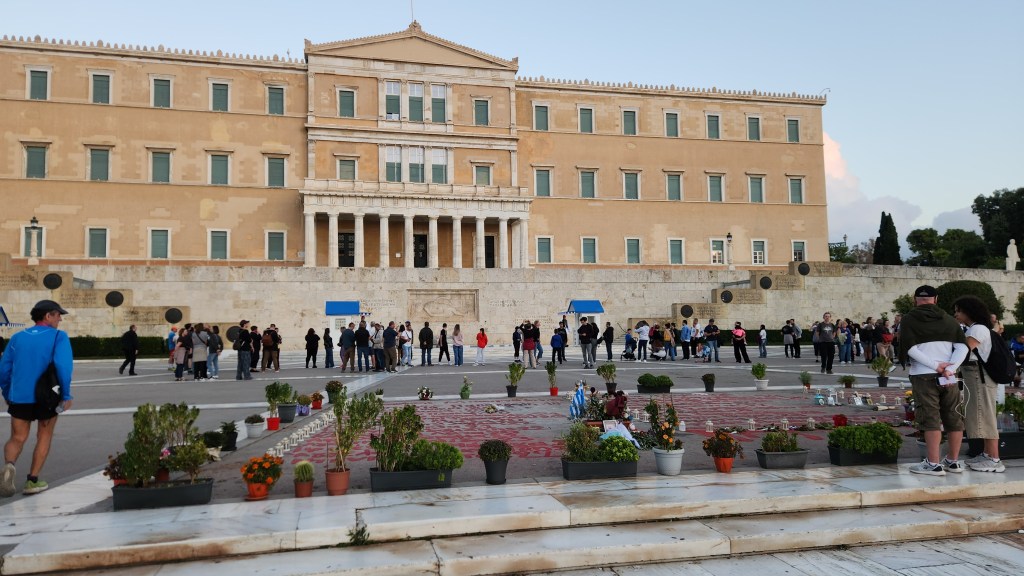
Following the Complete Acropolis Experience, our bus transported us to a hotel called the NJV Athens Plaza, where we would spend the next days while completing our tour of Classic Greece. The hotel is conveniently located in the well-known Plaka District of Athens, next to Syntagma Square, a popular and busy square which is also adjacent to an Athens Metro stop and the Hellenic Parliament Building. There are also multitudes of nearby shops, restaurants, museums, and other interesting sites in the vicinity, some of which I’ll describe below.

After we checked into the hotel, I strolled over to the Hellenic Parliament building to watch the hourly changing of the guard ceremony, a fascinating ritual in which two Evzone (Presidential Guard) sentries stationed outside the building are replaced by fresh troops. The Presidential Guard is an elite ceremonial unit founded in 1868 to guard the Tomb of the Unknown Soldier in front of the Parliament. The elaborate uniforms and the ceremony’s choreography trace back to Greek resistance fighters who battled the Ottoman occupation; their shoes include hobnails designed for traction in the snowy, mountainous regions of Greece, and the “pompoms” on the toes are said to have once concealed knives for defending against their enemies. Here’s an edited video of the ceremony that I took while watching (unfortunately my vantage point was not directly in front since I arrived too late for a prime, central viewing spot) and some photos I took afterward.
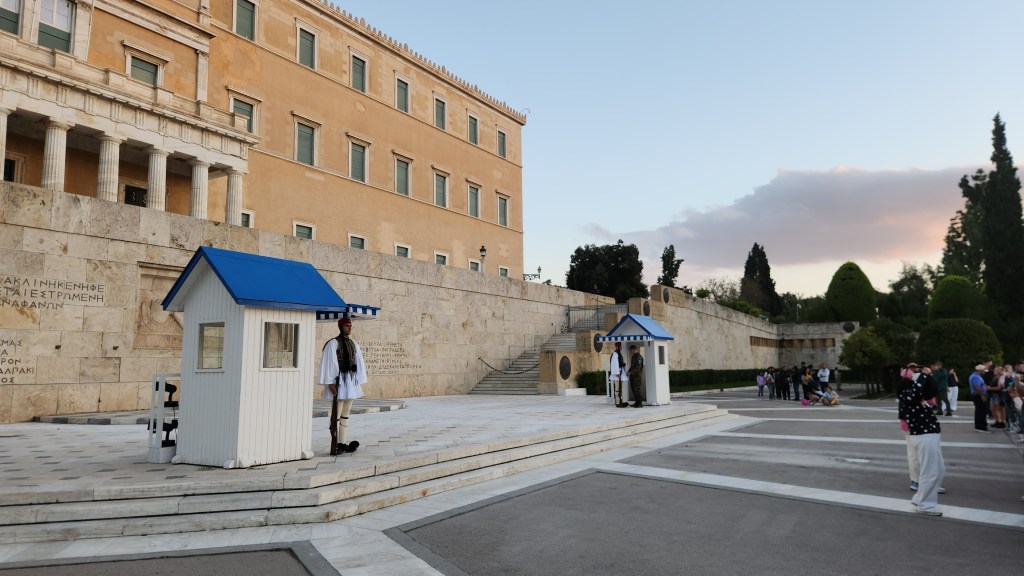
Changing of the Guard
The Fresh Guards in Place
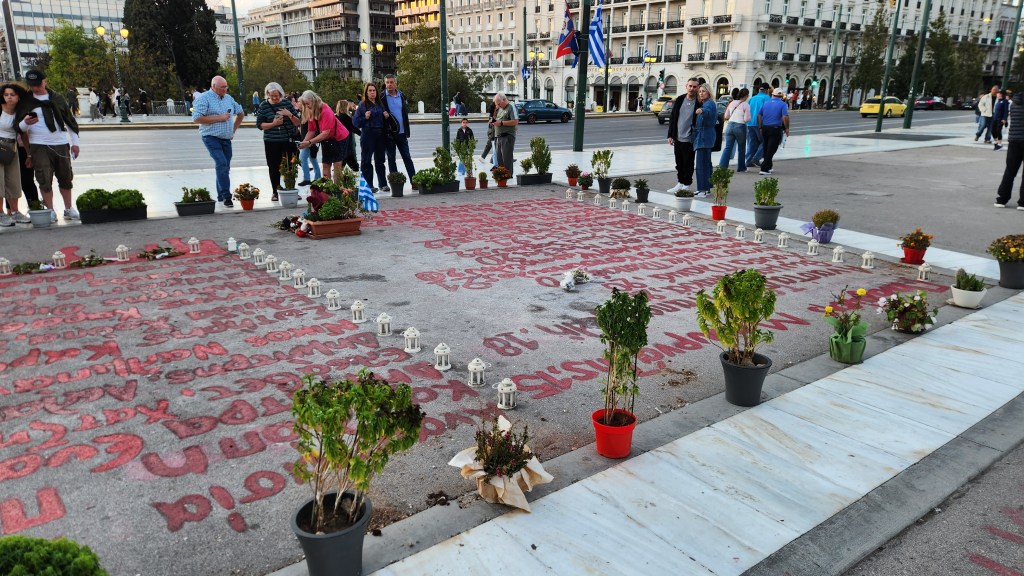
Memorials at Tomb of the Unknown Soldier
Hellenic Parliament and Tomb of the Unknown Soldier

Interestingly, when we passed by the Parliament the following Tuesday, the guards were wearing different uniforms as seen below, which I later learned were the cold-weather version rather than the ceremonial version worn on Sundays.

Guards in Cold-Weather Uniforms

I checked out the area around the square before returning to the hotel, telling Pat I’d found a good place for a quick dinner. However, by the time we got back there it had closed, so we wandered around for a half hour before deciding on a nice outdoor dining spot for some tasty Greek pizza.

Corinth, Epidaurus and Mycenae, Greece (Monday, November 10, 2025): At 7:30 Monday morning, we departed for a bus tour of ancient sites on the Peloponnese Peninsula. We stopped along the way near Corinth, where we saw a 4-mile-long canal that connects the Ionian Sea with the Aegean Sea, cutting through the narrow Isthmus of Corinth, which separates the peninsula from the Greek mainland. The first attempt to build a canal there was made by Roman Emperor Nero in 67 AD, but an actual canal was not completed until 1881. Since it is much too small for modern ships, it has little commercial value today, but tourists like me love to see it anyway.
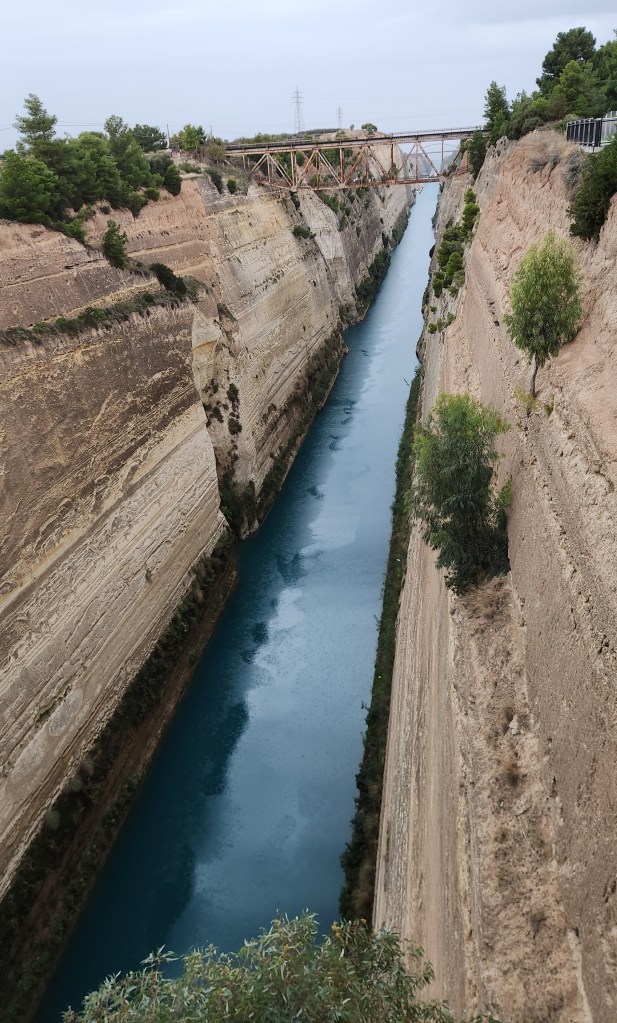
The Corinth Canal

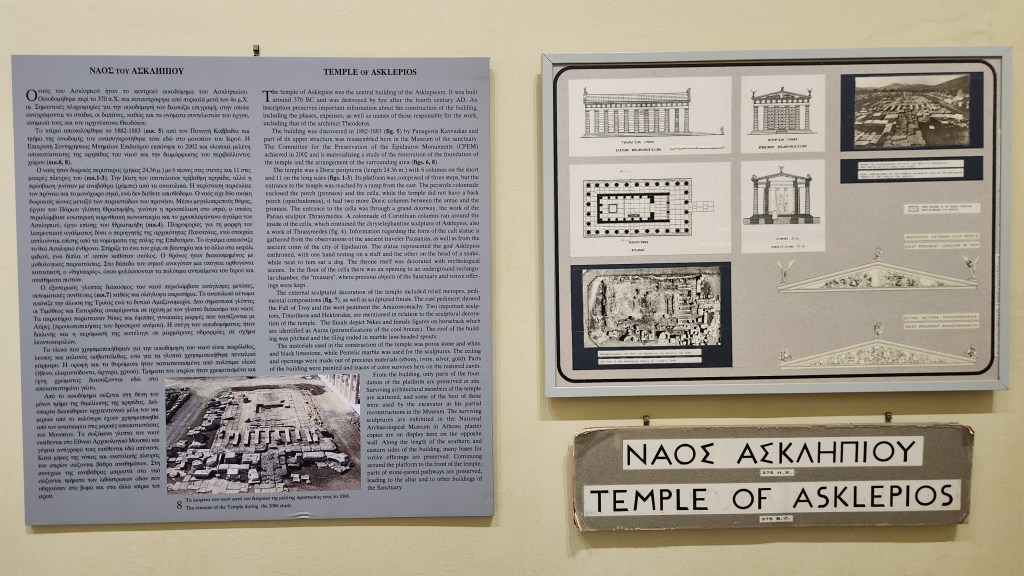
After the canal, we traveled on to Epidaurus, where we visited the Sanctuary of Asclepius, a famed healing center of ancient Greece where early physicians learned much about the human body and how to treat the ailments of the time. Many Greek physicians (possibly including Hippocrates?) learned their trade at the sanctuary, named for Asclepius the Healer, said to be a son of the god Apollo and reportedly born in Epidaurus. The site includes an impressive Odeon, or theater, which is still used for performances today due in large part to its excellent acoustics, as well as a museum displaying many artifacts from the sanctuary.
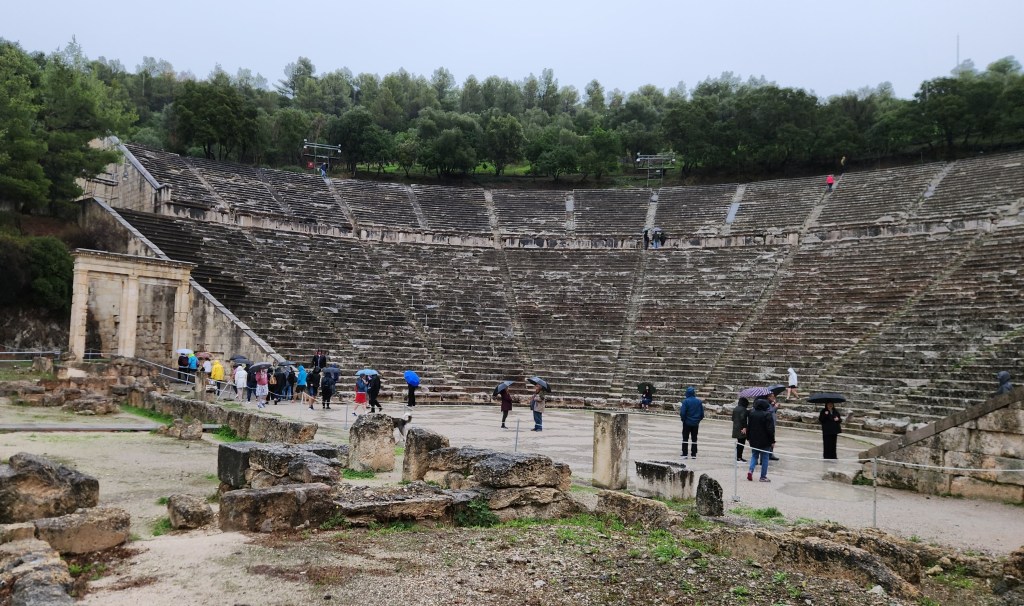
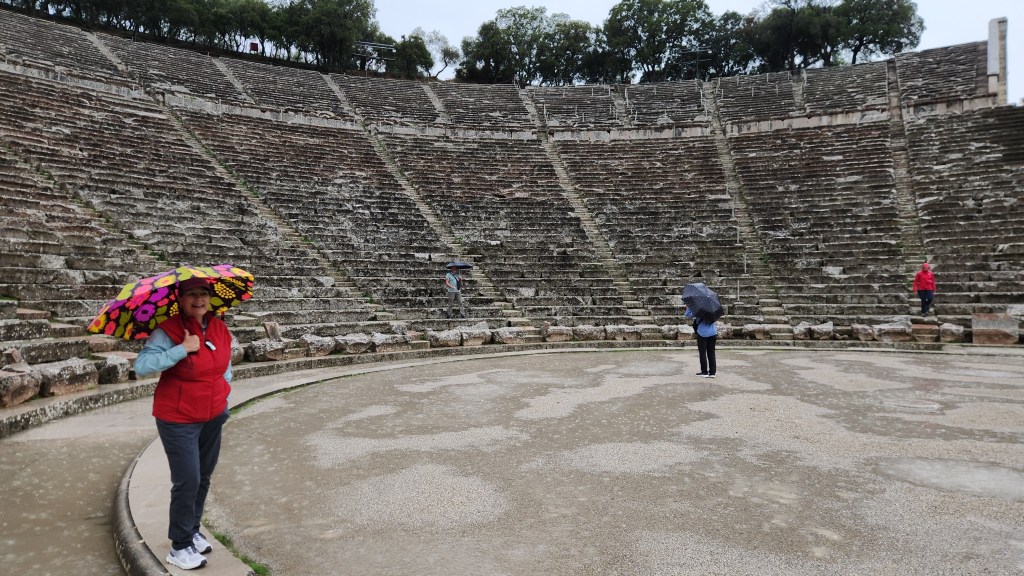
Theater at Sanctuary of Asclepius
I forgot to mention … it was raining
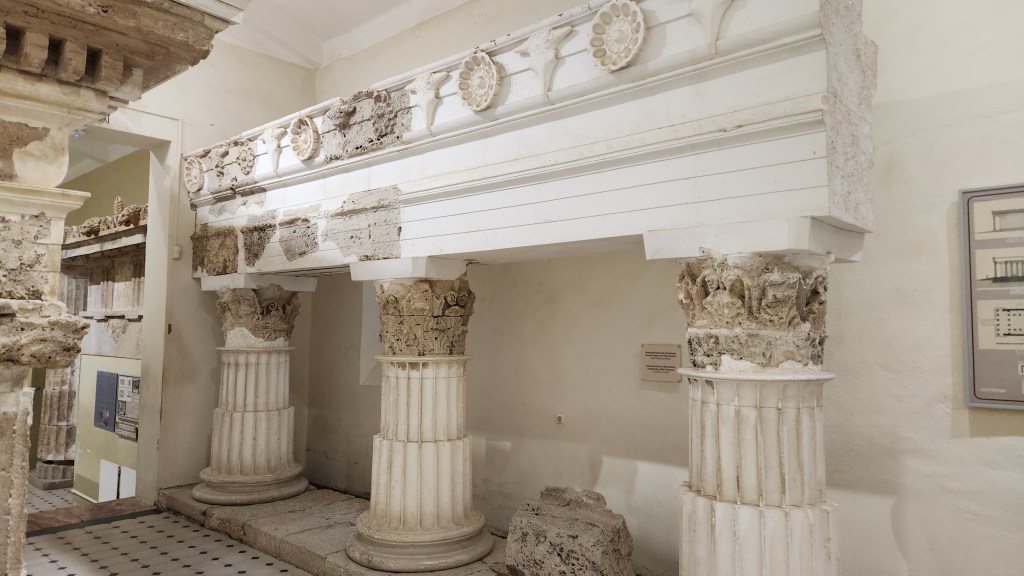
Display at Epidaurus Museum
Statue of Asclepius the Healer
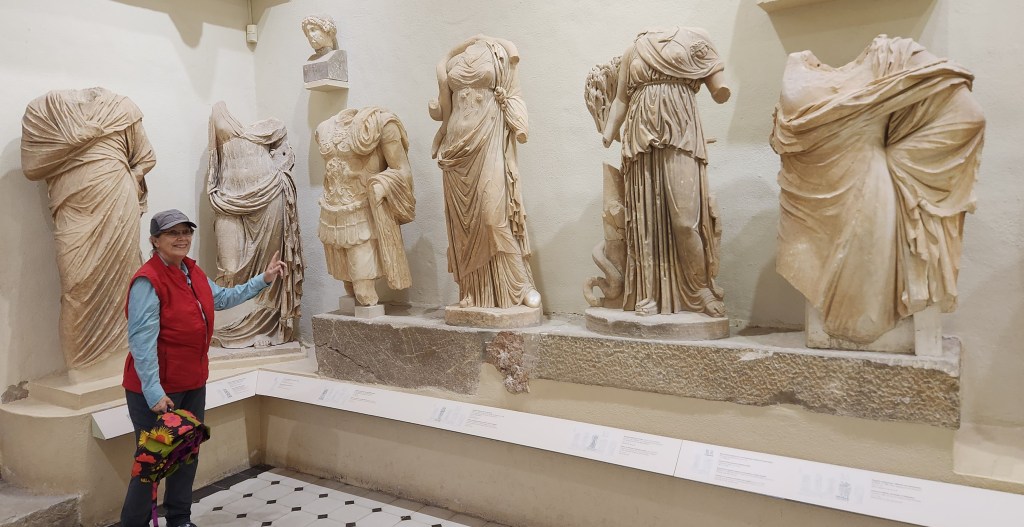
Artifacts at Epidaurus Museum
At Least Pat Kept her Head …

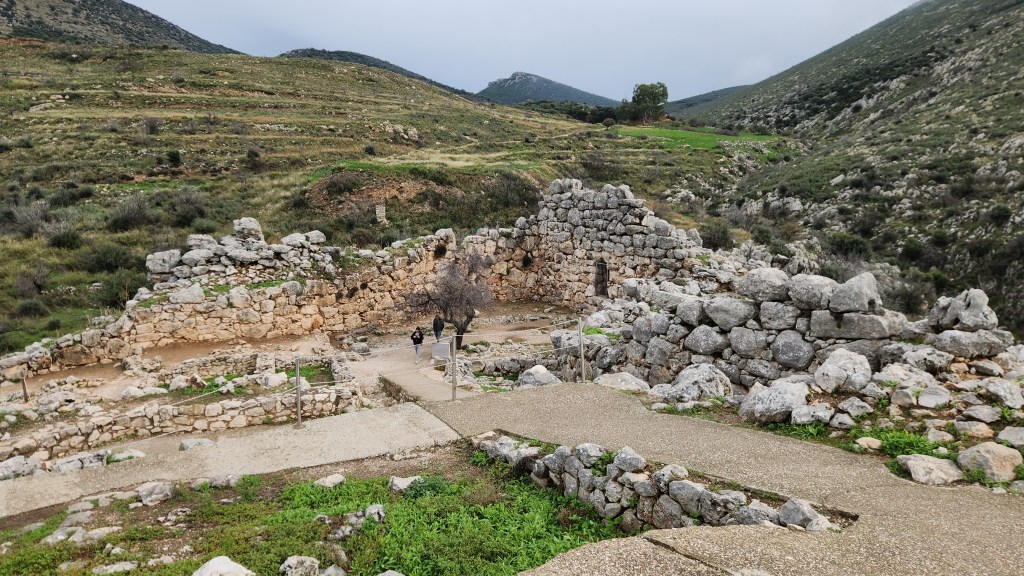
After Epidaurus, we stopped for lunch at a family-owned restaurant before driving on to Mycenae, which was one of the major centers of Greek civilization in the second millennium BCE. It was a military stronghold, an acropolis, that dominated much of southern Greece, Crete, the Cyclades and parts of southwest Anatolia. Multiple grave sites have been found in the surrounding area as seen in the photo below, and archaeological exploration is ongoing.

Architectural Site at Mycenae

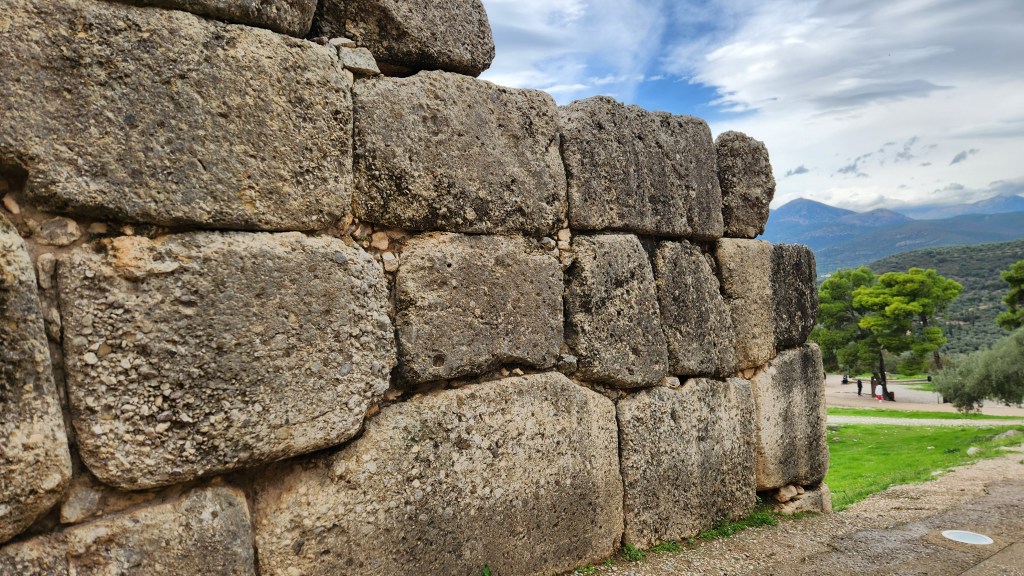
We climbed up the hill and passed through the Lion Gate to view the foundations of Agamemnon’s Palace, the Tomb of Agamemnon, and the Treasury of Atreus. I was especially impressed by the precise masonry work in which enormous stones were fitted together precisely to create the impregnable walls of the fortress. The fact that such works could be built 3,000 years ago is a tribute to ancient Greek technology. Once again, I’ll try to let the photos do the talking …
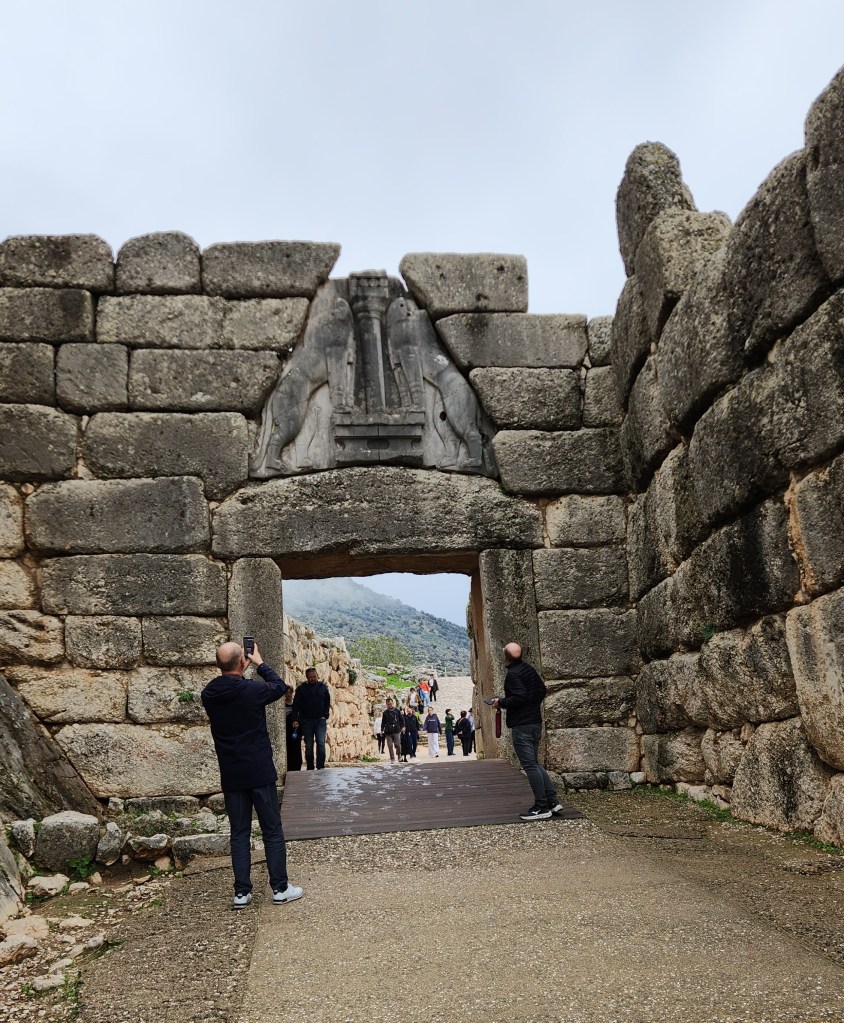
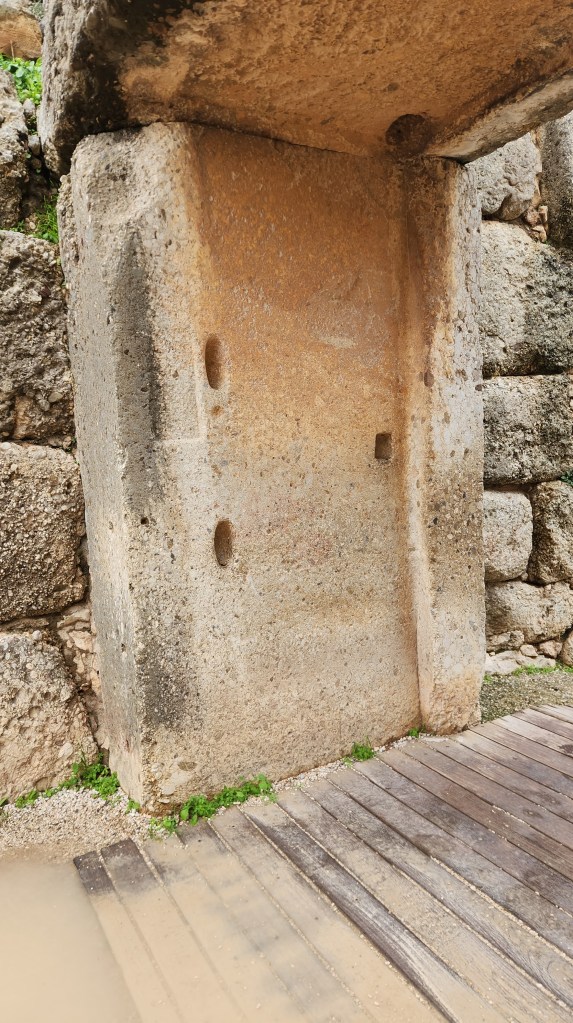
The Lion Gate — Entrance to the Fortress at Mycenae
Interior of Lion Gate
Massive Stones Placed by Ancient Masons
Ruins of Agamemnon’s Palace
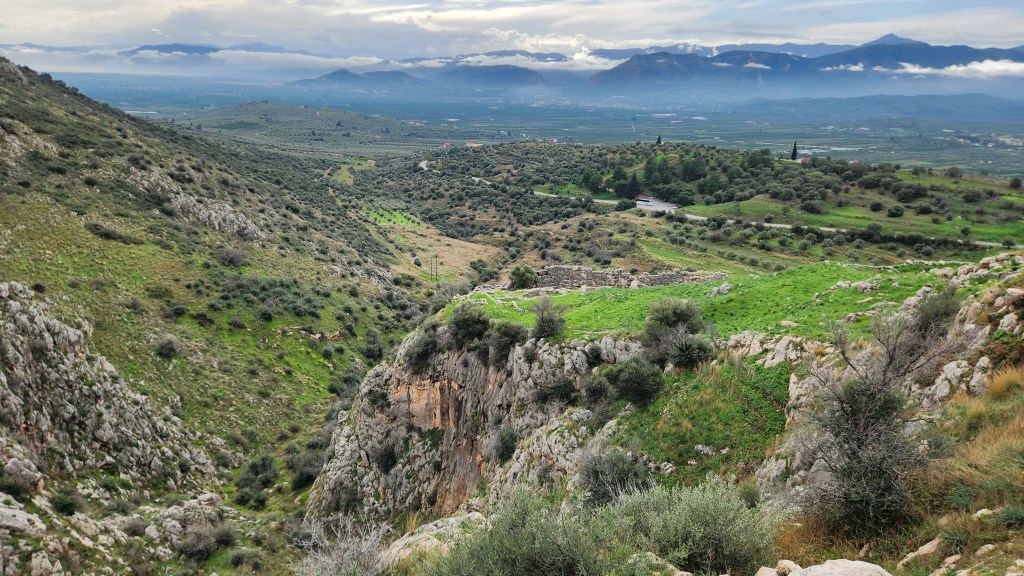
View from Fortress at Mycenae
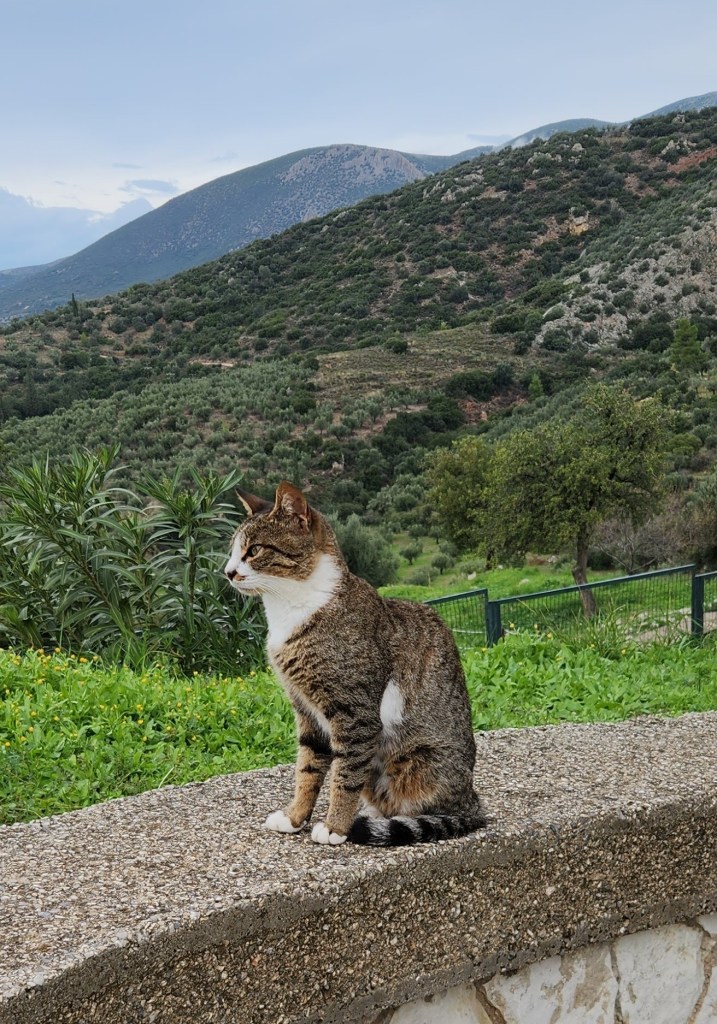
This Feline was Enjoying the View

Our final point of interest was a huge underground chamber nearby, perhaps a tomb built for one of the noble inhabitants of the palace. Once again, what impressed me was the massive scale of the construction.
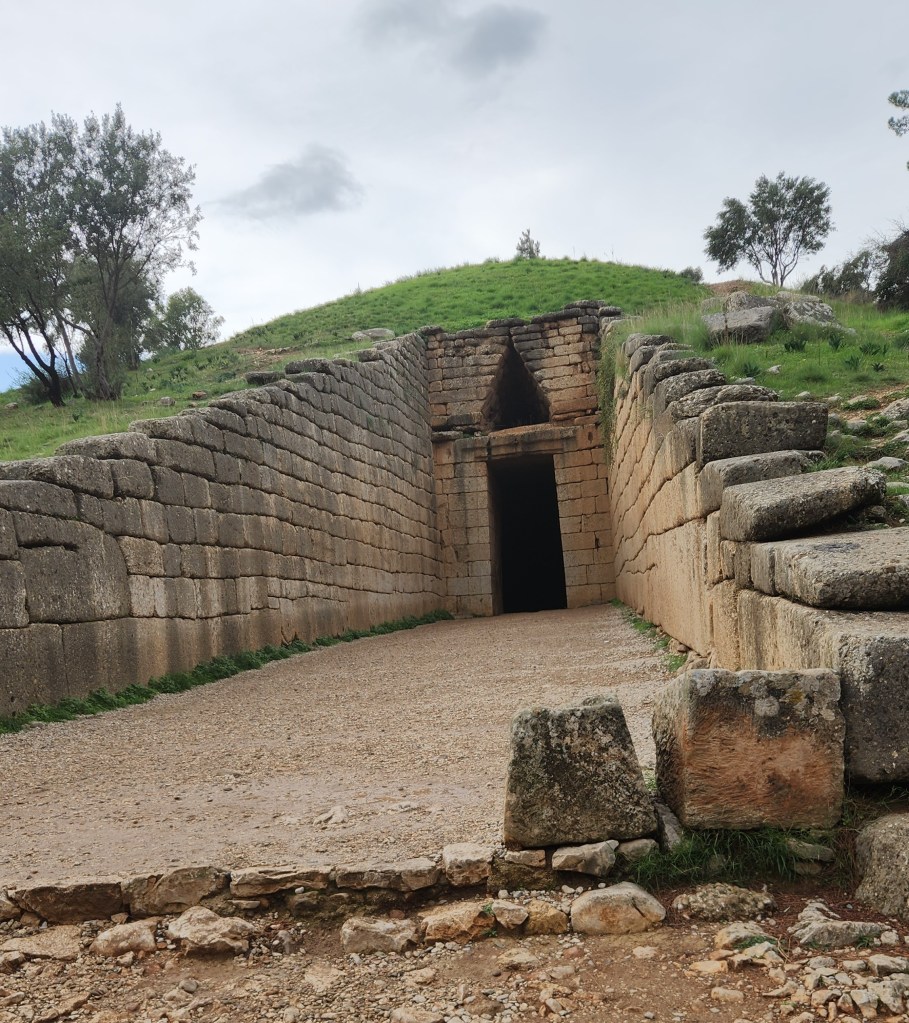
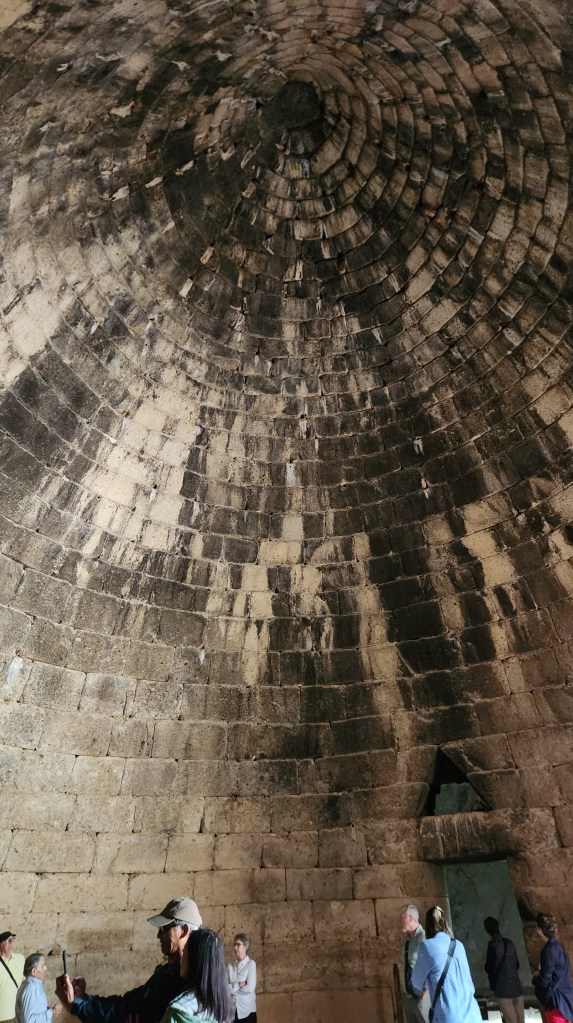
Underground Chamber
Interior of Chamber

The return trip was slowed by brutal traffic as we neared Athens, and we didn’t make it back to the hotel until 5:30 PM. Pat wasn’t interested in any dinner, so after a brief rest, I ventured out into the square to take in the ambience as well as some very non-Greek food (the details of which I will only mention in private to anyone who presses me for details).

Delphi, Greece (Tuesday, November 11, 2025): We departed the hotel at 7:15 for another bus trip, this time to the site of the ancient Oracle at Delphi. Fans of the Greek classics know that the Oracle was responsible for all sorts of tragedies, as various protagonists went to learn their fates and then spent years trying in vain to prevent them from occurring. Luckily, no such tragedy has befallen us, as the Oracle was not in during our visit. Her place of business was beautiful, however – yet another example of the amazing architectural achievements of the ancient Greeks.

The site, in the shadow of Mt. Parnassus, was originally sacred to Gaia, the Earth goddess, but later became a temple to Apollo, who, in some myths, killed Gaia’s serpent child, Python, to claim the site from her. Our first point of interest was a replica placed at the location of the Omphalos, or “navel of the world,” believed by the ancient Greeks to be the center of the world, discovered by two eagles dispatched by Zeus.
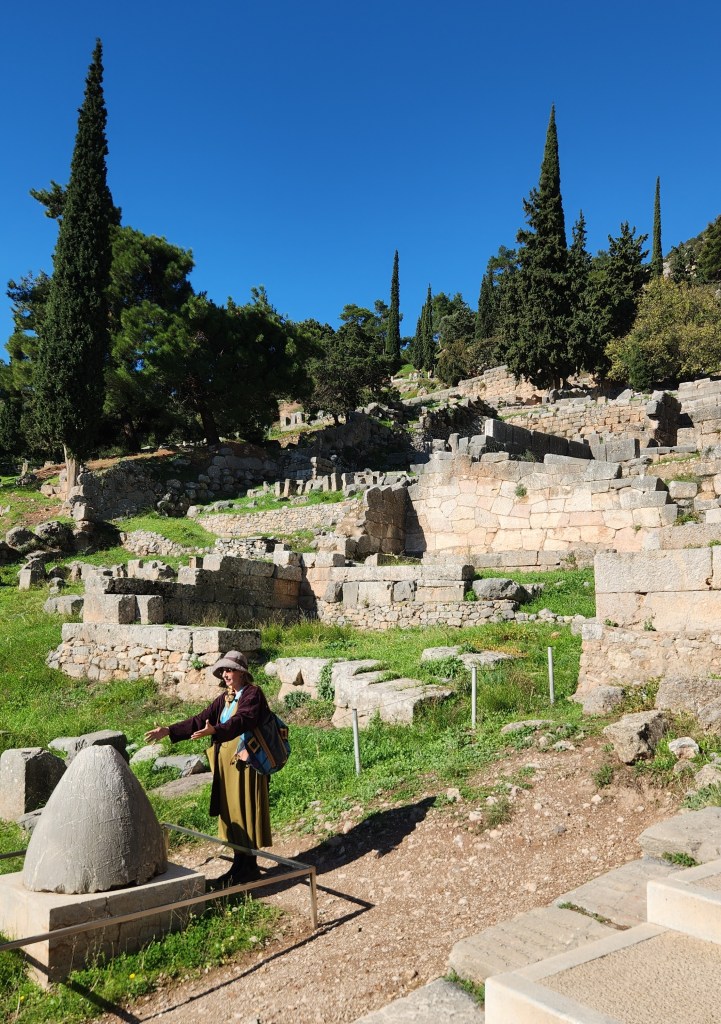
Replica of the “Navel of the World” at Delphi

From there, we climbed up the hill to see the entrance to the Temple where the Oracle received visitors, the magnificent theater, and the site of an ancient race track where chariot races were held, not to mention spectacular views of the surrounding countryside.
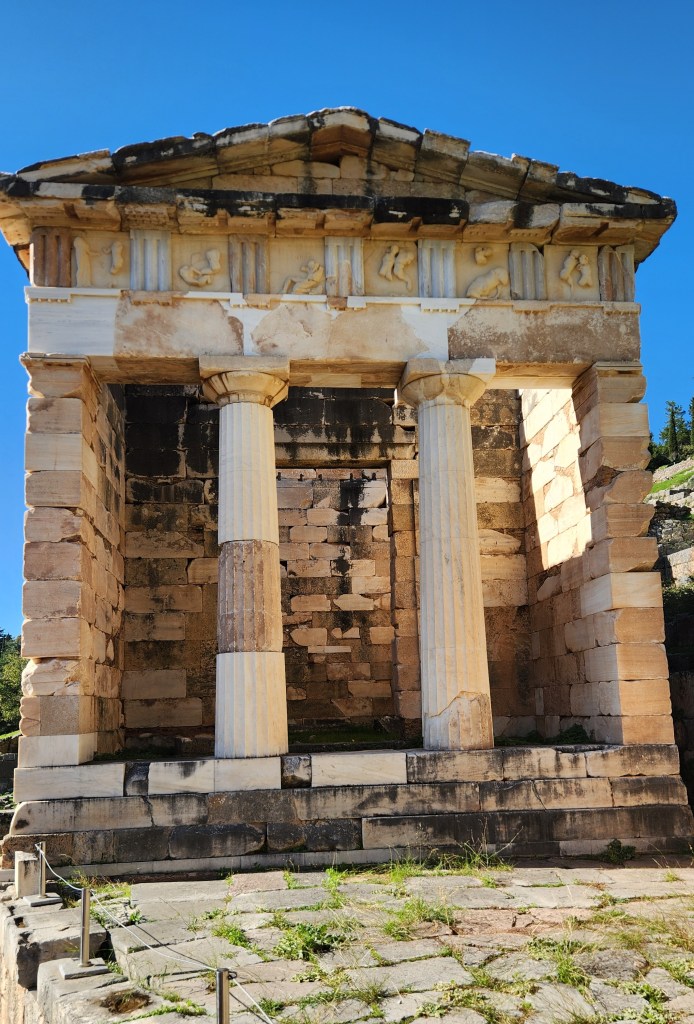
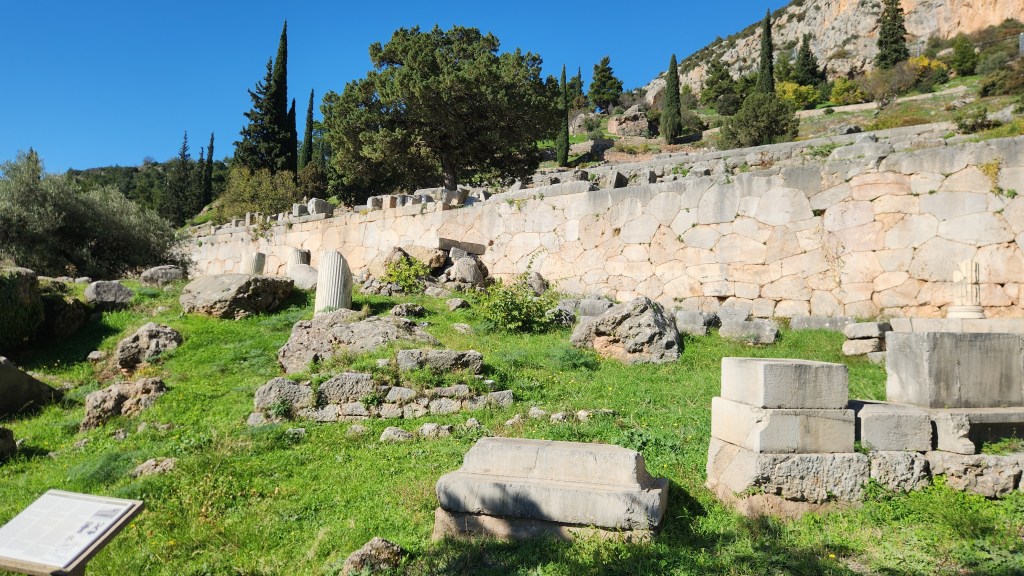
Entrance to The Oracle’s Temple
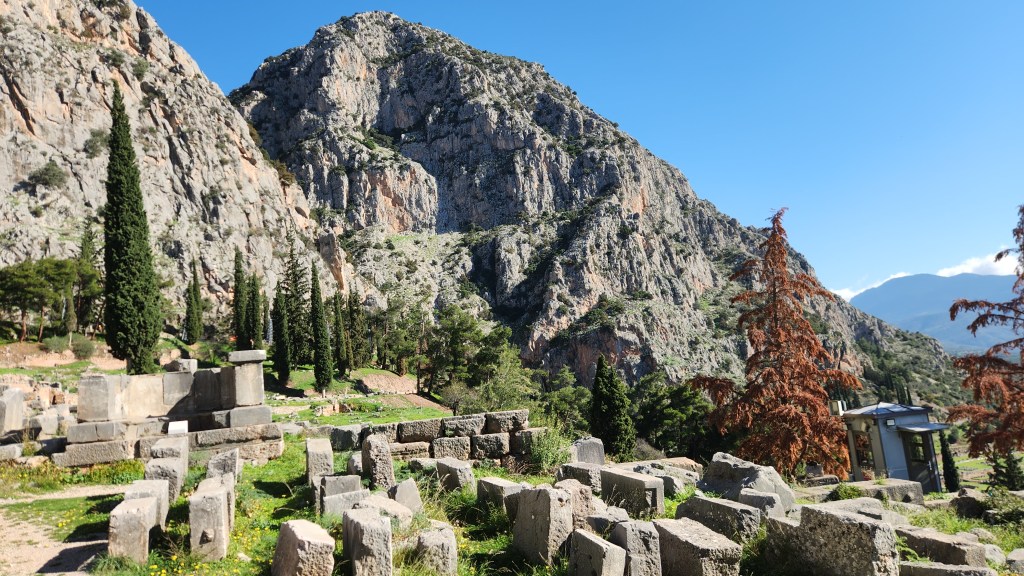
Walls and Remnants at Delphi Site
Remnants at Delphi Site
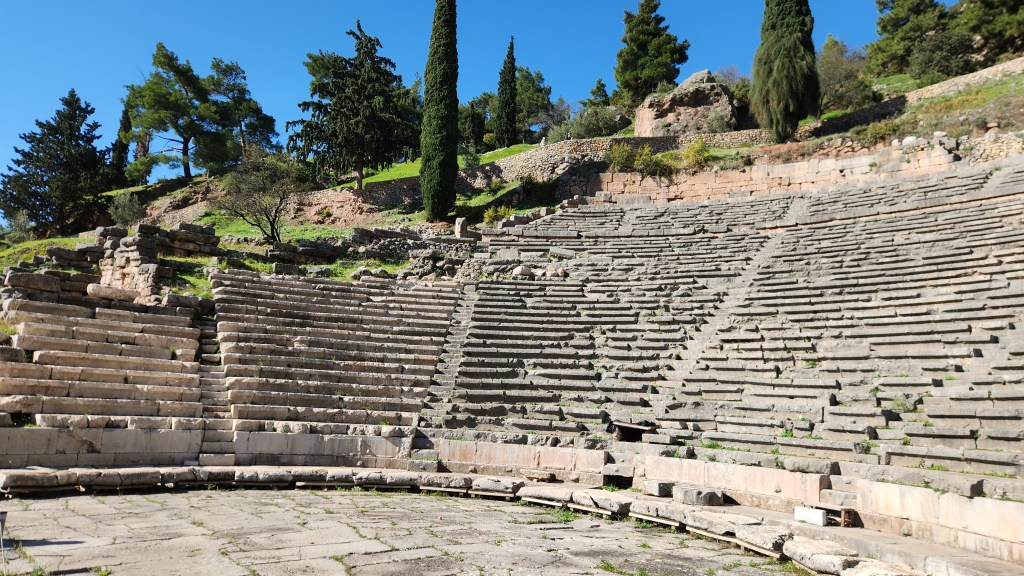
Theater at Delphi Site
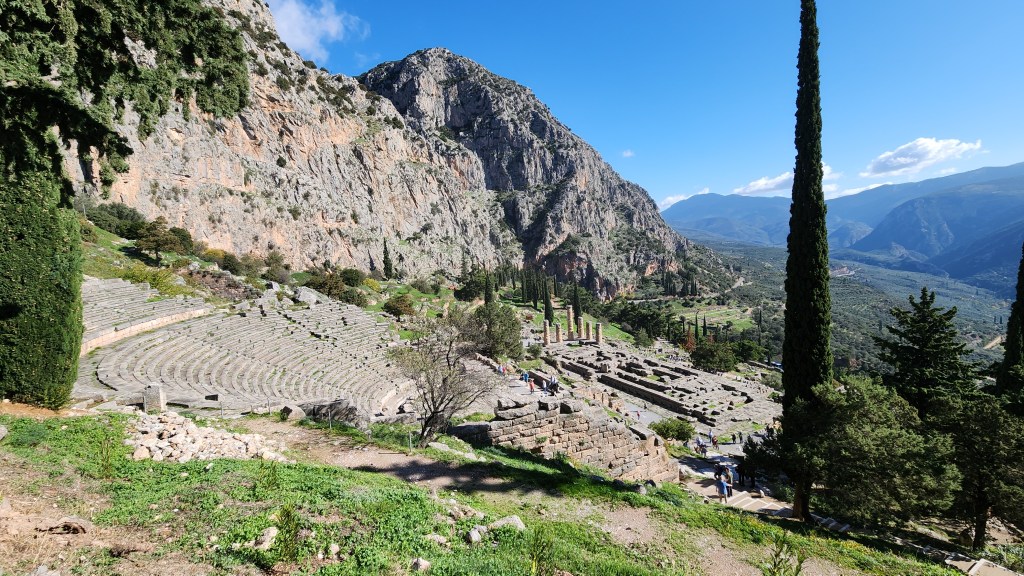
Overlook of Theater and Scenic Surroundings
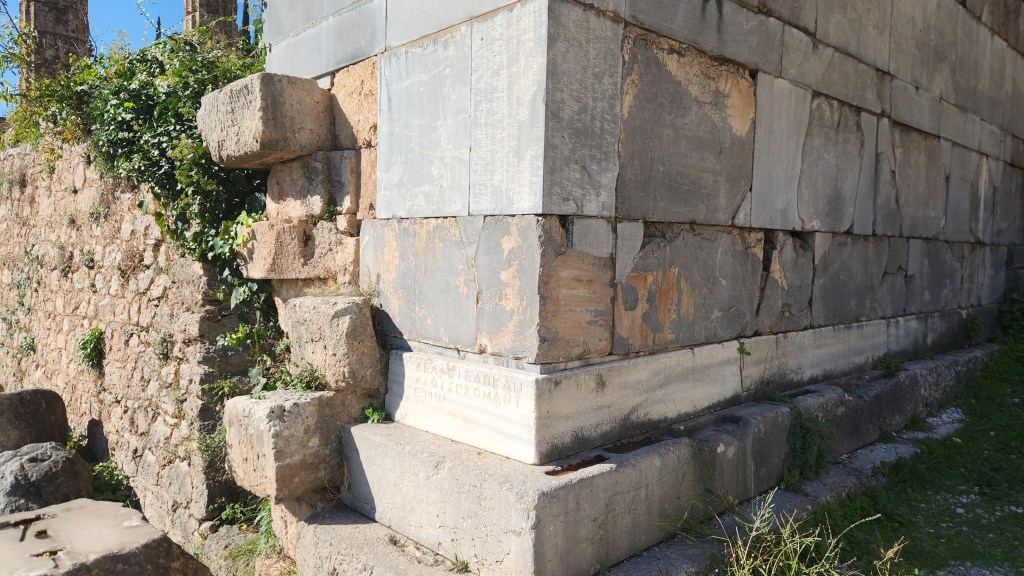
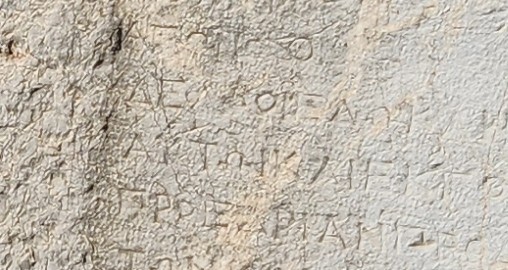
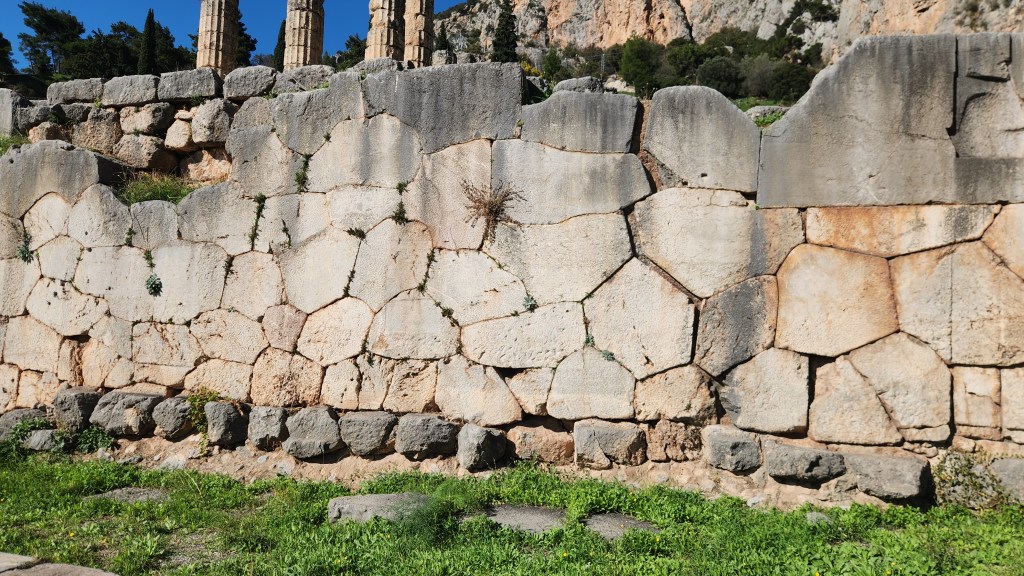
Massive Blocks with Ancient Inscriptions
Closeup of Inscriptions
Impressive Masonry Work

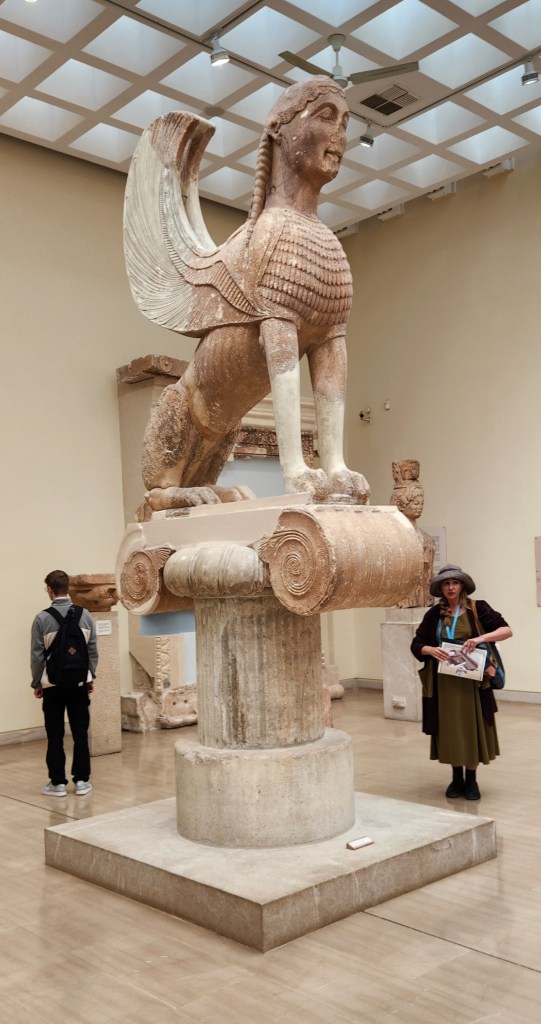
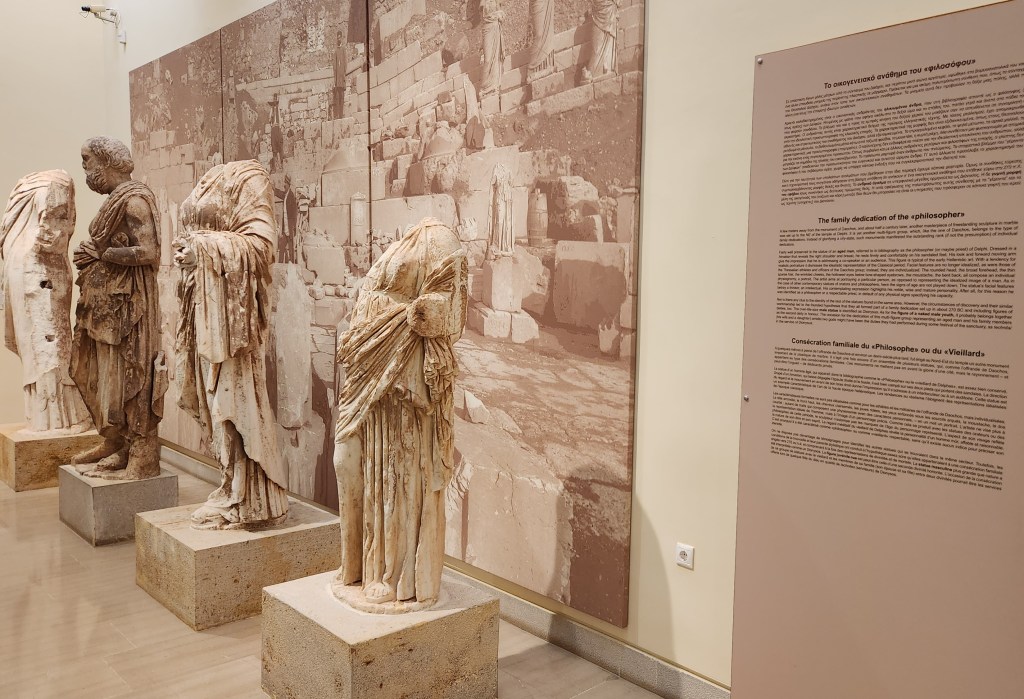
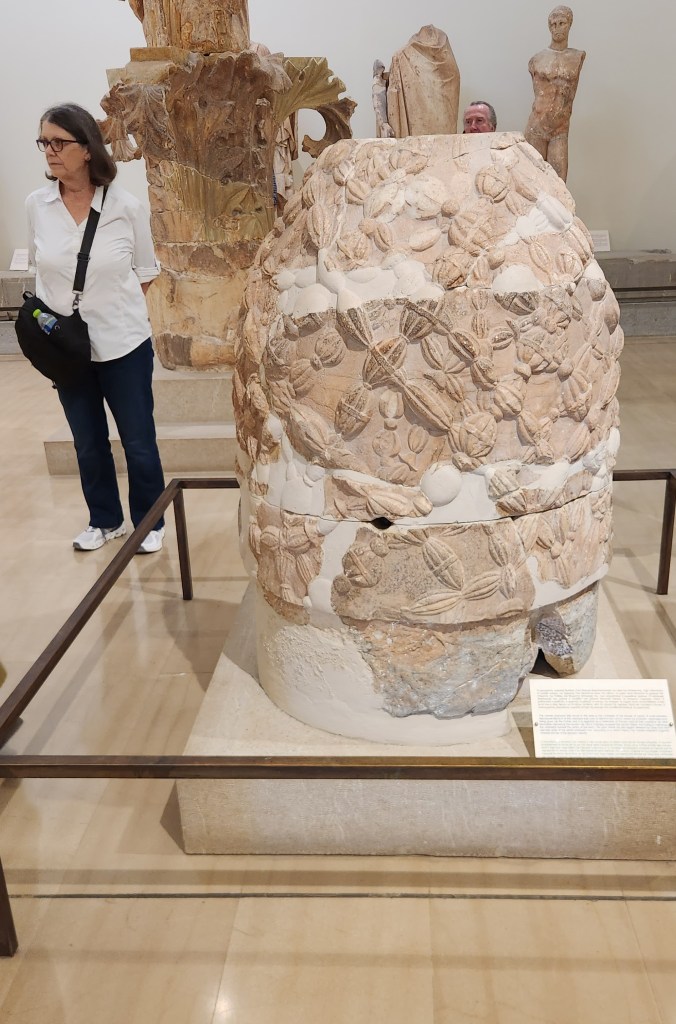
After touring the site, we proceeded to the adjacent Delphi Archaeological Museum, where we saw the original Omphalos along with many other ancient artifacts.
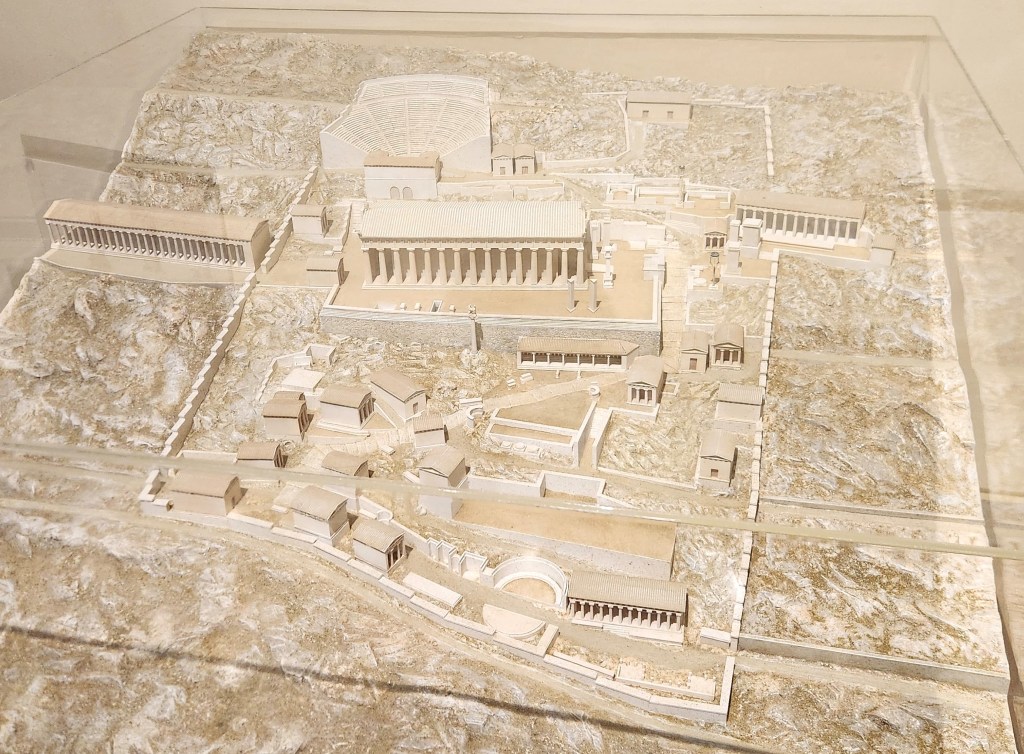
Model of Delphi Site in Ancient Times
Original Omphalos at Delphi Archaeological Museum
Statue at Delphi Archaeological Museum
Display of Artifacts at Delphi Archaeological Museum
Column Base at Delphi Archaeological Museum

After a very filling lunch at another family-owned restaurant, the Omphalos Tavern, we headed back toward Athens. The return trip took even longer than Monday’s trip as traffic approaching from the northwest was even more brutal, and we didn’t make it back to the hotel until after 8 PM, making for quite a long day. We again dined at a restaurant near the hotel, enjoying actual Greek fare this time.

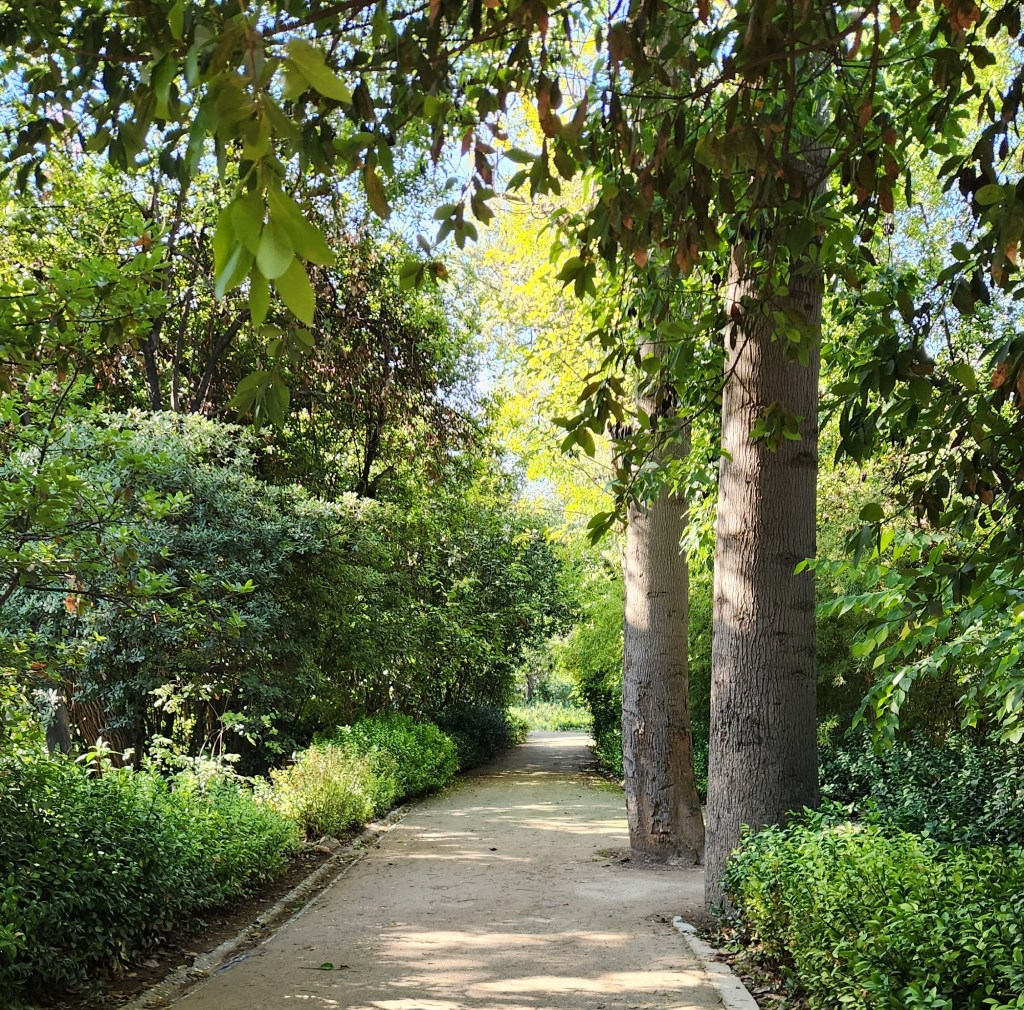
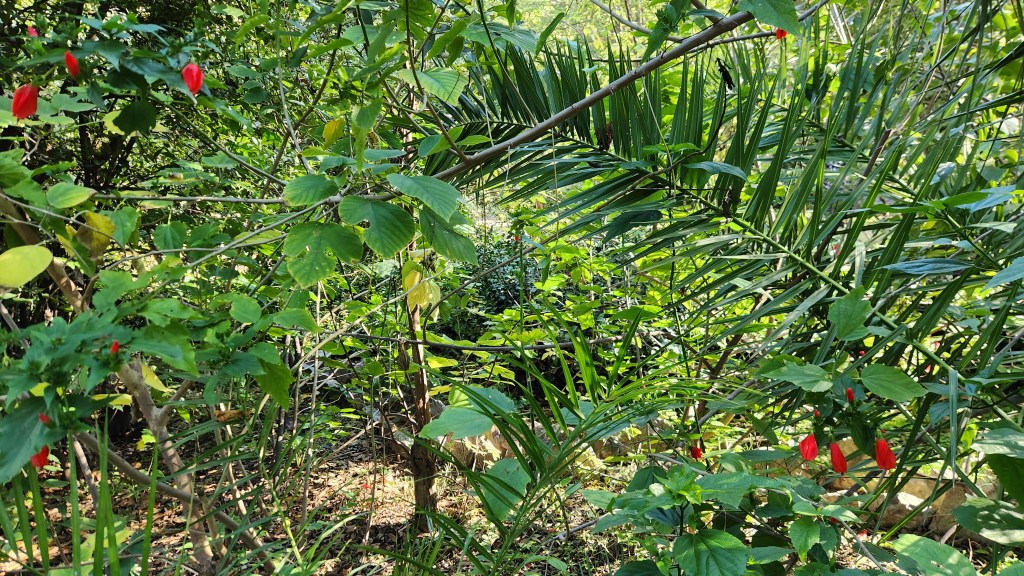
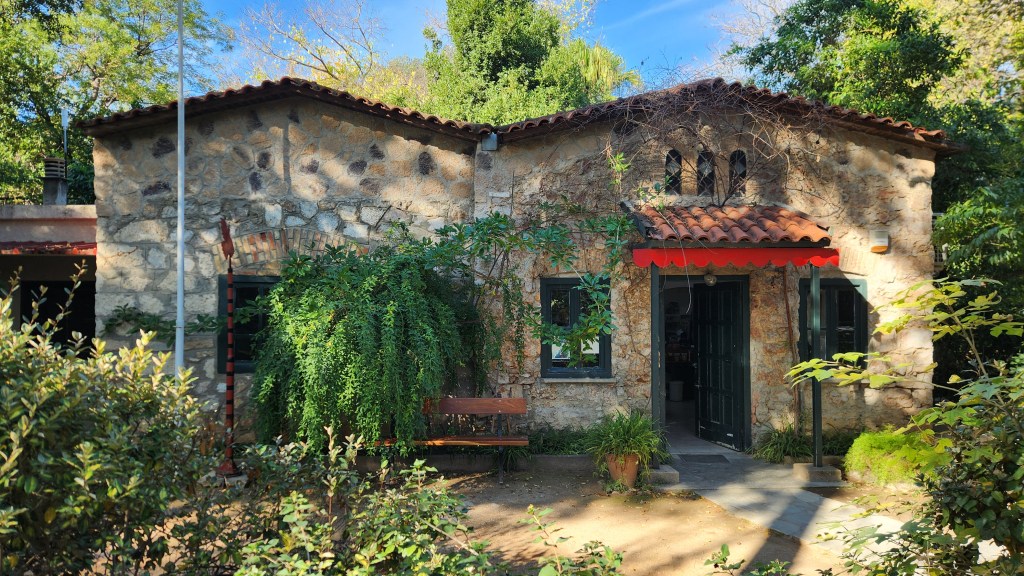
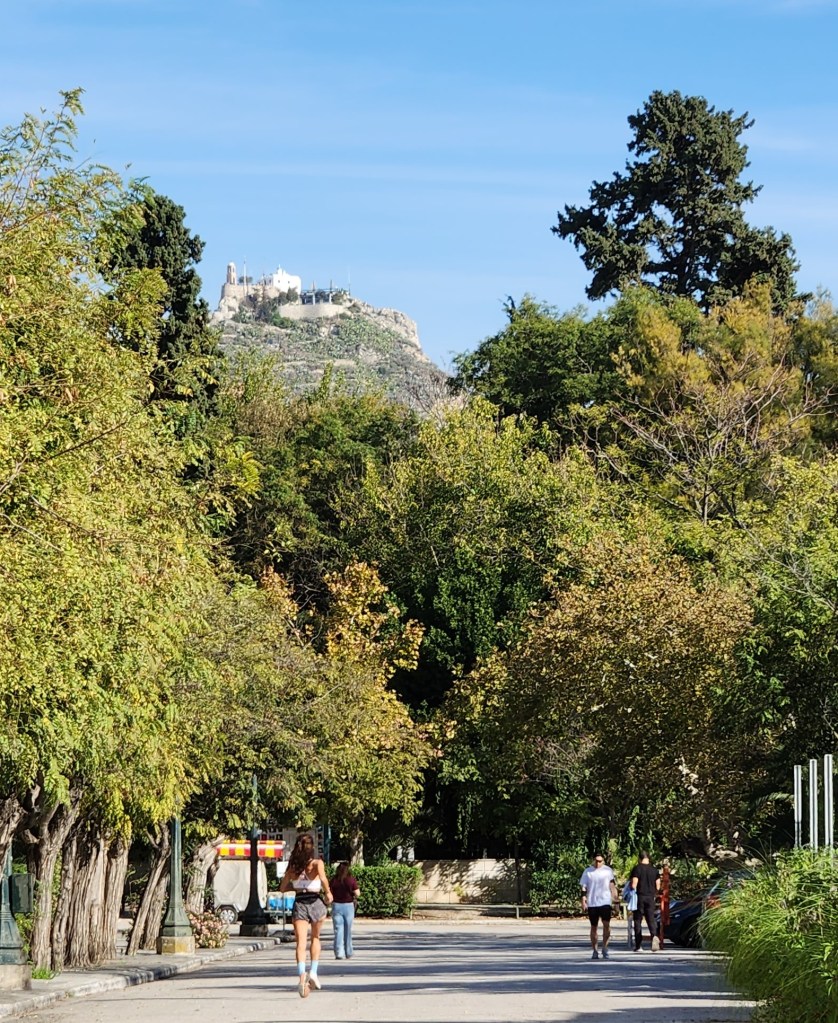
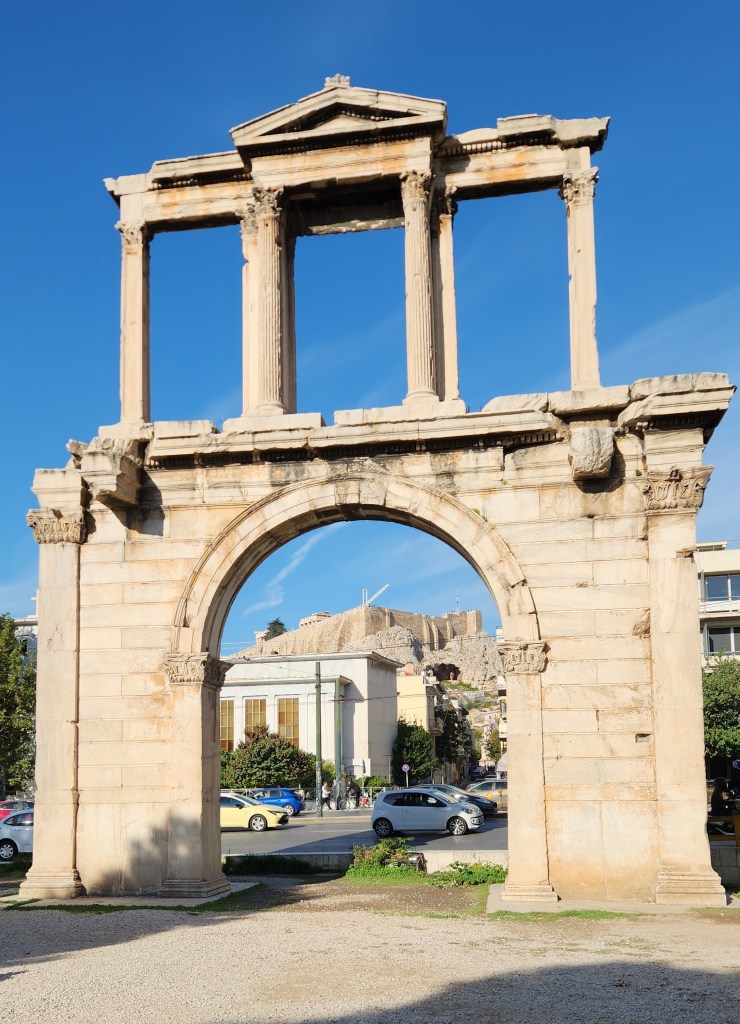
Athens, Greece (Wednesday, November 11, 2025): All of the organized Viking activities were over at this point, leaving us a day to wander about Athens at our leisure. We began the day by wandering around the Plaka District; the sites we saw included some ruins uncovered during excavation for the Metro system, Hadrian’s Arch, the ruins of the Temple of Olympian Zeus, the Panathenaic Stadium (site of the first modern Olympics in 1896), the Zappion Exhibition and Congress Hall, and the National Gardens.
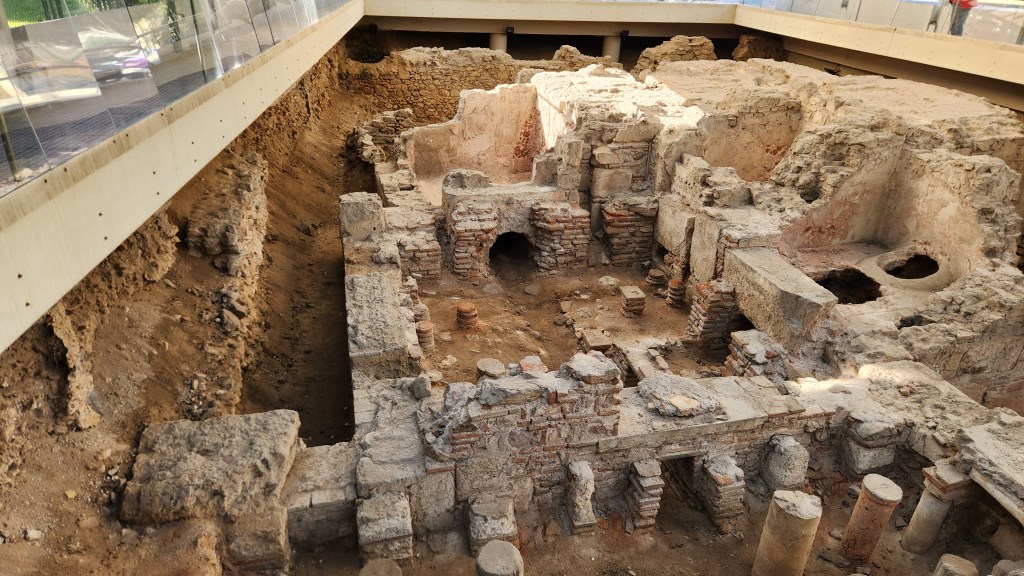
Ruins Uncovered During Metro Excavation
Hadrian’s Arch and View of Acropolis Hill
Hadrian’s Arch — Opposite View
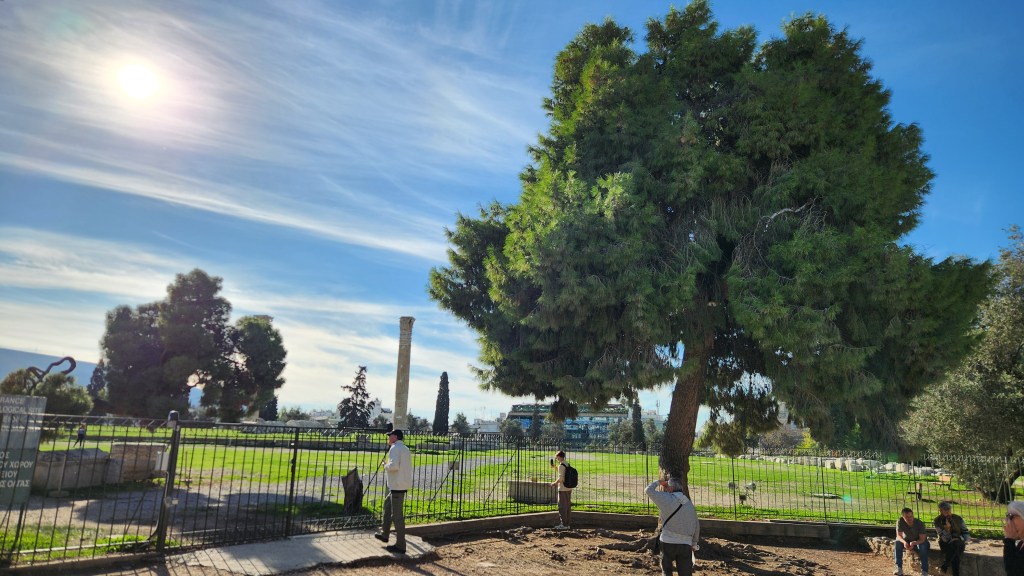
Ruins of Temple of Olympian Zeus
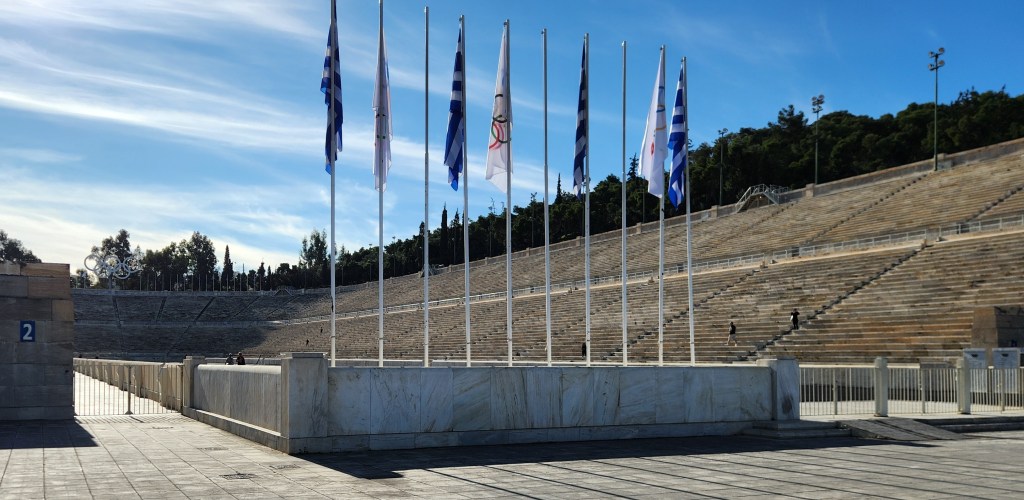
Panathenaic Stadium
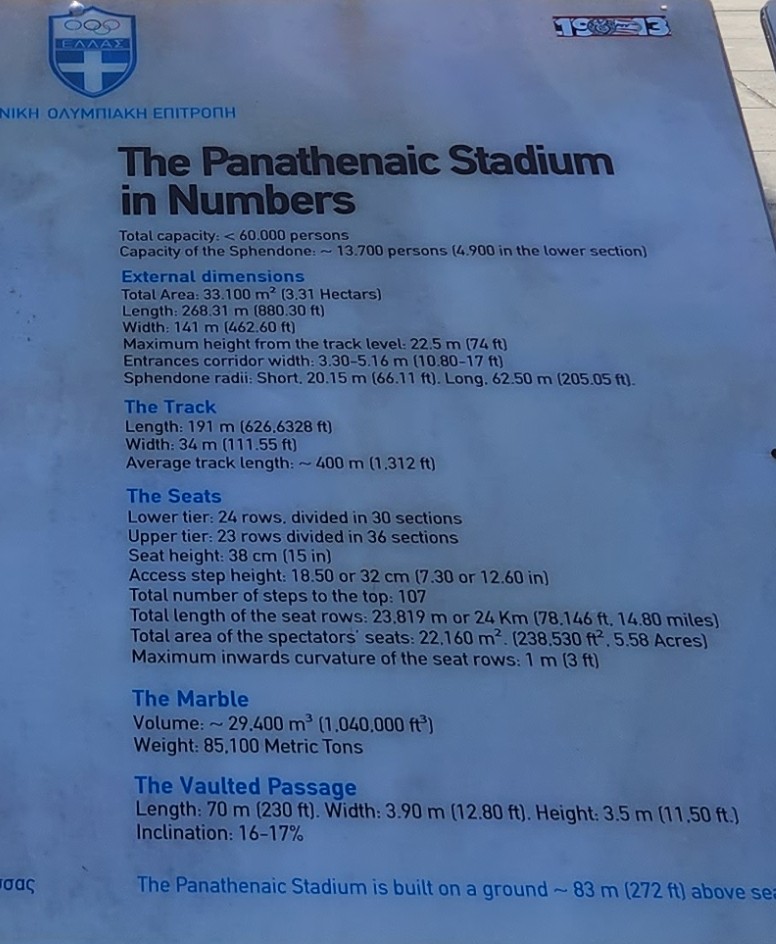
Panathenaic Stadium Vital Statistics
Pathway in National Gardens
Foliage in National Gardens
1848 Century Hermitage for Gardener, now a Children’s Library
Exhibition and Congress Hall Near National Gardens
Acropolis Hill Viewed from Exhibition and Congress Hall Grounds
Acropolis Hill Viewed from Walkway Near National Gardens

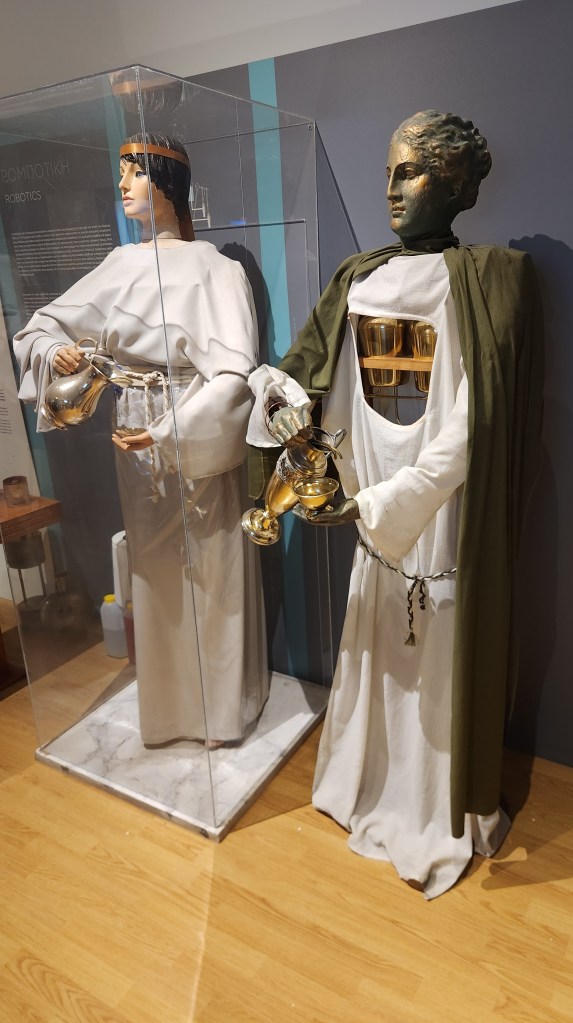
After that, we visited the nearby Museum of Ancient Greek Technology, which we were inspired to do by our earlier visit to the Archimedes Museum in Olympus as well as general awe at the technological achievements we’d seen over the past days. The museum had many impressive exhibits about ancient Greek inventions – such as an early computer, a hydraulic pump, an endless screw, a machine for creating enlarged or reduced copies of objects, even wine-serving robots! – as well as an extensive collection of ancient musical instruments.
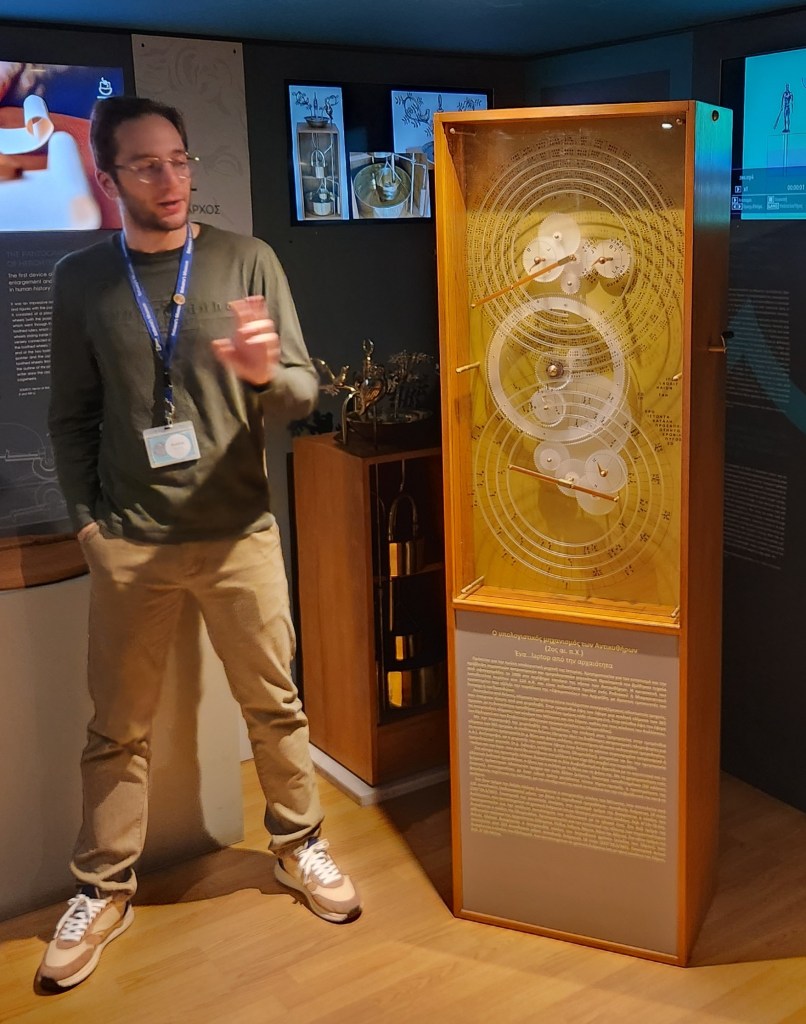
Ancient Computer for Calculating Dates
Ancient Hydraulic Fire Pump
Ancient Hydraulic Endless Screw
Replicas of Ancient Wine-Serving Robots — 3rd Century BCE
Ancient Instrument

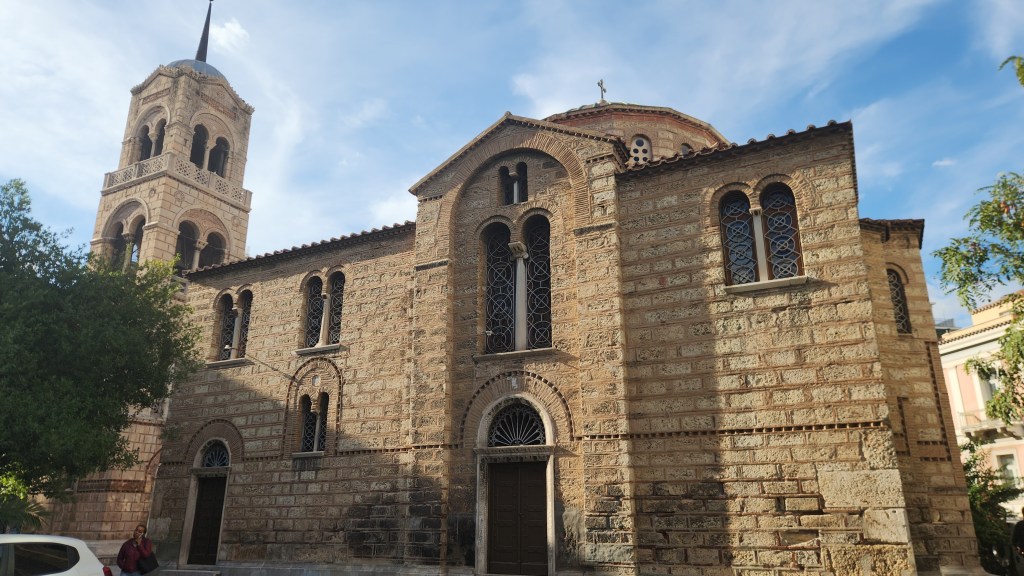
We then had a lunch of pita sandwiches at a small bistro before continuing to wander through the Plaka District, encountering various interesting buildings and other sites along the way.
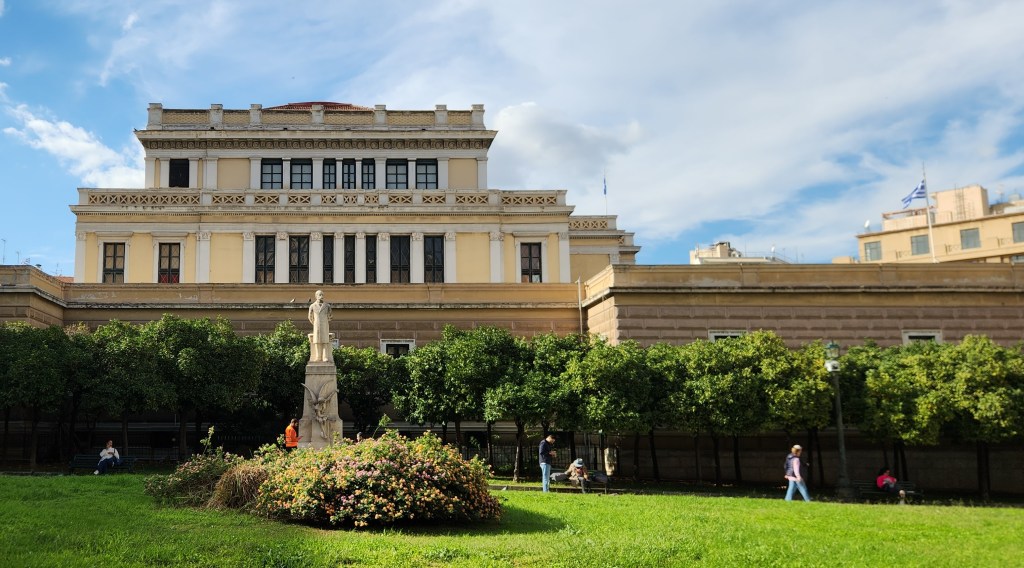
Interesting Building in Plaka District
Orthodox Church in Plaka District
Statue in Plaka District

We capped off the day with our final Greek meal at the nearby Ella Restaurant before returning to the hotel at 8 PM for an early night’s sleep.

Final Thoughts: We got up Thursday morning at 3 AM, had our final included breakfast, and sleepily boarded a shuttle van which delivered us to the Athens International Airport. After a 29-hour trip (from wake-up in Greece to crash in our condo, including layovers in London and Chicago along the way), we returned safely back to our Minneapolis home. Since our return, I’ve been reflecting on the outstanding experience we had on the trip and appreciating how fortunate we are to be able to enjoy so many such experiences during our Golden Years of retirement. At the same time, having returned from the birthplace of democracy to a nation whose founders took their inspiration from the ancient Greeks, I feel somewhat depressed by the efforts underway by the current US administration to rewrite history, to retreat from the ideals set forth by those founders, and to undo the progress we as an immigrant nation have made over nearly 250 years to better define and more fully achieve those ideals. But the trip also helped me put the current situation in perspective. The first, though imperfect, democracy was established in ancient Athens starting in 507 BCE, 2532 years ago. Over the subsequent millennia, there have been many setbacks and steps forward throughout the world, yet the dream of democracy still persists. Now is not the time to give up hope. I urge all my readers to stay strong and help turn the tide in the right direction again.

Okay, that’s it for our monumental Mediterranean Empires tour. I hope you enjoyed the read and will come back in the future for more of my travelogue series.
Pat and Dave’s Mediterranean Moments – PART 3: Corfu, Olympia, Santorini, Athens

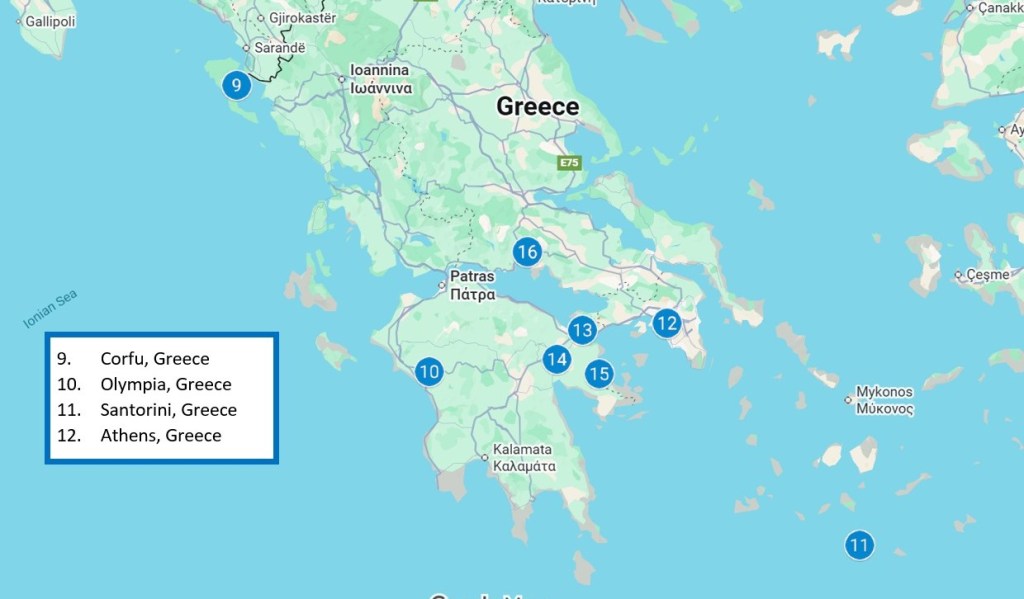
Welcome back for Part 3 of this travelogue series. Part 2 concluded as we sailed away from Kotor, Montenegro, down the Adriatic Sea toward Greece. Here’s a map showing the places I’ll describe in this part of the travelogue: Corfu, Olympia, Santorini, and Athens, all in Greece.
Now let’s continue the story …

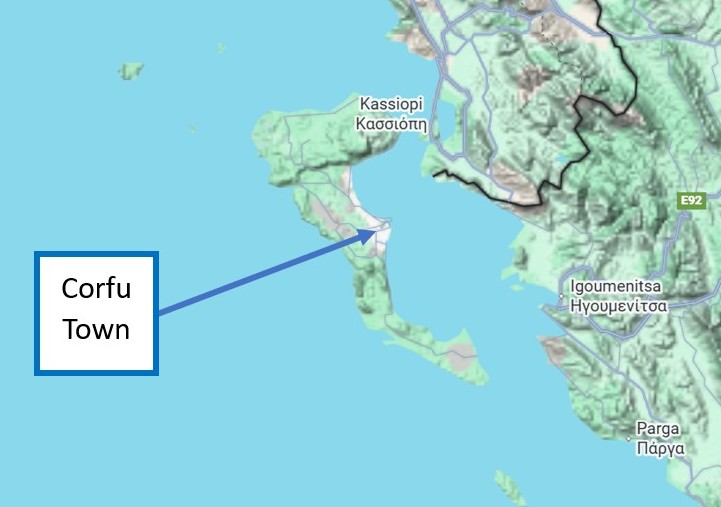
Corfu, Greece (Wednesday, November 5, 2025): After sailing overnight from Kotor, we docked in the Corfu Cruise Port Terminal on the island of Corfu (known as Kérkira in the Greek Language) at about 8 AM on Wednesday. Here’s a map showing the Island and our docking port:

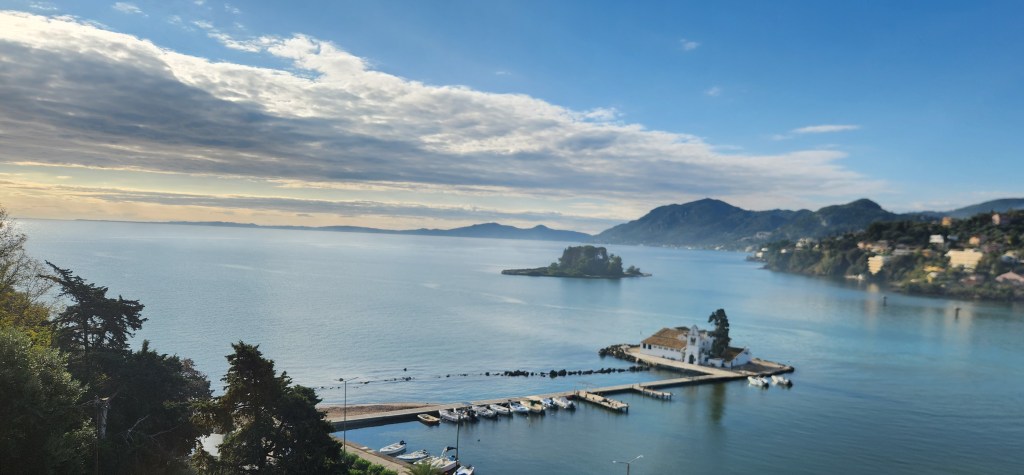
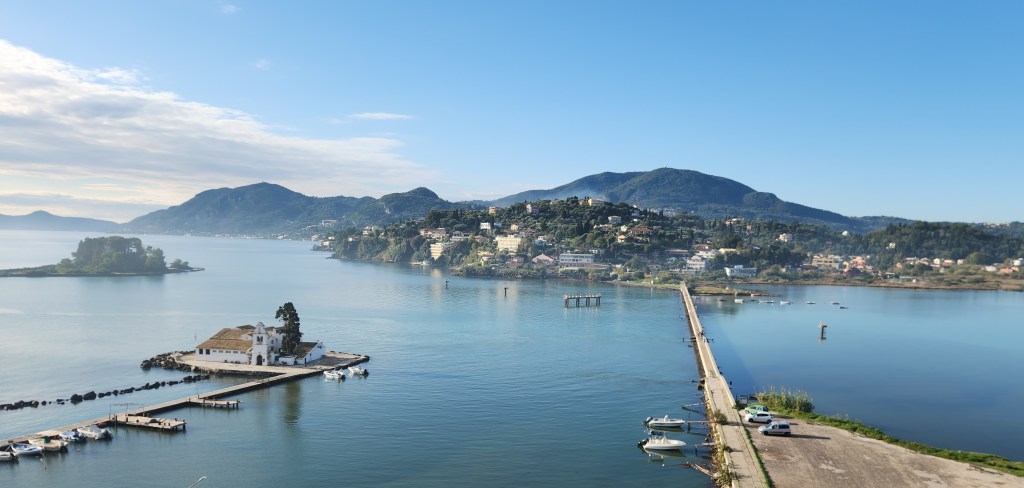
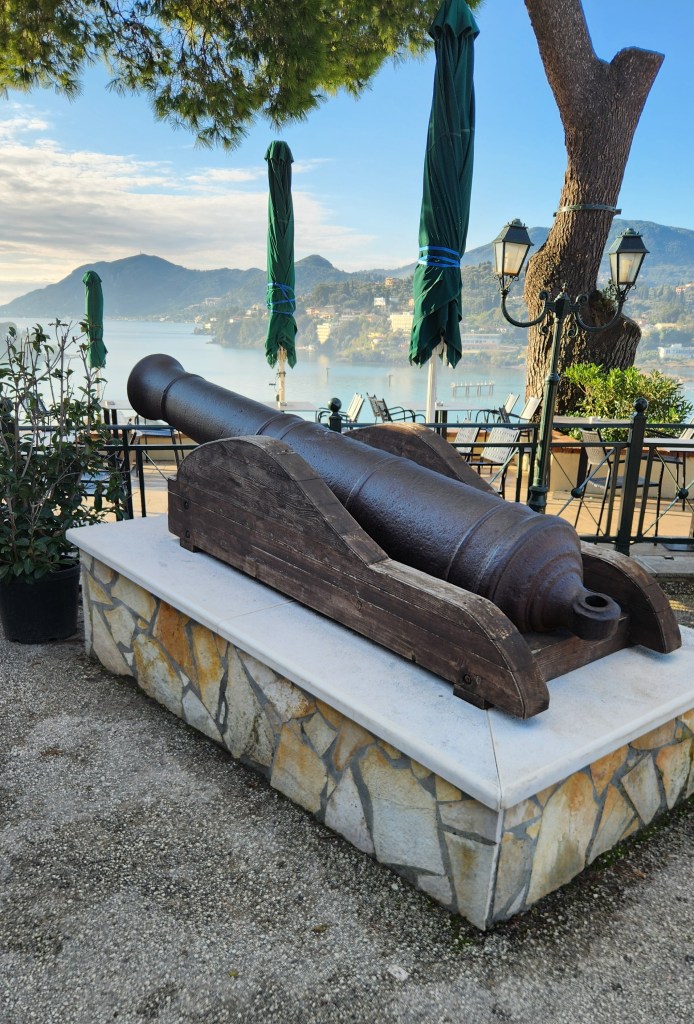
Our shore excursion began with a bus trip through the countryside to the Kanoni viewpoint, a popular lookout spot high above the harbor of Corfu Town named for the old cannon facing the sea. From there, we had beautiful views of the Straits of Corfu and the Greek mainland in the distance. The most famous island near Corfu town is called Mouse Island, supposedly for its mouse-like shape; the island is famous for its Byzantine church and connection to the Odyssey legend. Closer to shore sits the 17th century Vlacherna Monastery, situated nearby on a separate islet connected to the mainland by a causeway.

View from Kanoni Viewpoint
The Kanoni

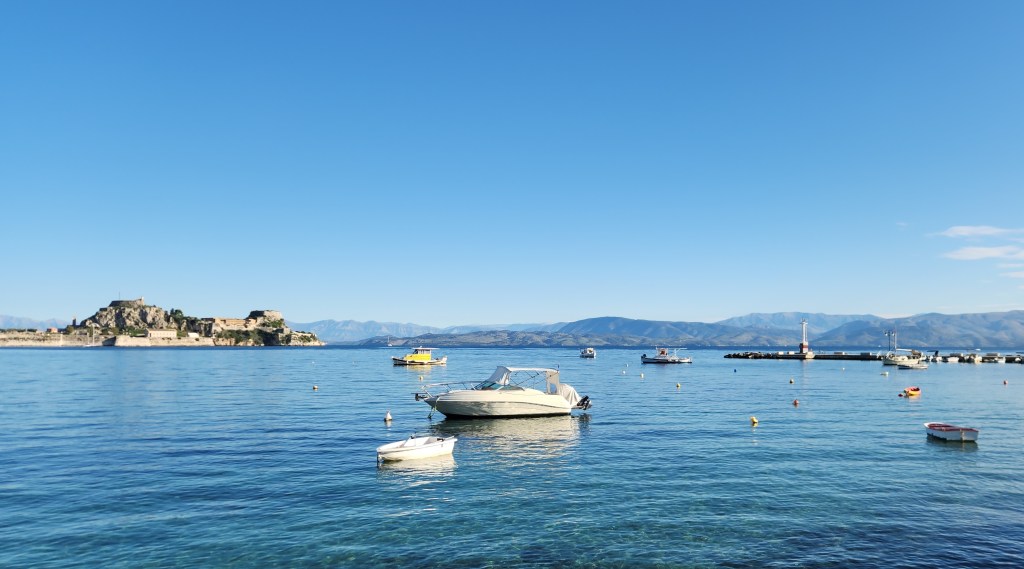
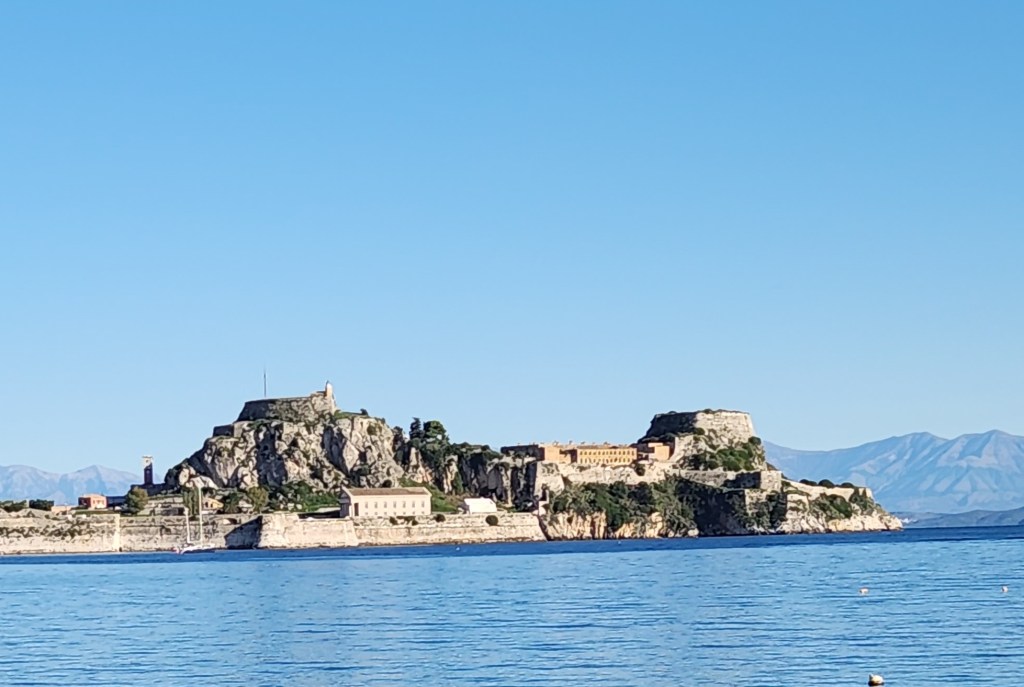
The bus then delivered us to the Corfu Town marina. Across the water we could see the Old Fortress, built by the Venetians in the 15th century on a site originally fortified by the Byzantines in the 12th century. The fortress was isolated from the mainland by a large moat and was used for successful defense of the city during multiple sieges by the Ottomans in the 16th century. The fortress has two towers, or peaks, which gave rise to the name of the Island – the Byzantine Greek word “Koryfó,” meaning “city of the peaks,” refers to the two peaks of the old fortress.

Corfu Town Marina
The Old Fortress

We then had a brief walking tour before setting off on our own to explore the city. Here are some of the sights we saw.

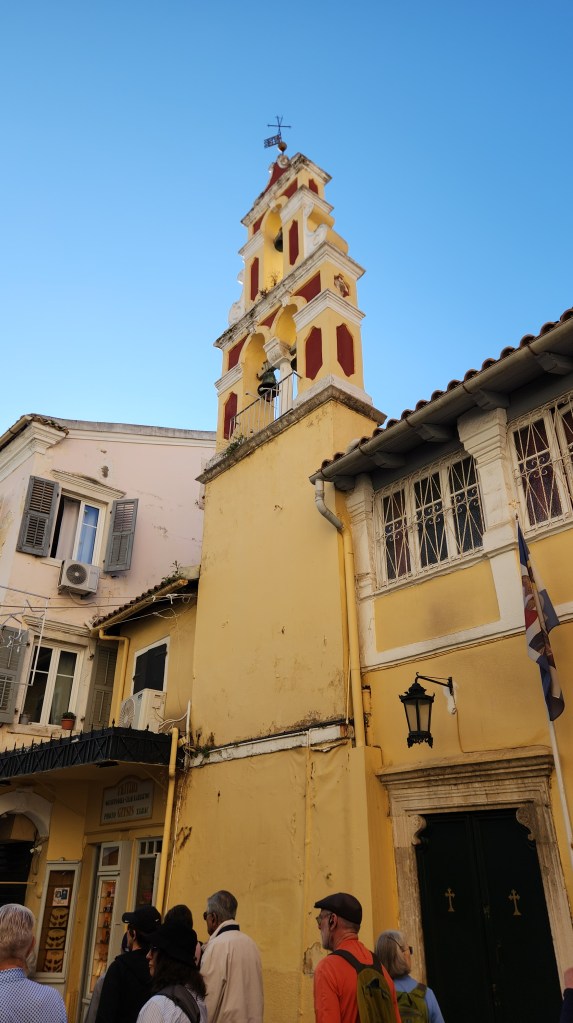
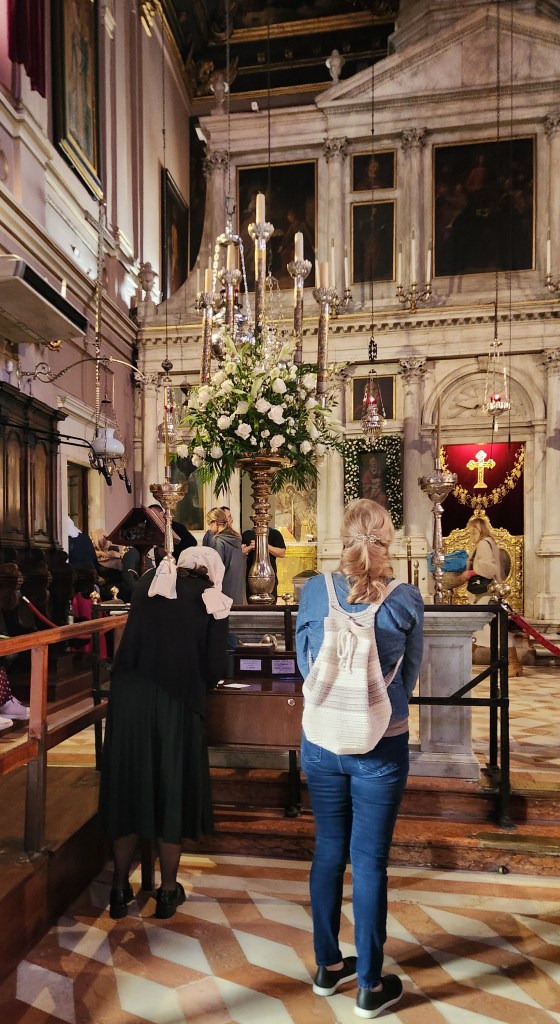
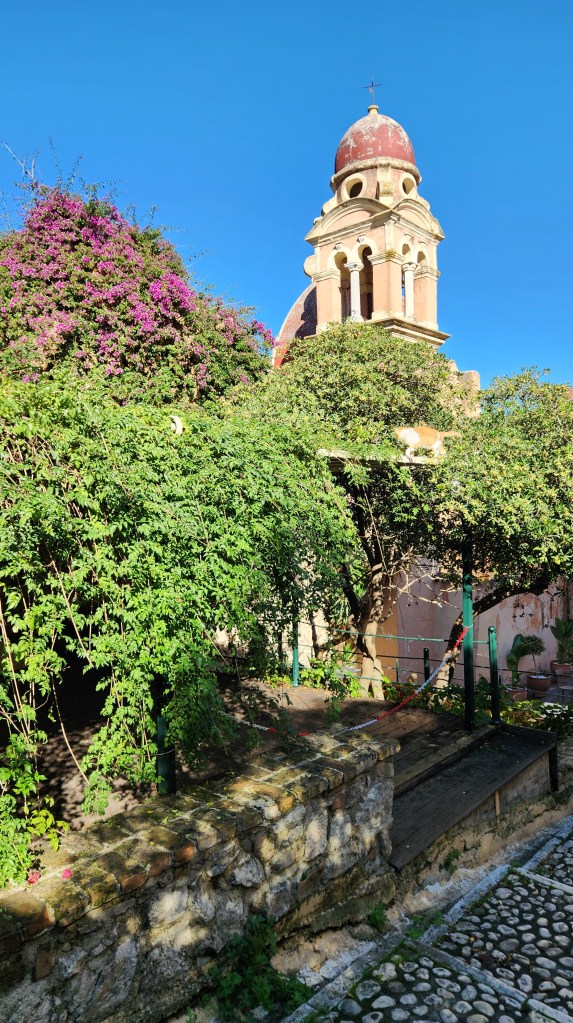
Greek Orthodox Church in Corfu Town
Interior of the Church
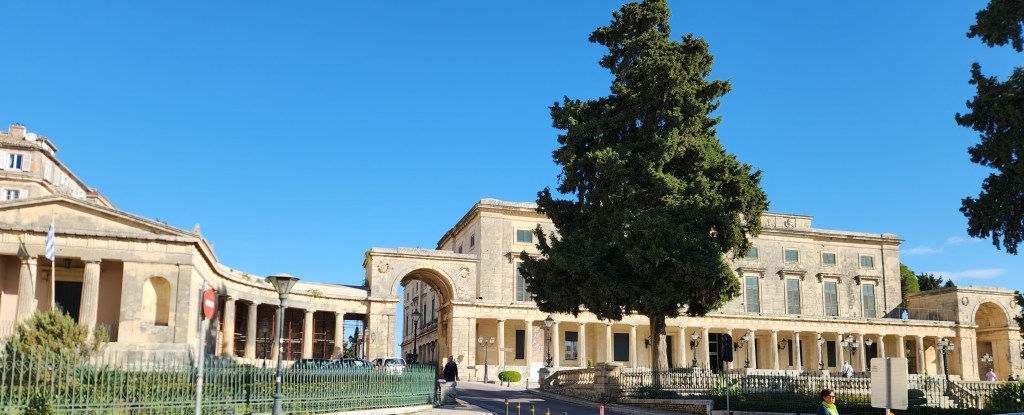
Government Buildings in Corfu Town
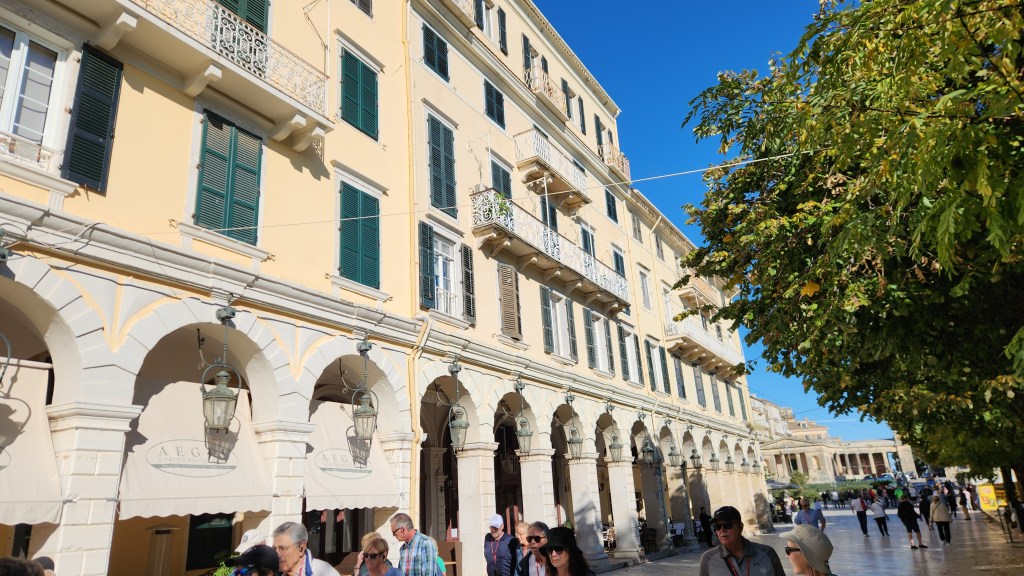
Main Square in Corfu Town
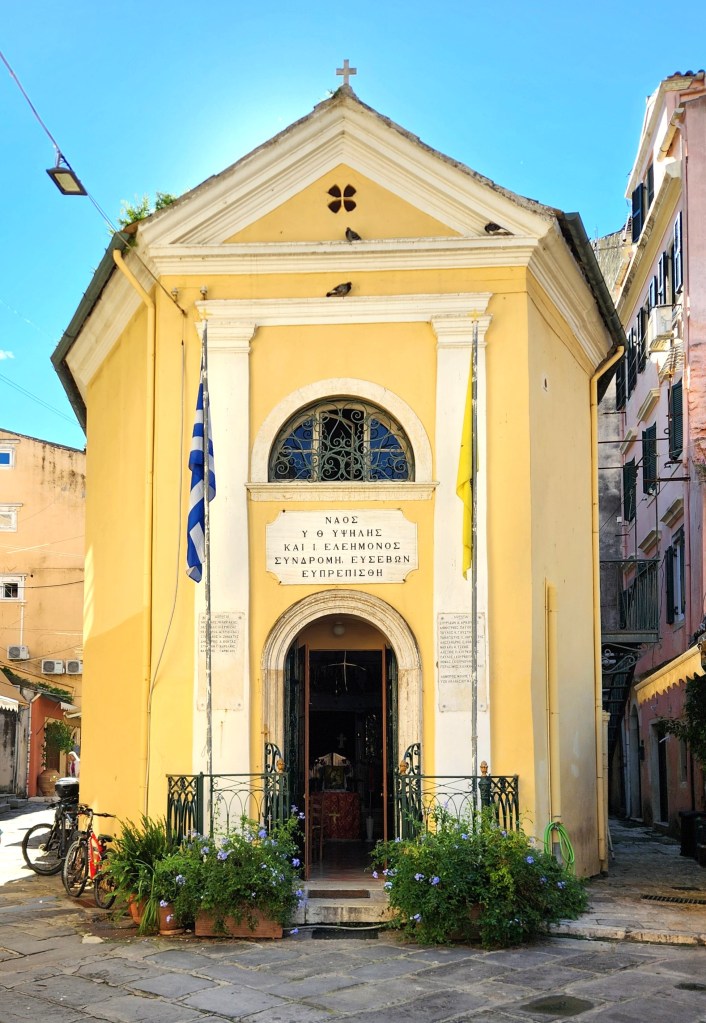
“,,, a Church I Passed Along the Way …” (with apologies to The Mamas and Papas)
And Another One …

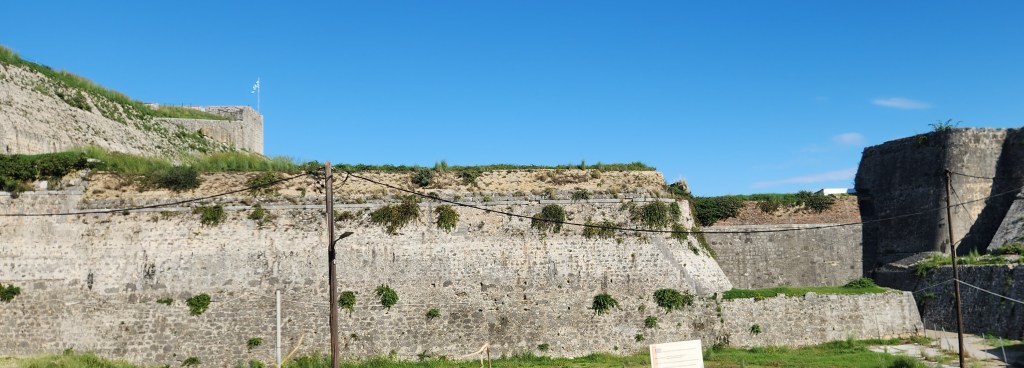
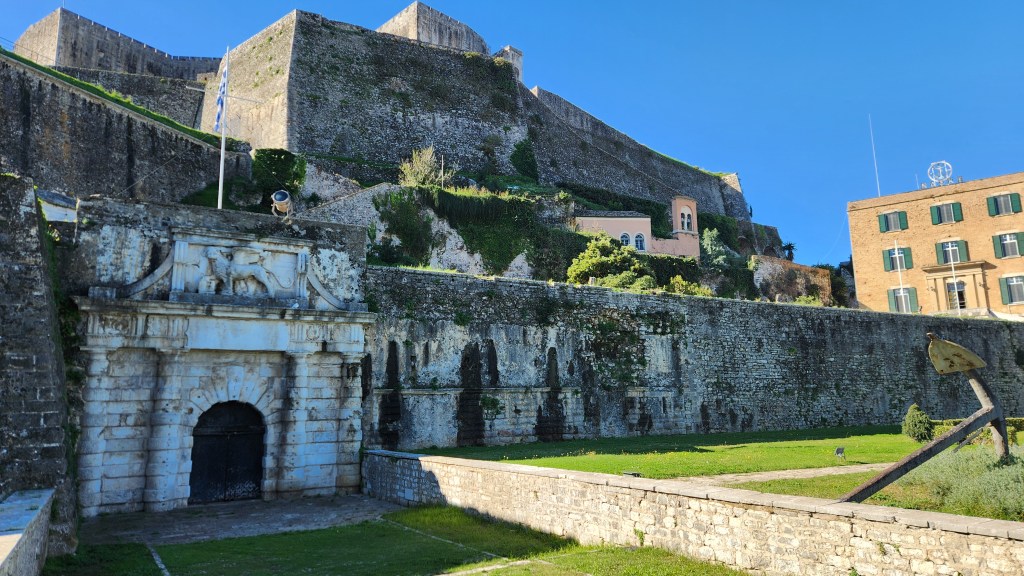
Of particular interest to me was the so-called New Fortress. It was built after the first major Ottoman siege of 1537 to provide additional fortification for the city, beginning in the mid-1570s. We were told that it was open to the public for tours, so we spent about an hour wandering around its periphery trying to find the entrance, but when we finally found the ticket booth, it turned out to be closed for renovations.

Rear Walls of the New Fortress
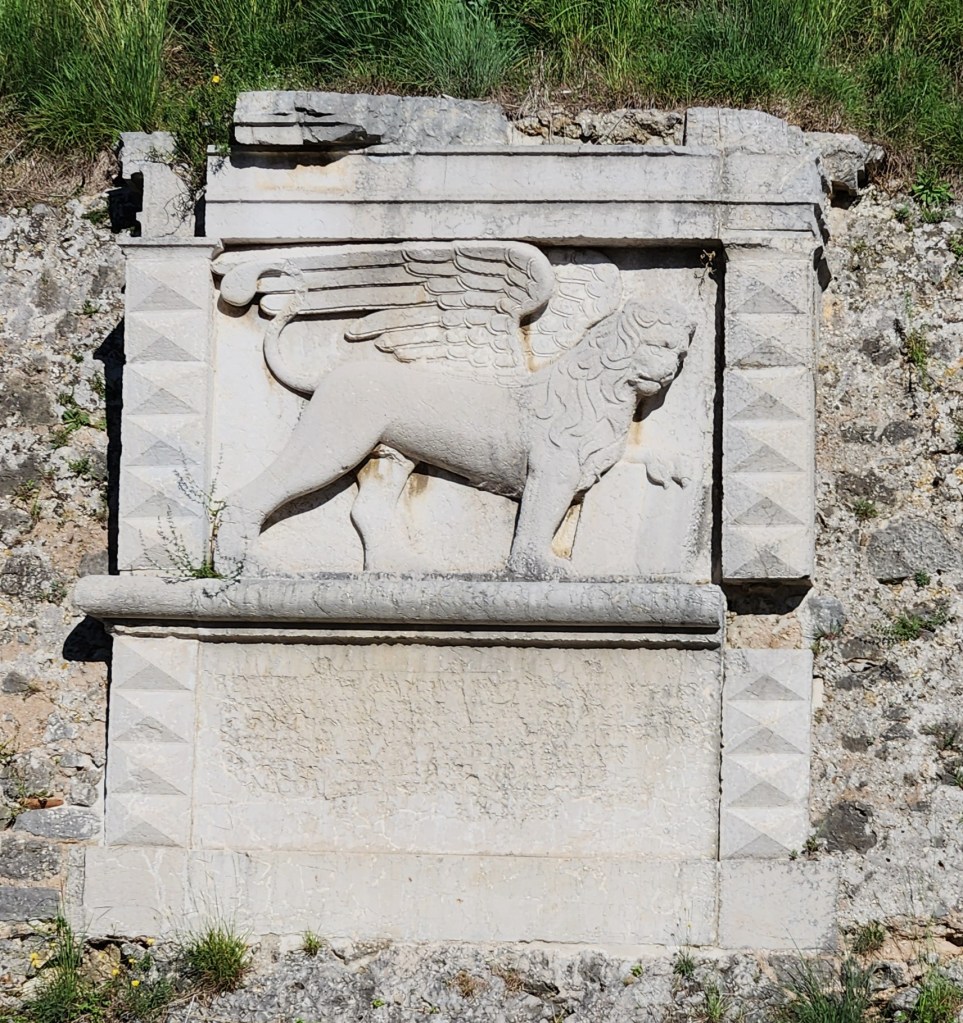
Symbol of the Venetian Republic
Main Gate to New Fortress
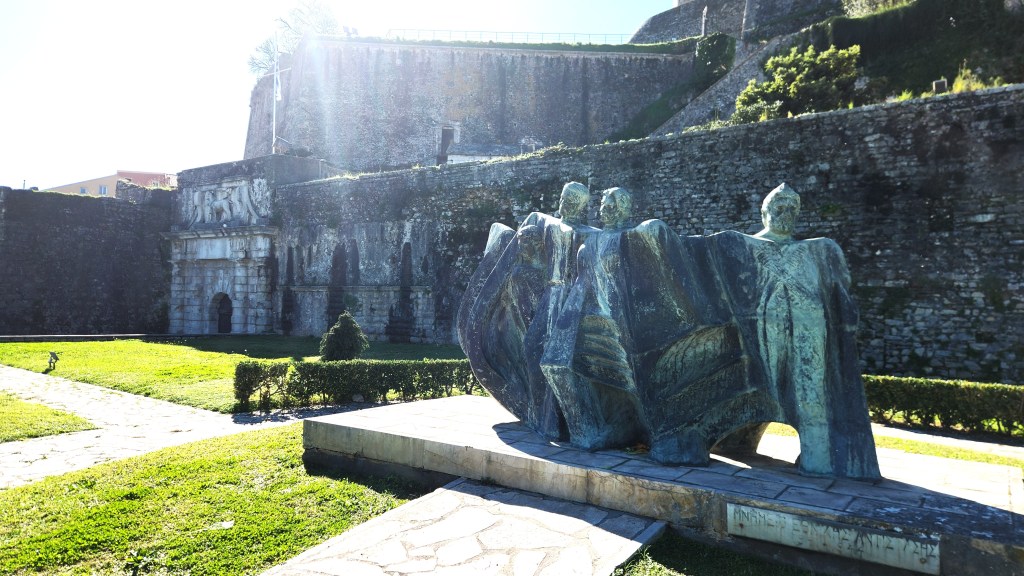
Sculpture at the Old Fortress
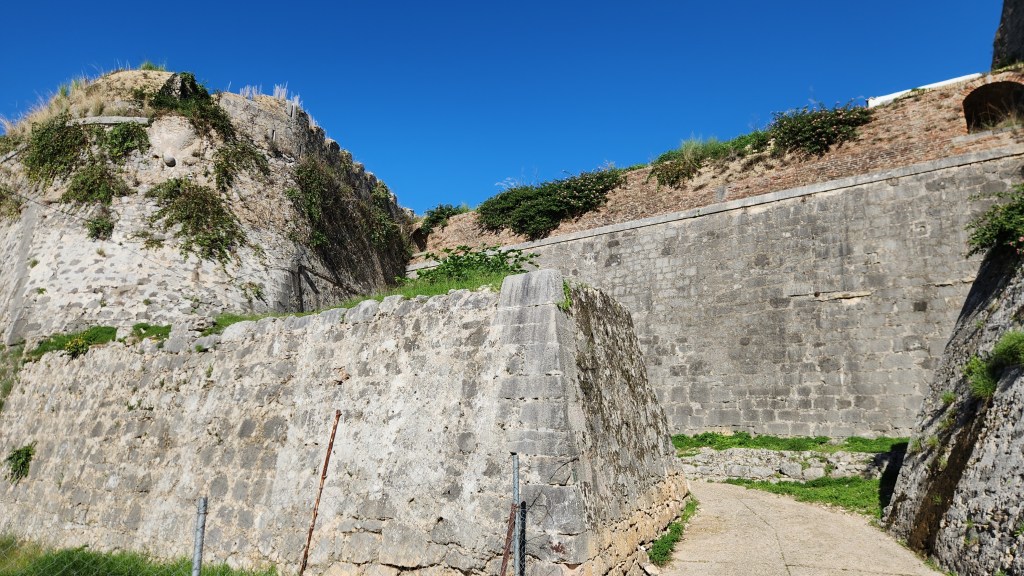
New Fortress Walls Near Public Entrance

We still enjoyed the outing, however, which carried us through a good portion of the city before we returned to the marina to catch a Viking shuttle bus back to our ship. Here’s a final look at the Straits of Corfu as the ship sailed off for our next destination.

Leaving Corfu

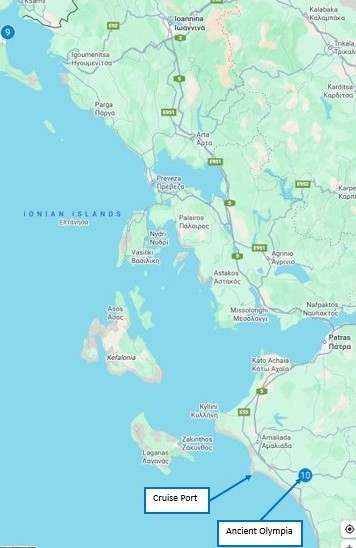
Olympia, Greece (Thursday, November 6, 2025): On Thursday morning the ship docked at the port in Kotakolon, on the northwestern edge of the Peloponnese Peninsula. Kotakolon serves as the main port for access to the ancient site of Olympia. Here’s a map showing Corfu, Kotakolon, and the ancient site:

From the port, we departed for a 20-mile, 40-minute bus ride to the ancient site of Olympia, where the original Olympic Games were held every four years from 776 BCE until they were abolished in 393 AD by the Roman Emperor Theodosius I, who banned pagan festivals like the Olympics as part of his efforts to suppress paganism and promote Christianity.

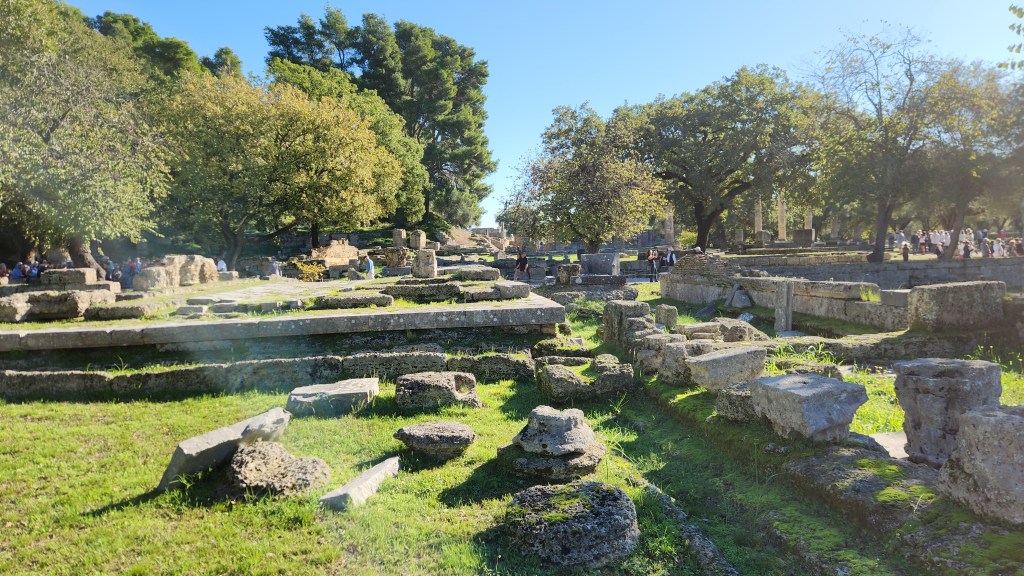
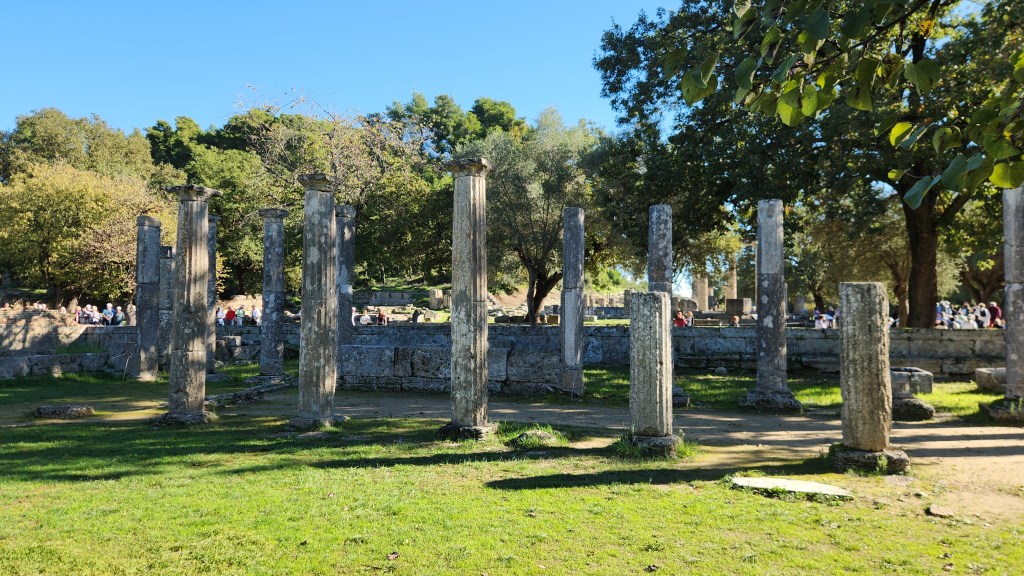
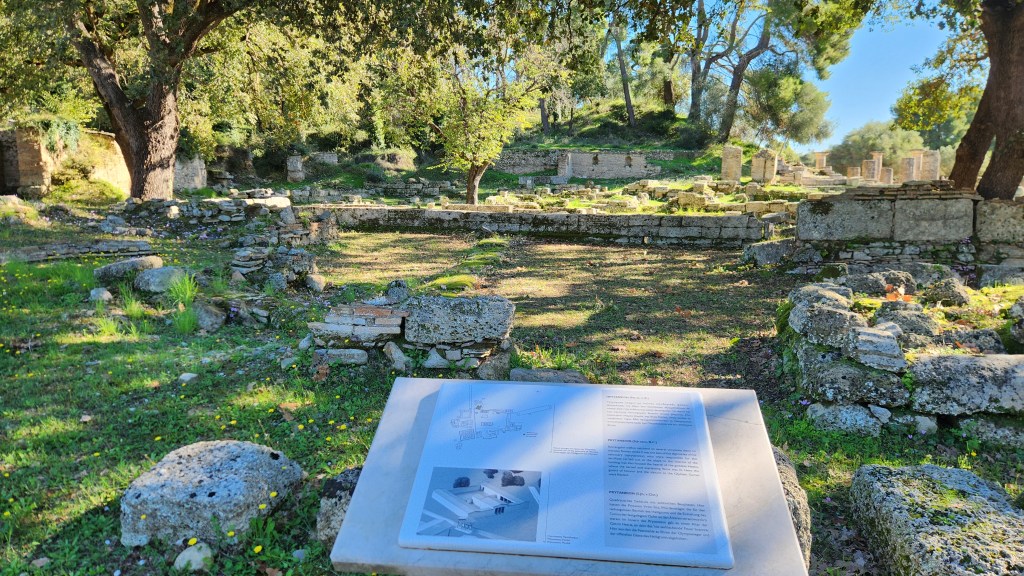
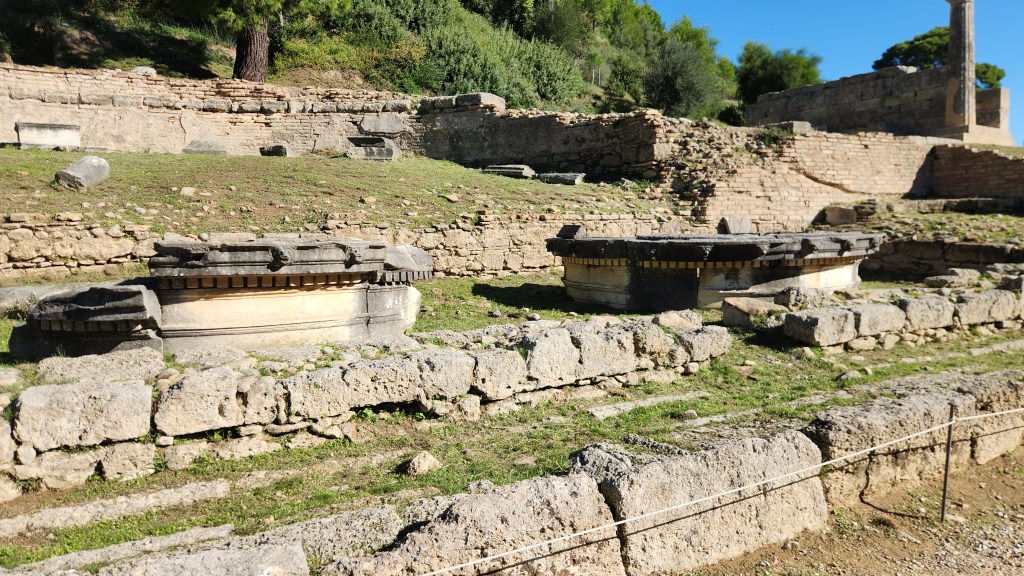
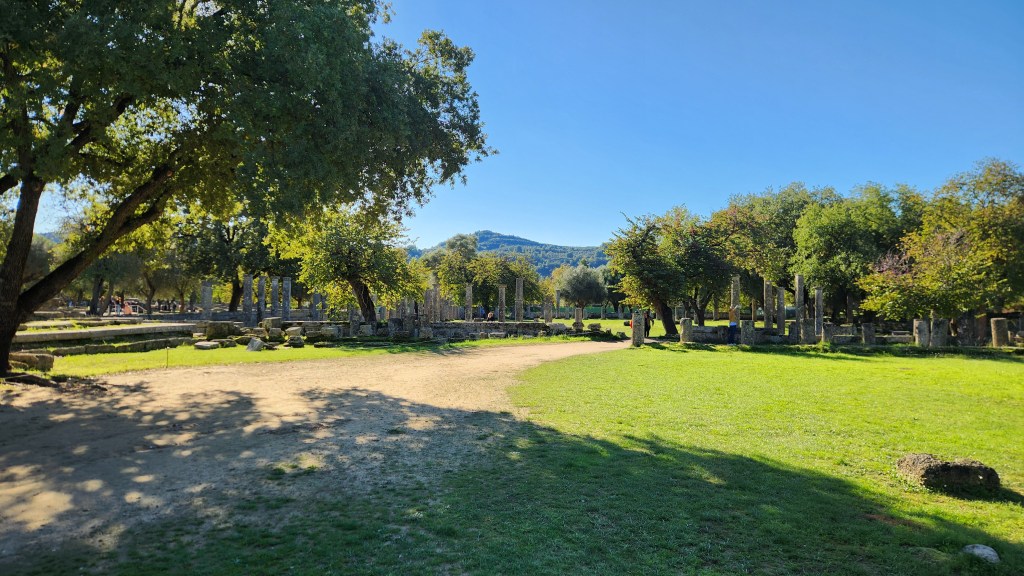
We spent a couple of hours on an extensive tour of the site, which was definitely among the highlights of the trip. I’ve included photos to try and portray the vast extent of the site and the amazing degree to which the ancient ruins have survived for up to 2,800 years. ’ll also pass along some of the interesting tidbits we learned from our local guide:

  • The Olympic athletes were all male and competed in the nude, slathered with oil and covered in dust, with the aim of paying tribute to the god Zeus. Women were banned under penalty of death, except for the priestess of Demeter, goddess of fertility, who had a reviewing stand next to the stadium altar. One exception to the death rule was Kallipateira of Rhodes — she disguised herself as a male trainer to watch her son compete but, when caught, was pardoned because her father, brothers, and son were all Olympic champions.
  • There were, however, separate competitions for unmarried women known as the Heraia Games, in honor of the goddess Hera, in which the participants raced a shorter course at the Olympic stadium while clad in costumes with short skirts.
  • During the celebration of the games, the Olympic truce (ekecheiría) was announced so that athletes and religious pilgrims could travel from their cities to the games in safety.
  • The prizes for the victors were olive leaf wreaths or crowns.
Ancient Olympics Site
The Prytaneion — Seat of Dignitaries and Site of Celebratory Feasts
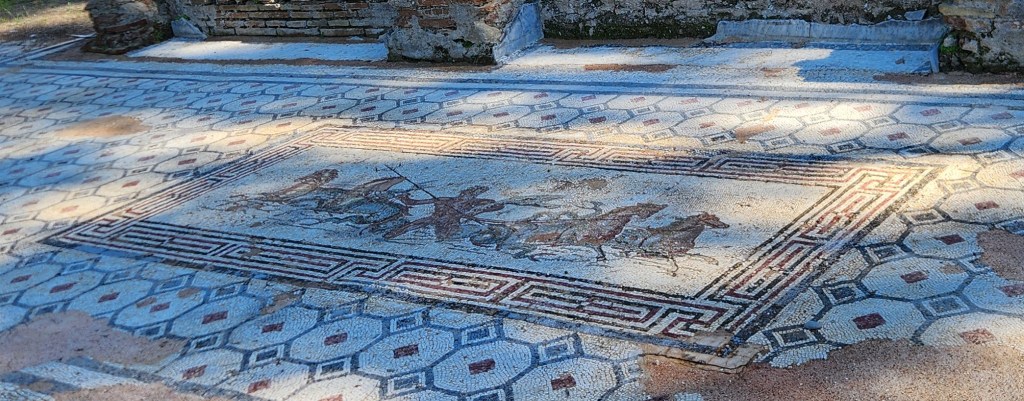
Mosaic Illustrating Chariot Raceing
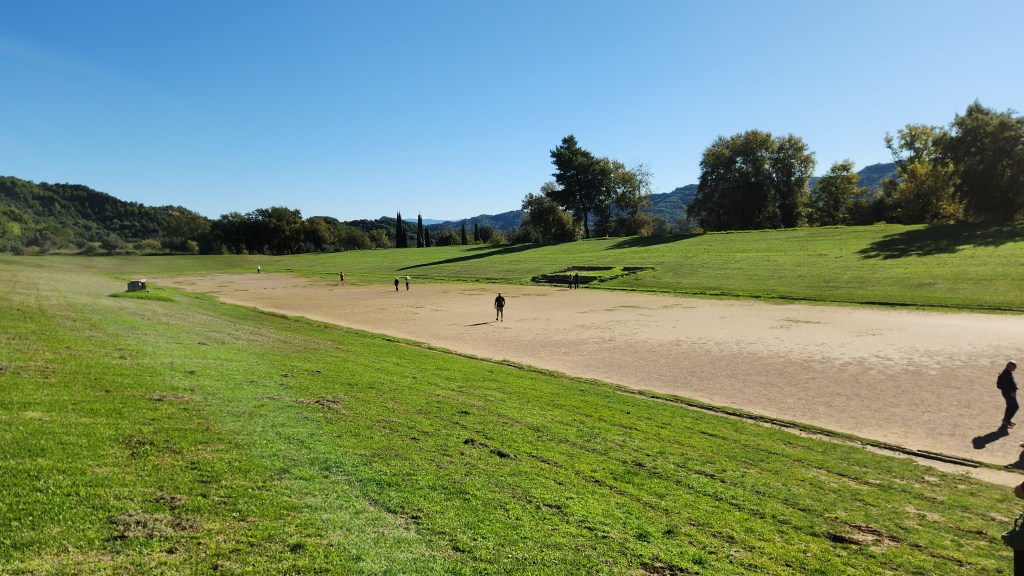
Site of the Running Stadium with Viewing Stand

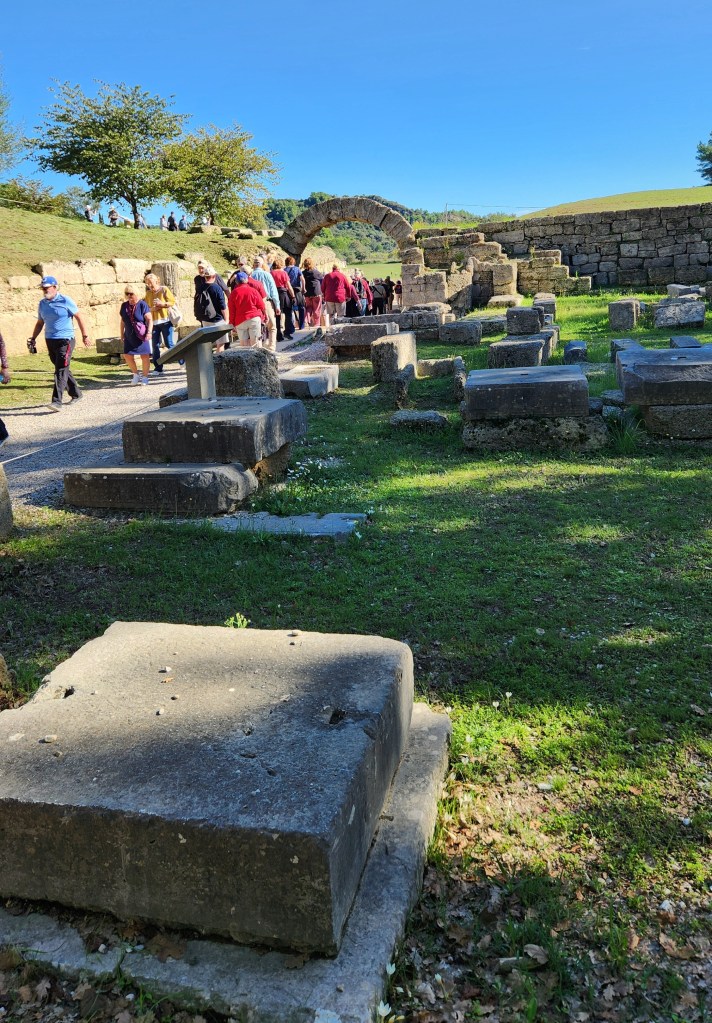
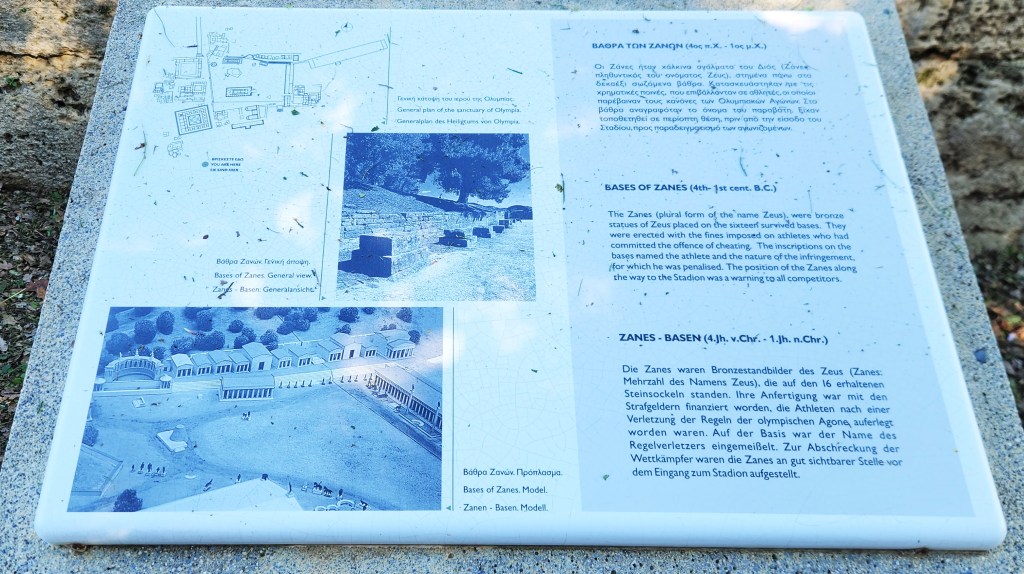
The path to the stadium is lined with bronze statues known as Zanes, which were paid for by athletes who cheated during the games. Known as the walk of shame, the walls feature inscriptions by the miscreants including their names and the misdeeds for which they were being punished, such as bribery, lying about their city-state, or other acts against the integrity of the games. The display was a reminder to all athletes entering the stadium of the importance of honesty and integrity.

Walk of Shame
Description of the Zanes

After our tour of the Olympics site, we strolled into the nearby town of Olympia for lunch and a brief stop at a small museum dedicated to Archimedes. Photos were prohibited, so I can’t show any of the exhibits, but they were quite impressive, detailing many of the Greek genius’s inventions and relating the sad story of his death at the hands of a Roman soldier during the siege of Syracuse in 212 BCE, despite Roman orders to spare his life. (NOTE: We later went to a much larger ancient technology museum in Athens that also featured Archimedes; I’ll describe that in Part 4.)

After the shore excursion, we were driven back to the ship for departure shortly after 3 PM. I took this photo of the Port as the ship was preparing to depart:

Kotakolon Port

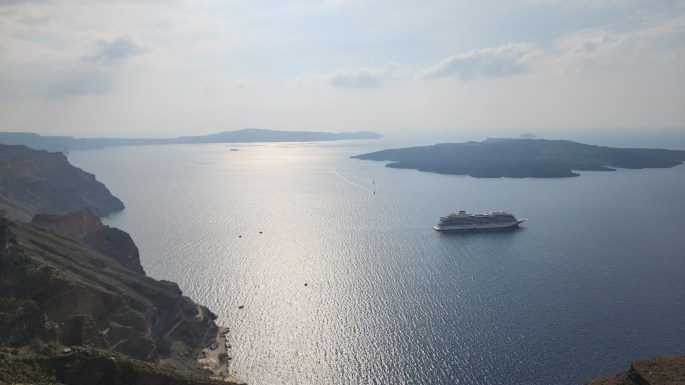
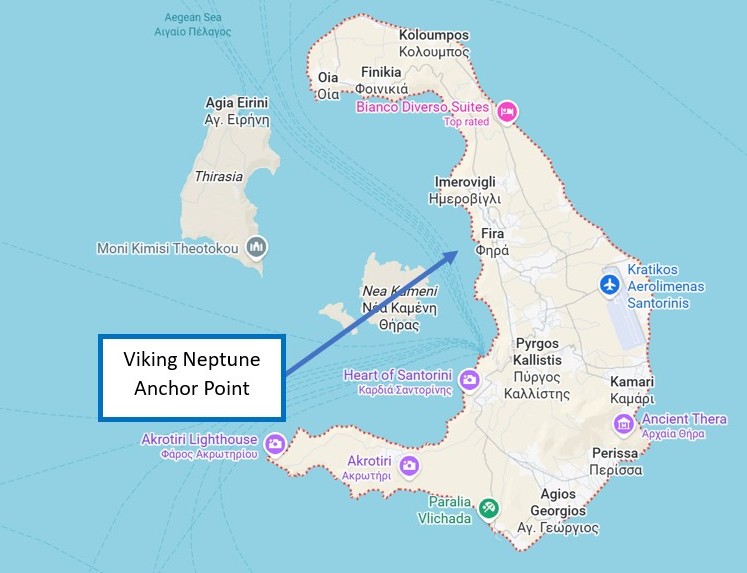
Santorini, Greece (Friday, November 7, 2025): On Friday morning around 9 AM, the Neptune dropped anchor in the waters off the island of Santorini, or Thi̕ra in Greek. Santorini in its present form was created by an enormous volcanic eruption circa 1600 BCE. The eruption destroyed the Minoan settlement at Akrotiri, as well as communities and agricultural areas on nearby islands and the coast of Crete with subsequent earthquakes and tsunamis. What remained behind is a partial caldera, the hollow that remains after a volcano disgorges its contents. Here’s a map of the island showing its configuration and the Neptune’s anchor point.

For our shore excursion, we boarded a tender boat operated by the local Greek authorities, which deposited us on shore. We then boarded a bus for a zig-zagging trip up the steep slope to the rim of the caldera and the capital city of Fira and then on to the village of Oia (pronounced “ee-ya”). In Oia, we had a brief walking tour before heading off for exploration on our own and lunch at a nice café, where we had lamb and Moussaka accompanied by an excellent Santorini wine. The village is known for its beautiful vistas, cliffside whitewashed buildings, blue-domed churches, and stunning sunsets over the caldera. (Unfortunately, the overcast skies hampered the views and we had to leave before dark so did not see the sunset. Such is life …)

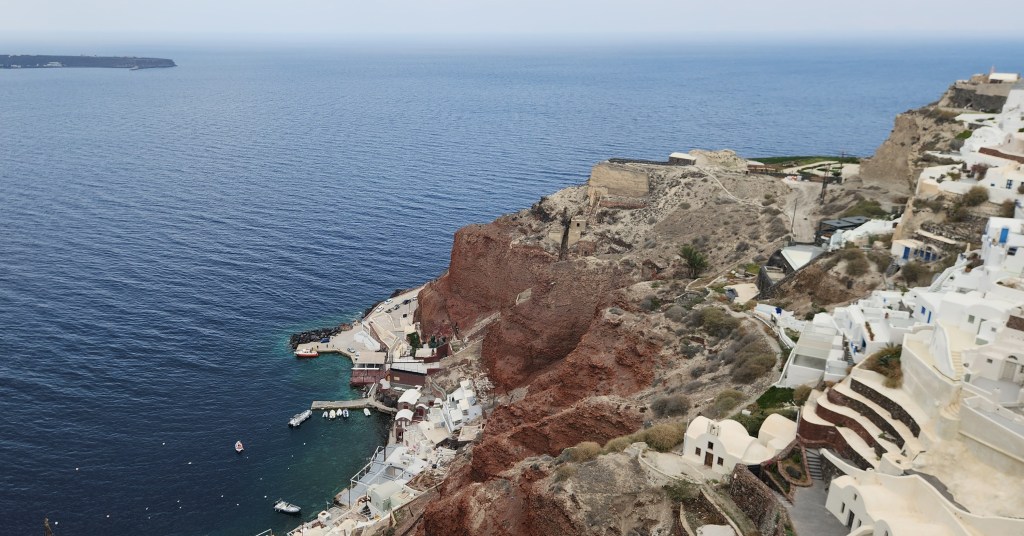
View of Oia and the Caldera
View from Oia — Caldera Basin and Viking Neptune at Anchor
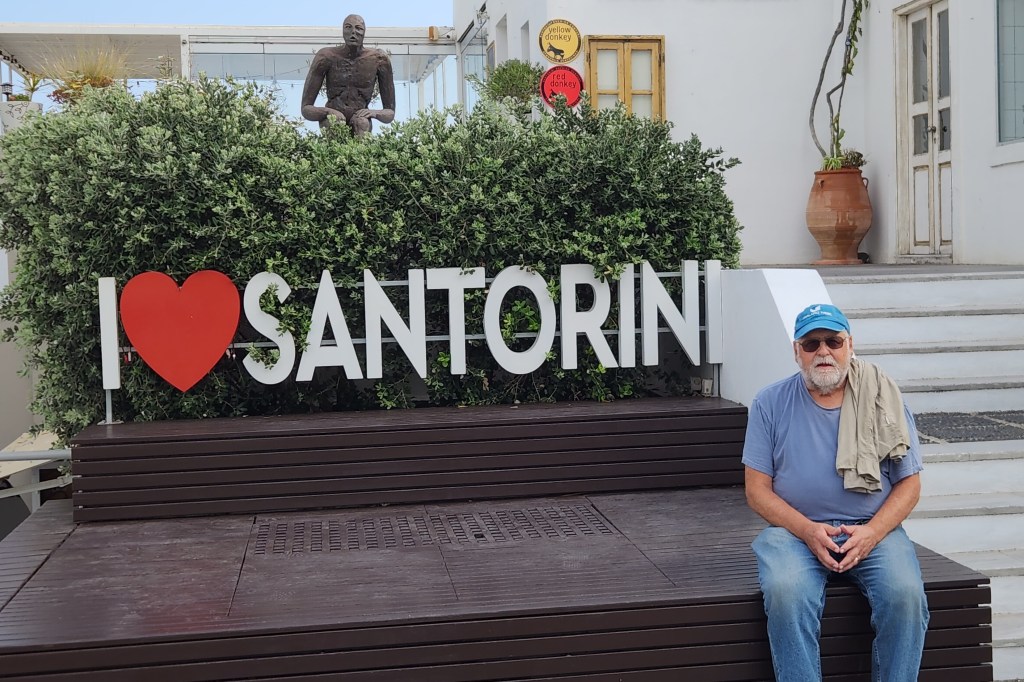
A Couple of Gentlemen Enjoying the Vibe in Oia
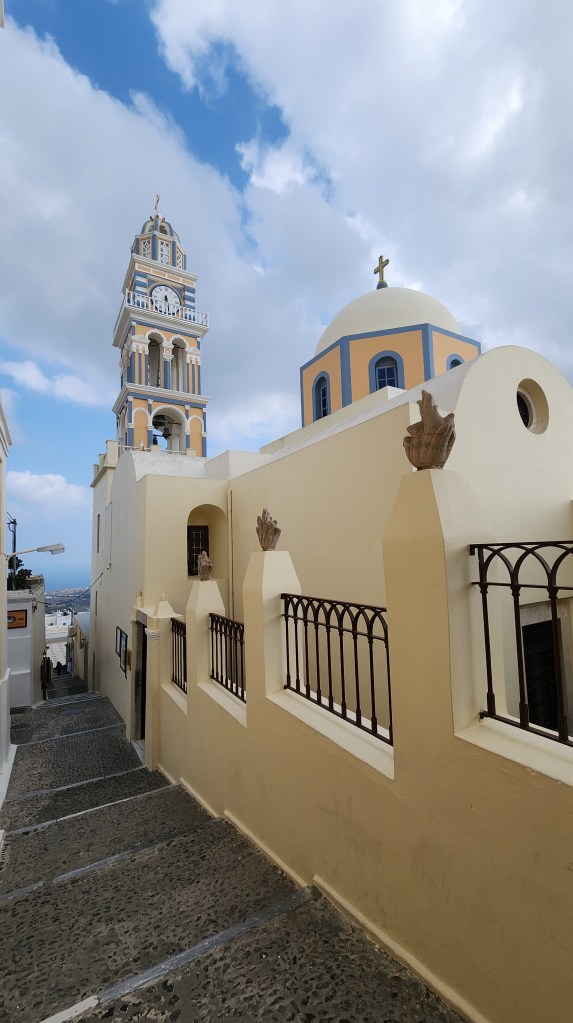
Oia Church and Clock Tower
Church in Oia
Park Area in Oia

Earthquakes caused by a nearby underwater volcano have damaged some buildings over the years, such as this house we saw as we wandered around.

“Captain’s House” Damaged by Earthquake

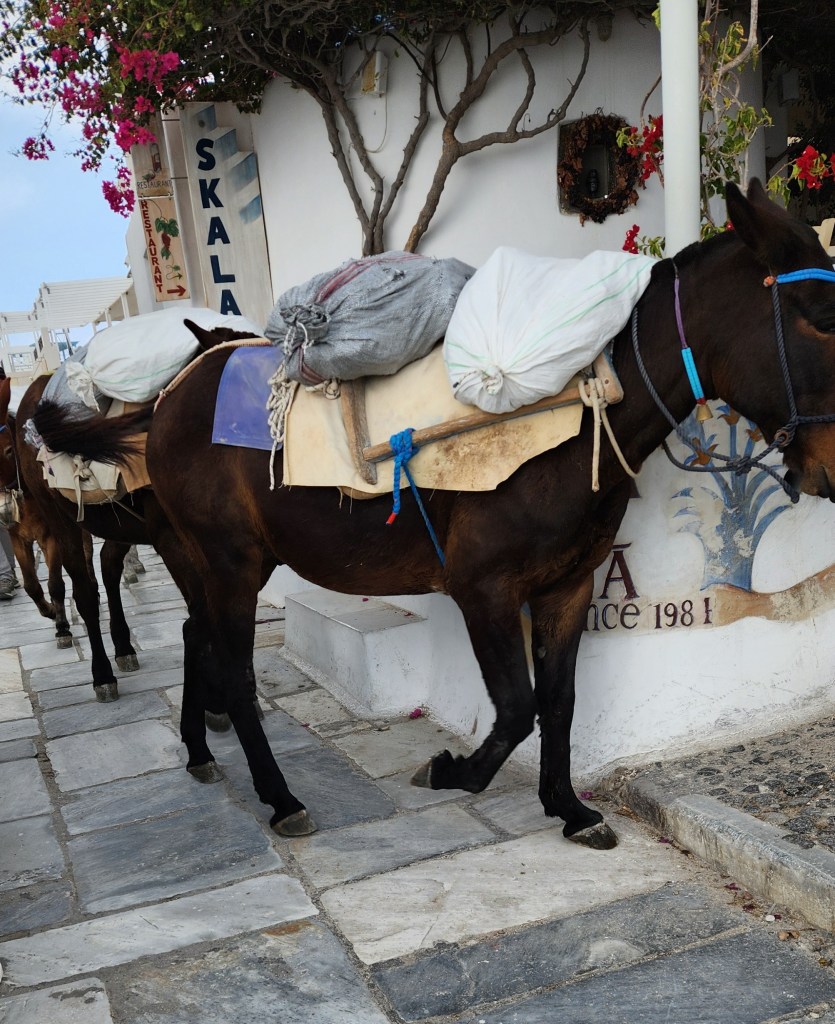
As in many Greek towns, cats are to be seen all over the place. Donkeys are also still used to transport goods from the harbor below, and we were lucky enough to encounter some during our stroll along the main pedestrian street.

Cat Roaming the Main Pedestrian Street of Oia
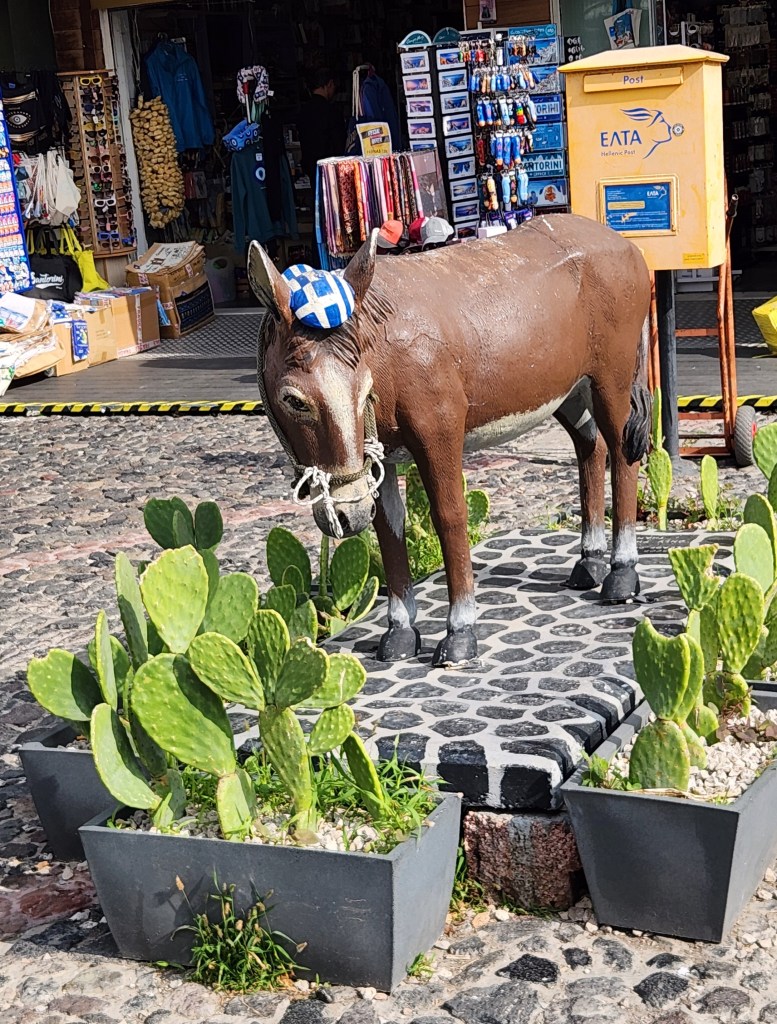
A Tribute to the Donkeys
Donkeys Delivering Goods in Oia

I was particularly taken by the remains of a castle on the edge of the village and naturally had to clamber around taking photos.

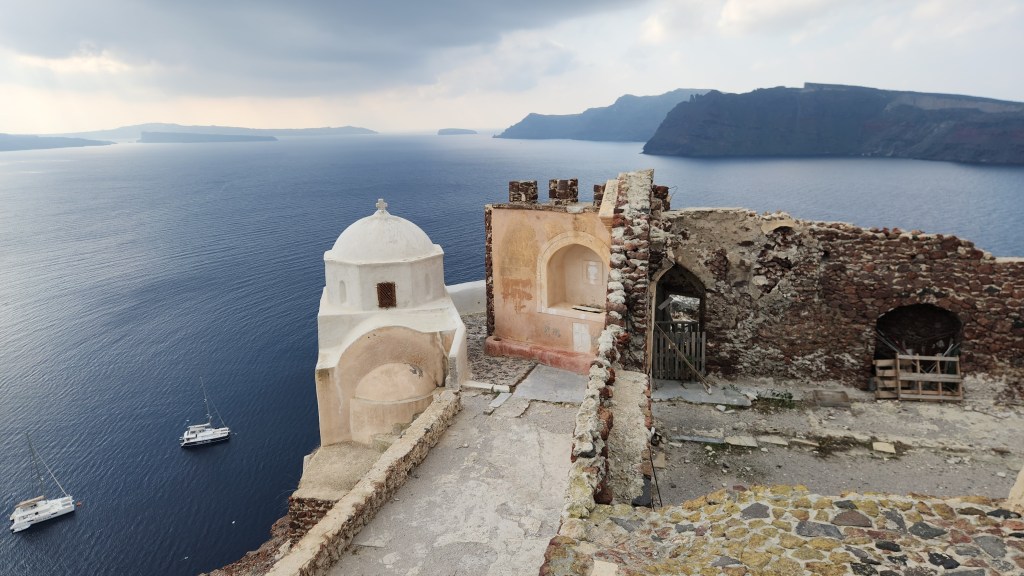
Remains of the Old Castle
View of the Sea from the Old Castle

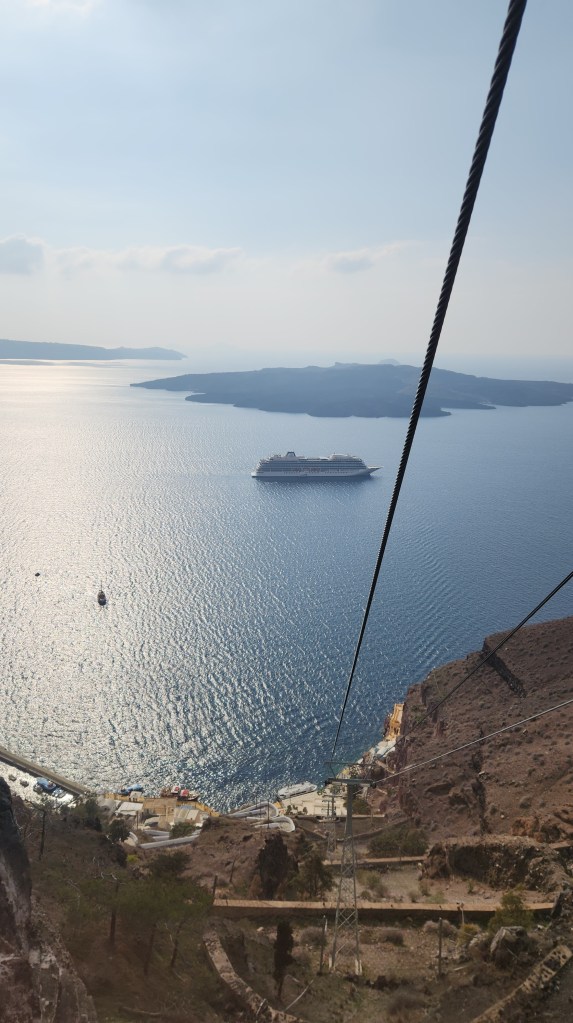
Once it was time to return to the ship, we took a very steep cable car ride down to the harbor below Oia. Two other tourists who rode in the same cable car with us seemed scared nearly witless, but to me it was a suitable thrill to cap off a thrilling day.

The Cable Car Ride — Going Down
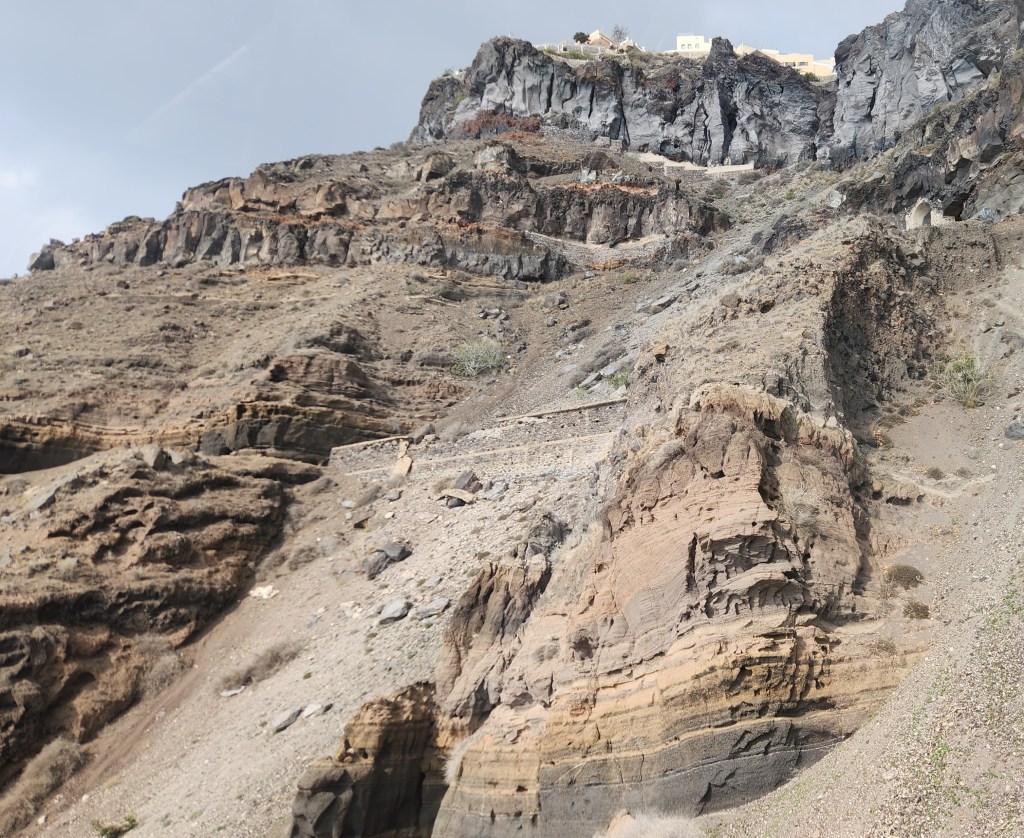
Looking Up from the Harbor

In the harbor, we caught another tender boat that returned us to the Viking Neptune. Here are a photo I took from the tender and one final look back at the harbor and Oia as the Neptune began to sail away shortly after 5 PM.

Buildings Near the Harbor
Looking Back at Oia from the Ship

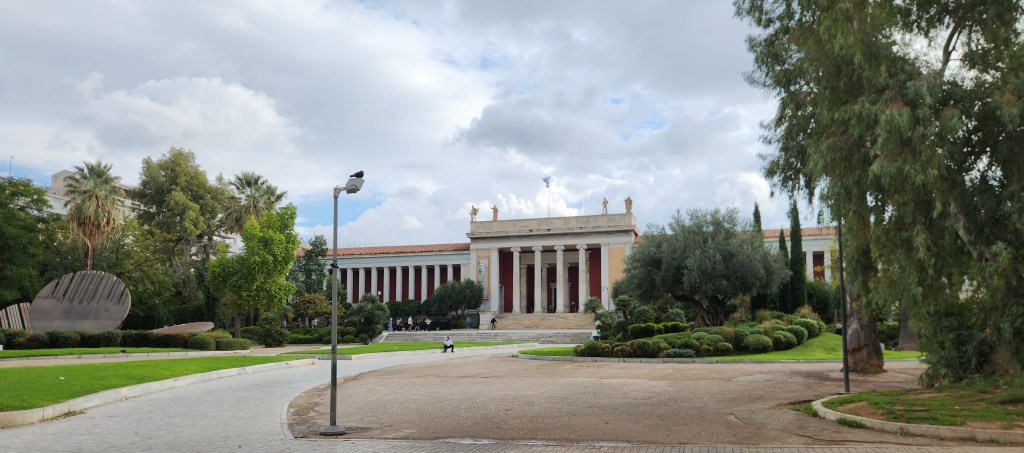
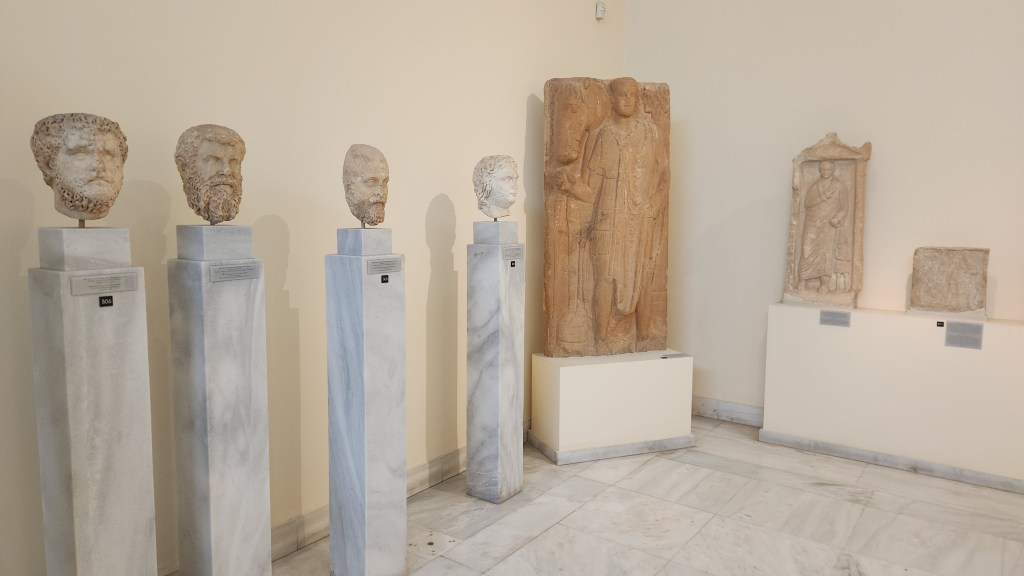
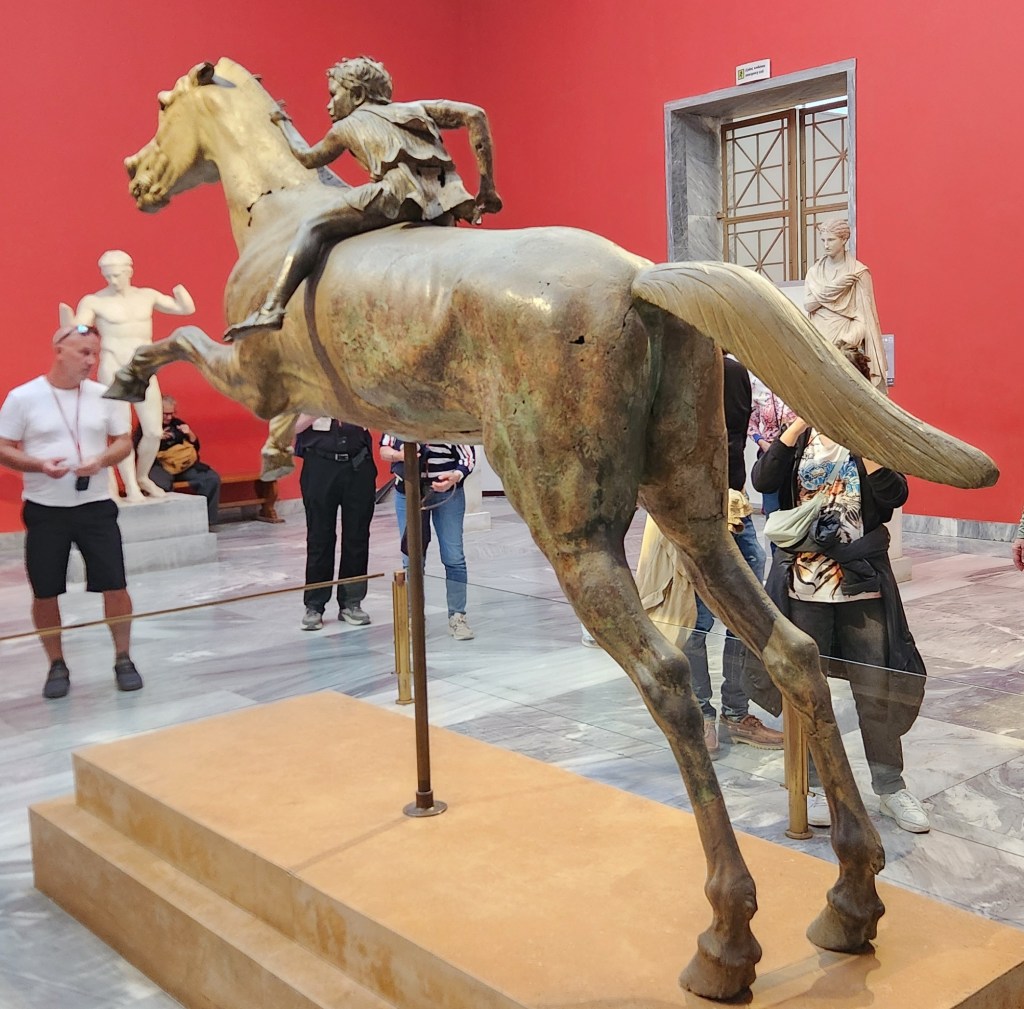
Athens, Greece (Saturday, November 8, 2025): Our ship arrived in the port of Piraeus, the largest of three ports serving the capital city of Athens, at 8 AM Saturday morning. Shortly after, we left for a half-day shore excursion to the city of Athens during which we saw the major sights out the bus windows before stopping for a thorough tour of the National Archaeological Museum. I’ve included some photos from the museum below. (I didn’t get any good photos from the bus, but don’t worry – you’ll see plenty more of Athens coming up in Part 4.)

National Archaeological Museum in Athens
Archaeological Museum Exhibit

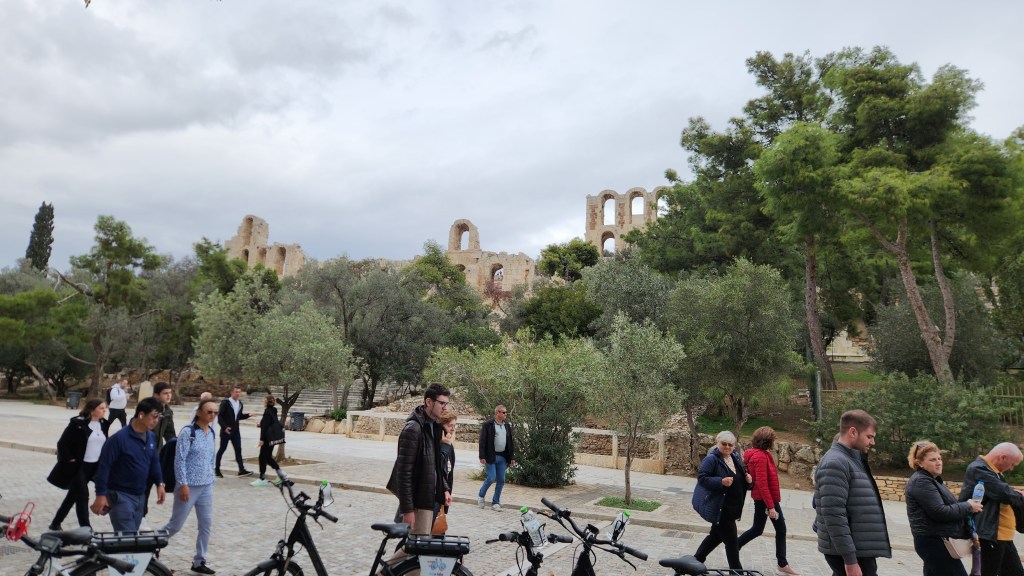
After returning to the ship, we set off again by bus back into Athens for a very enjoyable tour of the city on E-bikes, along with some 18 fellow Viking passengers (all senior citizens like us). For the most part, our ride followed spacious pedestrian boulevards, though we did need to intermingle with cars in a few areas. While a couple of the wobblier riders had spills and suffered minor scrapes along the way, nobody was seriously injured. The main difficulty was starting to ride again after our various stopping points because we had to ride so slowly, often dodging among hordes of pedestrians and motorbikes. Pat and I were unscathed, although her bike died about halfway through. Luckily, our guide, a fit young man some thirty or forty years younger, traded bikes with her and pedaled manually up some of the steepest hills. Here are some photos of the spectacular scenery we encountered during the ride.

E-Bike Tour Near Odeon of Herodes Atticus
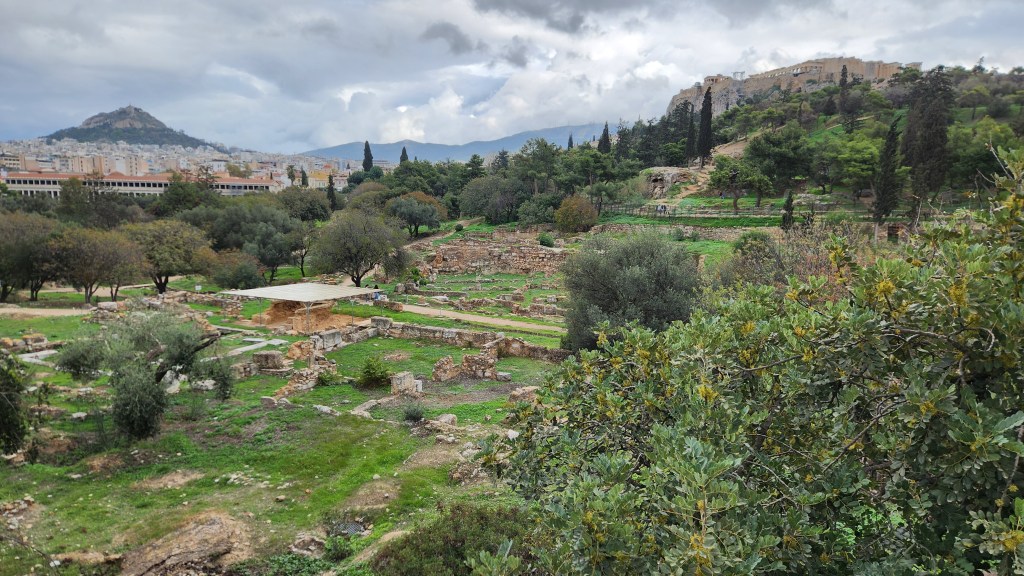
Site of Ancient Agora Viewed During E-Bike Tour
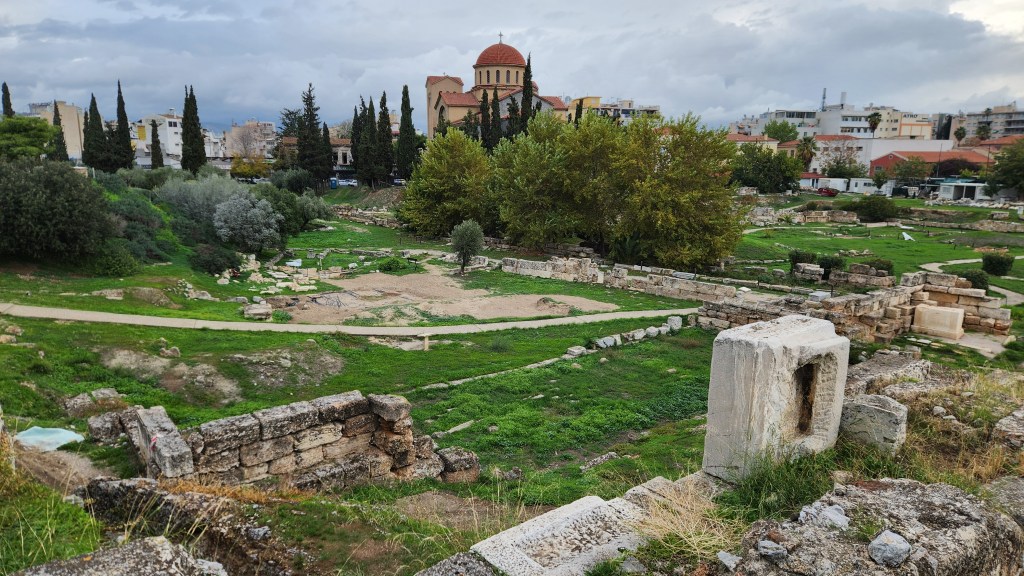
Site of Ancient Cemetery Viewed During E-Bike Tour
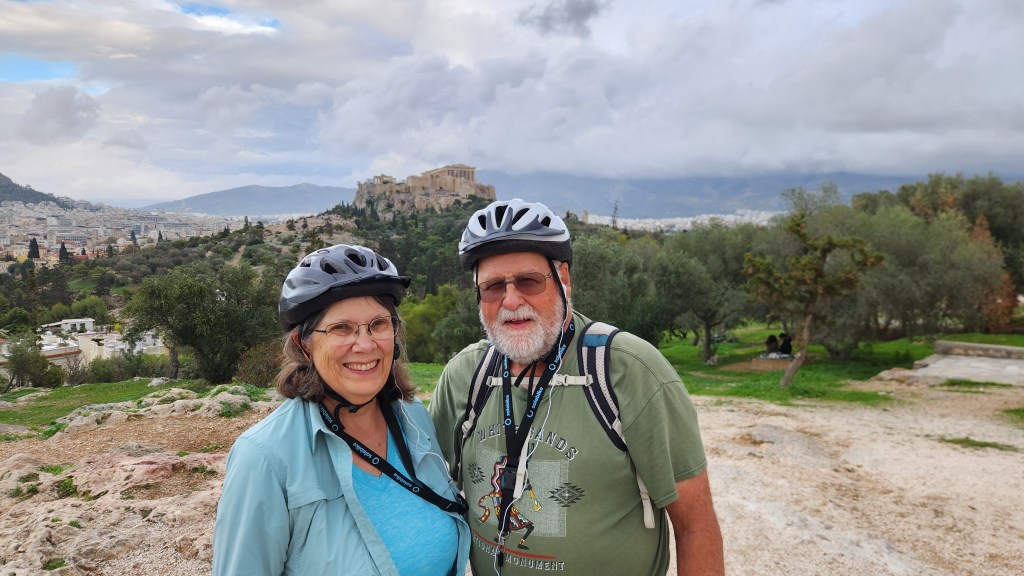
The E-Bikers with Acropolis Hill in Background

Then it was back to the ship again via the Viking shuttle bus.

Okay, that’s it for Part 3. I hope you enjoyed the read and will come back for Part 4, which will cover the post-cruise extension in Athens including the most famous sites of Classic Greek culture.

Stay tuned …

Pat and Dave’s Mediterranean Moments – PART 2: Slovenia, Croatia, Montenegro

Welcome back for Part 2 of this travelogue series. Part 1 concluded in Venice, Italy, as we had returned to our ship after a brief jaunt into the city to begin the Ocean Cruise portion of the trip. (I’m not going to spend time discussing the ship, the Viking Neptune, since it is nearly identical in layout and features to the Viking Star, on which we sailed previously in 2023. I described that ship extensively in “Pat and Dave’s Tremendous Tropical Trek, Part 1,” so readers interested in learning about Viking Ocean Cruise ships can click on this link.)
Here is a portion of the overall journey map showing the places I’ll describe in this part of the travelogue: Koper Slovenia, Zadar and Dubrovnik, Croatia, and Kotor, Montenegro.

Now let’s continue the story …

Koper, Slovenia (Saturday, November 1, 2025): After sailing overnight from Venice, we docked in Koper harbor on Saturday morning and departed for our shore excursion to the Old Town. Koper is the fifth largest city in Slovenia and the main urban center of the Slovene coast. The Port of Koper is the country’s only container port, a major contributor to the local economy and a popular destination for Mediterranean cruise lines. It was originally built on an island (Goat Island) by Roman settlers around 500 AD. Land reclaimed from the ocean in modern times now connects the city directly to the mainland. The city was a trading partner with Venice as early as 932 AD and eventually became a capital city of the Venetian Republic in 1278. After the fall of Venice, Koper became part of the Austrian empire in the late 18th century, then was assigned to Italy after World War I and to Yugoslavia after World War II. Slovenia became an independent country in 1991 following the dissolution of Yugoslavia.

On our walking tour, we strolled through the Old Town where we saw some remnants of the old city walls, and a mix of old and new buildings, and many shops and restaurants.

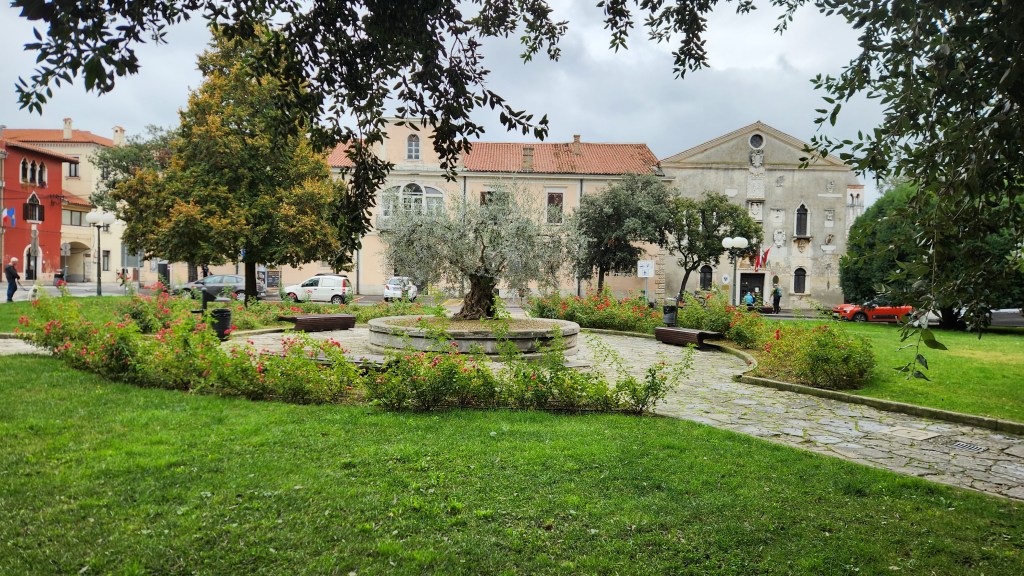
City Park with Olive Tree
Portion of the Old City Wall
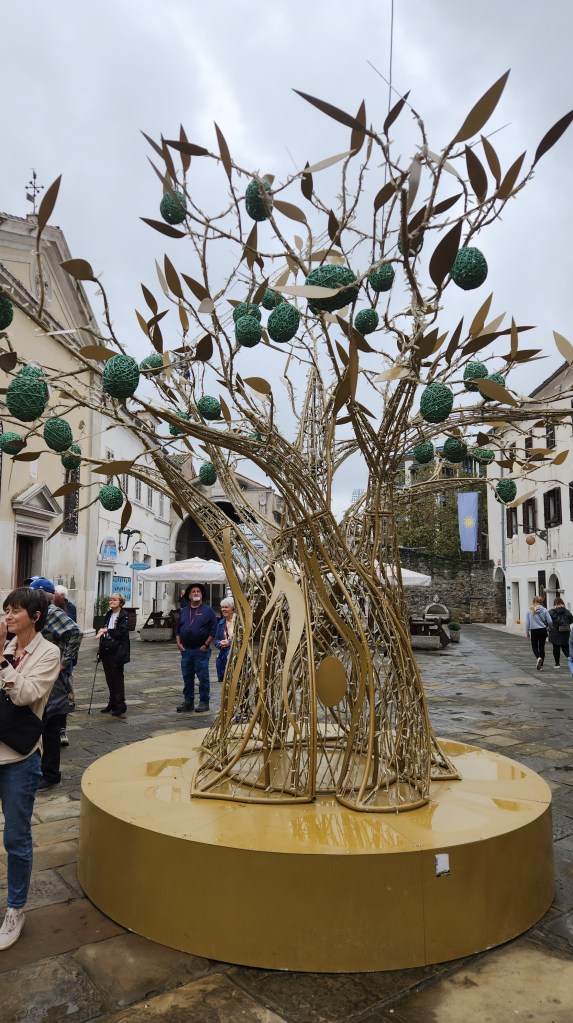
Monument Dedicated to the Olive Tree
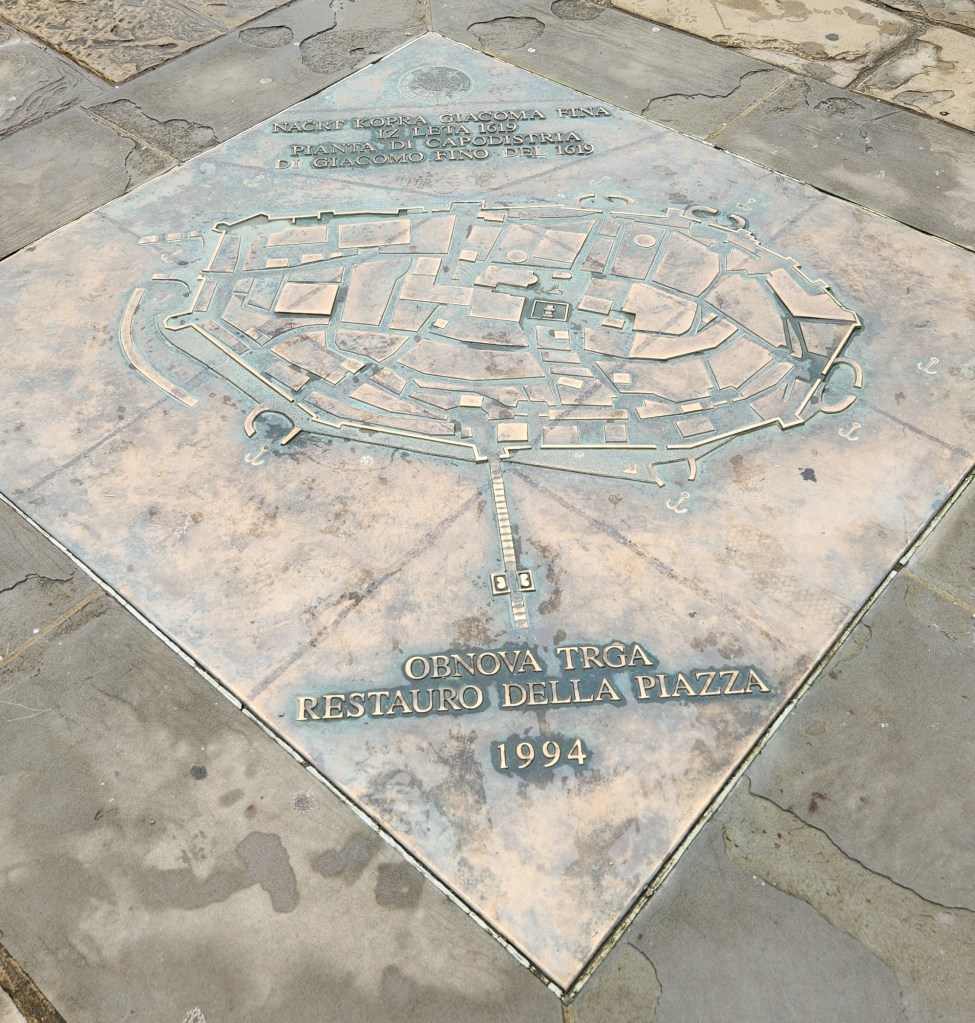
Street Decoration Depicting the Old City

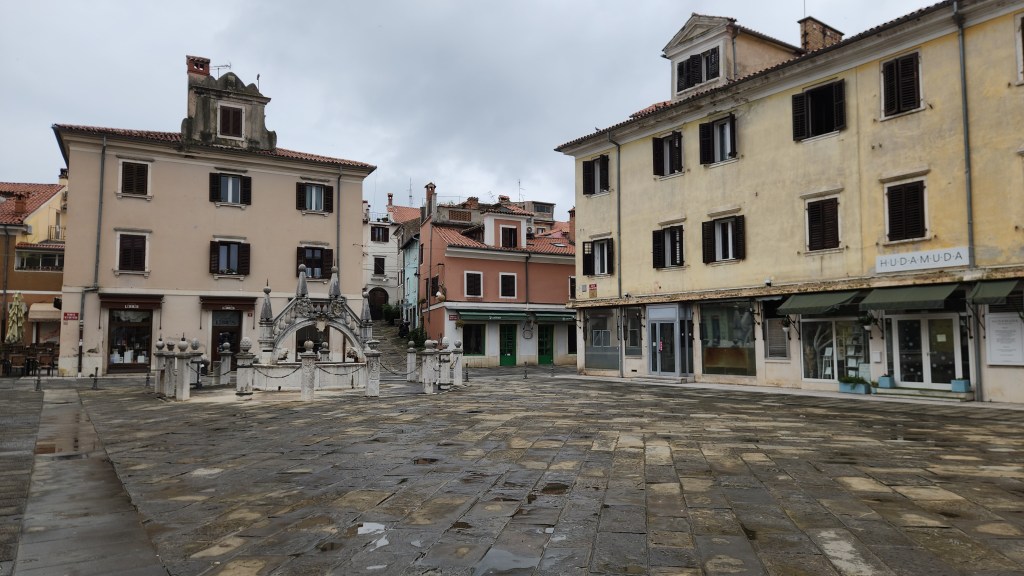
This photo is of the Prešeren Square, including the Muda Gate (completed in 1516), and the Da Ponte Fountain (1666), modeled after the Rialto Bridge in Venice.

Prešeren Square

The tour ended at the main square, still known as Tito Square. Our guide explained that Tito, despite his many years as a dictator, is recognized by city residents as the man who saved their parents and grandparents from “slavery” under the Austrian Empire. The main buildings in the square are the Praetorian Palace and the Koper Cathedral.

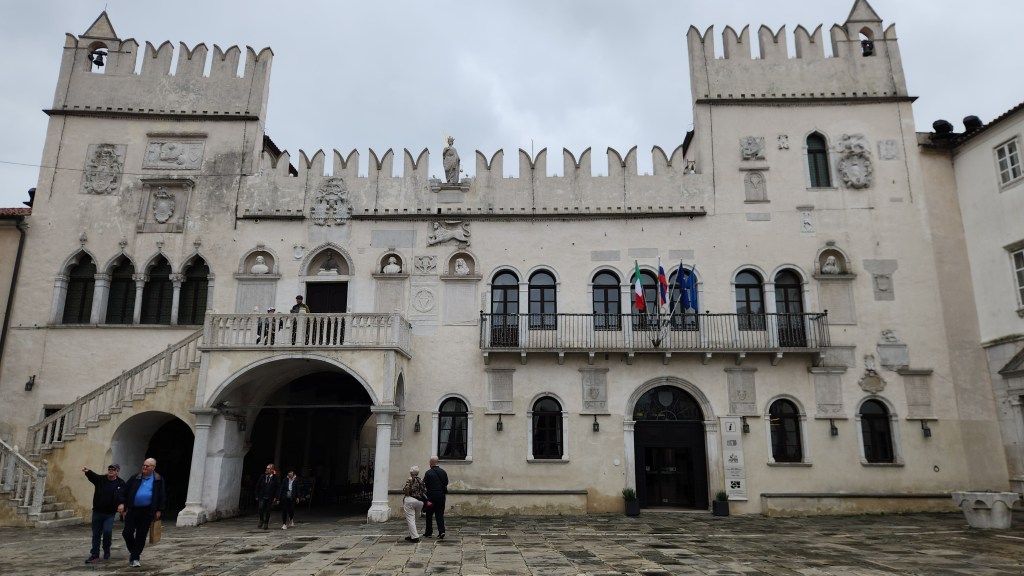
The Praetorian Palace is a 15th-century Venetian Gothic structure. It was built on the site of an earlier municipal hall that was destroyed during a major revolt in 1348, and an incomplete replacement building that was destroyed in 1380 when the city was sacked and burned in 1380 by raiders from Genoa. It currently houses the Koper city government and a wedding hall.

Praetorian Palace

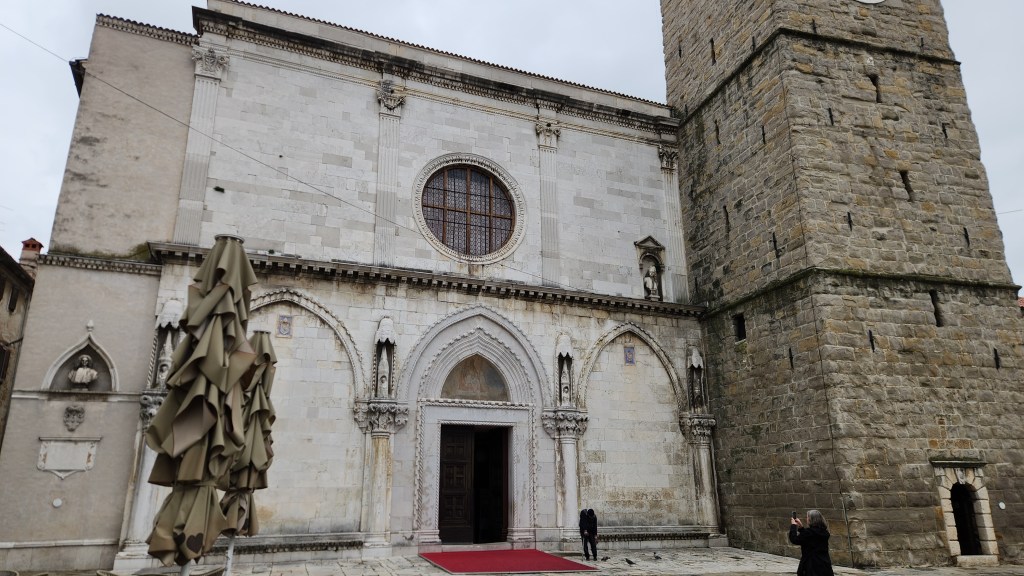
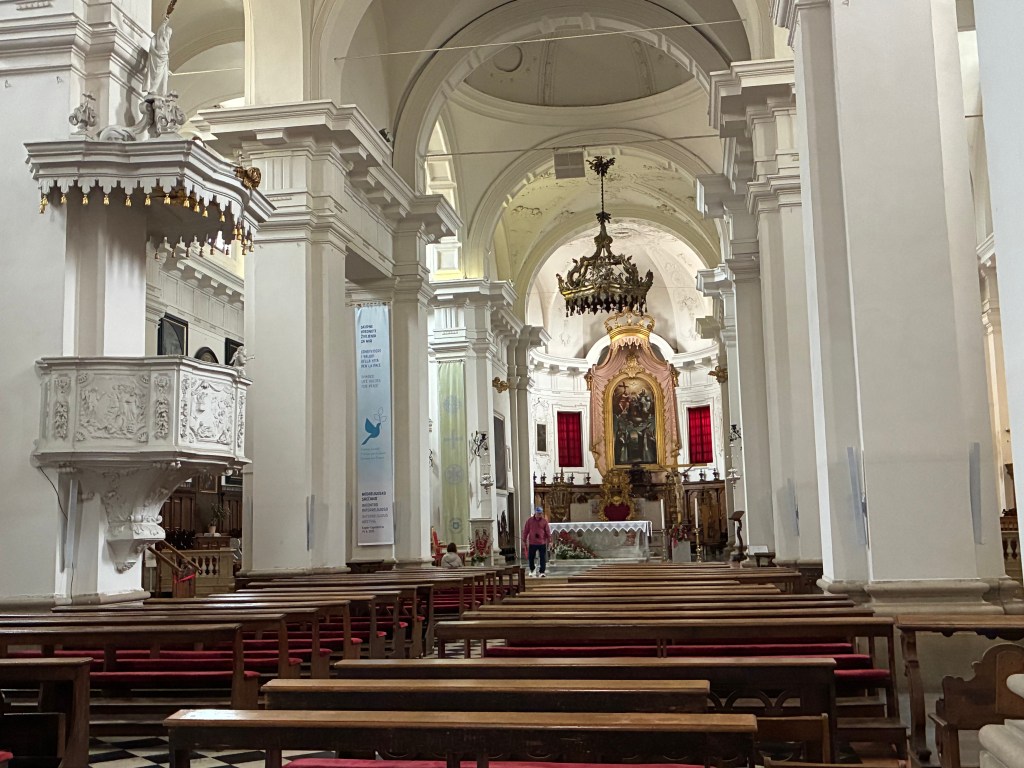
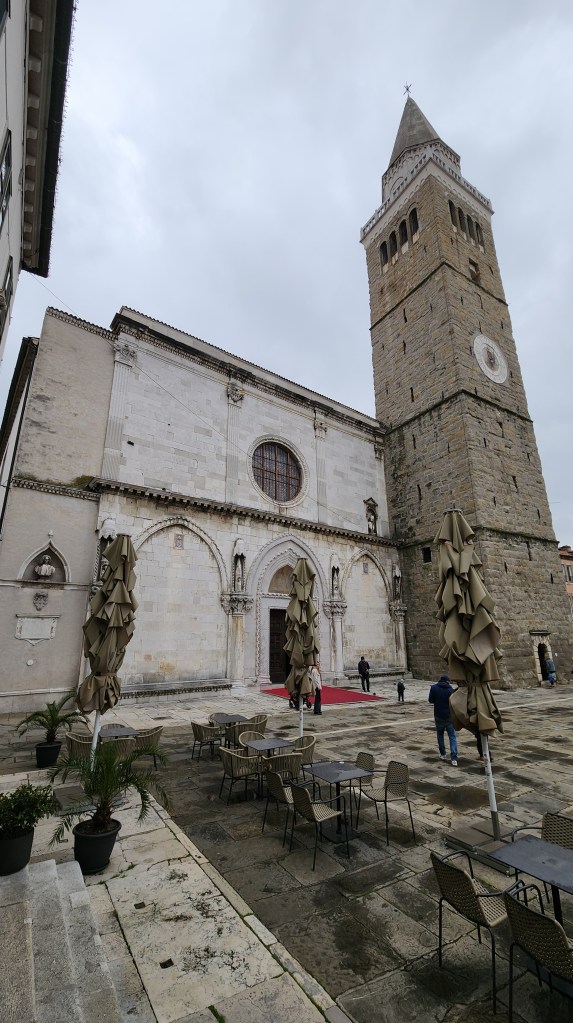
The 12th century Cathedral of the Assumption of the Virgin Mary was built in the Romanesque style, with three naves, each with an apse. Changes and additions continued until 1392, including the Gothic western facade. After an earthquake in 1460, the facade was redesigned in 1488, with the addition of Renaissance elements.

Cathedral of the Assumption

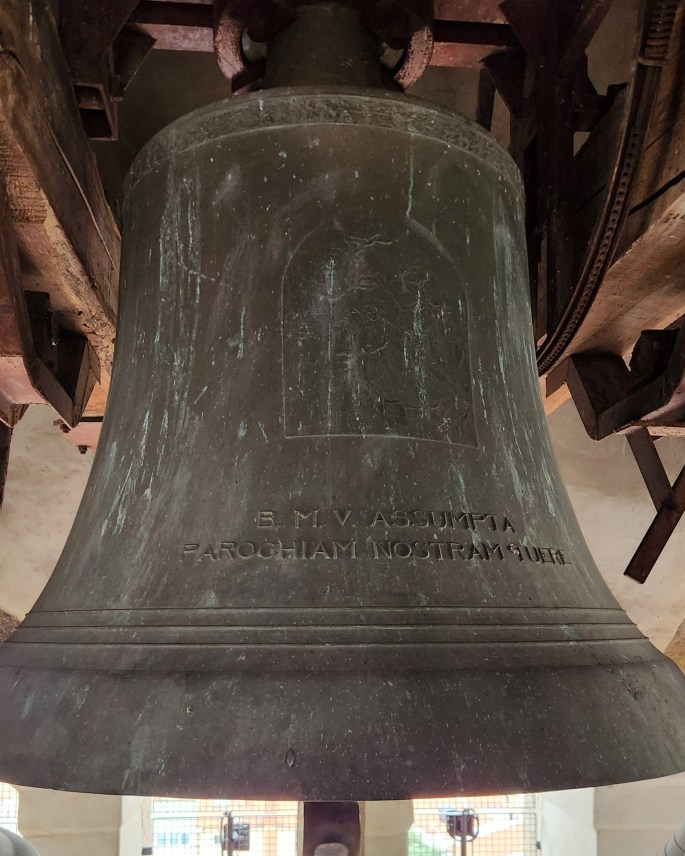
The adjacent 177-foot Bell Tower was originally part of a Roman fortification. I jumped at the chance to pay eight Euros (with senior discount!) to climb 204 steps to a platform at the 140-foot level, where I enjoyed beautiful panoramic vistas of the city and the Adriatic Sea. On the way up, I saw the oldest functioning bell in Slovenia, which was cast in Venice in 1333, though I couldn’t get a good picture of it due to the protective grating.

The Bell Tower
Tito Square Viewed from Bell Tower
Koper and Adriatic Sea Viewed from Bell Tower
The Old Bell

After I joined Pat in the square again (she had no interest in climbing the tower due to her acrophobia), we went back to the Cathedral to hear a beautiful organ concert. Here’s a video clip for your visual and aural enjoyment, and as a close to this segment about Koper.

The Cathedral Organ Concert

Zadar, Croatia (Sunday, November 2, 2025): On Sunday, our ship docked in the harbor of Zadar. Zadar was originally built on an Island with a moat separating the walled city from the mainland. It is the oldest continuously inhabited city in Croatia, dating to prehistoric times. Zadar was laid out as a settlement by an ethnic confederation of Mediterranean and Indo-European people known as Liburnia in the 9th century BCE. I found this interesting list of historical affiliations on Wikipedia:

  • Liburnia (9th century BC – 59 BC)
  • Roman Empire (59 BC – 476)
  • Byzantine Empire (476–800)
  • Carolingian Empire (800–812)
  • Byzantine Empire (812 – 10th century)
  • Kingdom of Croatia (10th century – 1202)
  • Republic of Venice (1202–1358)
  • Kingdom of Croatia (1358–1409)
  • Republic of Venice (1409–1797)
  • Austrian Empire Habsburg monarchy (1797–1804)
  • Austrian Empire Austrian Empire (1804–1805)
  • Napoleonic Italy (1806–1809)
  • France Illyrian Provinces (1809–1813)
  • Austrian Empire Austrian Empire late Austria-Hungary (1813–1918)
  • Kingdom of Italy (1918–1946)
  • Italy (1946–1947)
  • Yugoslavia (1947–1991)
  • Croatia (1991–present)

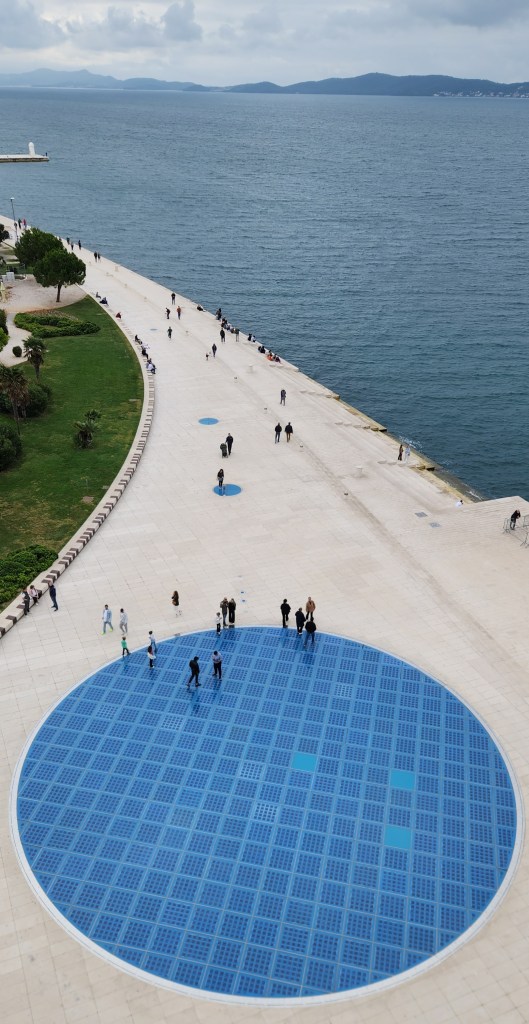
Our shore excursion began at the modern pier, which has two unique and innovative features. The first is a large representation of the solar system, lit at night by solar-powered lights, which we unfortunately did not see since we sailed away before dark. It consists of true-scaled discs representing the sun and the planets, as shown in these photos.

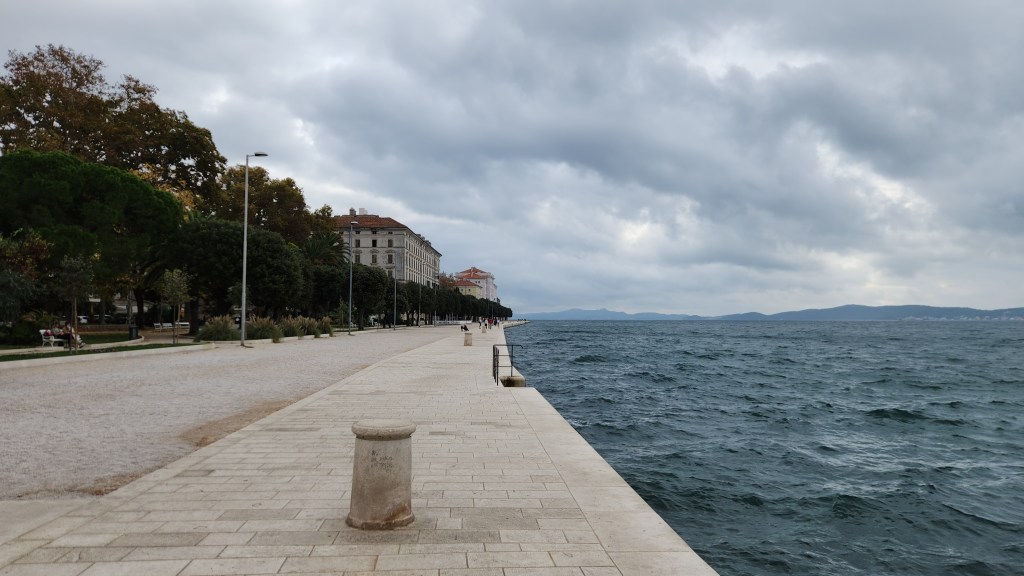
Zadar Pier
The Solar System Display
Close-up of Mercury, Venus, Earth, and Mars
Earth Closeup

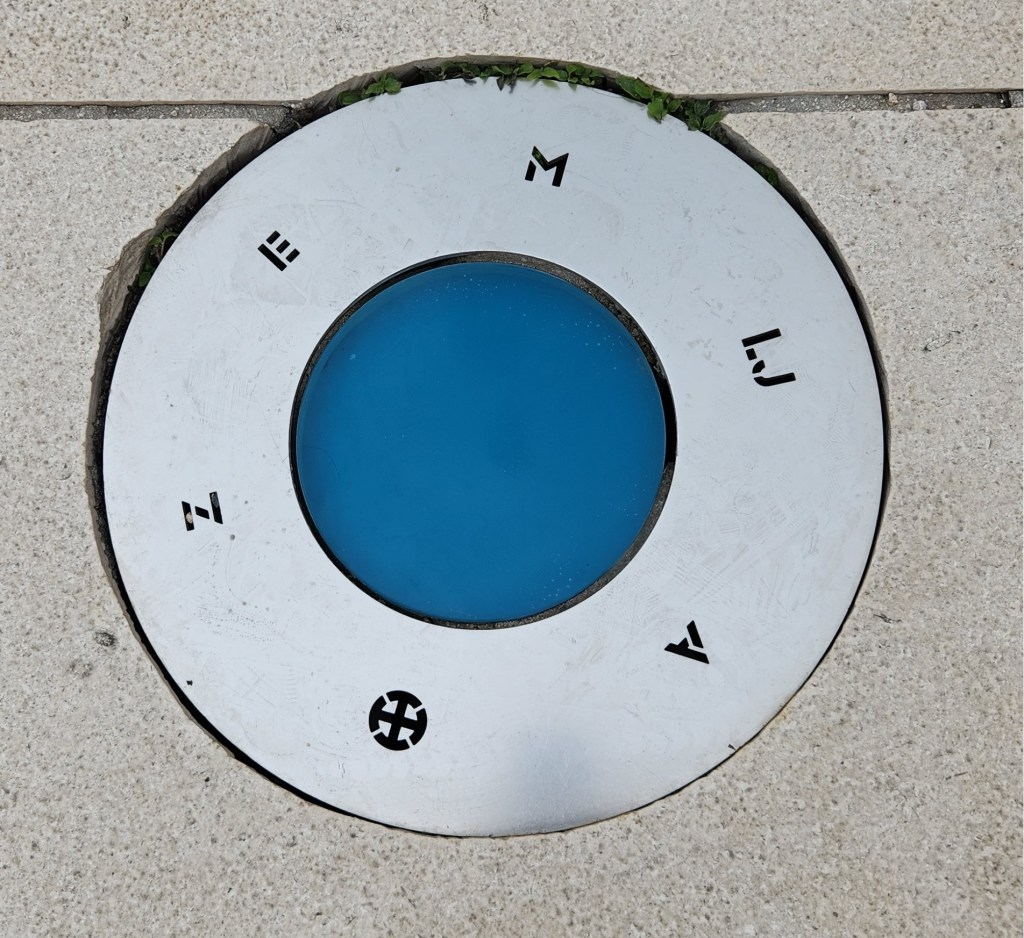
The second feature is the “sea organ,” consisting of tubes embedded in the concrete and extending into the sea, such that the wave action of the water creates lovely, soothing sounds.

Sea Organ on Zadar Pier

From the pier, we walked through a scenic park into the main city and on to the nearby Old City.

City Park in Zadar
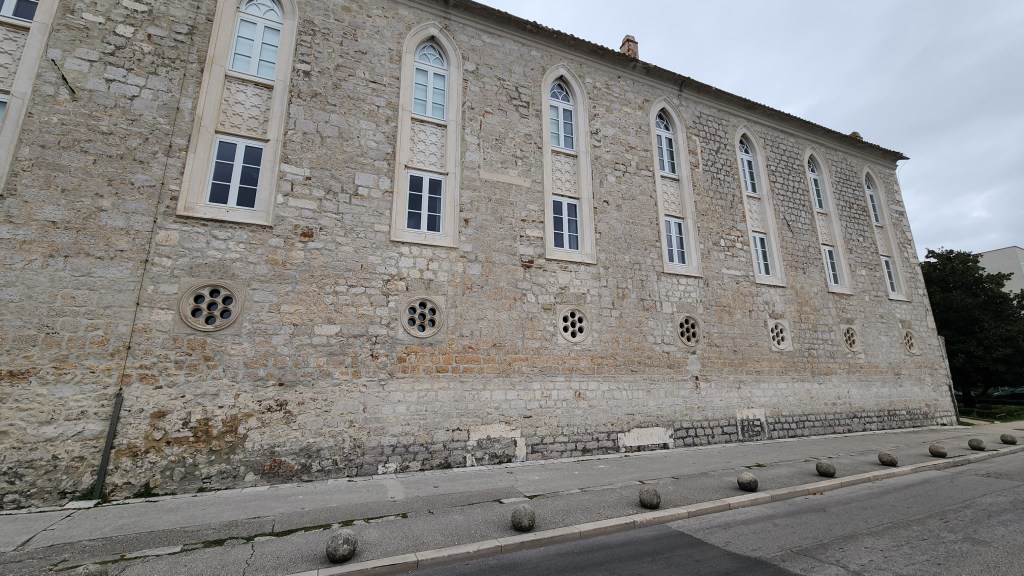
Old Building Now Used for Government Offices
Orthodox Church — Note Distinctive Cross
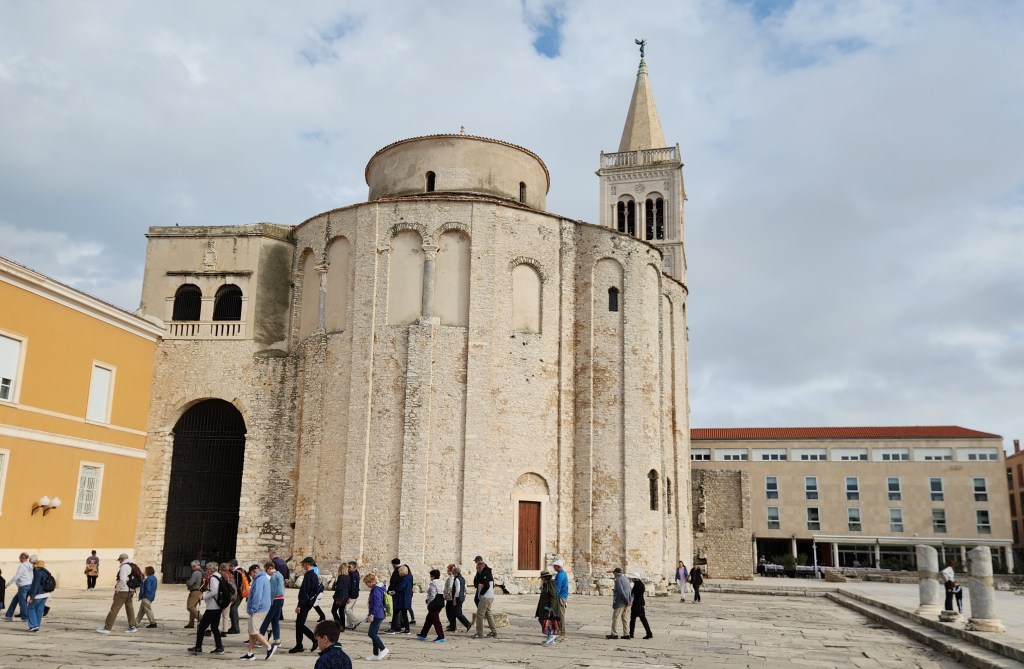
Church of St. Donatus, 9th Century

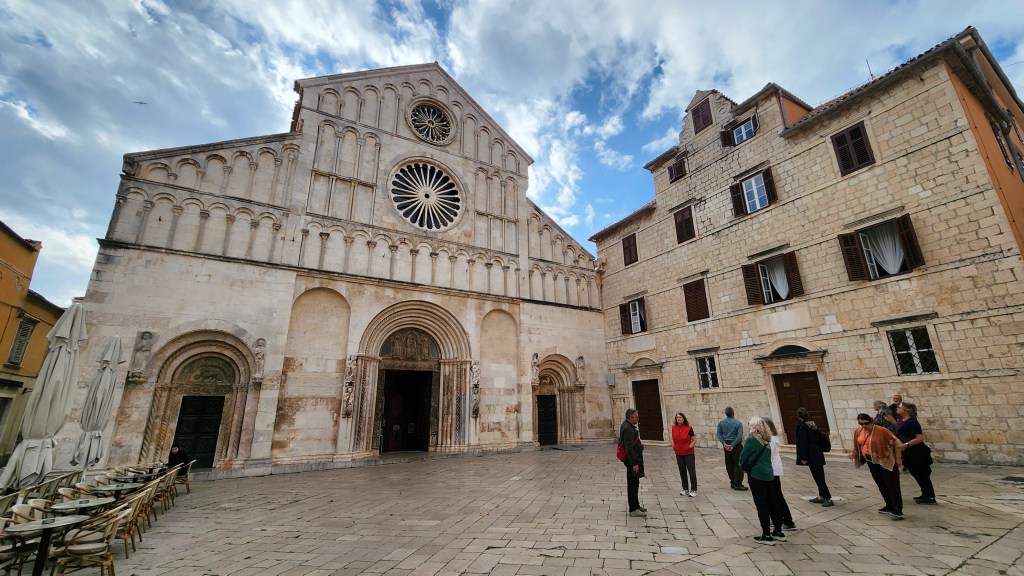
The Cathedral of St. Anastasia was originally built as a basilica in the 4th and 5th centuries. Much of the currently standing three-nave building was constructed in the Romanesque style during the 12th and 13th centuries. The cathedral was heavily damaged during a siege of Zadar by the Venetians and Crusaders in 1202. For the entire 13th century, the building was under repair. It was reconsecrated in 1285, although the new building was not completed until 1324.

Cathedral of St. Anastasia
Cathedral Entrance
View of Old Town
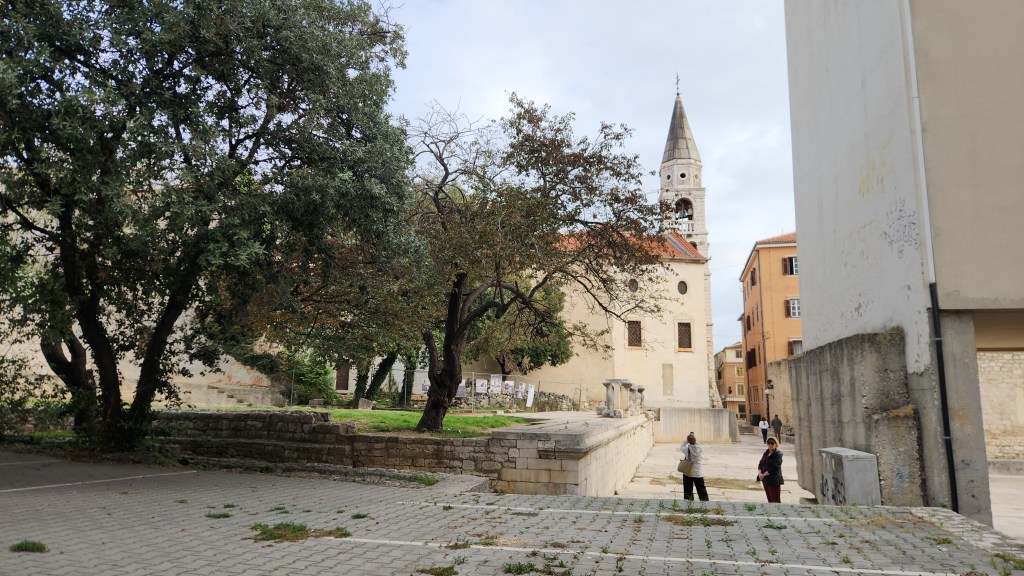
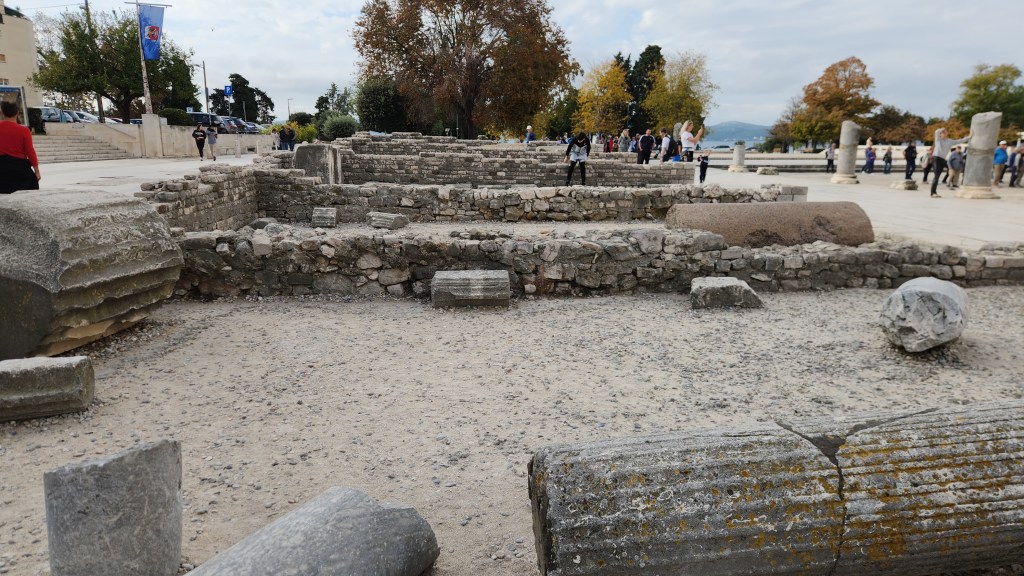
Roman Column in Forum Area
Ruins of Roman Forum

The tour ended at the ruins of the ancient Roman forum, after which we returned to the ship, which sailed off for the next stop shortly after 3 PM.

Dubrovnik, Croatia (Monday, November 3, 2025): Dubrovnik is a spectacular, walled city near the southernmost border of Croatia and Montenegro. The city dates to approximately the 7th century, when the town known as Ragusa was founded by refugees from Epidaurum, an ancient Greek city under Roman rule at the time. Ragusa was a protectorate of the Byzantine Empire and later part of the Republic of Venice. Between the 14th and 19th centuries, Dubrovnik ruled itself as a free state. As the capital of the maritime Republic of Ragusa, it achieved a high level of development, particularly during the 15th and 16th centuries, as it became notable for its wealth and skilled diplomacy. During this time, the city was governed by a series of Rectors elected to one-month terms by the noblemen who ruled over the city.

Dubrovnik was almost destroyed in a devastating earthquake in 1667 but was rebuilt. More damage was sustained in 1991 during the Croatian War of Independence, when Dubrovnik was besieged and shelled by the Yugoslav People’s Army for seven months. However, extensive repair and restoration work in the 1990s and early 2000s completely restored the old wall and the damaged buildings. Known as “The Queen of the Adriatic,” Dubrovnik is one of the most popular destinations in the Adriatic and in Europe.

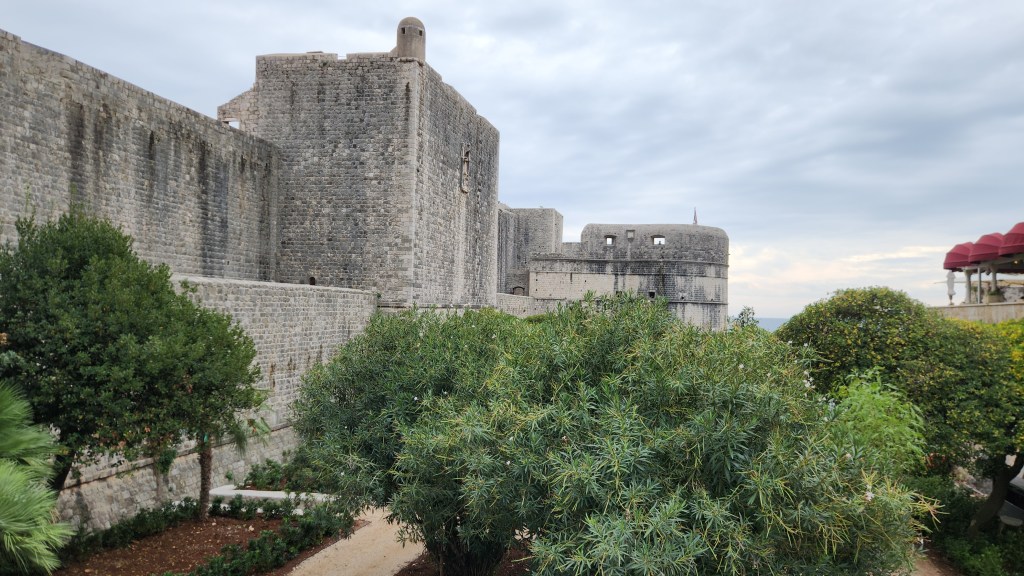
Our shore excursion on Monday was a walking tour of the Old Town. Access to the walled Old Town is via the Pile Gate, built in 1537. The gate has a drawbridge, since the entire Old Town was originally surrounded by a moat.

Dubrovnik Old City Walls
The Pile Gate to the Old City

Naturally, we went to see a Cathedral. Construction of the Cathedral of the Assumption was begun in 1671 and completed in 1713.  

Cathedral of the Assumption
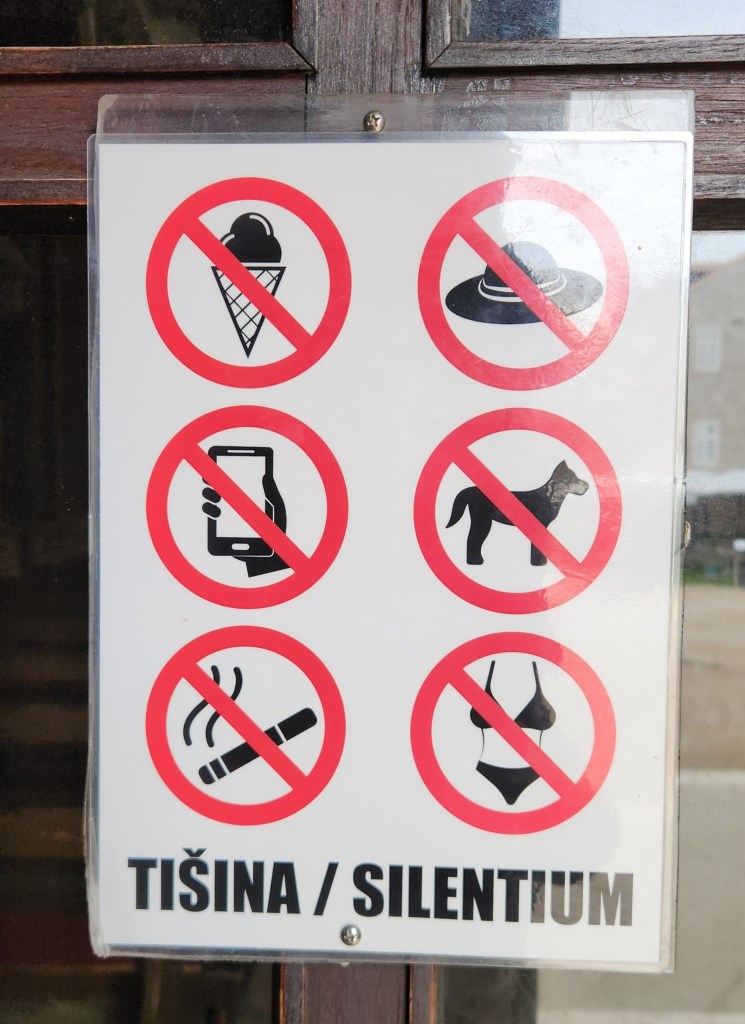
No Bikinis Allowed in the Cathedral

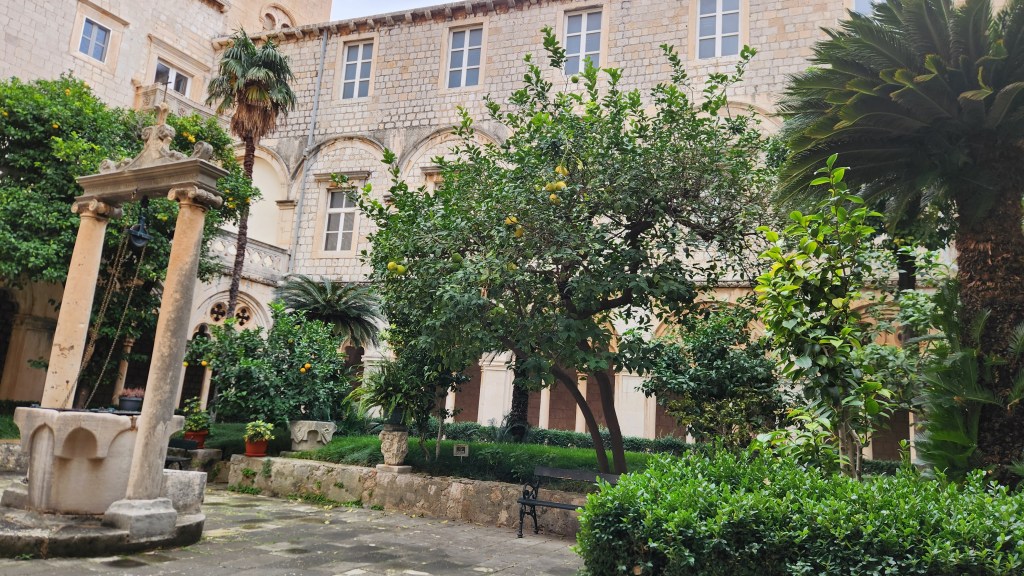
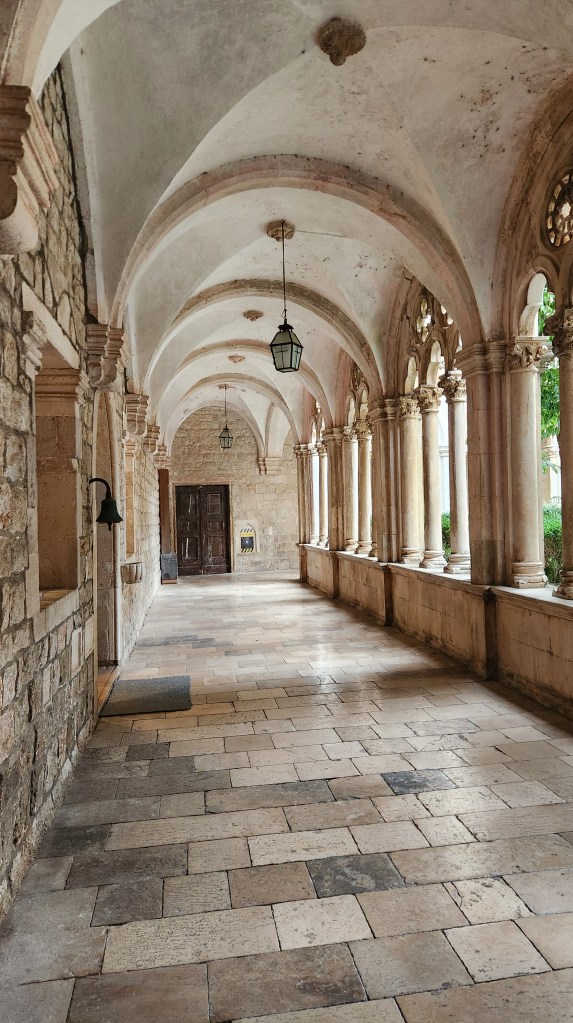
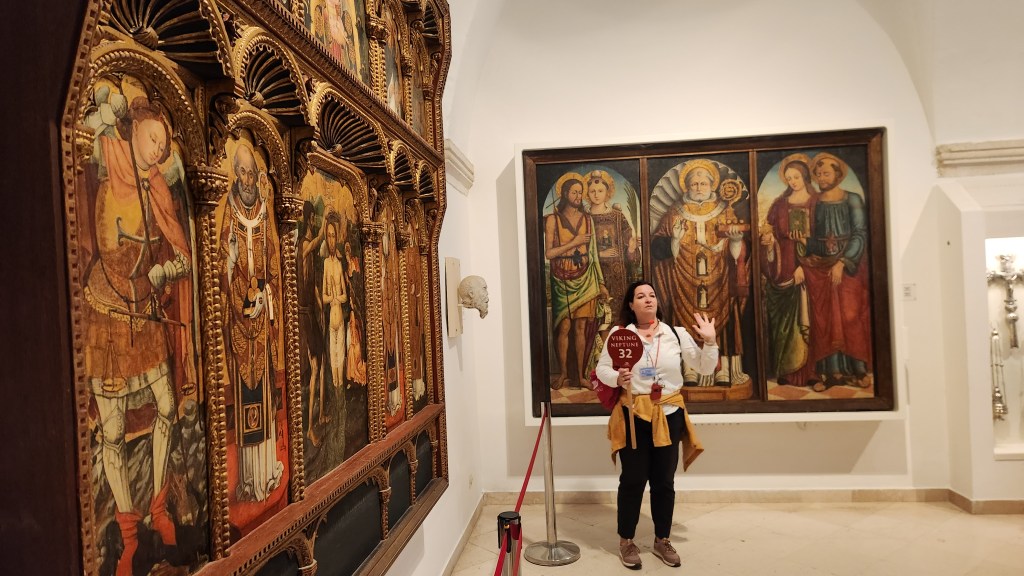
The Franciscan Church and Monastery is a religious complex featuring a historic church, a tranquil cloister, a library with over 70,000 manuscripts, and one of Europe’s oldest continuously operating pharmacies, dating back to 1317. The monastery is a significant cultural and historical landmark, showcasing a mix of Romanesque, Gothic, and Baroque architectural styles.

Cloister of the Monastery
Museum of the Monastery

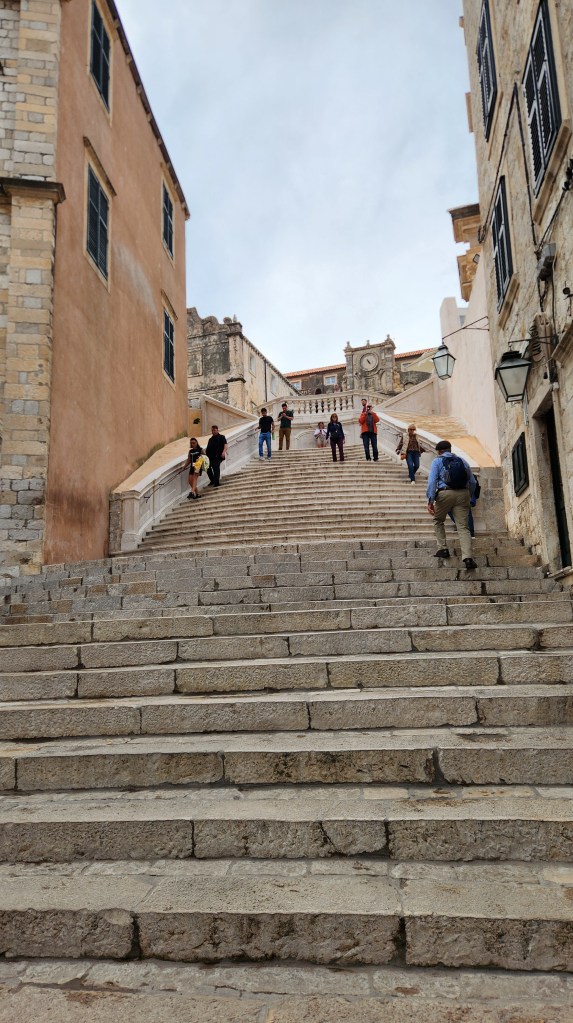
The Jesuit staircase, similar in appearance to the Spanish Steps in Rome, is a popular tourist destination, in part because the infamous “Walk of Shame” scene in Game of Thrones was filmed there. We saw many GOT souvenir shops throughout Dubrovnik.

The Jesuit Staircase

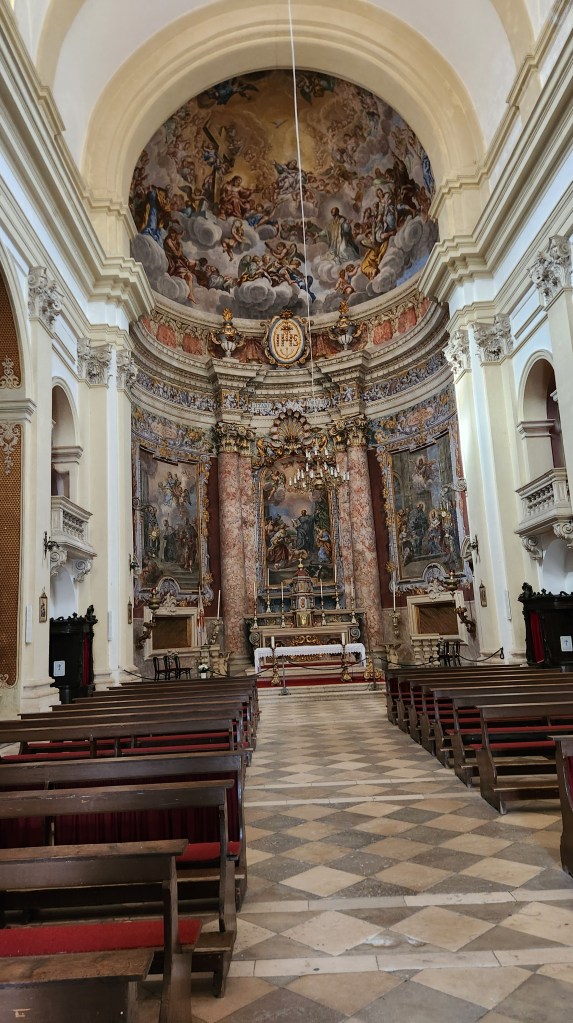
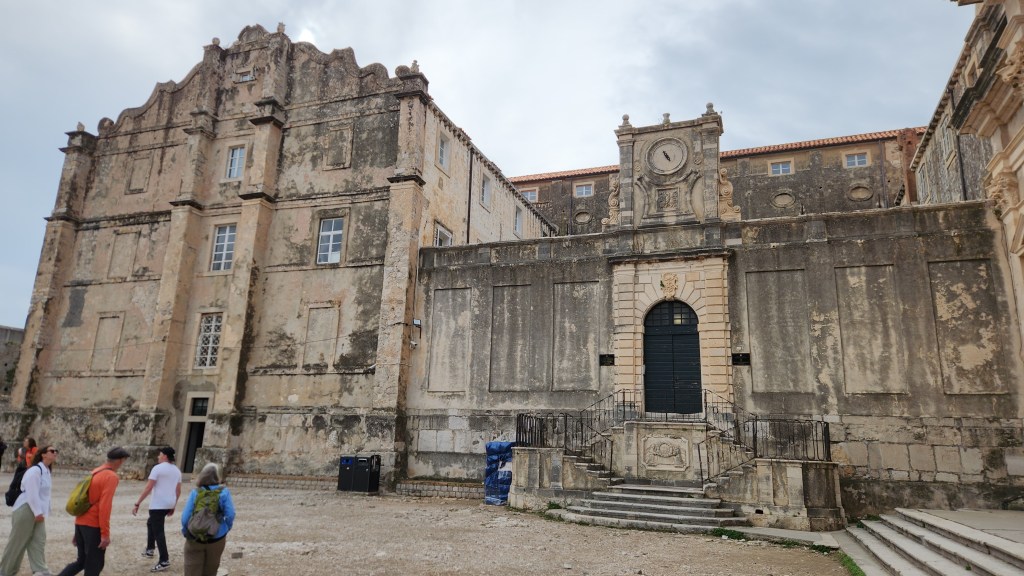
The Church of St. Ignatius of Loyola, a Baroque-style church, is located at the top of the Jesuit staircase, next to the Jesuit college. It was built between 1699 and 1725.

Church of St. Ignatius of Loyola

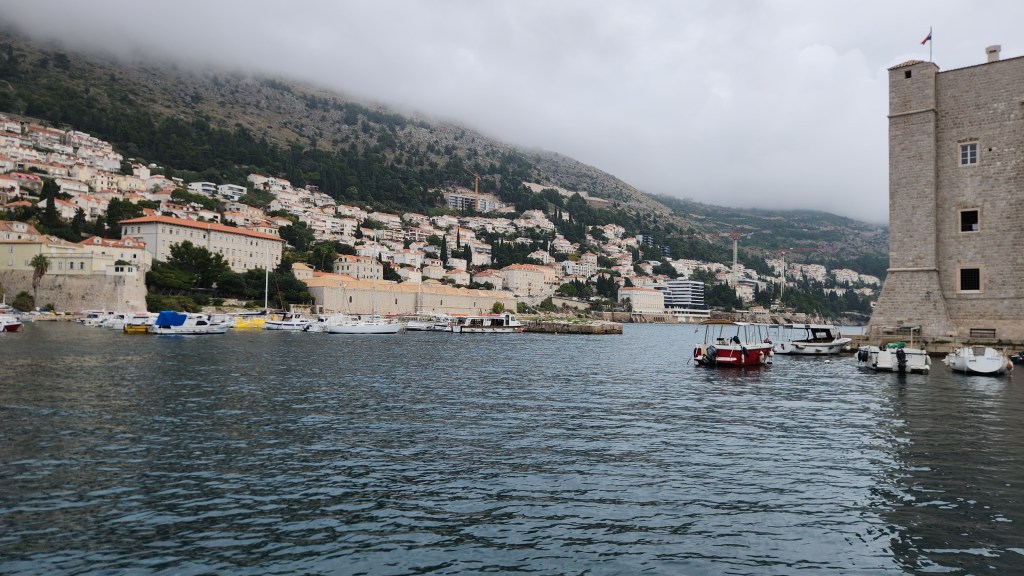
The Old Town harbor was the original access point for seagoing vessels. During the plagues in Europe, the city officials required that all new arrivals had to stay in isolation from the city to determine whether or not they were sick. Not knowing what duration might be most appropriate, they settled on an isolation period of forty days, or “quaranta” in Italian. Henceforth, a protective stay in isolation became known as “quarantine.”

Dubrovnik Harbor — Across from Quarantine Building

After the tour, we roamed all around the city and traversed the inner periphery of the city walls. Public access to the walls is available at a cost of 40 Euros per person. Given the overcast skies, which limited visibility and most likely obscured what would have been spectacular views on a sunny day, we elected to forego that activity. Here are some of the memorable sights from our wandering.

Main Street of the Old City
Typical Old City Street
View of the Old City Walls
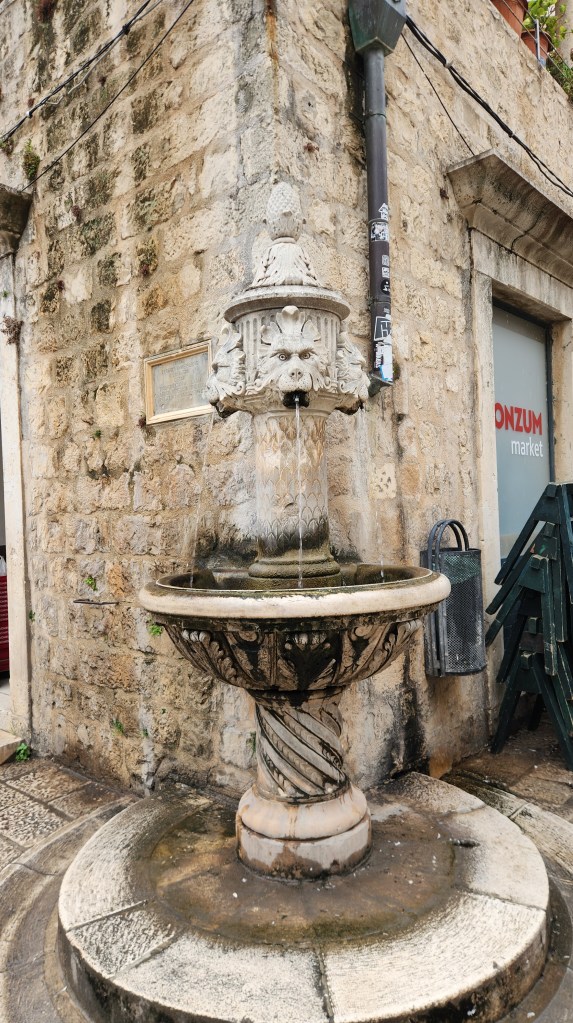
Ancient Fountain

One of the things we saw was a ritual in which a man throws out grain for the local birds every day at noon. The birds begin gathering on the rooftops shortly beforehand and descend on the booty in a frenzy when the man appears. I found it quite fascinating, but Pat was creeped out by the Hitchcockian scene.

The Daily Noon Bird Feeding

Eventually we returned to the ship, docked at the cruise ship pier, where I took a few photos.

View of Dubrovnik from the Ship
View of the Dubrovnik Bay

The ship sailed off for the next destination shortly after 8 PM.

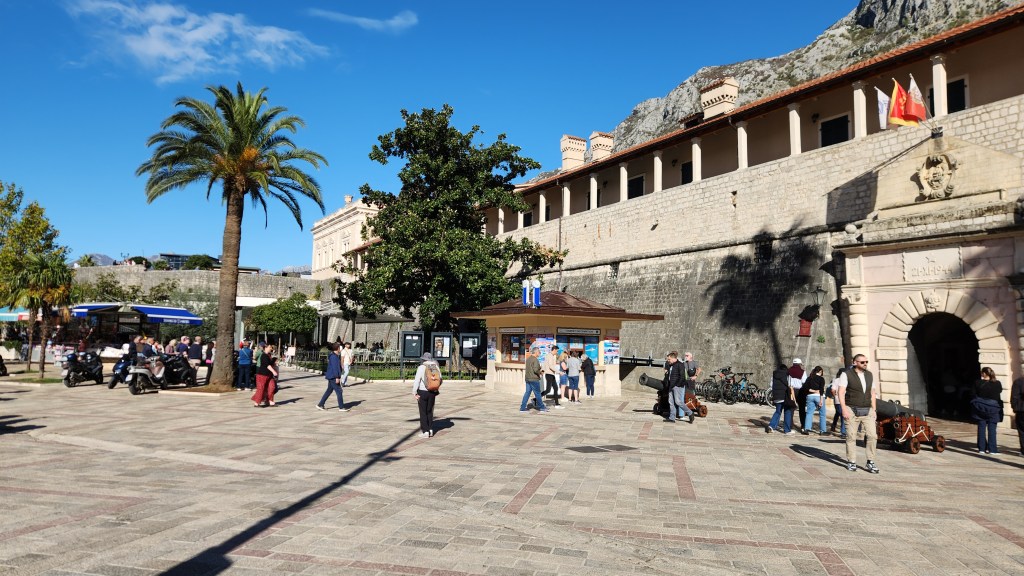
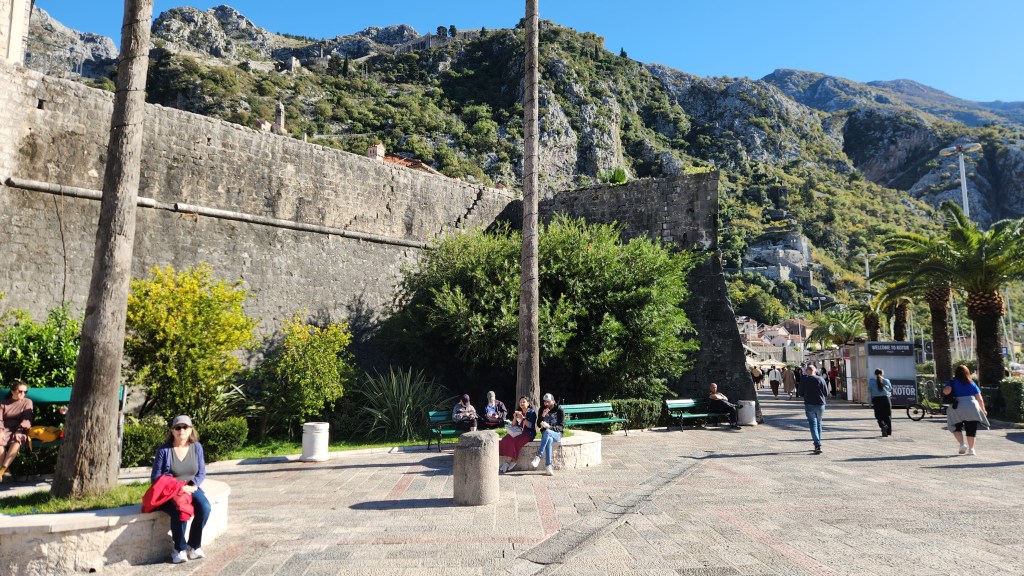
Kotor, Montenegro (Tuesday, November 4, 2025): Kotor is a medieval city, designated as a UNESCO World Heritage Site, nestled between limestone cliffs and a bay. For our shore excursion, we walked with a local guide through Kotor’s network of cobblestone streets. In the main square, we viewed the Venetian walls that surround the city. Constructed in 1420, they have been reinforced through the centuries and are well-preserved today.

Old City Walls and Entrance Gate
Old City Walls

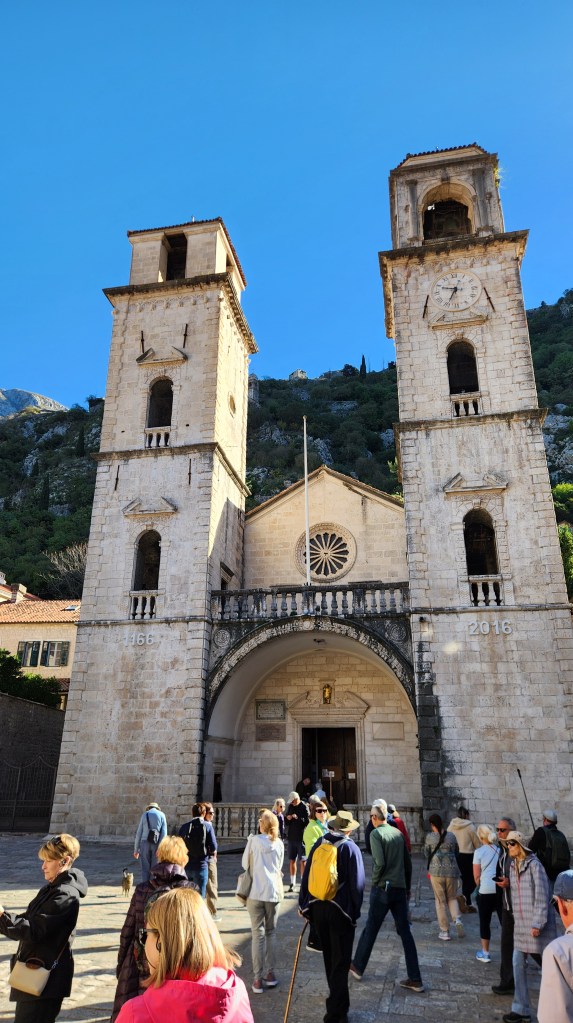
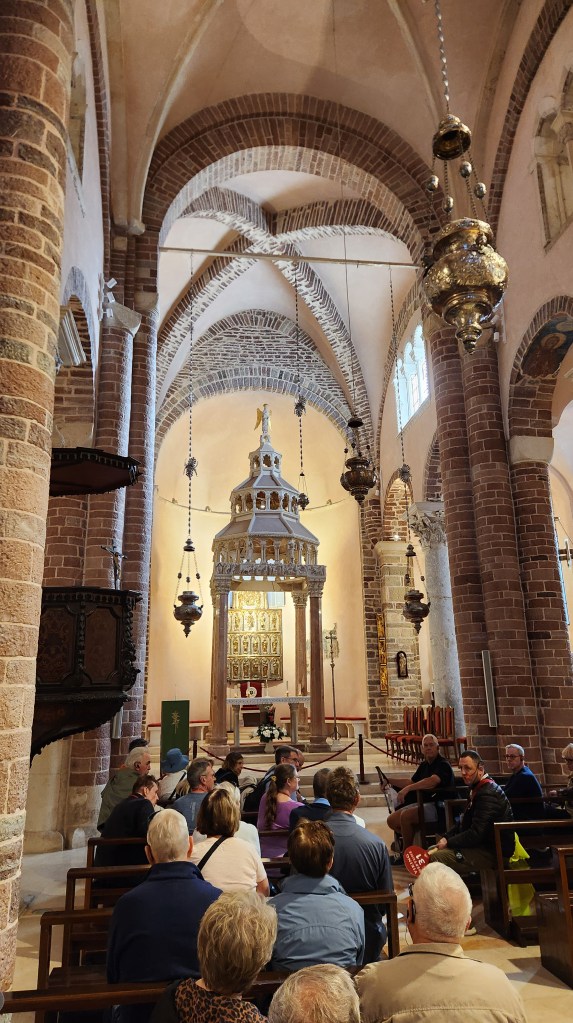
We visited the 12th-century Romanesque Cathedral of St. Tryphon, a remarkable repository of 14th-century frescoes and valuable artifacts. Over the centuries, the building has suffered earthquake damage—as evidenced by its mismatched towers, one of which was rebuilt with meager funds after a tremor. It was particularly interesting because of the Byzantine and Orthodox influences on the architecture, although it is a Roman Catholic church.

Cathedral of St. Tryphon

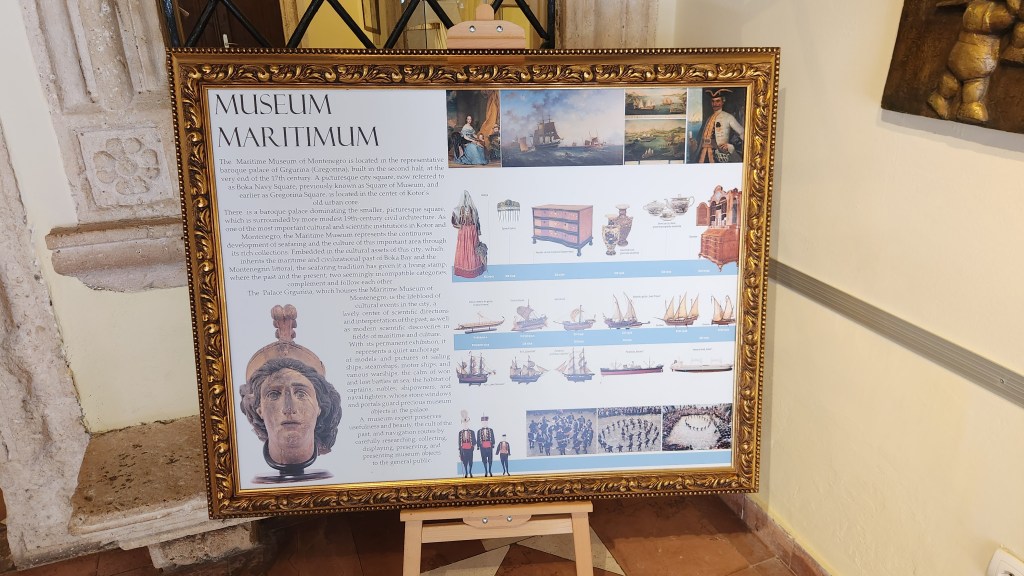
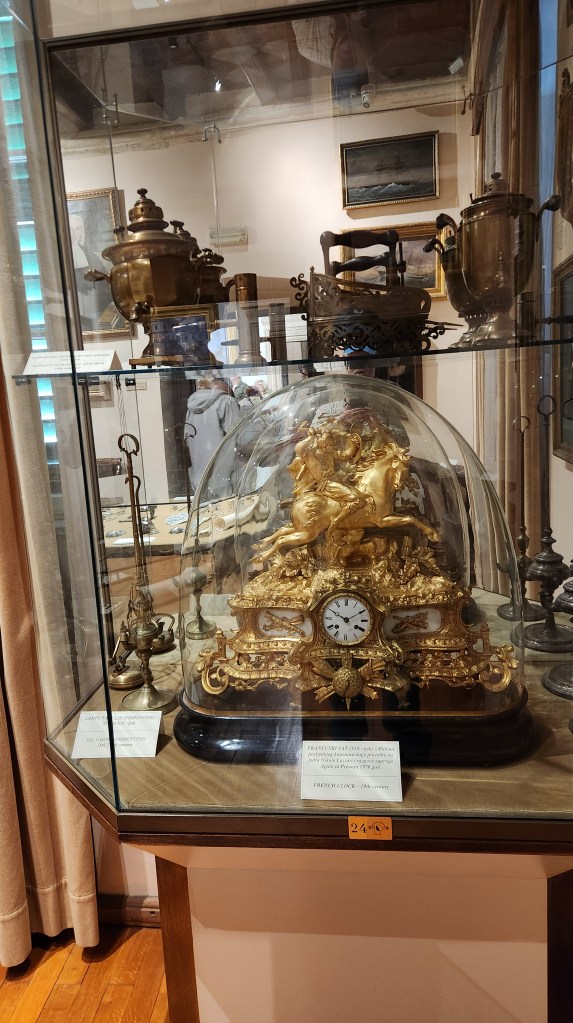
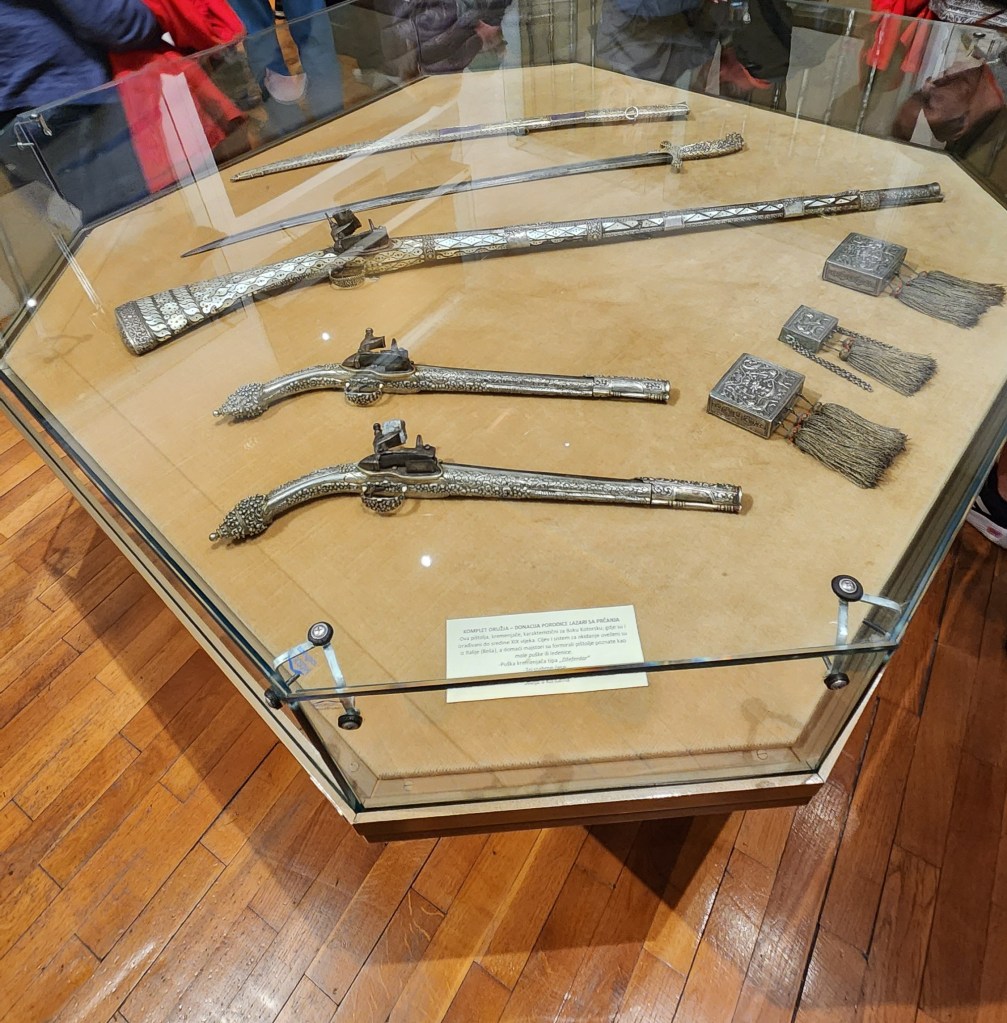
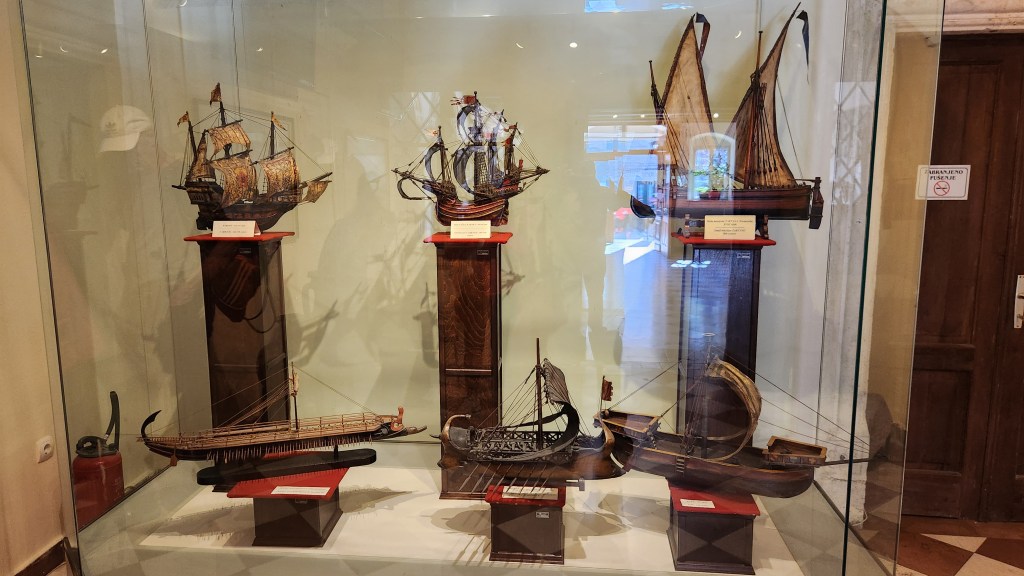
Next, we visited the city’s Maritime Museum, which houses many artifacts of Kotor’s history.

Maritime Museum
Maritime Museum
Maritime Museum
Maritime Museum

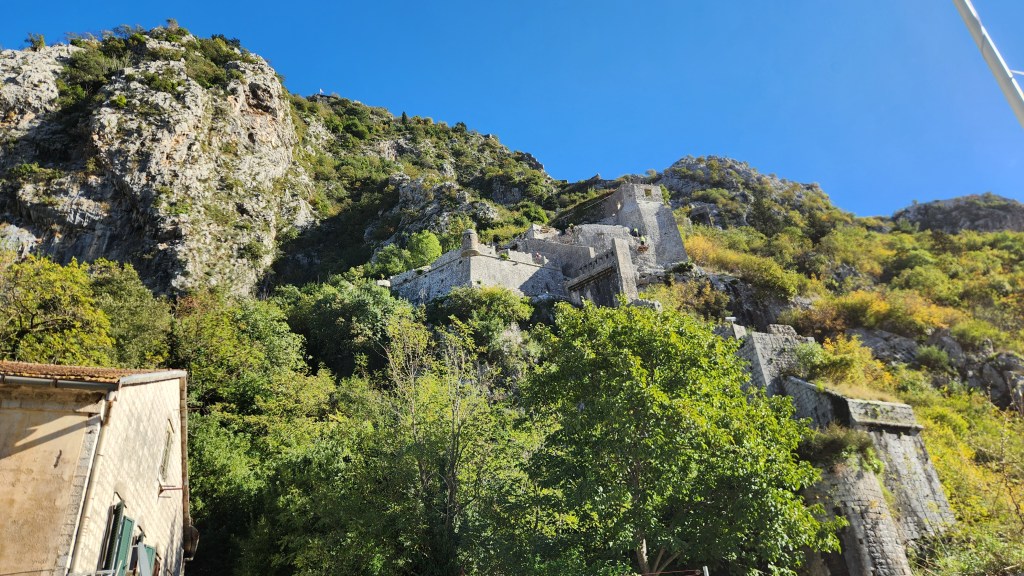
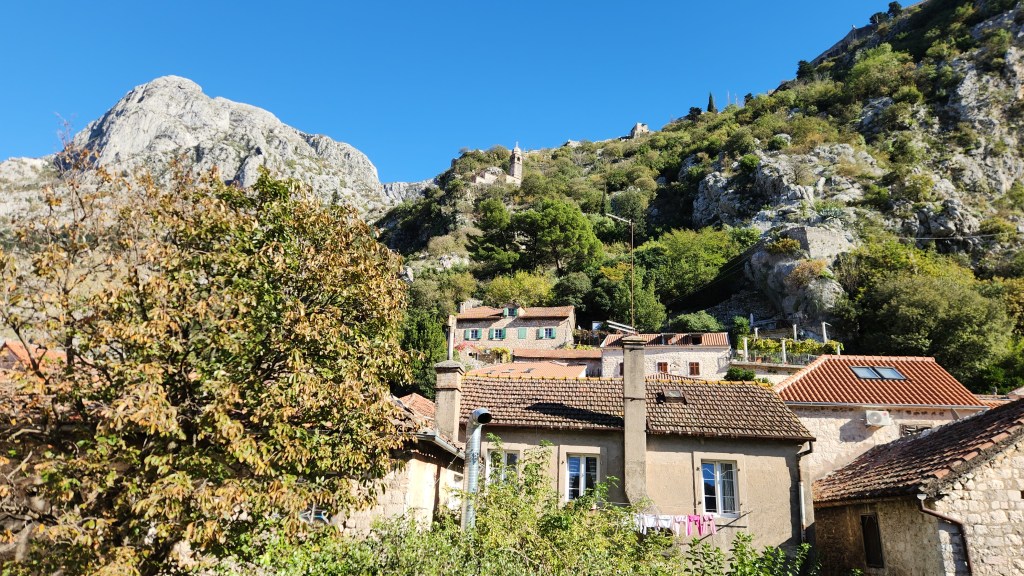
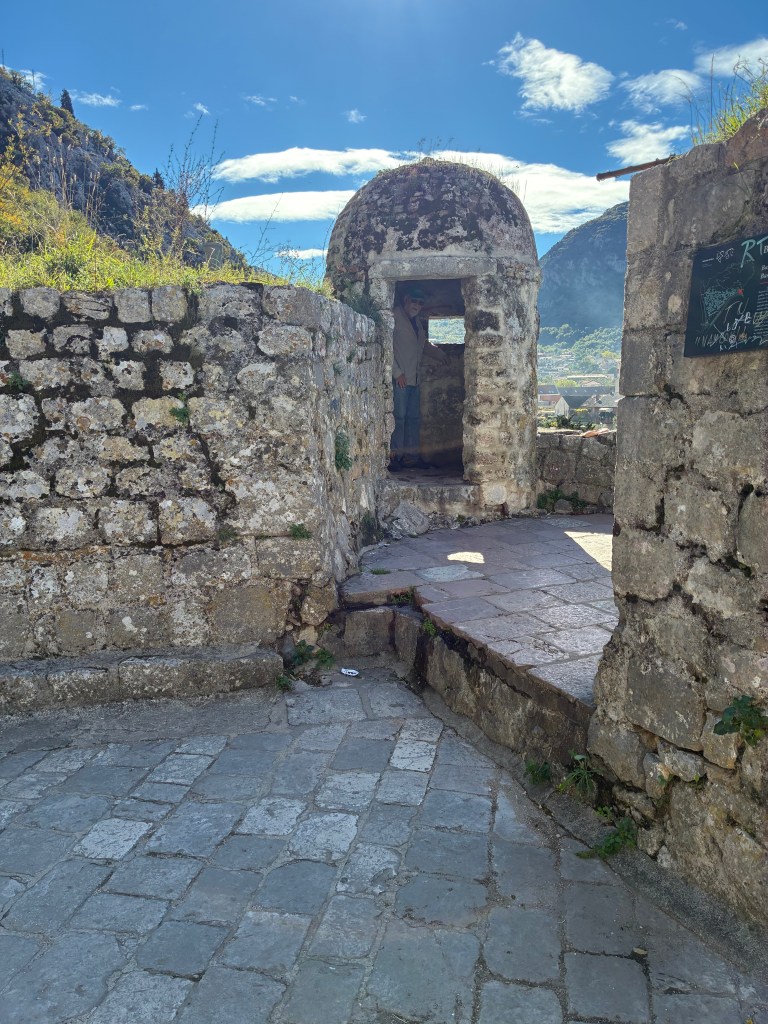
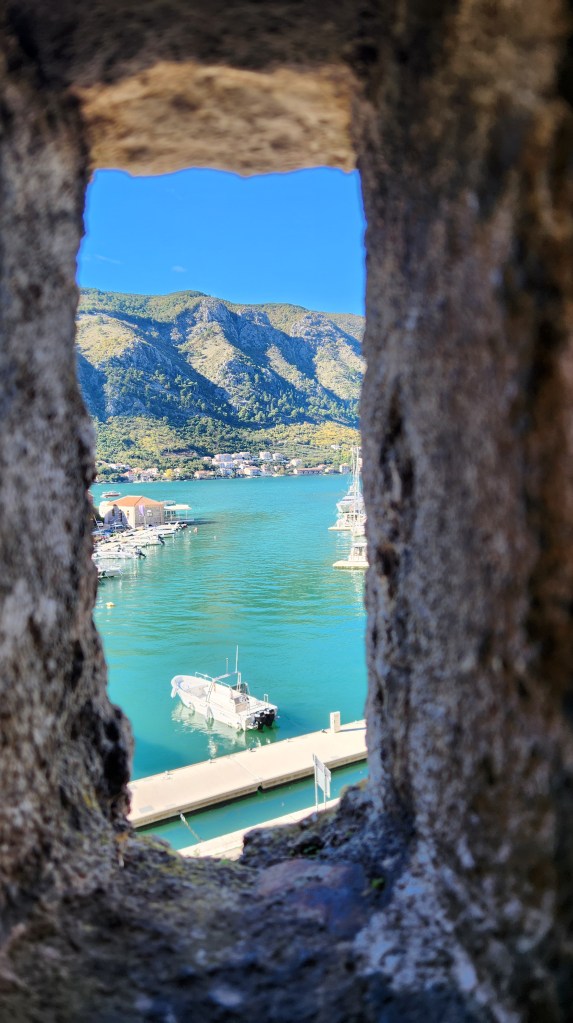
After the tour, we walked along the city walls and enjoyed the spectacular views of the mountainous terrine and the ruins of ancient Roman and Venetian structures and fortifications. Not only was the sky clear and sunny, but access to the walls was free, so this compensated somewhat for missing the wall walk in Dubrovnik.

Ancient Dwellings Viewed from City Wall
View from City Wall
Fortification on Old City Wall
Great View from Here
As I said …

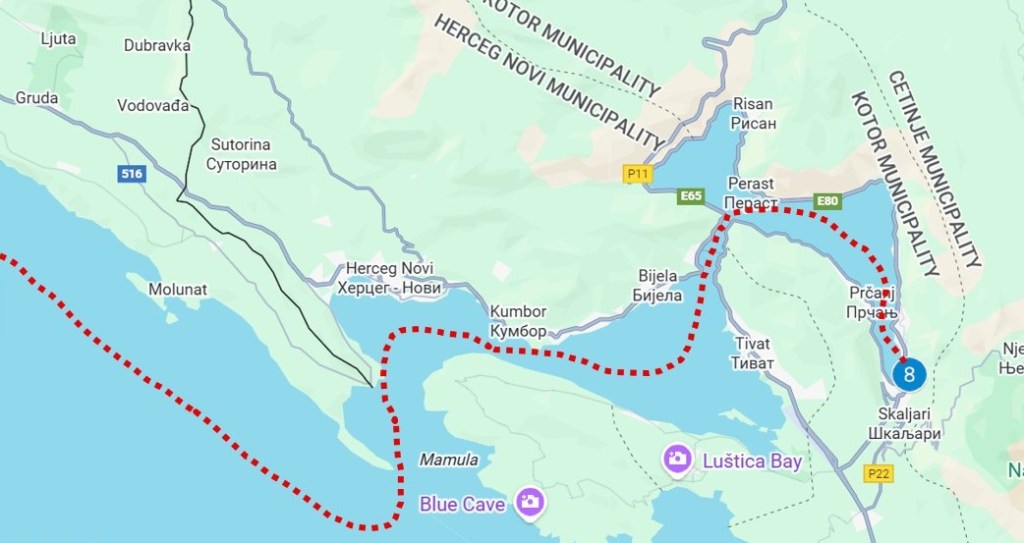
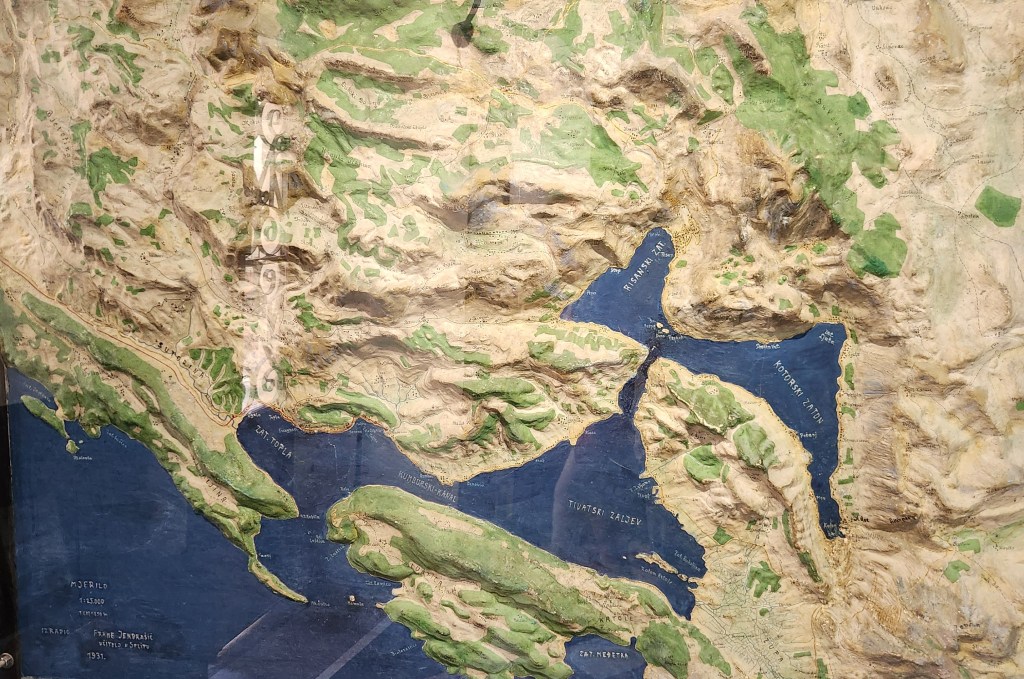
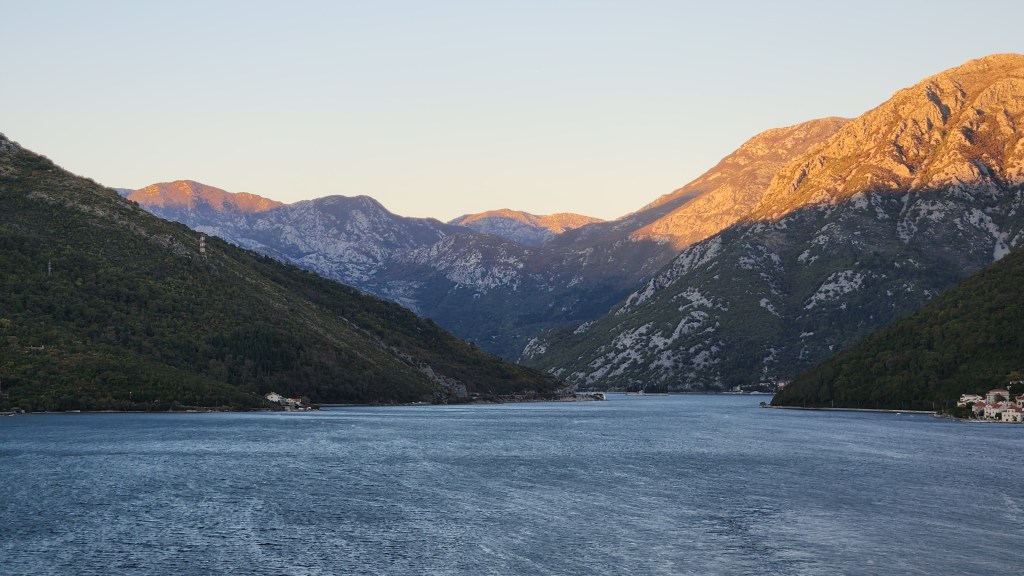
Access to Kotor from the Adriatic requires a sail of some 20 miles through a winding passage as illustrated in these maps.

The Approach to Kotor
Relief Map of Kotor Area

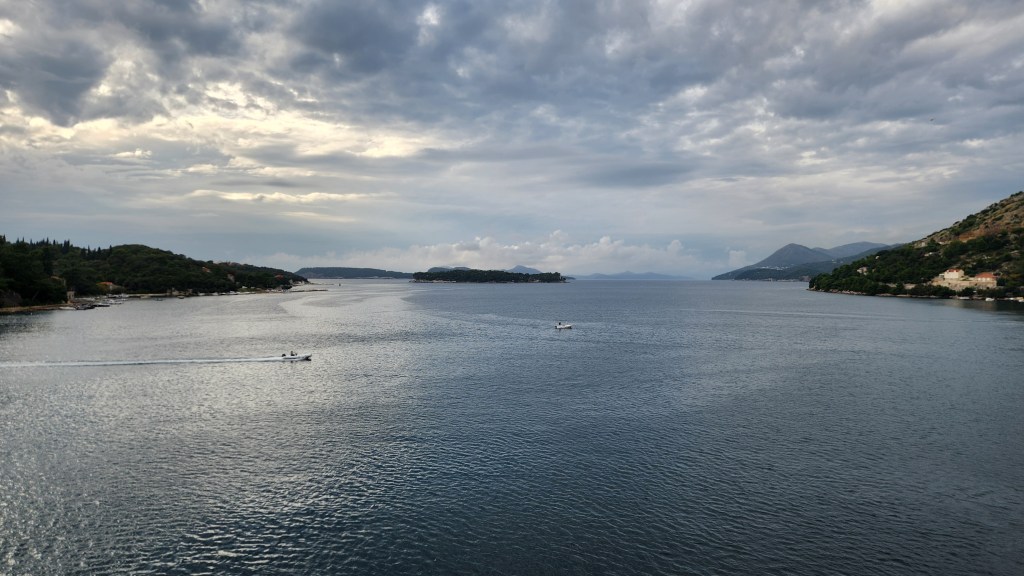
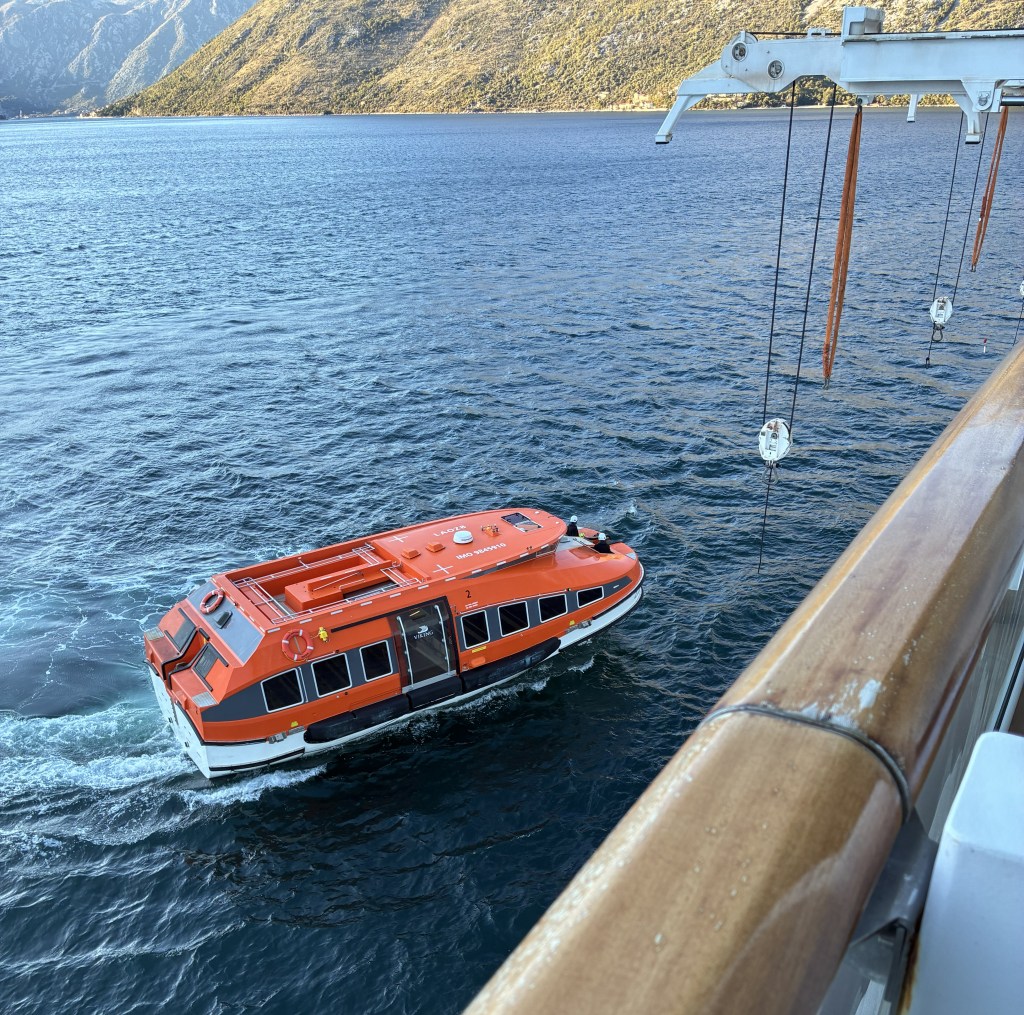
Given the limited access to Kotor harbor, the ship dropped anchor in the bay and we used the Viking Neptune’s tender boats to go into town for our excursion and to return to the ship. I took this photo and video from the ship as the last tender returned. (This is one major difference between the Neptune and the Star – the Star had no tender boats.)

Tender Boat Returning to Viking Neptune
Tender Boat Being Lifted to Storage Bay

And, for a finale, here are a couple of photos as the ship sailed away from its anchor point in the bay.

Sailing Away from Kotor
Old Structure on Channel to Kotor

Okay, that’s it for Part 2. I hope you enjoyed the read and will come back to read future installments:

  • Part 3 will cover the rest of the Ocean Cruise, with shore excursions in Greece (Corfu, Olympia, and Santorini).
  • Part 4 will cover the post-cruise extension in Greece.

Stay tuned …

Pat and Dave’s Mediterranean Moments – PART 1: Overview and Italy

Preamble

Here comes another in my ongoing series of travelogues documenting our domestic and international travel experiences. Since the fall of 2018, I’ve produced fourteen of these travelogues (see INDEX). As past readers will know, the domestic travelogues have been road trips (either with the RV we formerly owned or with one of our two our electric cars) while the international travels have mostly been with the Viking River Cruise or Viking Ocean Cruise lines. We took our first Viking River Cruise on the Danube River back in 2018 (before I started blogging about our travels), as a direct result of watching hundreds of TV ads prior to episodes of the dramas we love to watch on PBS. We were so impressed with Viking that we’ve now taken four more cruises: Switzerland to Paris via the Rhine and Mosel (River Cruise), Ft. Lauderdale to the Panama Canal and back (Ocean Cruise), Spain, Portugal, and the Douro River (River Cruise), and most recently, another Ocean Cruise which is the subject of this travelogue. With that, let’s get to it.

The Itinerary

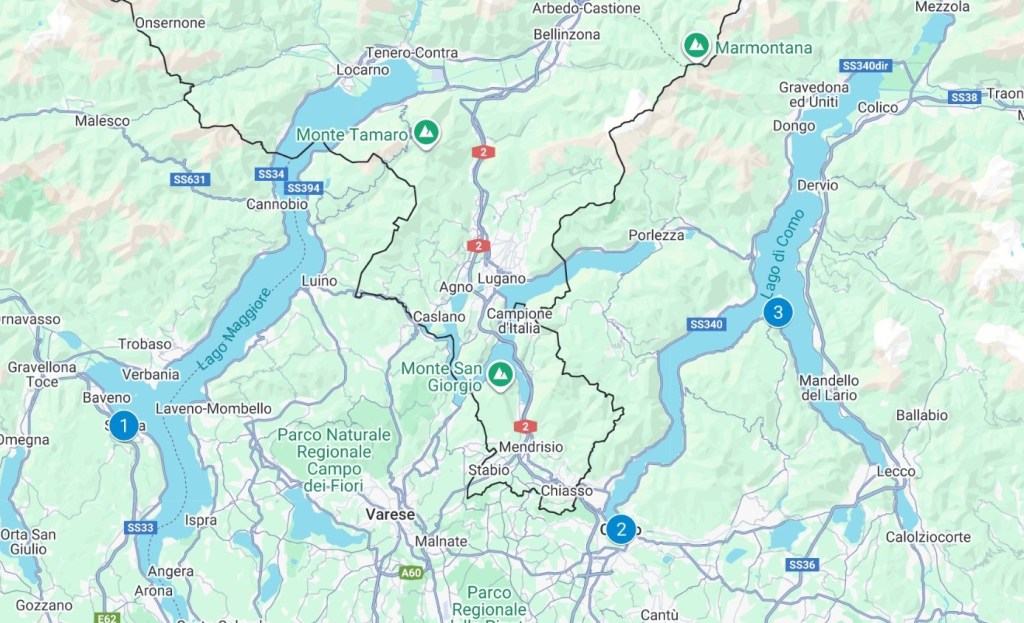
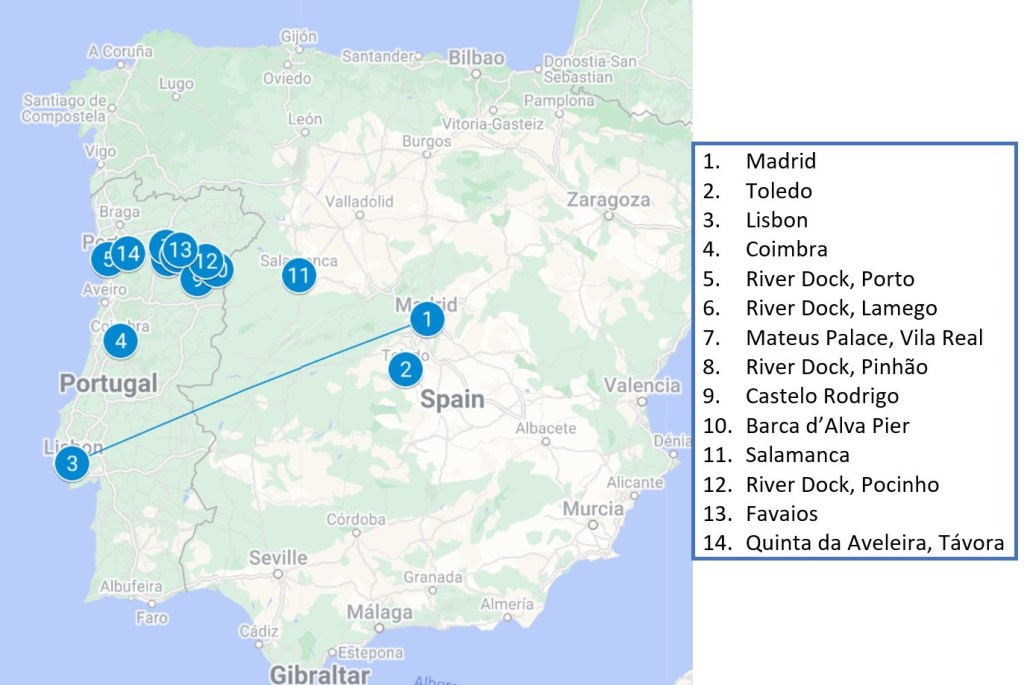
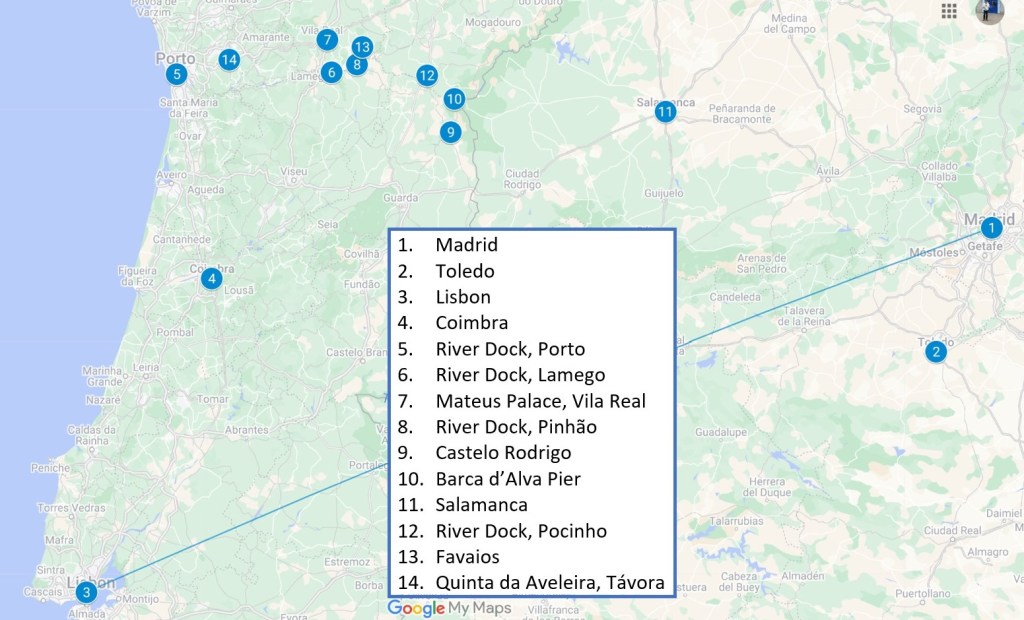
The Ocean Cruise portion of the trip was entitled “Empires of the Mediterranean,” and we also booked a pre-cruise extension in the Italian Lakes region and a post-cruise extension in Greece.  Here’s a map of the journey indicating the various places we visited along the way.

Part 1 of the travelogue (the one you’re now reading) covers the pre-cruise extension in Italy. So, let’s get started …

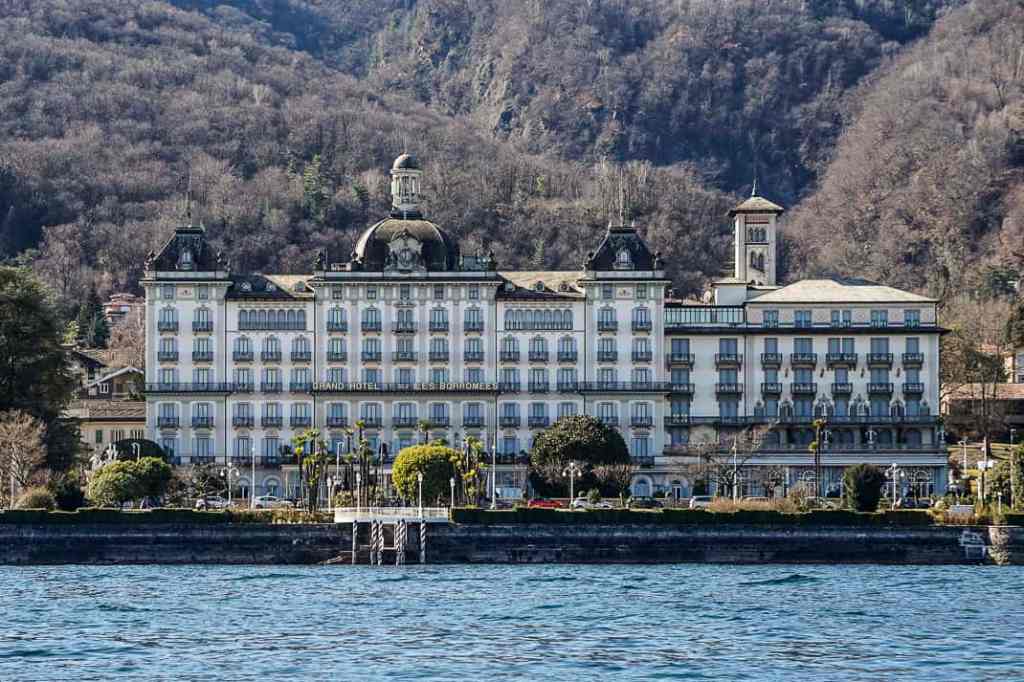
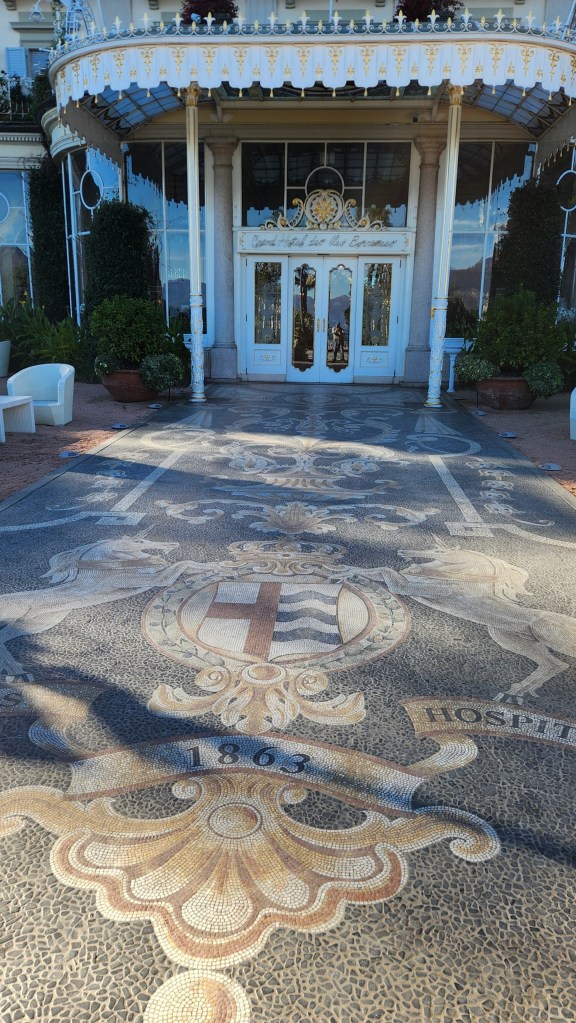
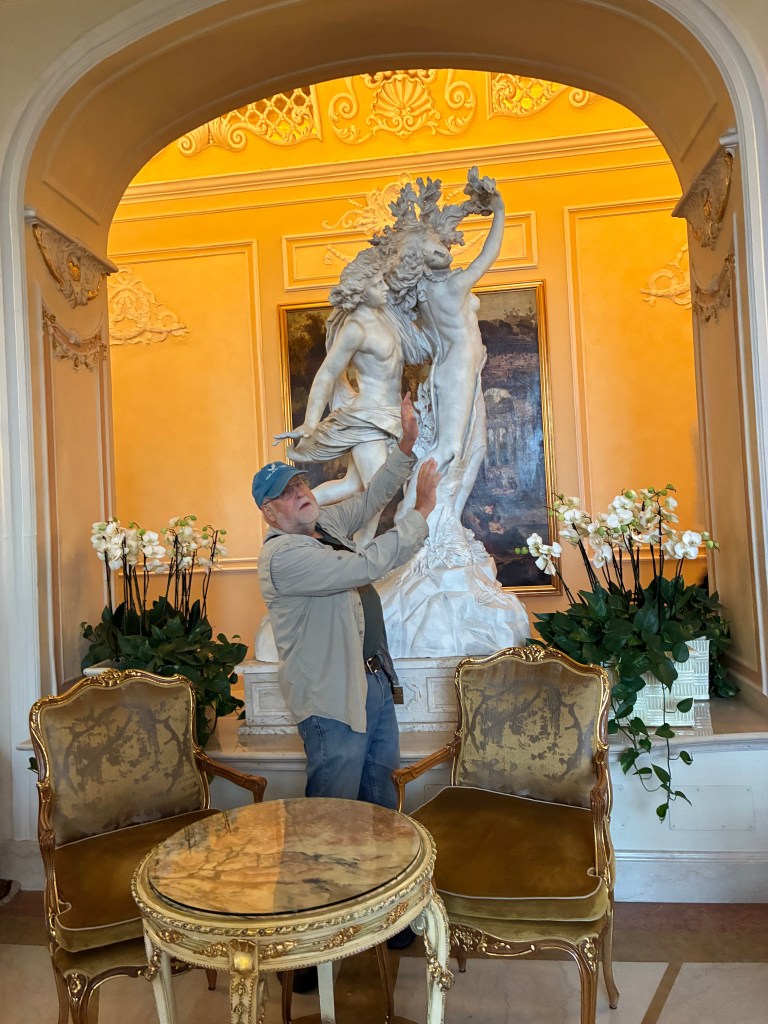
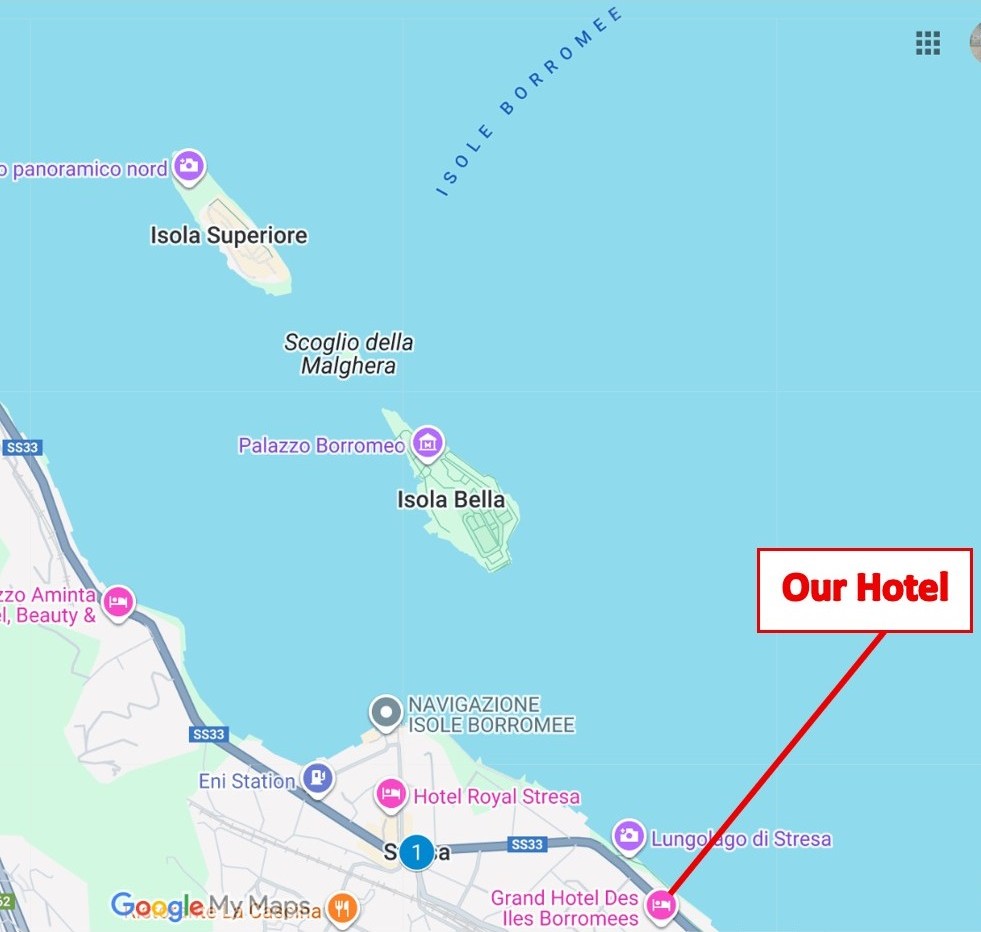
Stresa (Tuesday, October 28 – Friday, October 31, 2025): Our flight from the US landed at Milan Malpensa International Airport shortly before eight AM Tuesday morning, where we were met by Viking representatives and dispatched along with some twenty other Viking guests for a thirty-mile chartered bus trip to our first destination, the town of Stresa on the shores of Lake Maggiore. The hotel we’d been booked into, the Grand Hotel des Iles Borromees, was indeed quite grand as you can see in these photos:

The Grand Hotel des Iles Borromees
The Hotel Entrance
Hotel Stairway
Some Classic Sculptures in the Hotel (and one Neo-Classic?)
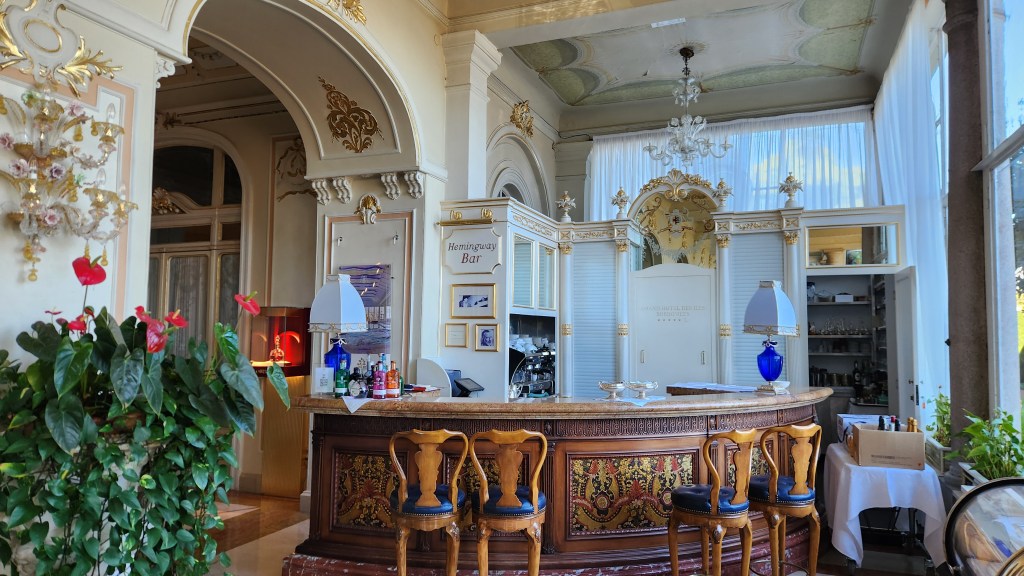
The Hemingway Bar

The Hotel is named for the Borromean Islands (Iles Borromees) and is well-known as the place where Ernest Hemingway stayed while on a ten-day pass from the Milan hospital where he was convalescing from war wounds in 1918. The hotel, the city of Stresa, and Lake Maggiore feature prominently in his novel A farewell to Arms, published a decade later, and he subsequently returned to the hotel many times. The Hemingway Suite (room 105, next to the room he stayed in), and the Hemingway Bar still commemorate the world-famous author.

We arrived at the hotel around ten AM local time Tuesday, then strolled around the scenic town while waiting for our room to be available. Once we eventually checked into the room in the early afternoon, I crashed due to exhaustion from no sleep during the previous 24-hours. Pat was in much better shape, having managed several hours of sleep on the flight. Once I came to again, we went out for another stroll around town, enjoying some gelato and stopping for a few items at a small grocery store along the way.

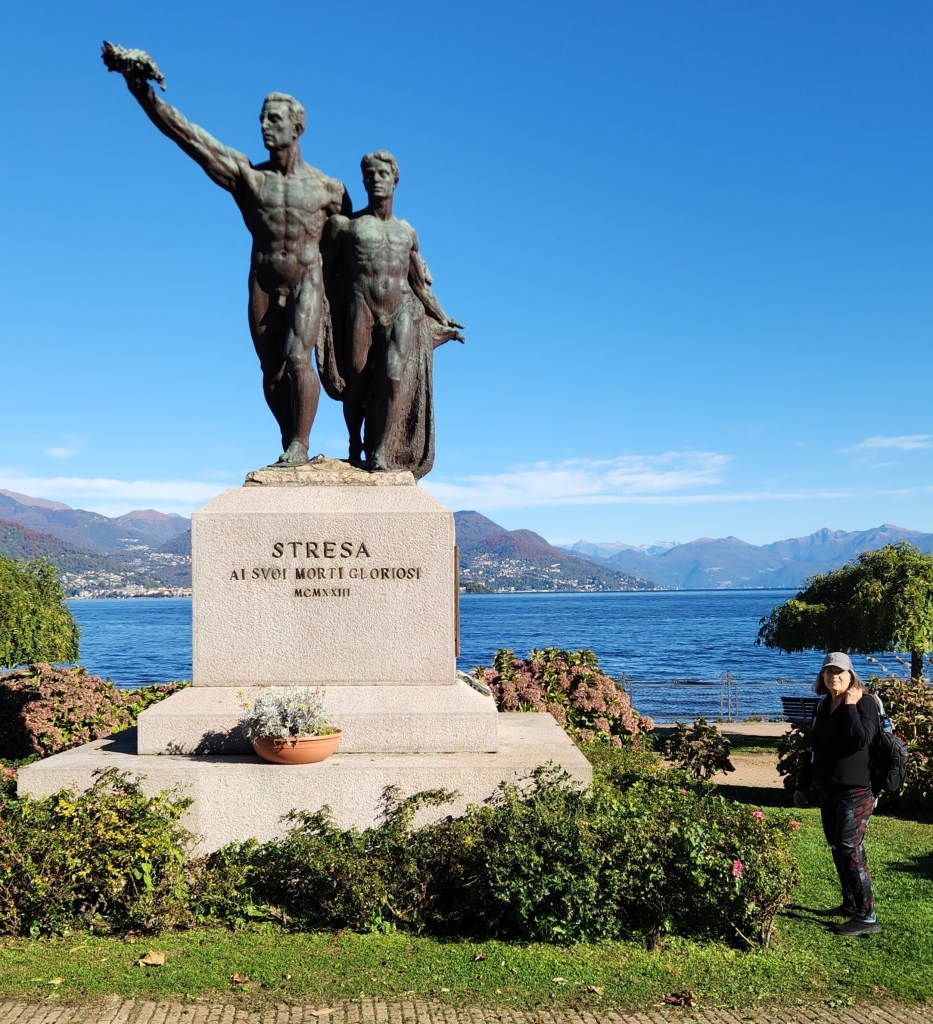
Stresa City Monument
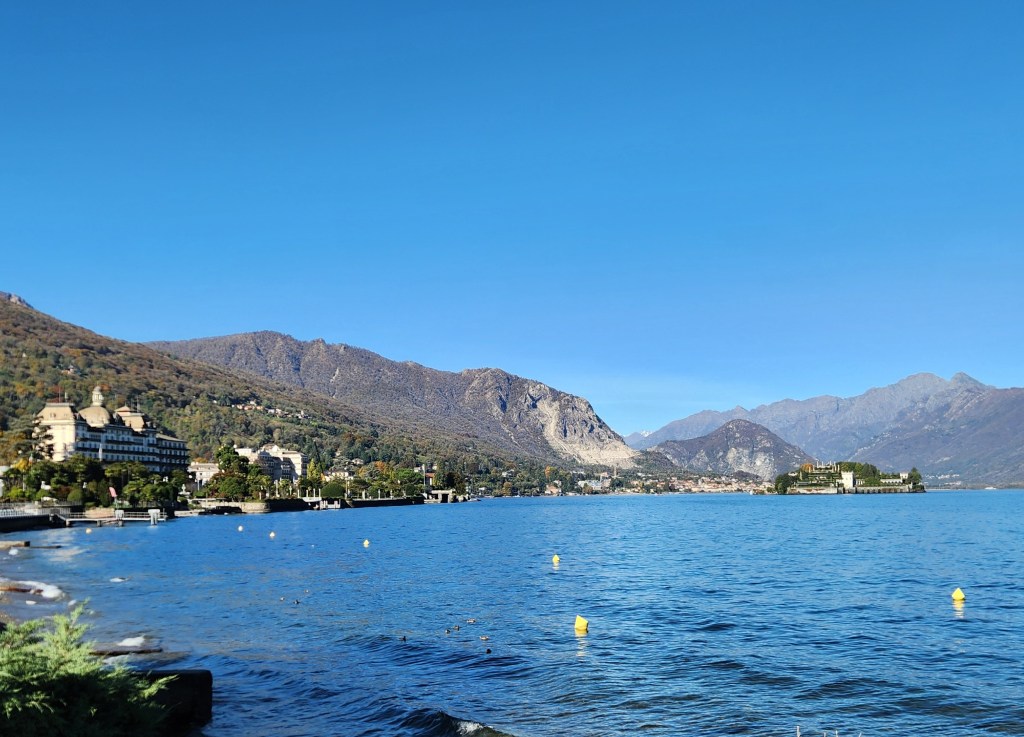
Lake Maggiore view (our Grand Hotel on the left, Isola Bella on the right)

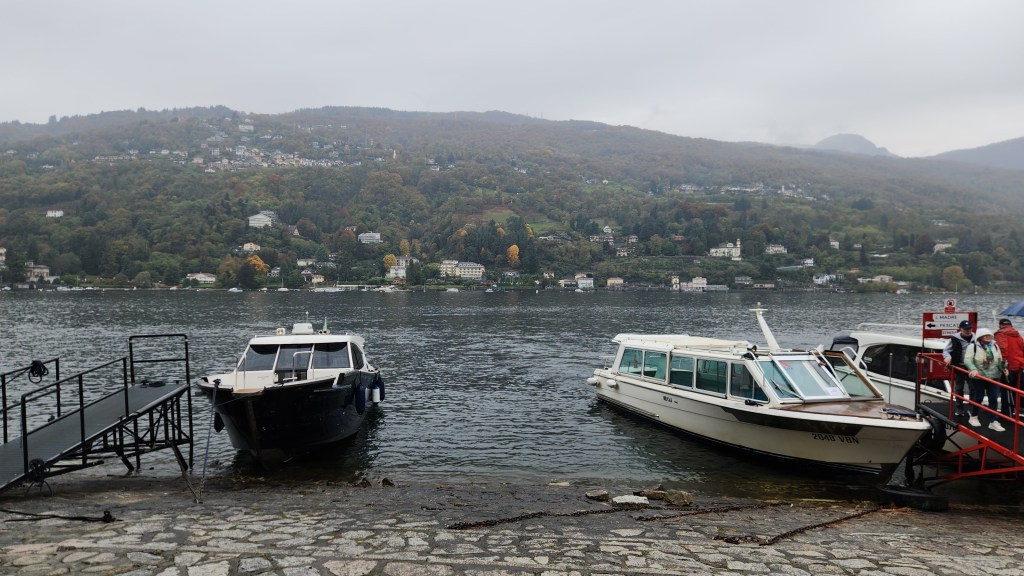
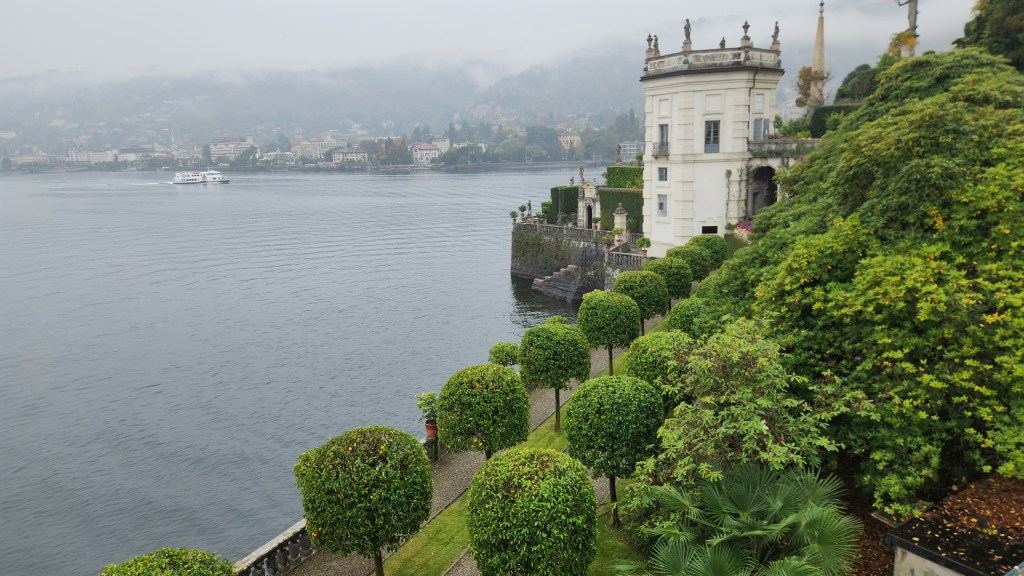
Borromeo Islands (Wednesday, October 29, 2025): On Wednesday, we traveled by boat with a local tour guide to the three nearby Borromean Islands. Interestingly, the islands do not have any piers or docks – the boats simply slide up onto the rocks until they are far enough out of the water to stay put.

Interesting Boat Landing Method

The islands are named for the House of Borromeo, an Italian noble family that started as merchants around 1300 and became bankers in Milan after 1370. The family accumulated wealth and power over the years, acquiring the islands in the early 16th century and eventually establishing a quasi-state in the Lake Maggiore region. We learned that in each subsequent generation of the family, the first-born son inherited the title and properties of the father, the second born entered the church hierarchy, and the third served in the military. (Daughters had to marry well, of course.) The most famous of the second born was Charles II Borromeo, who served as Archbishop of Milan from 1564 to 1584, was made a cardinal in 1560, and was canonized in 1610, in large part due to his reverence for “humilitat,” or pious humility, and for his reforms to the Catholic church. When Napolean invaded Milan in 1797, all lands and privileges of the Borromean State were revoked except for the Borromean Islands. Interestingly, Napoleon and wife Josephine were frequent guests at the Palazzo Borromeo, described below.

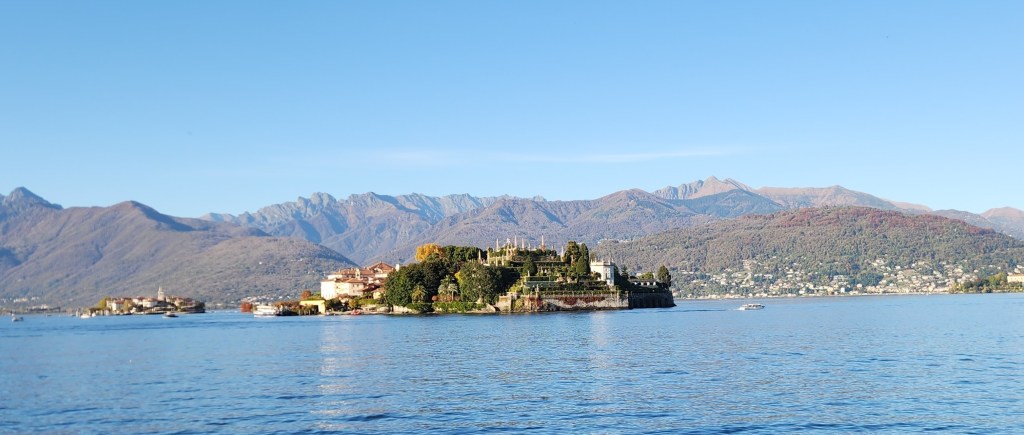
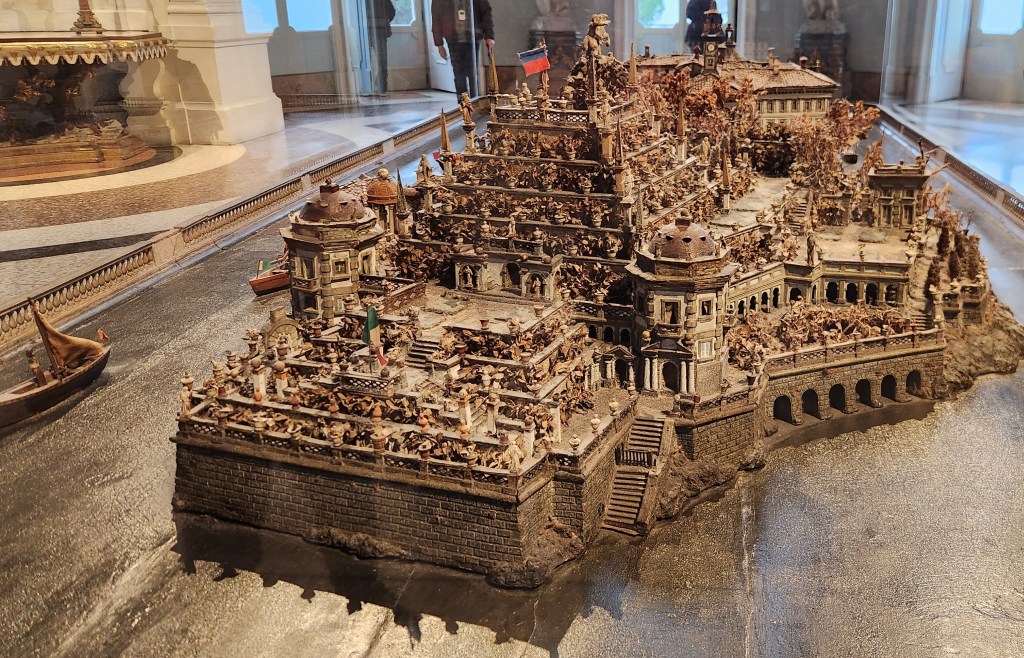
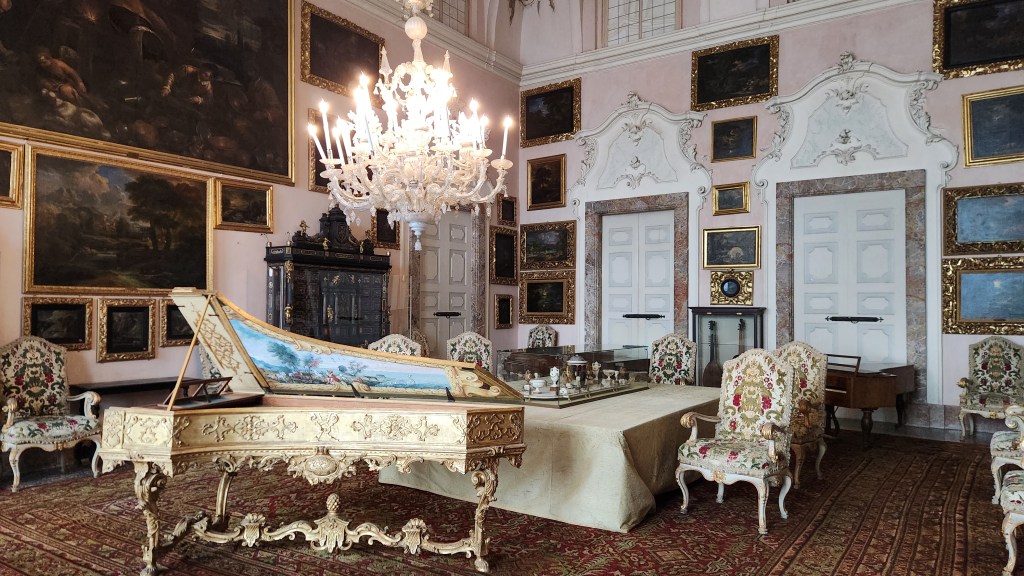
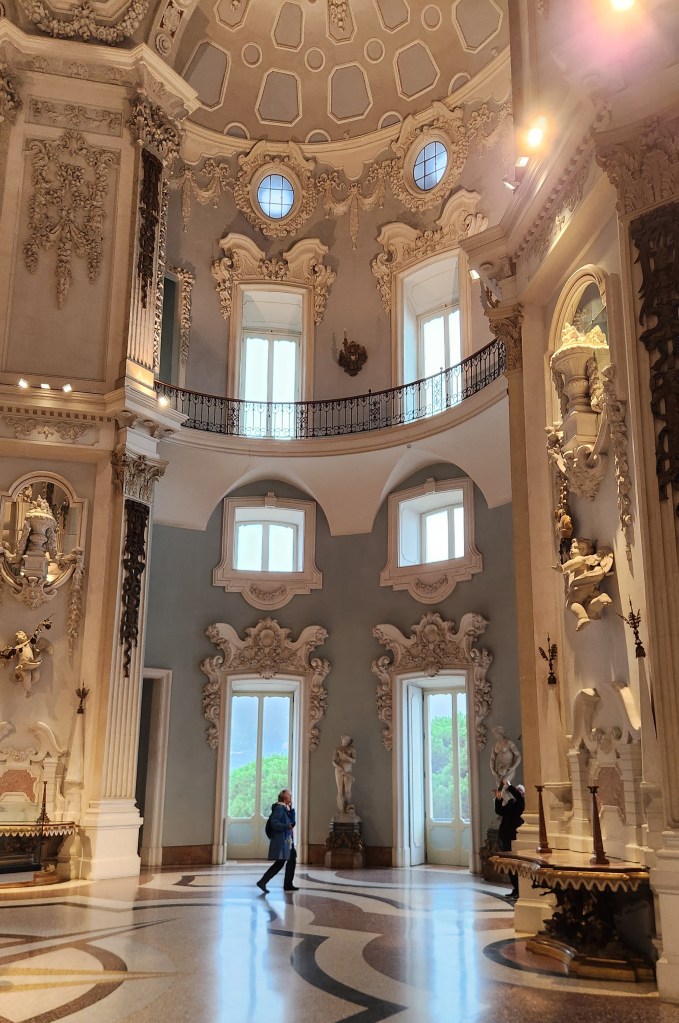
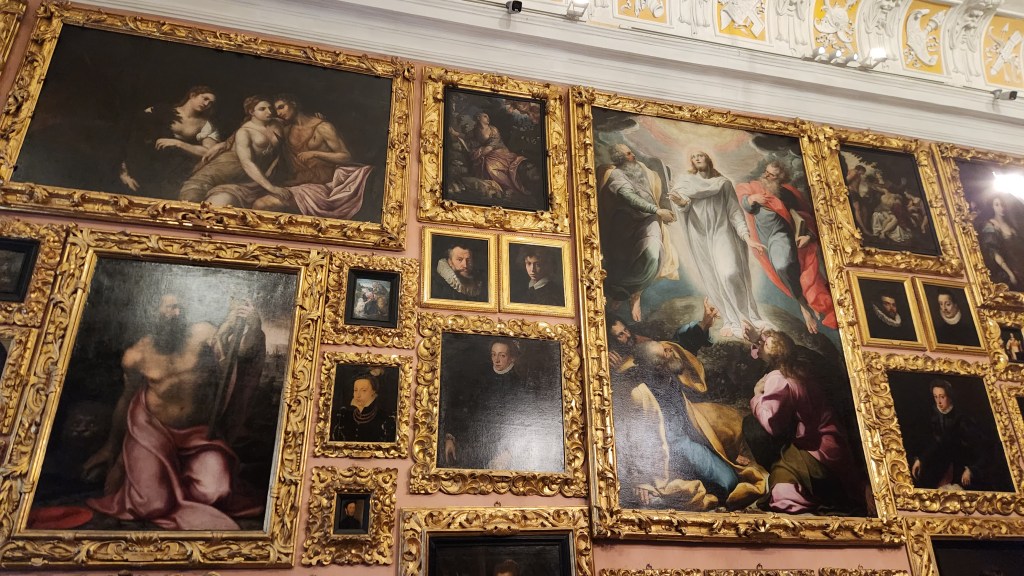
Our first visit was to Isola Bella (the Beautiful Island), named for Isabella D-Adda, wife of Charles III Borromeo (not the Saint). He began building the Palazzo there in honor of Isabella in 1632. After a pause due to plague in Milan, the palace and the adjoining gardens were completed by his heirs in 1671. Later additions and a new northern facade were finished by Vitaliano X Borromeo in the 20th century, so the palace complex is considered to have been fully completed in its present form in 1959, at which time it was opened to the public. The palace and gardens are absolutely stunning as you can see in the photos below. One ironic aspect is the family crest, prominently emblazoned throughout the palace, including the word “humilitat.” We found it hard to swallow the notion that this ostentatious display of wealth was supposed to inspire humility.

Isola Bella and Palazzo Borromeo
Model of Palazzo Borromeo
The Music Room
The Grand Ballroom
Walls Filled with Paintings
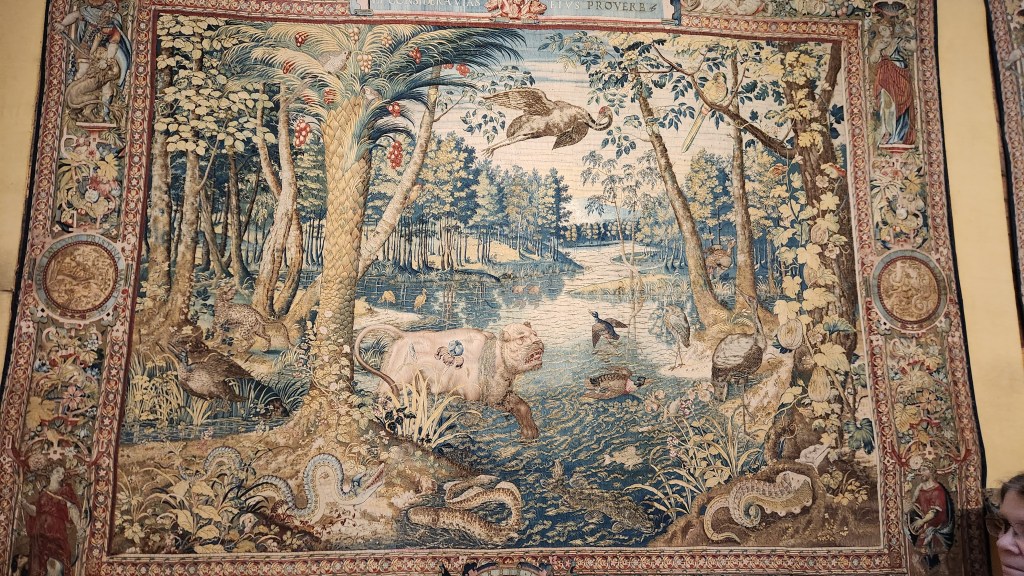
One of Dozens of Tapestries
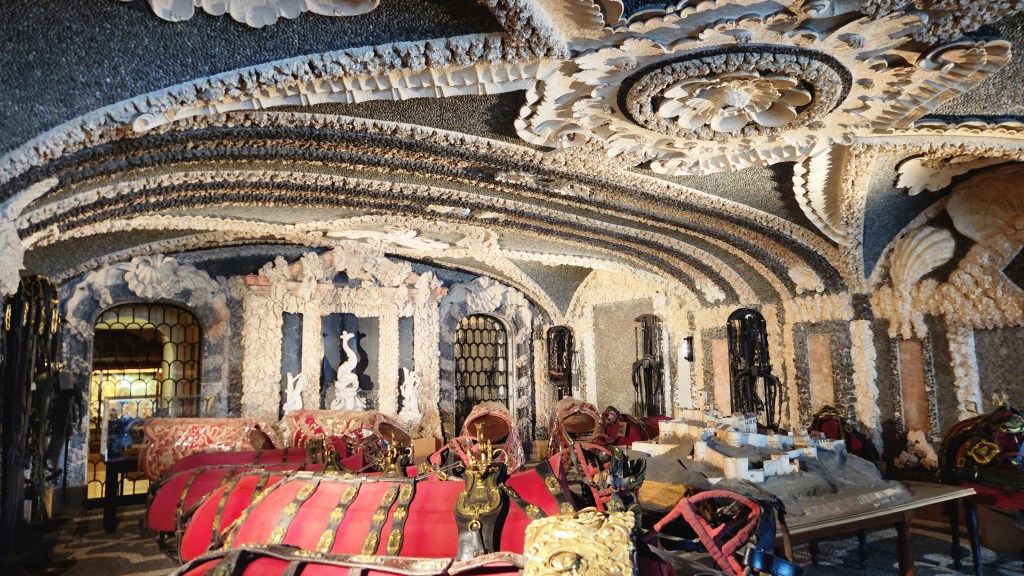
The Grotto
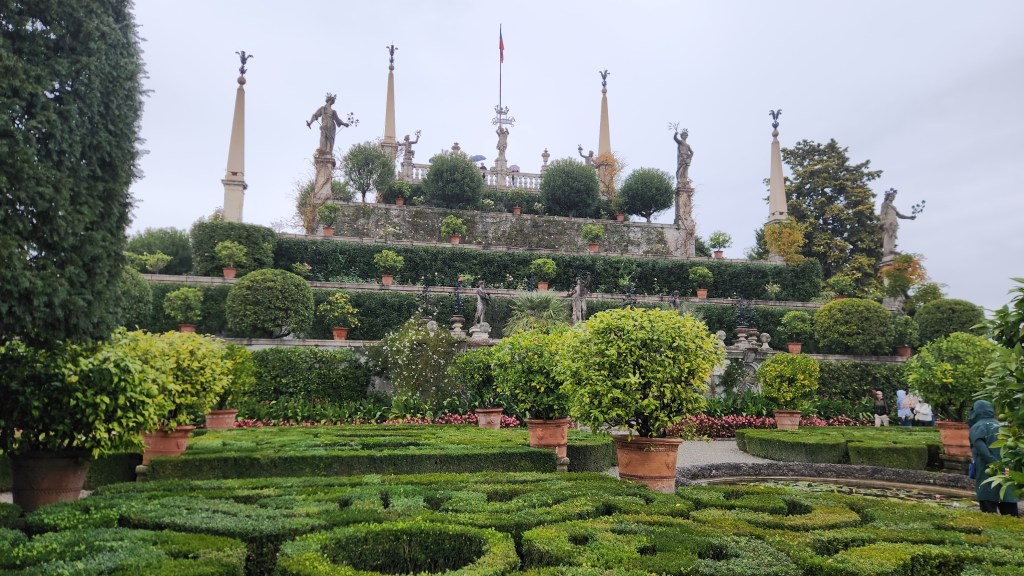
The Gardens — East End of Island
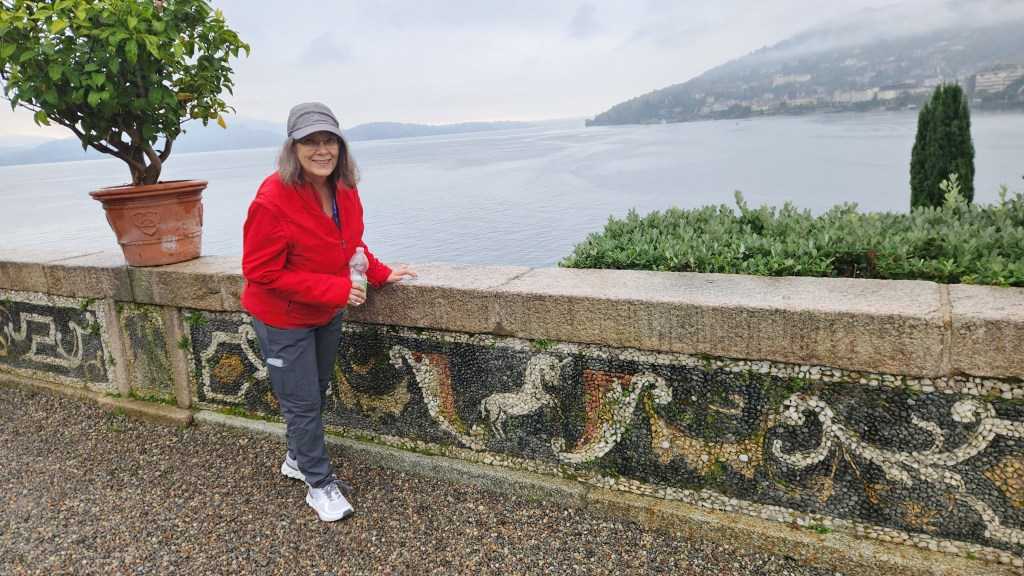
Elaborate Mosaics on Wall
View of Stresa from Palazzo Gardens

Next, our boat took us to Isola dei Pescatori (Fisherman’s Island), which is now the only inhabited Borromean Island. It is named for its fishing village, which had a population of 208 in 1971, but also includes many shops and restaurants to serve the tourist trade. We enjoyed an excellent lunch of local fish at a restaurant called Chez Manuel.

Main Street on Fisherman’s Island
Promenade on Fisherman’s Island (nearly empty in off-season)

The final visit of the day was to the one known as either Isola Superiore (Big Island) or Isola Madre (Mother Island), the largest of the three. As early as the ninth century, it included a church and a cemetery, and olives were cultivated there. In 1501, Lancillotto Borromeo introduced cultivation of citrus fruits using plants brought from Liguria and a gardener to tend them. He also began construction of the family residence on the island, which was extended in Renaissance style in the 1580s by Renato I Borromeo.

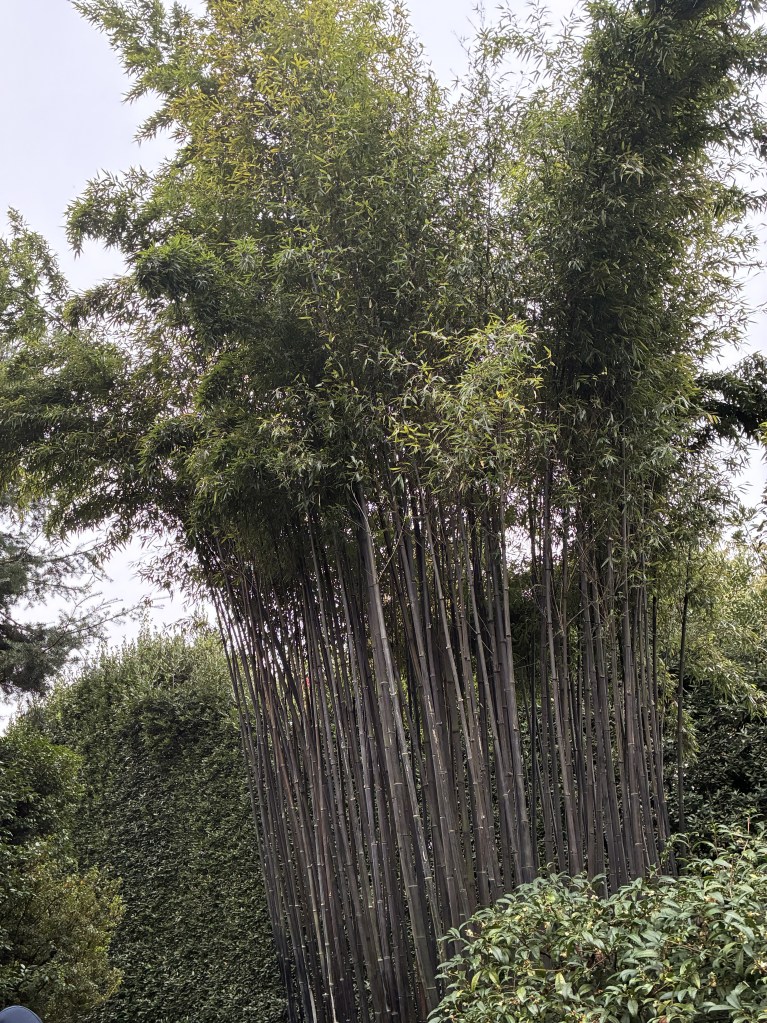
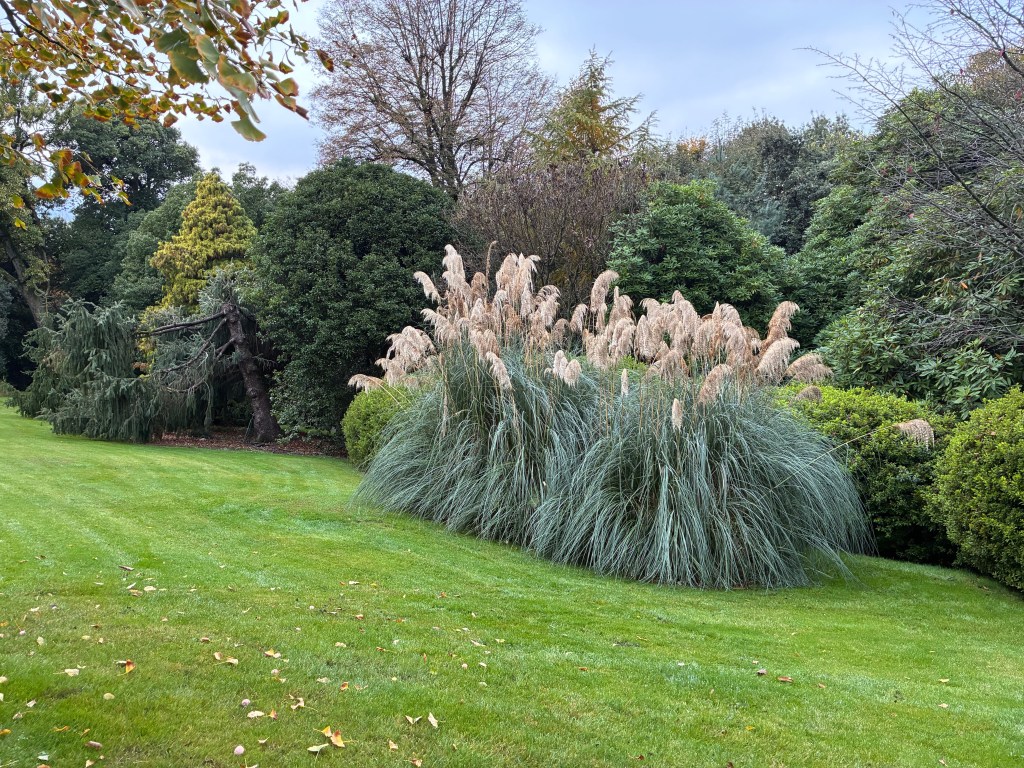
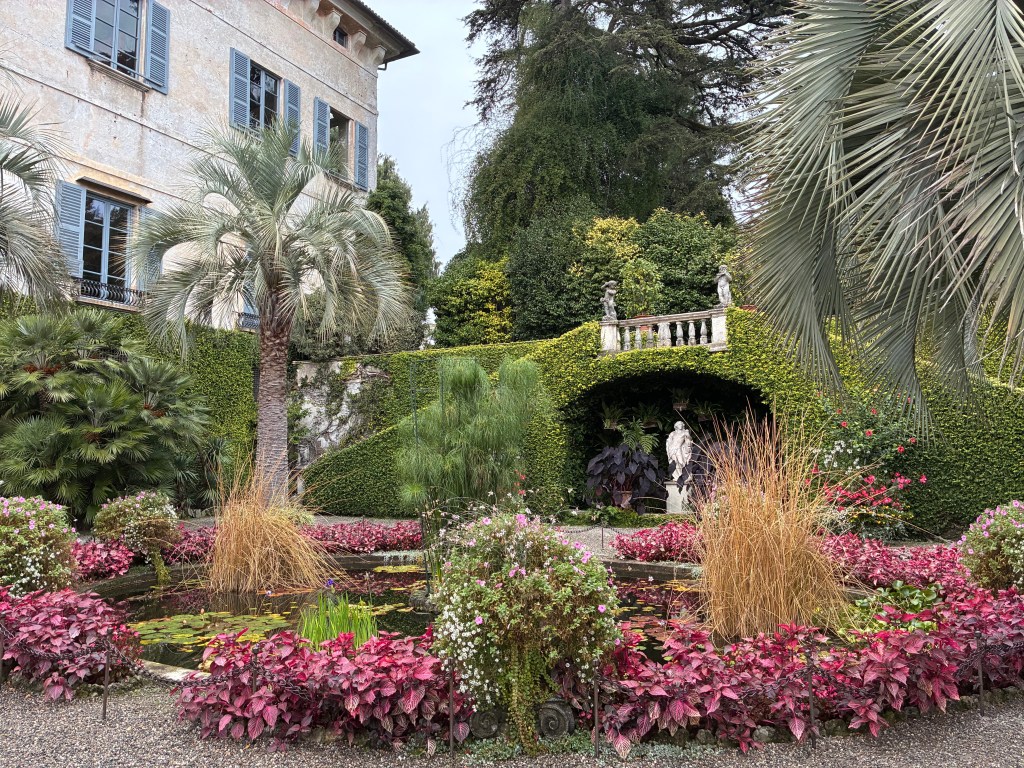
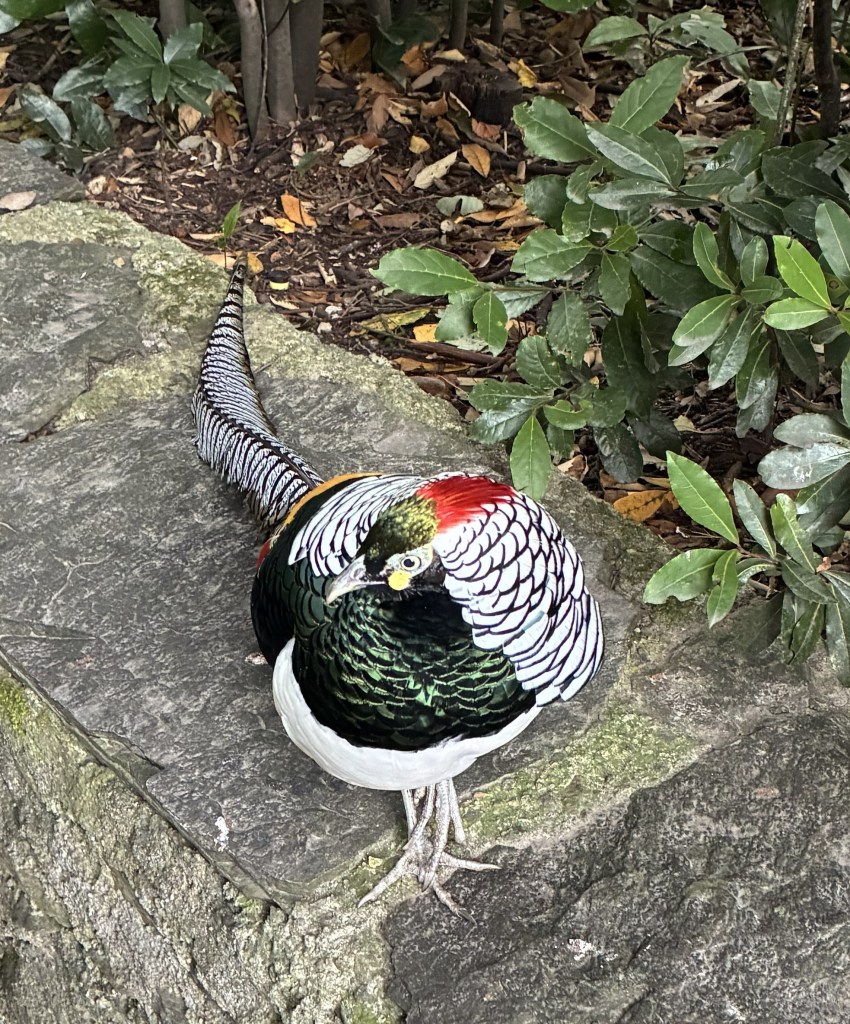
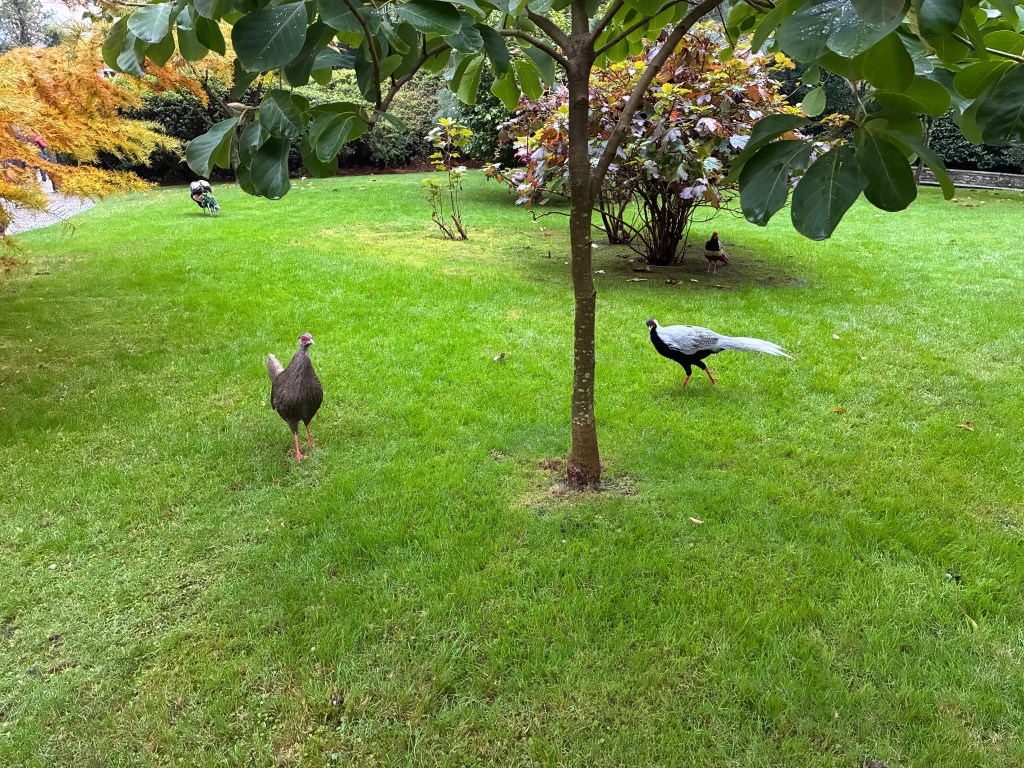
However, the main attraction is the extensive English style botanical gardens, begun in the late eighteenth century. The gardens contain impressive collections of cypress, rhododendron, camellia, wisteria, pampas grass, dogwood, magnolia, maple, and even bamboo and palm trees, all of which have adapted beautifully to the microclimate of Lake Maggiore. There are also large numbers of freely roaming parrots, peacocks, pheasants, and other birds.

“Walk of the Dead” on Site of Ancient Cemetery
Bamboo Trees
Sage Grass
Family Residence Courtyard
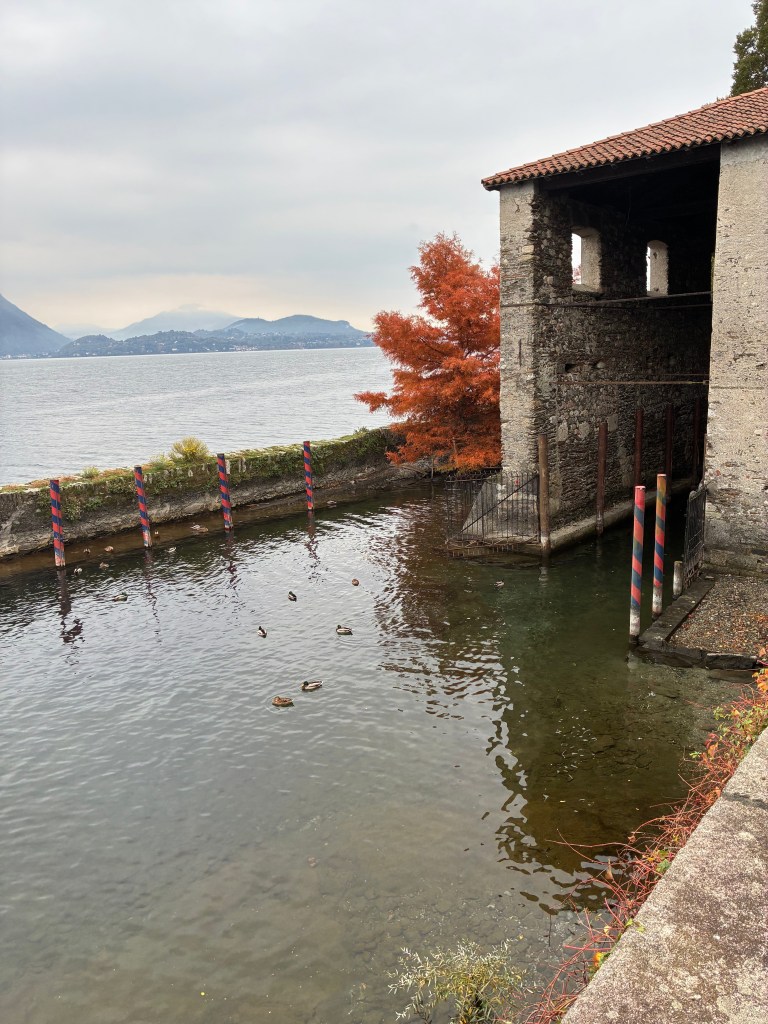
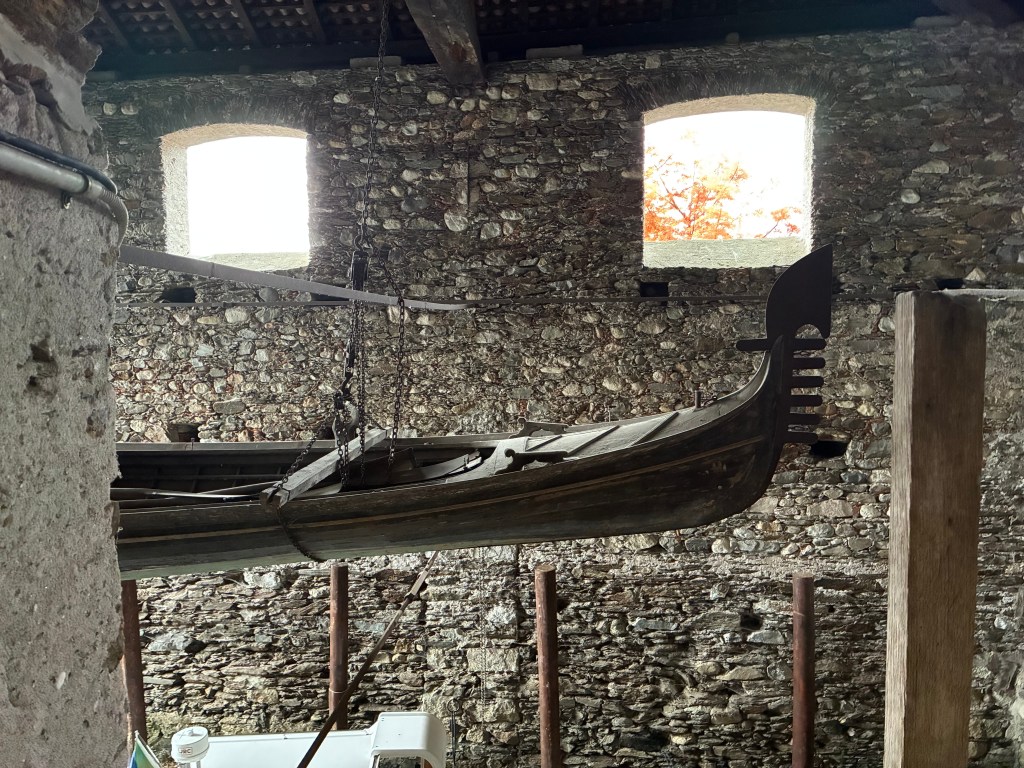
Boathouse
Ancient Boat Replica (our guide called it a Kayak)
A Beautiful Italian Supermodel Posing
Free Range Peacocks (or Pheasants?)
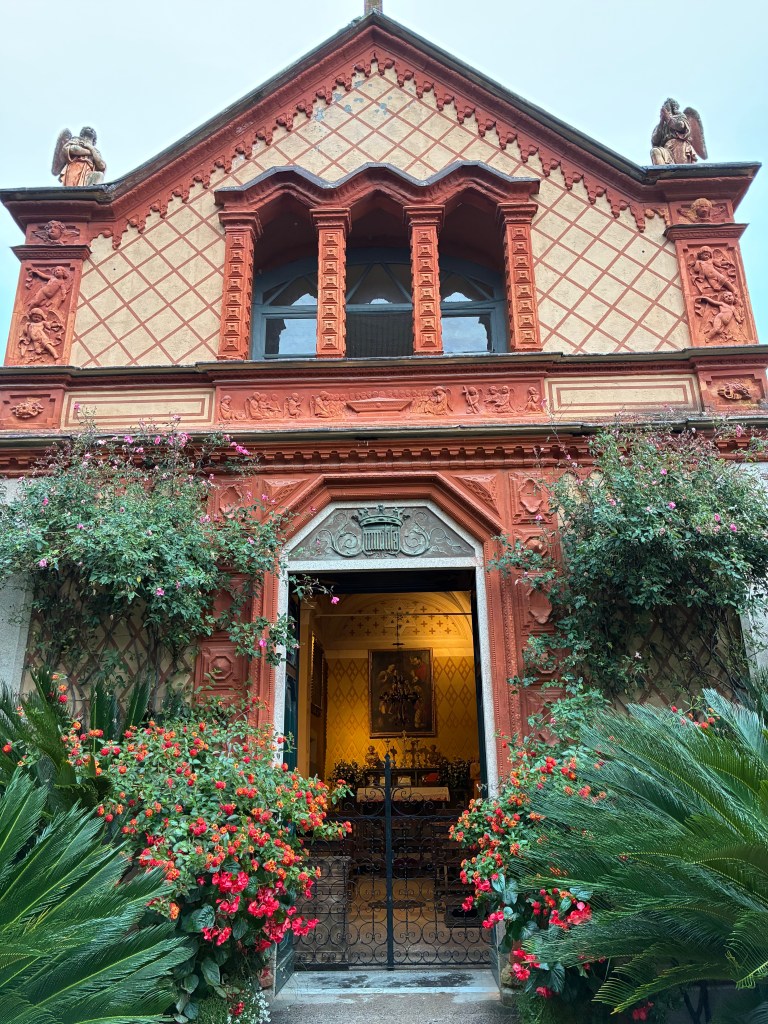
Family Chapel
Family Chapel

By the time we were ready for dinner, the overcast skies we’d had during most of the day had turned into a steady rain, but we donned rain gear and headed back into town for dinner at a nice place called Ristorante Pizzeria Mamma Mia.

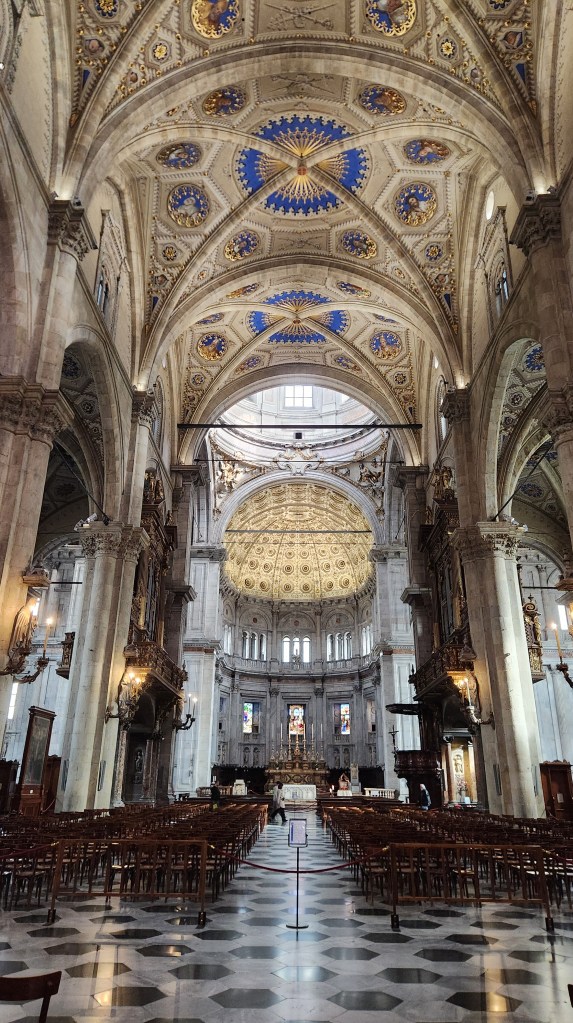
Como and Bellagio (Thursday, October 30, 2025): On Thursday morning, we boarded a bus for a trip to the city of Como, located at the southwestern tip of Lake Como (whose shape reminds me of a running man). We spent a brief time in Como, where we strolled along the main street, visited the cathedral, and stopped for a tasty gelato. I would have loved to ride on a neat looking funicular, but there wasn’t enough time, as the boat was due to leave for Bellagio shortly.

The church is described as the last Gothic cathedral built in Italy. Construction began in 1396 (on the site of the earlier Romanesque cathedral dedicated to Santa Maria Maggiore) ten years after the foundation of the Milan Cathedral. Construction work did not finish until 1770 with the completion of the Rococo cupola. The imposing west front was built between 1457 and 1498 and features a rose window and a portal between two statues of Pliny the Elder and Pliny the Younger, natives of Como.

Como Cathedral
Como Cathedral
City of Como with View of Funicular

After the brief stop in Como, we boarded a boat for a trip to Bellagio, located at the midpoint of the two “legs” of the lake. The boat zigged and zagged from one side to the other for close-up looks at some of the impressive villas along the shorelines and for a fleeting view of a lovely waterfall on the east side of the left “leg.”

Lake Como from Boat
Villa on Lake Como
Waterfall Near Village on Lake Como
George Clooney’s Villa — under renovation
Villa on Lake Como
Park in Bellagio

In Bellagio, known as the “Pearl of Lake Como,” we strolled through the town and visited a nice park with impressive views of the lake before stopping at a food truck for some pita wraps.

View of Lake Como from Park in Bellagio

On the way back, the boat made a more direct route to Como, where we boarded the bus again for our return to Stresa. That evening, our group of travelers enjoyed a lovely dinner at a restaurant in Stresa.

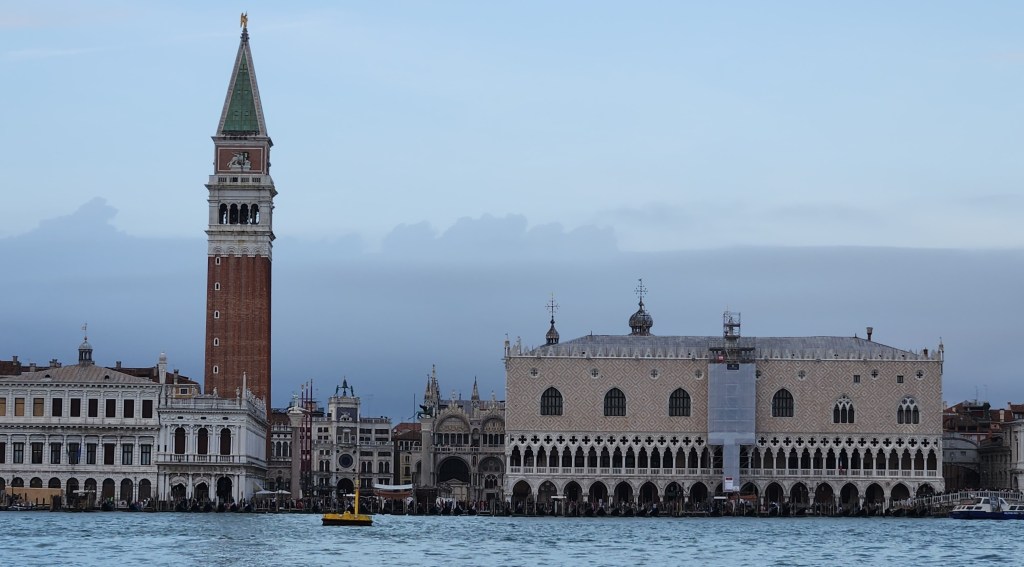
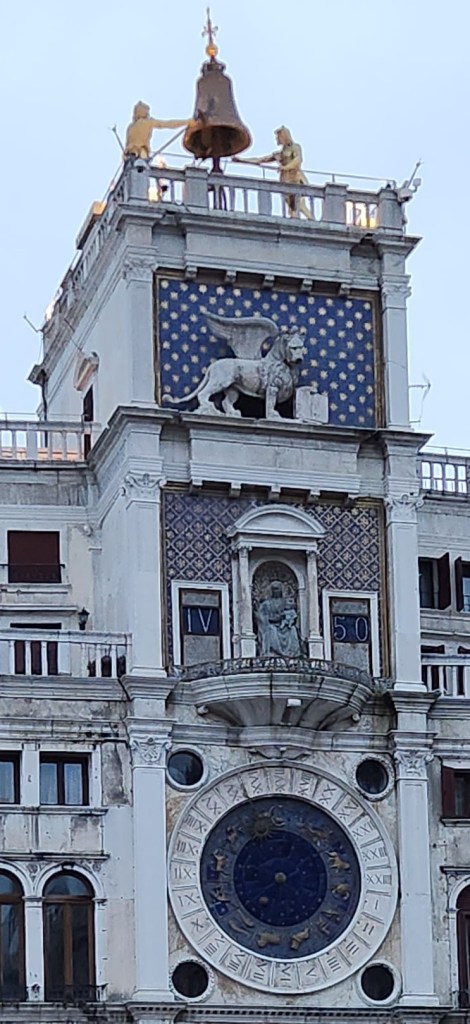
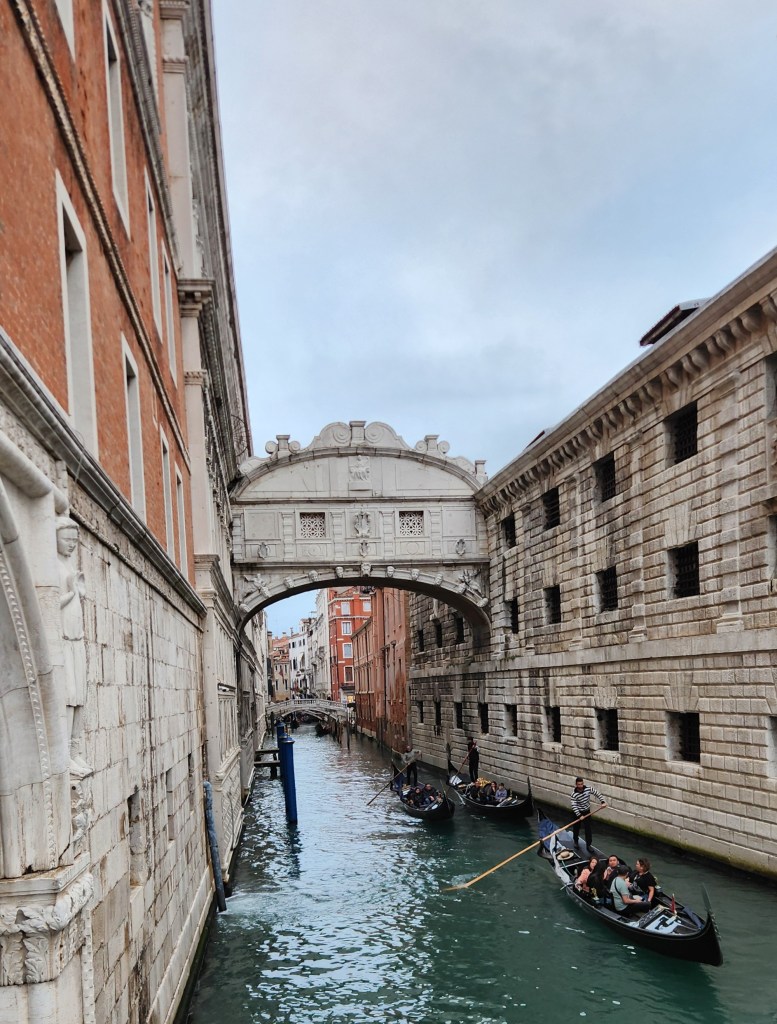
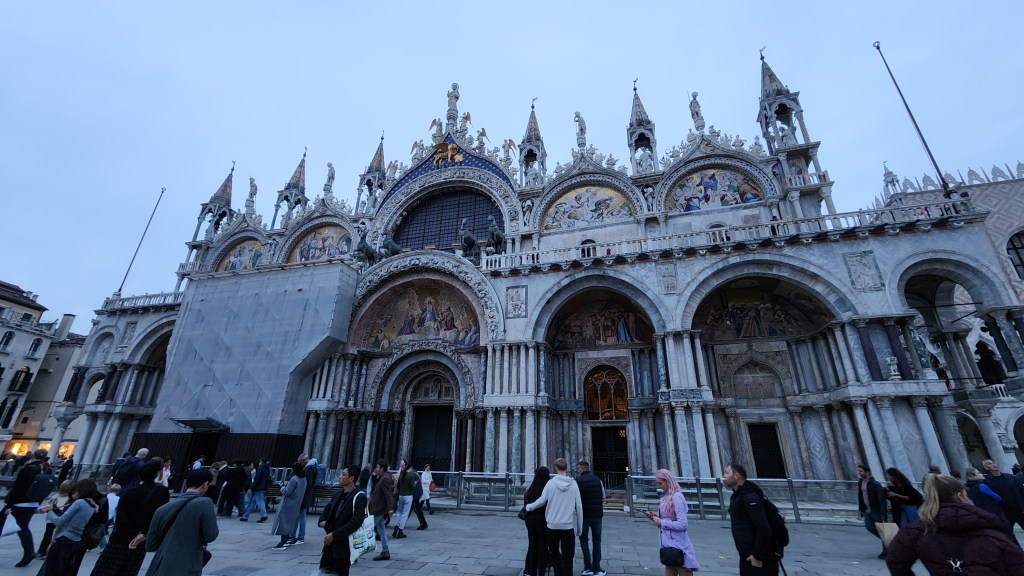
Venice (Friday, October 31, 2025): We departed the hotel in Stresa at 8:25 AM for a seven-hour bus trip to the port terminal at Fusina, located across the Venetian Lagoon from the island city of Venice. After boarding our cruise ship, the Viking Neptune, and checking into our stateroom, we departed again for a ferry trip across the lagoon to visit the city. Unfortunately, it was after four PM by the time we reached the Viking destination dock in Venice, leaving time for only a very brief visit before returning to the ship again. At least we did manage to see some of the most iconic sights in Venice during that time, including the Bridge of Sighs, the Doge’s Palace, and San Marco square before strolling through some of the busy, crowded streets in the vicinity. Of particular interest to me was the Renaissance era (1493-1499) Clock Tower in San Marco Square, with its astronomical clock, changing Roman numerals, and automated figures who ring the bell every hour.

San Marco Square, Doge’s Palace, and Bridge of Sighs
Clock Tower in San Marco Square
Bridge of Sighs
St. Mark’s Basilica in San Marco Square
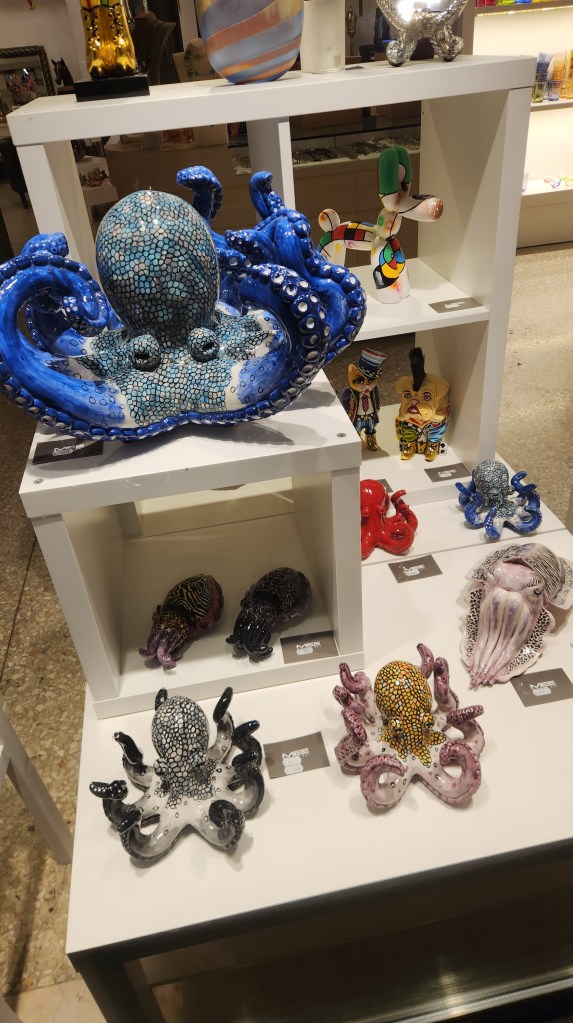
Glassware in Venice Shop
San Marco Square After Dark

Okay, that’s it for Part 1. I hope you enjoyed the read and will come back to read future installments:

  • Parts 2 and 3 will cover the Ocean Cruise, with shore excursions in Slovenia, Croatia, Montenegro, and Greece (Corfu, Olympia, and Santorini).
  • Part 4 will cover the post-cruise extension in Greece.

Stay tuned …

Pat and Dave’s Intrepid Iberian Interlude – PART 4: Favaios, Lamego, Porto, Quinta Da Aveleda

Welcome back for the final episode of this narrative of our recent trip to the Iberian Peninsula. Part 3 described three of the shore excursions we took during the river cruise, leaving off in Pocinho on November 15th. This episode describes the last four shore excursions and our trip back home.

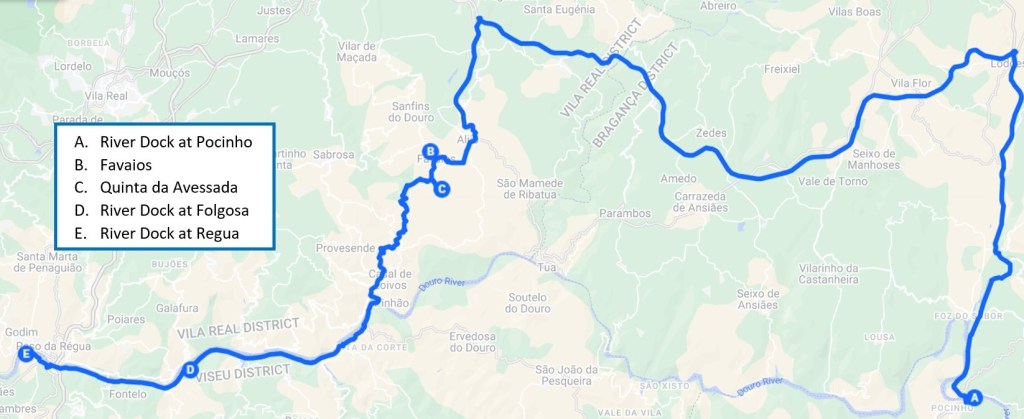
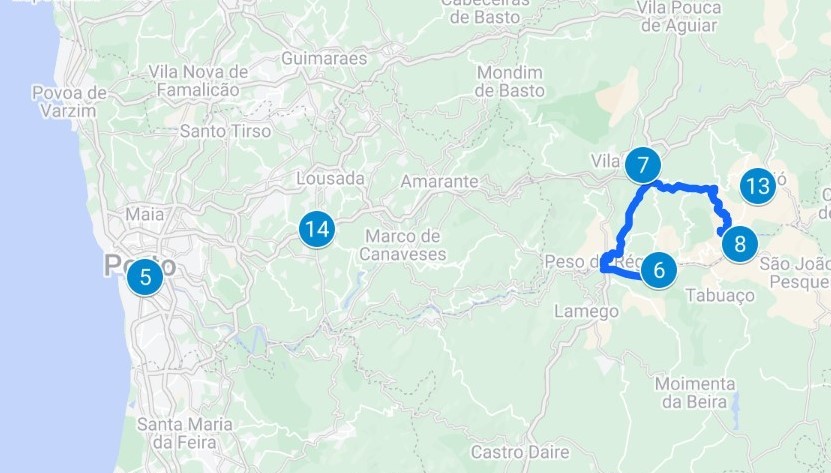
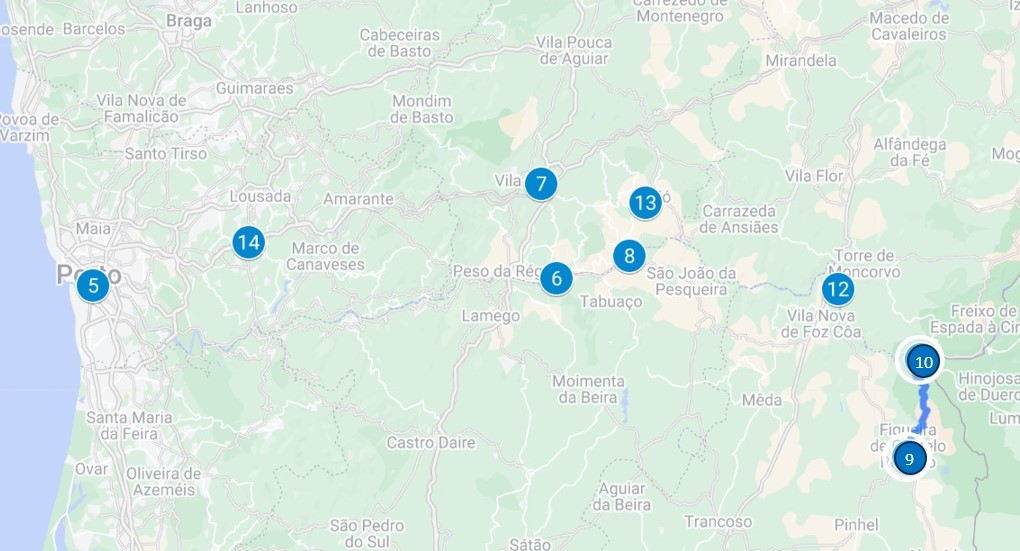
Favaios and Quinta da Avesado (November 16): On Saturday the 16th, we disembarked from the Helgrim at 8:30 AM for a 50-mile bus drive through the beautiful Douro valley to the town of Favaios. In Favaios, we visited a wine producing cooperative, a bakery, and a museum, before traveling to the Quinta da Avessada, an impressive vineyard where we were served an excellent lunch. After lunch, we returned to the ship, which had sailed downstream from Pocinho to Folgosa while we were on the shore excursion. After reboarding, the ship sailed on to Peso da Regua where we docked for the night. Here’s a map of the day’s travels:

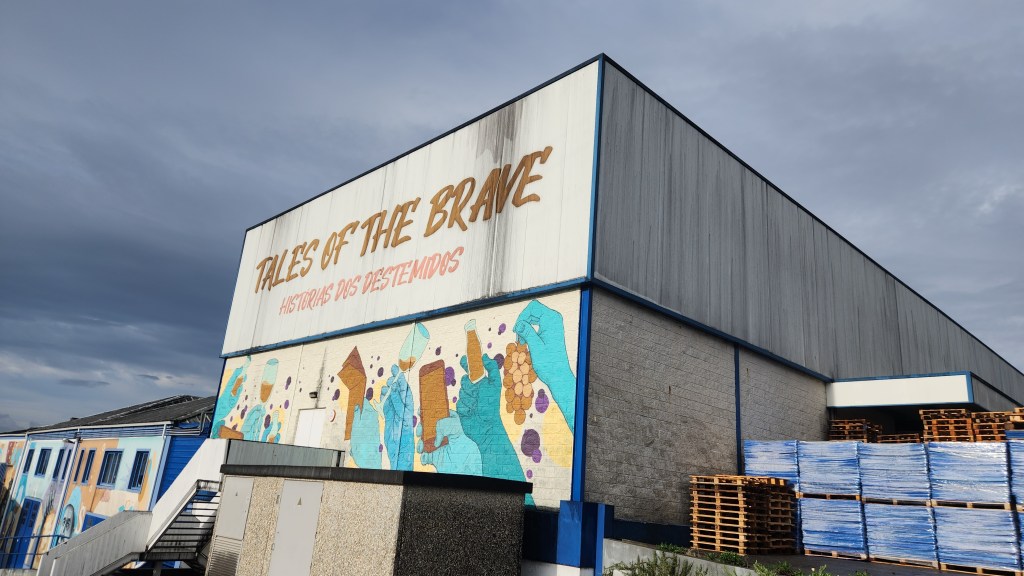
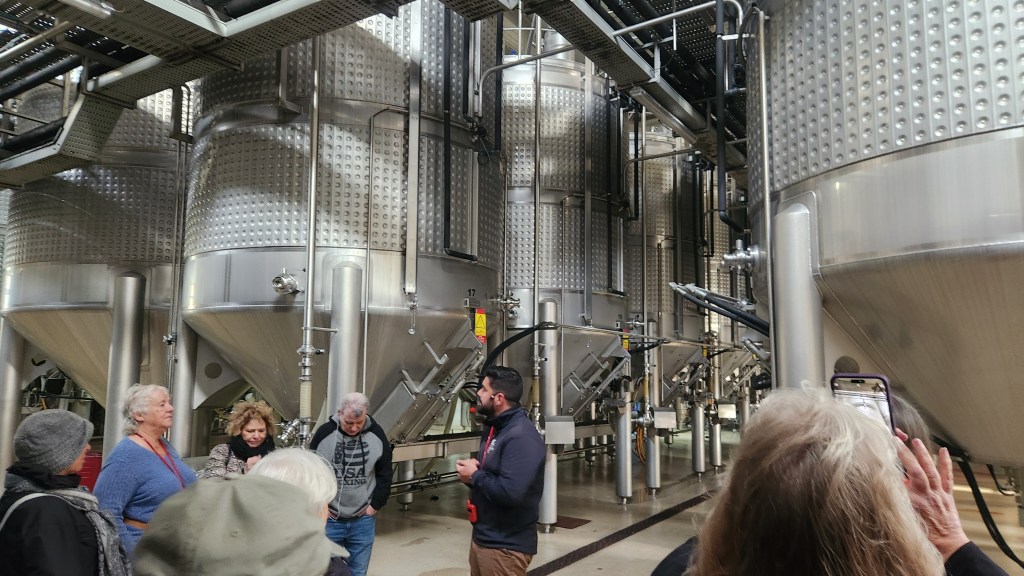
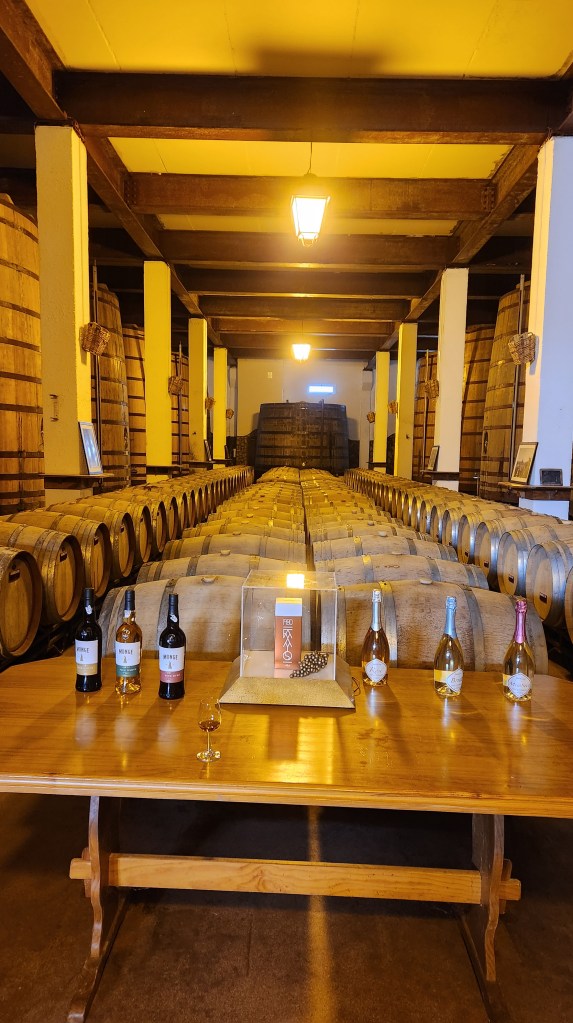
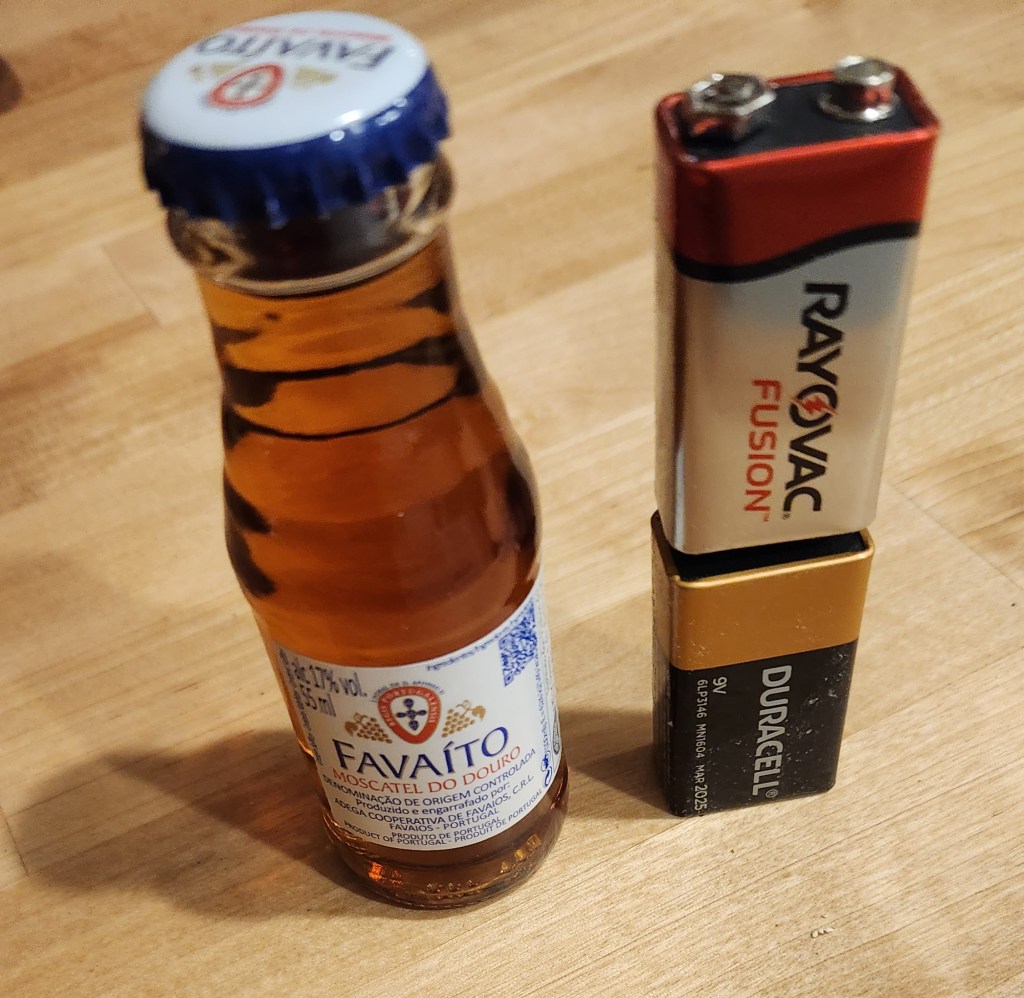
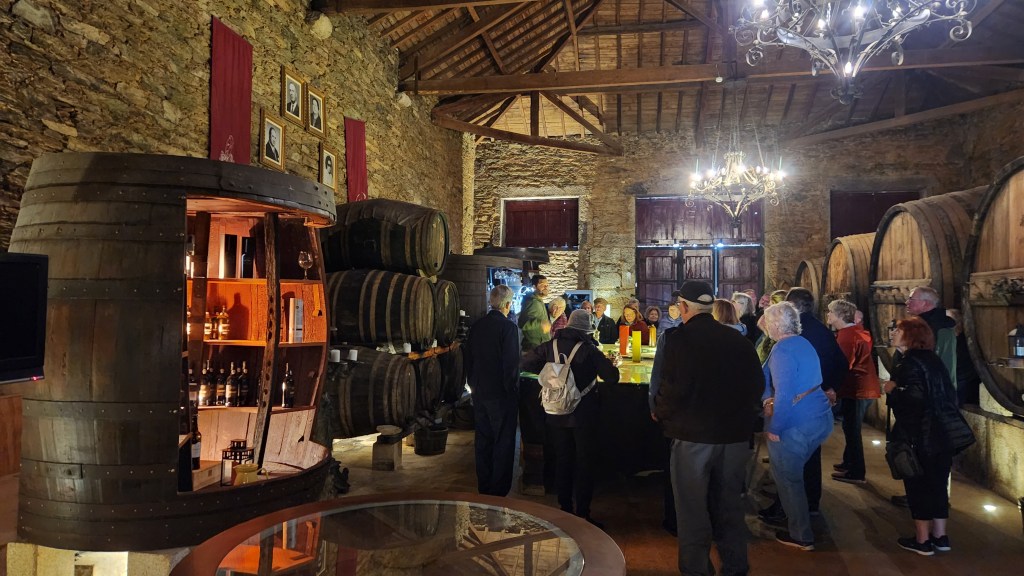
Favaios is the home of the Adega Cooperativa de Favaios, which was our first stop on the excursion. Adega is a cooperative that produces a popular fortified wine known as Moscatel, produced from the Muscat grapes that thrive in the plateau more than 1,000 feet above the Douro River (Favaios lies at an altitude of 1,800 feet). The cooperative includes some 100 member vineyards that supply the grapes during a short harvest season, typically from late September to mid-October. The cooperative has developed an ultramodern, computer-controlled processing facility that produces well over a million bottles of Moscatel each year, although the majority are the very popular 55 ml “shot” sized bottles that the Portuguese love to mix with beer. The cooperative has an aggressive expansion planned to add another hundred member vineyards and double the processing capacity to account for the ever-shorter harvest season due to the undeniable impact of climate change. The process is similar to that for Port wine, which I described in Part 2 of this series – the highly-sugared grapes are fermented in large stainless-steel vats before fortification with aguardente and then aged in wooden barrels for several years. Our tour of the facility concluded with a tasting of several glasses of Moscatel; we were sufficiently impressed to buy a couple of the little “Favaita” bottles to take home.

The Adega Cooperative in Favaios
Fermenting Vats
Aging Barrels and Sample Wine Bottles
The Delectable Favaito Muscatel

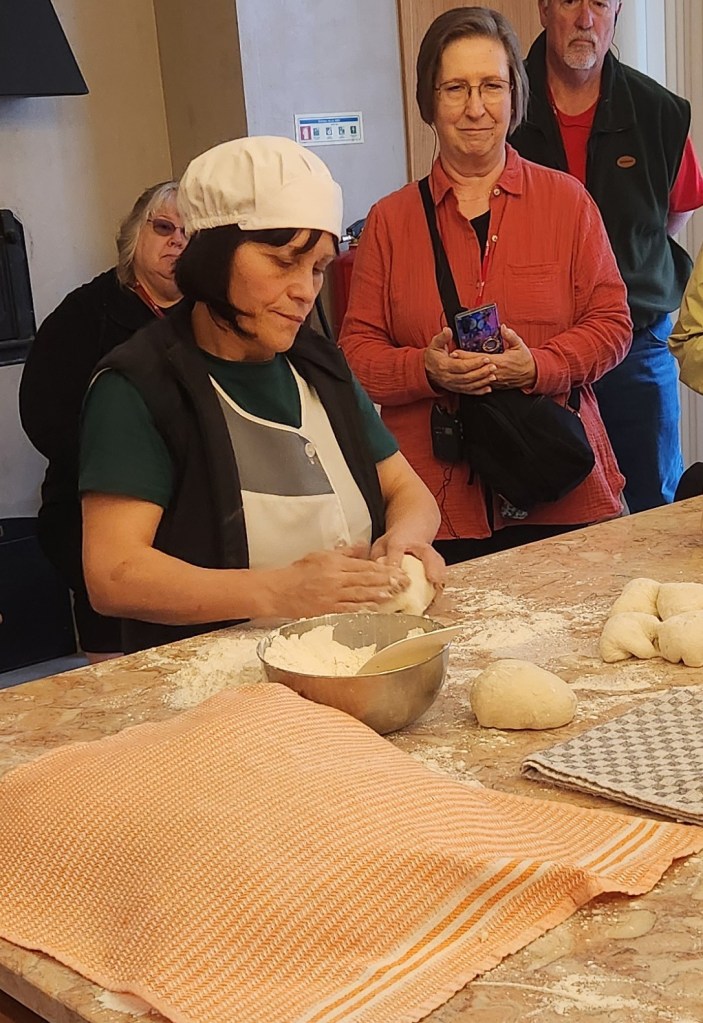
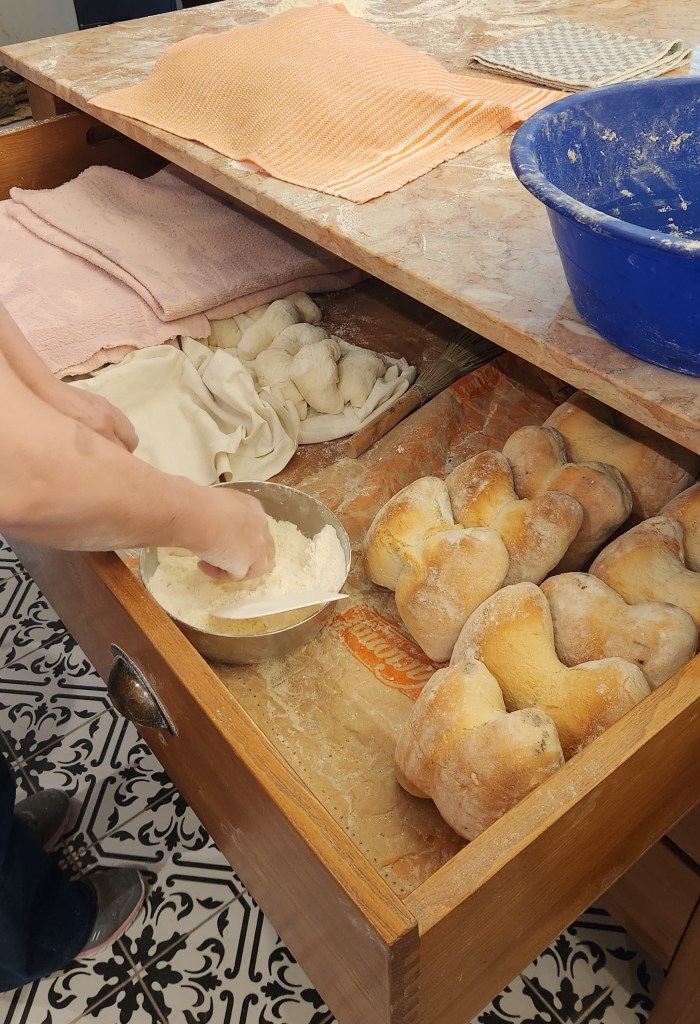
After the wine cooperative, we strolled down the street with a local guide to a bakery where bread is baked fresh daily. Eight bakeries in Favaios create 8000 loaves of the famous Four Corner Bread daily, by hand, using only four ingredients, and bake them in ovens fueled by pine branches. The loaves are distributed by the bakeries to bread shops throughout the region, and they sell out the entire lot every day. We watched as a skilled baker demonstrated the time-honored technique for kneading the dough into a time-honored shape. After witnessing the demonstration, I was delighted to sample the freshly baked bread and satisfy my watering mouth.

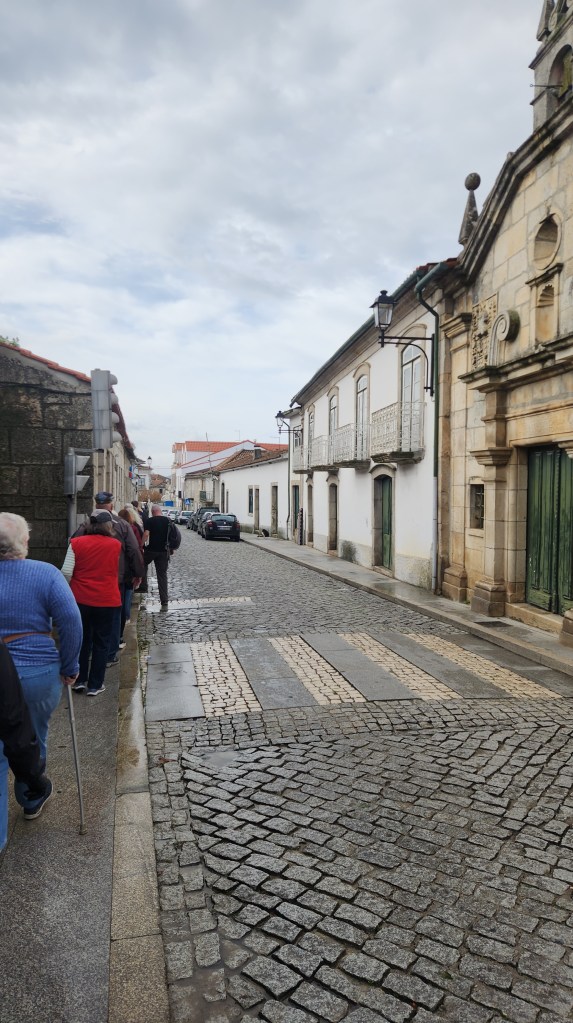
a Favios Street
The Favaios Bakery
Four Corners Bread Dough

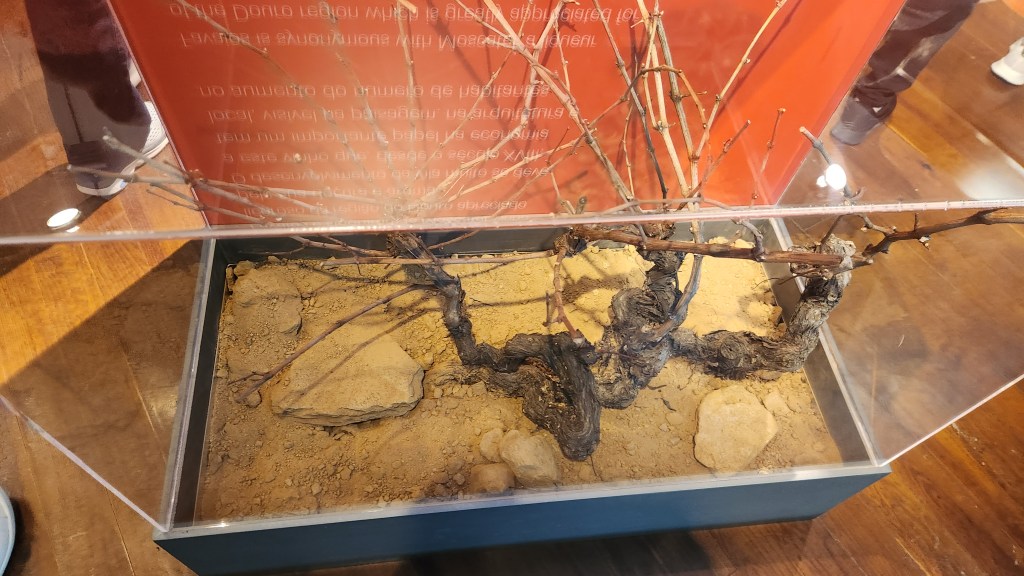
The final stop in Favaios was at the nearby Core Museológico Favaios, the Bread and Wine Museum. Among the exhibits there was a display of the thick grape root stock from America, to which the native wine plants were grafted in the 1800s to combat the deadly infestation of the phylloxera worm that nearly killed the wine industry.

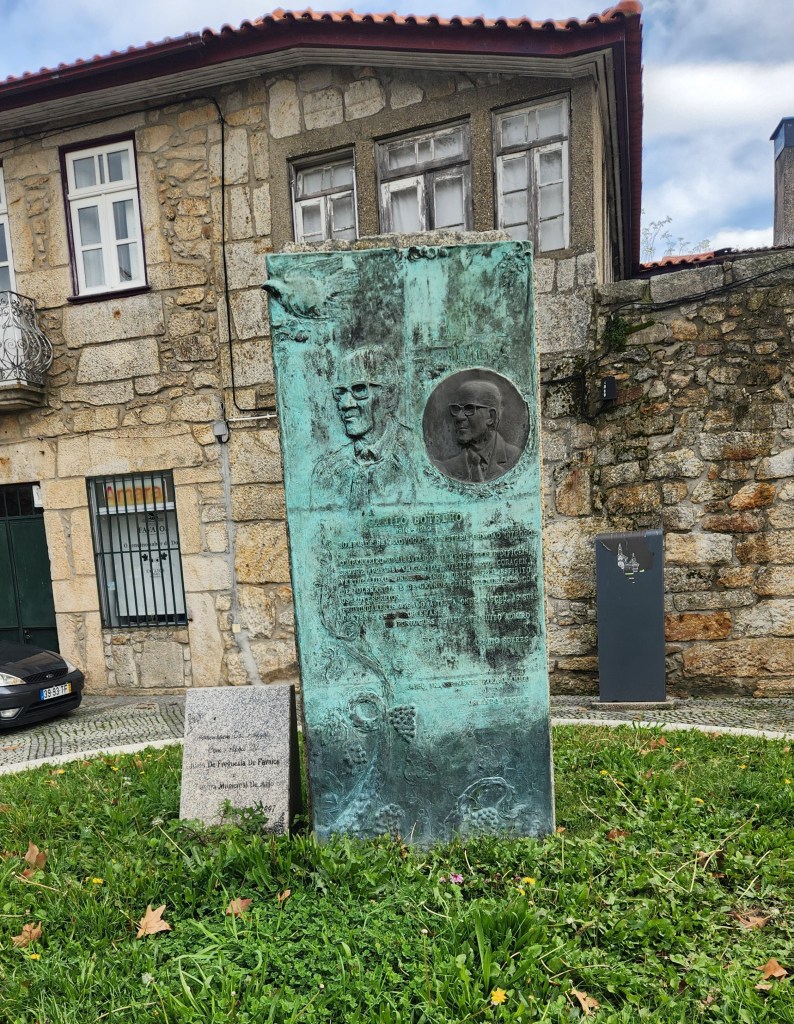
Near the Wine and Bread Museum in Favaios
Museum Display — American Roots for Grafting Native Grapes

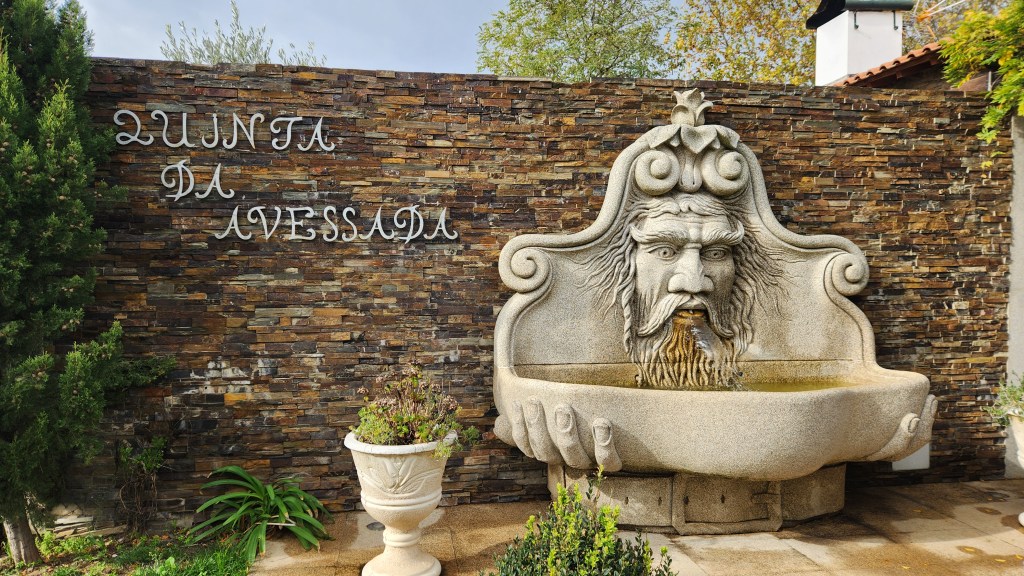
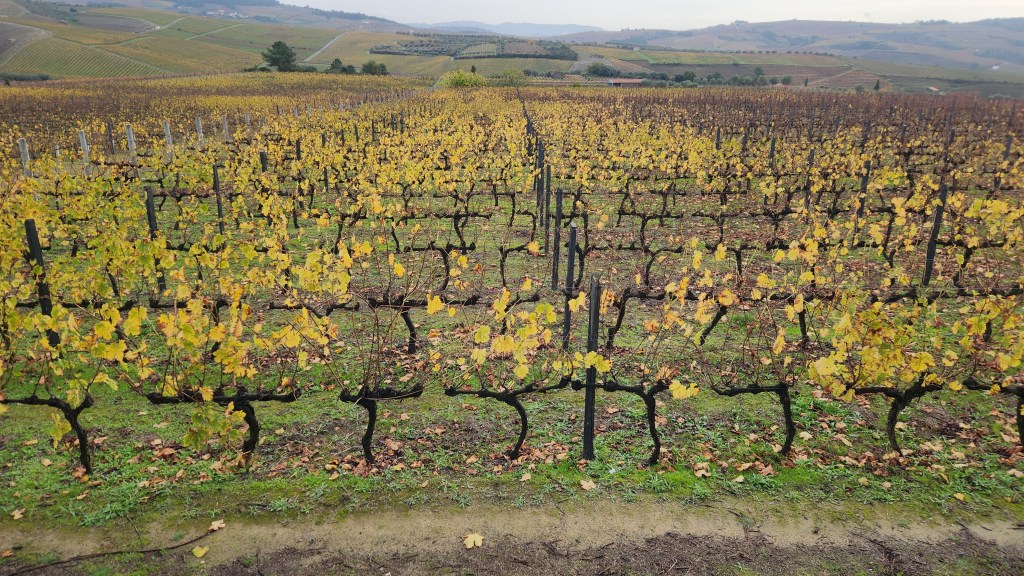
We then rode the tour bus for about 18 miles south to a beautiful vineyard called Quinta da Avessado. This winery is located at the highest point in the demarcated Douro region (1970 feet altitude) on a large, flat plain. Over 90% of the grapes grown on its 60-plus acres of vineyards are supplied to the Adega Cooperative for production of Moscatel. The vineyard and its facilities (including a 100-year-old building) were very beautiful, and we were treated to an excellent lunch, naturally including some of the wines produced from the grapes grown there. As a bonus, we were serenaded by an accordion player as we ate (luckily he had a better technique than my father).

Symbol of the Quinta da Avassado Winery
Quinta da Avassado Vineyards
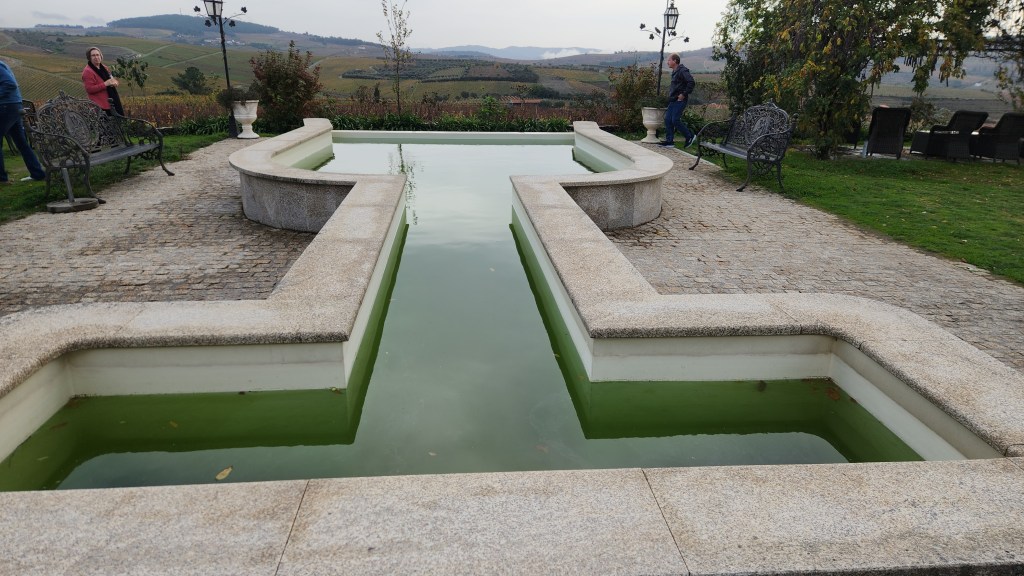
Wineglass-shaped Fountain at Quinta da Avasseda
Homage to the Olden Days
Wine Tasting in the Aging Room

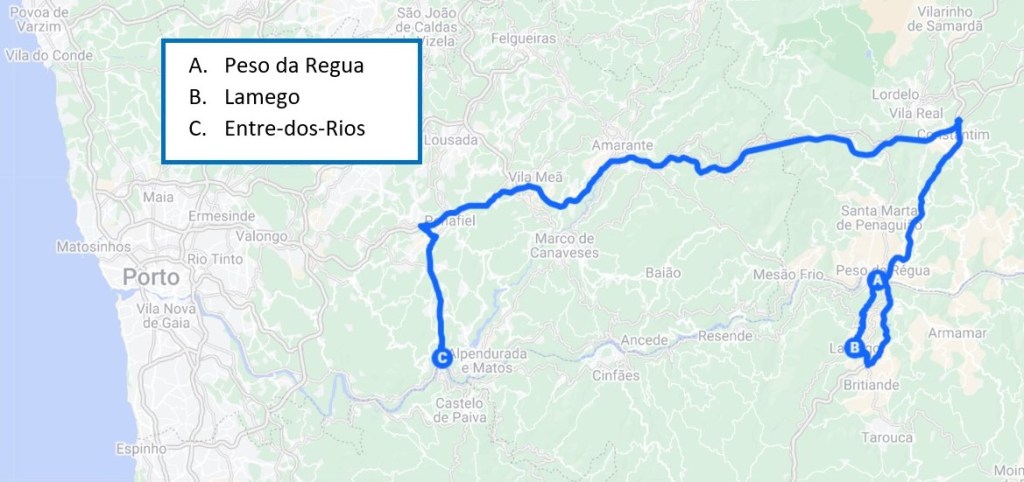
Lamego (November 17): After a night at the Regua pier, we set off at 8:30 AM for a tour of the town of Lamego. While we were enjoying the excursion, the Helgrim set sail again, moving downstream to Entre-os-Rios, where it waited for the excursion participants to return at 12:45. Here’s a map of our shore excursion journey:

Lamego was first settled before the Roman occupation of the Iberian Peninsula and is known for its historic city center. Legend holds that the first Portuguese Cortes (an assembly of nobility, clergy, and bourgeoise) was held in Lamego in 1143, proclaiming Alfonso Henriques as Portugal’s first King. Subsequent Cortes were called and dismissed by the King at will at places of his choosing.

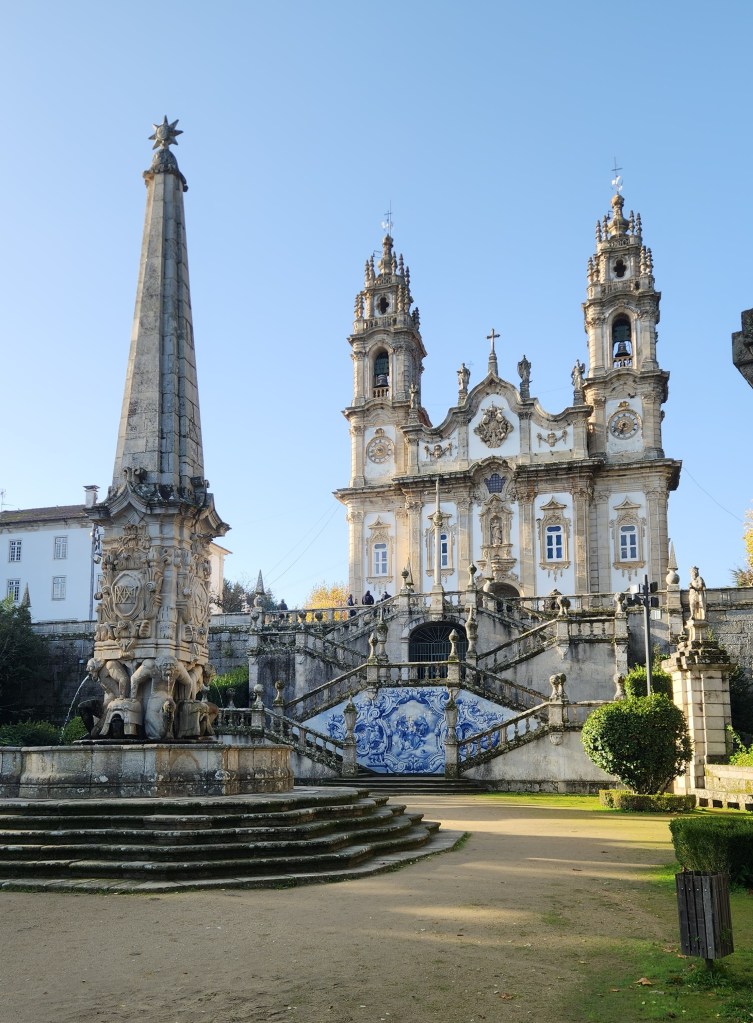
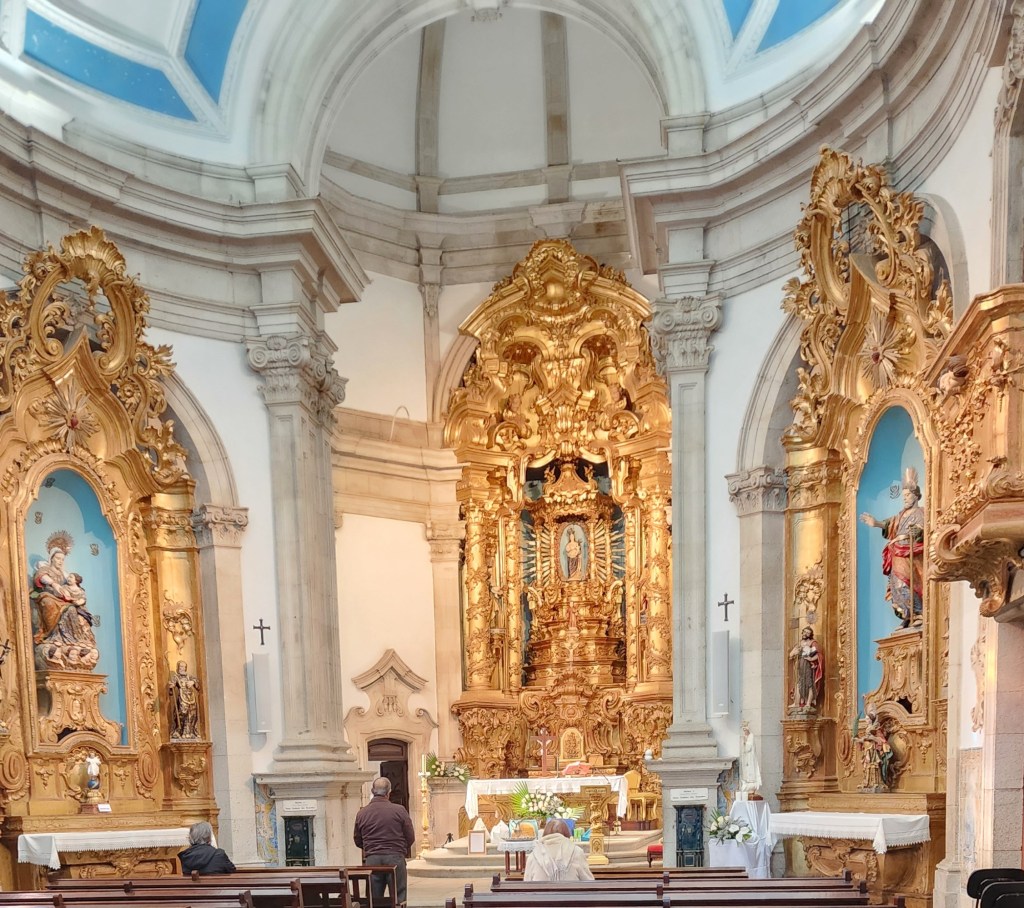
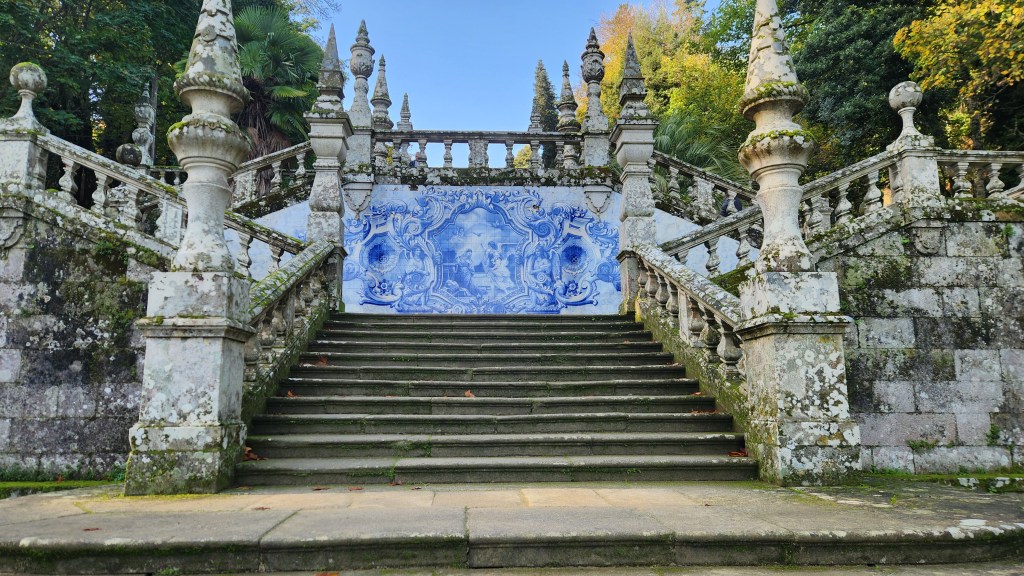
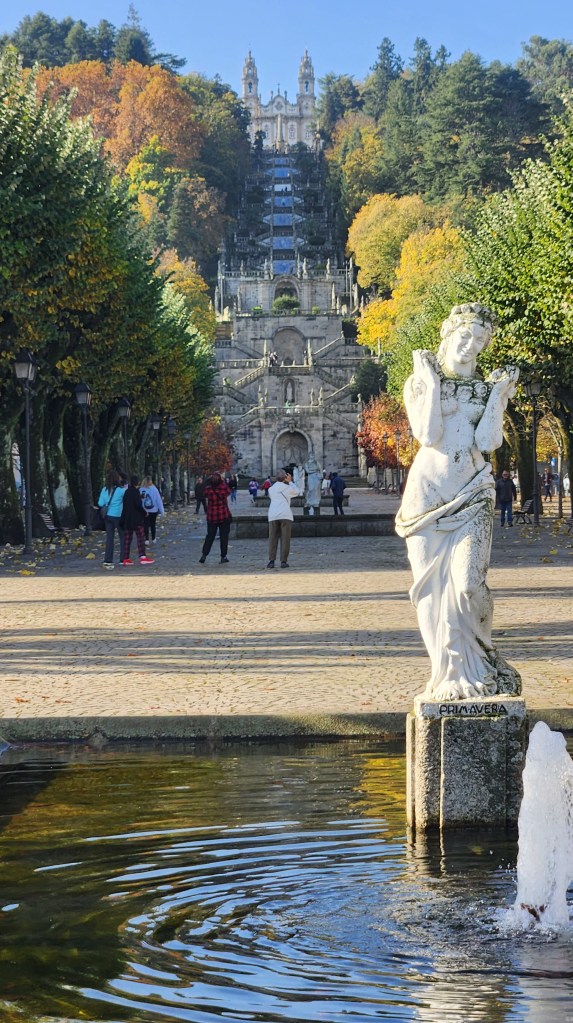
Our first stop was the Sanctuary of Our Lady of Remedies, built in 1750. The church houses an unusual and somewhat controversial statue of a breast-feeding Madonna commissioned at the request of the Bishop of Lamego in the 16th century, initially intended as a shrine to ensure fertility and later seen as a cure for various diseases. The Sanctuary sits at the top of a hill overlooking the city center, accessed by an imposing staircase with 686 steps and beautiful porcelain artworks depicting various historical or religious scenes. Pilgrims hoping to be blessed or cured would climb these steps on their knees to show their devotion before reaching the Sanctuary and kissing the Madonna statue. The church includes many other artworks as well, including a statue of baby Jesus that the nuns carefully dress from head to toe, including stockings.

Sanctuary of Our Lady of Remedies
Inside the Sanctuary
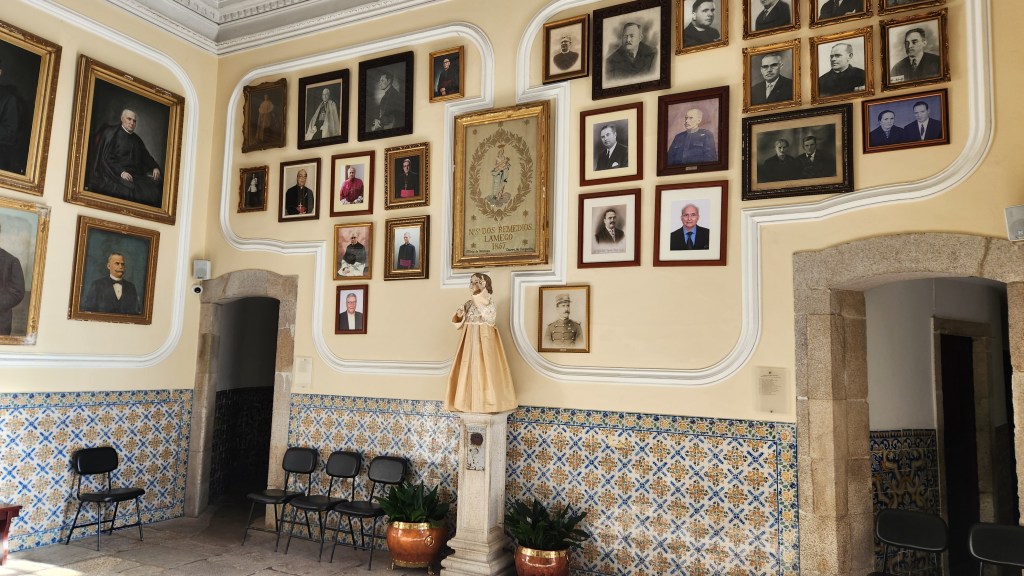
Artworks in the Sanctuary, including Baby Jesus Statue

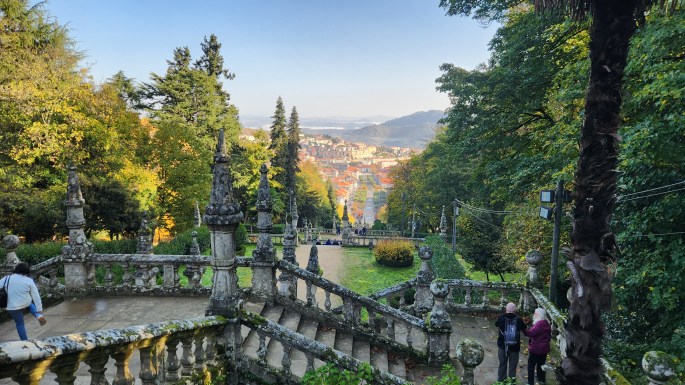
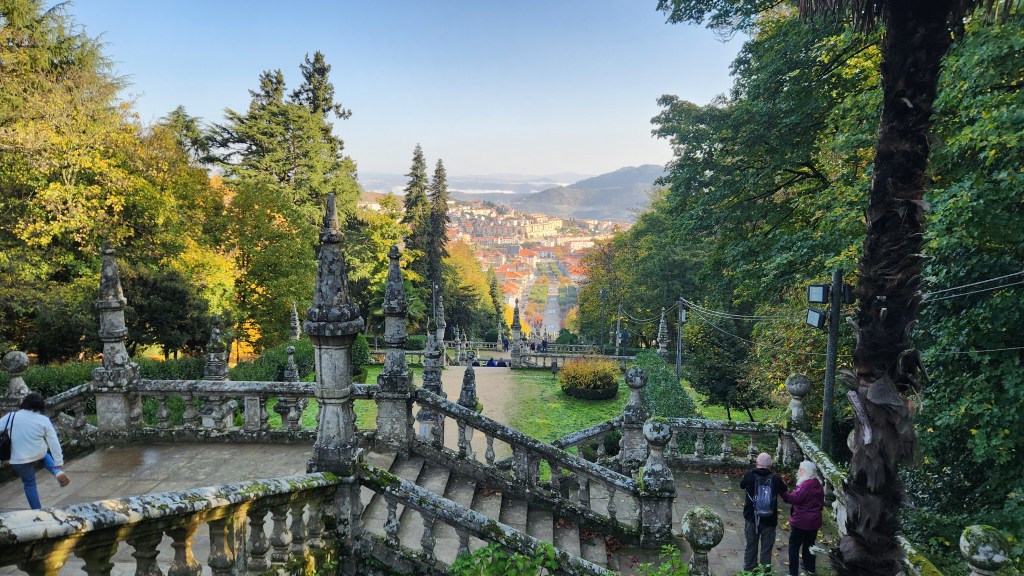
After touring the Sanctuary, we descended the steps to the city center, which provided the stunning views pictured below. Nerd that I am, I tried counting the steps on the way down and came up two off from the official 686, though I’m sure the guidebooks have the correct number.

View from the Sactuary Plaza
One of the Ceramic Tile Murals
View of the Sanctuary from Below

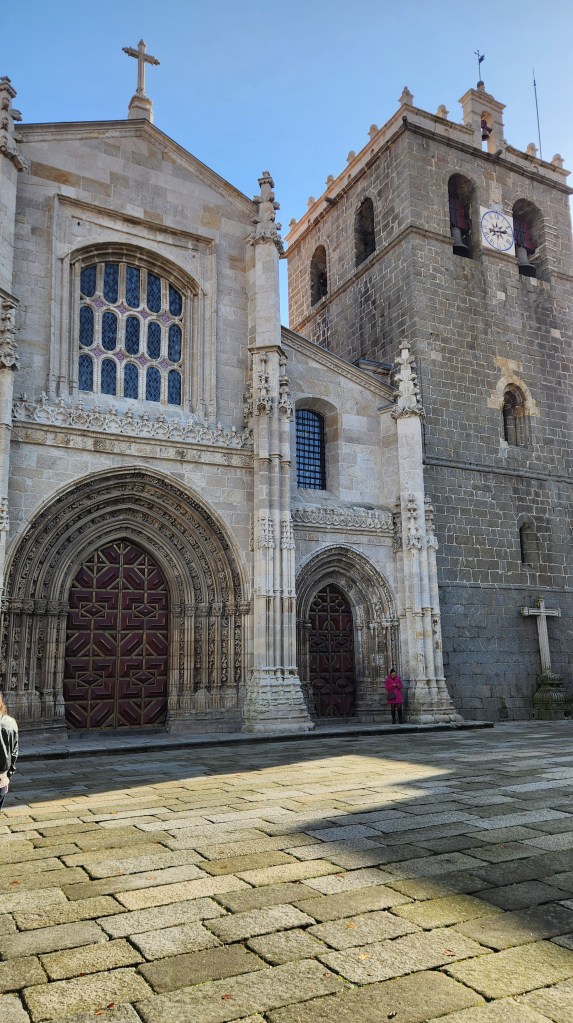
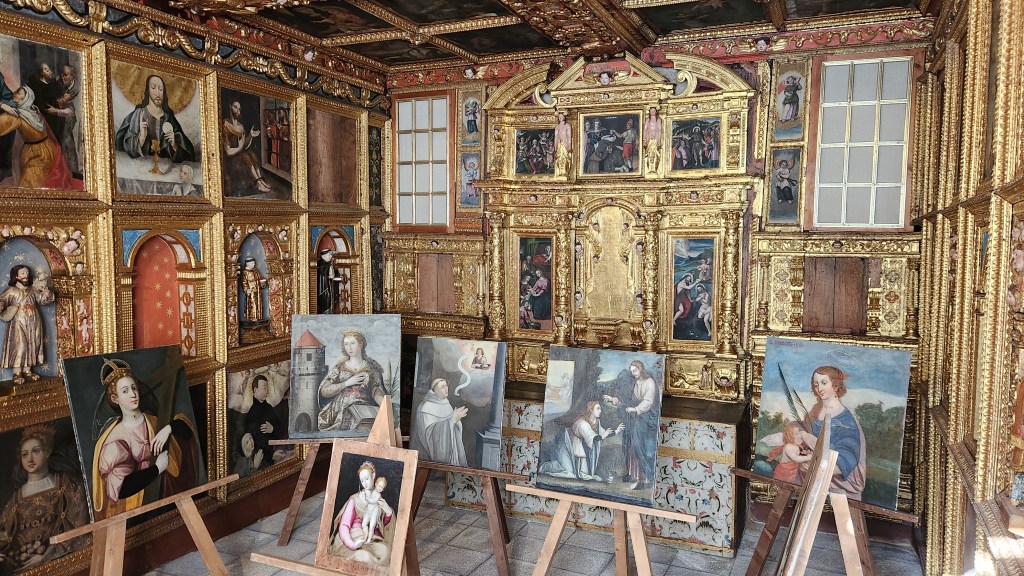
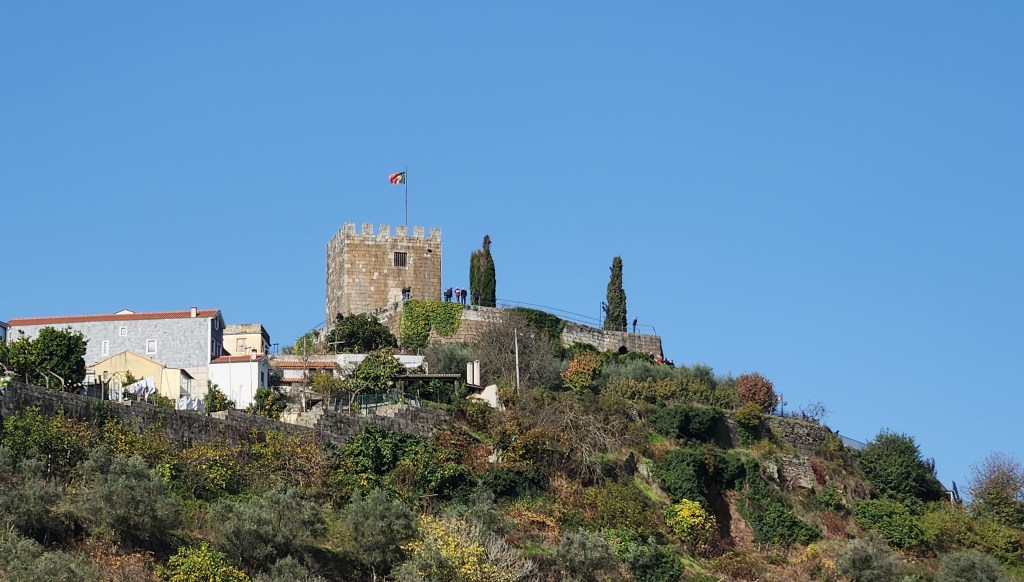
Once in the city center, we visited the Cathedral, which was founded in 1129 and still serves as the seat of the diocese of Lamego that was originally established in about 570. From the city, we had a good view of the medieval castle built in the 12th century by Ferdinand of Leon.

Cathedral of Lamego
Artworks in the Cathedral
Hilltop Castle in Lamego

In the city, we bought a purse and a wallet made from cork — Portugal is the world’s leading cork producer, accounting for over 60% of world supply, and Lamego had a lovely shop that specialized in cork products. As we were leaving town, I noticed some odd-looking trees, which are a type of oak with no leaves. Cork-producing oaks are the most valuable type in Portugal, but there are also many evergreen oaks and quite a few of these Dr. Seuss-like ones.

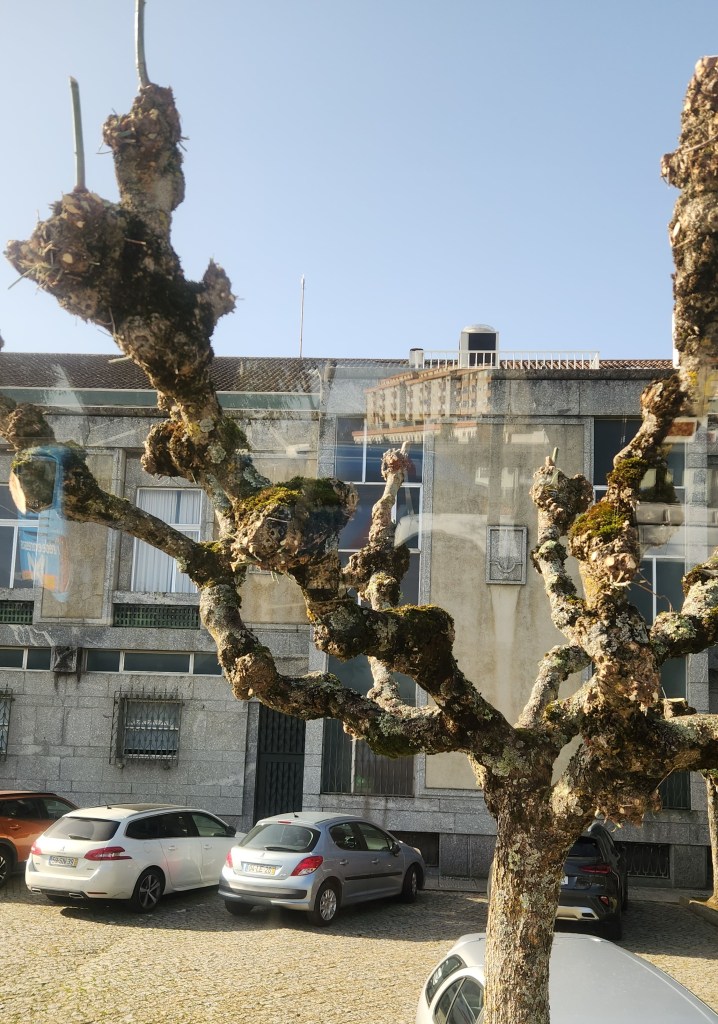
Unusual Oak Tree in Lamego

After a long drive through the impressive Portuguese countryside, we reboarded the ship at Entre-os-Rios. Once all the excursion passengers were aboard, the Helgrim resumed sailing downstream to its starting point at the pier in Vila Nova de Gaia where it docked for the night.

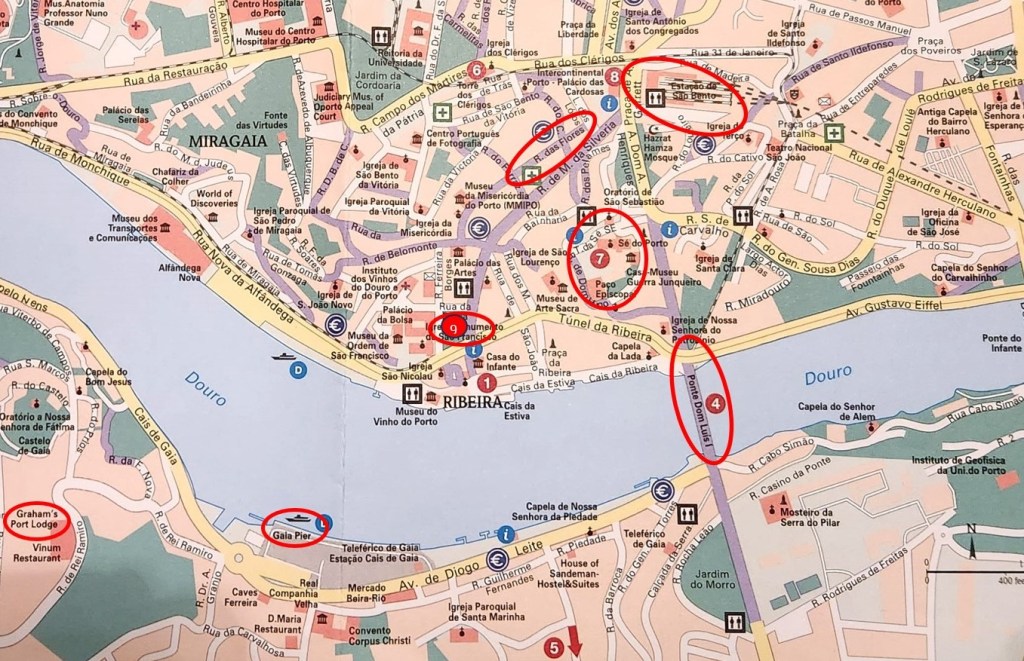
Porto (November 18): On Monday the 18th at 8:30 AM we left the Helgrim at its dock in Porto for a short bus ride to a bridge across the Douro River linking Vila Nova de Gaia, or just Gaia as the locals call it, and Porto. There we met up with a local guide who led us on a walking tour of the city. The map below shows some of the interesting places we saw on the excursion.

Our tour stops and points of interest included the following.

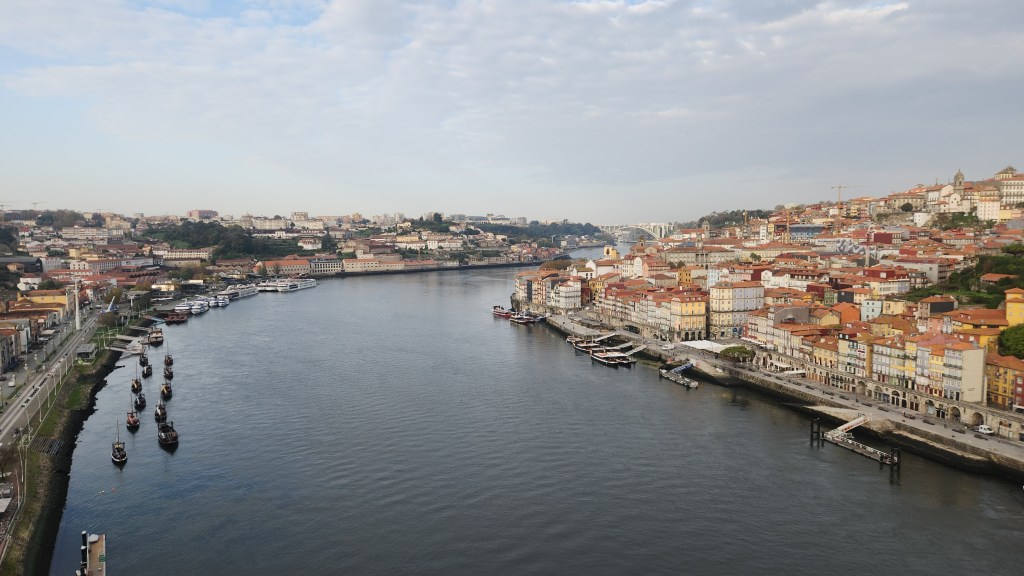
  • We began by crossing the Luis I bridge (location 4 on the map above) from Gaia into Porto. Here are some photos looking downriver and upriver from the bridge.
The Luis I Bridge connecting Porto and Gaia
Looking Downriver from Luis I Bridge
Looking Upriver from Luis I Bridge
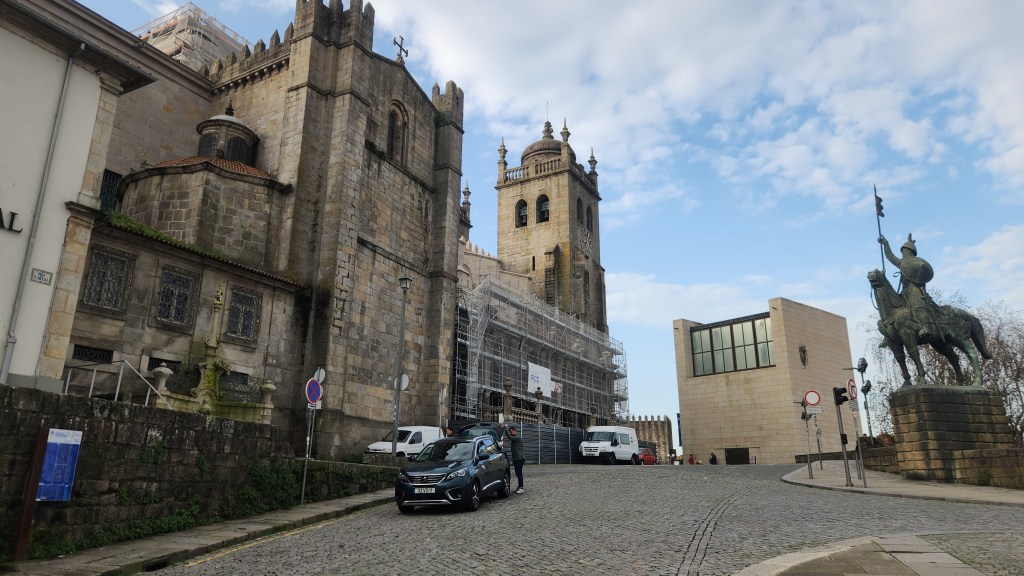
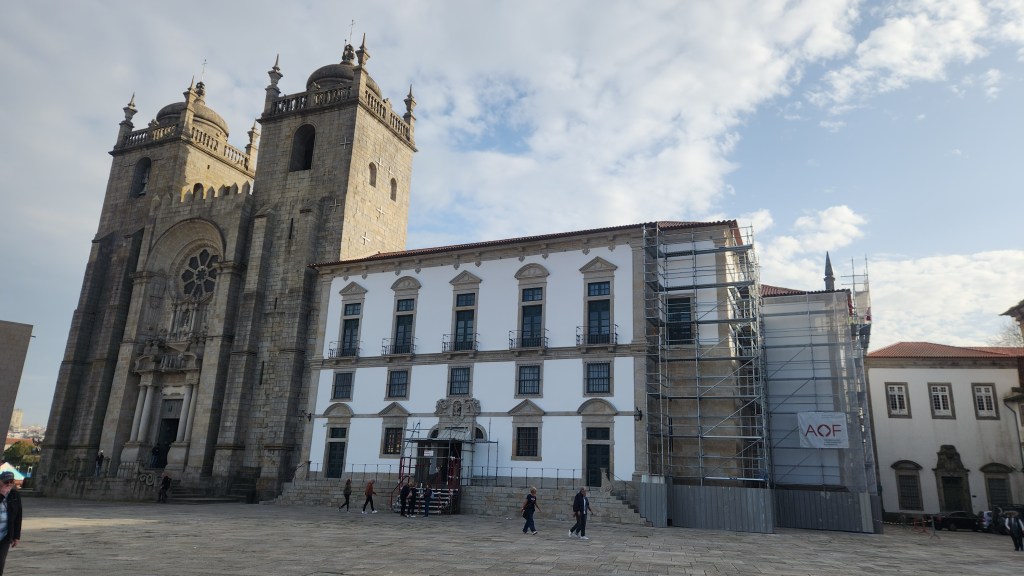
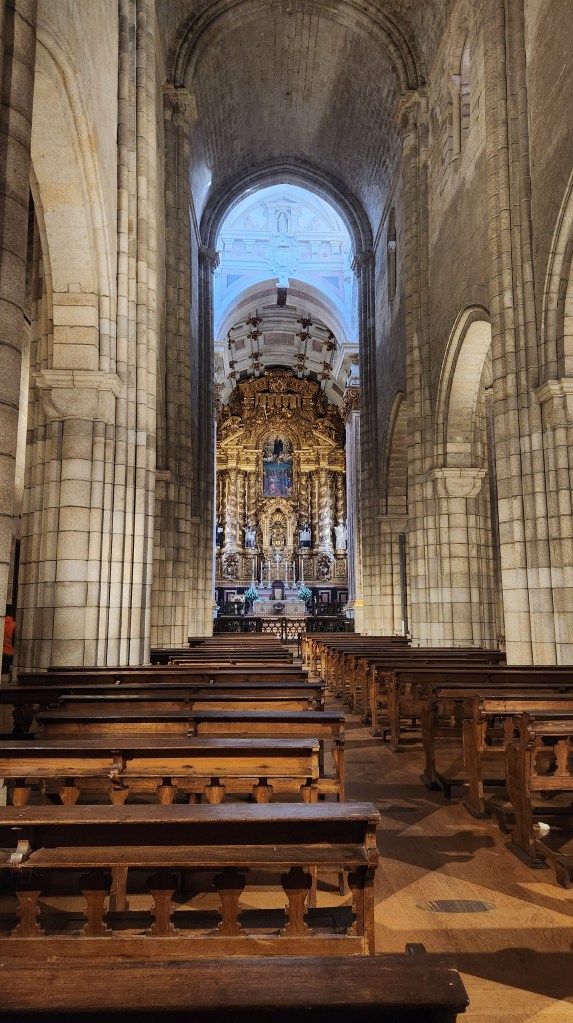
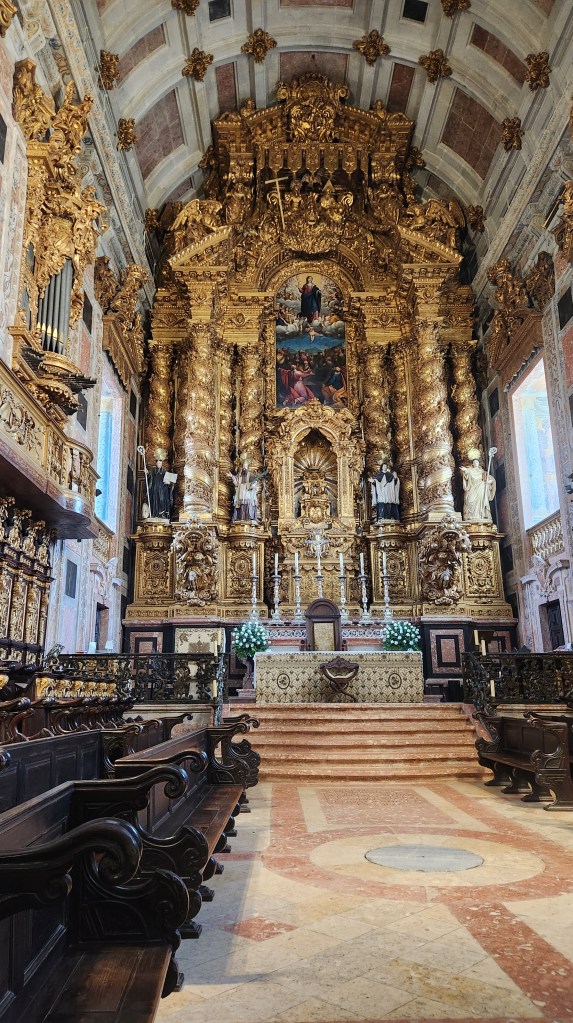
  • The Cathedral of Porto (location 7). Construction of the Cathedral began in the second half of the 12th century and work continued until the 16th century. There were major Baroque additions in the 18th century, and further changes were made in the 20th century.
Porto Cathedral Viewed from the Northeast
Porto cathedral and Monastery Viewed from the West
Cathedral Interior
Cathedral Altar
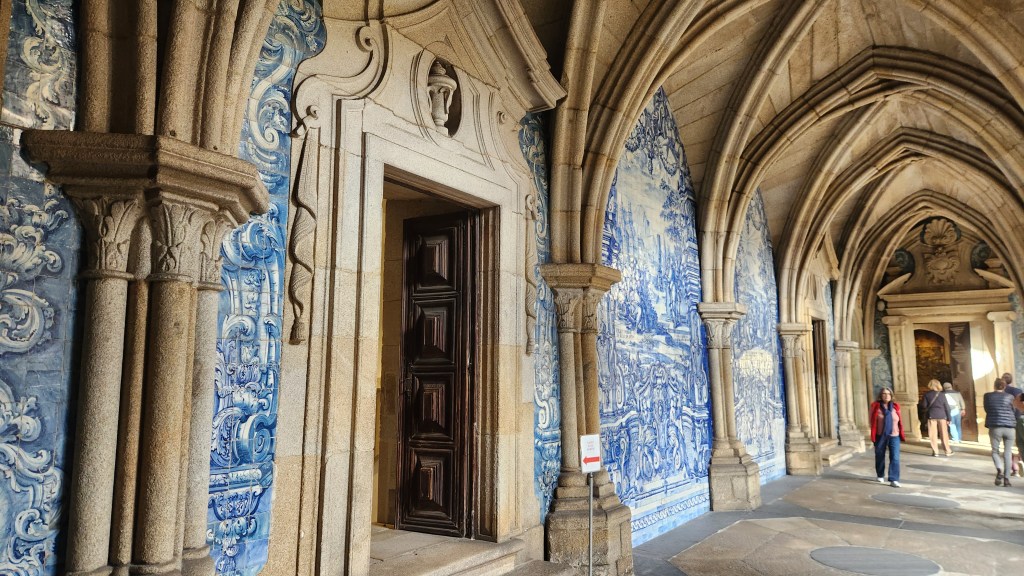
Monastery Cloister with Ceramic Tile Murals
Monastery Room with Ceramic Tile Murals
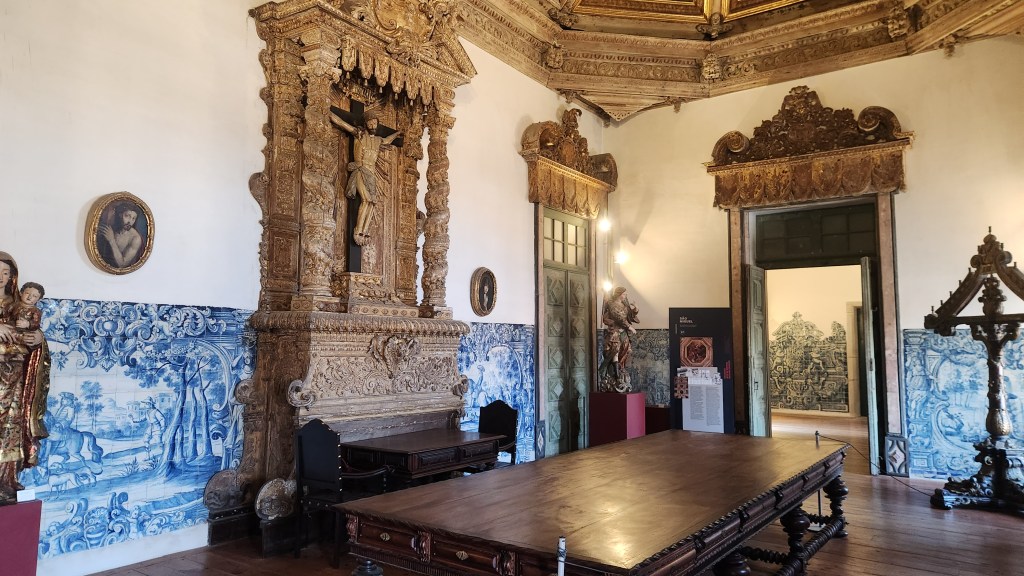
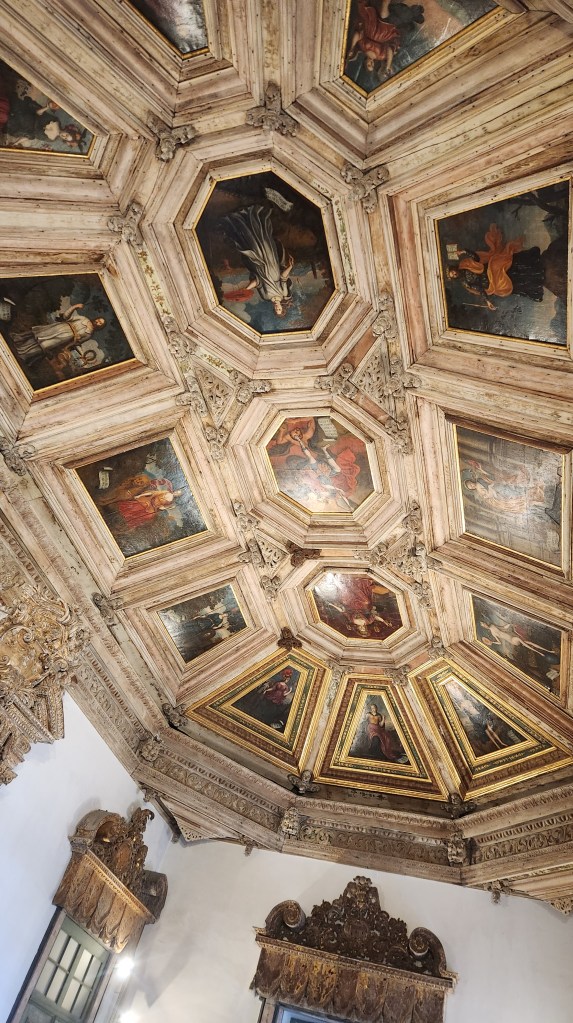
Ceiling in the Monastery
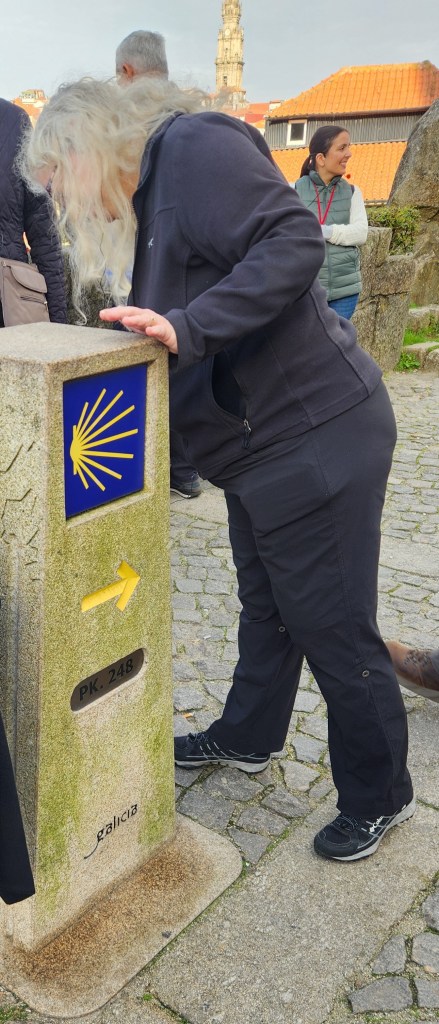
Is she looking for the way to Santiago de Compostela? The shell symbol marks the route.
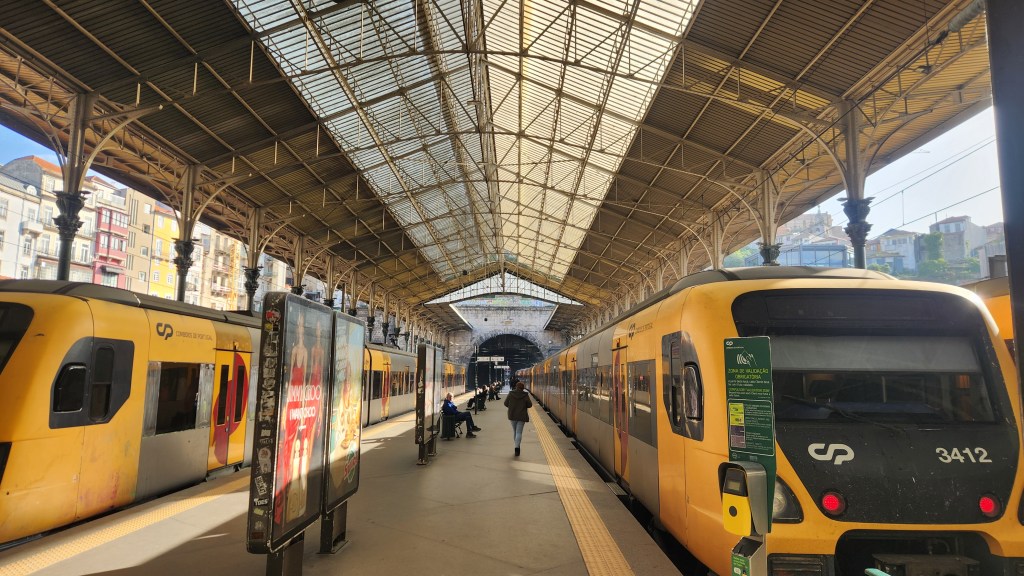
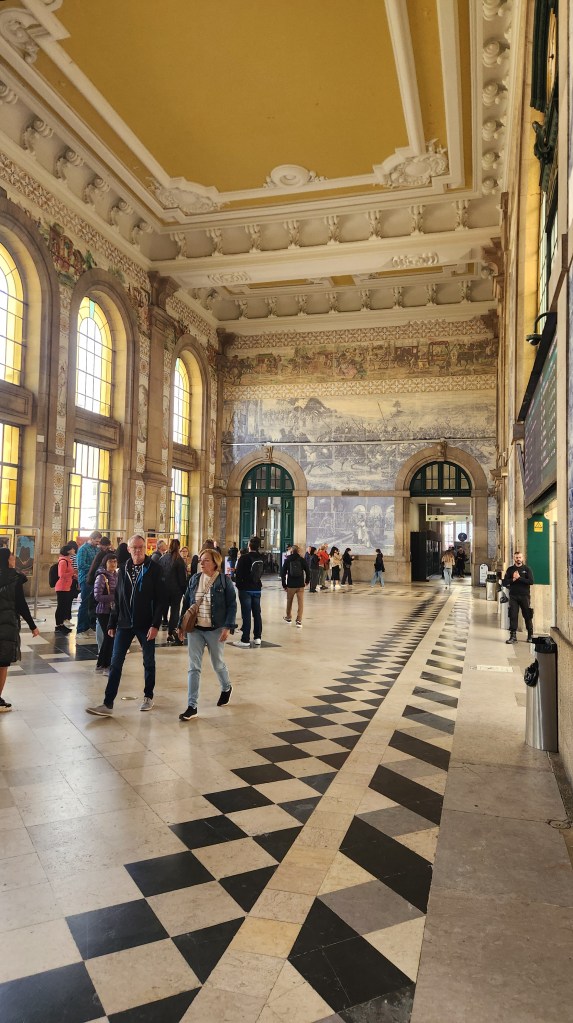
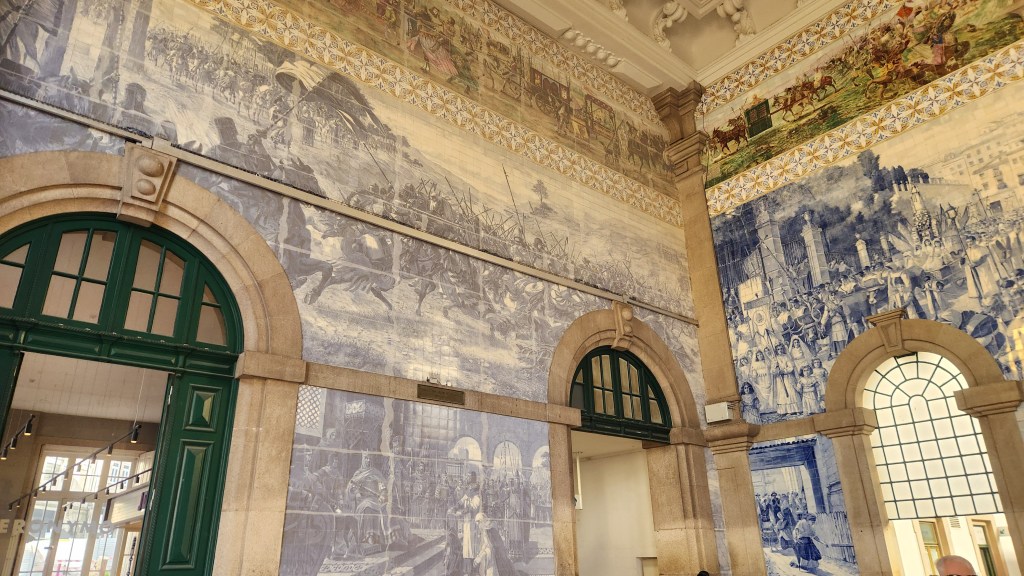
  • Sao Bento Railway Station (location 8). This is a major rail hub serving all of Portugal.  Construction of this building began in 1904, and the entry hall includes beautiful ceramic panels illustrating the history of Portugal.
The Railway Station
Railway Station Entry Hall with Ceramic Tile Murals
The Murals Illustrate the Story of Portugal’s History
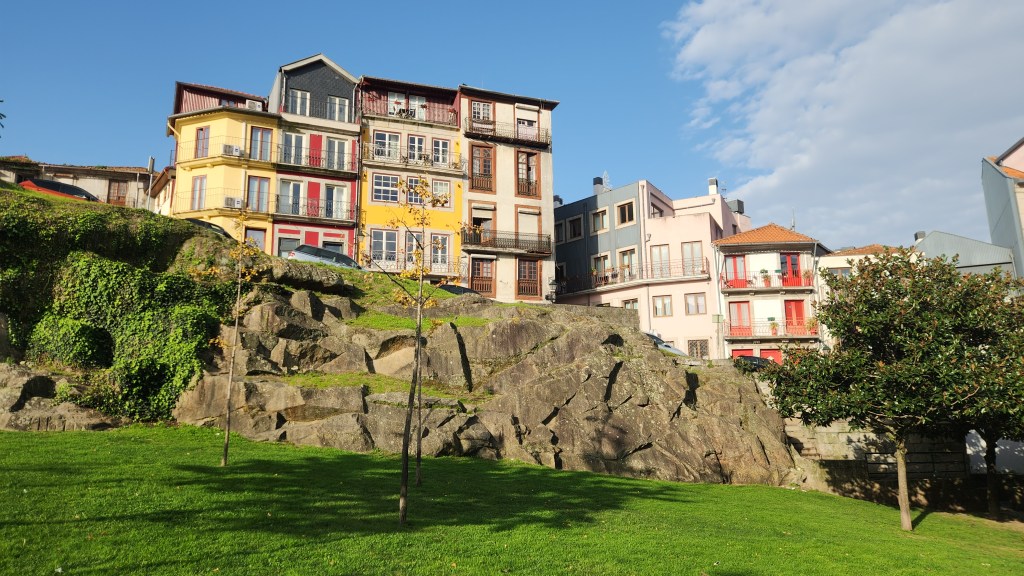
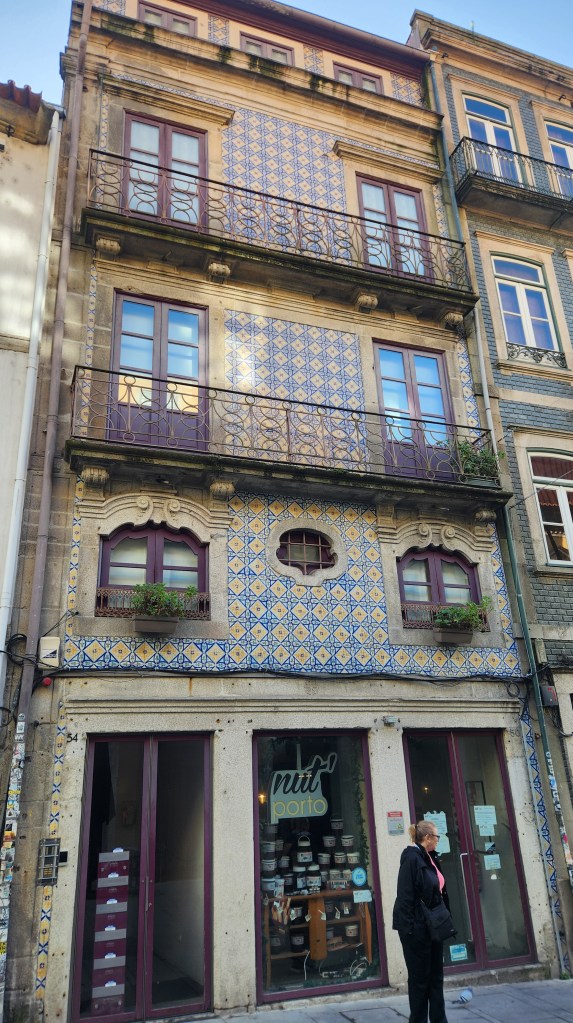
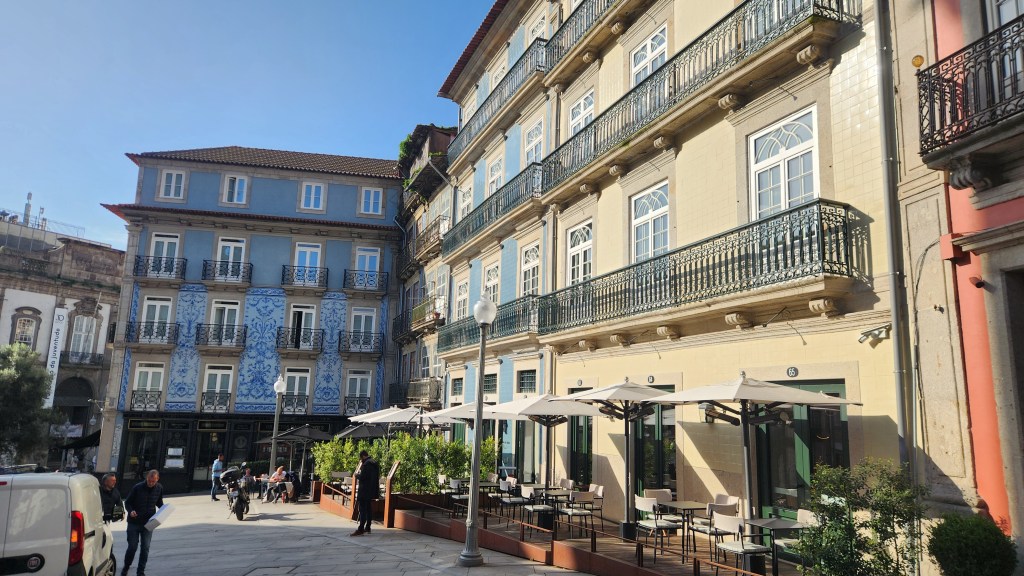
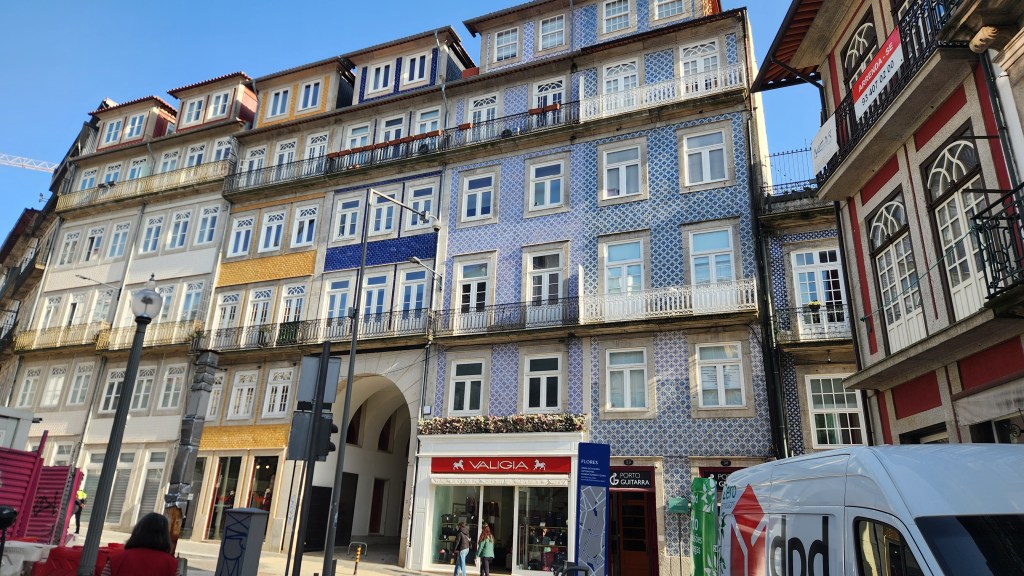
  • Various streets of the city, including Rua des Flores (Flower Street), a major shopping boulevard. Here are some photos illustrating the architecture, especially the lovely balconies and ceramic tiles.
On the way from the Cathedral to the Railway Station
Shop and Apartments near Flower Street
Restaurant and Apartments near Flower Street
Well-kept or renovated apartments sell for six figures in Porto
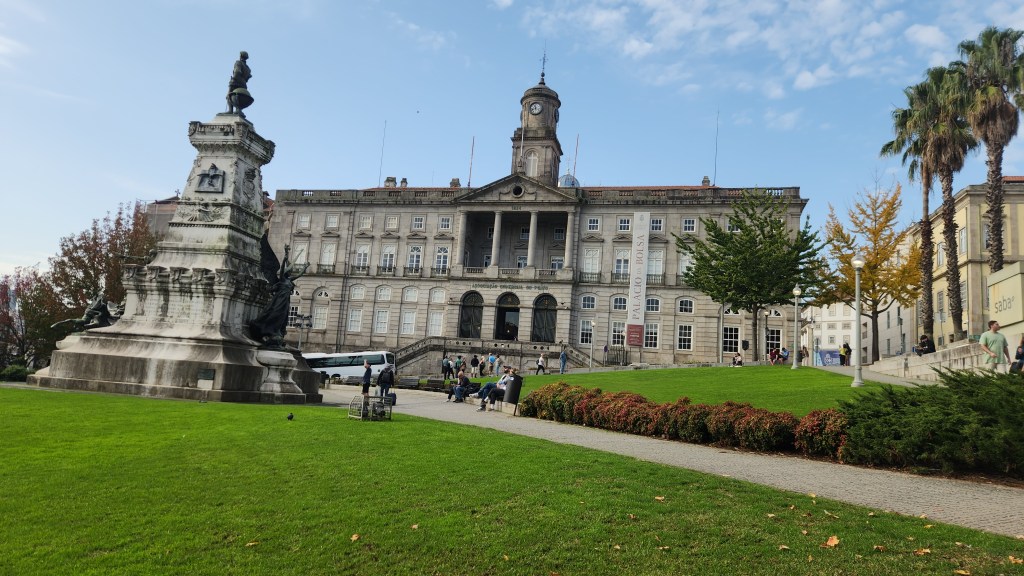
  • A plaza (location 9) dedicated to Prince Henry the Navigator (1394-1460), regarded as the main initiator of the Age of Discovery during which Portugal explored much of the world.
Prince Henry the Navigator

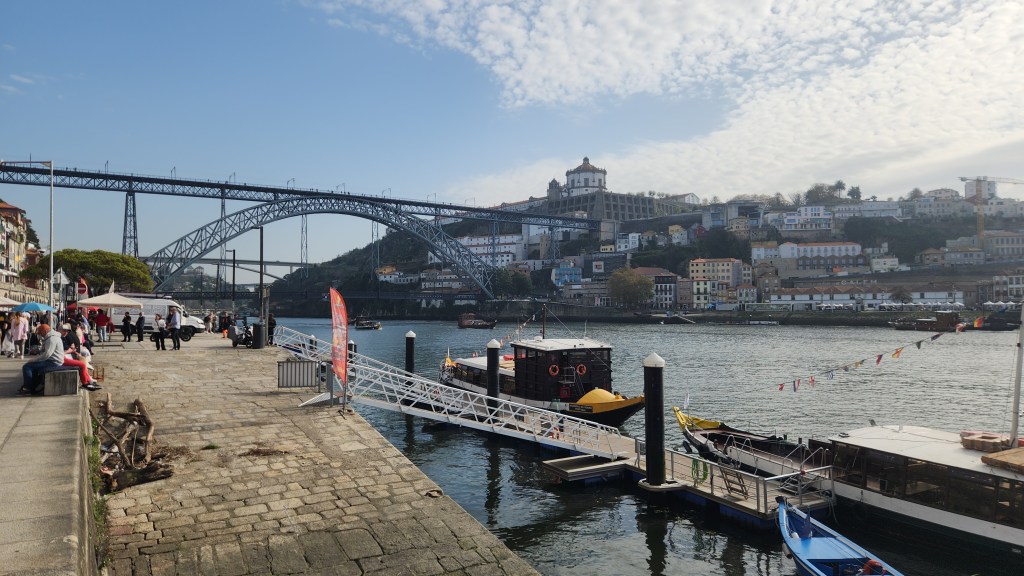
After the walking tour, we took a water taxi across the Douro River and walked back to our ship moored at the Gaia Pier, arriving about 12:15 PM.

The Water Taxi Dock

Note that the map above also shows the location of Graham’s Port Lodge, which we visited back on November 12 as described in Part 2 of this series.
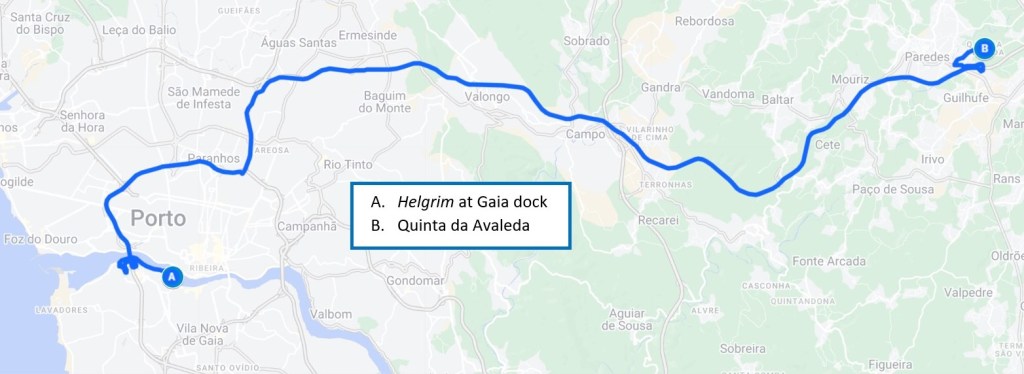
Quinta da Avaleda (November 18): After lunch aboard the Helgrim, we disembarked for our final shore excursion at 1:45 PM. We rode a tour bus with a small group of passengers to visit the beautiful winery of Quinta da Aveleda and its amazing garden.

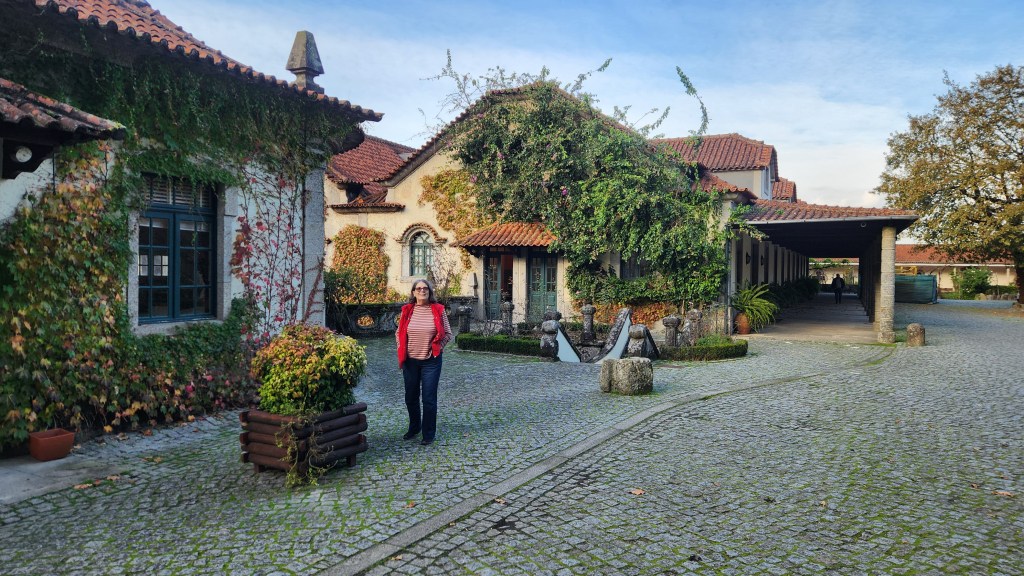
The main building was built in 1671 by a wealthy Portuguese family. Manoel Pedro de Guedes, an important Porto politician, inherited the property and established the estate in 1870, including the vineyards and the incredible garden. The Guedes family still owns the estate and uses the main house for family gatherings, but the estate is open for public tours and has become a highly popular tourist destination. After touring the garden, we sampled several wines produced under the Casal Garcia brand from grapes grown throughout Portugal, but the garden was the truly amazing aspect of the estate, including granite buildings, vineyards, a lake, a teahouse, fountains, gothic ruins, streams, oak trees, camelias, azaleas, eucalyptus, and sequoias. I’m sure readers are getting tired of my verbose descriptions, so I’ll just leave off with some of the photos I took.

The Commercial Winery Building with Gift Shop
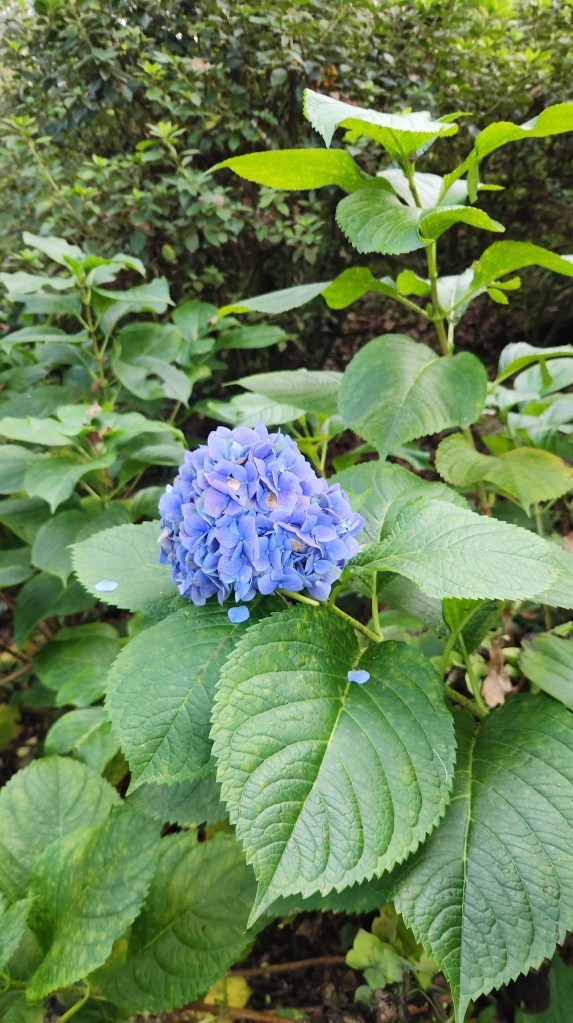
Beautiful Rhododendron (I think)
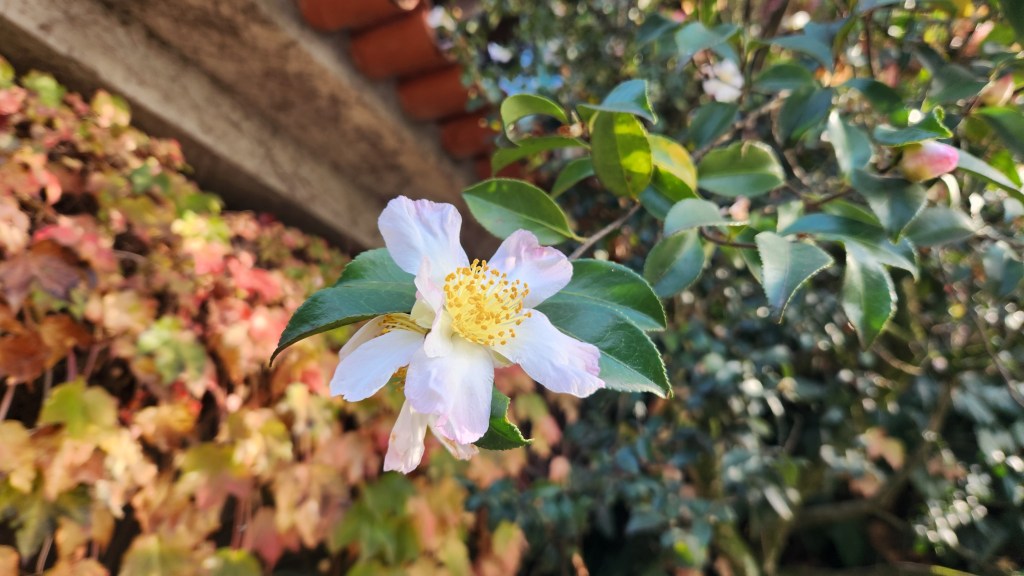
The Camellias were Blooming Early due to Warm Weather
Stairway to Heaven?
An Old Oak Tree (but no yellow ribbons …)
Strolling Down the Garden Path …
Hunting Lodge and Fountain
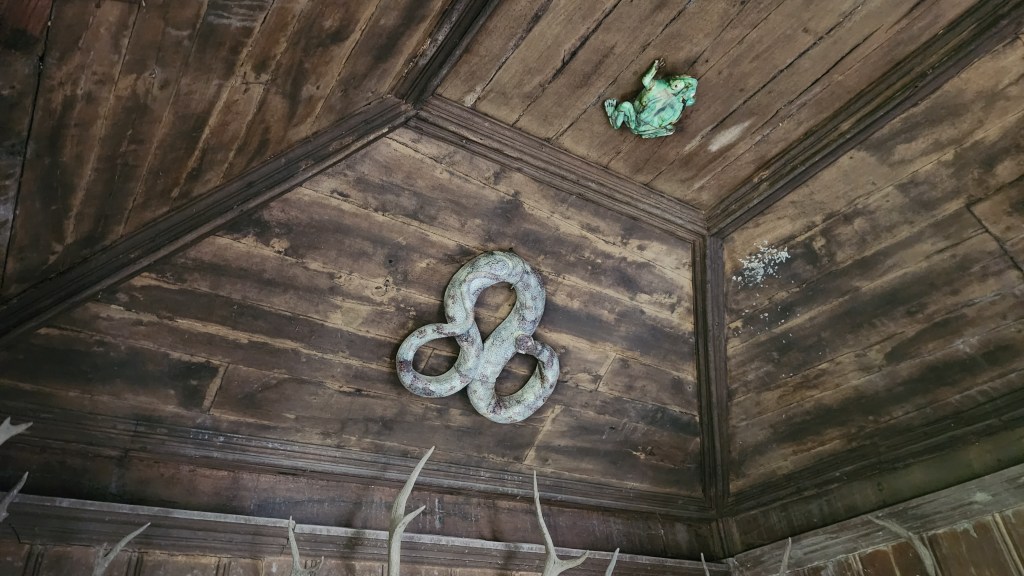
Hunting Lodge Ceiling
Vineyards seen form the Garden
Vineyards by the Garden
The Family Home, originally dating from 1671
A Lovely and Appropriate Mascot

The trip home (November 19-20): Why did it take two days to get from Porto to Minneapolis? Well, we had a glitch, the one and only disappointment of the entire trip. We left the Helgrim at 3:30 AM on Tuesday the 19th, boarding our Viking bus and heading for the Porto airport to catch a 6 AM flight to Frankfurt, Germany, from where we were booked on an 11:15 AM Lufthansa flight to MSP. All went smoothly through boarding at Porto, but once all the passengers were on board and the doors closed, the pilot announced that our flight would be delayed due to a problem with one of the runways in Frankfurt. So, there we sat, for well over an hour, and by the time we finally took flight and arrived in Frankfurt, our MSP flight was long gone. After attempting to navigate some incredibly long lines at several Lufthansa service counters, we received emails explaining that we were now booked on the 11:15 flight the next day and that we were receiving vouchers for an overnight stay in a nearby Frankfurt hotel. Off we trudged to find the hotel shuttle bus, which deposited us at the Intercity Hotel at 12:22 PM. Unfortunately, our luggage was still in the baggage queue at Lufthansa, including our clothes and toiletries as well as my medications, so we had to go without. Luckily, Pat had a travel toothbrush, so at least Pat didn’t have to abide my schnitzel-tinged breath all night. Thankfully, the voucher did cover dinner and breakfast, but we had to pop for our own lunch.

The only upside to this glitch was that our Wednesday flight to MSP was only about two-thirds full, so we were able to spread out comfortably. I watched a couple of movies while Pat dozed across the aisle, and the flight was uneventful. Once at MSP, we had our first test of the Global Entry system that we enrolled in last spring. After landing, we each submitted a request using the Global Entry apps on our phones, receiving electronic receipts that allowed us to whisk through a special customs line in a matter of minutes – definitely worth the $100 fee, which is good for five years and also includes the TSA PreCheck system for boarding flights.

After another Lyft ride from MSP, we made it back to our condo at 5:01 PM on Wednesday, a mere 31 hours after leaving the Helgrim, rather tired but exceedingly pleased with our Intrepid Iberian Interlude. I hope readers have enjoyed the journey as well.

OK, that’s a wrap. Thanks for reading, and stay tuned for more adventures in the future!

Pat and Dave’s Intrepid Iberian Interlude – PART 3: Mateus Palace, Castelo Rodrigo, Salamanca

Welcome back for Part 3 of this narrative of our recent trip to the Iberian Peninsula. Part 2 described our travel from Lisbon to Porto, via Coimbra, and our journey up and down the Douro River. In this episode, I’ll describe three of the shore excursions we took during the river cruise.

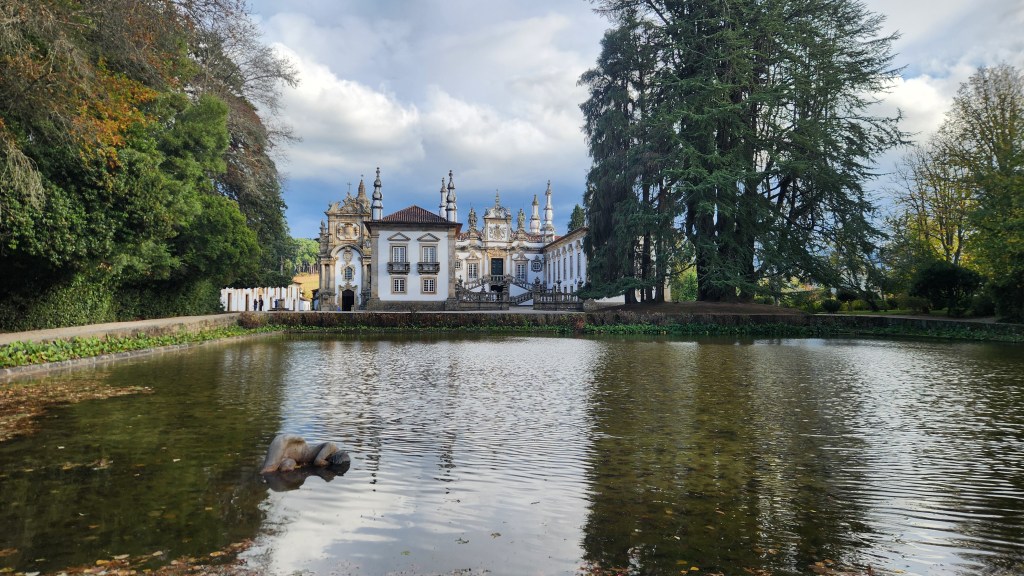
Mateus Palace and Gardens (November 13): On Wednesday the 13th, after sailing from Vila Nova de Gaio to a pier near Lamego, we disembarked at 2:30 PM for a 20-mile bus drive to the Mateus Palace located in the Mateus parish of the city of Vila Real. After touring the palace and its magnificent garden, we drove back to the ship, which by then had sailed further upriver to Pinhão and docked for the night.

The Mateus Palace was built around 1740 on the site of an estate originally built in the early 1600s by a family of wealthy vineyard owners. The third-generation owner, António José Botelho Mourão, had it designed and constructed by Nicolai Nasoni, an Italian architect widely-known for his work throughout Portugal. It was designated as a National Monument in 1910 and is now a major tourist attraction. The interior decoration includes intricately carved chestnut wood ceilings, furniture from several periods, 17th and 18th century paintings, and an impressive library with hundreds of books.

The Mateus Palace and its Reflecting Lake
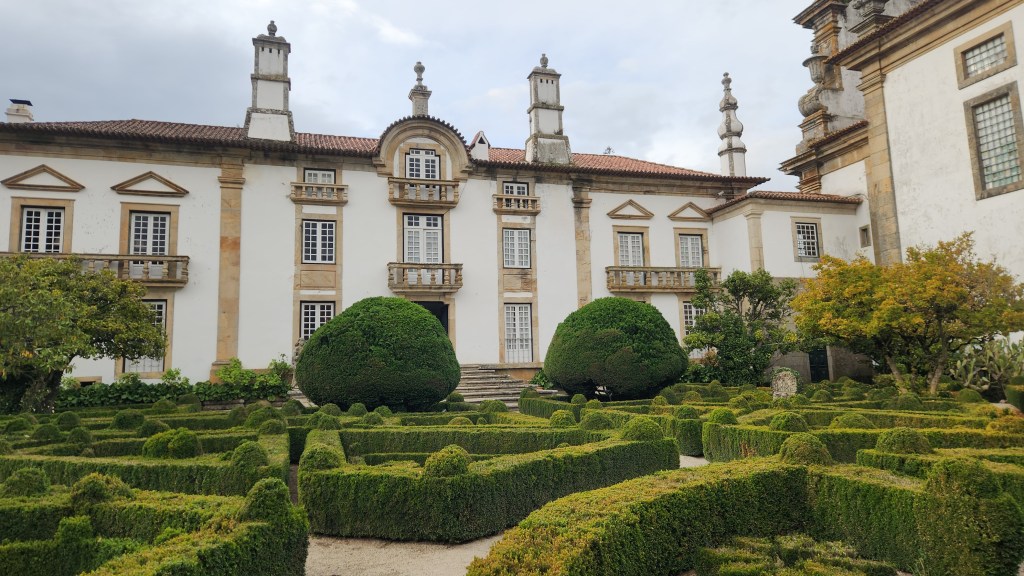
Wing of the Mateus Palace
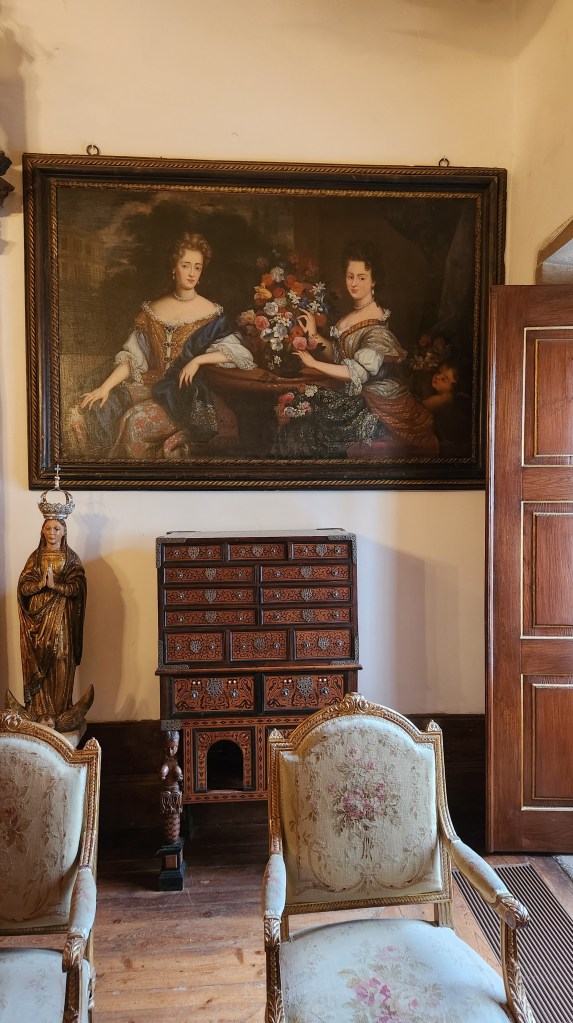
Decor, Including Painting, Cabinet of Drawers (with secret codes for opening each drawer), and Chairs
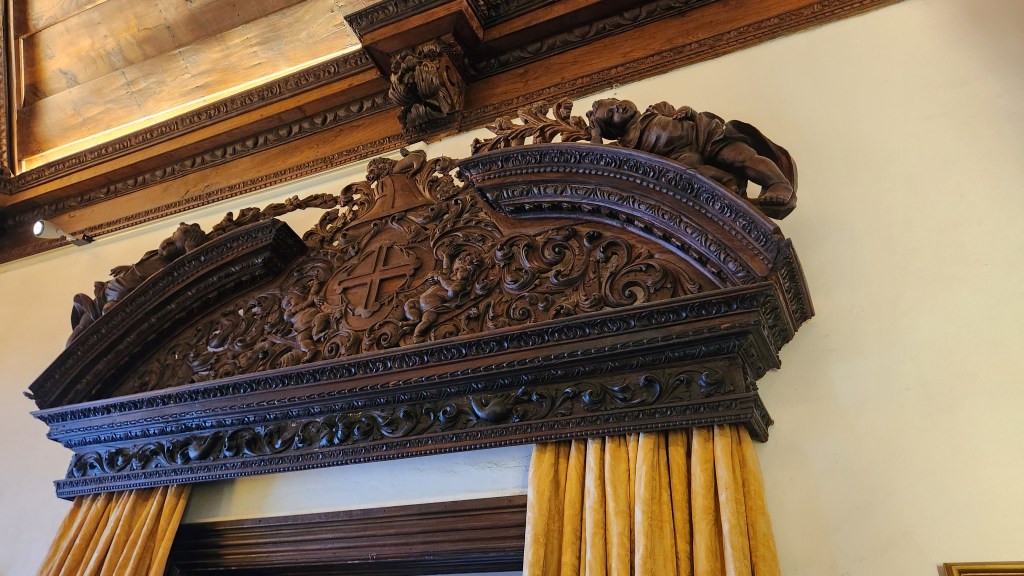
Oak Carving above Window
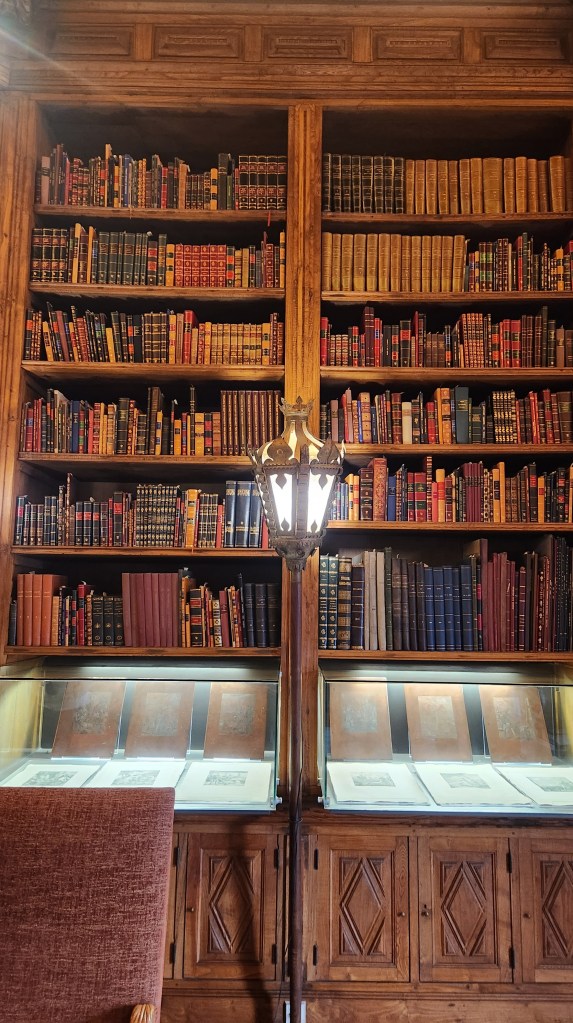
The Library
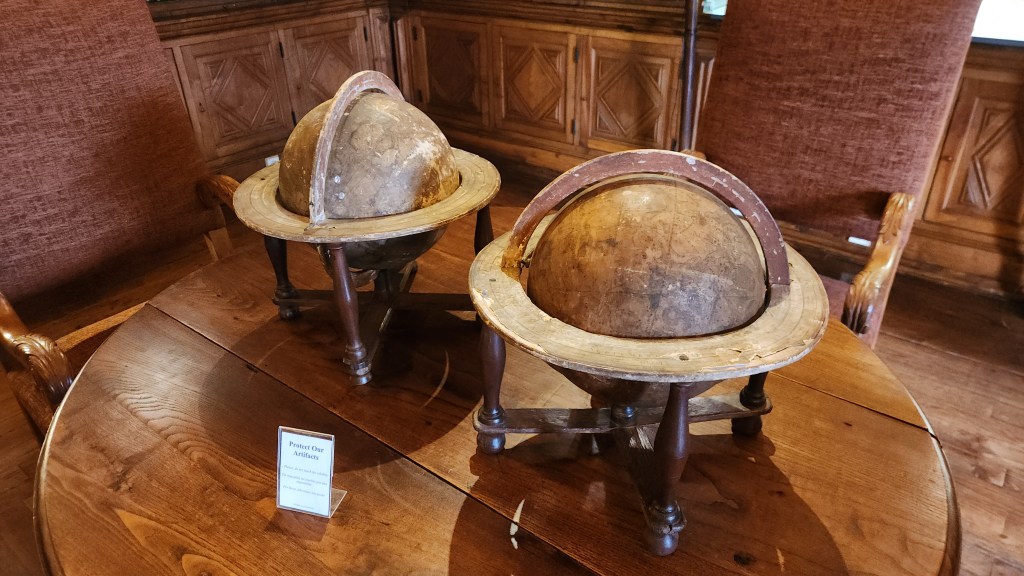
Library Artifacts
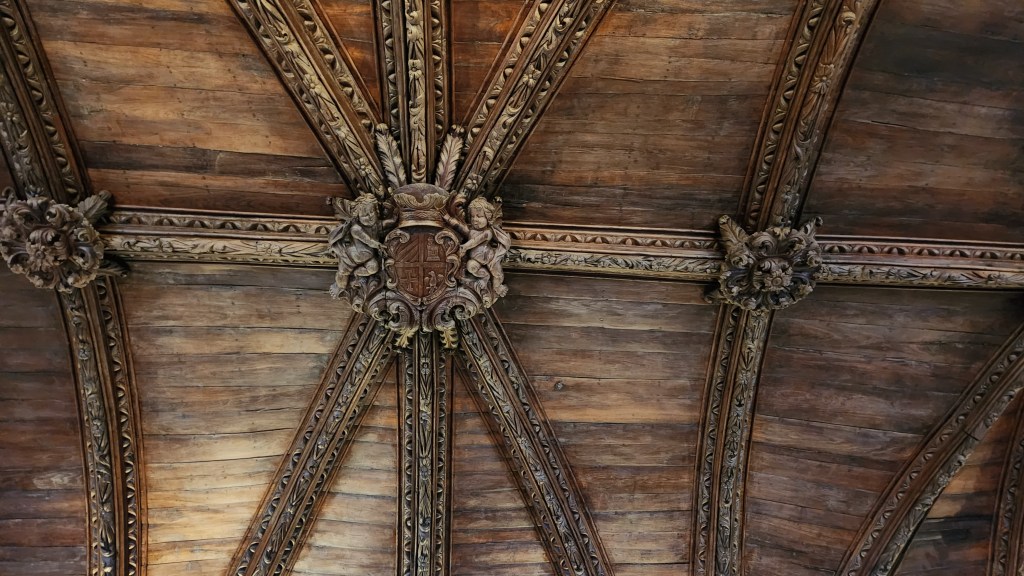
Oak Ceiling

The palace is surrounded by an immense garden originally planted in the 1700s, then modified in 1870 and expanded in 1930. In the 1950s and 1960s, the garden area was extensively modified and a lake was added to act as a mirror reflecting the manor house. A dense planting of chestnut and oak trees was added in the 1970s. Amazingly, the garden is overseen by a single, full-time gardener, though our guide told us that he has help from multiple volunteers.

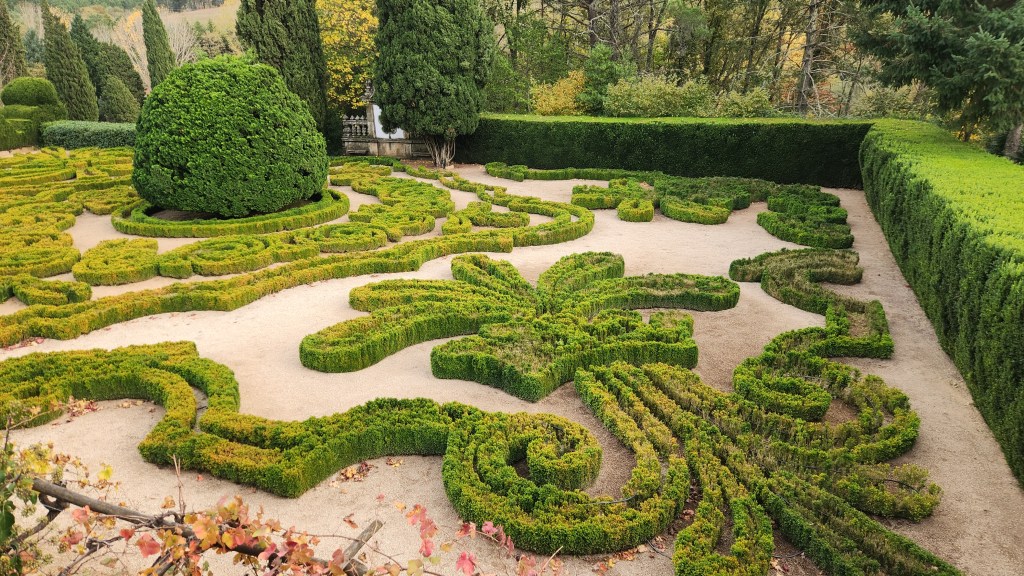
One Small Segment of the Enormous Garden

We arrived back at the Helgrim at 7 PM, just in time for the usual sumptuous Viking dinner.

Castelo Rodrigo (November 14): We spent the morning and early afternoon of Thursday the 14th sailing upstream to Barca d’Alva, then disembarked for a tour of an ancient town called Castelo Rodrigo.

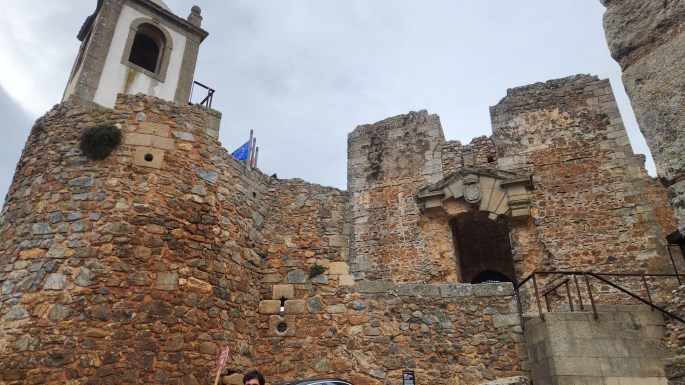
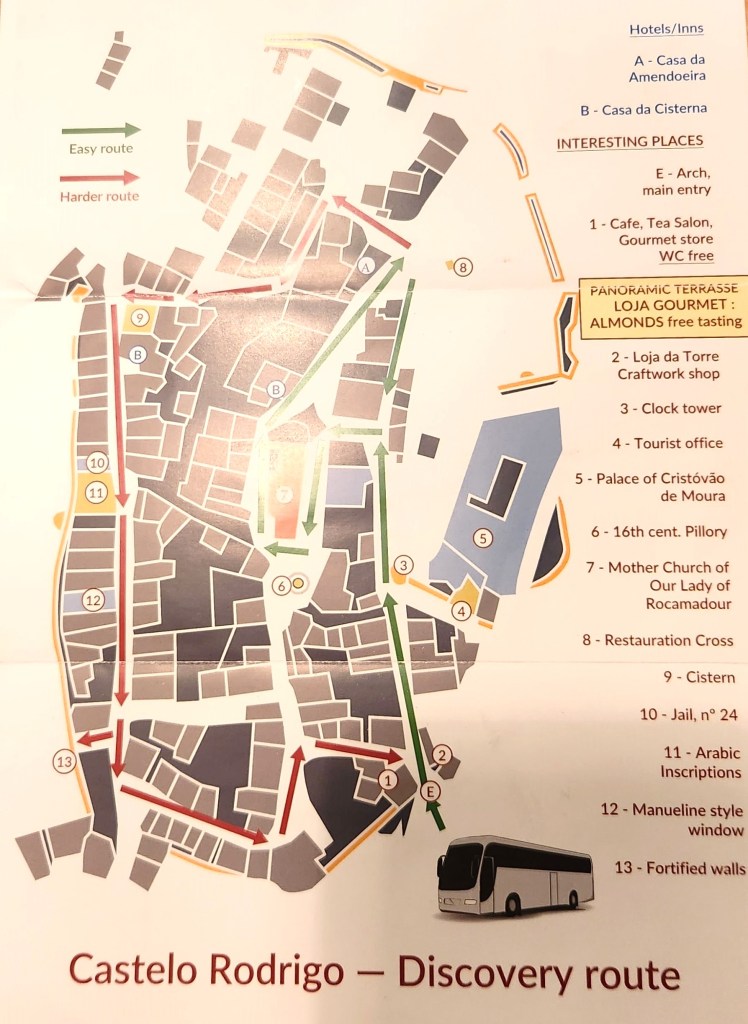
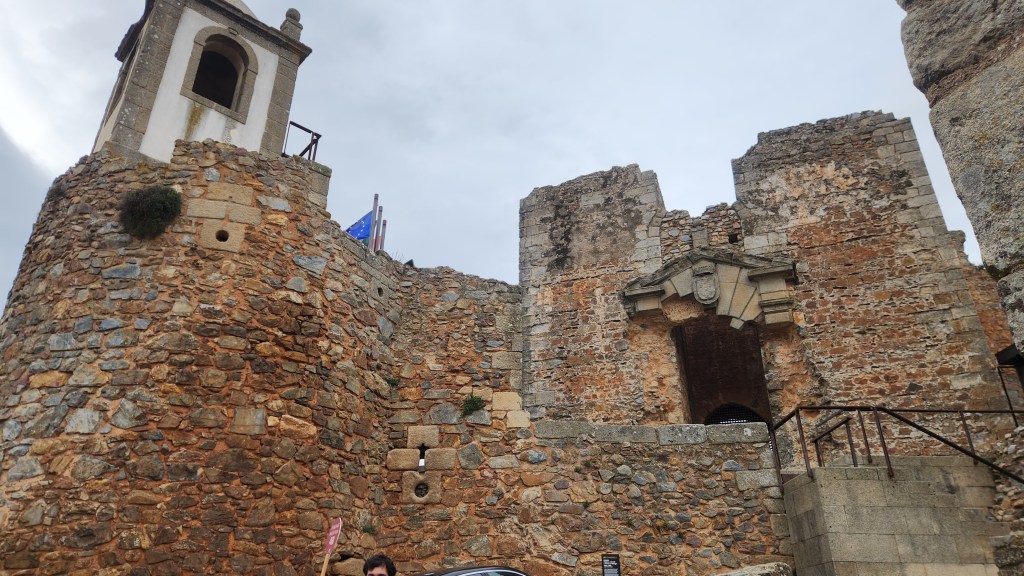
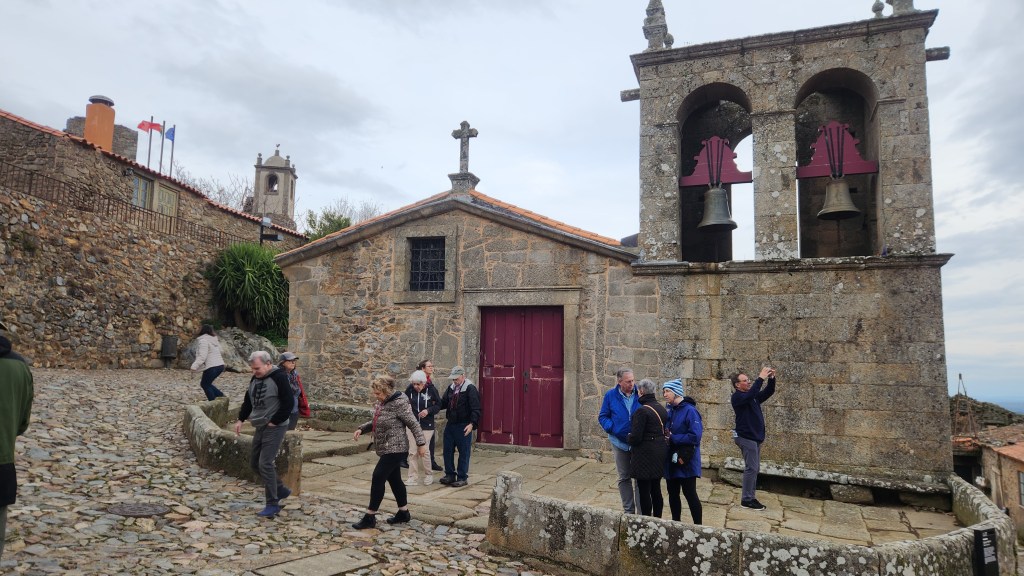
It is believed a castle and village were founded on the site in the 6th century and subsequently inhabited by Romans and Moors before being conquered by King Alfonso IX of Leon in the 1200s. Alfonso had the city fortified and the walls reinforced, placing Count Rodrigo Gonzalez de Girón in charge of its defense, and he became its namesake. It was incorporated into the Kingdom of Portugal in 1297, ceded by Leon to King Denis after extensive battles. The fortress and walled fence were rebuilt, and 13 turrets, a keep, a fortified entrance gate, and moats were constructed by Denis in the 14th century. It has been listed as a National Monument since 1922. Our tour group strolled through the town on the cobblestone streets, visiting among other places a medieval church, the ruins of an ancient synagogue, and a lovely shop where we bought some delicious roasted almonds.

Castel Rodrigo Keep
Mothyer Church of Our Lady of Rocamadour
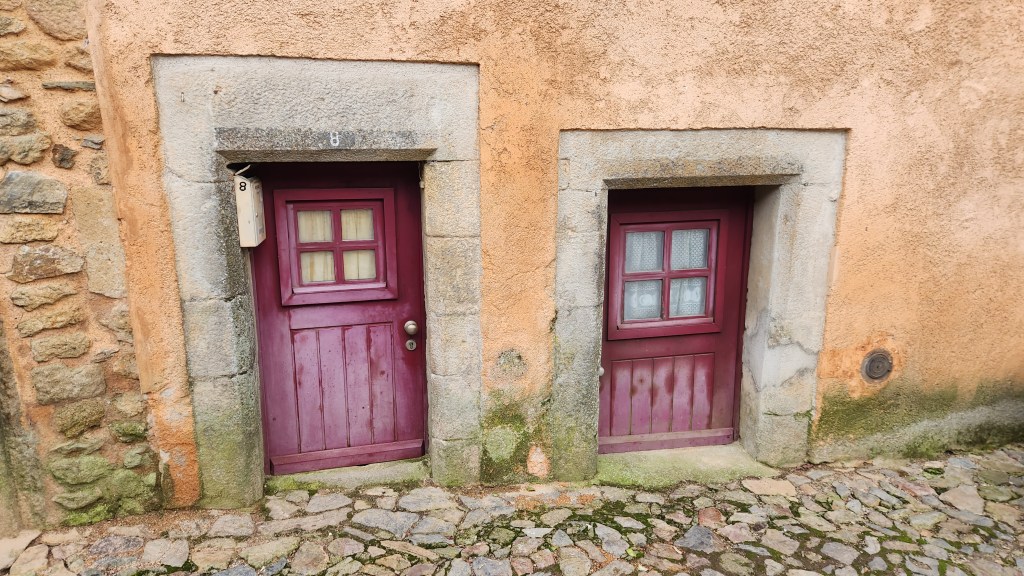
Doors — made as small as possible to conserve heat
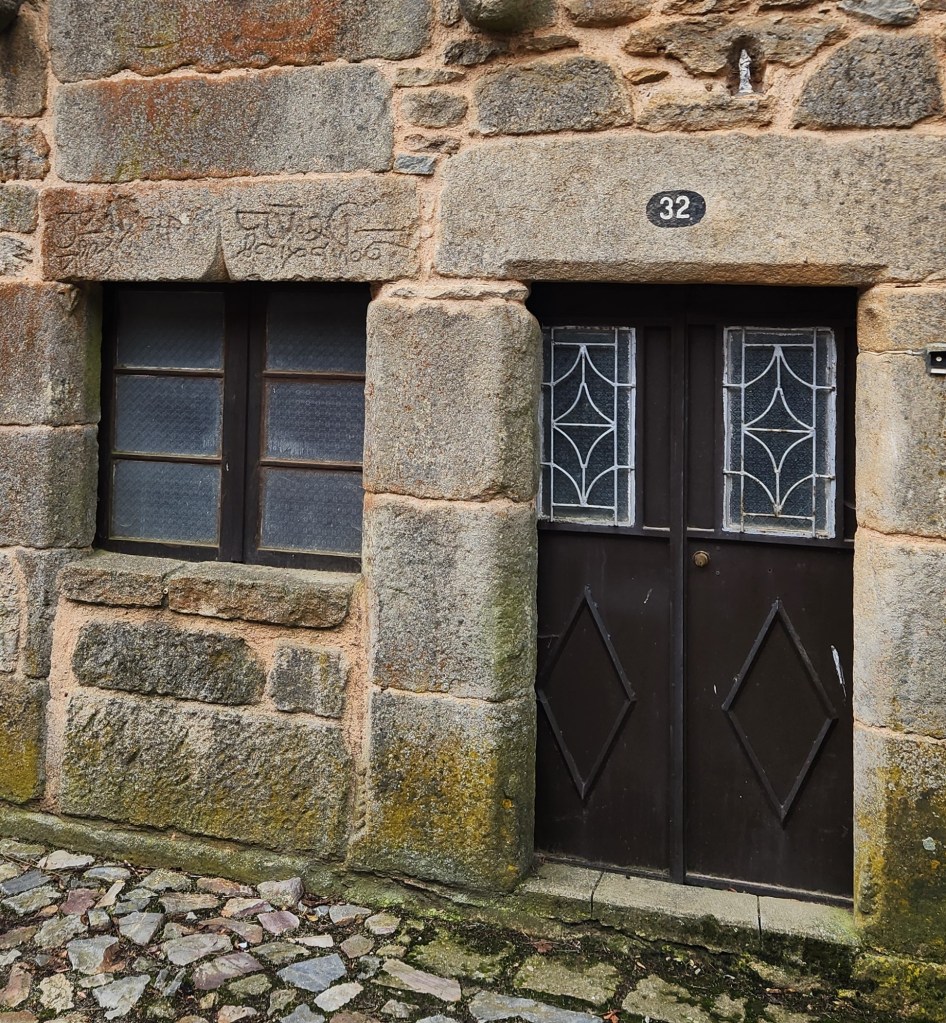
Building with Ancient Hebrew Inscription

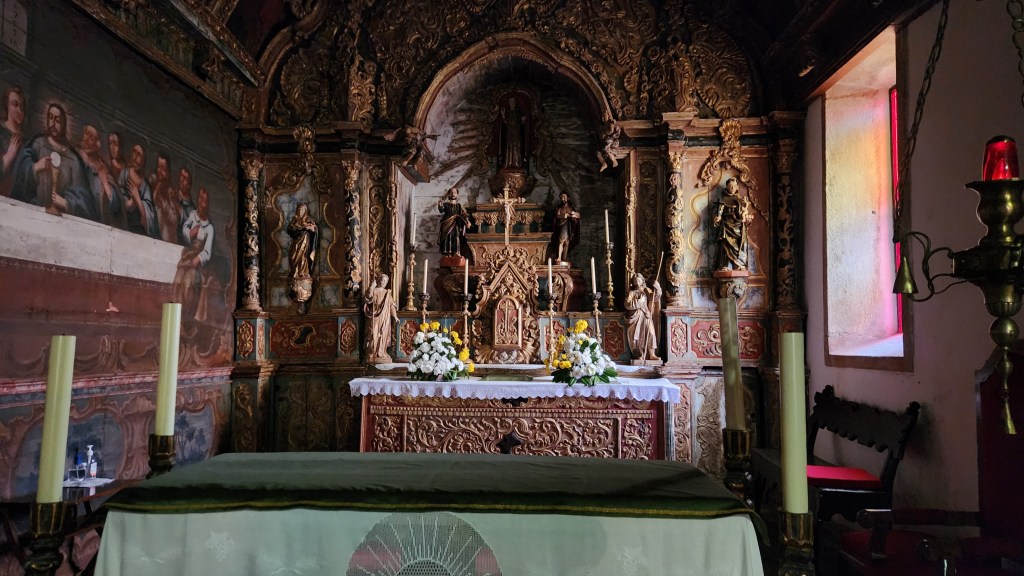
The church, Mother Church of Our Lady of Rocamadour, located on the path to the famous shrine, Santiago de Compostela, and marked by images of seashells, was established in the 12th century by the Brothers Hospitallers. It contains some interesting artwork as shown in the photos.

Church Altar
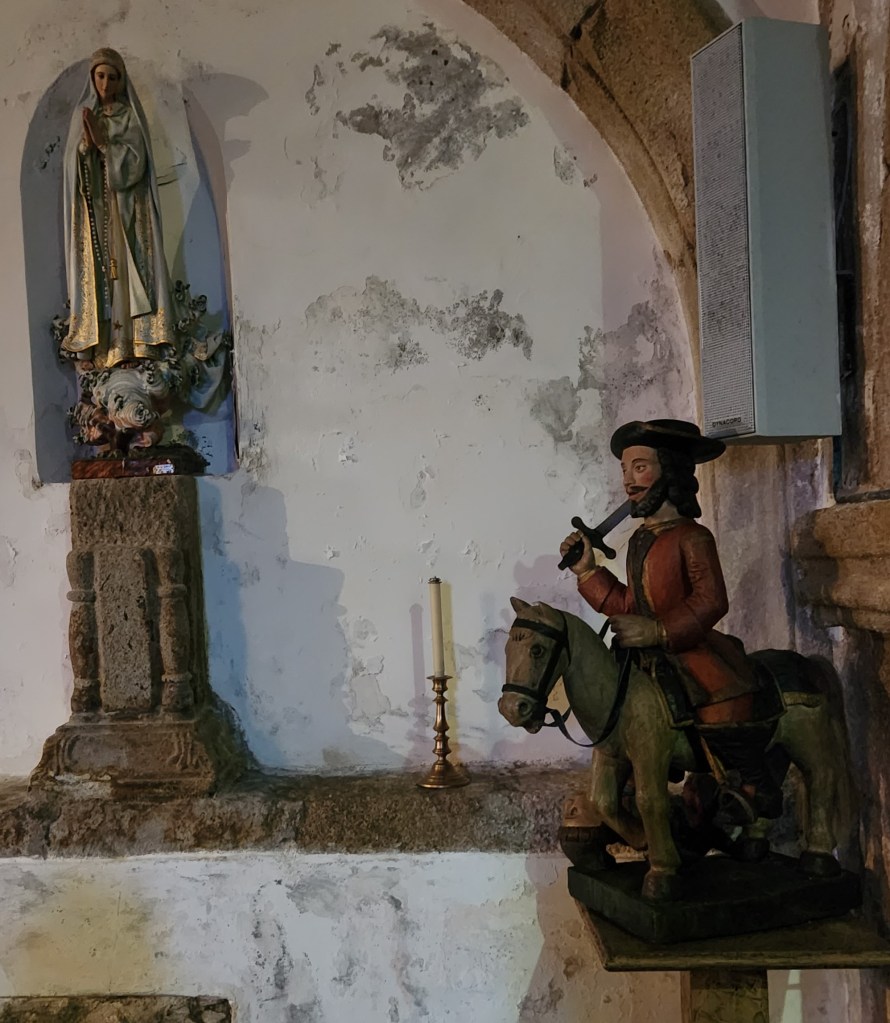
Was the Conqueror a Giant, or was he Riding a Pony?
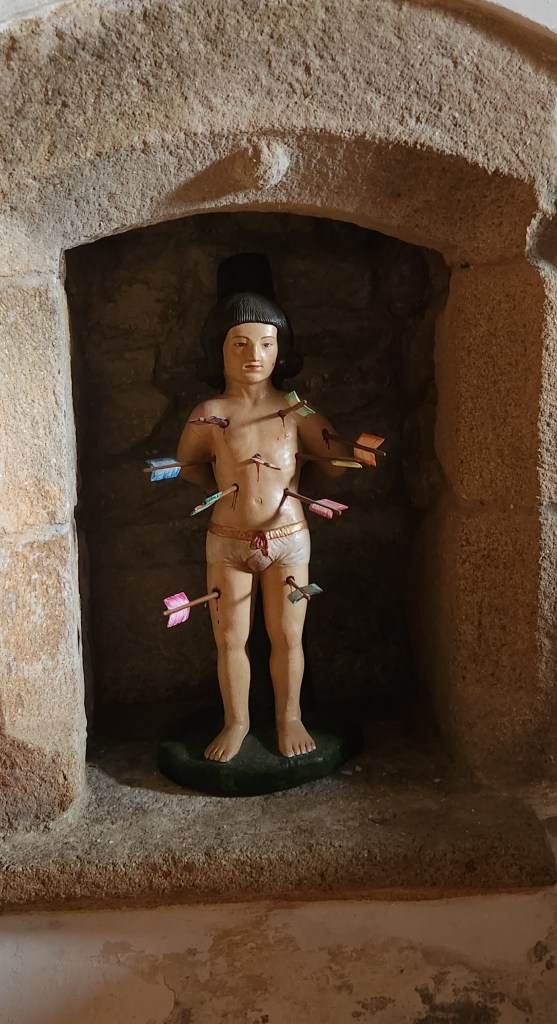
St. Sebastian is honored in the Church

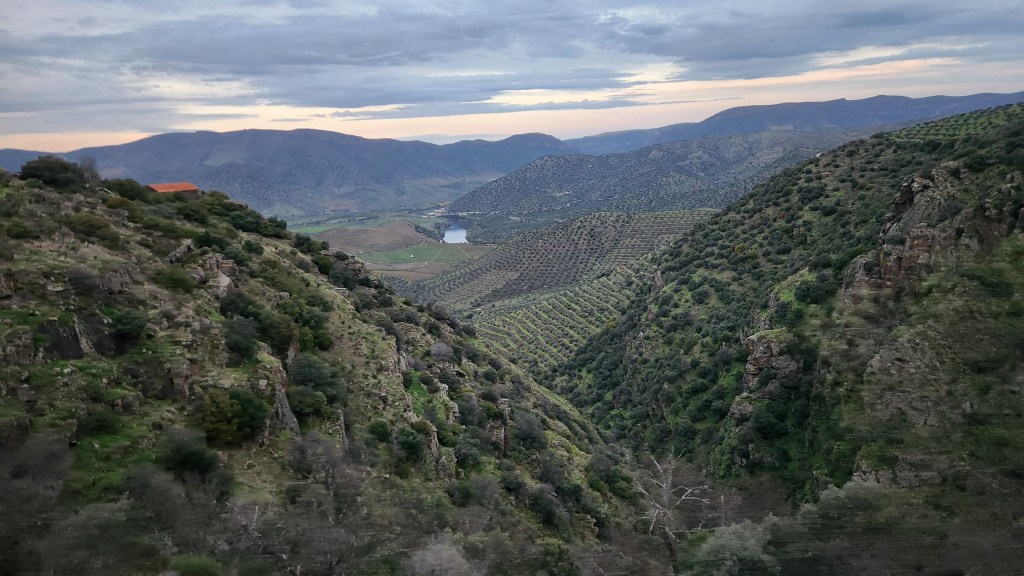
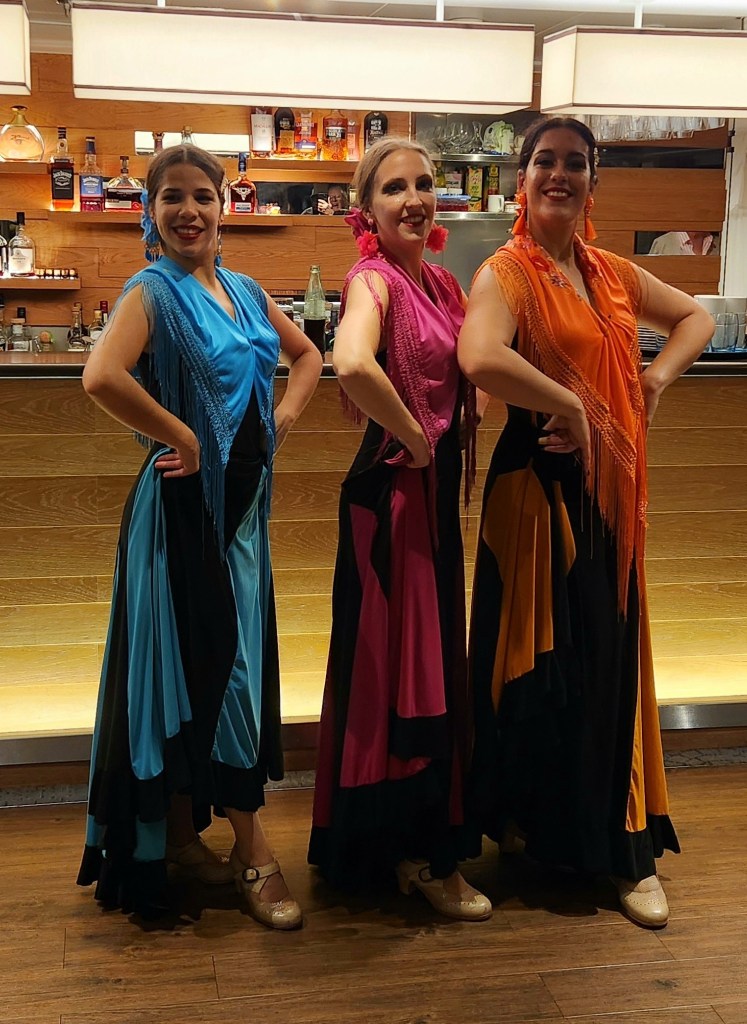
On the way back to the ship, we passed by acres and acres of almond and olive trees, both of which are major products in the areas outside the Douro Valley. Back on the ship, we were treated to a Flamenco Dance exhibition by a trio of professional dancers to cap off a lovely day.

Orchards near the Agueda River (Portugal/Spain Border)
Closeup of Orchard (sorry for the blur — the bus was moving fast)
Flamenco Troupe Visits the Helgrim

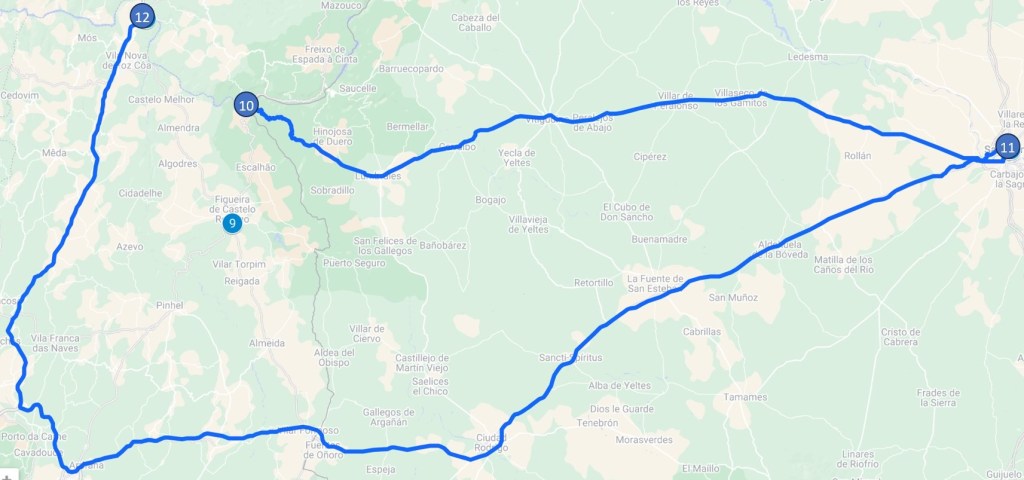
Salamanca, Spain (November 15): On Friday the 15th, we left the Helgrim at its dock in Barca d’Alva at 8:30 AM for a bus ride to Salamanca, Spain. While we and a majority of the 102 passengers traveled to Salamanca, the Helgrim began the return journey down the Douro, and we eventually returned to the ship at its overnight position in Pocinho at 9:20 PM.

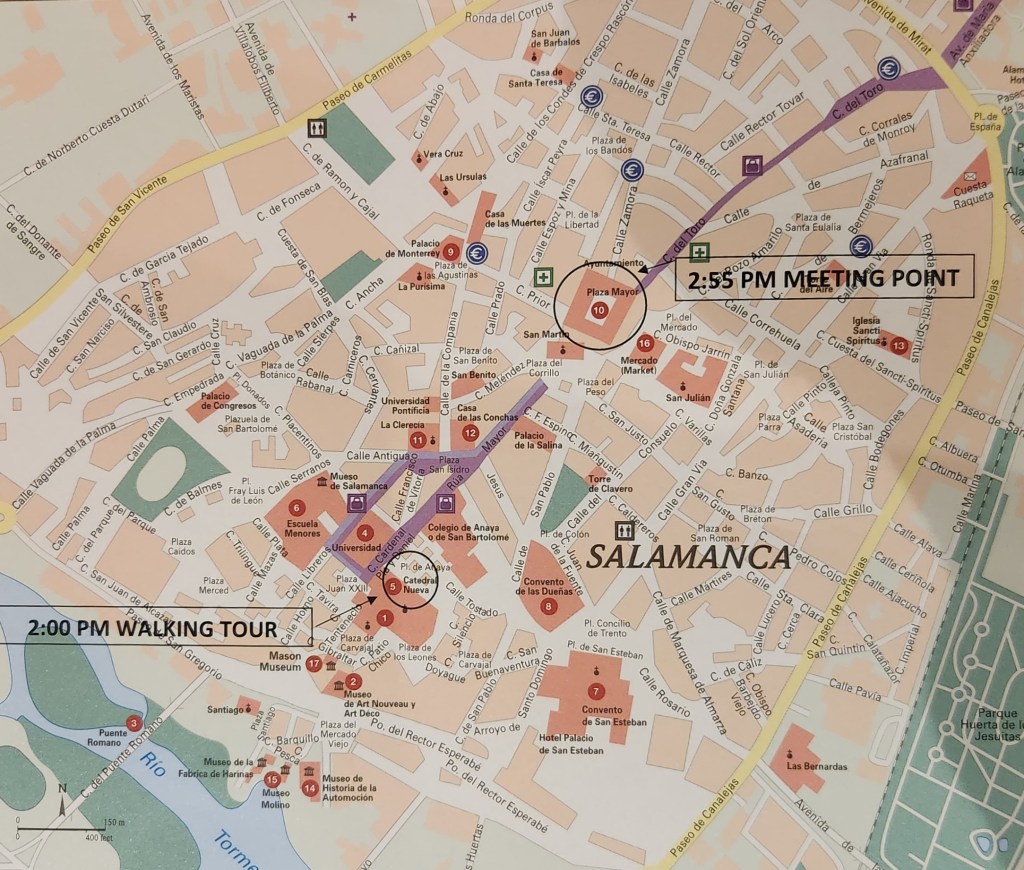
The earliest human habitation of Salamanca occurred in the first millennium BCE, and the earliest stable settlement in the 7th century BCE. As throughout Spain, the city was subsequently occupied by Romans, Alans, Visigoths, and Moors before being recaptured by Alfonso VI of Leon in 1085. It is known for its two Cathedrals and for the University of Salamanca, and these were the primary focus of our tour. The Old Cathedral of Salamanca was built between 1120 and 1236. The adjacent New Cathedral was built between 1513 and 1733. The first school buildings were established nearby to the Old Cathedral in 1134, and it was officially founded as a university in 1218, and many of its current buildings were constructed from 1401 through 1611. Here’s a map of the Old City:

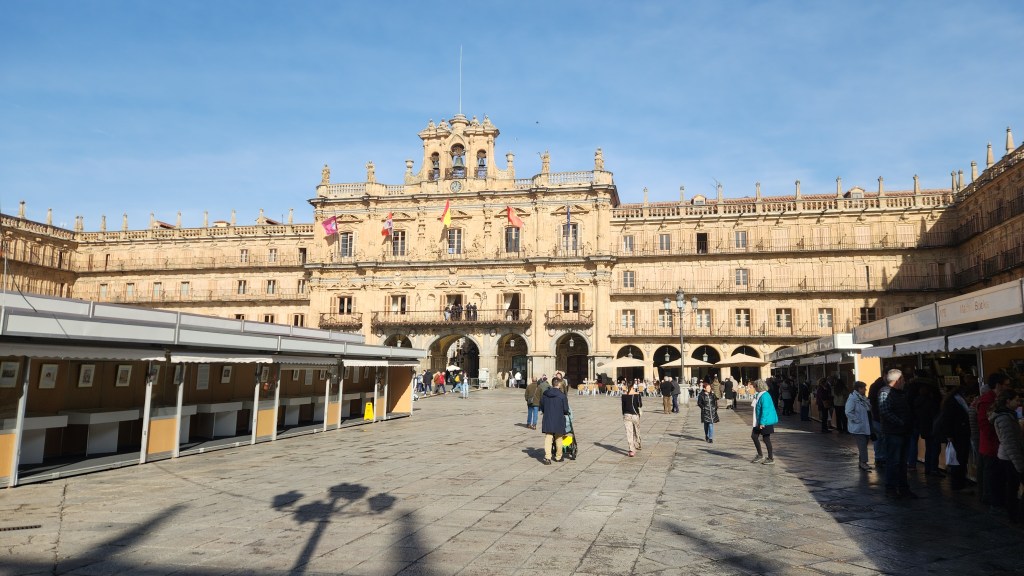
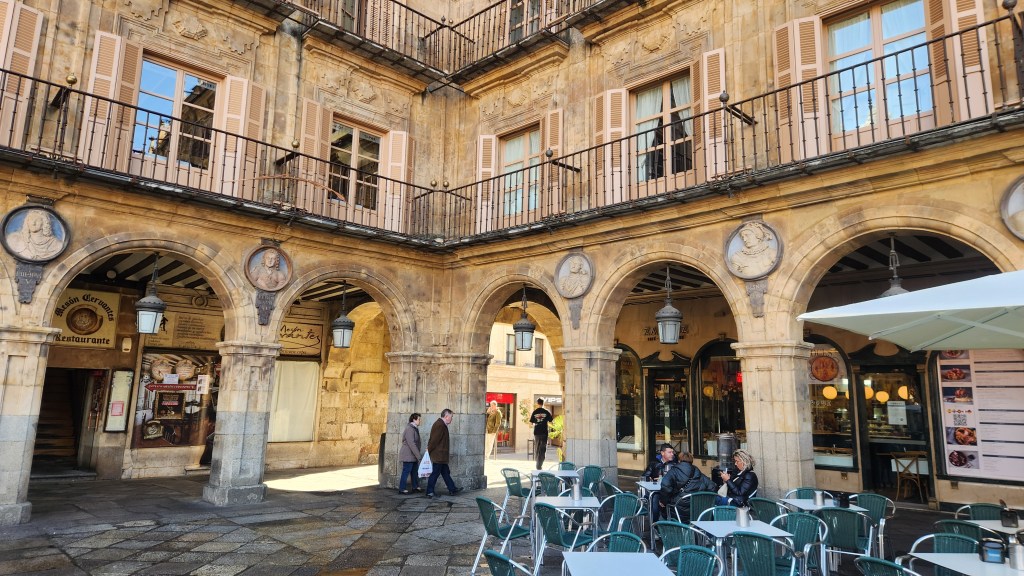
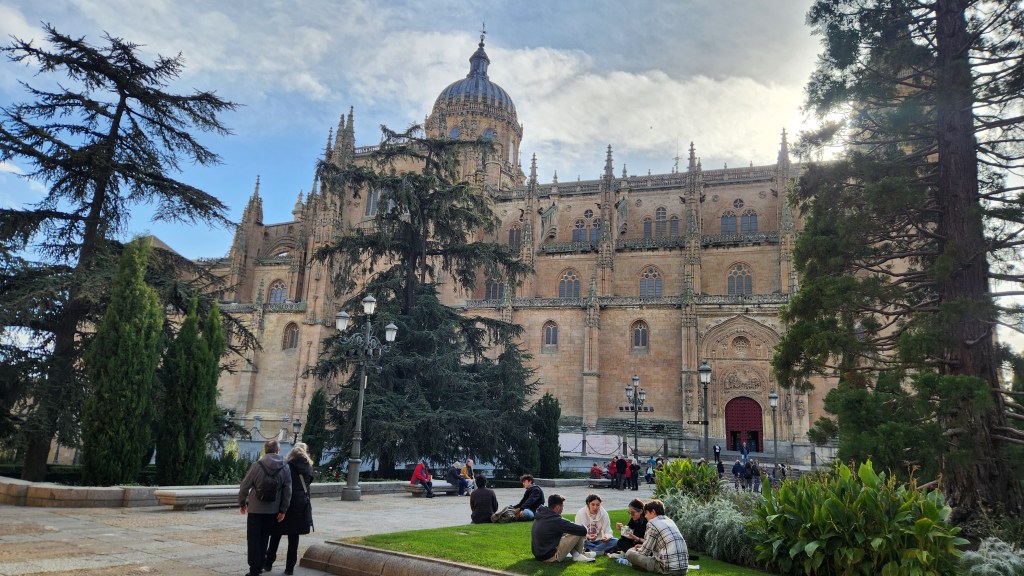
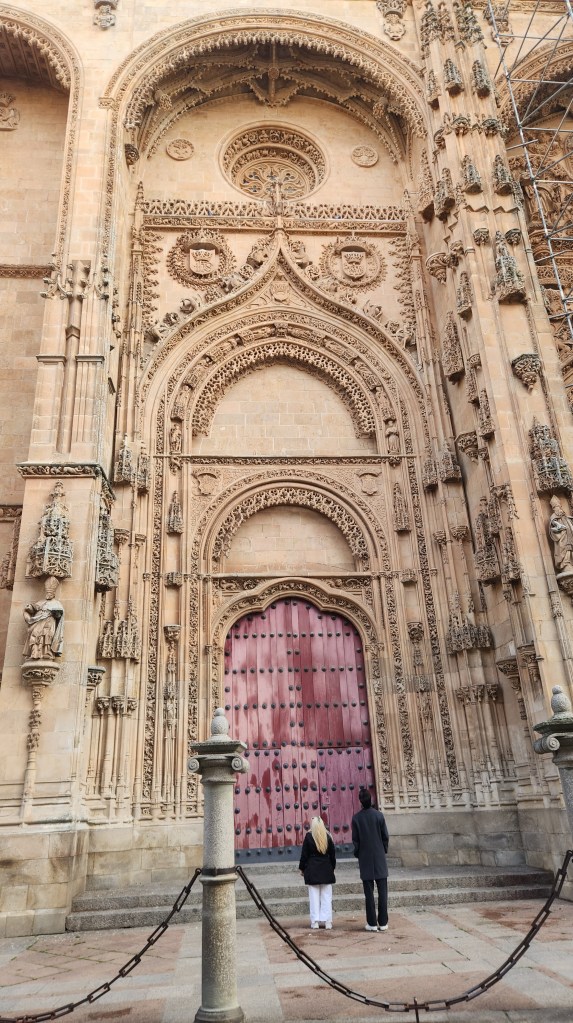
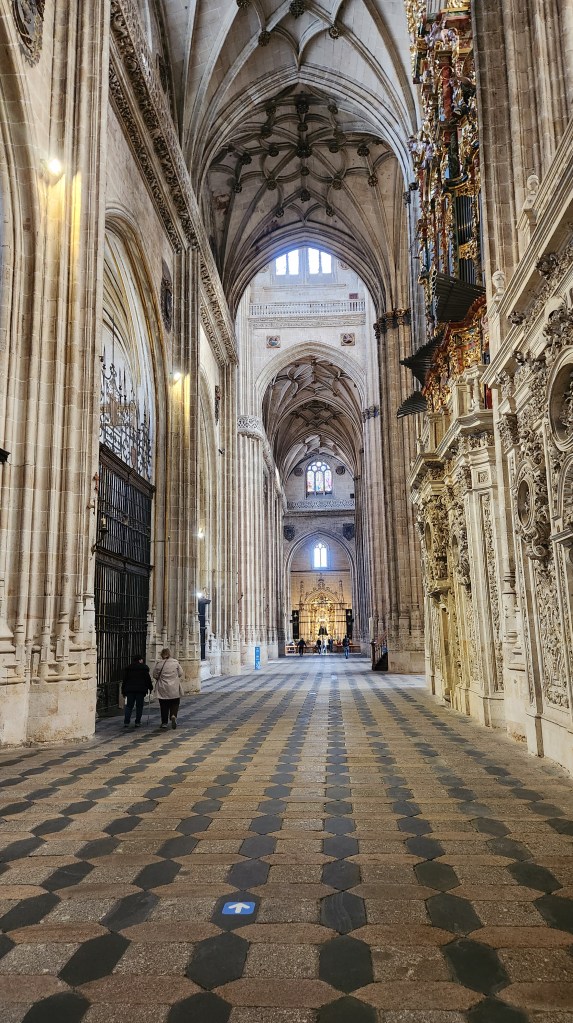
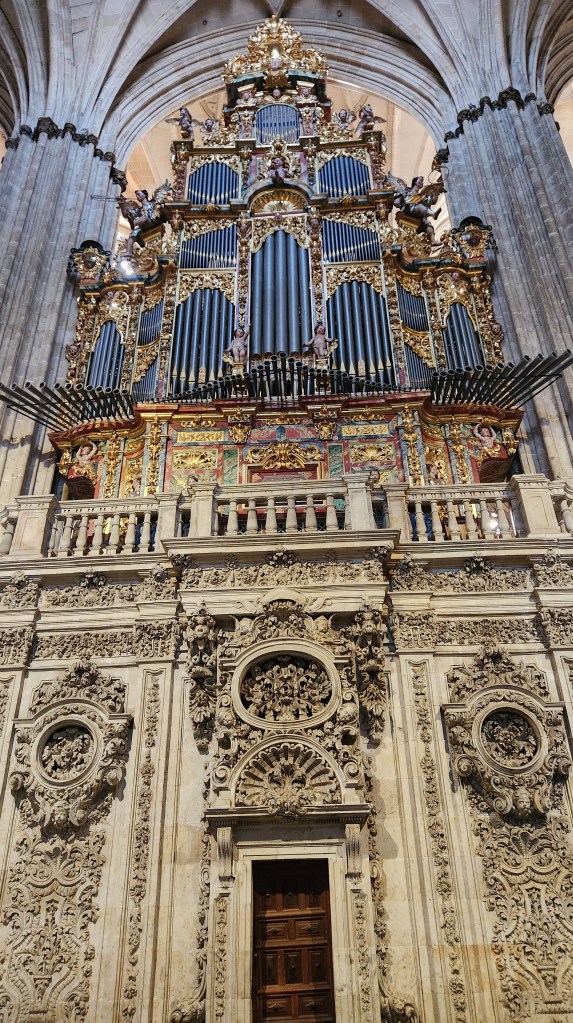
After strolling to the Plaza Mayor with our Viking guide, we had some free time to explore the area before joining a local guide at the entrance to the New Cathedral. This was far and away the biggest and most magnificent church we saw on the entire trip, rivaling anything I’ve seen anywhere in Europe. Maybe the photos below will give you a feel for it, but the scale was so grand that I couldn’t really capture the essence of it with my puny little cell phone.

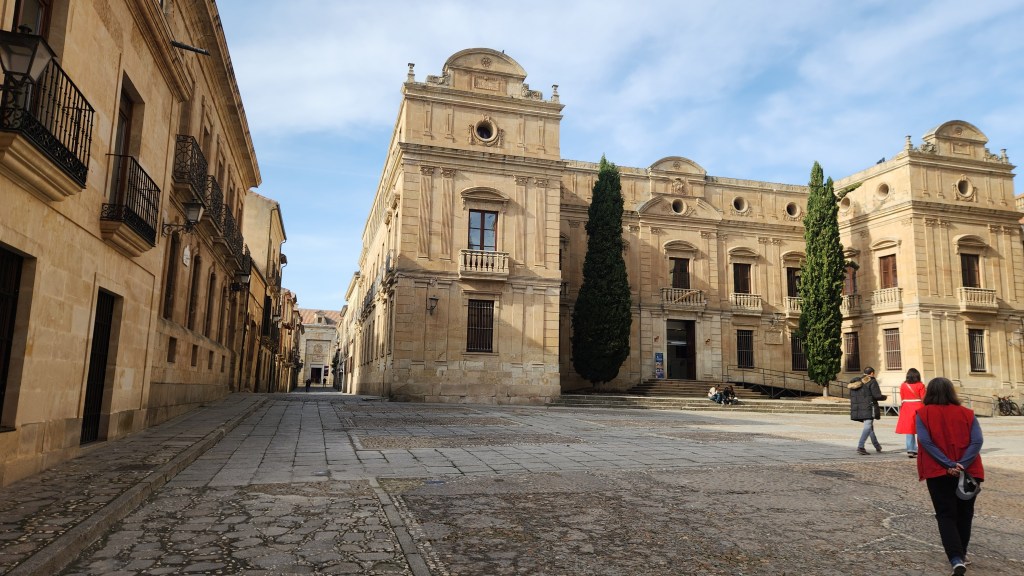
Plaza Mayor in Salamanca
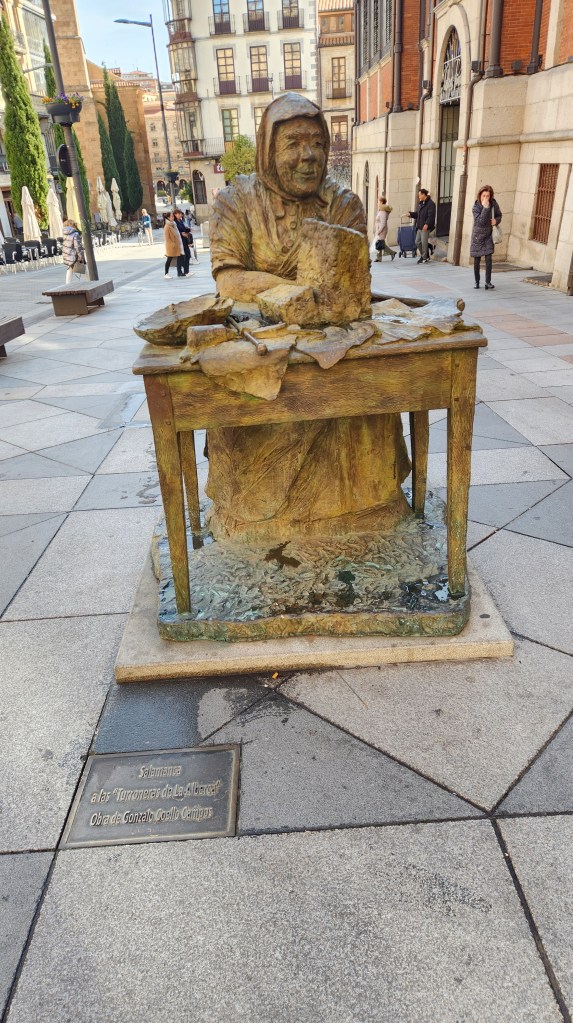
Statue Commemorating Salamanca Artisans
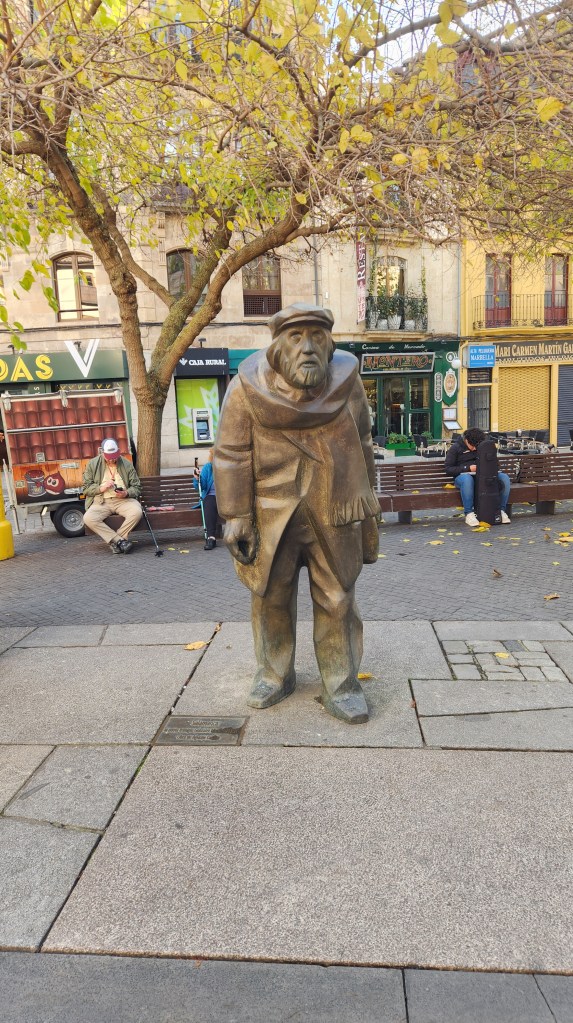
And One for Salamanca laborers
New Cathedral of Salamanca
New Cathedral Door
New Cathedral of Salamanca
New Cathedral Organ
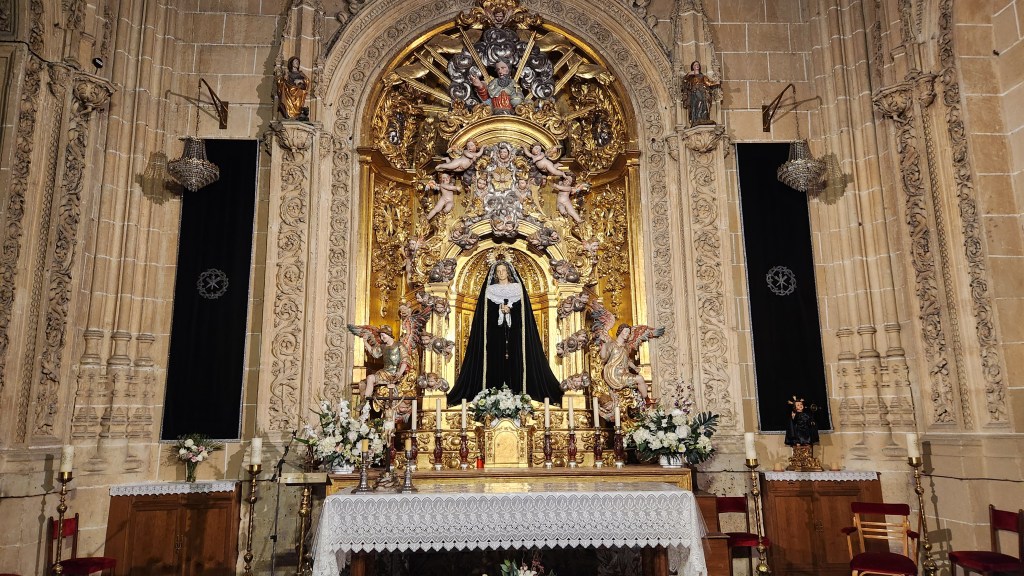
One of Many Shrines in the New Cathedral
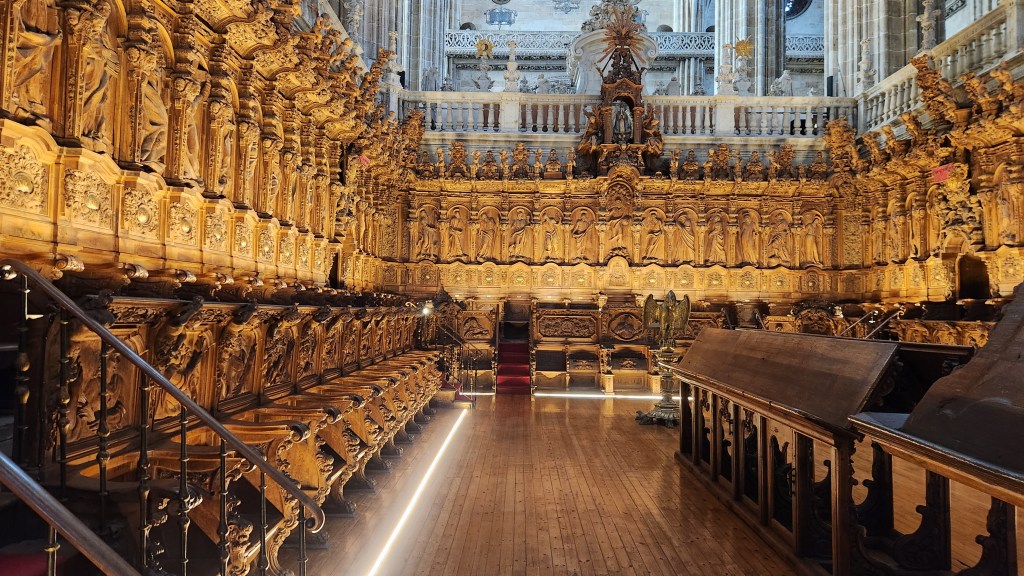
The Cardinals’ Seats in the New Cathedral
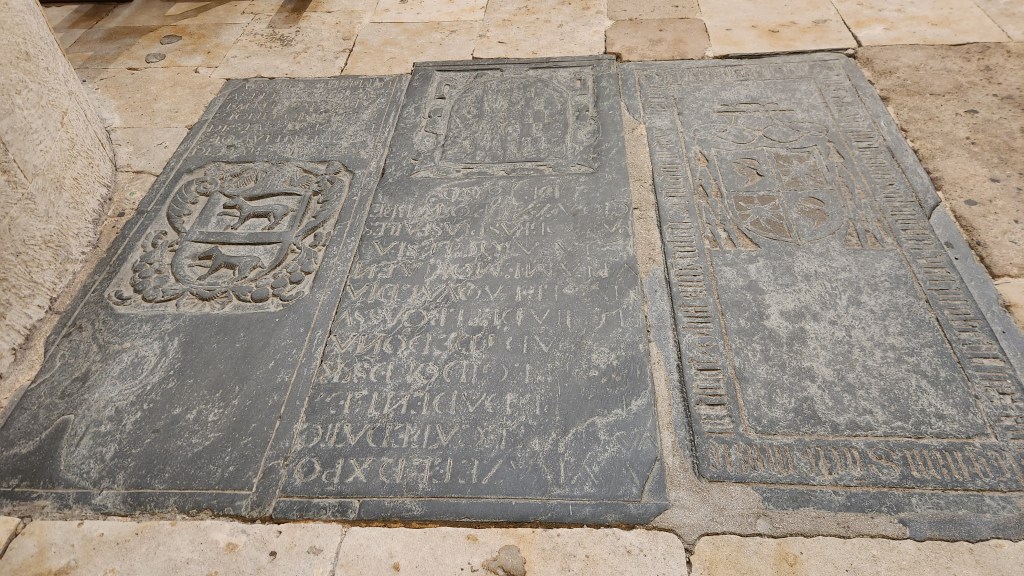
Crypts in New Cathedral Floor
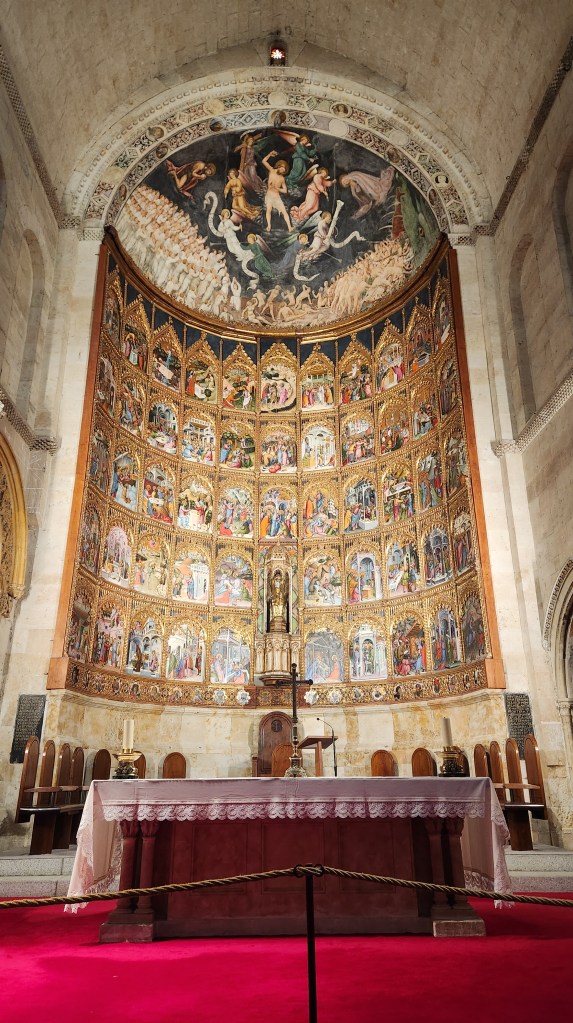
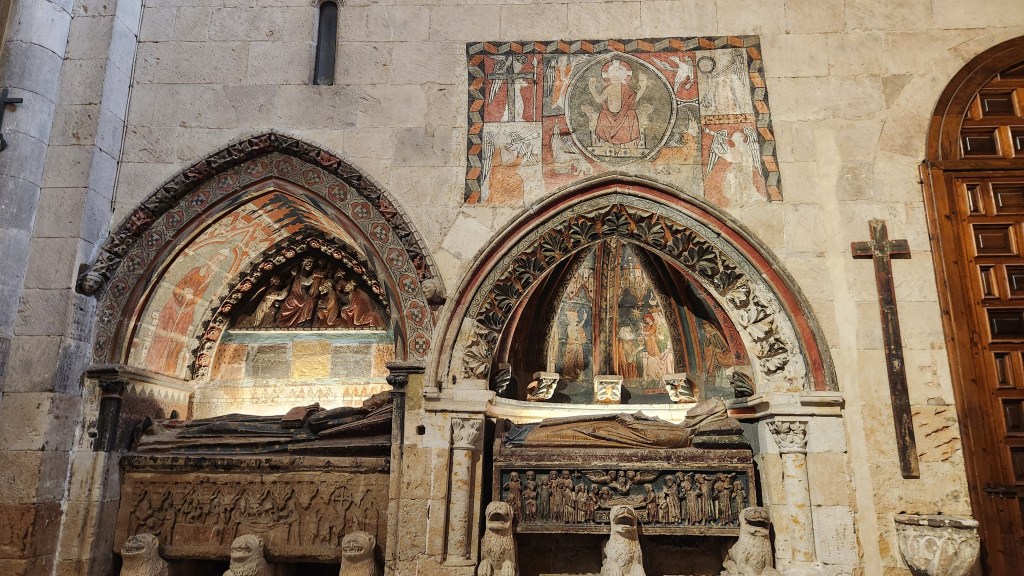
Altar in the Old Cathedral
The Old Cathedral of Salamanca

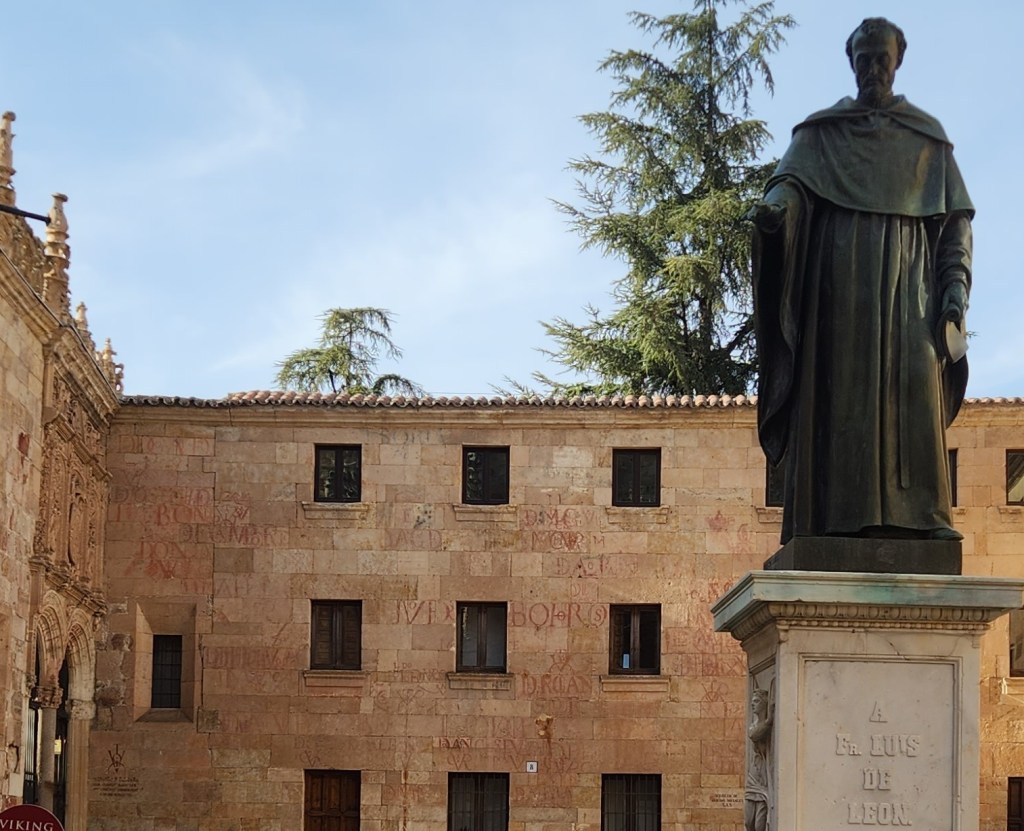
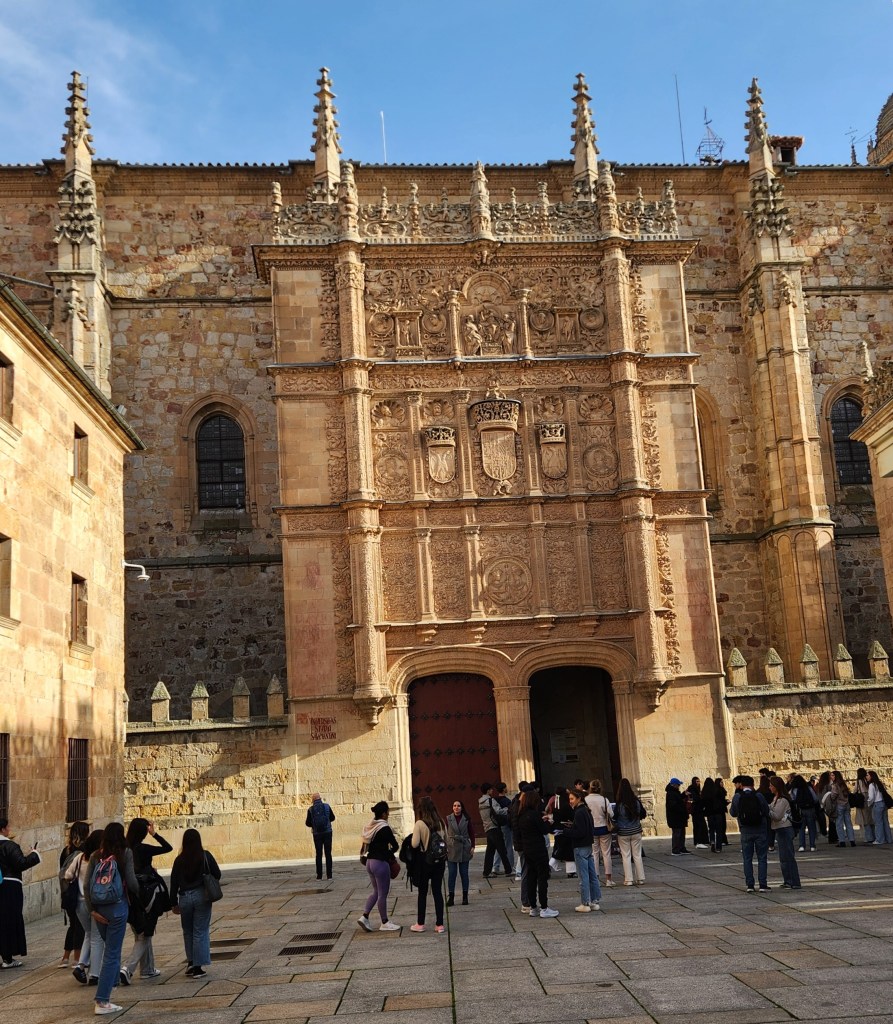
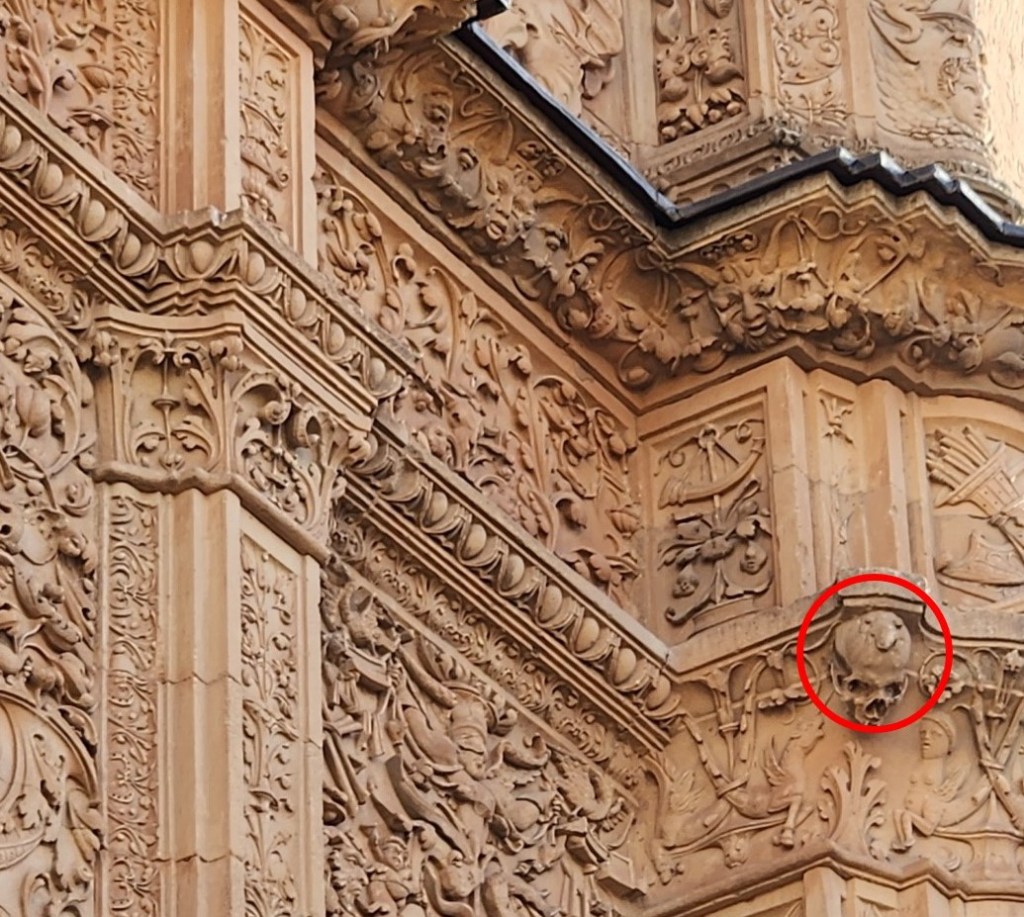
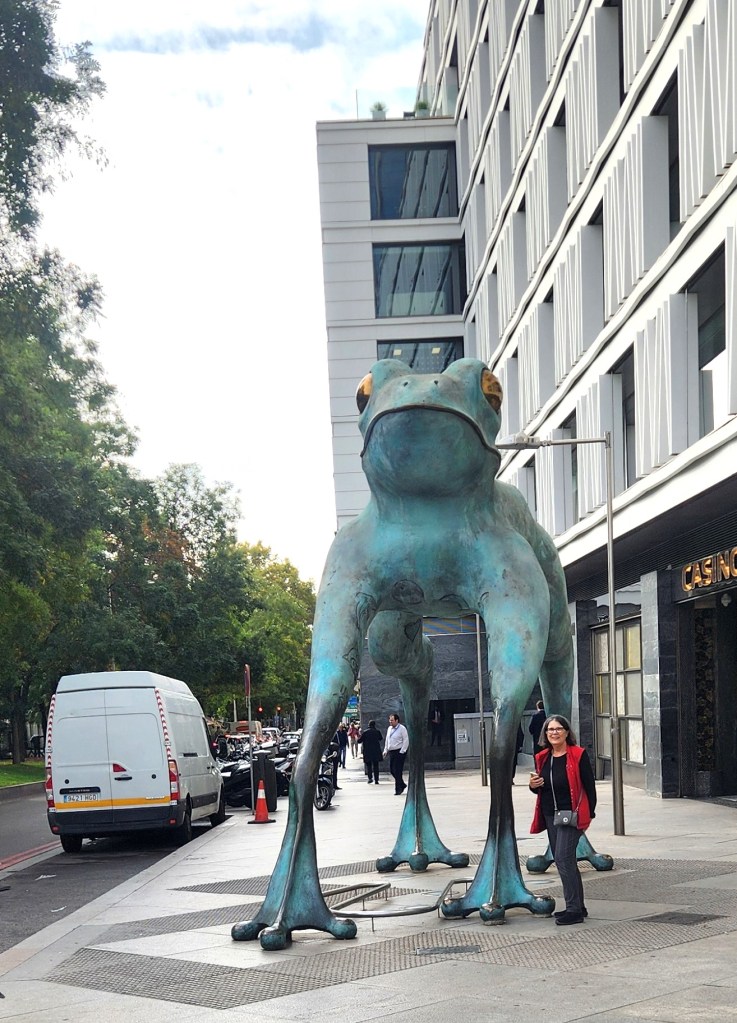
After the Cathedral, we strolled with our guide among the University buildings where our guide told us some interesting stories about the history of the place. Many of the building walls sported names and dates inscribed with bull blood; these were written by doctoral students to celebrate and commemorate the day when they survived a days-long period of isolation and intense study followed by severe questioning by the professors to earn a degree. (And I thought my Ph.D. orals were tough!) The University Chapel has exceedingly ornate carvings around the entry door, including a skull on top of which a frog is perched. Many of the carved images, including the frog, were intended as a warning to the students that misbehavior of any sort while attending the University was forbidden (I didn’t quite “get” the frog connection myself). This frog became world famous, and souvenir frogs of all sizes and colors are sold at gift shops throughout the city and in the wider region around Salamanca.

One Building of University of Salamanca
Inscriptions on the Walls in Bull Blood
The University of Salamanca Chapel
Detail of University Chapel Facade (with famous frog highlighted)

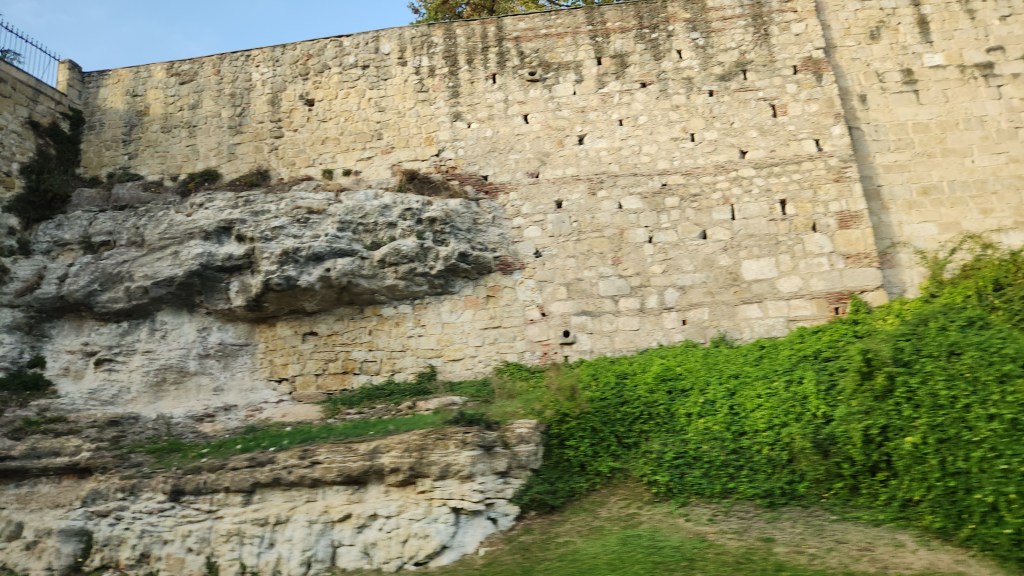
We then followed our guide along Rua Mayor back to the Plaza Mayor before boarding the bus back to the ship, catching a glimpse of the crumbling old walls as we drove past.

The Old Walls of Salamanca

OK, that’s it for Part 3. In the final episode, I’ll describe the last four shore excursions we took during the river cruise and our travels (and travails) getting back home to Minneapolis.

Pat and Dave’s Intrepid Iberian Interlude – PART 2: Coimbra, Porto, and the Douro River

Welcome back for Part 2 of this narrative of our recent trip to the Iberian Peninsula. Part 1 left off as we completed a walking food tour of Lisbon on November 11th. In this episode, we’ll head north to Porto, with a stop at Coimbra along the way, and begin sailing along the Douro River.

Coimbra (November 12): On Tuesday the 12th, we set our luggage outside our Lisbon hotel room for collection by the Viking team at 6:45 AM before heading down for our final excellent breakfast at the Corinthia. We boarded our Viking bus at 8:15 AM. During the two-hour, 130-mile drive north to Coimbra (with a rest stop for snacks and the all-important restrooms along the way), our Viking guide gave us some background on the history of Coimbra and the places we were going to visit. The city, located on a hill by the Mondego River, was originally founded by the Romans during the reign of Augustus (63 BCE – AD 14). It was later conquered and ruled by Germanic tribes including the Visigoths beginning in the 400s and then by the Moors beginning in the 700s. It was recaptured in 1064 by the king of León. The subsequent king, Alfonso VI of León, gave Henry of Burgundy stewardship of Coimbra and the surrounding territories when he married Alfonso’s illegitimate daughter. Henry’s son, Alfonso Henriques, later rebelled from of León, consolidated power in the territories and had himself declared the first King of the newly independent Kingdom of Portugal in 1131, establishing Coimbra as its capital and continuing to expand Portuguese territory by driving the Moors out of the south. Coimbra remained the capital until 1255, when it was relocated to Lisbon.

When we arrived in the city, we first had a short break as we strolled down a long, commercial street. Our guide suggested we stop at a pastry shop to try Coimbra’s famous custard tart, the Pasteis de Santa Clara, or St. Claire pastry, originally invented at the Santa Clara convent and popularized when the nuns began selling them to University students. However, when I asked for a “Saint Claire pastry,” the clerk sold me an éclair instead, so I unfortunately didn’t get to taste the proper thing.

Commercial Street in Coimbra
How one Coimbra Restaurant Adapts to the Hilly Terrain
Christmas is Big in Coimbra, as in all of Portugal

The University of Coimbra was founded in Lisbon in 1290 but relocated to Coimbra in 1308 and transferred to the premises of the Coimbra Royal Palace in 1537. Since then, city life has revolved around the state-run university, which we toured during our visit. Of special interest was the Biblioteca Joanina, or the Joanine Library, founded in 1717 by King Joan V. It is home to more than 70,000 volumes, including many priceless historical documents and first editions. It is registered as a National Monument. The library is carefully climate controlled and taking of pictures was forbidden, so you’ll just have to believe me when I say it was a beautiful and impressive place. A resident colony of bats protects the books from termites, but this aspect of preservation does dictate covering the tables at night and daily cleanup before tours are admitted. Some say that the library was used as the Harry Potter film set for the Hogwarts library; it was not, but its appearance is quite reminiscent of the movies. Also, the University students’ traditional uniforms are said to have inspired the Hogwarts uniforms in the Potter books, as author J. K. Rowling resided for a time in Porto.

Here are some photos of other parts of the University.

Main Plaza of the University of Coimbra
Overlook of Coimbra from the University Plaza
Entrance to the University Jail formerly used for Recalcitrant Students
Entrance Door to University Chapel
University Chapel
University Student Wear — Said to be the Inspiration for Hogwarts Students

After visiting the University, we stopped for an excellent lunch at a restaurant called Republica da Saudade. As we ate, we were entertained by a trio of musicians performing what is known as Coimbra Fado – a genre of music born of the late-night love serenades made famous by university students over the centuries. Here’s a sample:

Fado Singer and Musicians: a nice extra touch for our lunch

Porto (November 12): After lunch, we boarded the bus again and headed north for some 80 miles . We arrived at the river dock in Vila Nova de Gaia (a suburban city across the river from Porto) and boarded our ship, the Viking Helgrim, at about 4:30 PM. After we settled into our stateroom and walked around the ship a bit, we were called for a mandatory safety drill during which all 102 passengers reported to the lounge area with our safety vests for instructions should an emergency occur. Once properly trained, Pat and I and a dozen or so other passengers departed for an optional tour of Graham’s Port Lodge, a major wine production house built in 1890 by a Scottish wine importer and located high on the nearby bank of the river.

At Graham’s we learned about the history and production of Port wine. First and foremost, a wine can only be called Port if it is produced in the Douro Valley. The Douro valley was defined and established as an official appellation in 1756, making it the third oldest wine in the world (after Chianti, 1716, and Tokaj, 1730). It is named for the city of Porto, where much of the wine is produced and from where much of it was initially exported to England. Port wine is produced from grapes with a high sugar content, which are fermented in large wooden barrels. After several days of fermentation, the wine is fortified by the addition of a tasteless and odorless grape spirit known as aguardente (78% alcohol content) which stops the fermentation, leaving residual sugar in the wine and boosting its alcohol content. The wine is then stored in barrels. This technique for producing so-called fortified wine was developed in the late 17th century to prevent spoilage during transportation by ship from Portugal to England. These two kingdoms first signed one of the oldest existing trade agreements in the world, the Treaty of Windsor, in 1386, establishing terms for the trade of English cod for Portuguese wine. English and Scottish merchants subsequently set about perfecting the methods for producing wine – and eventually Port wine – in the Douro Valley.

There are three major types of Port wine:

  1. Ruby Port is filtered after fermentation and stored in steel or concrete barrels to prevent oxidation and preserve its bright red color and full-bodied fruitiness. Once bottled, it does not age further. Once opened, a bottle of Ruby Port should be consumed within three to four months.
  2. Tawny Port is aged in wooden barrels after fermentation, allowing it to mellow to a golden-brown color and pick up nutty flavors. These wines are typically blended to produce a desired style and character, then filtered and bottled. As with Rubies, Tawny Ports do not age further after bottling. Once opened, a bottle of Tawny Port should be consumed within three to four weeks.
  3. Vintage Port is made only in certain years when the growing conditions are deemed to be of the highest quality by the Instituto dos Vinhos do Douro e do Porto (IVDP), a government organization overseen by the Minister of Agriculture. A wine producer may decide to declare a Vintage Port if they believe the wine from a specific harvest year meets specified criteria. The producer then submits samples of the wine to the IVDP for analysis. The IVDP assesses the samples, and if the wine receives a rating of 9 out of 10, it is certified as a Vintage Port. The wine must then be bottled by the end of the year of certification, but it is not completely filtered so that it continues to age in the bottle. A Vintage Port may be aged in its bottle for decades, but then should be consumed within three or four days after opening.

Here are some photos of the Graham’s climate-controlled production and storage facilities:

Port Fermentation Vats at Graham’s
Aging Barrels at Graham’s

After our tour of the facilities, we were treated to a tasting of five Graham’s wines: a Ruby, two Tawnies, and two Vintages (2000 and 2014). Various member of our group preferred one or another of them, but Pat and I were in agreement that the 2000 Vintage was the best, so we bought a bottle to bring home. (Now all we need to do is decide what special occasion to choose for opening it.) To close out the evening, we were served a fantastic three-course dinner in the restaurant on the top floor of the building, which provided a spectacular view of the Douro and the cities of Porto and Vila Nova de Gaia.

Douro River with Porto on the Left and Vila Nova de Gaia on the Right

Douro River (November 13-18): On Wednesday the 13th, the Helgrim cast off and headed upriver. Here’s a map showing details of the river portion of the trip:

Over the course of the river journey, the ship sailed upstream from Porto to Vega de Terron and then back downriver to Porto again. It passed through five locks in each direction. Here are the technical specs for my fellow geek readers some photos of our passage through the lock of Carrapatelo, and a video of the upstream lock gate being retracted (more geeky stuff).

An Eastbound Ship Emerging from the Lock
Interior of Lock of Carrapatelo
Not Much Sideways Clearance in the Lock
Lock Gate Retracting After the Lock is Filled with Water from Upstream
Leaving the Lock of Carrapato

As you can see from the photos, the maximum width of the river ships is restricted by the width of the locks. I determined from walking around the ship as we passed through at least one of the locks that the ship could also not have been any longer. Here’s another one that shows that the height is also limited by various bridges spanning the river, even with the superstructure lowered – the lucky crew member holding a stick is there to alert the captain if the ship is riding too high to fit beneath the bridge — more evidence that the Viking Helgrim was custom built specifically for travel on the Douro.

The Helgrim Passes Beneath a Low Bridge

I’ll close out this episode with some pictures of the scenery along the river as we sailed upstream to Vega de Terrón and back downstream again to Porto.

View from the Helgrim between Porto and Lamego (Nov 13th)
The Riverbank between Pinhao and Pocinho (Nov 14th)
View from the Helgrim between Pinhao and Pocinho (Nov 14th)
View from the Helgrim near Peso da Regua (Nov 16th)
View from the Helgrim between Entre os Rios and Vila Nova de Gaia (Nov 17th)

OK, that’s it for Part 2. In the remaining episodes, I’ll describe seven shore excursions we took during the river cruise and our travels (and travails) getting back home to Minneapolis.

Pat and Dave’s Intrepid Iberian Interlude – PART 1: Madrid, Toledo, Lisbon

Winter temperatures have arrived in Minneapolis with highs in the low teens, though we only have a light layer of snow so far. Fortunately, I can conjure up some warmth by fondly reflecting on our most recent travel experience and writing this latest installment of my travel blog series. Perhaps your first question might be “why are you calling it your ‘Intrepid Iberian Interlude?’ ” So, let’s start there.
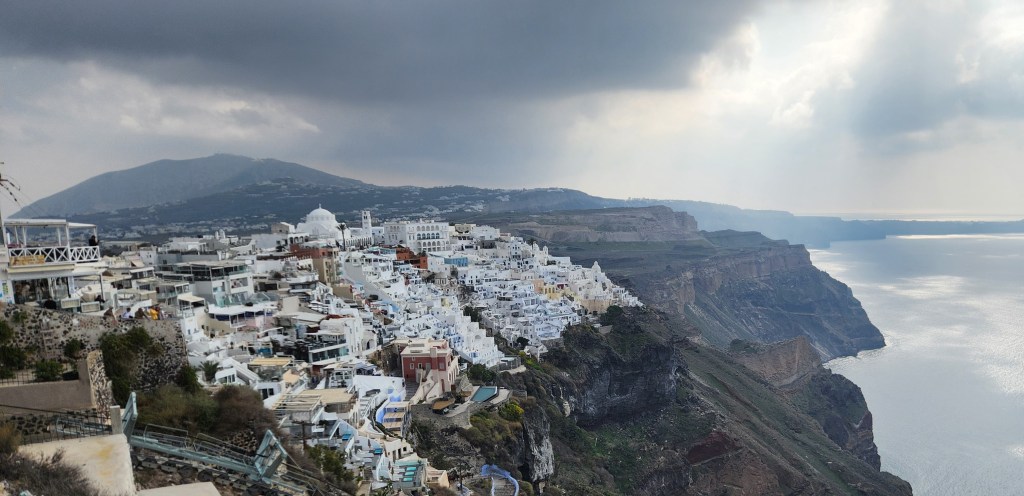
The travel blog series was born back in 2018 when, at the urging of family members, I began documenting a 10,200-mile RV trip during which Pat and I visited 11 states, 9 National Parks, 2 National Monuments, 1 National Recreation Area, and 12 or more State Parks in Iowa, Missouri, Kansas, Oklahoma, Texas, New Mexico, Arizona, and California. Since then, I’ve documented a total of fourteen trips. Here’s a list of the travel blog series so far:

  1. Pat and Dave’s Excellent Adventure (12 parts)
  2. Coming Soon to a Blog near You – Another Winter RV Trip (1 part compendium of 4 trips)
  3. The Saaris’ (Sorta) Safe Sojourn (10 parts plus Summary)
  4. Pat and Dave’s Eastern Escapade (4 parts)
  5. Pat and Dave’s Eclectic Electric Road Trip (4 parts)
  6. Pat and Dave’s Post-Covid Continental Caper (4 parts)
  7. Pat and Dave’s Tremendous Tropical Trek (3 parts)
  8. Pat and Dave’s Magical Maritime Meanderings (3 parts)
  9. Pat and Dave’s Easy EV Road Trip (3 parts)
  10. Pat and Dave’s West Coast Wayfaring (2 parts)
  11. Pat and Dave’s Nifty National Park Lark (2 parts)

(For the convenience of readers who may be real gluttons for punishment, the list provides hyperlinks to the final part of each installment.)

You’ll notice that, beginning with the third one, I took to naming the narratives using clever alliterative titles that provide hints about each trip. So, in keeping with this approach, the current narrative’s title includes: 1) “intrepid” because traveling abroad at our advanced ages seems rather bold and daring, 2) “Iberian” because we visited the Iberian Peninsula (Spain and Portugal), and 3) “Interlude” because the last four trips have been in North America as will be our next one (to Arizona), so going to Europe was a sort of interlude. (And because I couldn’t think of a better word that started with I, OK?) Now that that’s out of the way, let’s get on with the story.

The trip was booked with Viking River Cruises, and included pre-cruise stays in Madrid and Lisbon before boarding a ship in Porto and sailing up and down the Douro River, described poetically as Portugal’s River of Gold.

ASIDE: We’ve become huge fans of Viking, this being out fourth journey with them. Previous trips included numbers 6 and 7 in the above list and a 2014 cruise down the Danube before I began blogging about our trips. The beauty of Viking is that all we need to do is arrange one booking, and all the details are planned and executed for us, efficiently and luxuriously. We truly can “travel the world – in comfort,” as their tagline says. (Sort of diminishes that “intrepid” business a bit, but hey.) Just to be clear, I do not receive any compensation from Viking for writing this blog even though I may deserve it; I’m sure they don’t even know the blog exists.

Here are maps showing the main places we visited along the way. I’ll provide more detailed maps of specific areas when appropriate as the story unfolds.

We left our condo in Minneapolis on Wednesday, November 6 at 7:28 AM CST, catching a Lyft ride to MSP airport, then flew to Chicago O’Hare and then on to Madrid on Iberia Airlines, arriving at 7:45 AM CET (Central European Time) on November 7.

Madrid and Toledo (November 7-9): On Thursday the 7th, Pat and I were met at the Madrid Airport by a Viking driver, who drove us and our luggage to the Hyatt Regency Hesperia Hotel in the Paseo de la Castellana neighborhood of Madrid. There we met our Madrid Viking Host, Susana, who explained that we were the first of a dozen Viking tourists to arrive for this pre-cruise extension and provided us with a map of the area and suggestions for exploring on our own before meeting with the entire group later that evening. Thus armed, we trundled off to wander the streets of Madrid, observing many interesting buildings and sculptures. I confidently led us off in the wrong direction, but after Pat activated the Google maps app, we made our way to the Retiro Park, established in the mid-17th century for the enjoyment of King Philip IV. The nearby Puerta de Alcala, erected in 1778 by Italian architect Francesco Sabatini, is a triumphal gate that was once the main entrance to the city. It was commissioned by King Charles III (later nicknamed the Best Mayor of Madrid), who was unimpressed by the gate that welcomed him when he first arrived in 1759.
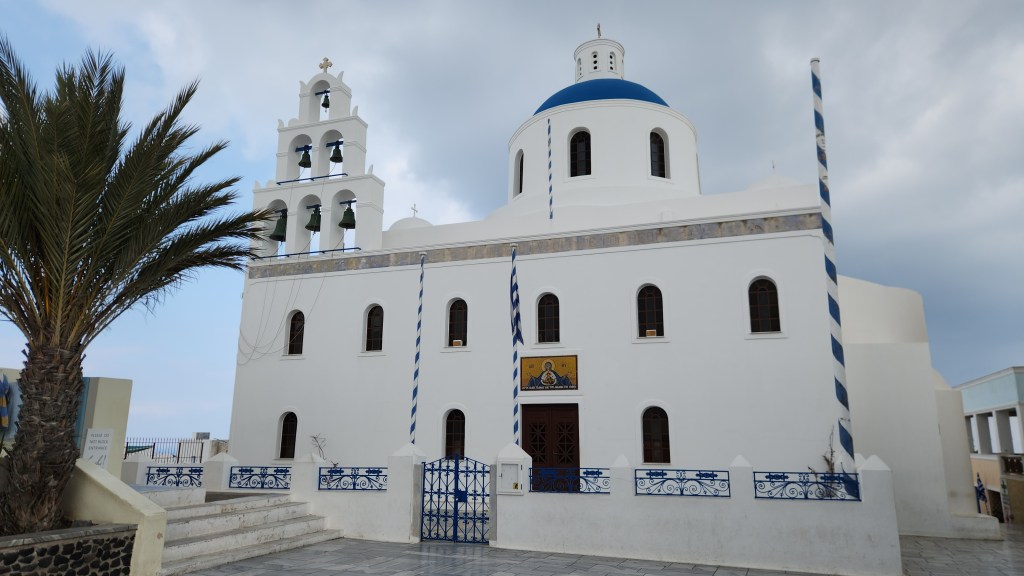
One of the Eclectic Statues in Madrid
The Puerta de Alcala
Retiro Park
Retiro Park

On our way back to the hotel, we passed by a large plaza including a sprawling monument to Christopher Columbus, including inscriptions of the crew members’ names from the famous 1492 voyage.

Christopher Columbus Monument
The Giant Head, near Columbus Monument
Madrid Sculpture

After returning to the hotel and taking a brief nap in our room, the Viking group was briefed by Susana on the plans for the next days before she led us on a brief walk around the neighborhood. Later, we went to a local café that Susana had recommended. The two young men manning the place spoke no English and were convinced we wanted beer, but with the aid of Google translate to decipher the menu and much gesticulating, we managed to order some delicious jamon de bellota sandwiches. The meat was carefully carved in thin layers off a huge pork leg, from a free-range pig fed only on acorns to produce the best Iberian ham.
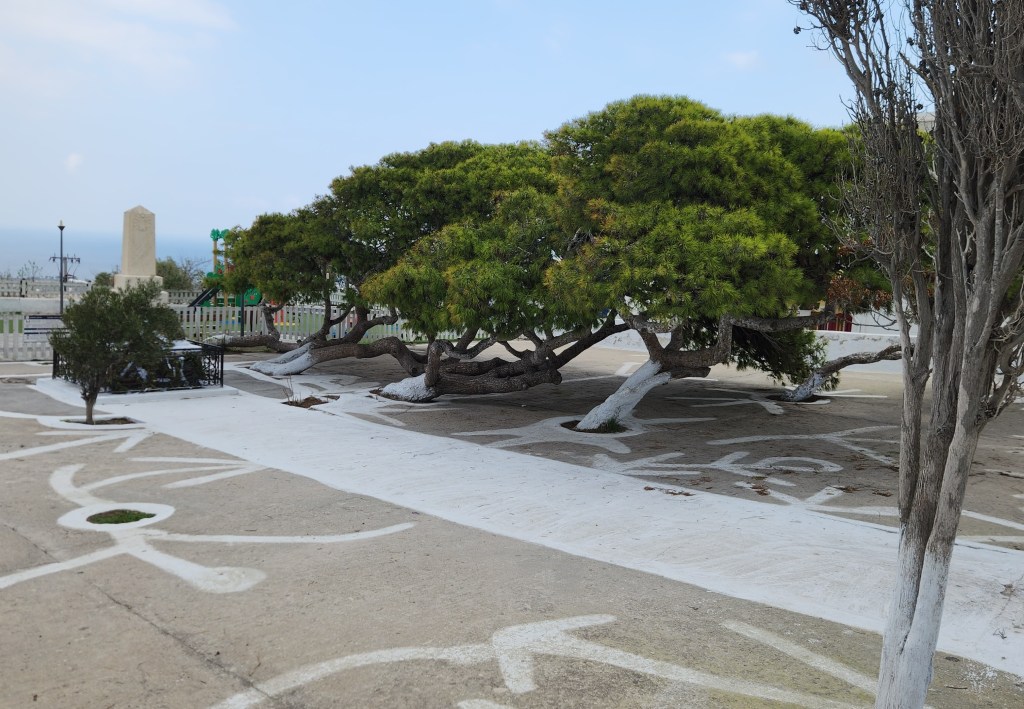
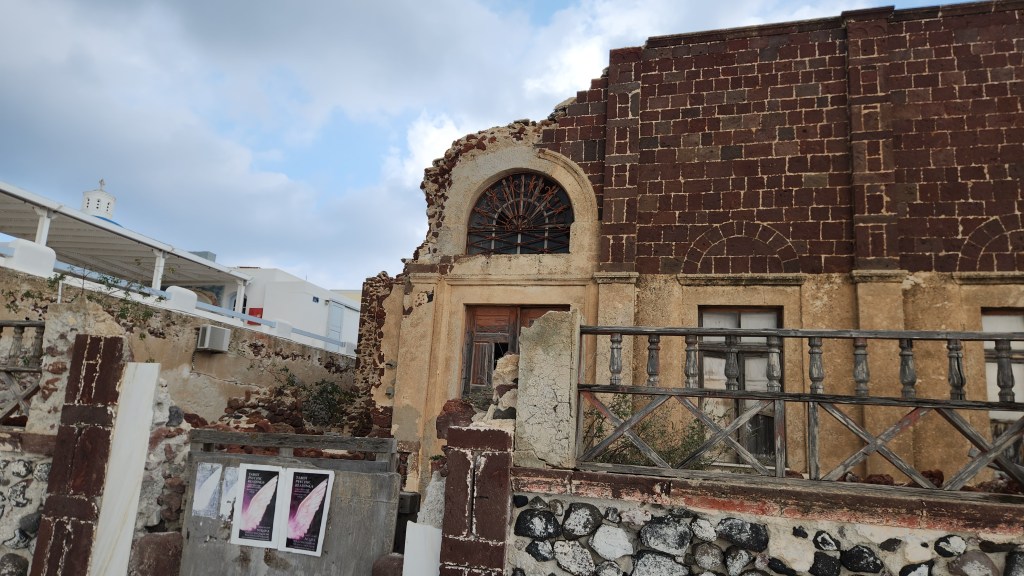
On Friday the 8th, we had a bus and walking tour of Madrid, during which we visited the Mercado de San Miguel (a bustling marketplace) and the Plaza Mayor, a huge square established in the 17th century by King Philip III, whose bronze equestrian statue stands in the square. We then passed by the Royal Palace and other landmarks before heading to the famous Prado art museum.

Mercado de San Miguel
Plaza Mayor
The Royal Palace
The Prado Museum

We spent a couple of hours in the Prado, including lunch in the cafeteria. Photos were not allowed except in a few rooms, so I can’t show any, but some favorite things we saw were “The Washing of the Feet” by Tintoretto and “Las Meninas” by Velazquez (amazing perspective works), “Garden of Earthly Delights” by Bosch (intricate details, some bizarre and unsettling), and a series of paintings by Goya throughout his career, including the disturbing “black paintings” from his early 70s and his later return to using vibrant colors after moving to France. After the Prado, we elected to return to the hotel on our own by city bus rather than with the Viking tour bus. Unfortunately, we missed getting off at the bus stop nearest the hotel and ended up walking an extra eight or ten blocks. All in all, we found Madrid to be a clean, bustling, pleasant city. That evening, we had an excellent dinner of seafood paella at a restaurant near the hotel called La Gaditana.

Restaurant where we ate Seafood Paella

On Saturday the 9th, we rode a bus some 45 miles south to Toledo, the original capital of Spain before Philp III made Madrid the capital in 1603. Toledo is strategically located on a high hill on the north bank of a bend the Tagus River.

Overlook of Toledo
Toledo Old City

Toledo is known as the “City of the Three Cultures” for the cultural influences of Moors, Christians, and Jews throughout its history. Toledo has long been known for its production of fine steel for weapons and jewelry, so we first visited a touristy factory/retail outlet just outside the town and saw how some of the products are made today. We then traveled into the city and rode to the top of the hill on a series of conveniently located escalators before beginning our walking tour. While the streets of the old city are very narrow, many houses have beautiful courtyards just inside their doors.

Old City Toledo Street
Courtyard of Toledo Home

Our first visit was to the gothic style cathedral, which was begun in 1226 and completed in 1493. Among its treasures is a magnificent gold artwork called the monstrance, made for Queen Isabella in 1515-1523, that is carried through the city during annual festivals.

Cathedral of Toledo
Cathedral of Toledo
Monstrance in Cathedral of Toledo

Another highlight was the Church of Santo Tome, the lobby of which displays the El Greco masterpiece “The Burial of the Count of Orgaz” which commemorates a local legend and is known for its use of multiple schools of art and for inclusion of a self-portrait of the artist as one of the funeral attendees.
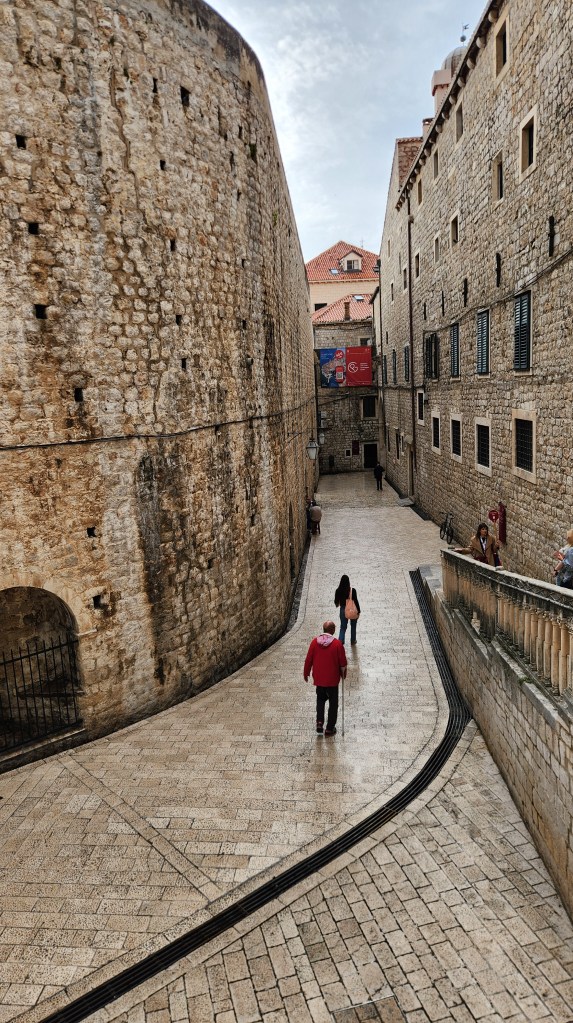
“The Burial of the Count of Orsaz” by El Greco

We also visited the Jewish quarter, including a former Jewish synagogue that has been established as a national monument although given the unfortunate name of Santa Maria La Blanca (St. Mary of the White Virgin).

Entrance to the Jewish Quarter
What a name for a Jewish Synagogue
But at Least the Synagogue is a National Monument

We then strolled through the old town area and emerged into a street with modern shops, even one in which Pat and I encountered some friendly inhabitants.
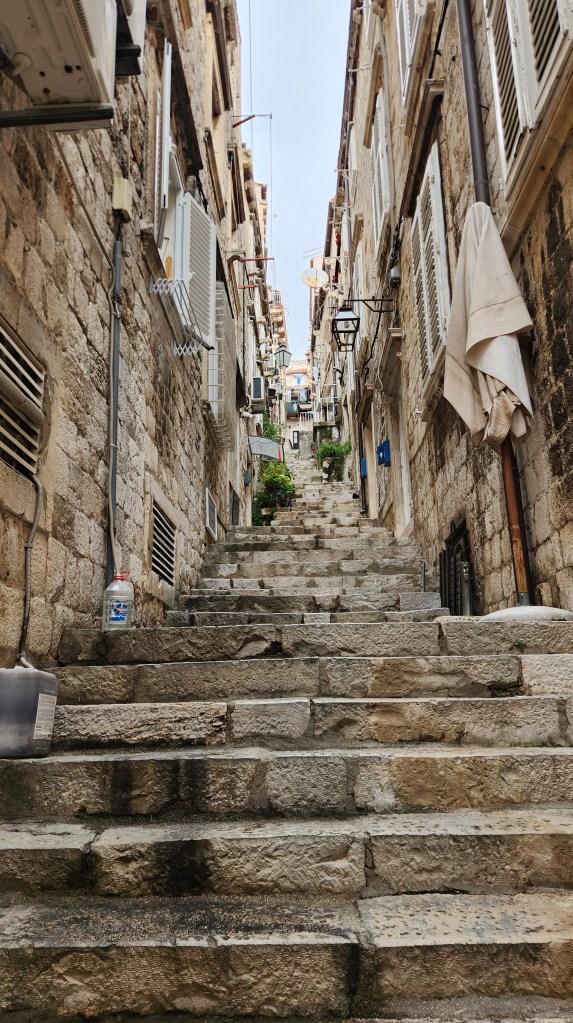
Dave Meets Don Quixote …
… and Pat Meets a Knight in Shining Armor

Lisbon (November 10-11): On Sunday the 10th, we were transferred by a Viking bus from our hotel back to the Madrid airport, where we boarded a flight to Lisbon operated by a regional carrier for Iberia Airlines. We were again met by Viking representatives and were driven to the Corinthia Lisbon Hotel, where we met our Viking Cruise Director Tamara and the local Viking Host. We spent some time wandering around the neighborhood and ate a light lunch in one of the hotel restaurants, then joined the Host at 3:30 PM for an introductory walk-and-talk, then attended a welcome session by Tamara at 6:00 PM for an overview of Lisbon and plans for our time there. After a short walk to a nearby restaurant for a delicious meal, we retired to our hotel room. My only complaint about the elegant five-star hotel is that the electronic safe in our room did not operate properly so we could not store away our passports.
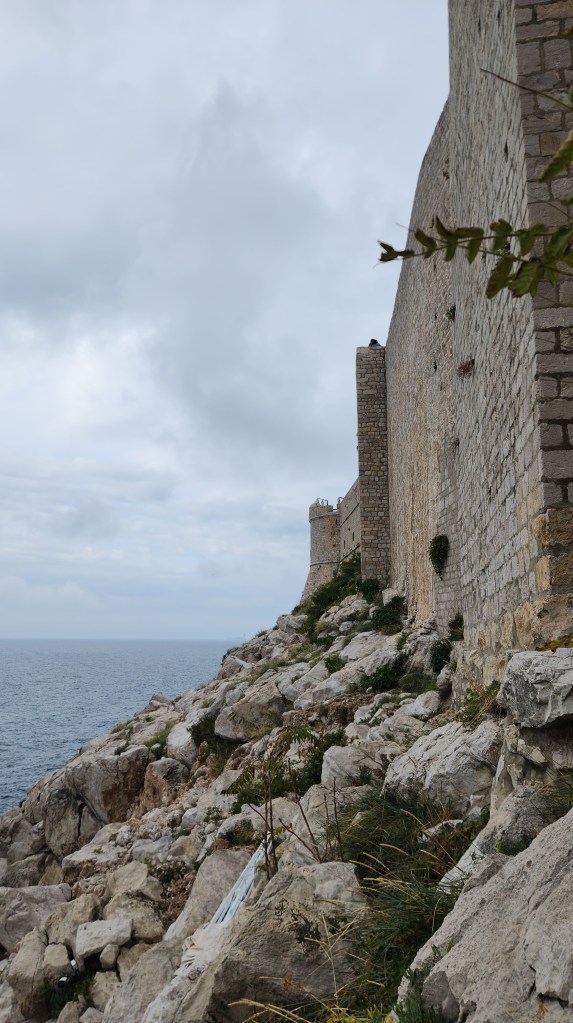
Courtyard of the Hotel Corinthia

On Monday the 11th, we headed off on a bus and walking tour of Lisbon, during which we took in the sights and learned quite a bit of Portuguese history. (Now known as a well-functioning democracy, Portugal was actually ruled by a dictator, António de Oliveira Salazar, from 1932 until he died in 1970. His successor was deposed in the bloodless Carnation Revolution in 1974, and Portugal transitioned to a constitutional democracy by 1976). We drove through the hilly city to the tourist area called Belém near the Tagus River – the very same river we saw in Toledo, by this point grown very wide before discharging into the Atlantic – where we saw the Belém Tower, a 16th-century fortification that served as a point of embarkation and disembarkation for Portuguese explorers and as a ceremonial gateway to Lisbon. It was built during the height of the Portuguese Renaissance, and is a prominent example of the Portuguese Manueline style, but it also incorporates other architectural styles, such as the minarets inspired by Moorish architecture.

The Belém Tower

After visiting the tower and a surrounding park, we moved on to the Maritime Museum, dedicated to all aspects of the history of navigation in Portugal. Our guide pointed out many of the interesting features and explained how Spain (Castile at the time) and Portugal signed the Treaty of Tordesillas in 1494 to divide the world in half – Portugal was given the lands to the east and Spain those to the west of a line of demarcation. The two countries explored and claimed much of the world, with Portugal establishing colonies in Africa and India and conducting trade as far east as Japan beginning in 1543. Portuguese explorers continued to sail the east coast of North America – an inscription carved on Dighton Rock in 1511 supposedly commemorates Miguel Corte-Real – but did not settle there in accordance with the treaty. Portugal was allowed to establish their colony in Brazil since it lay to the east of the treaty’s demarcation line, although the western part of what became Brazil is actually to the west of that line.

World Map in Maritime Museum (Line of Demarcation Highlighted)
Replica of Dighton Rock Inscription
Ceremonial Boat in Maritime Museum

Following the museum visit, we had free time to visit the Jeronimos Monastery, erected in the early 1500s near the launch point of Vasco da Gama’s first journey, and nearby shops, including the Pastéis de Belem bakery, established in 1837 to make the original, world famous Pastéis de Belém from an ancient recipe developed by the monks of St. Jerome at the monastery. The recipe remains secret, and these delicious custard pastries are made every day “by hand,” supposedly using traditional methods. Amazingly, they produce and sell 20-40,000 of them per day. Pat and I each had one, and they more than lived up to their reputation. We explored the nearby Vasco da Gama Garden while savoring them, before returning to the tour bus.

World Famous Famous Bakery
Vasco da Gama Garden

Another stop on the tour was the Parque Eduardo VII, the largest park in central Lisbon, covering 62 acres. The park was named after King Edward VII of England, who visited Lisbon in 1903, and provides a gorgeous view of Lisbon and the Tagus River.

View of Lisbon Overlooking Parque Eduardo VII

Once back at the hotel, we spent some time exploring a nearby park before heading off on a 3 ½-hour walking tour of Lisbon restaurants, where we sampled a variety of Portuguese delicacies and libations. One of the spots was called the Pastéis de Nata bakery, where they make a custard tart very similar to the Pastéis de Belém, using a non-secret recipe well known to millions of Portuguese. We were told by our Viking host that the Portuguese people are divided on which of these delicacies is better. For my part, I thought they were equally delicious.

Our “Taste of Lisbon” Tour Guide
The Other Custard Tart Bakery Logo
Lisbon Street View During our Tasting Tour

OK, that’s it for Part 1. Thanks for reading, and stay tuned as we head north toward the Douro River and our ship, the Viking Helgrim, coming in Part 2.