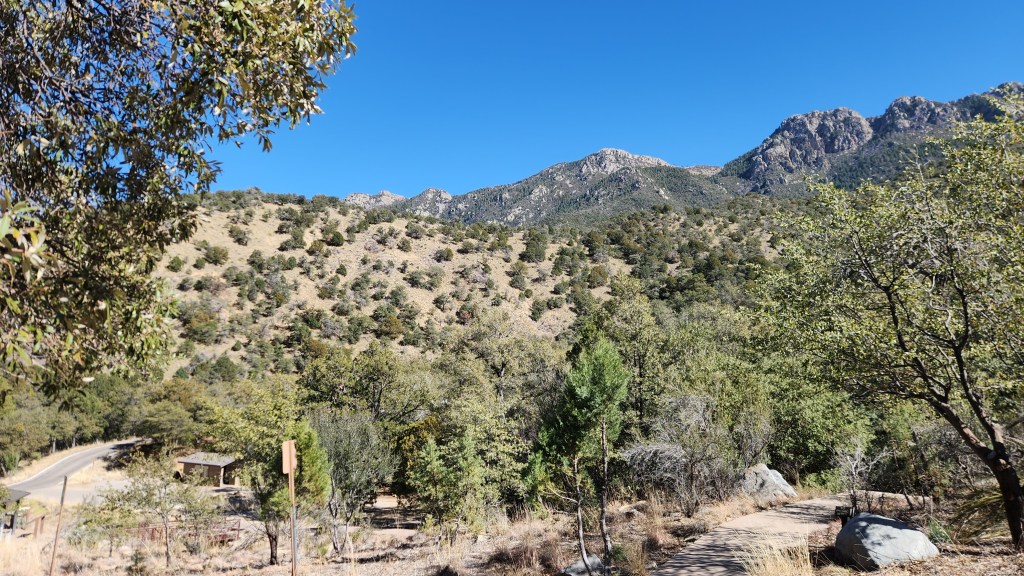
Pat and Dave’s (Almost) Redundant Road Trip Redo – PART 2: More Repeat Visits

Part 1 of this travelogue covered our 6-week stay in Green Valley, AZ, which was essentially a repeat of last year’s Winter Warmup enlivened with a few new places we discovered this time around. While we very much enjoyed the warm weather and the relaxation associated with a long-term stay, we were eager to move on as we packed up the car on Friday, March 6, and headed westward. This installment covers several of the stops we made during our circuitous return to Minneapolis, all of which we’d done during previous road trips. (As Steely Dan put it back in the 1970’s, “You go back, Jack, do it again …,” although I’d say our repeat choices were much better than those of the unfortunate subject of that song.)

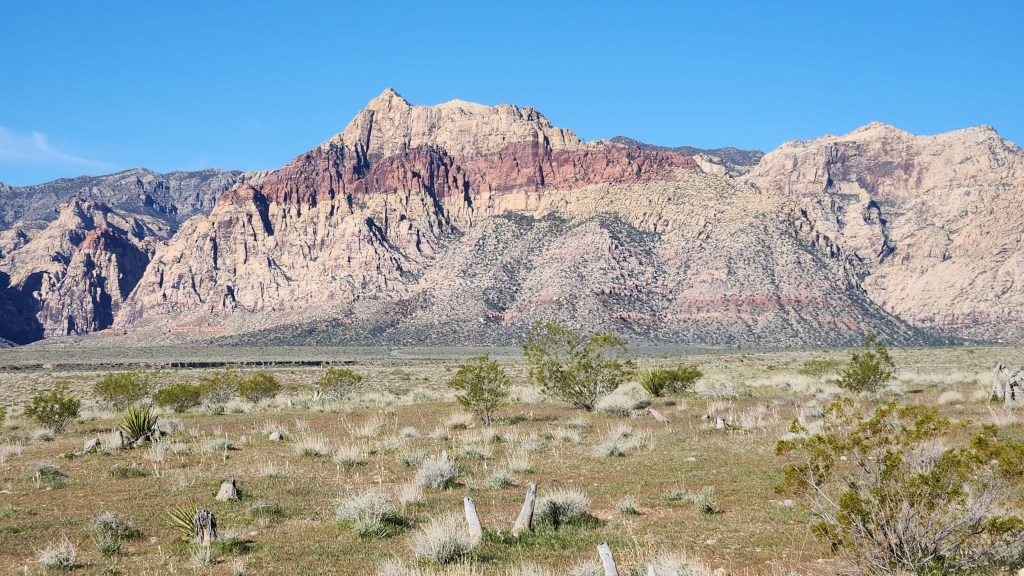
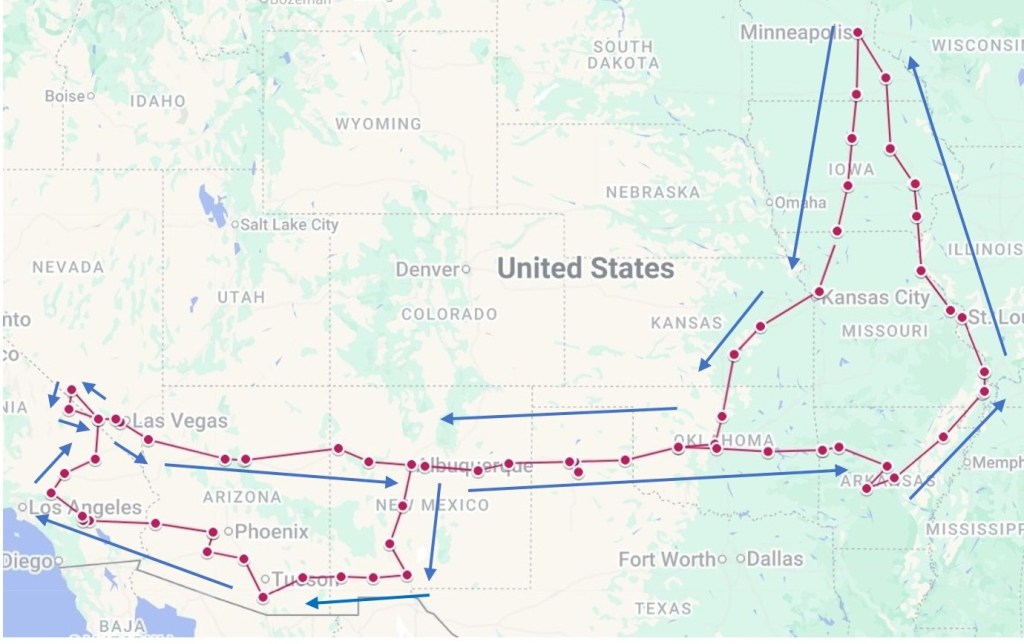
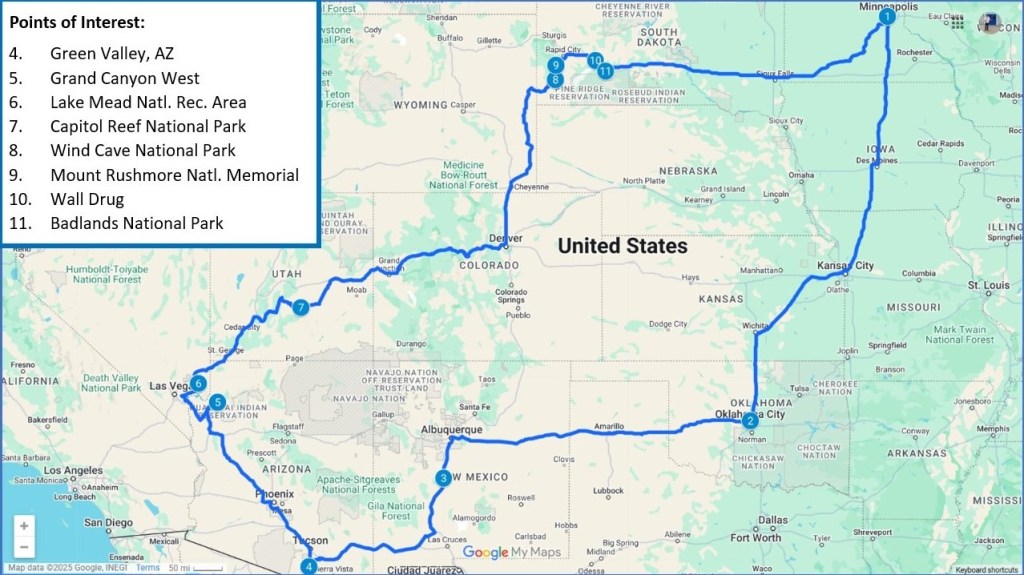
Here’s a map showing the interesting places we visited during the stretch from March 6 through March 16 followed by brief descriptions of those visits.
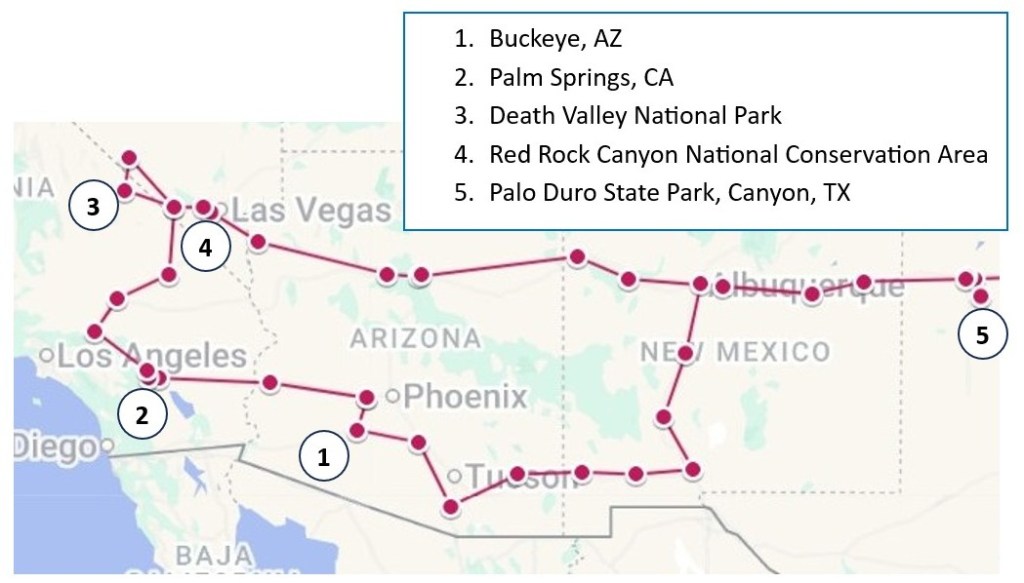
Buckeye, AZ: Since we’d allowed for three travel days to make the relatively short drive from Green Valley to our next booked destination in Palm Springs, we decided to stop for a couple of days in Buckeye along the way. This was based primarily on our great memories from Pat and Dave’s Excellent Adventure (Part 4) in 2018 as well as The Saaris’ (Sorta) Safe Sojourn (Part 8) in the Covid times of 2021. During both of those trips, we stayed at an RV park in Buckeye and went hiking at the Skyline Regional Park.

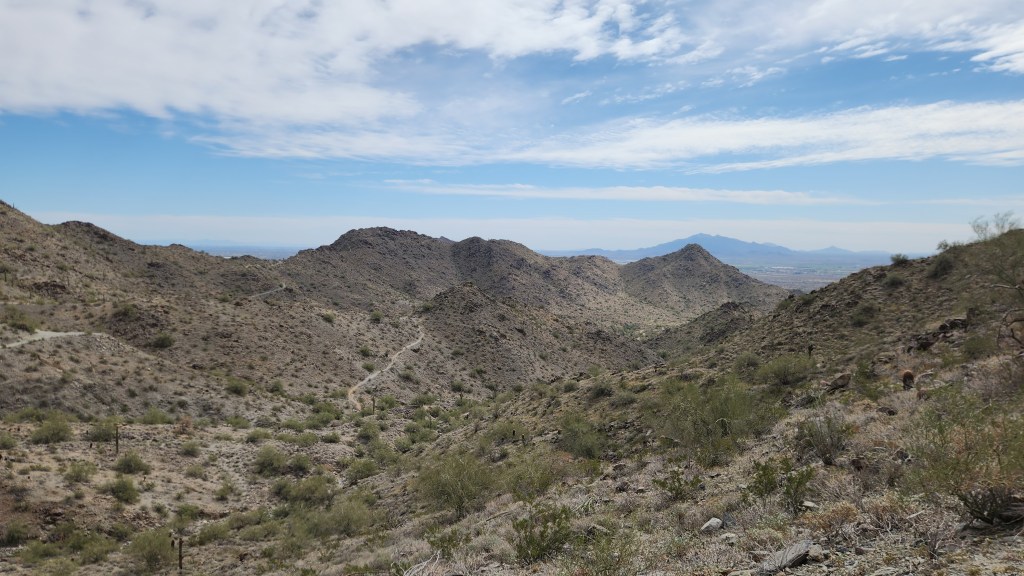
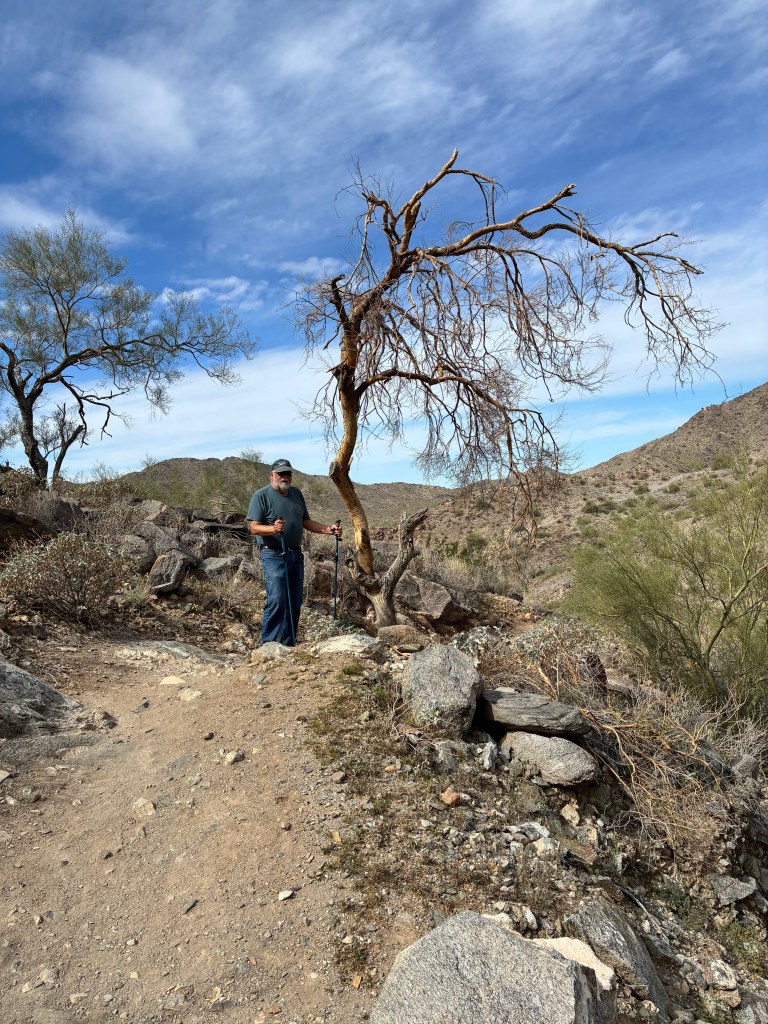
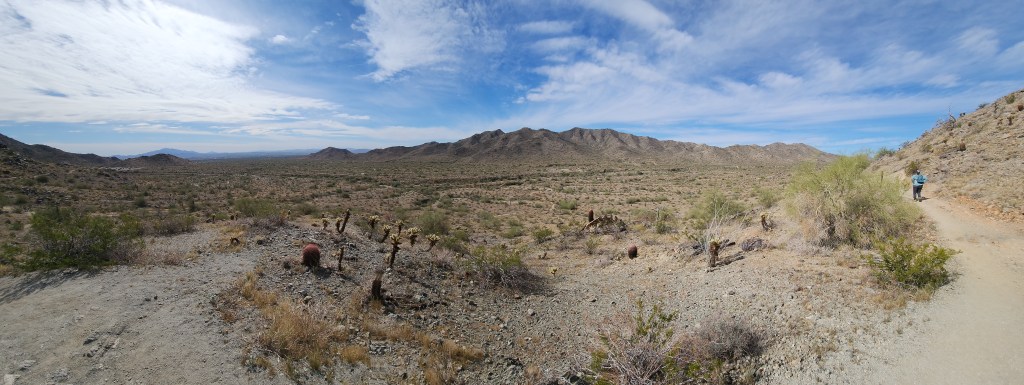
This time around, we stayed in a hotel, but on Saturday, we again hiked the Turnbuckle Trail at Skyline, a 3-mile loop which we also covered in 2018. The views were spectacular and the hike was demanding enough to get our hearts pumping, even though its difficulty was only rated as “Moderate.” While the intervening six years didn’t seem to have slowed me down too much on the uphill portions, I definitely needed my walking sticks to navigate the rocky portions on the final downhill leg.
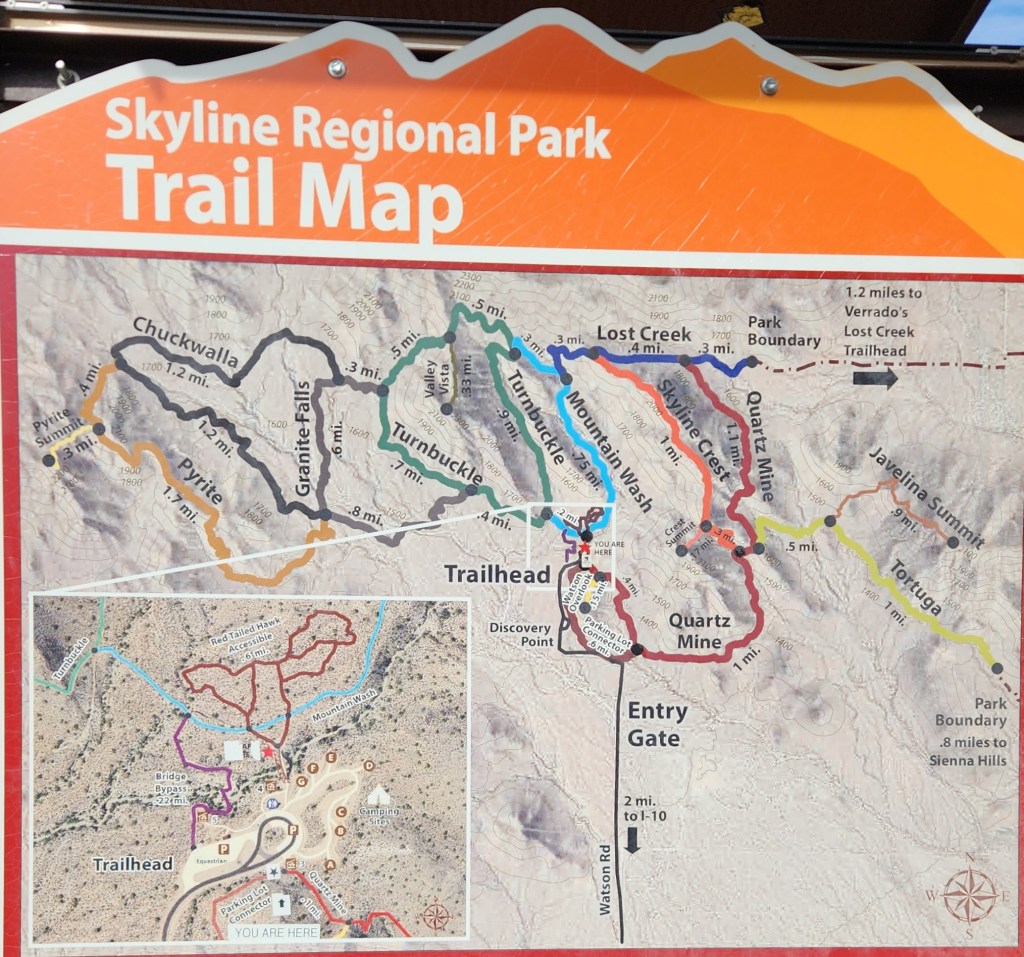
Map of Hiking Trails at Skyline Regional Park
Panorama Picture on the Turnbuckle Trail
View from Turnbuckle Trail
Going up was fairly smooth …
Coming down, not so much

Loyal readers may recall that on both of our previous visits to Buckeye, we dined at a terrific pizza place called Ciao Grazie, so naturally in the “do-it-again” spirit, we had to go there again after our Skyline hike. We had shown a tiny bit of independent spirit, however, on Friday night, when we dined at a nice Indian restaurant called Punjabi Dhaba that was quirkily located inside a large truck wash.

Palm Springs, CA: On Sunday, we drove to the Omni Rancho Las Palmas Resort and Spa near Palm Springs. I would call it the most upscale place we’ve ever stayed at in our lives – a sprawling place with multiple buildings, swimming pools, tennis courts, and a golf course – although our hotel room did show some signs of wear. The reason we had booked such an un-Saari-like place to stay was simple: Pat wanted to go see some matches at the BNP Paribas Open tennis tournament in Indian Wells, and I wanted to play some golf in the Palm Springs area. So, we decided to splurge on a tennis travel package offered through the official tournament site that included a 3-night stay at a fancy hotel, reserved seats for two all-day sessions at the tournament, and a shuttle service to take her to and from the tournament site.
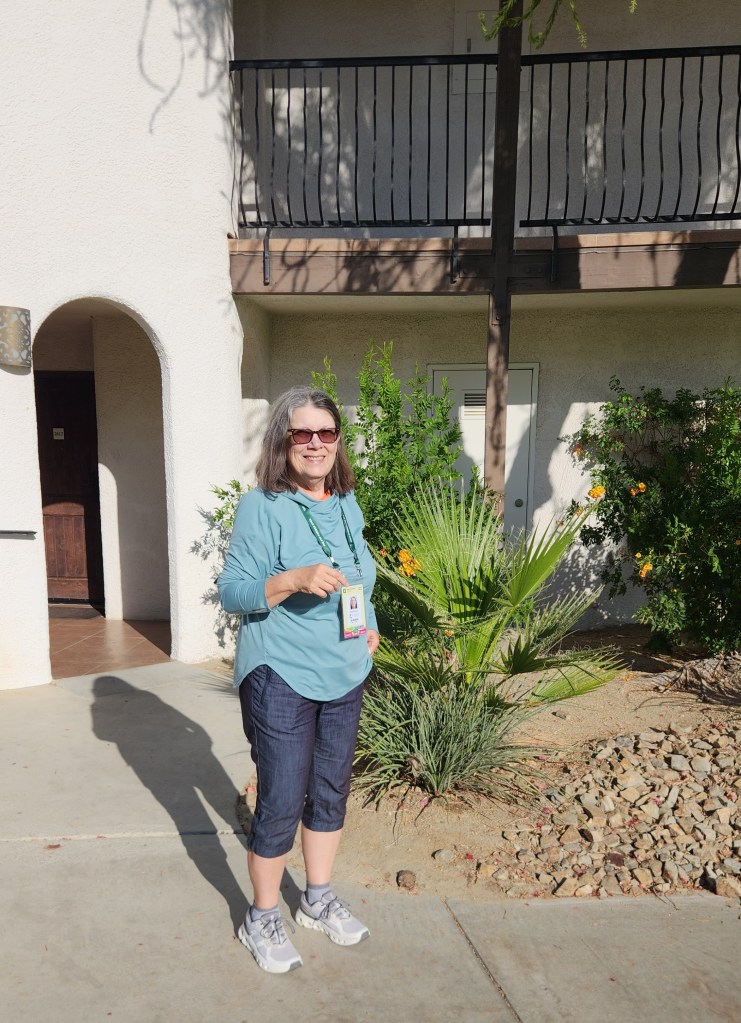
Pat with her Tournament Pass outside our Room at Omni Rancho Las Palmas Resort
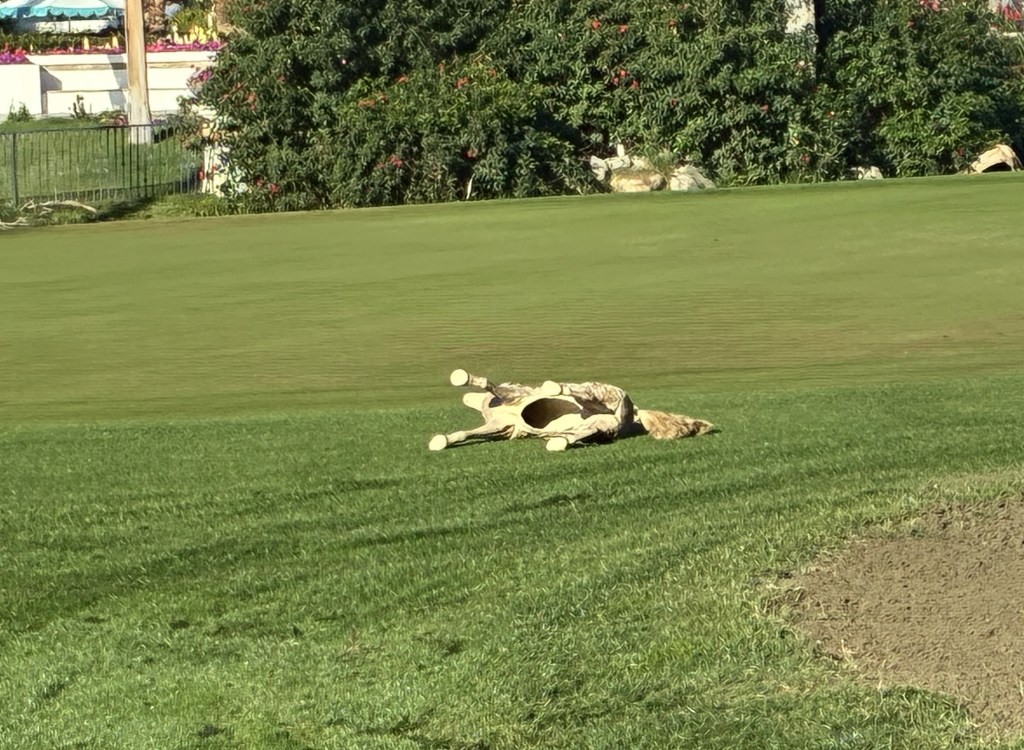
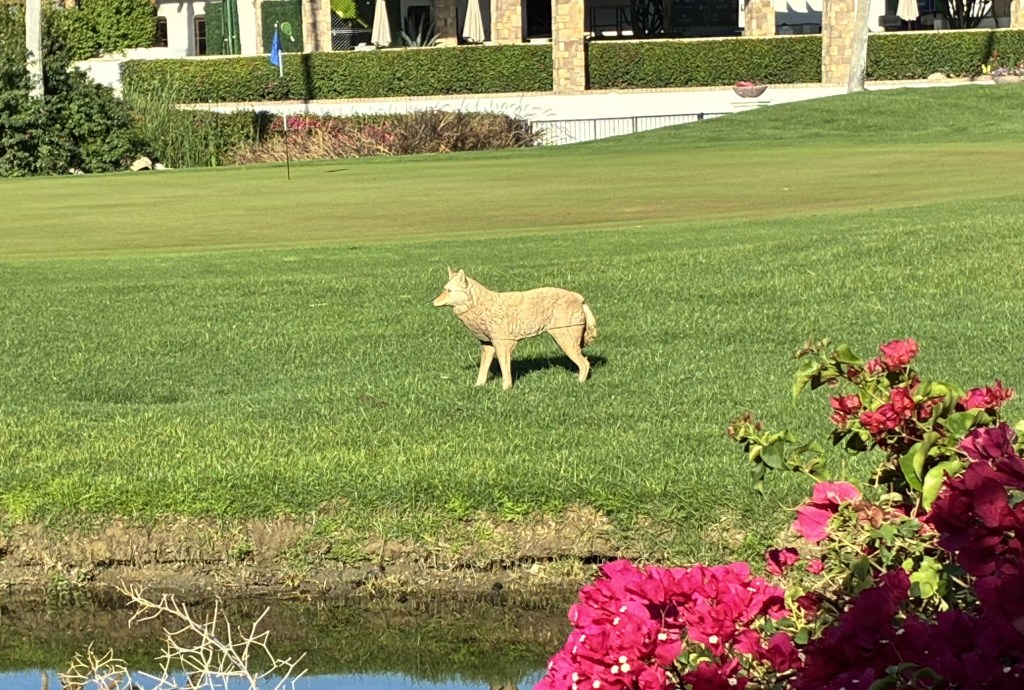
Wildlife at Rancho Las Palmas Resort
Oops … done in by the greenskeeper!

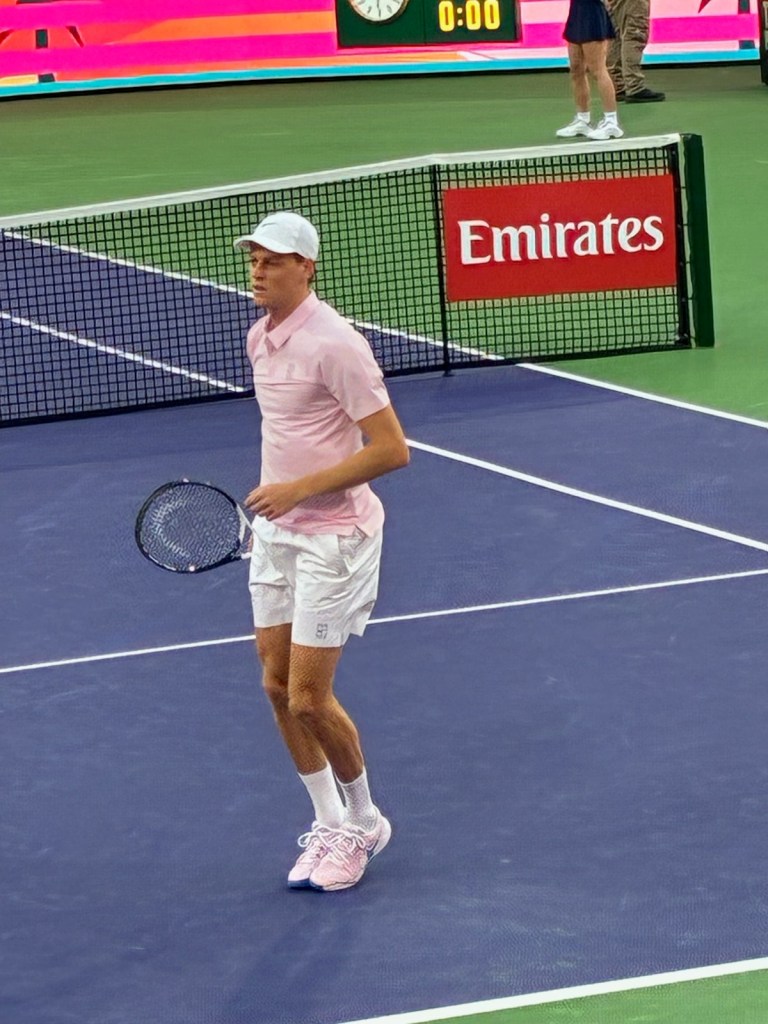
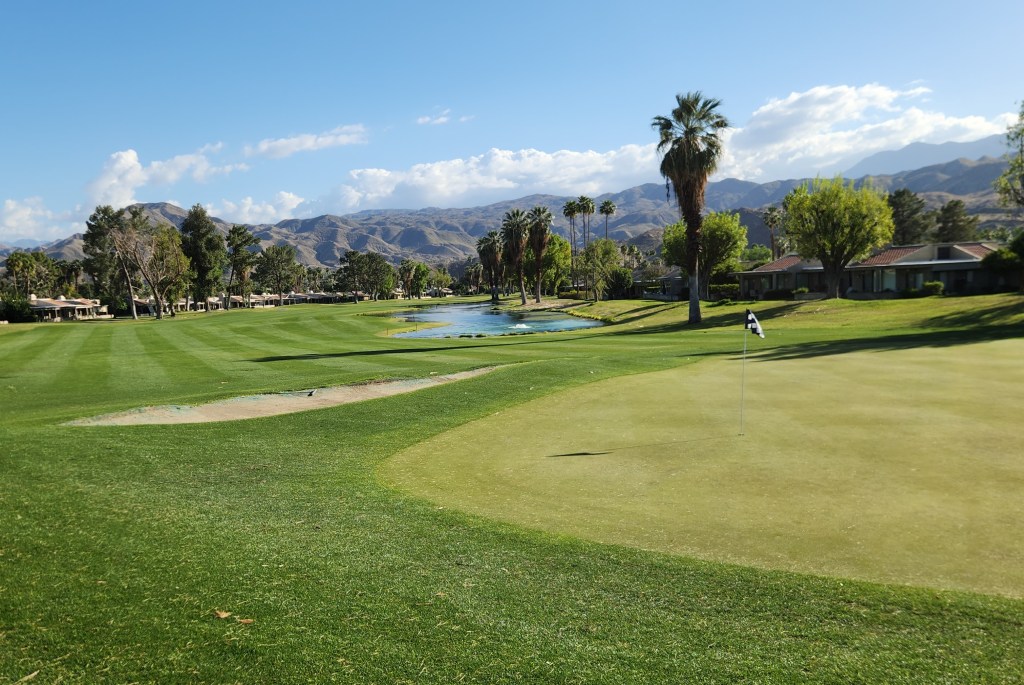
We both thoroughly enjoyed our separate activities. Pat saw a total of eight tennis matches on Monday and Tuesday during the middle rounds of the tournament, with top players including Jannik Sinner and Aryna Sabalenka, the eventual tournament winners, while I played golf at the Cathedral Canyon Golf Club on Monday and at the Rancho Las Palmas course on Tuesday.

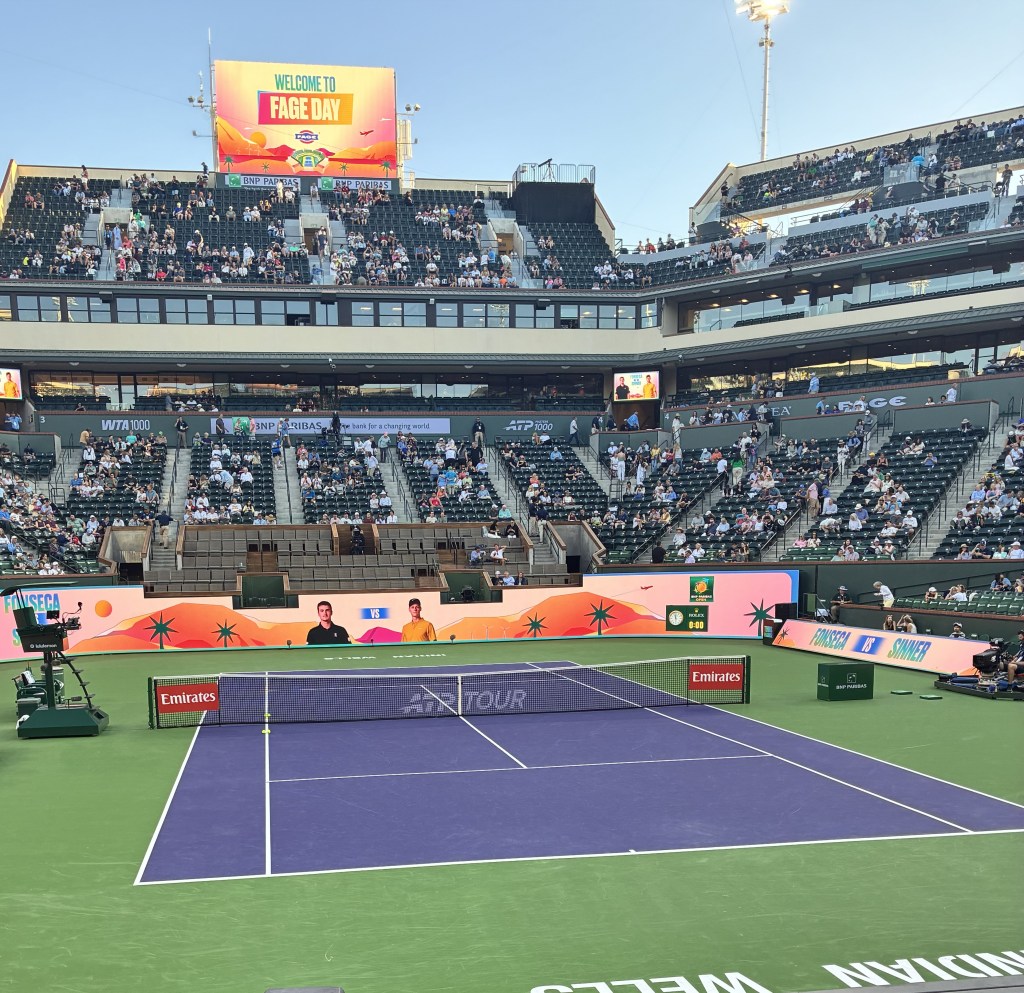
The Indian Wells Tennis Stadium
Great View from Pat’s Seat on Tuesday
Aryna Sabalenka at BNP Paribas Open
Jannik Sinner at BNP Paribas Open
18th Hole at Cathedral Canyon Golf Club

I should point out that these activities also were repeats of things we did during previous visits in 2019 and 2021, although the fancy hotel was quite an upgrade from our earlier stays in a nearby RV park. Also, I must add that while I chafed in the non-denim pants I brought along expressly to play at the pretentious Coachella Valley courses, I did try to salve my blue-collar sympathies by booking half-price greens fees through GolfNow and dining at McDonald’s on Tuesday evening.

Death Valley National Park, CA: My original hope when we set off on this trip was that we could visit Yosemite National Park after the stay in Palm Springs, though we hadn’t booked anything as we wanted to see how things developed with weather conditions. That would have been something new for us, a real departure from the redundant aspects of the trip. However, as our stay in Green Valley was ending, the reports we saw online indicated that much of the park was still inaccessible due to snow. As a result, we shifted our sights to Death Valley, another familiar site from our earlier RV trips that we knew would be warm and snowless. As a result, we reserved a 2-night stay in Pahrump, NV, yet another place where we had stayed on our previous trips, and drove there on Wednesday.

We drove from our hotel in Pahrump to the Death Valley National Park on Thursday morning and spent several hours exploring the park. One difference from our previous visits was that we entered the park from the north this time, rather than from the west as we had during our two previous visits, and were rewarded by the beautiful view from that direction.
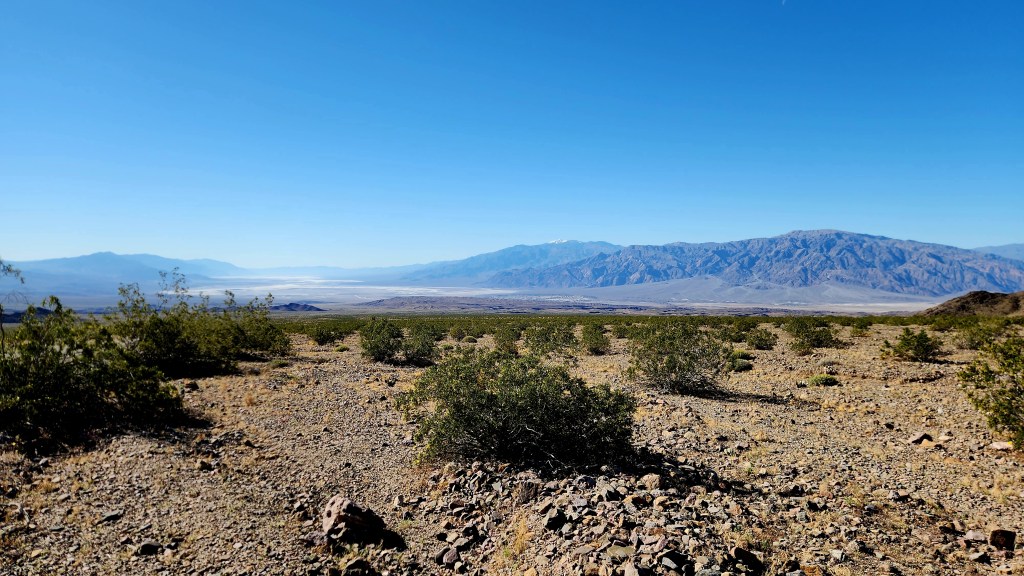
View of Death Valley from North Entrance Road

Death Valley is famous for being the hottest, driest, and lowest National Park. Here’s a quote from the National Parks website:

“In this below-sea-level basin, steady drought and record summer heat make Death Valley a land of extremes. Yet, each extreme has a striking contrast. Towering peaks are frosted with winter snow. Rare rainstorms bring vast fields of wildflowers. Lush oases harbor tiny fish and refuge for wildlife and humans. Despite its morbid name, a great diversity of life thrives in Death Valley.”

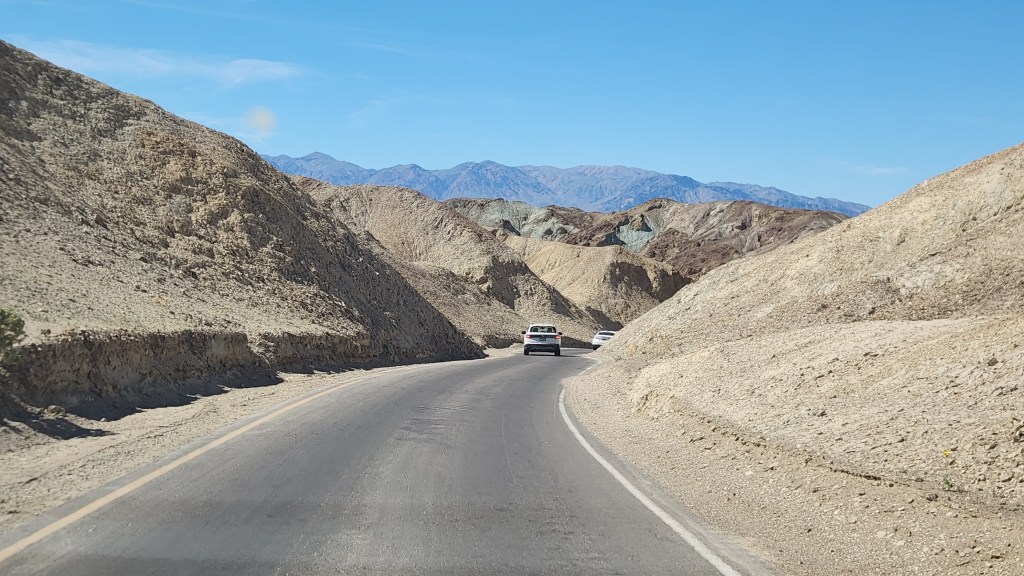
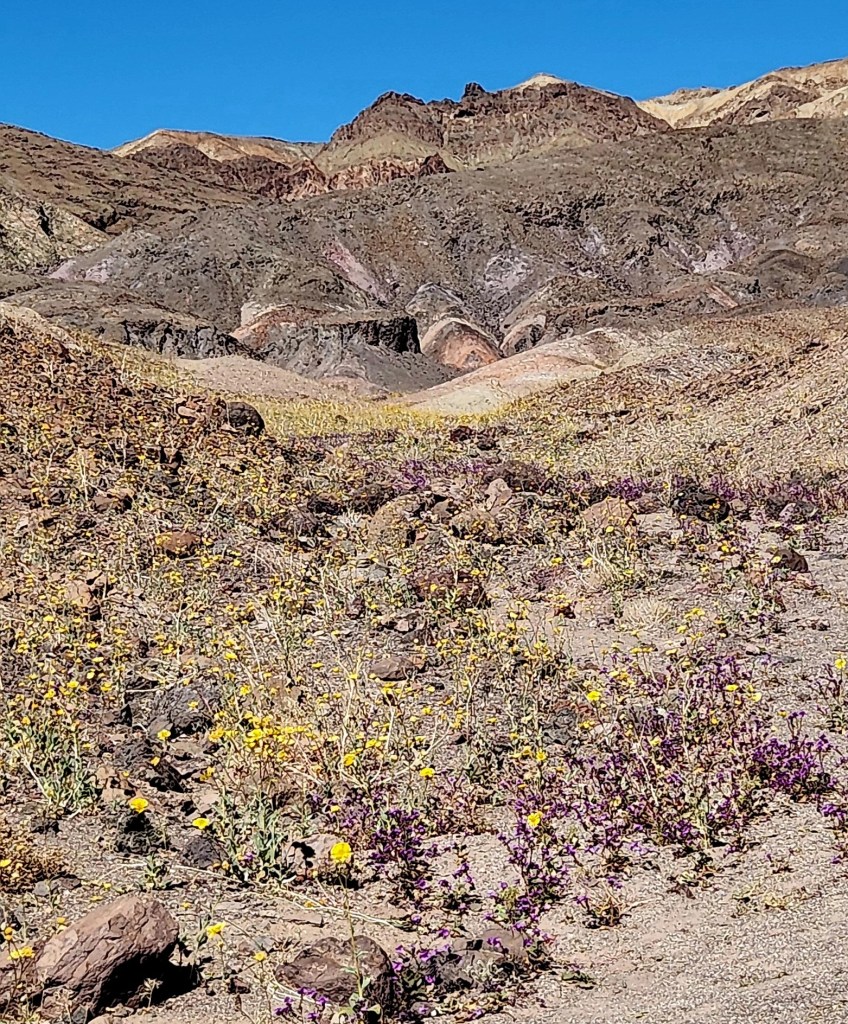
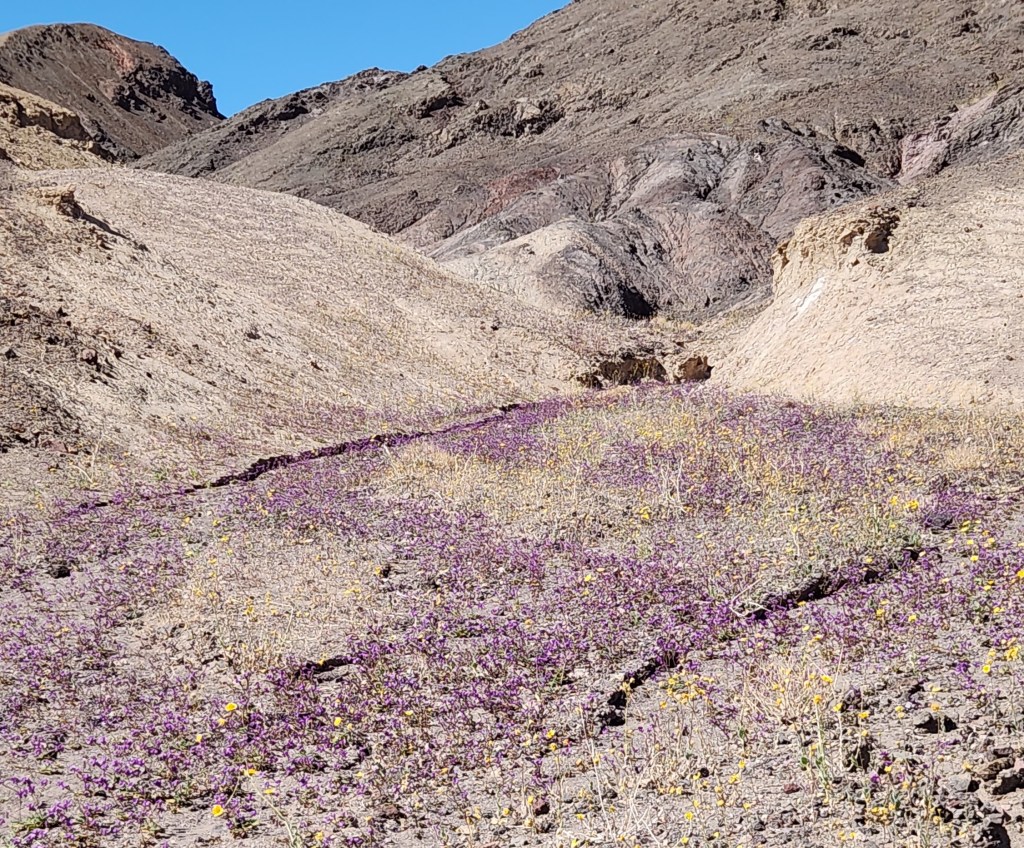
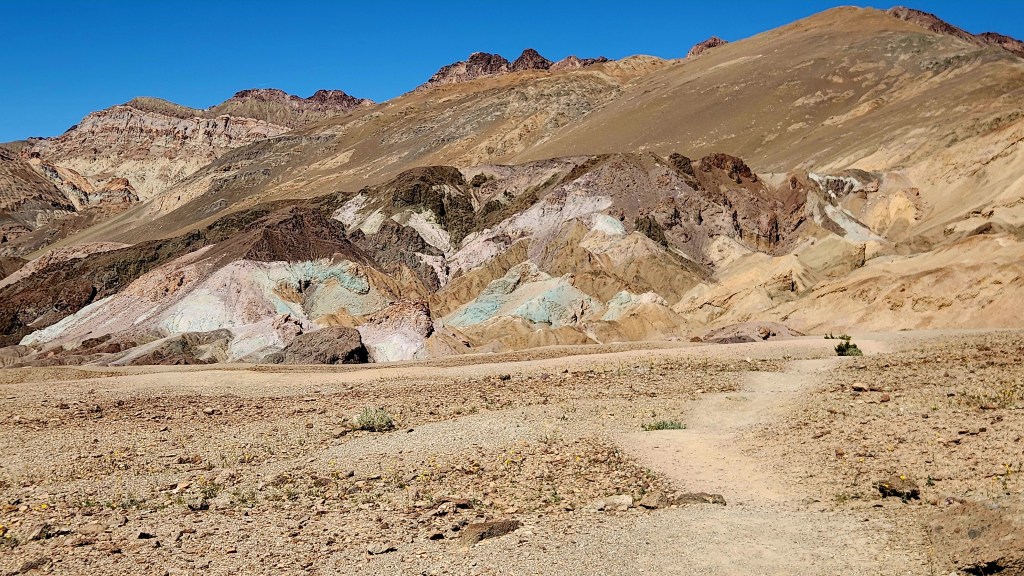
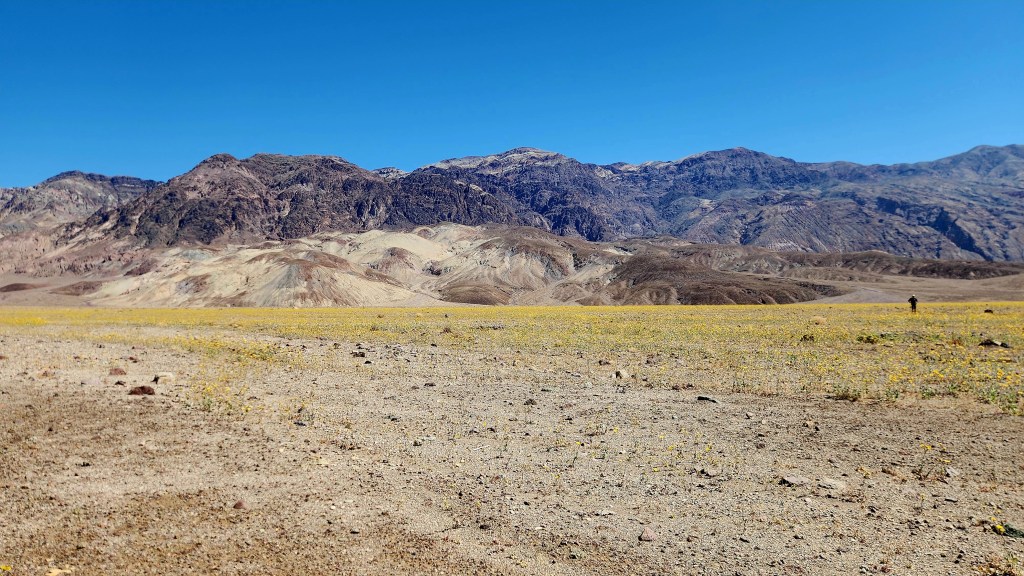
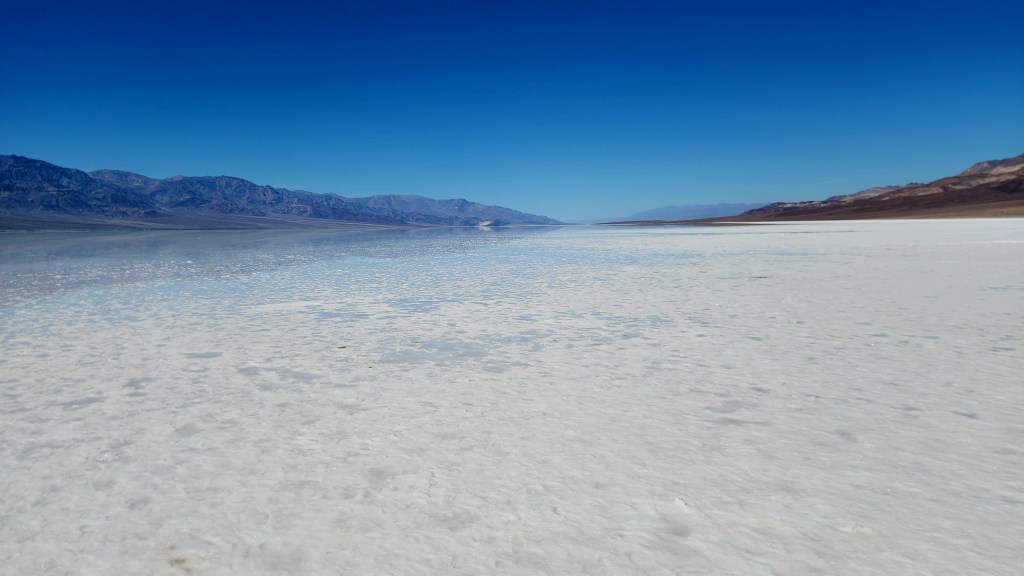
True to these words, we enjoyed the great diversity evident in the park. The yellow and purple wildflowers were blooming to a much greater degree than during our previous visits, and we again enjoyed visiting the Badwater Basin salt flats and driving the stunning Artist Drive loop. We enjoyed lunch and ice cream in two of the eateries in Furnace Creek and strolled on a path that meandered through a portion of the golf course as well as the on-site hotel buildings while we recharged the Tesla at a conveniently located – and free – EV charger before heading back to Pahrump.
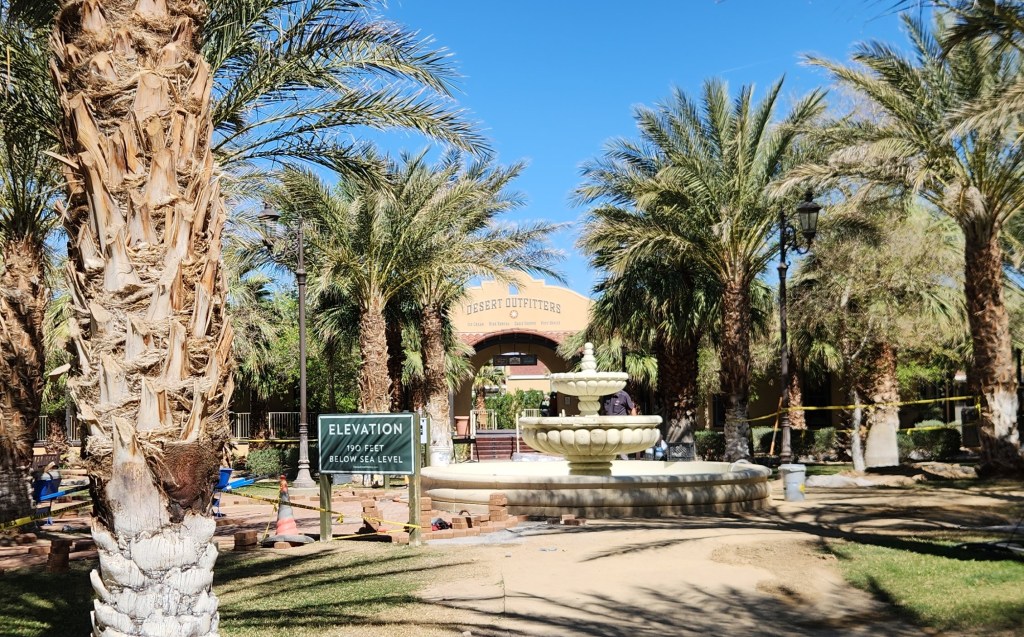
Central Plaza in the Oasis at Furnace Creek, Death Valley National Park
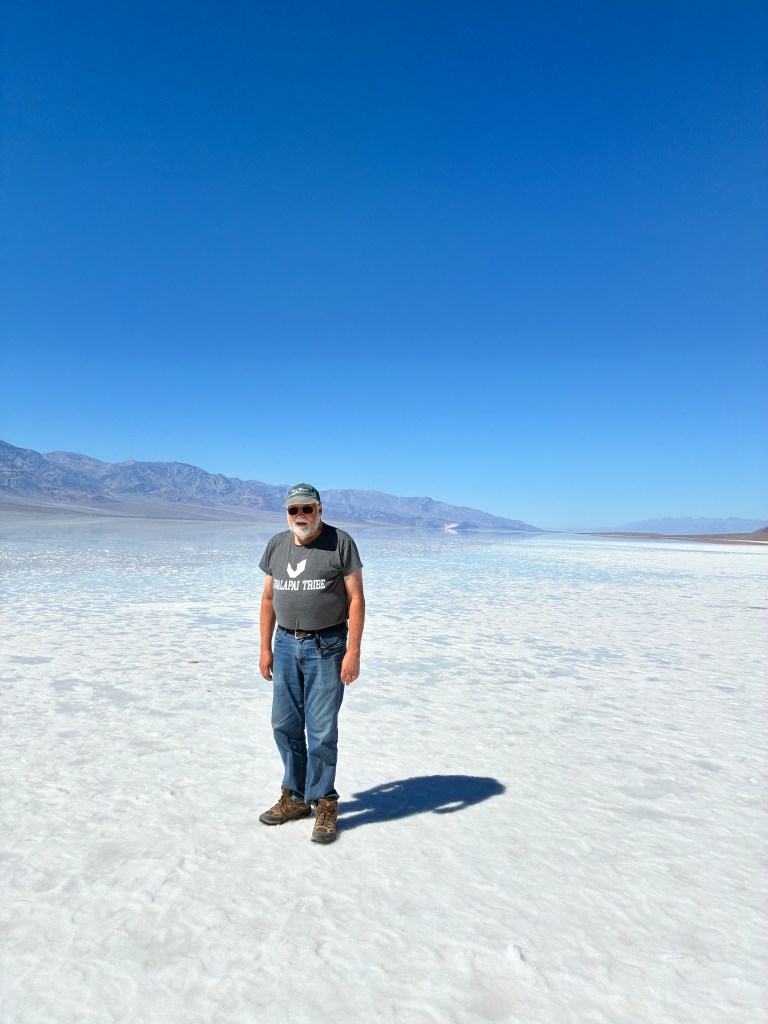
Salt Flats at Badwater Basin, Death Valley National Park
No need for walking sticks here …
View from Death Valley Wilderness Road
Artist Drive Loop
View from Artist Drive Loop
View from Death Valley Wilderness Road

As an added highlight to this visit – and something new as well! – we went to a local winery, the Artesian Cellars, and enjoyed a nice meal along with tastings of five different local wines. This was something we had tried to do back in 2021, but the restaurant was closed at that time due to Covid.

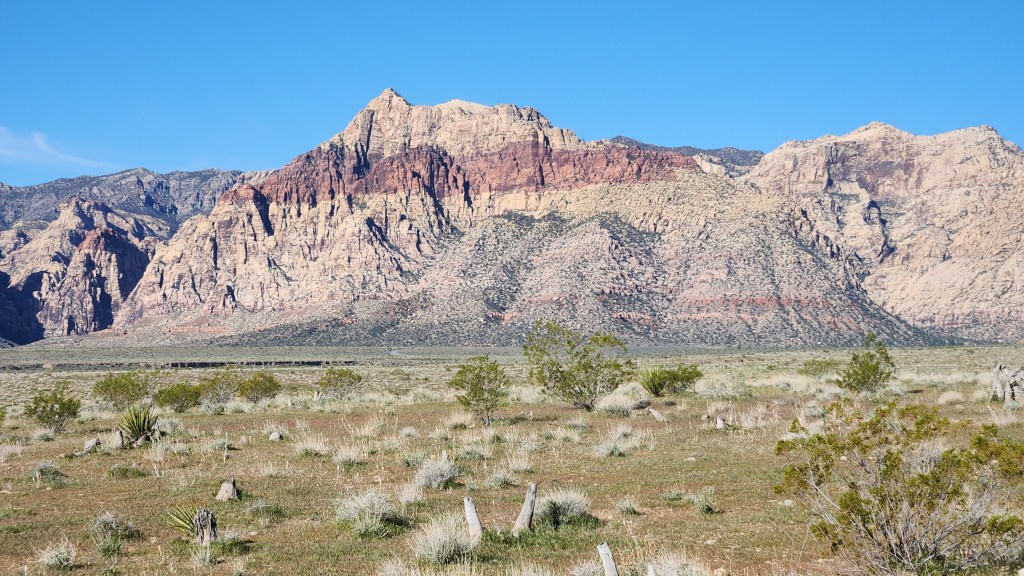
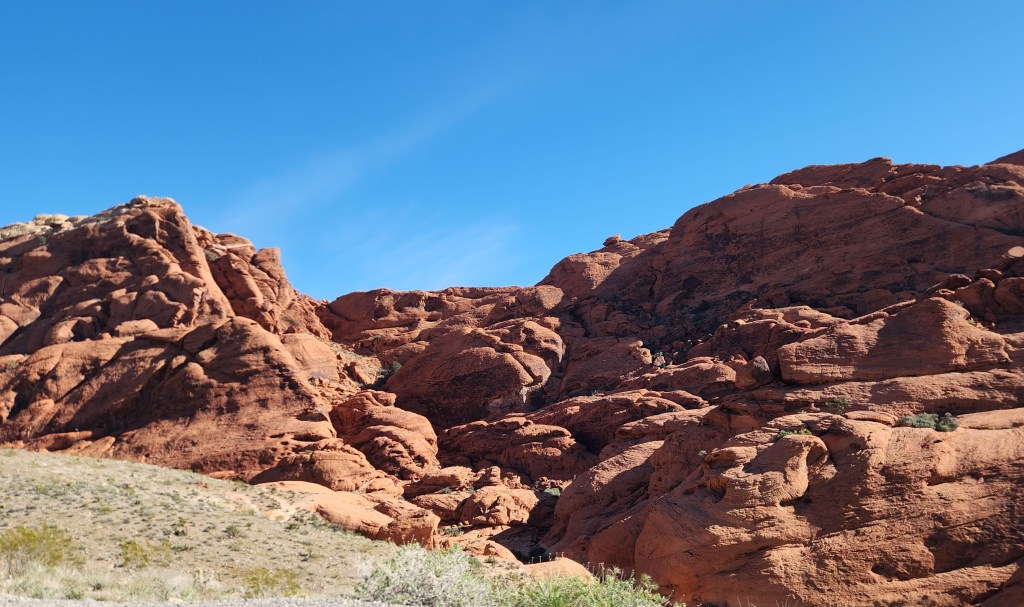
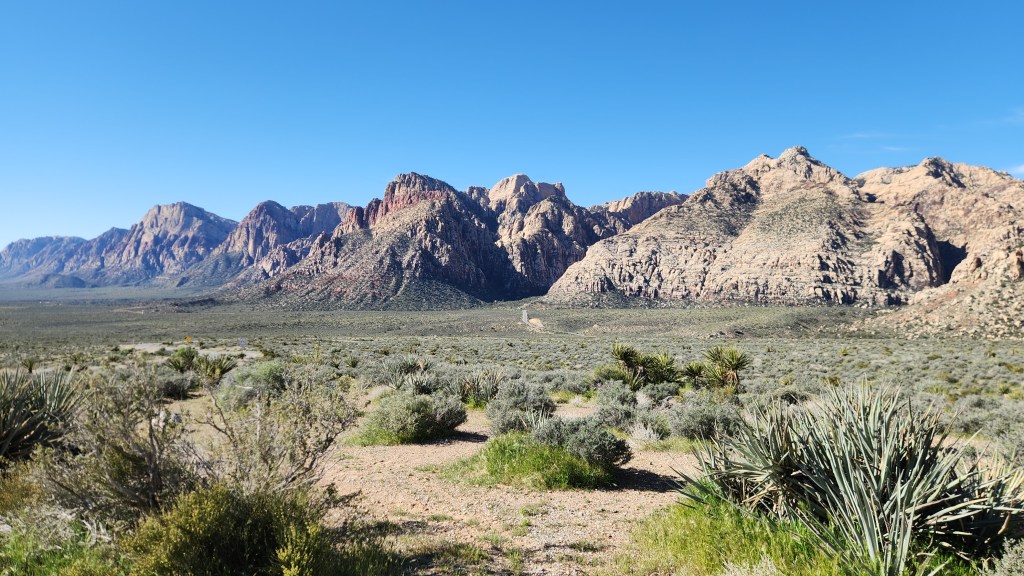
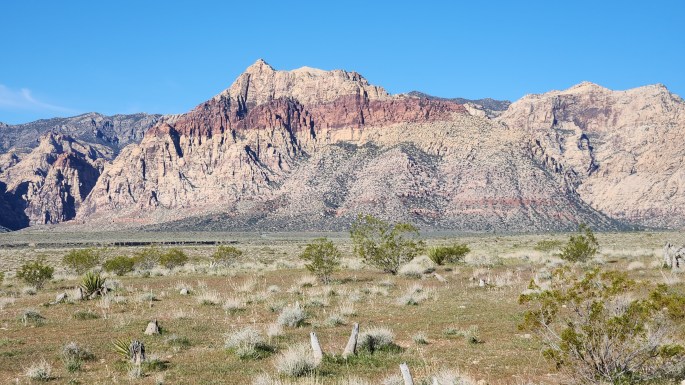
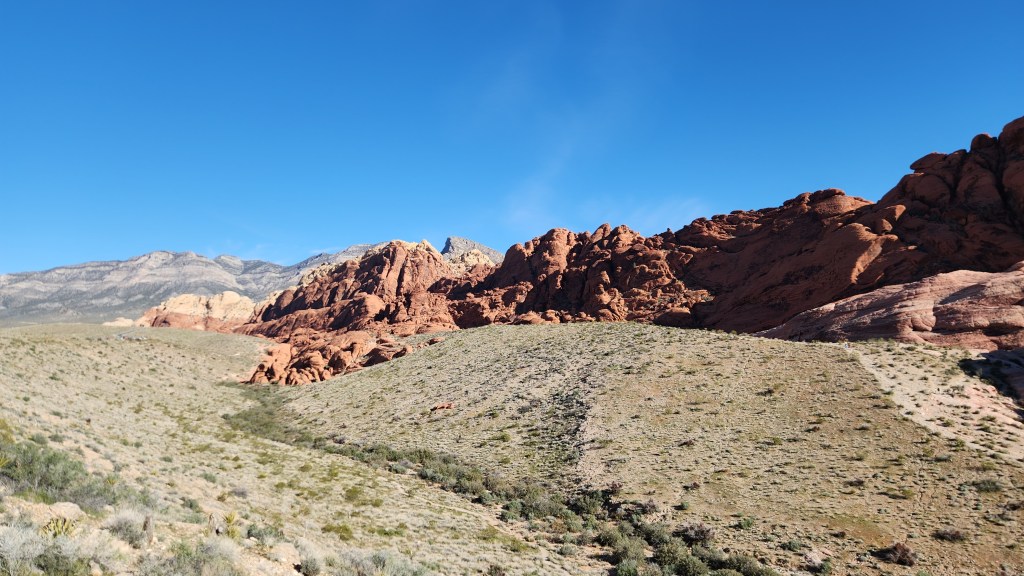
Red Rock Canyon National Conservation Area, Clark County, NV: As we sat in our hotel room in Pahrump the night before departing, we realized that our subsequent travels would take us directly past the National Conservation Area that we had visited back in 2021. Naturally, in the “do-it-again” spirit, we decided we should visit there again on this trip. So, I reserved a timed-entry slot on the Recreation.gov site for 9 AM on Friday, March 13. We arrived at the entry gate shortly after nine and spent an hour motoring around the 13-mile Scenic Drive loop, stopping frequently to ogle at the stunning scenery.
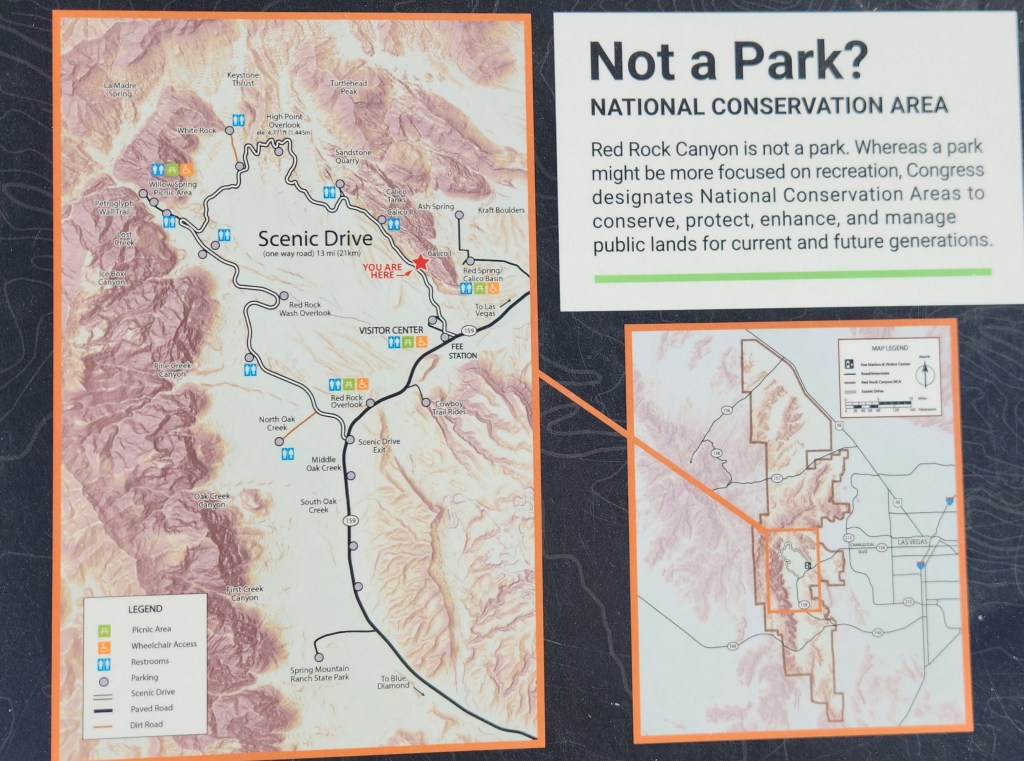
Map of Scenic Drive at Red Rock Canyon National Conservation Area
View from Scenic Drive

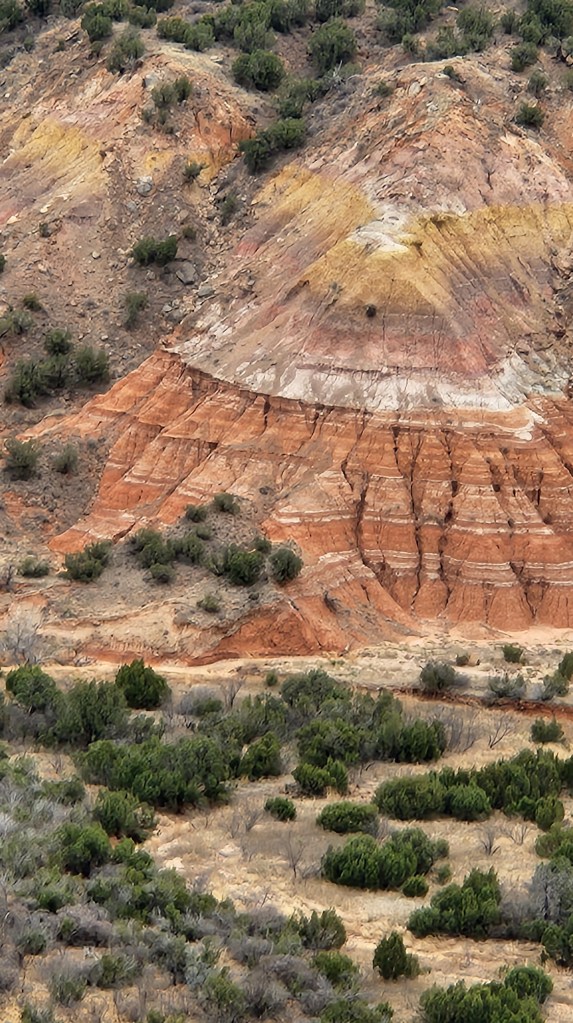
Palo Duro Canyon State Park, Canyon, TX: After our Red Rock Canyon visit, we spent two days travelling east to Amarillo, TX, where we stopped for a 2-night stay and another “do-it-again” visit, this time to the nearby Palo Duro Canyon State Park. Not to sound like a broken record, but yes, we had visited this place during both of our previous RV adventures and had very fond memories of the place. Palo Duro is known as the “Grand Canyon of Texas” and definitely lives up to the name. The visitor center is located on the rim of the 120-mile-long, 20-mile-wide canyon. After passing the visitor center, we descended on an amazing, scenic road with multiple hairpin turns and switchbacks that winds down some 800 feet to the canyon floor. The well-maintained, 16-mile loop road continues through the portion of the canyon that is open to the public, with access to over 30 miles of hiking trails and multiple campgrounds. On our previous visits, we stayed in the RV at the Hackberry Campground, located about halfway along the loop road, and the Mesquite Campground at the westernmost end. We drove past both of these sites on our trip around the loop, eliciting a raft of fond memories.
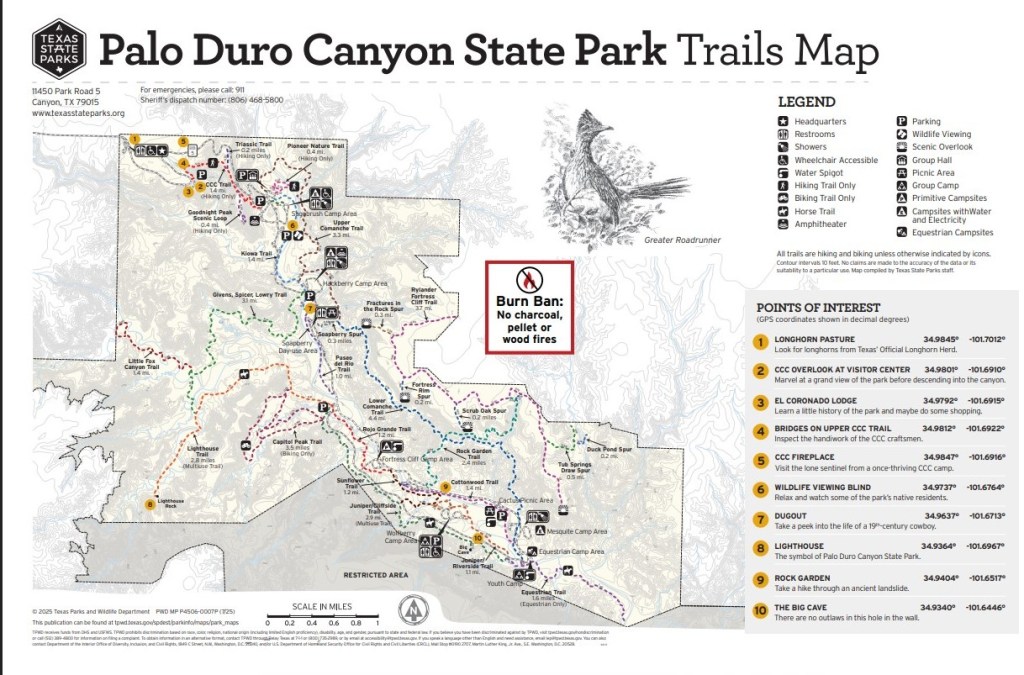
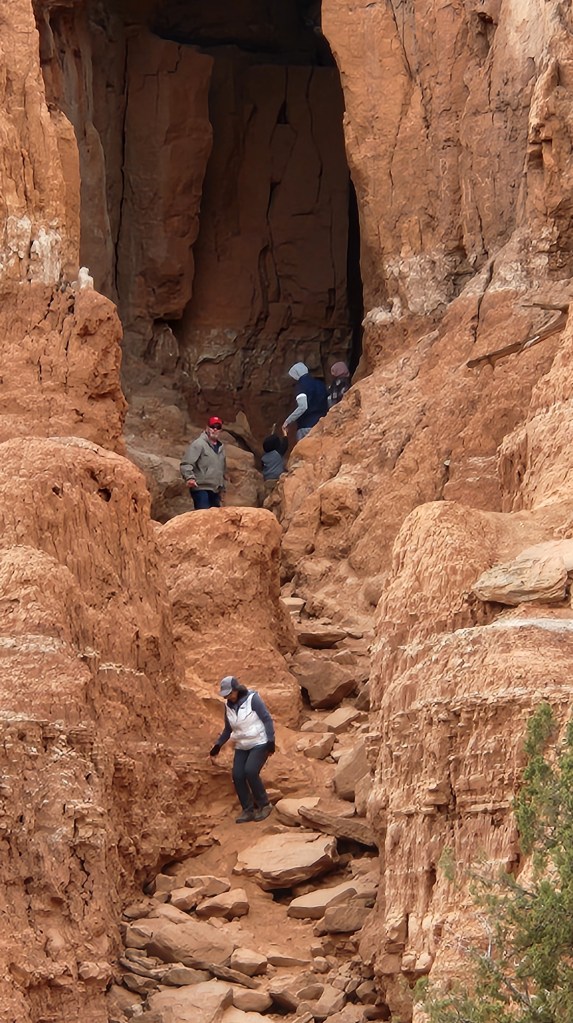
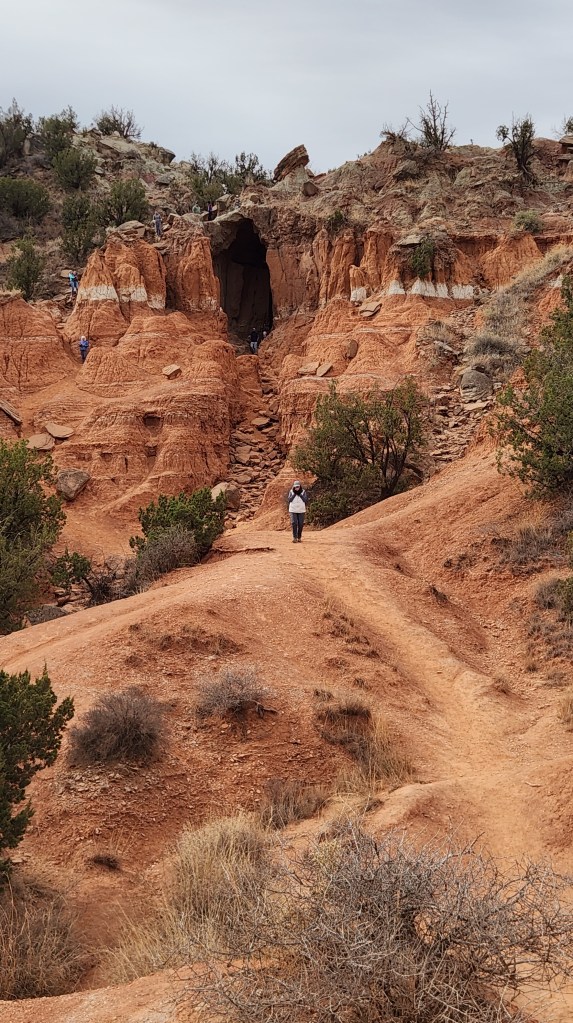
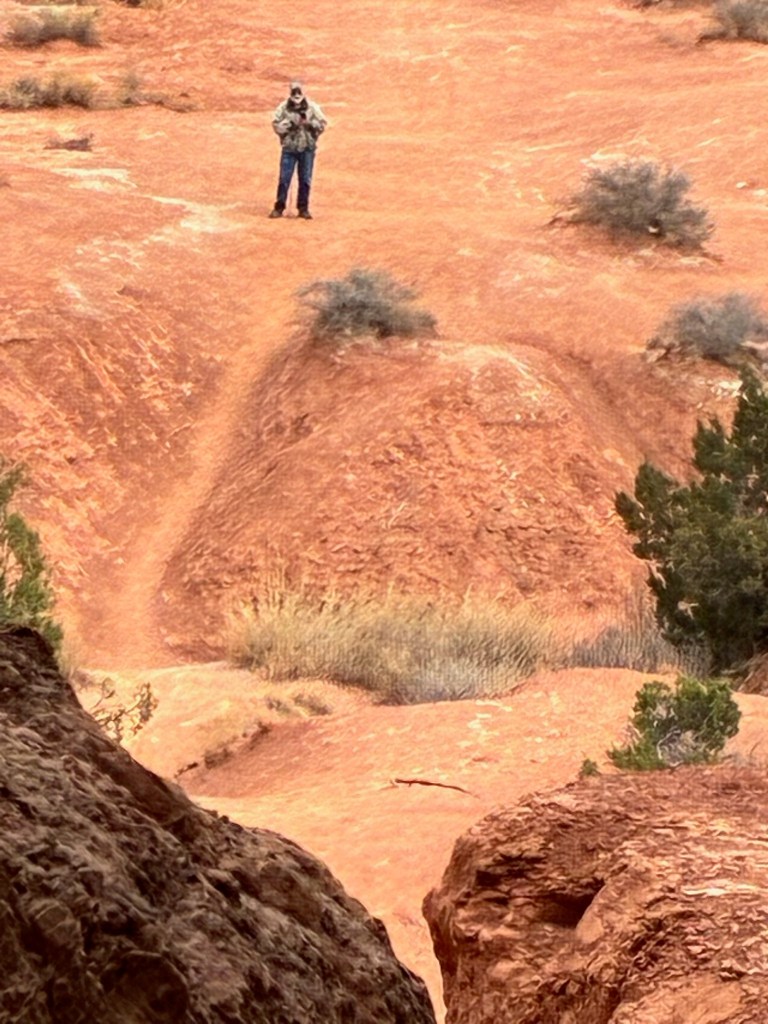
As we traversed the loop road, we stopped at a number of turnouts to take photos and took a short hike to a point of interest called the Big Cave (number 10 on the map above). I ventured partway up the steep climb to the cave, but even with my walking sticks I felt too wobbly to go the whole way. Pat was more adventurous, but I decided discretion was the better part of valor and instead documented her exploits from afar. She went inside the cave before returning to the base where I was waiting.
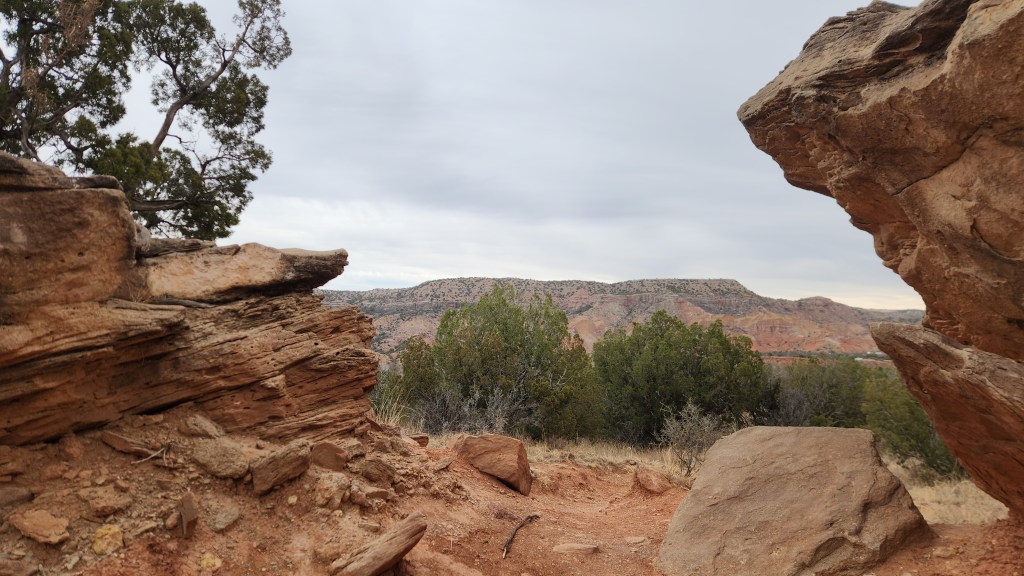
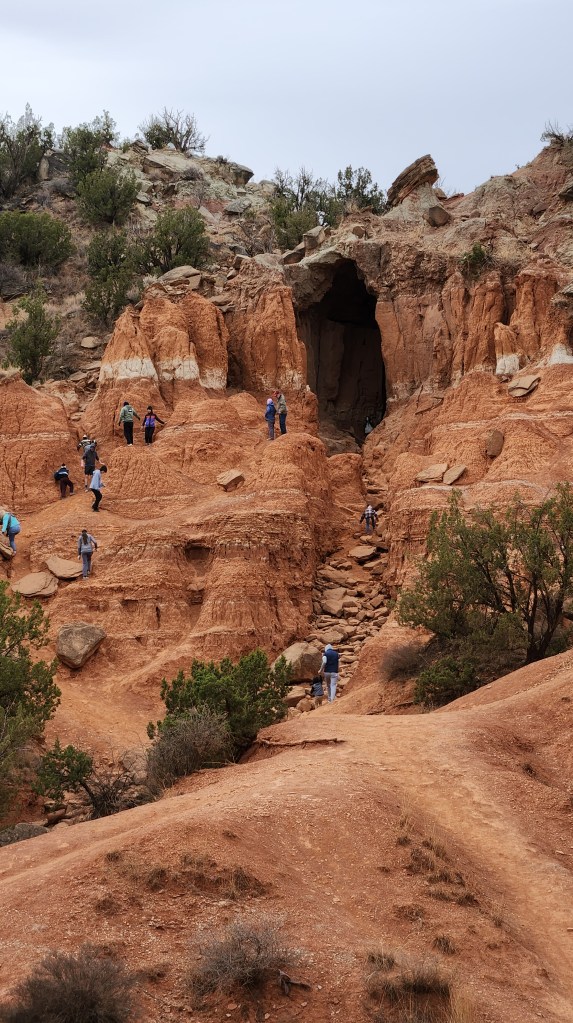
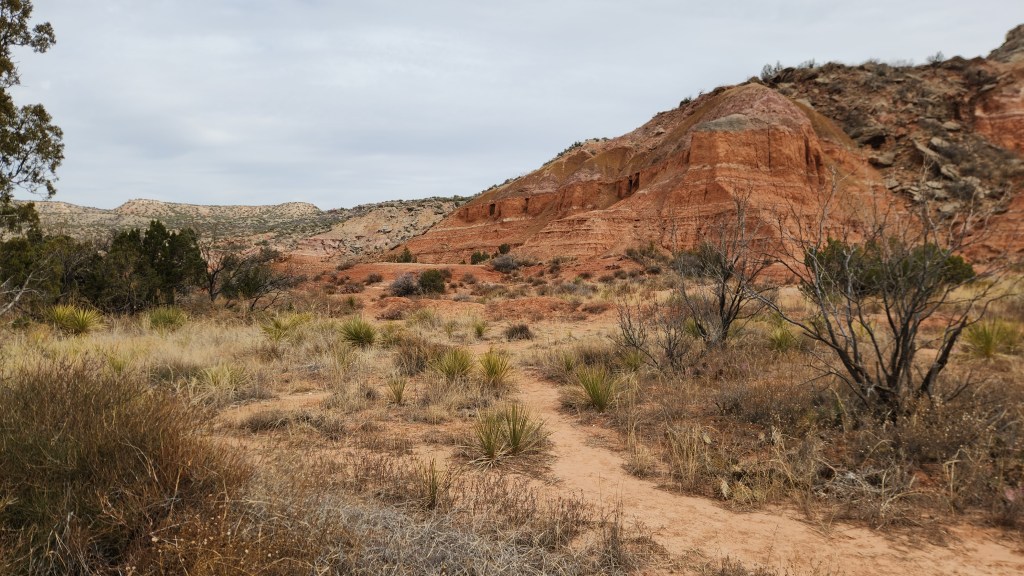
View from Trail at Palo Duro Canyon State Park
The Big Cave at Palo Duro Canyon State Park
Pat Returning from the Big Cave
Pat decided to take a picture of me on her way back …
… while I was photographing her
View from Trail at Palo Duro Canyon
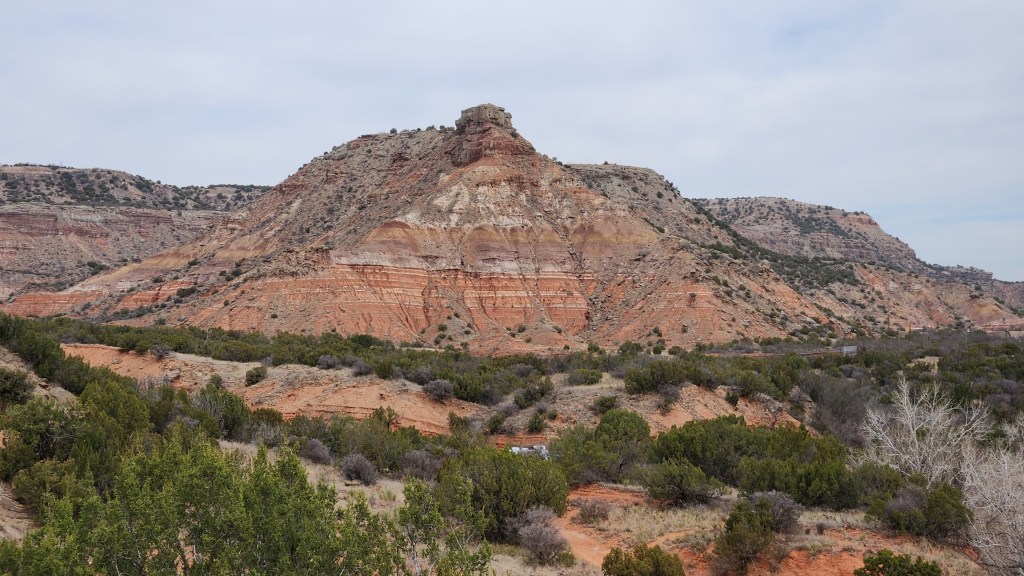
Capitol Peak at Palo Duro Canyon
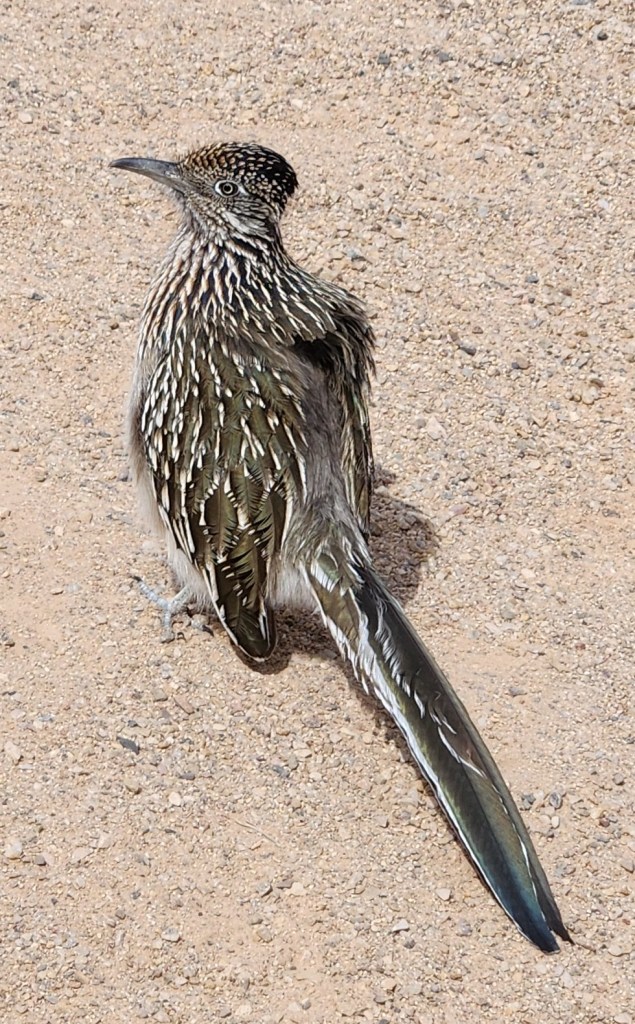
Unfortunately, we ruffled some of this Road Runner’s feathers

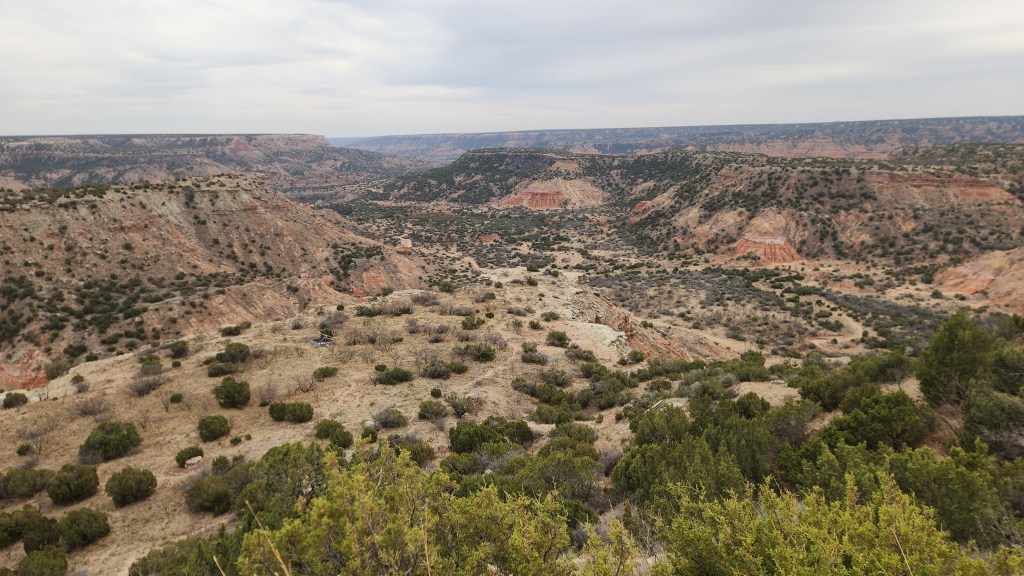
After that, we walked a short way along the Capitol Peak trail before heading to the Trading Post for a lunch of their “world-famous” burgers. We then took another short hike on the Pioneer Nature Trail before heading back up to the rim for a final stop at the visitor center with its spectacular overlooks into the canyon.
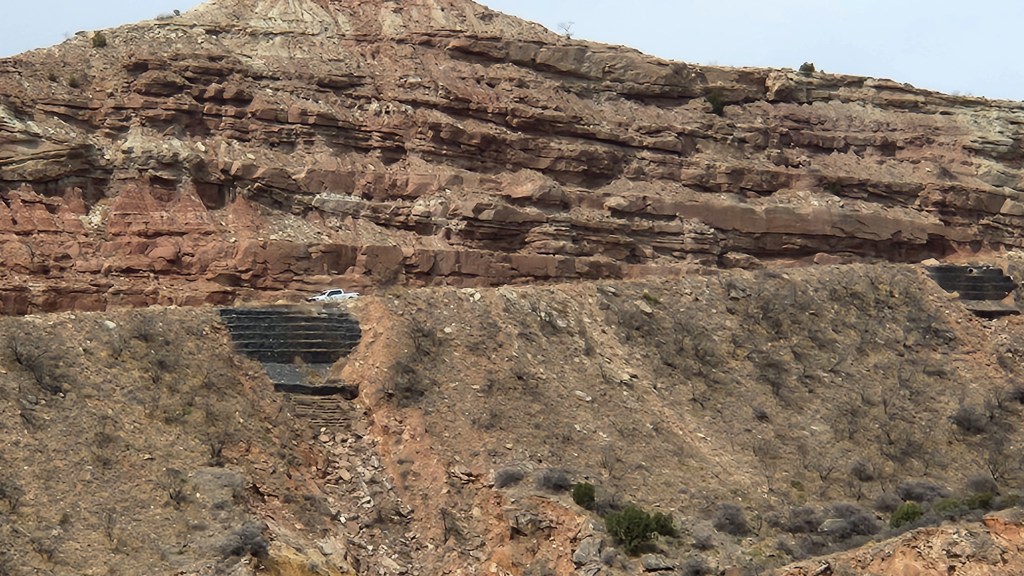
Palo Duro Canyon Access Road
View from Visitor Center Overlook

I’ll wrap up this episode here, as we depart from Palo Duro Canyon. Stay tuned for the next installment, in which we actually visit some places we’d never been to before!
Pat and Dave’s (Almost) Redundant Road Trip Redo – PART 1: Overview and Green Valley

Overview: It seems that each year, as we grow older, winter in Minneapolis becomes less attractive. Last year, we went on a road trip during February and March, which I dubbed Pat and Dave’s Winter Warmup and documented in a four-part travelogue post. Since we thoroughly enjoyed it, we decided to do it again this year. Better prepared this year than last, I managed to secure a reservation for a six-week stay at the same place, the Canoa Ranch Golf Resort in Green Valley, AZ, from January 25th through March 6th.

As part of last year’s Winter Warmup, we also took a couple of weeks visiting various National Parks and other attractions on the way back home, so we decided to do a similar thing this year. Given the timing of this year’s trip, Pat suggested we go west to California after our stay at the Canoa Ranch Resort, specifically to Indian Wells so she could attend a few sessions of the BNP Paribas Open tennis tournament. I readily agreed, since I’d be able to play a couple rounds in the golfing paradise known as Palm Springs while she watched tennis. We had done the same thing previously, during Pat and Dave’s Excellent Adventure (Part 10), so this road trip was shaping up to be pretty much a repeat of things we’d already done in the past. However, we didn’t actually book anything other than the six-week stay in Green Valley and a three-day tennis tournament package at the Omni Rancho Las Palmas Resort in Palm Springs, including two all-day tickets and shuttle service for Pat to attend the tournament. We agreed to decide on other places to visit after that, depending on weather conditions and spur-of-the-moment impulses.

As our departure date neared, the cold weather in Minneapolis was wearing us down. To add to the misery, our beautiful city was invaded by a horde of out-of-control ICE agents, resulting in mass protests which only intensified after the murder of Renee Good on January 7th. We had planned to leave on January 20th, and as we began cramming stuff into our trusty 2020 Tesla Model Y and mounting our e-bikes on the bike rack, we were feeling very depressed and in desperate need of a getaway to someplace not only warmer but safer.  On the other hand, we felt somewhat guilty abandoning our fellow citizens during such a time of need, so it was with mixed emotions that we set off on Tuesday morning, January 20, with the temperature hovering near zero Fahrenheit.

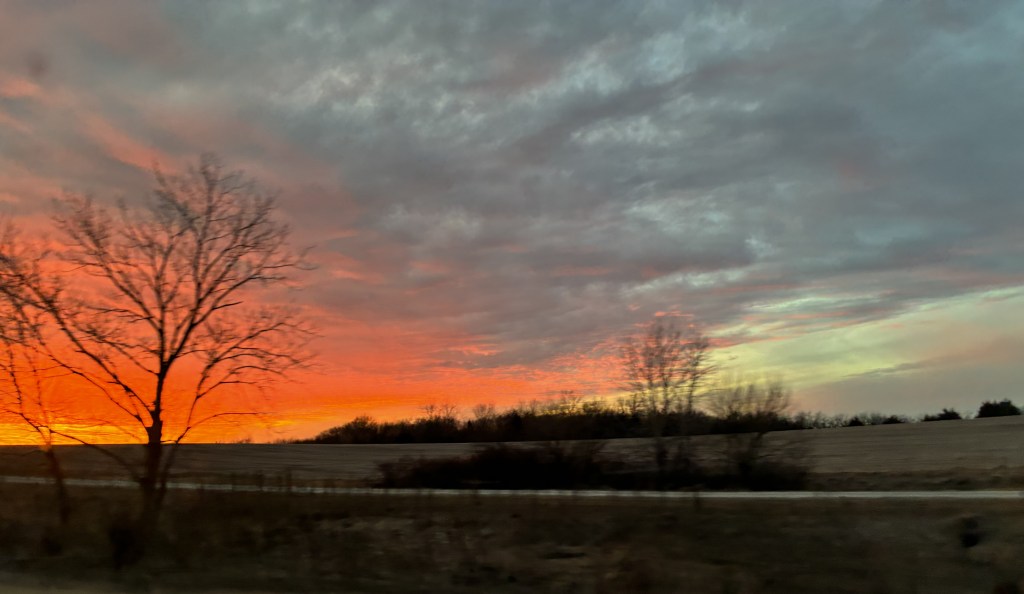
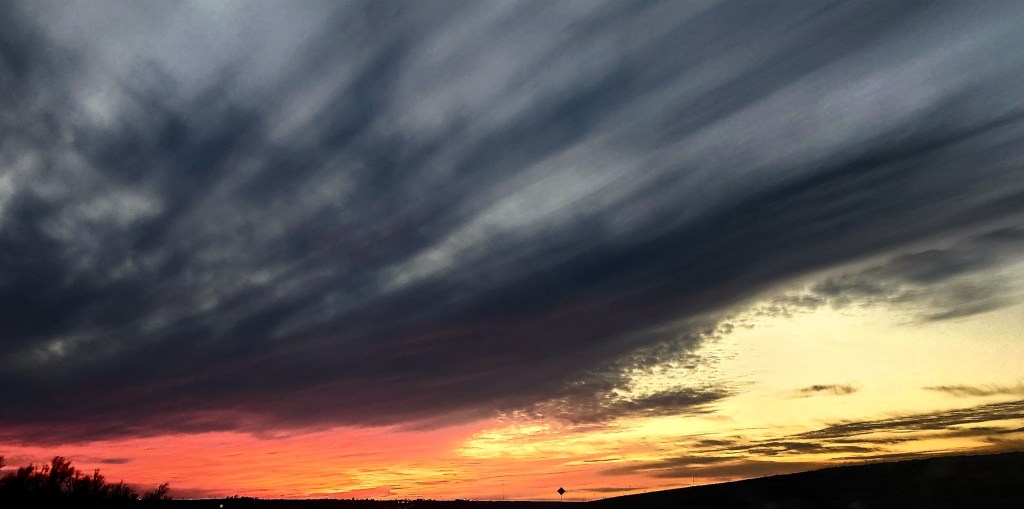
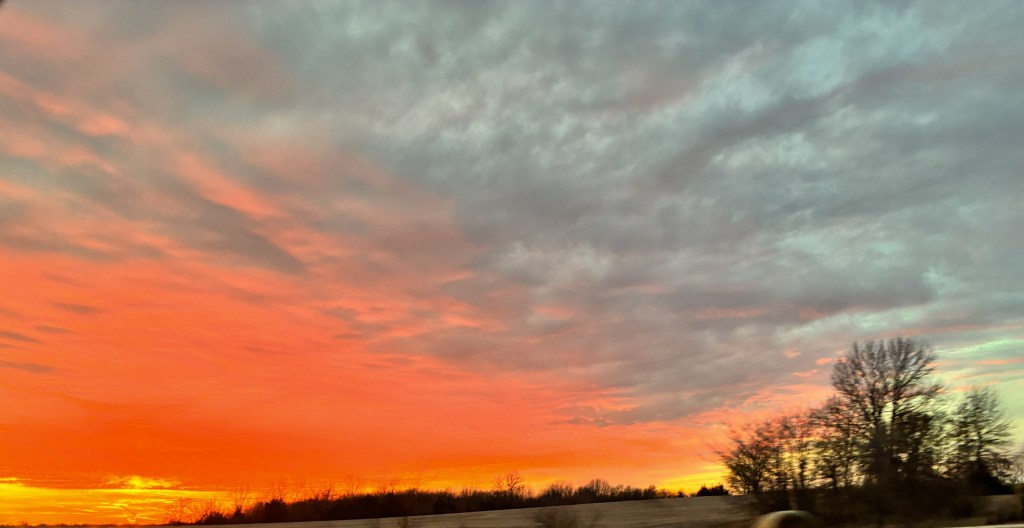
We had opted to take our older Tesla because it has a hitch receiver for our bike rack, and we wanted to bring our e-bikes along to enjoy during the six-week stay in Green Valley. We knew from past experience that the extra aerodynamic drag from the bikes would reduce the range of our EV, having used the bike rack during a trip to St. George, UT, back in 2022, but this time it was significantly worse because we had also encased the bikes in a protective cover that flapped away like mad behind the car. I’ll describe the effect on the car in considerable detail in the final episode of this travelogue, but for now suffice it to say that we barely made it to our first planned charging stop, a mere 92 miles away in Albert Lea, MN, and quickly realized that we were going to have to stop nearly twice as often as we’d hoped for car charging, turning the long road trip into a tedious series of short hops. At least we saw some interesting scenes along the way, such as this sunset as we passed into Missouri on Tuesday evening.

Sunset Over Missouri, January 21, 2026
Sunset over Missouri, January 21, 2026

To make matters worse, a huge storm was developing along our planned route, so we needed to travel some 1300 miles – at least into New Mexico in order to beat the weather – in only three days rather than the four we had planned on. Wednesday the 21st was the worst day, as we left our hotel in Kansas City ay 8 AM and arrived at our hotel in Amarillo, TX, at 12:45 AM on Thursday. But as we settled in to a hotel in Las Cruces, NM, at 9:30 PM Thursday evening, we saw on the news that the route behind us had become unpassable due to unprecedented heavy snow, and it felt as though we had dodged a bullet.

As a result of this frantic dash, we arrived at the Canoa Ranch Resort two days earlier than our reserved date, travelling for most of the last day in steady rain that occasionally escalated to torrential downpours. Luckily, the resort was able to accommodate our early arrival, and we settled in to our rented condo on Friday the 23rd at 6:30 PM. By Saturday morning the rain had stopped and we began to look forward to some pleasant weather, although the news from home was terrible as another of our fellow Minneapolitans, Alex Pretti, was murdered by ICE and CBP agents. Our travel travails paled in insignificance compared to this depressing news, but we at least felt that we had escaped an intolerable situation and vowed to make the best of our good fortune.

I won’t try to write a detailed chronological description of the (Almost) Redundant Road Trip Redo, especially since many of the days were quite uneventful, but I’ll try to capture the highlights. First off, here’s a map of the overall journey, which covered 6,600 miles over 65 days:

Here’s a summary of the chronology:

  • January 20 – January 23: Driving from Minneapolis, MN to Green Valley, AZ.
  • January 23 – March 6: Stayed at Canoa Ranch Golf Resort. Visited sites in the vicinity.
  • March 6 – March 8: Stayed in Buckeye, AZ. Visited Skyline Regional Park.
  • March 8 – March 11: Stayed at Omni Rancho Las Palmas Resort. Pat attended the BNP Paribas Open and Dave played golf. While our original thought had been to visit Yosemite National Park following our stay here, news of heavy snowfall in or near the park persuaded us to change course and visit Death Valley National Park instead. We also decided to return to Minneapolis via a southern route rather than through the Colorado mountains (as we did last year) and catch two new (to us) National Parks along the way.
  • March 11 – March 13: Stayed in Pahrump, NV. Visited Death Valley National Park.
  • March 13 – March 14: Visited Red Rock Canyon National Conservation Area, a spur-of-the-moment decision. Overnight stay in Flagstaff, AZ.
  • March 14 – March 15: Overnight stay in Albuquerque, NM.
  • March 15 – March 17: Stayed in Amarillo, TX. Visited Palo Duro Canyon State Park.
  • March 17 – March 18: Overnight stay in Van Buren, AR.
  • March 18 – March 20: Stayed at The Arlington Resort Hotel, Hot Springs, AR. Visit Hot Springs National Park.
  • March 20 – March 21: Overnight stay in Sikeston, MO.
  • March 21 – March 23: Visited Cape Rock Park, Cape Girardeau, MO. Stayed in St. Louis, MO. Visited Gateway Arch National Park.
  • March 23 – March 24: Overnight stay in Coralville, IA.
  • March 24: Returned to Minneapolis.

I’ll expand a bit on the highlights mentioned above in this and the subsequent Parts of the travelogue.

Green Valley, AZ (January 23 – March 6): I documented our time in Green Valley during last year’s visit in Pat and Dave’s Winter Warmup, so I won’t go into much detail about this year’s activities. The following paragraphs touch on some highlights.

  • The Condo: We stayed in the same condo unit as last year and again enjoyed the beautiful views from the balcony. The weather was generally excellent, with only a few days that felt too hot and one or two days with light rainfall. We took many walks and bike rides in the area around the resort, and Dave managed to play golf ten times at the Canoa Ranch Golf Club (a short walk from the resort) and three times at Torres Blancas Golf Club (a ten-minute drive). Our stay at the condo definitely qualified as a Redundant Redo, except for the bikes, which we didn’t have last year.
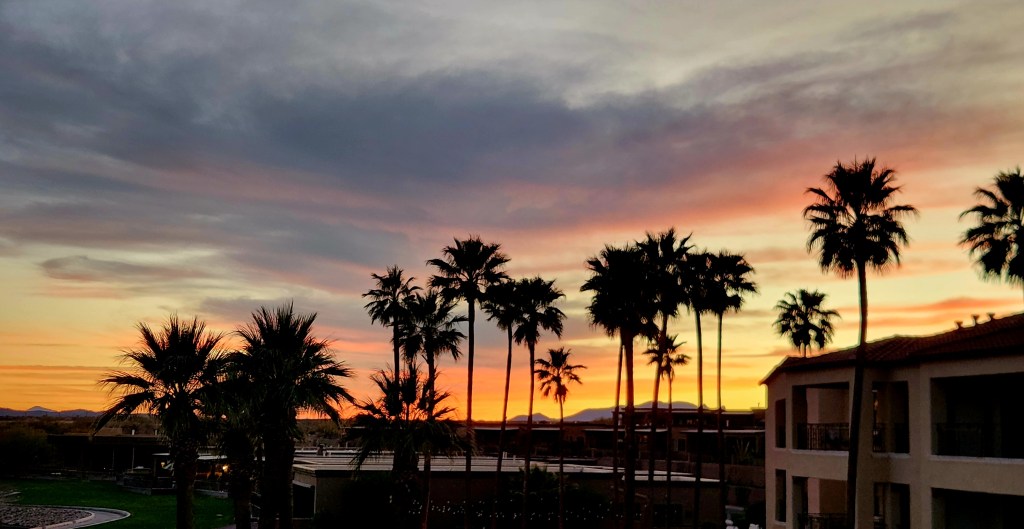
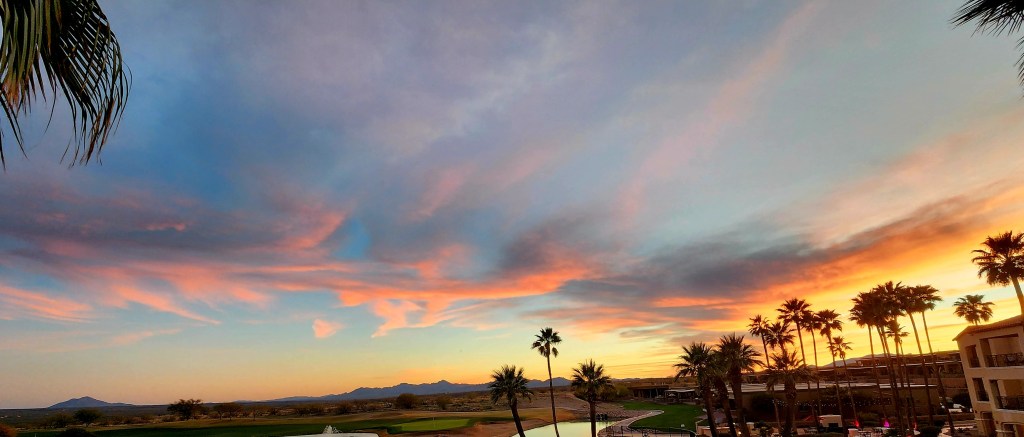
Sunset View from the Balcony
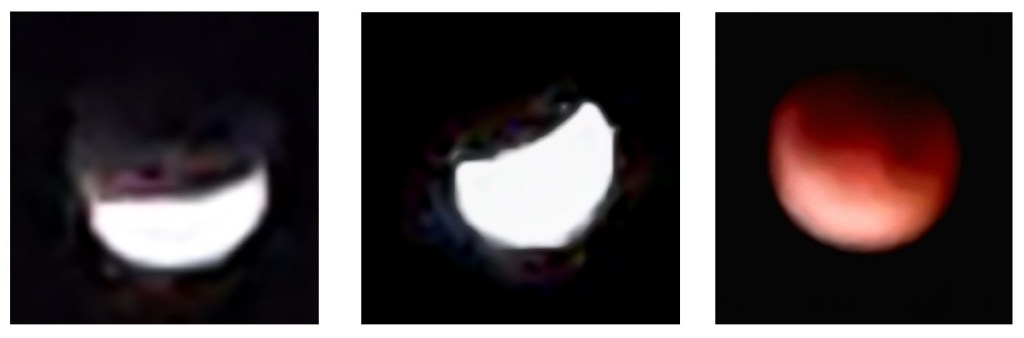
Lunar Eclipse and Blood Moon view from Balcony (I know it’s blurry — it’s 238,900 miles away!!)
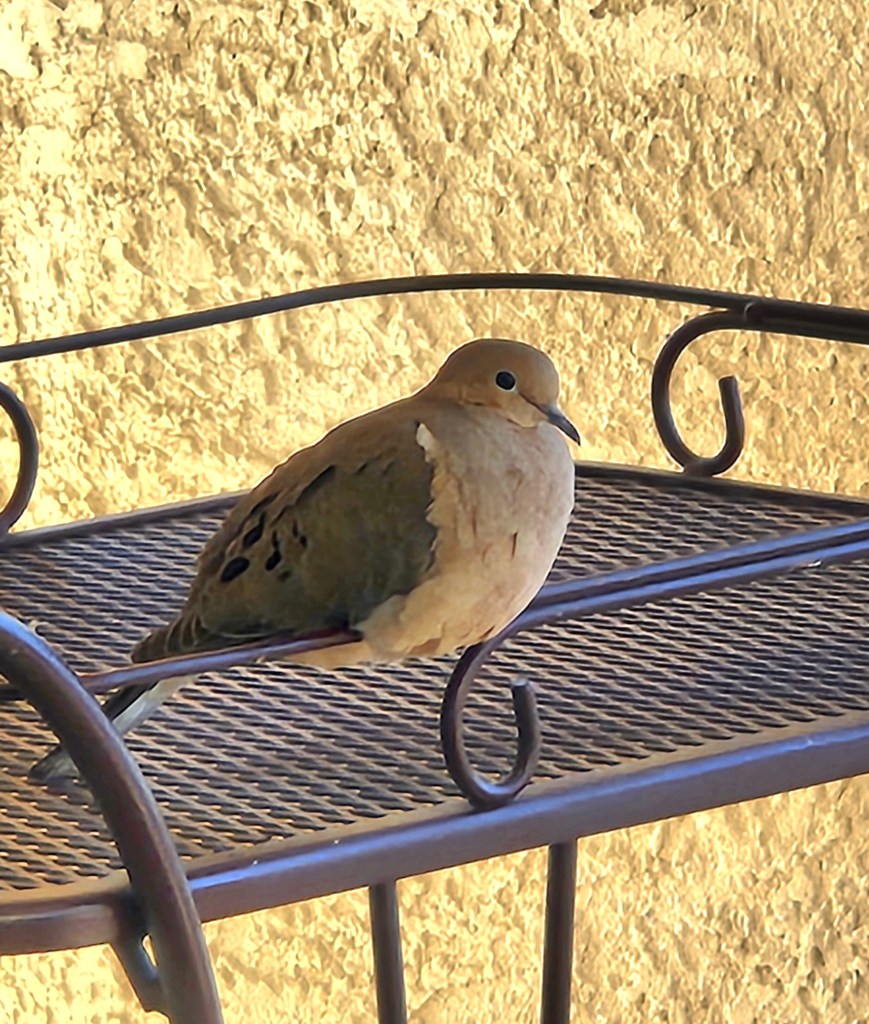
A Friendly Visitor on the Balcony
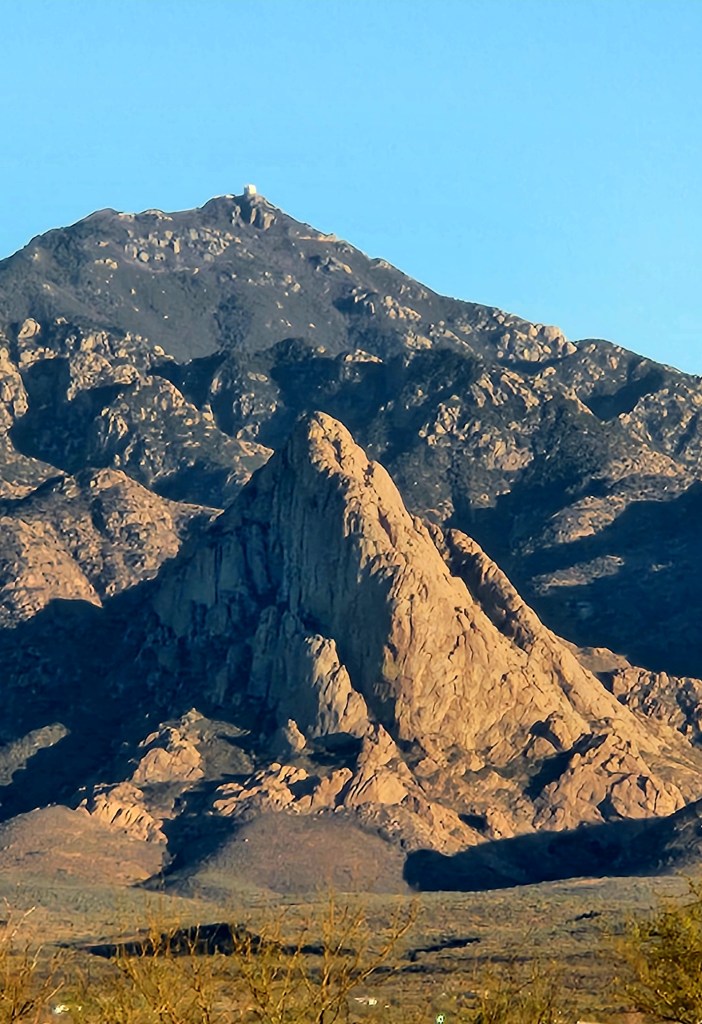
Elephant Head and MMT Observatory view from Balcony
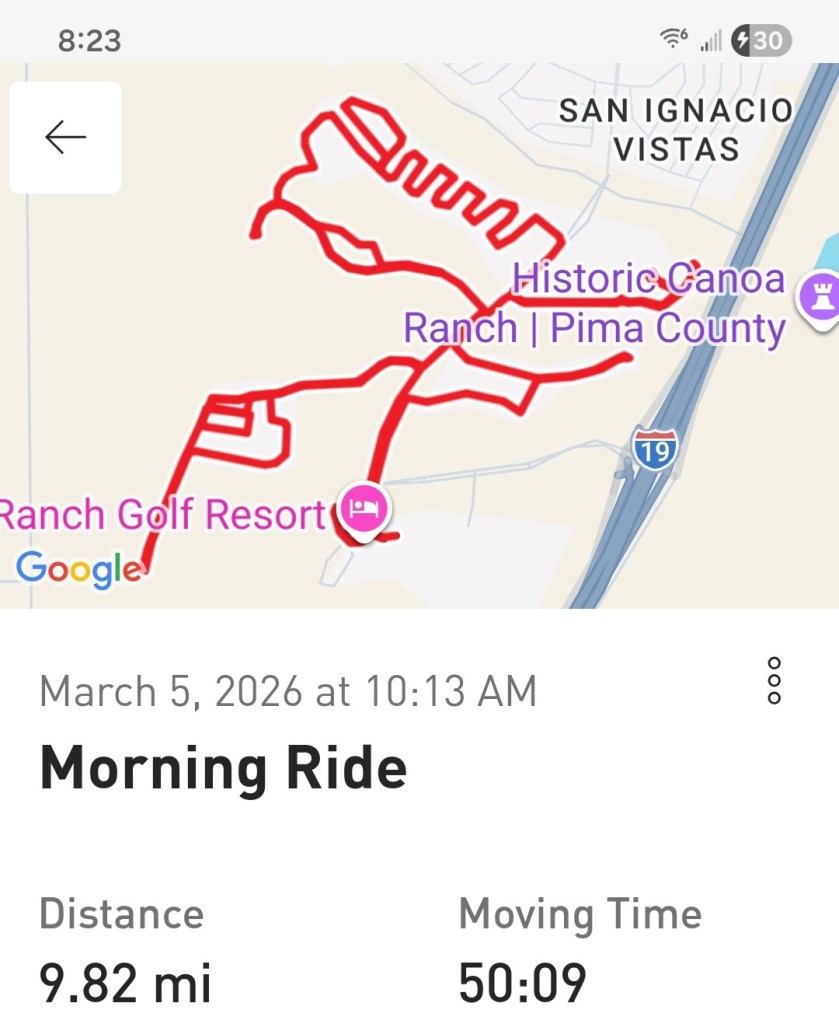
Our Final Bike Ride in Green Valley
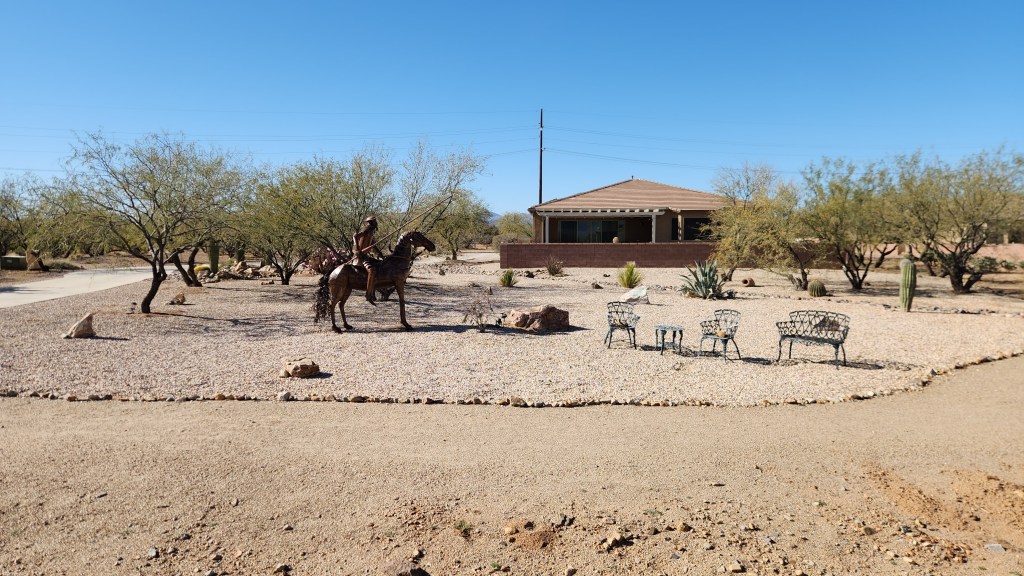
Don Quixote also likes our bike route …
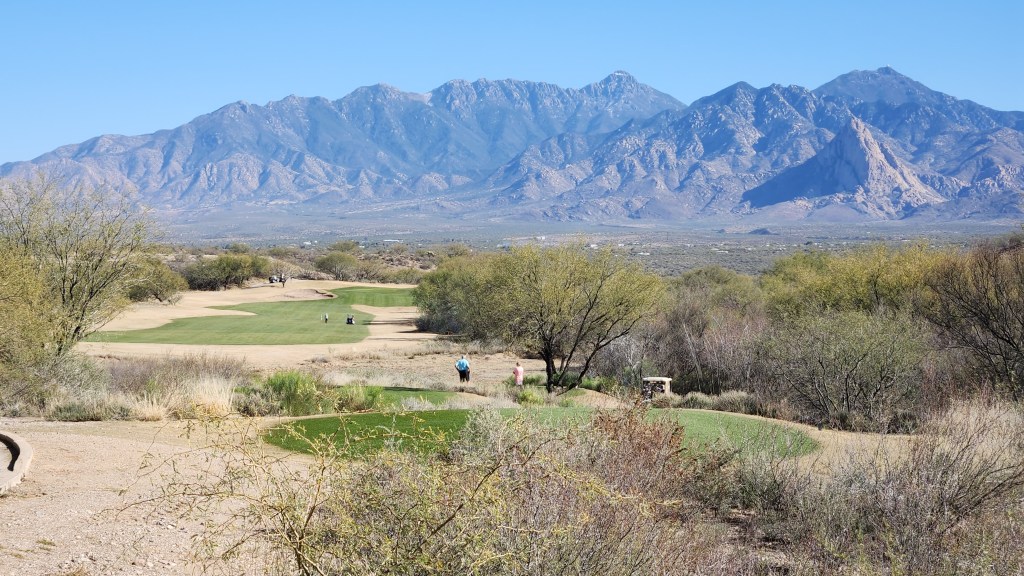
Fourth Hole at Canoa Ranch Golf Course
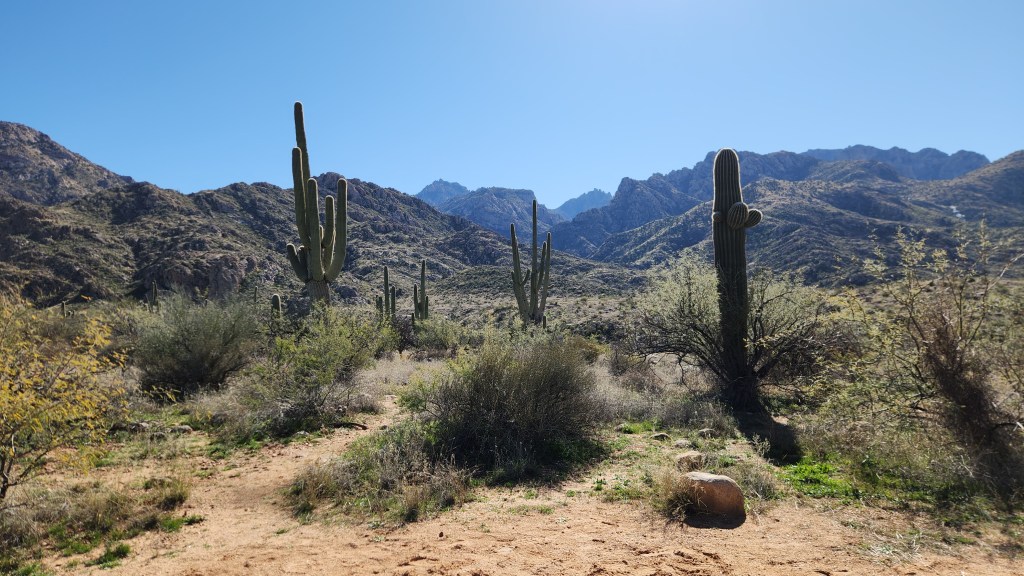
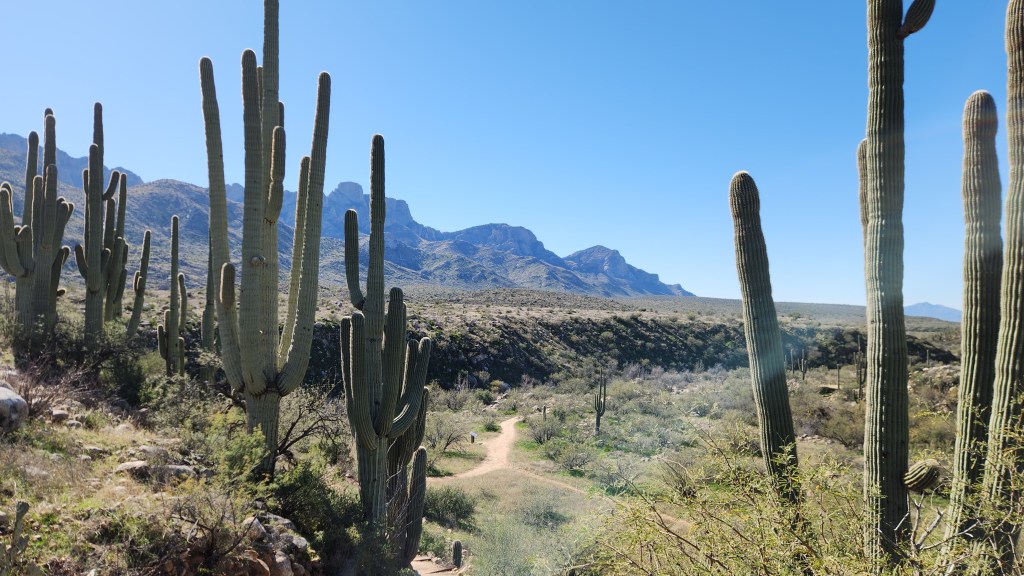
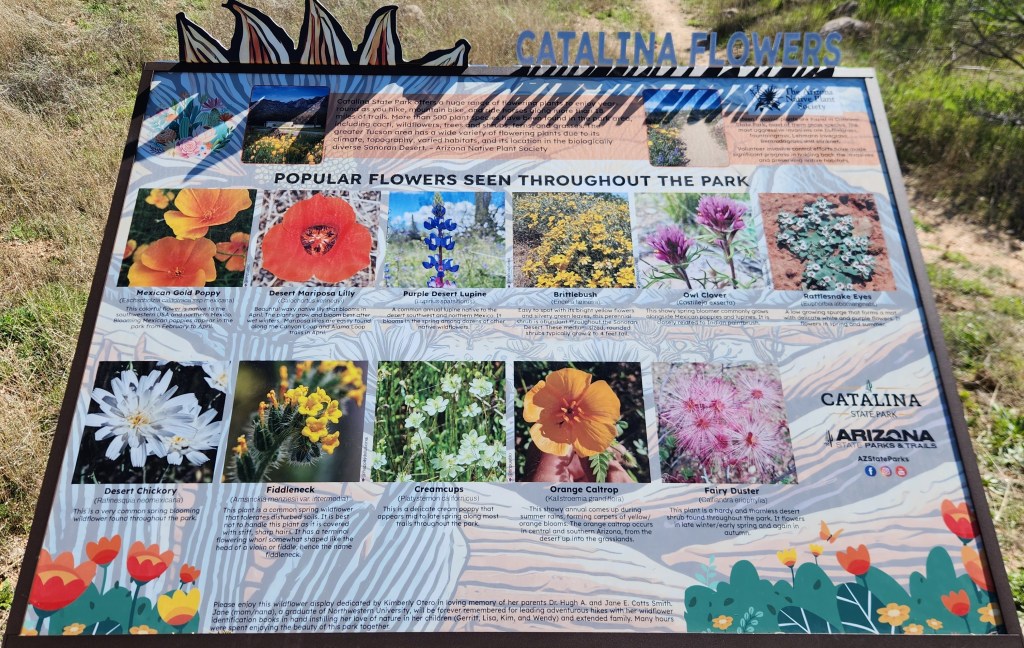
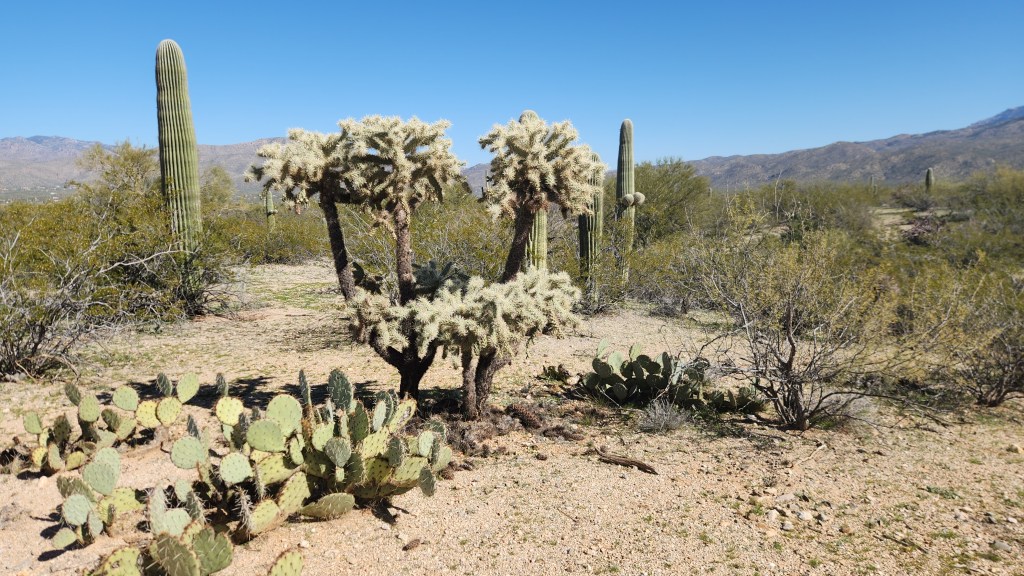
  • Catalina State Park: This State Park is located 16 miles north of downtown Tucson. We camped here with our RV back in 2021 during The Saaris’ (Sorta) Safe Sojourn, so this again qualifies as a Redundant Redo. Here are some photos from this year’s hike.
Catalina State Park
Catalina State Park
Catalina State Park
  • Saguaro National Park East: We also visited this National Park, located about 20 miles east of downtown Tucson, during The Saaris’ (Sorta) Safe Sojourn, so this also qualifies as a Redundant Redo. We drove around the well-maintained Cactus Forest Loop Road, stopping frequently at various overlooks for photos and short hikes.
Saguaro National Park
Javelina Rocks at Saguaro National Park
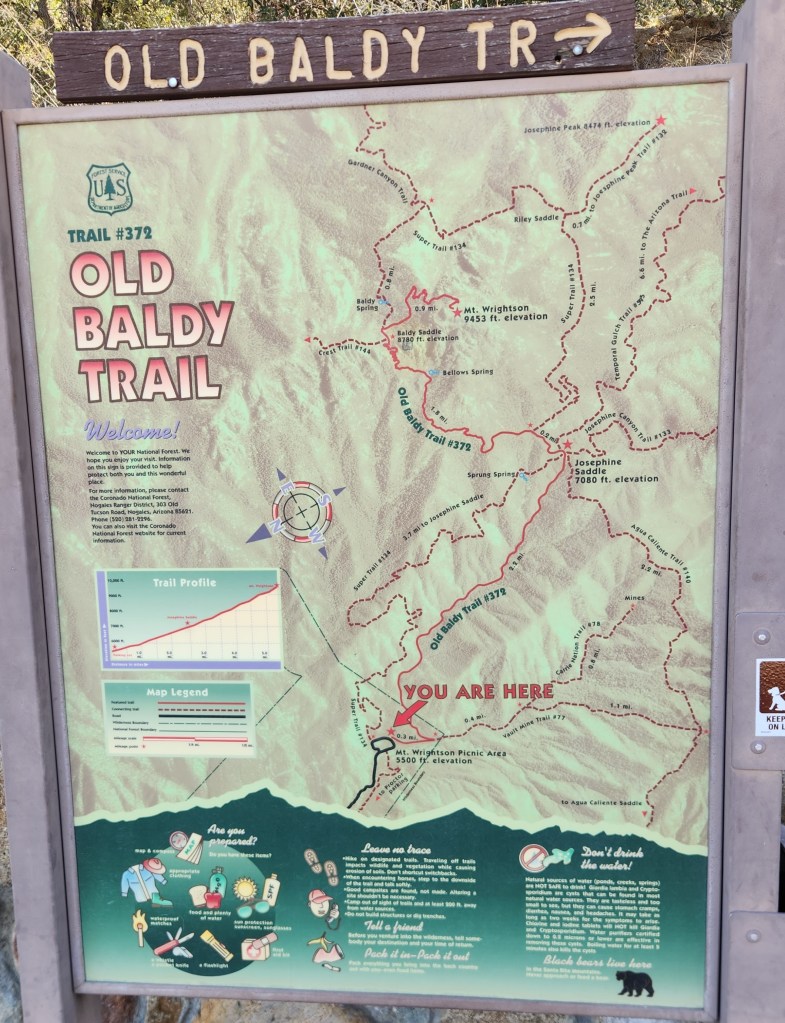
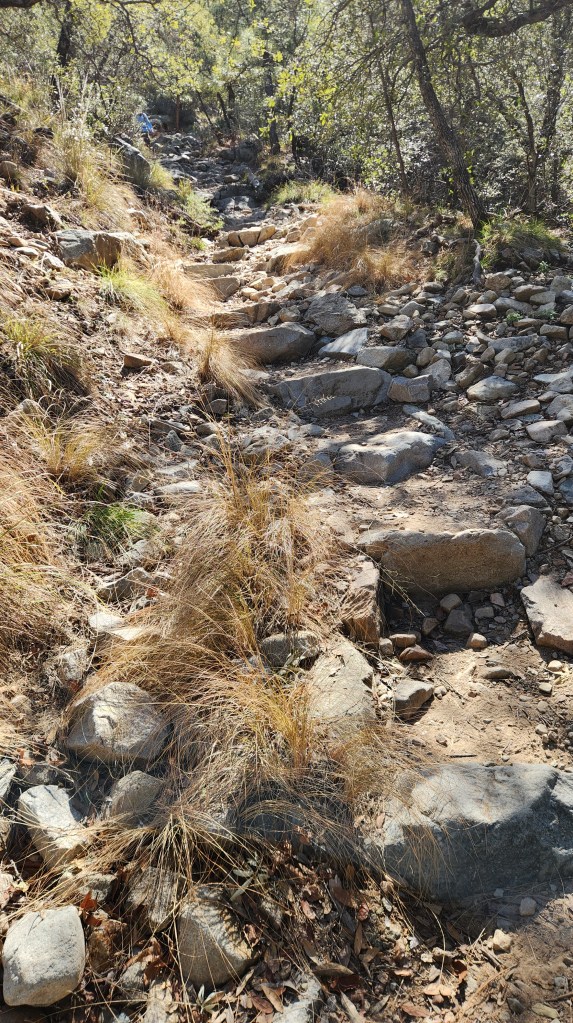
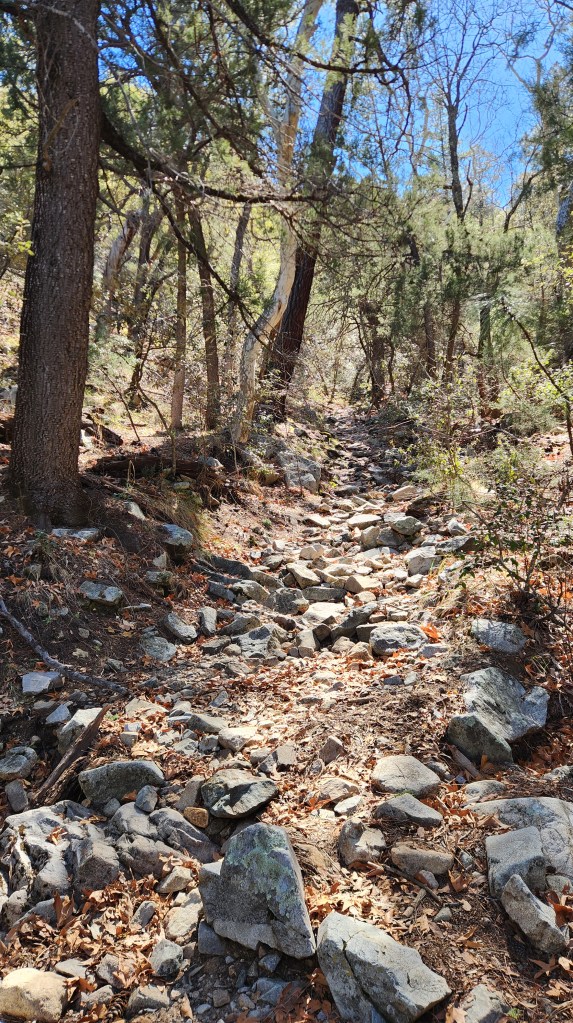
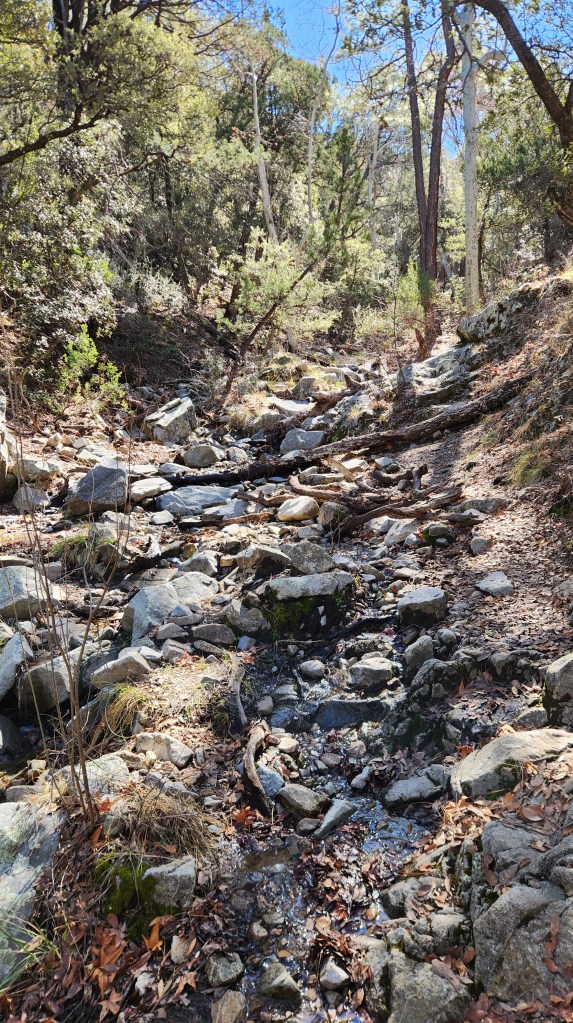
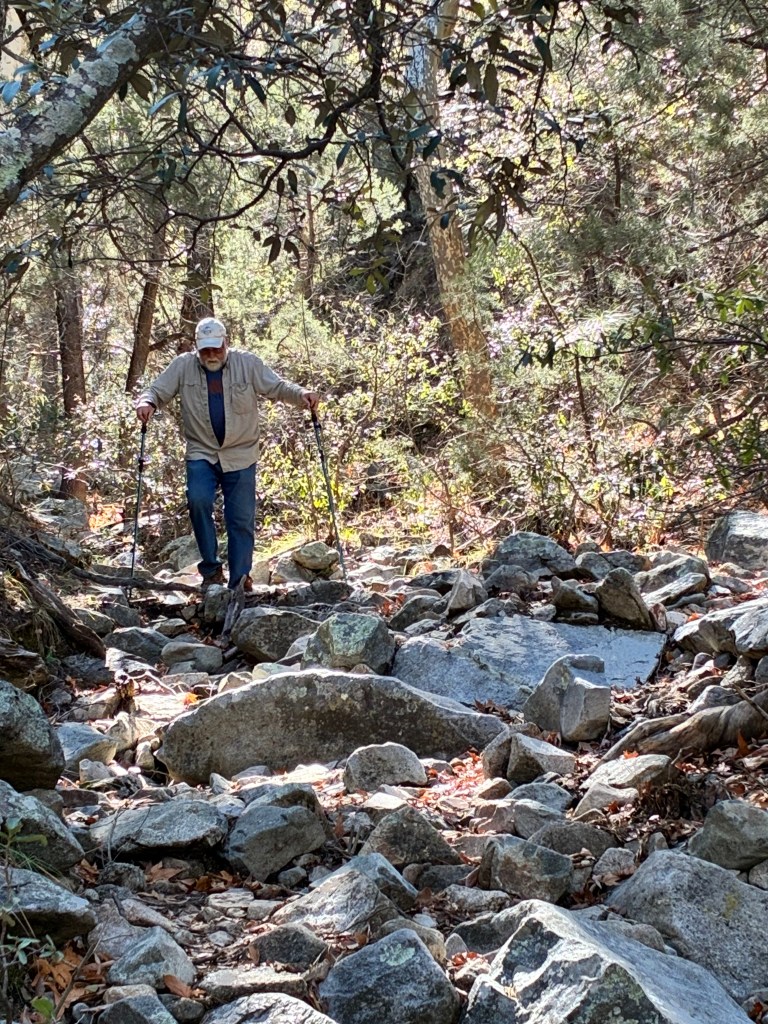
  • Madera Canyon: We visited here during last year’s stay in Green Valley, so again – Redundant Redo. We hiked along the same trail we made a futile attempt at last year and, while we got quite a bit farther this time, about a mile, I had to give up well before the desired objective. Even with my walking sticks, the trail just got too rocky and precarious for me – not to mention that it is almost all uphill. Nevertheless, this is a beautiful place and we enjoyed our visit.
Madera Canyon
Old Baldy Trail at Madera Canyon
Trail doesn’t seem so bad …
Still passable …
Getting worse …
Okay, I give up!
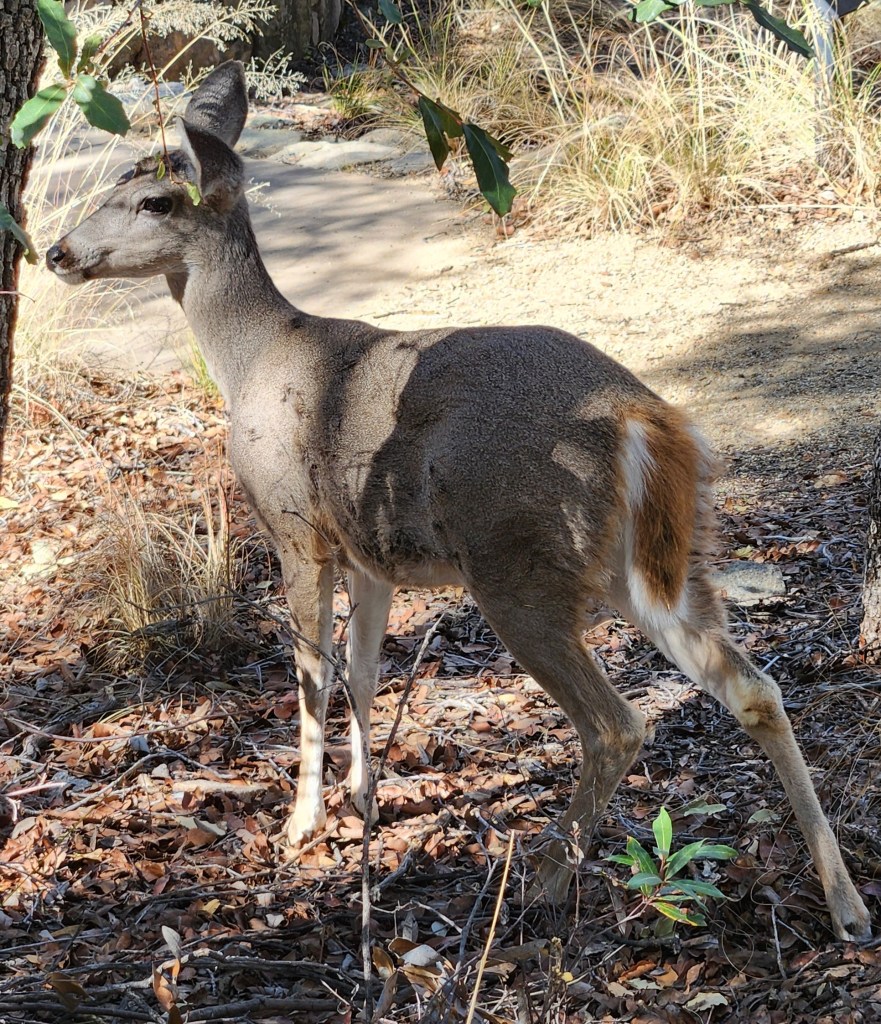
The friendly deer was sympathetic to my plight
  • Tubac Presidio State Park: You guessed it – we did this last year also. The trail we took here was much easier than at Madera Canyon, and parts of it follow the historic Juan Bautista de Anza trail followed in 1775-76 by a Spanish delegation travelling to the San Francisco Bay to establish the Presidio and mission there. It would have taken us a bit too long to go all the way to San Francisco, so we turned back after a couple of miles.
Tubac Presidio State Park
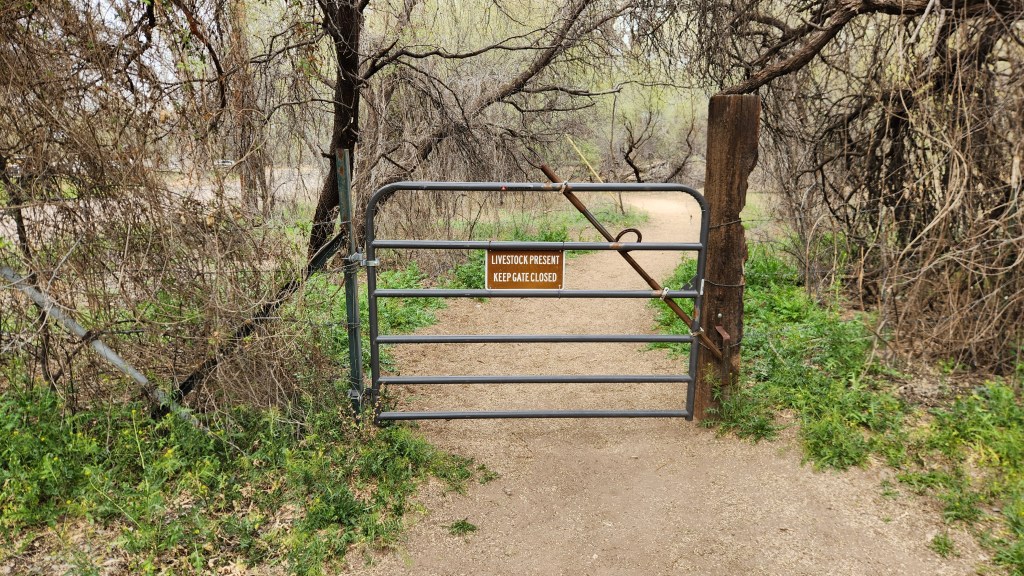
Apparently livestock aren’t allowed on the trail …
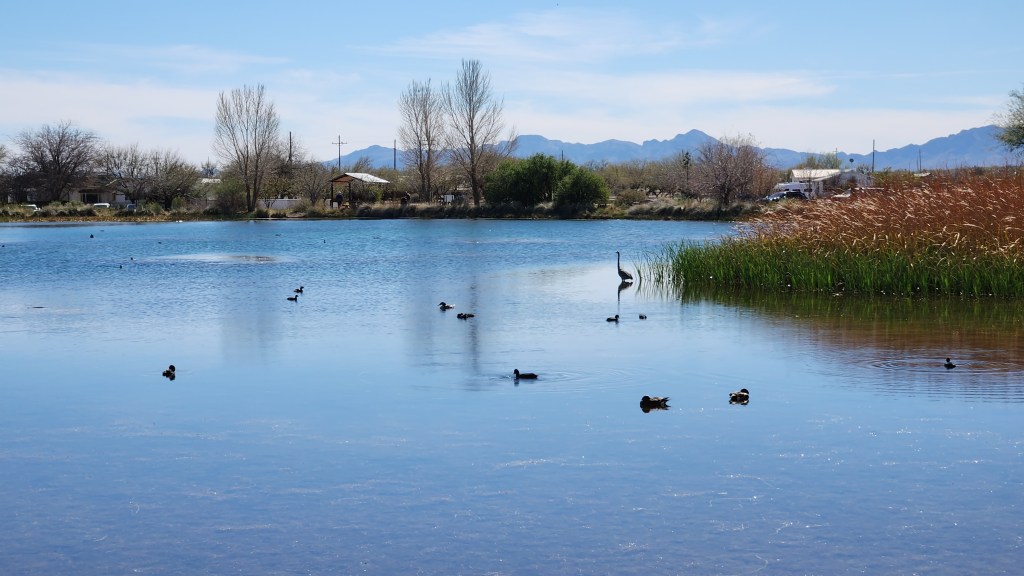
  • Historic Canoa Ranch: Yup, did it last year. It’s only a mile from the Resort, and it has a lovely 2.5-acre man-made pond inhabited by waterfowl and surrounded by desert plants. A Cienega, or marsh, was also created north of the pond to provide enhanced habitat for wildlife. The de Anza trail also runs alongside the park.
Canoa Pond at Historic Canoa Ranch
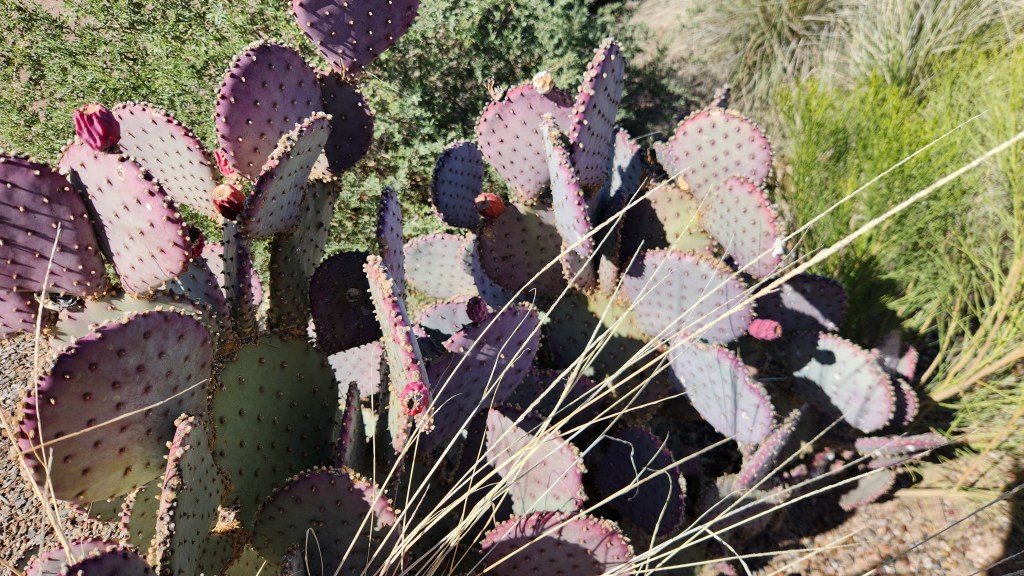
Desert Flora at Historic Canoa Ranch
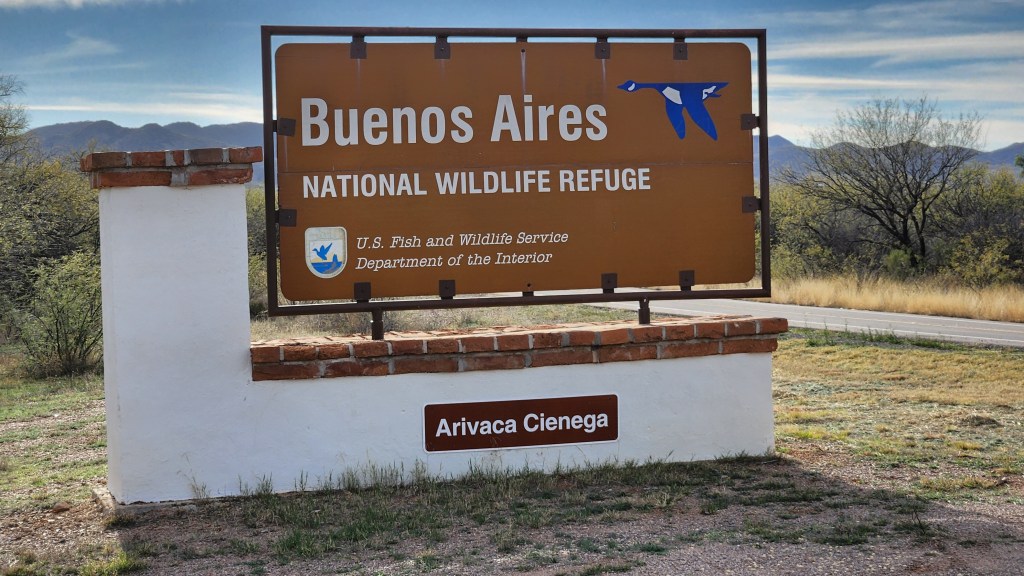
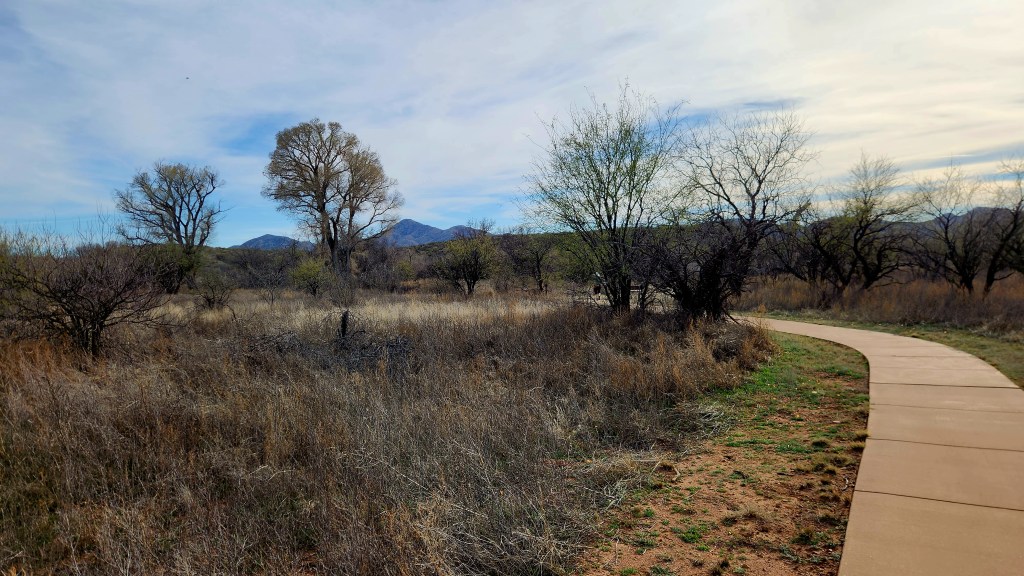
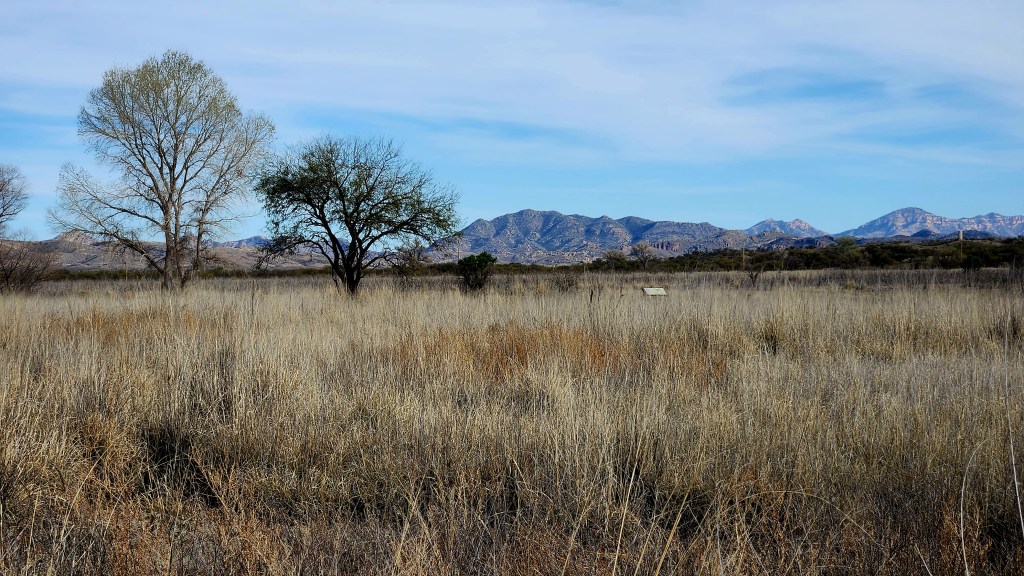
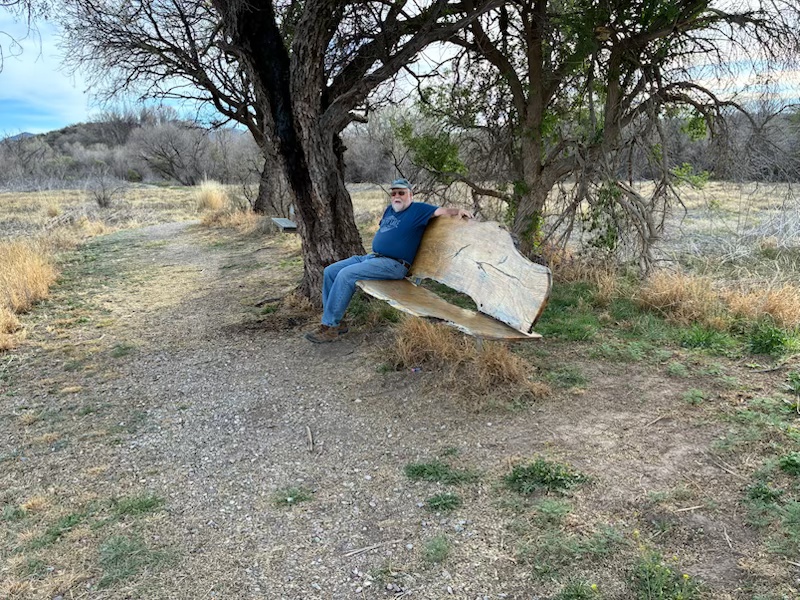
  • Buenos Aires National Wildlife Refuge: OHO! This was something new for us! We drove to the town of Arivaca, about 30 miles southwest of the Canoa Ranch Resort along a scenic, winding road, where we stopped at a General Store. I bought some delicious root beer (WBC, I think it was), and on our way out of town we stopped at this previously undiscovered Wildlife Refuge. The area we walked through was just a small part of the 117,464-acre refuge. The original settlement of the area took place in 1864 when Pedro Aguirre, Jr. built a homestead in the Altar Valley, naming it “Buenos Ayres” (good air) and establishing a ranch, which over time became a significant livestock operation. Decades of overgrazing and fire suppression had turned the grassland into shrubland when the U.S. Fish and Wildlife Service purchased the ranch in 1985 under the Endangered Species Act, specifically to prevent the extinction of the masked bobwhite quail. The refuge uses prescribed burning to restore native grasses, reduce mesquite trees, and enhance the landscape. We spent an hour or so walking the easy trails but didn’t see any wildlife, probably since we were there during the hot afternoon. Maybe we’ll visit again someday in the morning or evening when the animals might be out.
A new site for us!
Buenos Aires National Wildlife Refuge
What a cool bench!
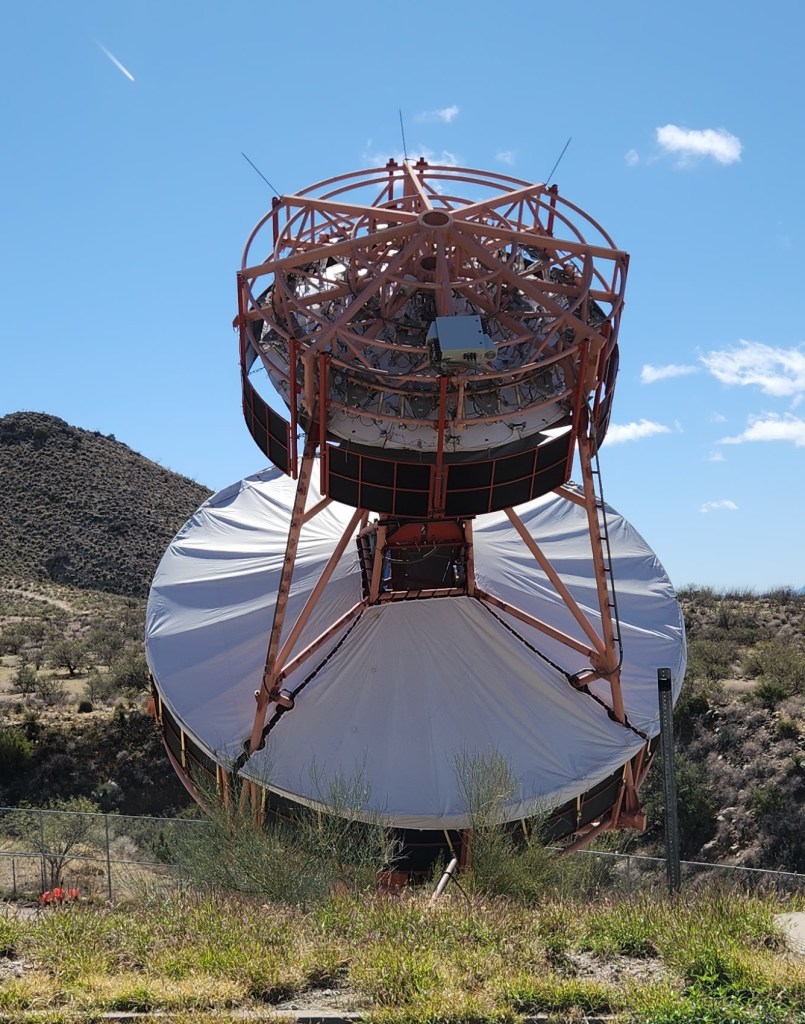
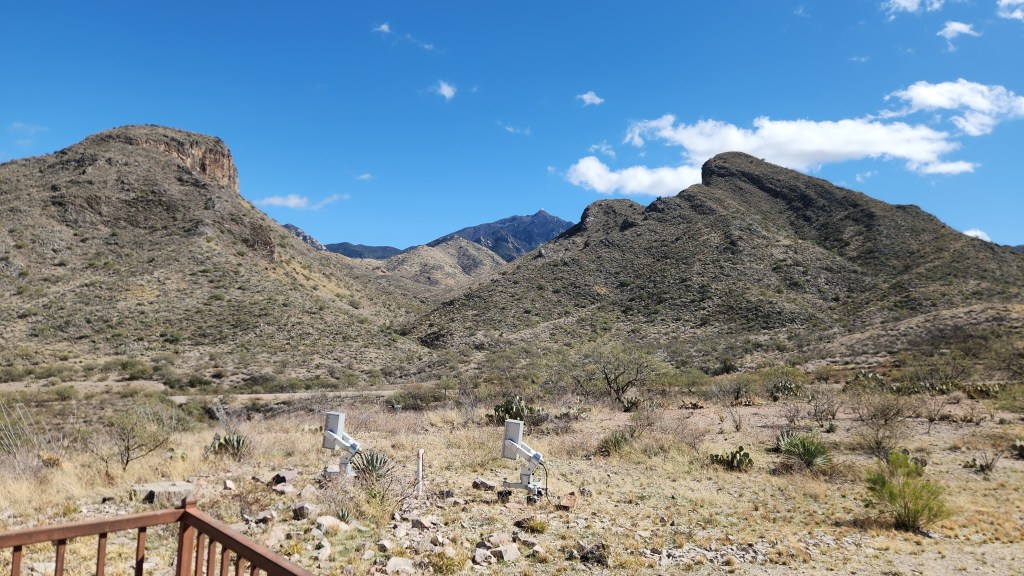
  • Fred Lawrence Whipple Observatory: This one was a half been-there-done-that. We had tickets for a tour during last year’s visit, but Pat got sick and couldn’t make it. However, I enjoyed the tour very much, so we got tickets again this year and both went. The Observatory is the largest satellite facility of the Smithsonian Astrophysical Observatory (SAO), part of the Center for Astrophysics | Harvard & Smithsonian. Located​ on Mt. Hopkins about 12 miles southeast of the Canoa Ranch Resort​, this remote site is home to a number of telescopes, including the 6.5-meter MMT Observatory. The observatory also includes the Very Energetic Radiation Imaging Telescope Array System (VERITAS) gamma-ray observatory, a 4-telescope array designed to find Earth-like exoplanets, and a number of other telescopes used for a wide range of astronomical observations. The tour specifically covered the VERITAS, but the Visitor Center included a number of interesting exhibits on a range of astrophysics topics. (We had a small world encounter when some other visitors enquired about my Grand Marais sweatshirt – they live in the town on Lake Superior where we have our summer home.)
View from Visitor Center at Fred Lawrence Whipple Observatory
Number 1 of 4 in VERITAS Array
Number 2 of 4 in VERITAS Array
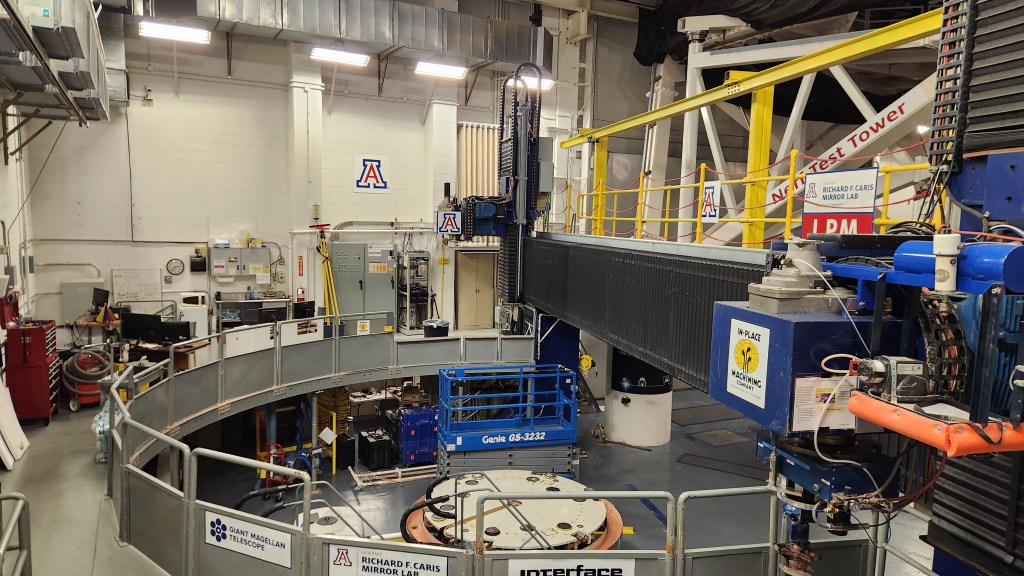
  • Steward Observatory and Richard F. Caris Mirror Lab: Another new one! We learned about this place, which is located at the University of Arizona in Tucson, during our tour at the Fred Lawrence Whipple Observatory, as the Mirror Lab manufactured the large mirror used in the MMT telescope. This lab manufactures the largest telescope mirrors in the world, using an advanced process to cast glass over honeycomb structures in a rotating furnace. The curved mirror surfaces are then polished to incredibly tight tolerance levels to provide the sharp focus and clarity needed for today’s advanced optical telescopes. A fun fact from our tour guide: during the fifteen minutes she took to explain the polishing process, our fingernails had grown more than the tolerance of the polished surface! The lab has produced something like 20 mirrors in 40 years, and no other manufacturer in the world can match the lab’s capabilities. We also learned that the Astronomy Department at the University of Arizona has the largest contingent of astronomy professionals in the entire world. This was a very informative and interesting tour lasting about an hour – I highly recommend it for Tucson visitors.
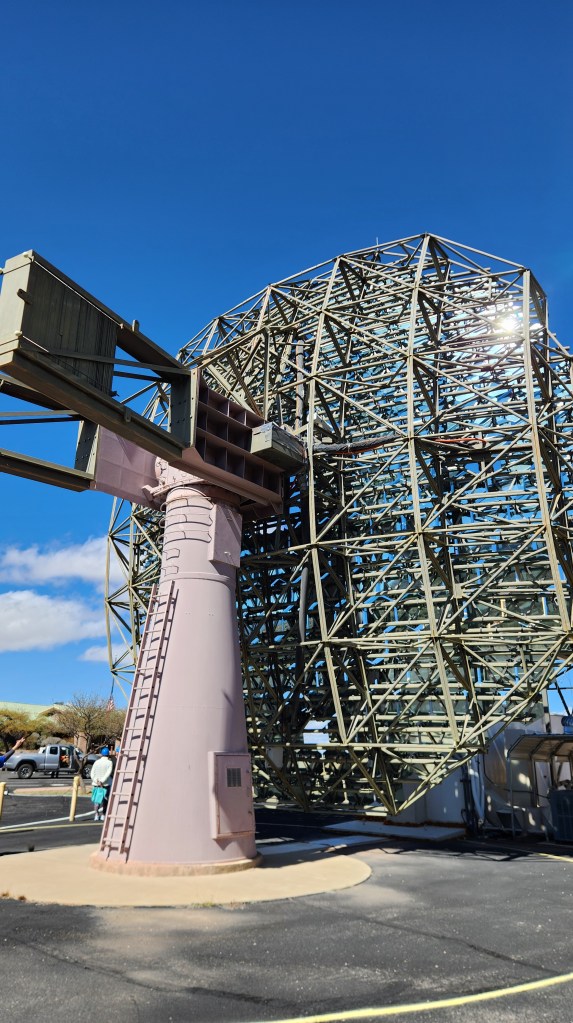
Richard F. Caris Mirror Lab
  • Community Performance and Art Center (CPAC): Finally, I’ll mention one last new thing we did in Green Valley this year – attend a concert at CPAC. This concert featured four musicians playing 17th century instruments, a harpsichord, two violins, and a cello. Their repertoire included works by well-known composers as well as some composed by the players themselves. While they were not quite at the level of excellence that we regularly experience when we listen to the St. Paul Chamber Orchestra, they were very enthusiastic and engaging, and we enjoyed the concert very much.

So, in summary, at least the first part of this adventure was indeed an (Almost) Redundant Road Trip Redo. Okay, that’s enough for Part 1. Stay tuned for more Parts to come …

The Saaris’ Summer Sanctuary – PART 2

This is the second and final part of a travel blog installment describing some of the places we visited during the summer season of 2025. Part 1 covered some interesting sites near our cabin on Lake Superior’s North Shore (the titular Summer Sanctuary) as well as several places along the shore that we visited during June of 2025. In this post, I’ll describe some additional places along the shore and in our great neighbor nation to the north over the course of the summer season (my generous definition of summer extends into the first week of October).

Near the Summer Sanctuary: I forgot to add this tidbit to Part 1. On August 25th, for the first time ever in my life, I encountered a pelican swimming in Lake Superior just off the mouth of Durfee Creek near the cabin. It was very calm as I approached, gently paddling out into the lake until it was out of view.

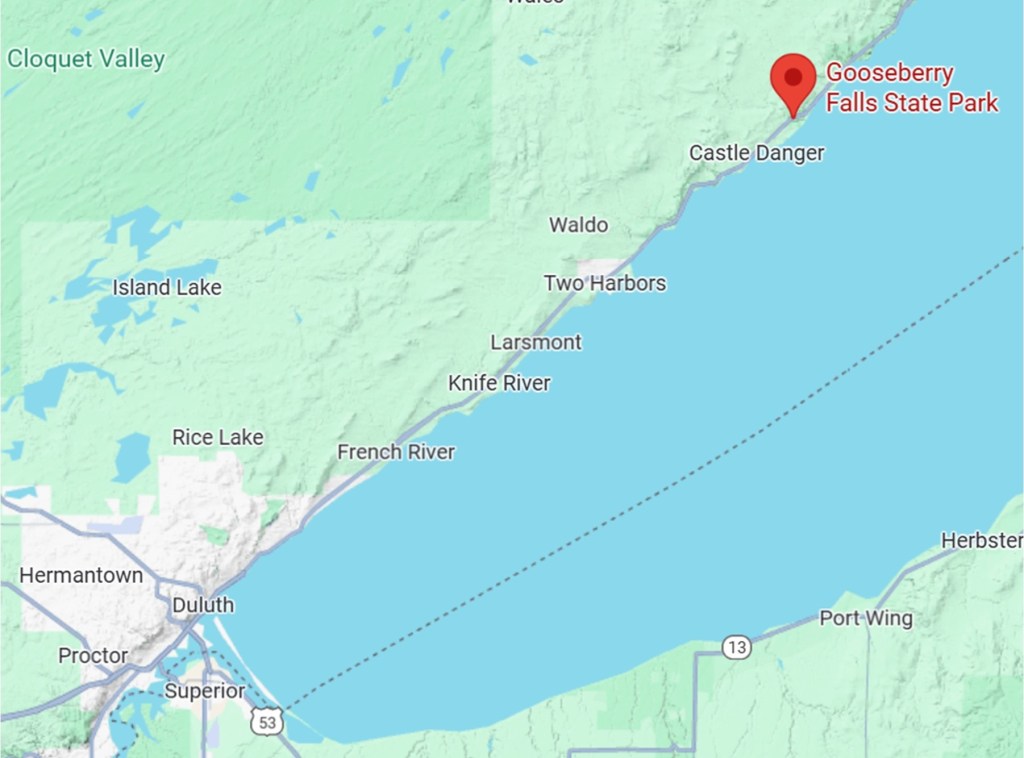
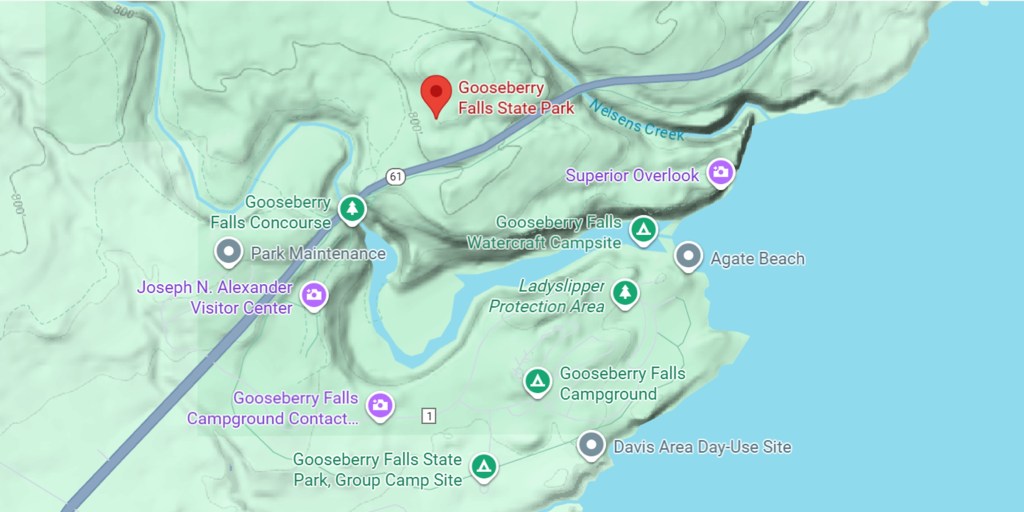
Gooseberry Falls State Park: Gooseberry, located 40 miles northeast of Duluth, MN, on Highway 61, is the most-visited of the eight state parks along the North Shore.

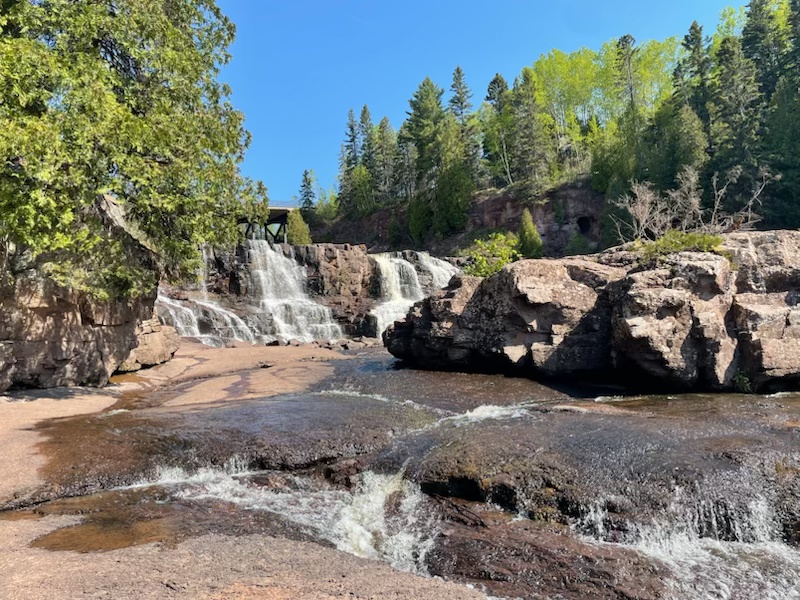
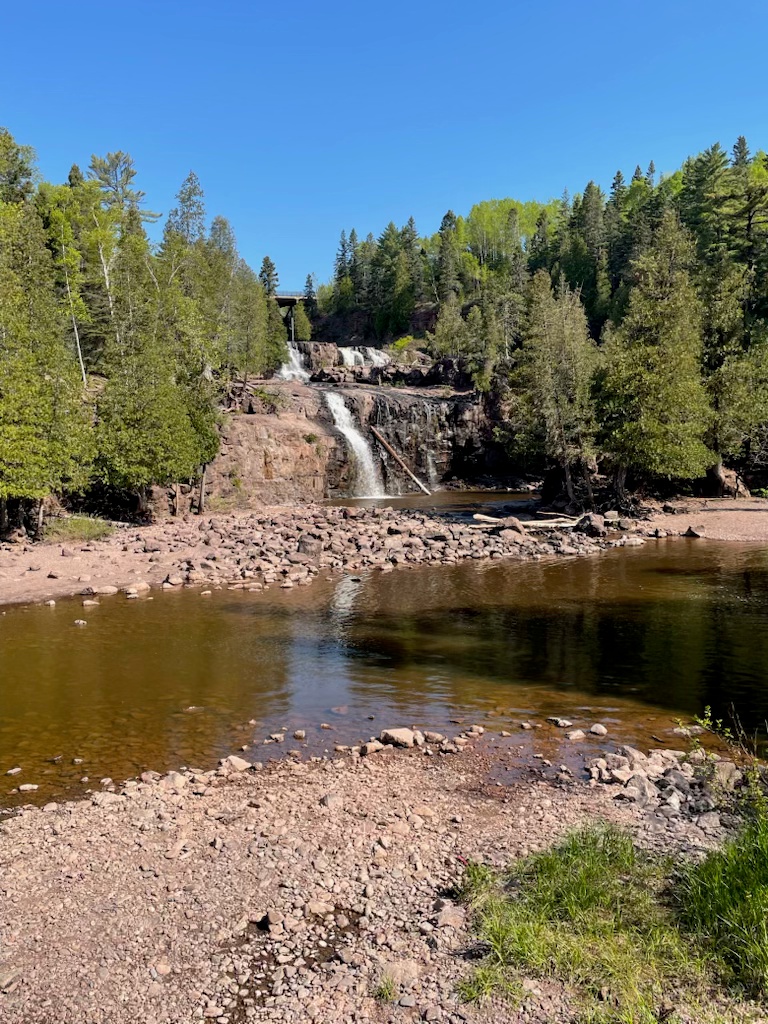
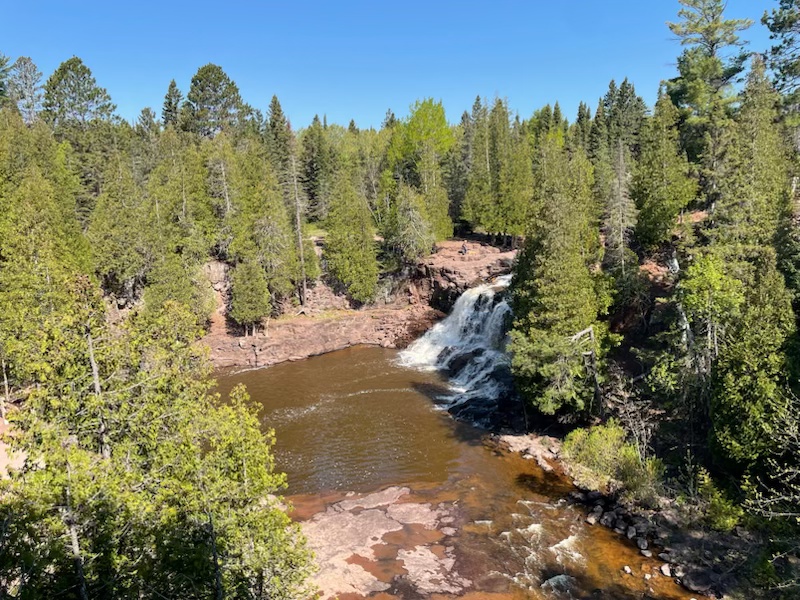
We stop there at least once every year on the way to or from the Summer Sanctuary. There is free access to the visitor center and the multiple trails on both sides of the Gooseberry River. There are two free EV chargers located in the parking lot, and for the first time in my experience when I stopped by on September 18, both chargers were being used. A sign of progress? Pat took these photos and video when she visited the falls on May 31 – they illustrate exactly why visitors love to stop there to hike the various trails and admire the scenery.

Probably the Most Popular View of the Lower Falls
View from Downstream of the Falls
The Upper Falls

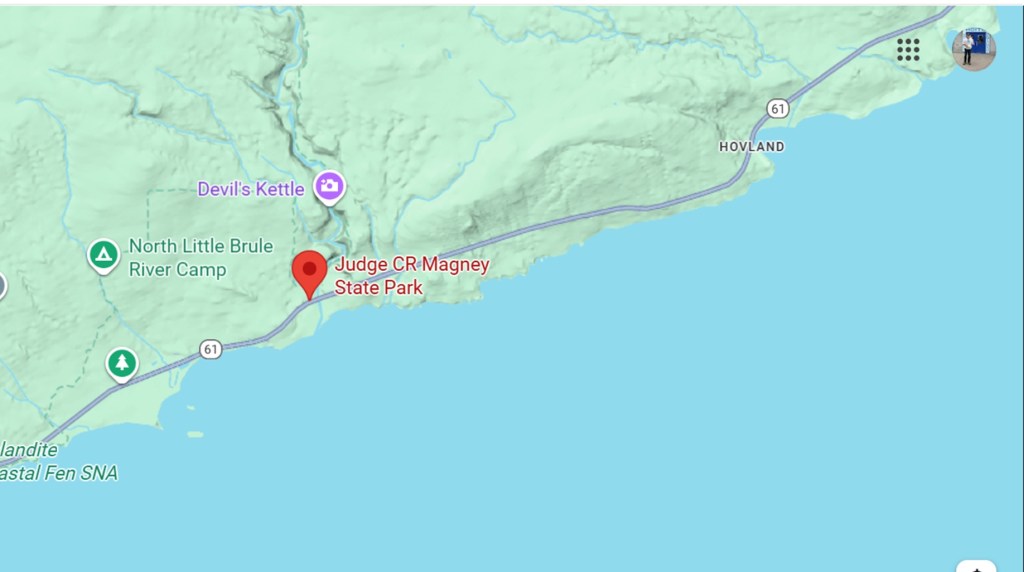
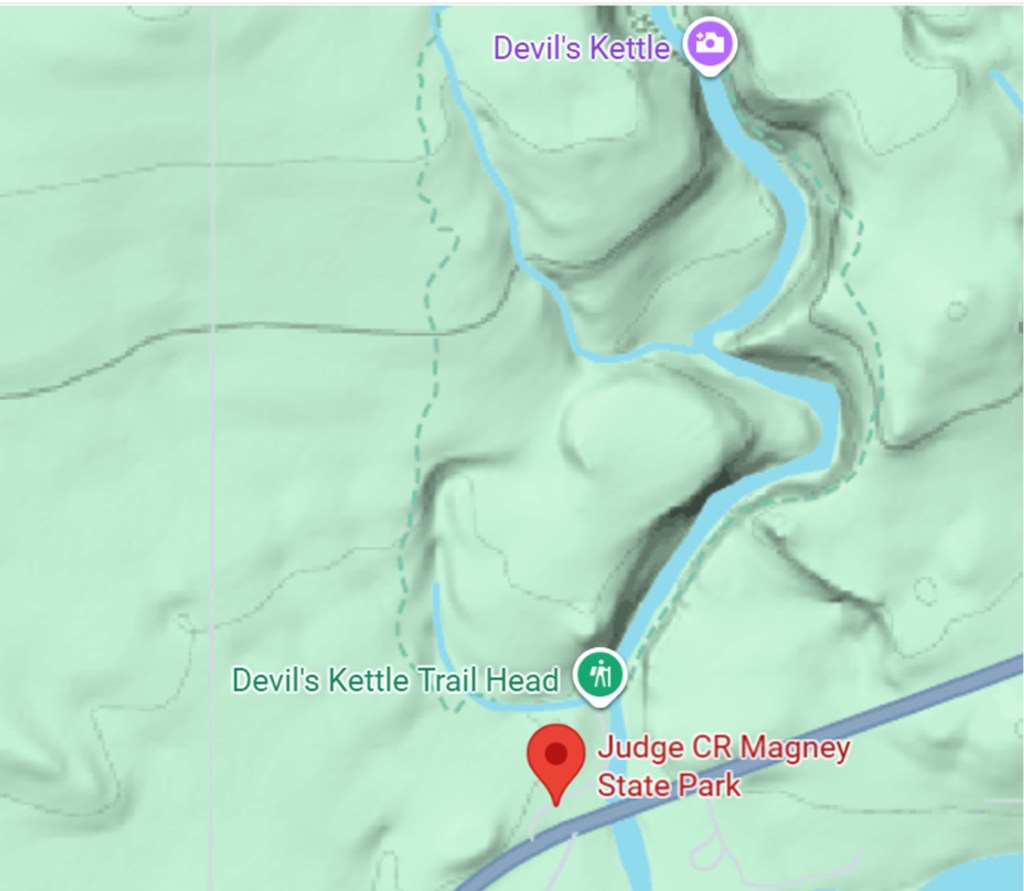
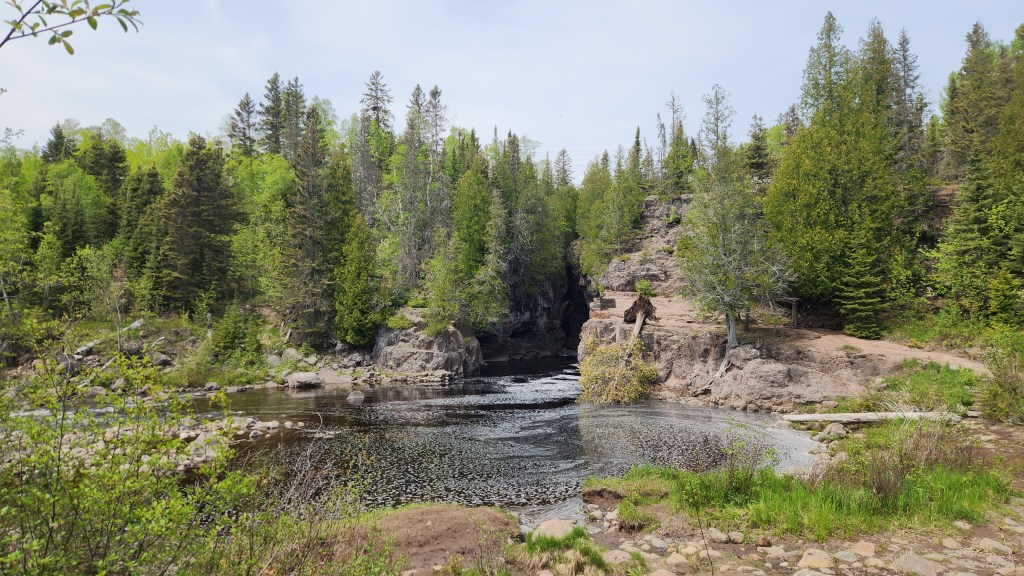
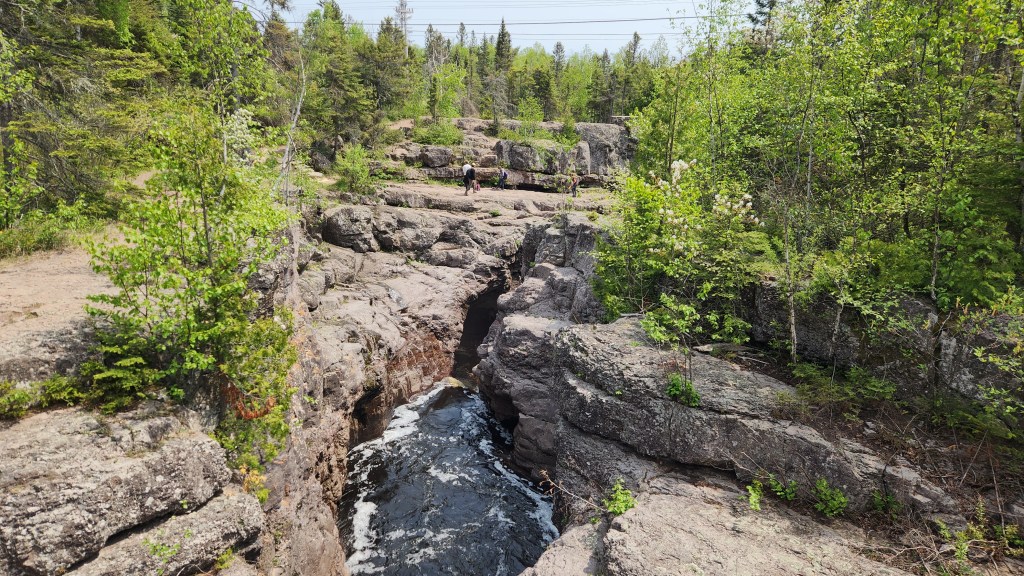
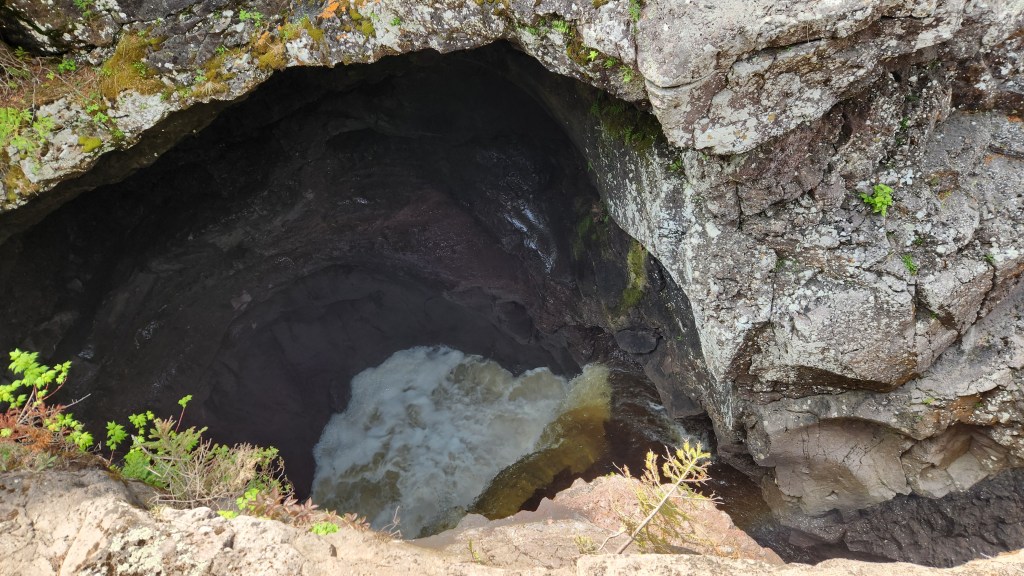
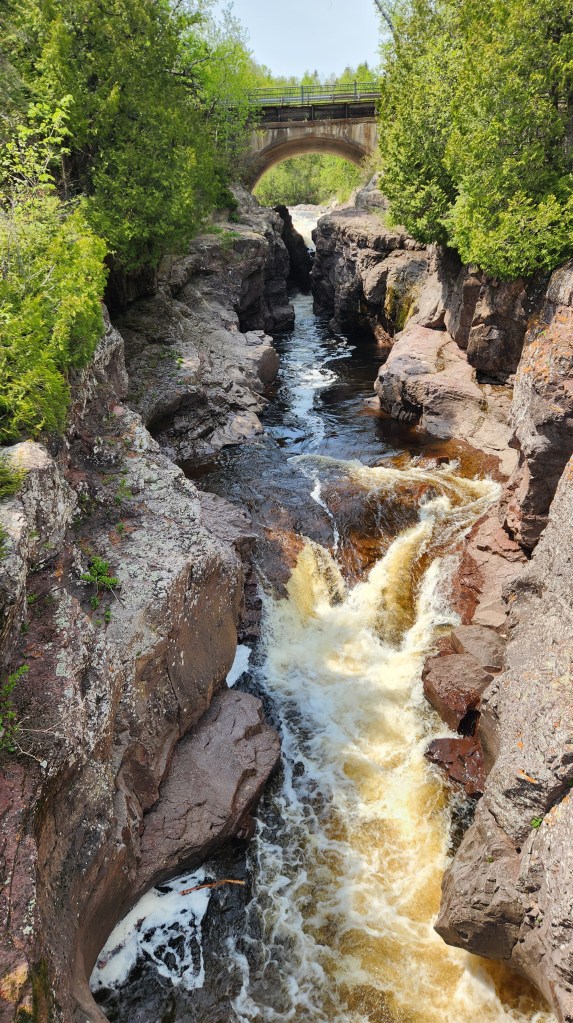
Devil’s Kettle: This interesting natural phenomenon is located on the Brule River within the Judge C.R. Magney State Park, located on Highway 61 four miles southwest of Hovland, MN.

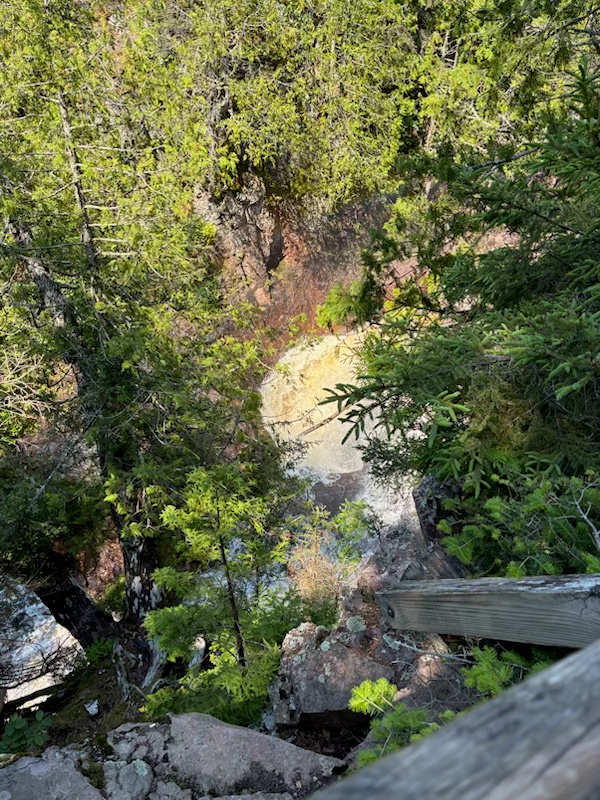
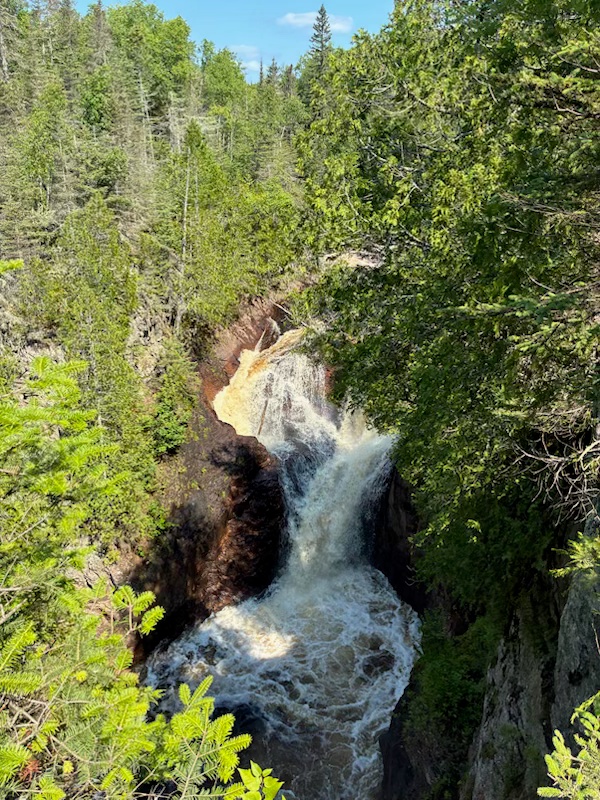
The Devil’s Kettle is a place where roughly half of the river disappears into a hole in the rocks while the rest of it flows on to a beautiful waterfall. I’ve read various stories about people trying, unsuccessfully, to find the outlet for the missing half of the river by putting various substances in the water. Wherever it may go, it’s a fascinating sight to see, after a hike of roughly a mile from the trailhead. Pat took these photos there on July 6th.

The Devil’s Kettle viewed from Above
The Devil’s Kettle and Brule River Waterfall

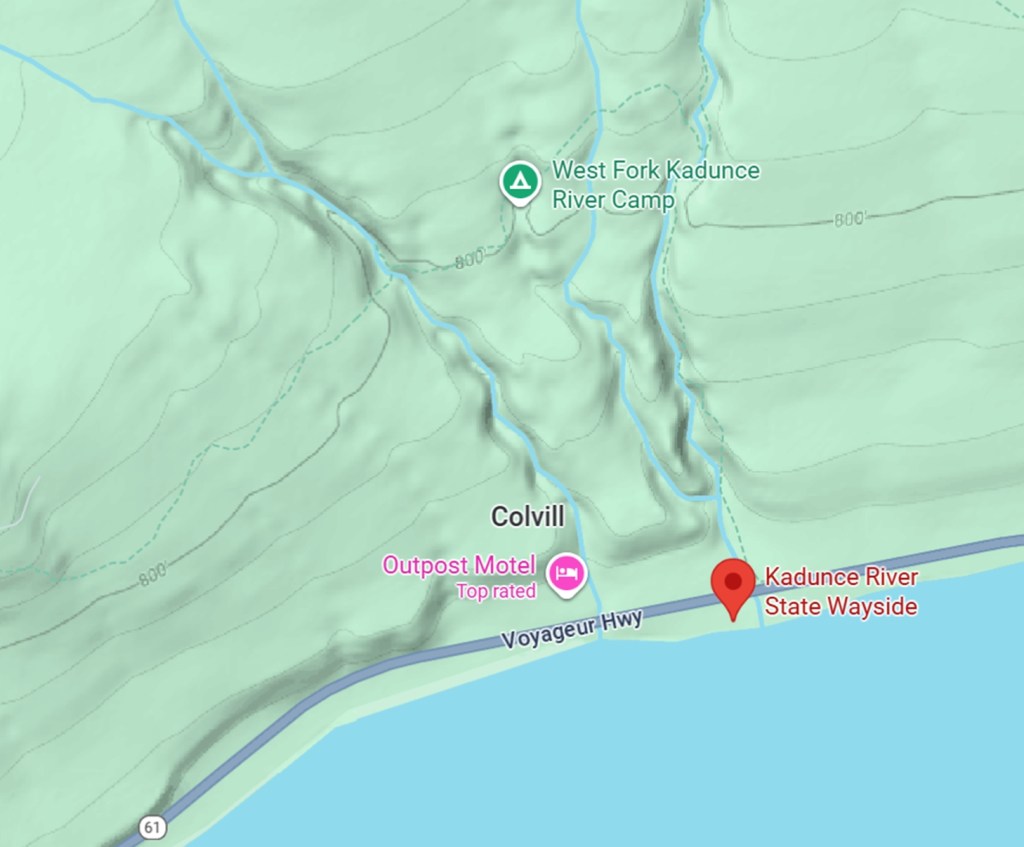
Kadunce River: The Kadunce River State Wayside is located just past Colvill, MN, on Highway 61.

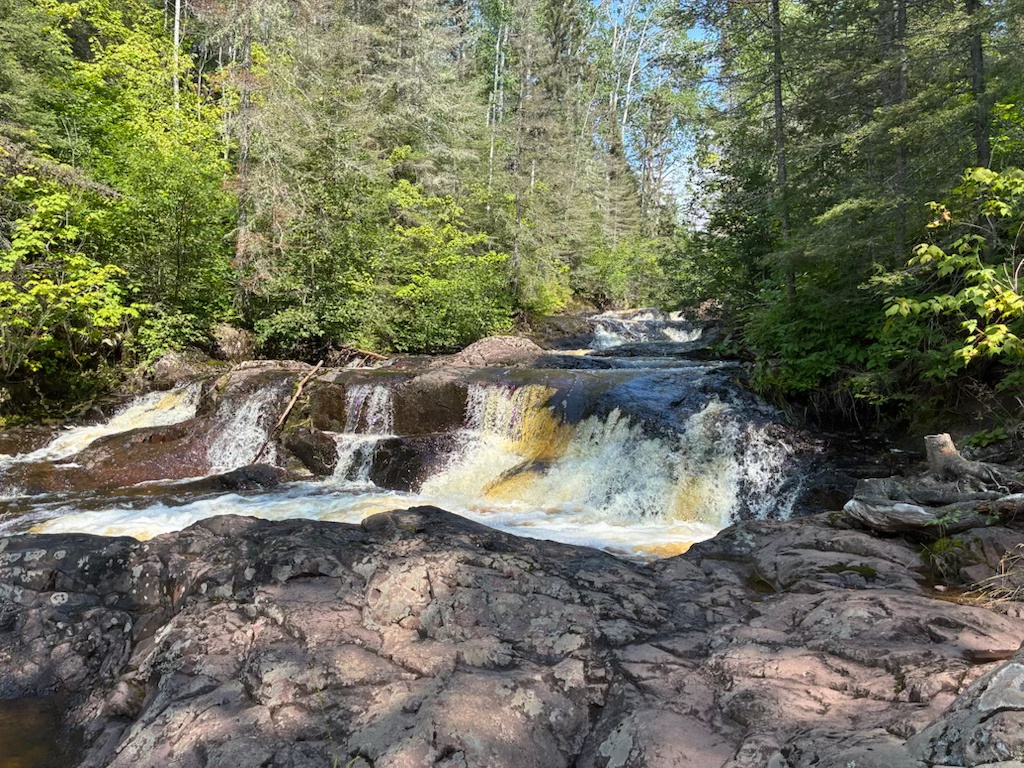
From there, a 0.9-mile spur trail follows alongside the river to a bridge that is part of the Superior Hiking Trail. We have walked along that trail dozens of times over the years. It begins at essentially the same elevation as the river, but then climbs steadily until the river can only be seen in glimpses flowing far below the trail through the adjacent canyon. At the upstream end of a series of some seven or eight waterfalls, however, the trail is again essentially at the same elevation as the river. The walk is quite enjoyable, passing through scenic woods, listening to the birds, glimpsing the river periodically, and then emerging next to a beautiful waterfall at what we call “decision point.” (If you want to hear the backstory for that, I’ll be happy to regale you in person with an epic tale, or you could read the book Snowman, whose climactic scene was inspired by the very tale I’m talking about.) At any rate, Pat took the photo and video below on August 11th.

“Decision Point” on the Kadunce River
One of Many Waterfalls on the Kadunce River

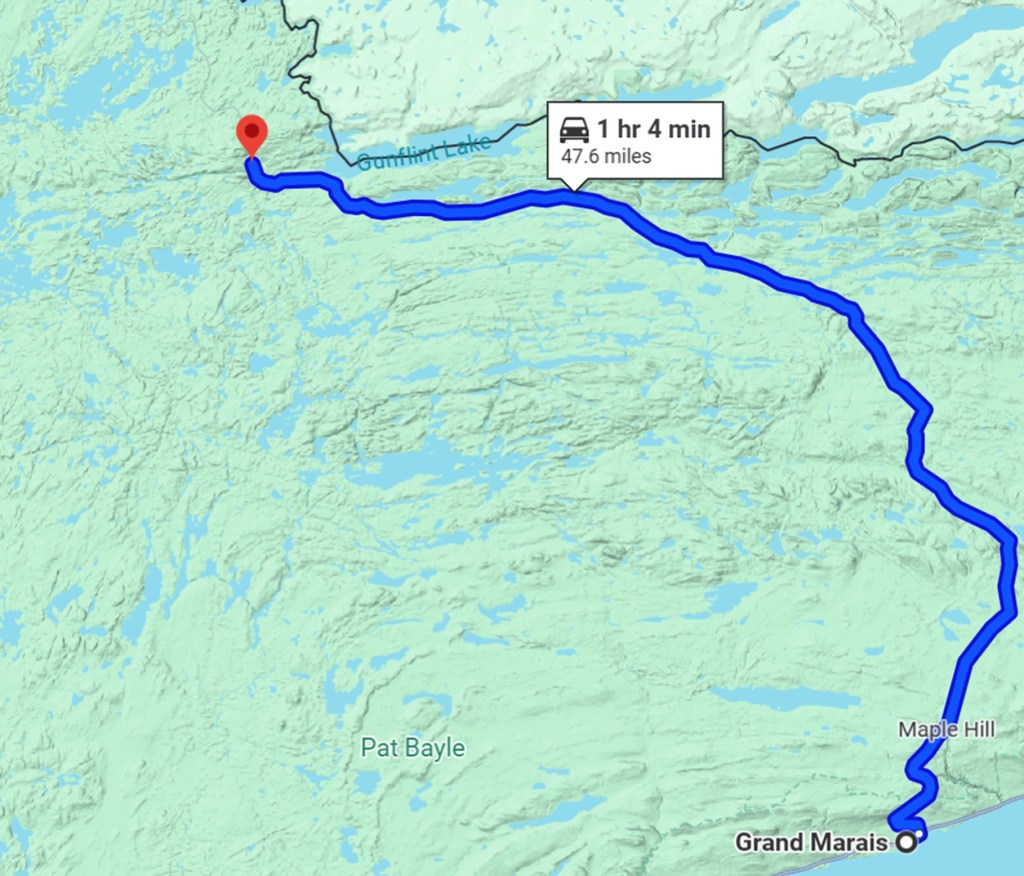
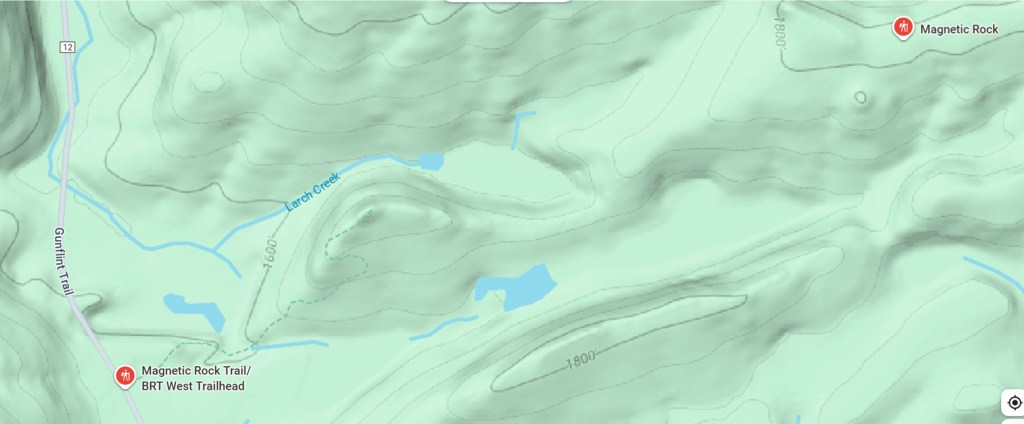
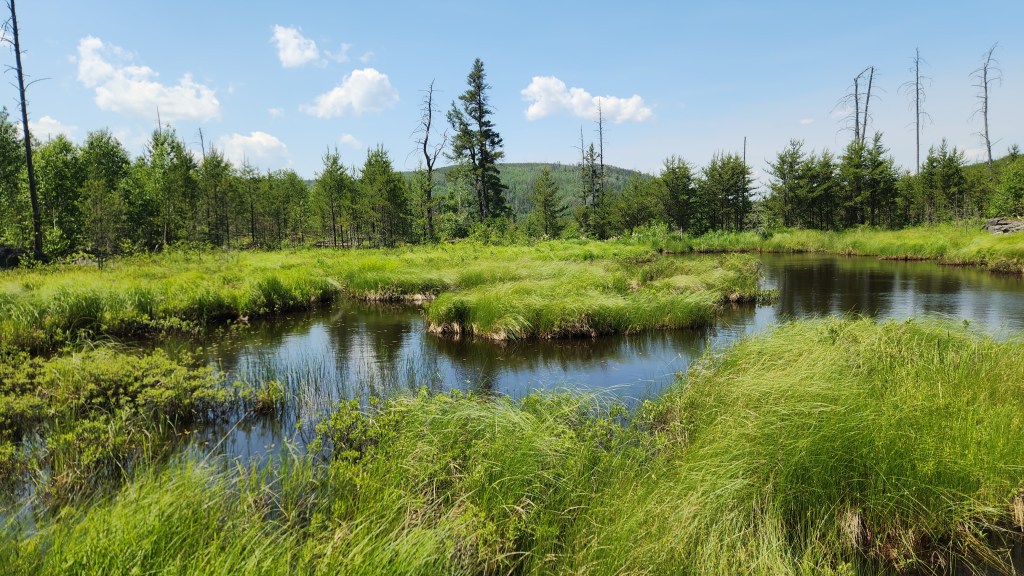
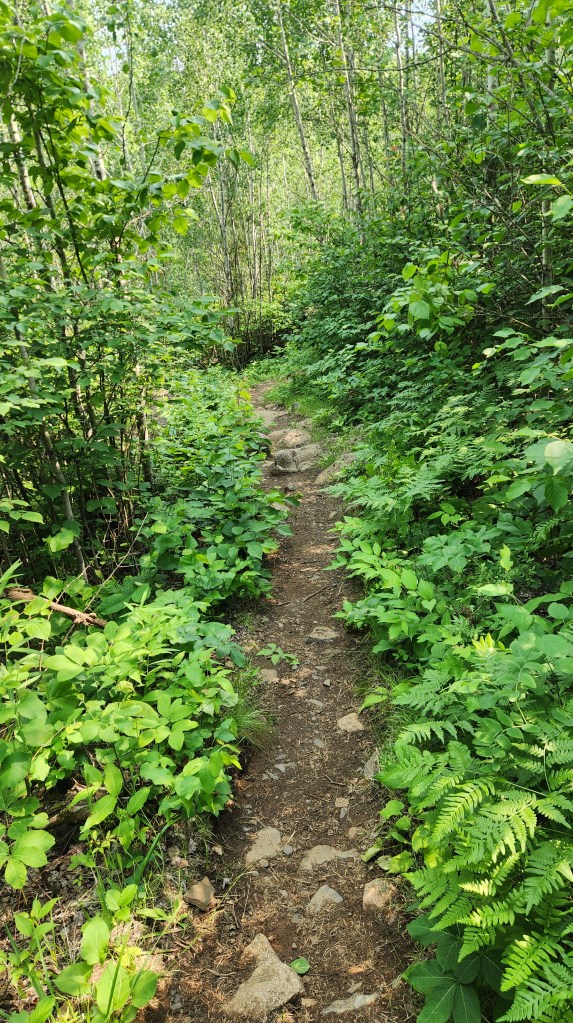
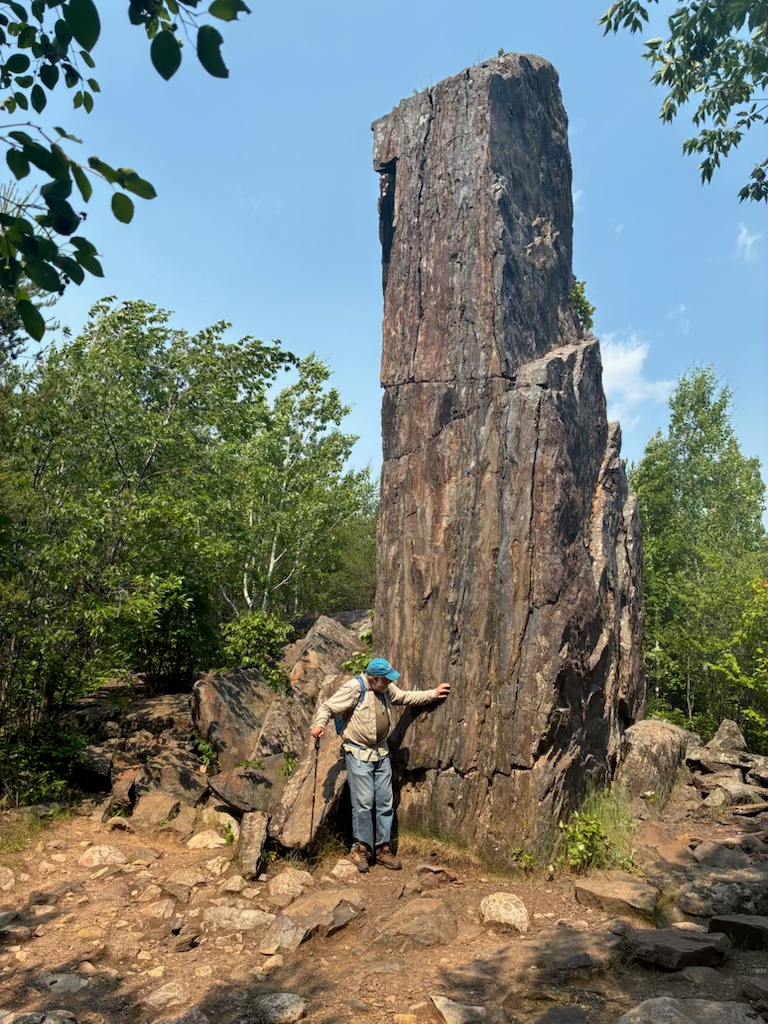
Magnetic Rock: The Magnetic Rock Trailhead is located 47.6 miles from Grand Marais, MN, on the Gunflint Trail. From there, a 3-mile trail passes through a diverse landscape – over bare and/or lichen covered rocks, through open meadows, through thickly forested areas – to a monolithic rock protruding from the earth.

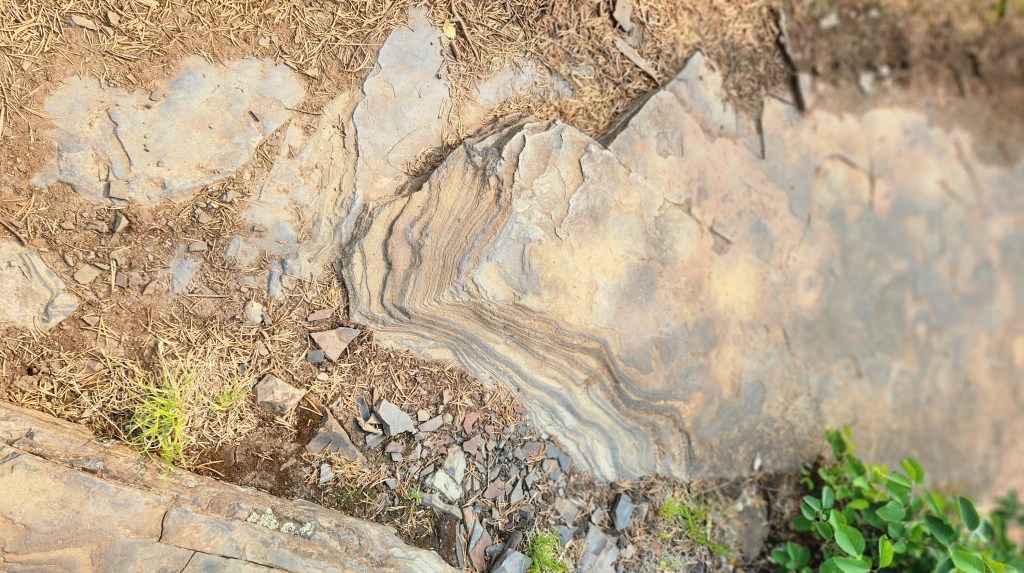
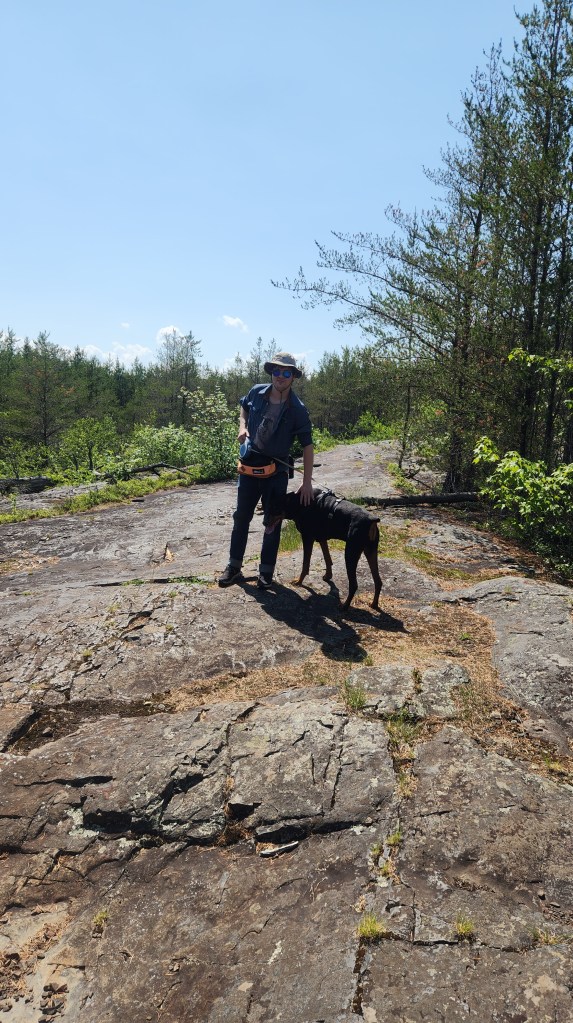
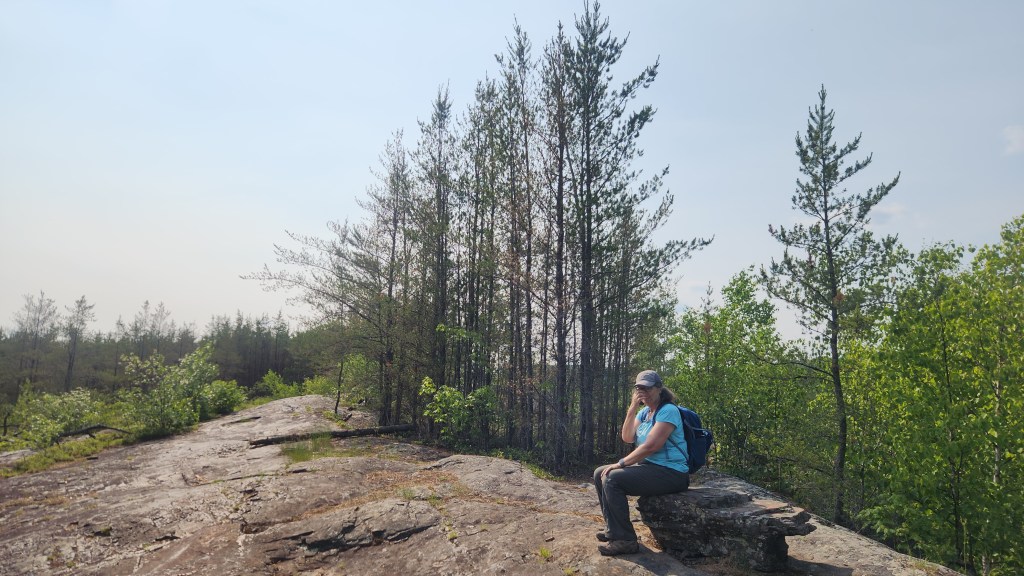
The rock contains so much iron that it can distort a compass needle to give a false indication of true north. We’ve probably walked this trail ten times or more over the past thirty-five years. The surrounding vegetation was severely damaged by fire in 2007, and we saw it begin to regenerate very quickly over the subsequent years until it is now almost at its pre-fire condition. There are still charred remnants of trees visible in some areas, though they are not readily noticeable. If the timing and climatic conditions are right, you can find quite a few blueberries along the trail. This year we went there with son Brian and his dog, Pippin, on July 1st, and there were no berries. Pippin nearly got heat stroke, so Brian stopped about halfway along and helped his pet back to the trailhead, but Pat and I made it all the way to the rock and back in two and a half hours. Here are some photos.

View from Magnetic Rock Trail
Rocky Surface Near Start of Magnetic Rock Trail
Brian and Pippin on Magnetic Rock Trail
Natural Bench on Magnetic Rock Trail
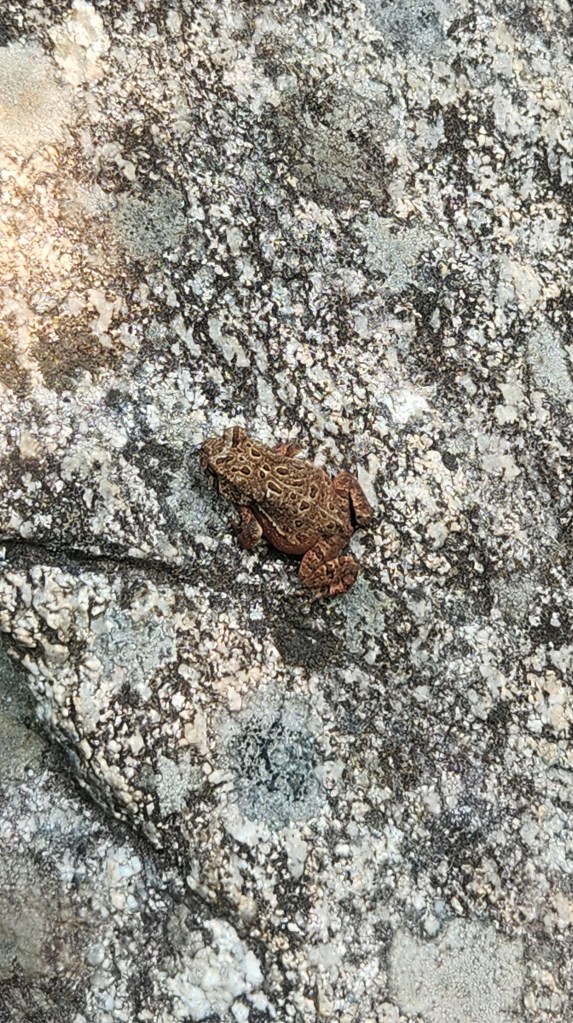
A Friendly Denizen of the Magnetic Rock Trail
Forested Portion of Magnetic Rock Trail
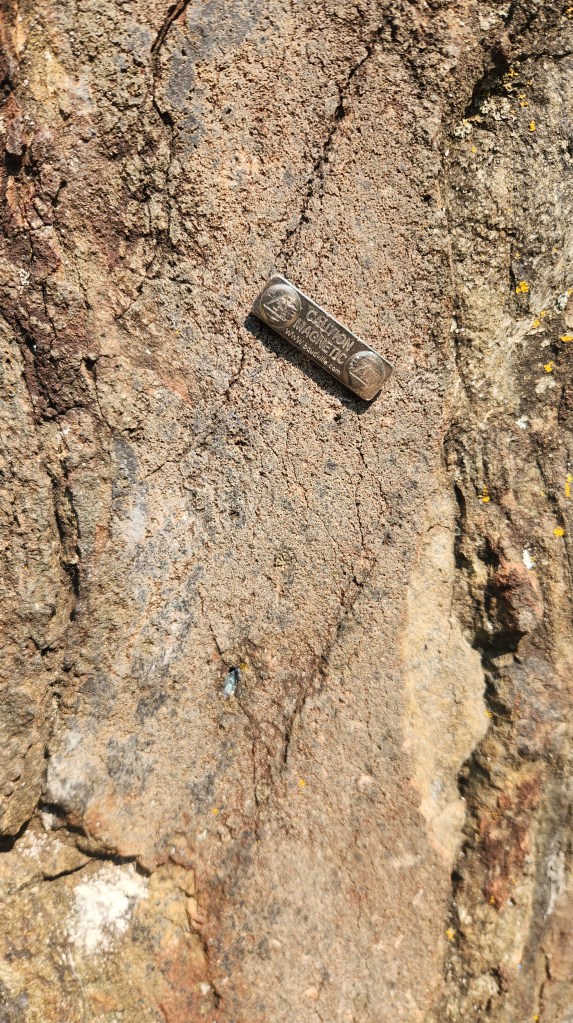
The Magnetic Rock (I’m examining the artifact pictured below)
Magnet Left Behind by a Previous Visitor

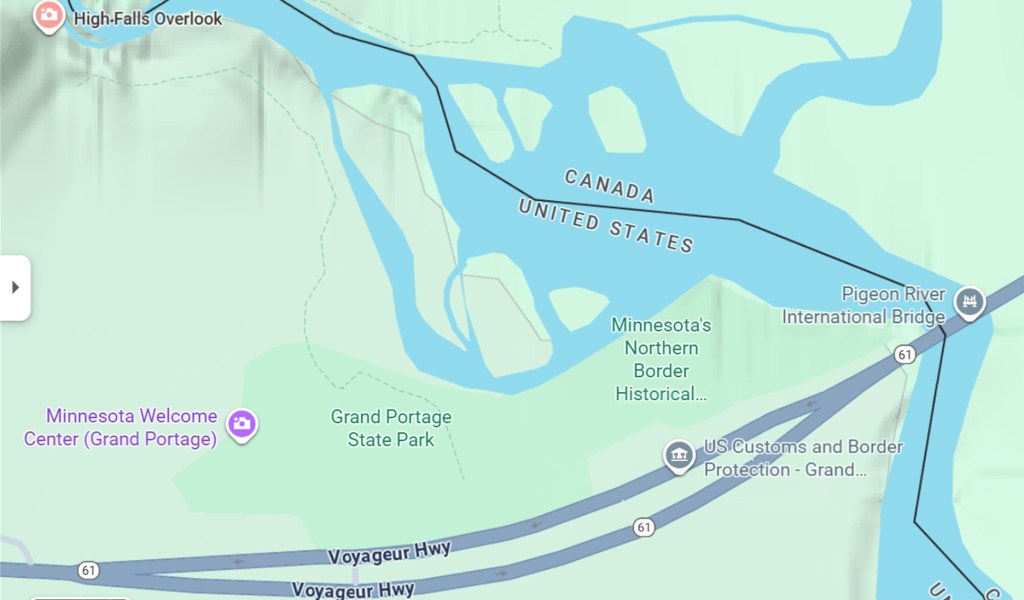
Pigeon River High Falls Overlook: The Grand Portage State Park, located on Highway 61 about a mile from the US-Canada border, is jointly operated by the State of Minnesota Department of Natural Resources and the Grand Portage Band of Lake Superior Chippewa.

It includes a very easy, paved walking path from the Visitor Center to the High Falls Overlook. The High Falls can also be reached from the Canadian side of the border, but the view isn’t as good from there. The State Park is only a 36-mile drive from the Summer Sanctuary, so we manage to visit once or more every year. This year, we visited on August 2nd.

High Falls on the Pigeon River
That’s a Lot of Water …

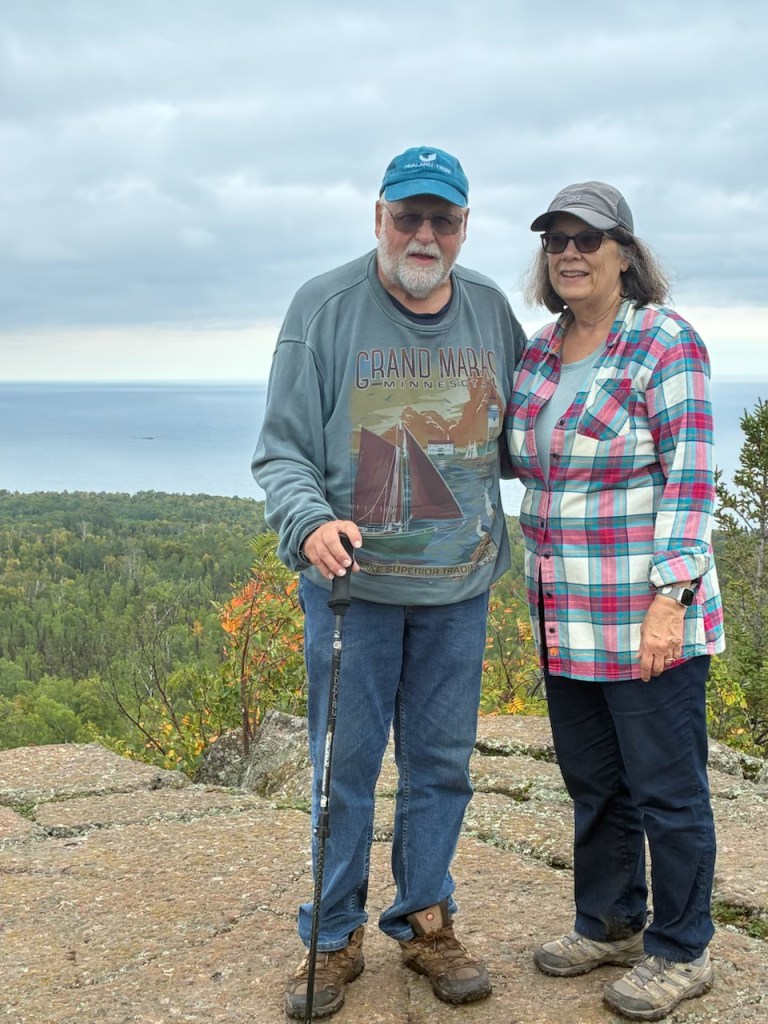
Pincushion Mountain: The Pincushion Mountain Overlook is accessible via a three-mile drive from Grand Marais up the Gunflint Trail. From the parking lot at the overlook, there are multiple trails that lead to Pincushion Mountain, which we have walked many times over the years. This year, we walked on the Superior Hiking Trail for 4.5 miles to the Pincushion Summit on September 20th. While there, a friendly hiker snapped our picture, with Five Mile Rock on Lake Superior barely visible in the background.

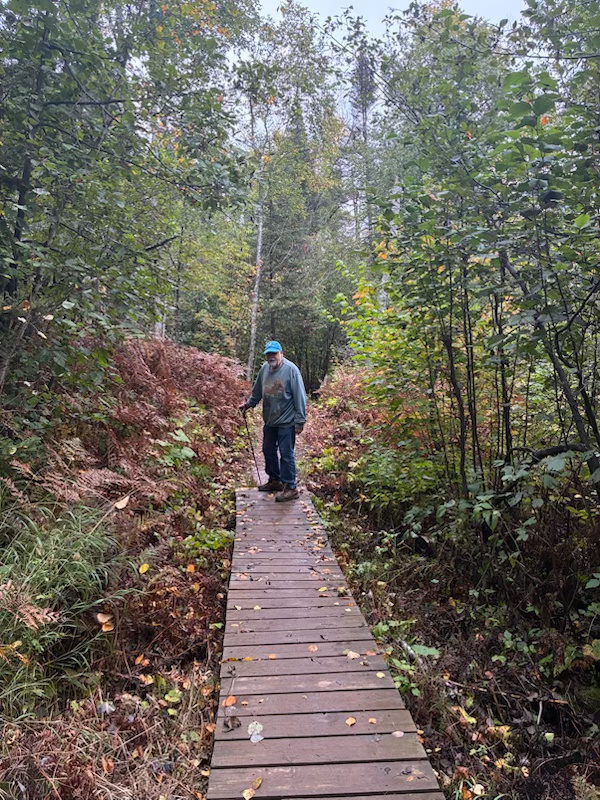
Heading Toward Pincushion Mountain on the Superior Hiking Trail
At the Summit of Pincushion Mountain

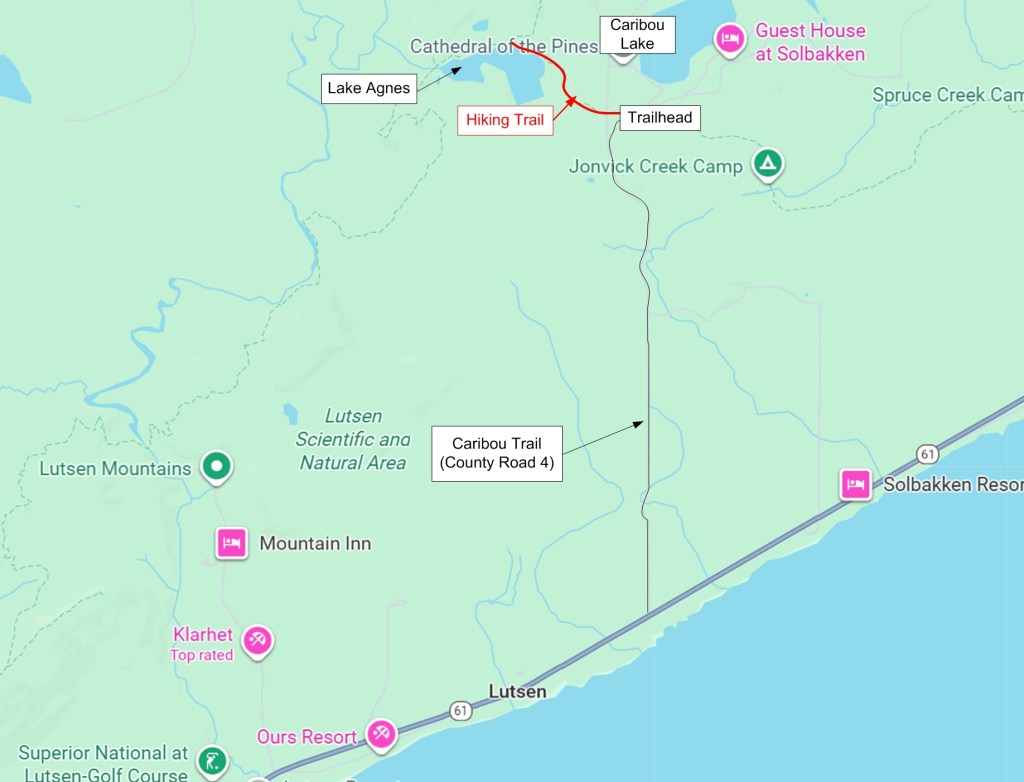
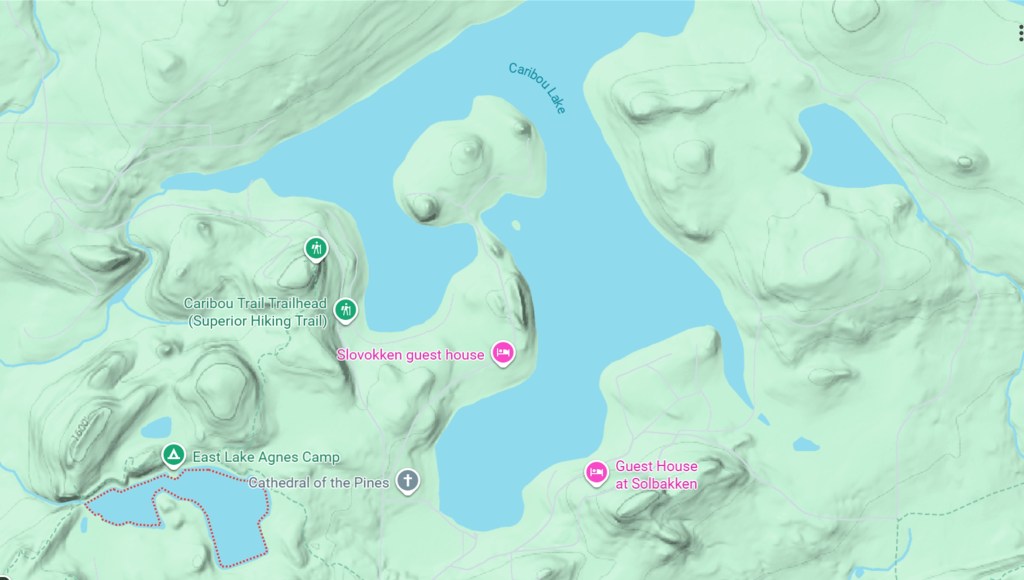
Lake Agnes and Lutsen Mountains:  This was our last hike of the season, on October 10th. After driving southeast on Highway 61 to the Caribou Trail near Lutsen, MN, then north about 3.2 miles to a trailhead for the Superior Hiking Trail, we embarked on a 2 ½ mile round trip hike to a campground on Lake Agnes.

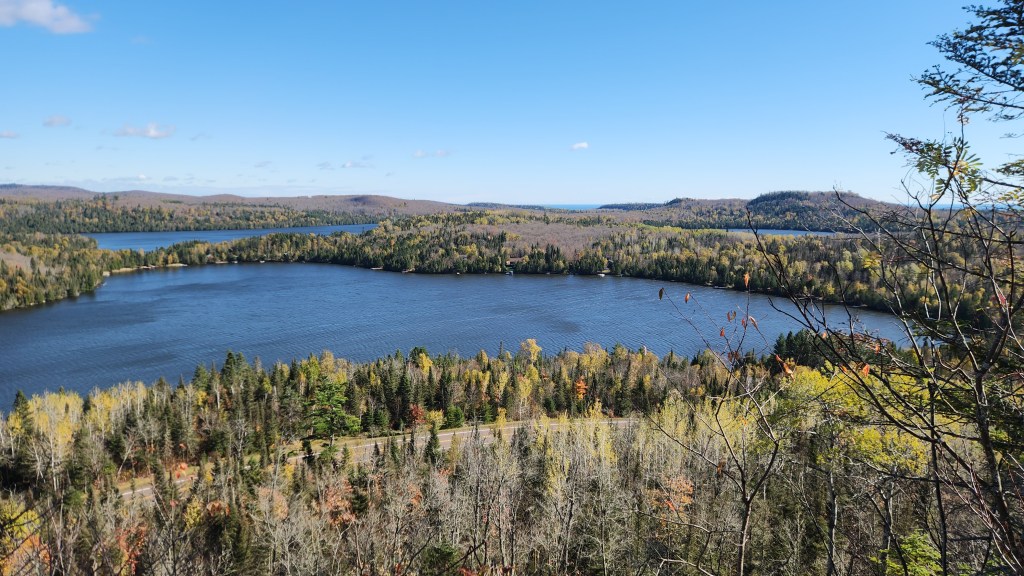
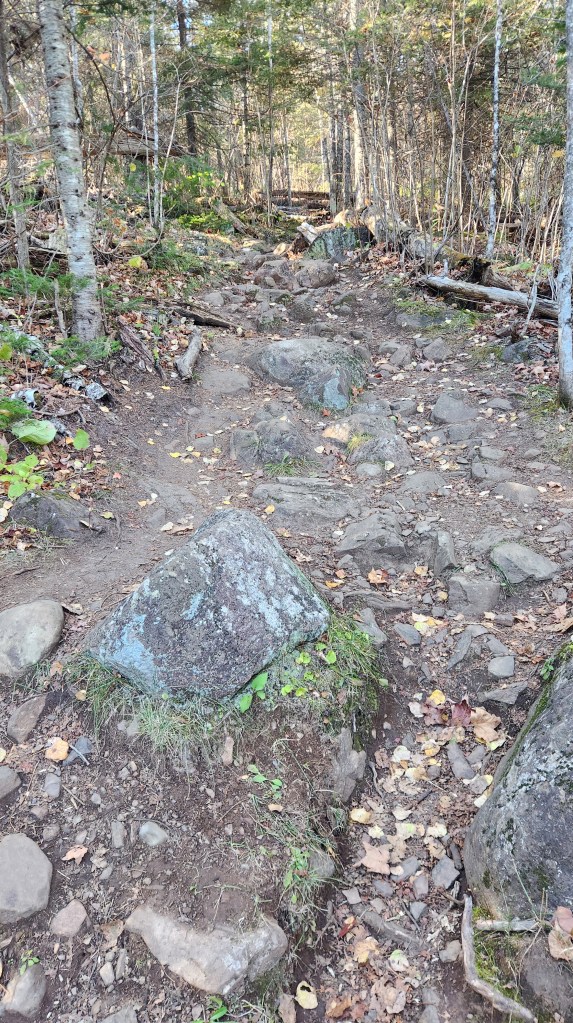
The hike started out with a steep, rocky climb to a short spur trail which led to what is known as White Sky Rock, an outcropping that provides a spectacular view of Caribou Lake.

Caribou Lake View from White Sky Rock

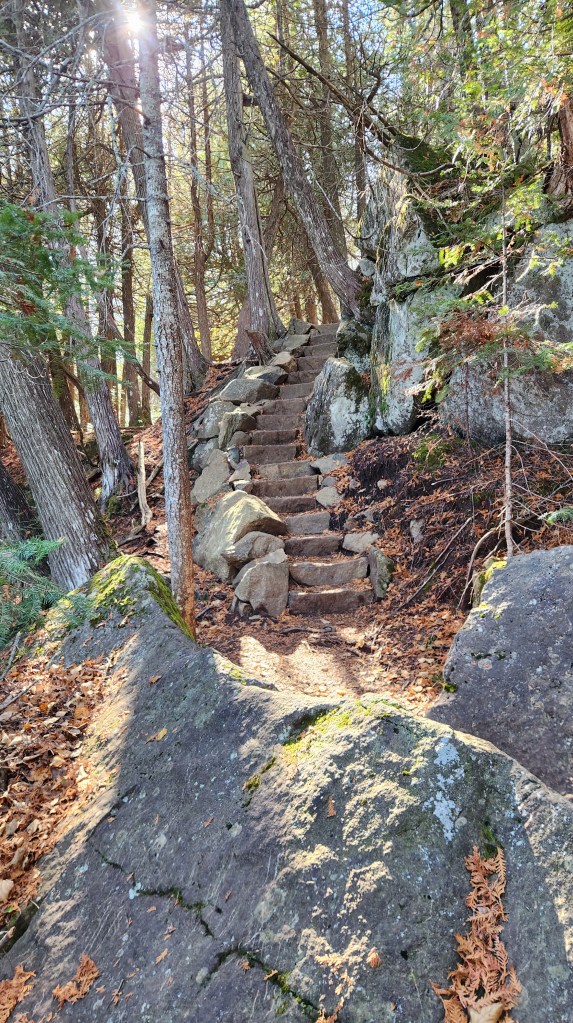
After taking in the view from White Sky, we returned to the Superior Hiking Trail and headed west to Lake Agnes. The trail was surprisingly diverse – sometimes rugged and rocky, sometimes easy; sometimes forested, sometimes surrounded by steep bluffs and rock outcroppings.

Superior Hiking Tral Heading Toward Lake Agnes

The trail hugged the northern shore of Lake Agnes as we headed to The East Lake Agnes Camp, where I had camped once (with son Brian, brother-in-law Andy, and nephews Chris and Dan) some fifteen years ago, at which point we turned around and headed back to our car parked at the Caribou Trail trailhead. I would rate this hike among the best we’ve ever had on the North Shore due to the diversity I mentioned above.

Panorama of Lake Agnes from Superior Hiking Trail
View from East Lake Agnes Camp
Almost Back to the Car …

After the hike, we took a short drive to Lutsen Mountains to ride the gondola up to top of Moose Mountain, where we enjoyed the beautiful views.

Riding the Lutsen Mountains Gondola
View from Moose Mountain
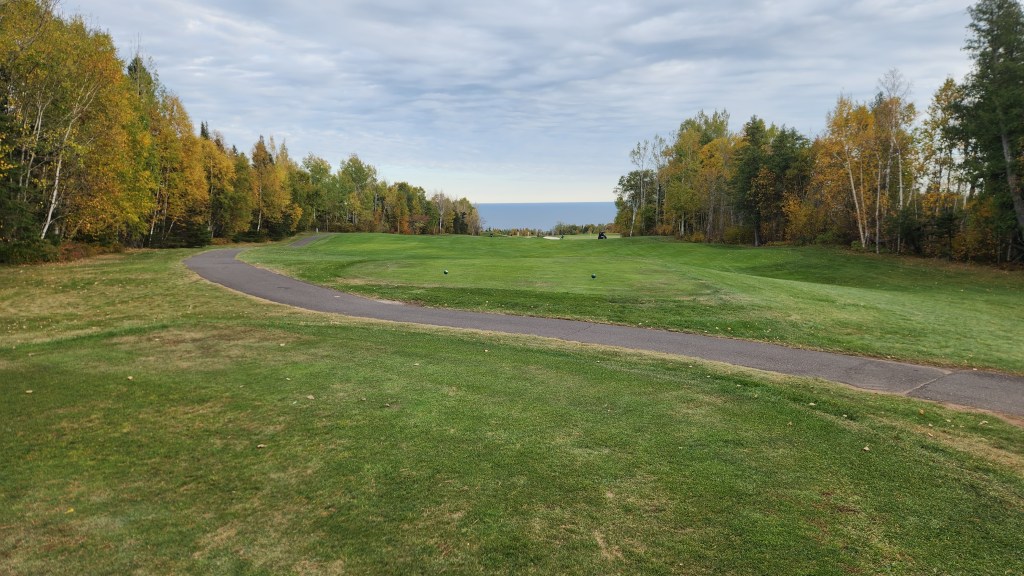
7th Hole at the Superior National Golf Course (in case any readers are golfers)

Canada:  We also made a few forays into Canada, as we usually do each year. (We like the fact that our Summer Sanctuary is so close to our northern neighbor, so that if we ever decide we can no longer tolerate the disgusting manner in which the current United States Government “leaders” are dragging the country, we can quickly escape to a place where we feel safer and more welcome. Not that I wish to inject politics into my travel blogs, but sometimes it’s just hard to cope.)

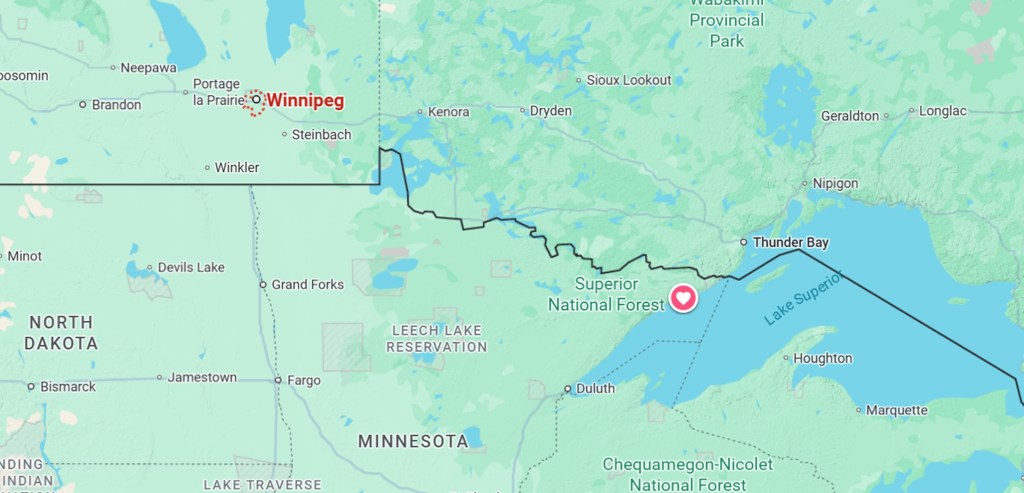
Thunder Bay, Ontario, Marina:  Pat and I made our annual summer visit to Thunder Bay, Ontario, on August 8th this year. Thunder Bay is located 75 miles northeast of the Summer Sanctuary via MN Highway 61 and Canadian Highway 61.

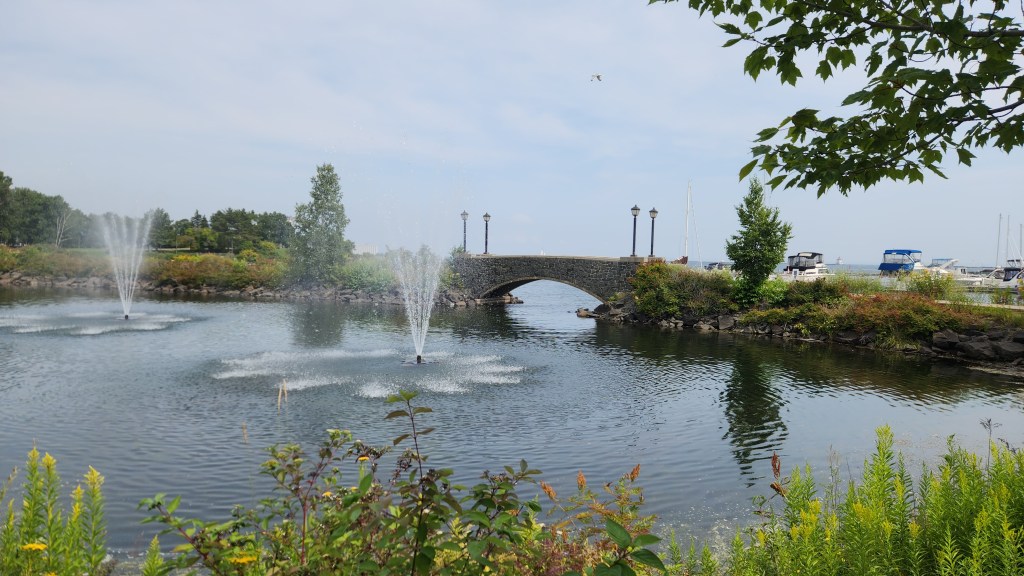
As usual, we went to the Algoma and Bay “Finntown” neighborhood to visit the Finnish Bookstore, the Finnport shop, and the Cheese Encounter store. Unfortunately, the Hoito Hose Restaurant reconstruction has ground to a halt, with only a large foundation waiting sadly for a future recreation of the iconic landmark following its total destruction in a fire several years ago. We continue to wait with hope in our hearts. We also stopped at the Thunder Bay Marina for a nice lunch at the Bight Restaurant and a stroll around Marina Park.

Thunder Bay Marina Park
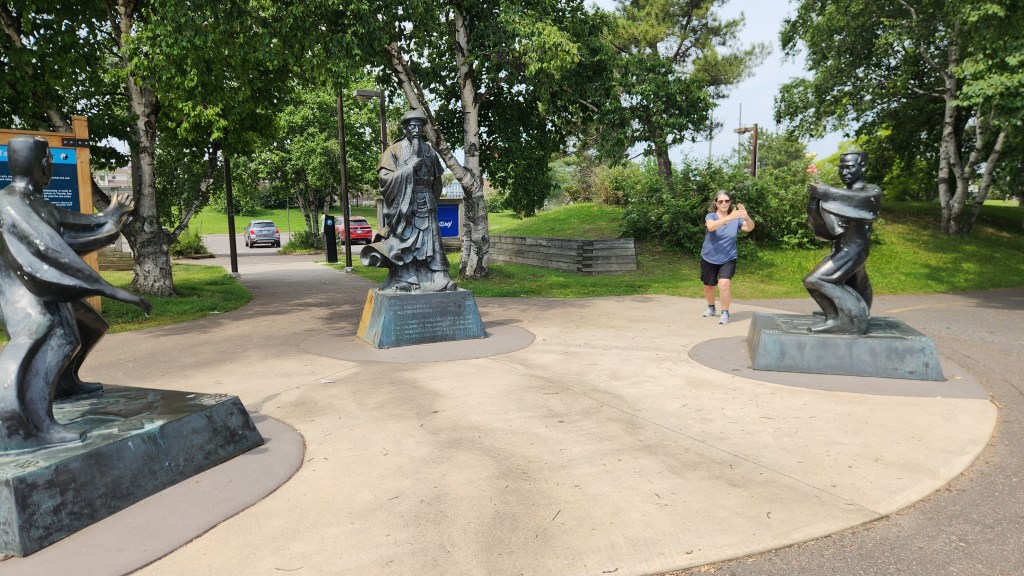
Communing with Tai Chi Masters in Marina Park

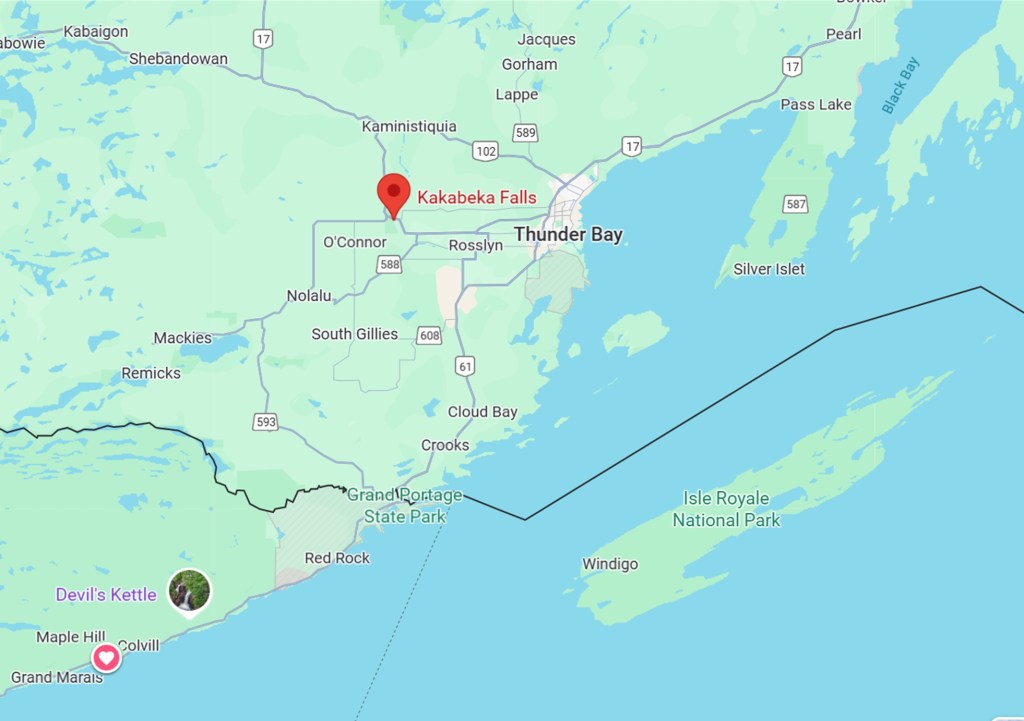
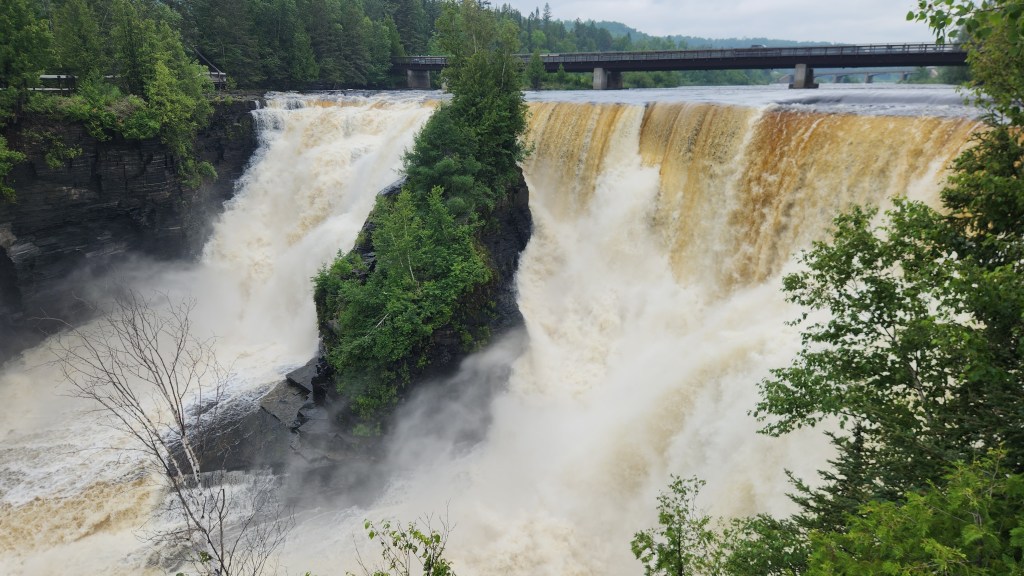
Kakabeka Falls, Ontario: This 130-foot-high waterfall on the Kaministiquia River is a fairly frequent stop for us when we venture up north to Thunder Bay, but this year Pat didn’t go there at all, and I only made one quick stop with my frequent golf partner after we played at the nearby Whitewater Golf Club on July 15th. I always feel a thrill when observing the awesome power of the thunderous water, and perhaps readers will feel the same way as they check out the following.

Kakabeka Falls from North Side Viewing Platform
Kakabeka Falls from North Side of River
Through the Mist from Downstream Viewing Platform

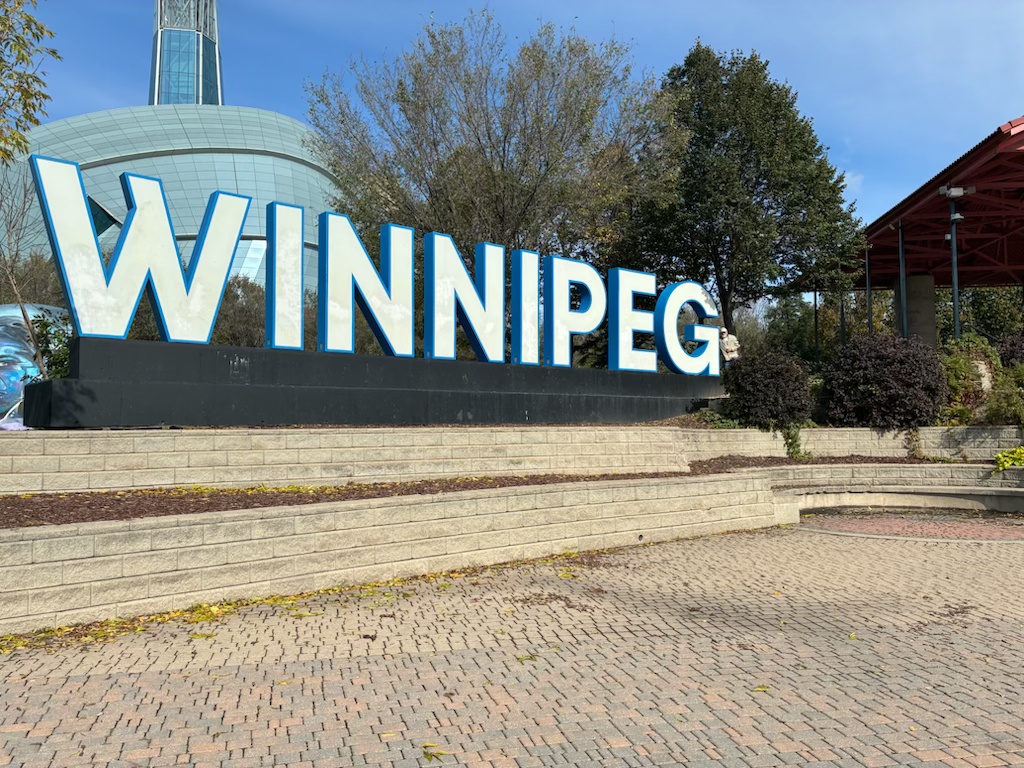
Winnipeg, Manitoba: As our final foray of the season, we decided to visit Winnipeg, Manitoba, departing from Minneapolis on October 4 and returning to the cabin on October 7. We’ve discussed going to check out Winnipeg several times over the years, but had never seemed to make it happen until this year, when we deiced to emulate the marketers from Nike and “just do it.”

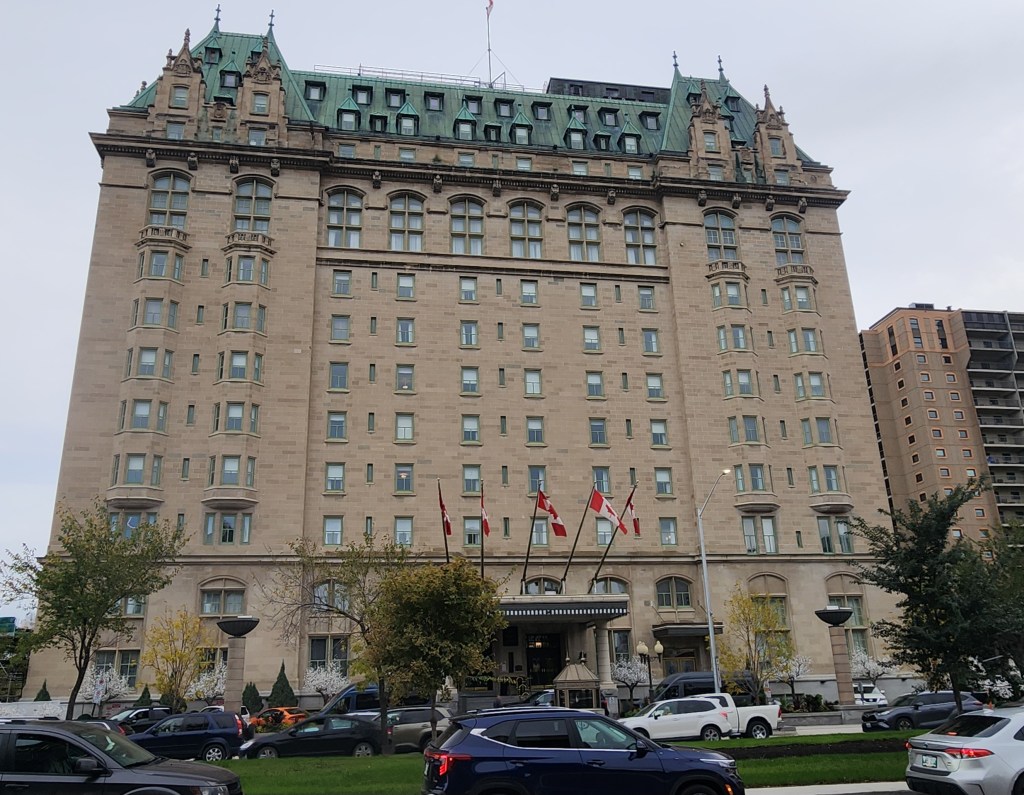
We stayed at an impressive place called the Fort Garry Hotel, Spa, and Conference Centre, built by the Grand Trunk Pacific Railway in 1913 as one of Canada’s grand railway hotels. While there were a few quirky aspects of the place, like an elevator that occasionally decided to do something other than what you had in mind, it was very conveniently located near the places we wanted to visit.

The Fort Garry Hotel, Spa, and Conference Centre

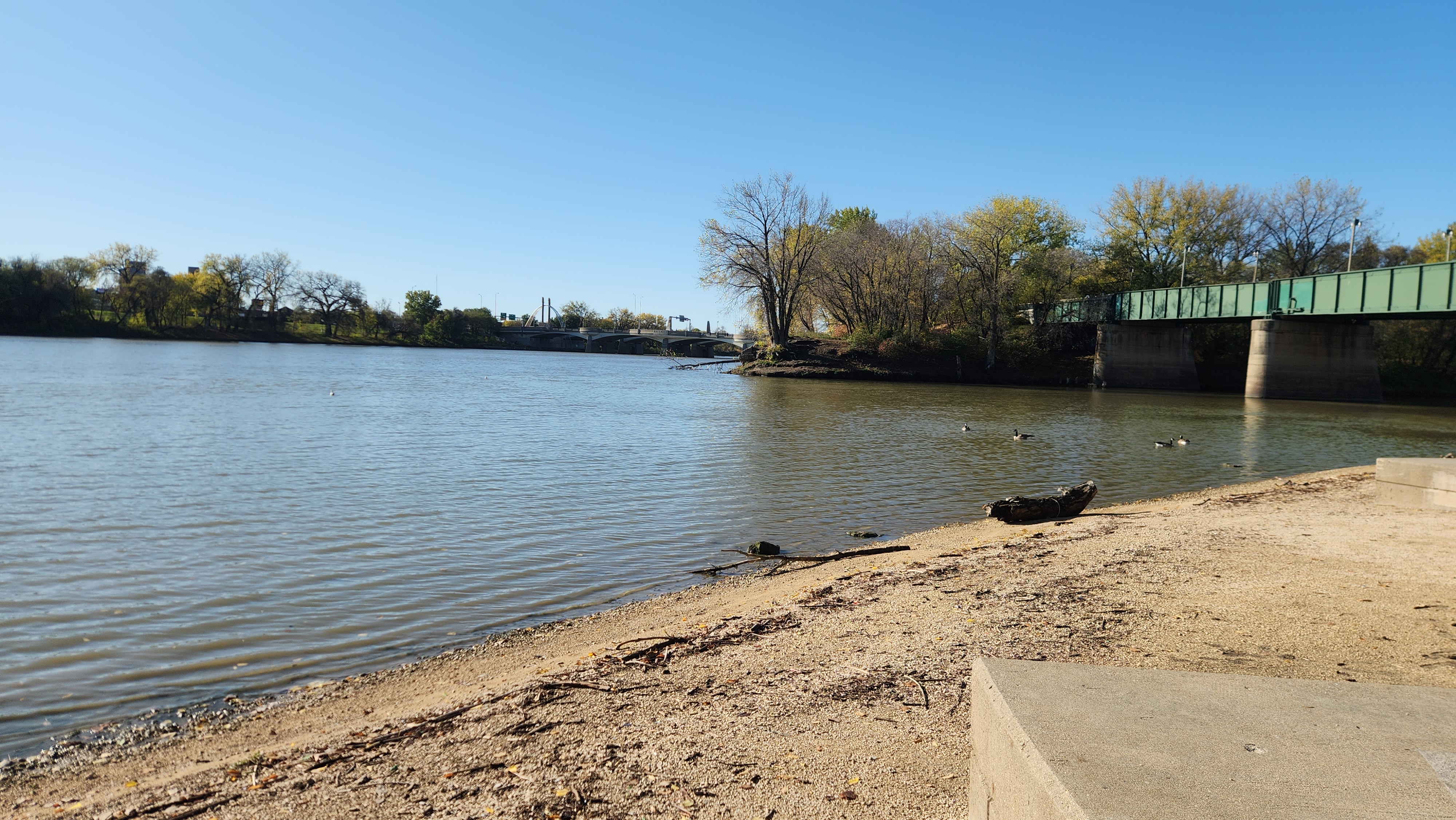
First, a bit of history. The confluence of the Assiniboine River and the Red River, known as The Forks, is located within the city of Winnipeg. The Forks was a focal point for canoe river routes travelled by Aboriginal peoples for thousands of years before the arrival of European traders and settlers. Populated by First Nations peoples, the area was used for camps, hunting, fishing, trading, and (further north) agriculture. The rivers linked the Assiniboine, Ojibway, Anishinaabe, Mandan, Sioux, Cree, Lakota, and others for trade and knowledge sharing.

The Red River flows north from the confluence of the Bois de Sioux and Otter Tail Rivers near Wahpeton, ND, and Breckenridge, MN and empties into to Lake Winnipeg, which then drains into Hudson Bay via the Nelson River. This made The Forks a natural place for the indigenous people to supply firs to the Hudson’s Bay Company which, along with British colonialists, laid claim to the entire Hudson Bay drainage basin, including what is now Winnipeg, in the late 17th century. However, French traders worked the area for the rival Montreal-based North West Company decades before the first English traders arrived in about 1767. During these years, various French and British forts were built in the area to facilitate operations of the rival fur companies.

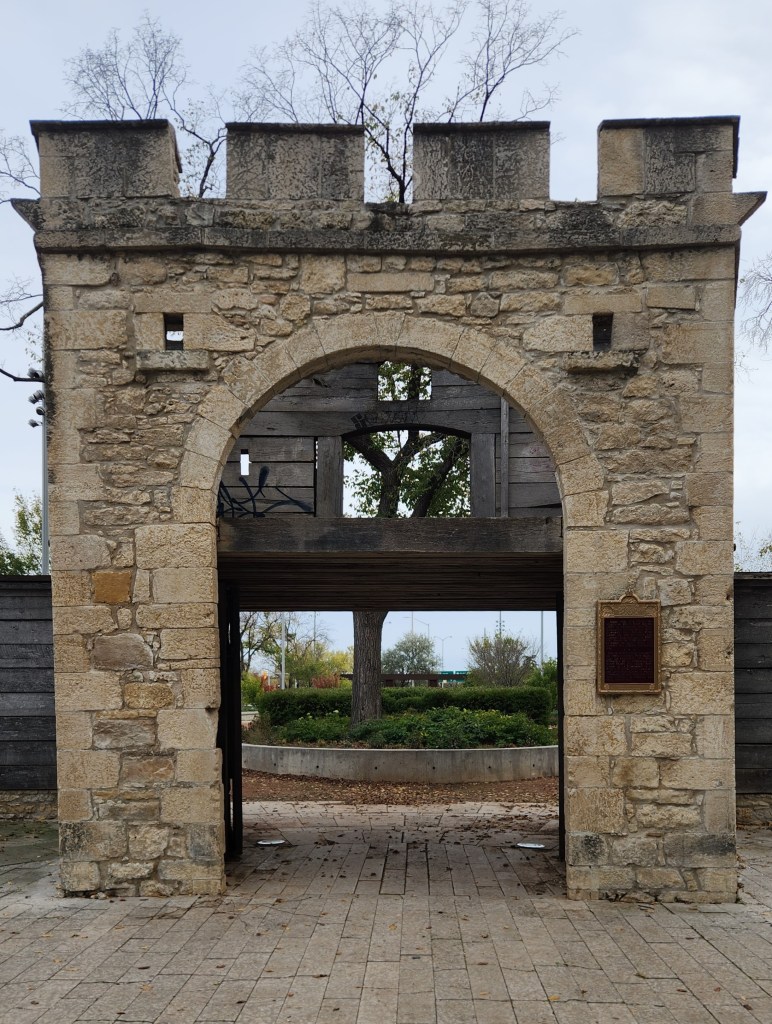
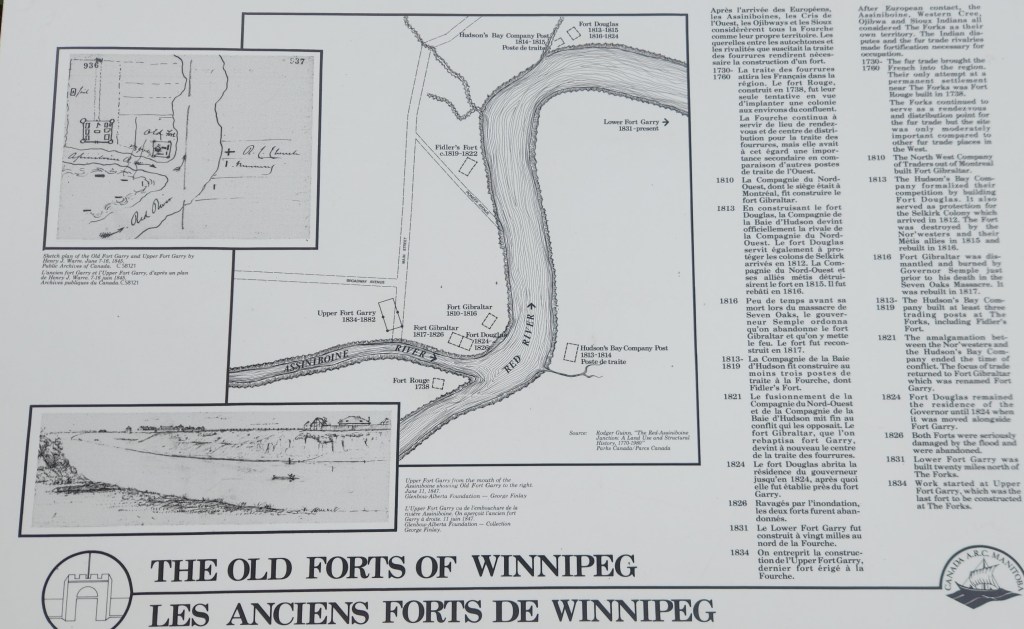
In 1811, Scottish aristocrat and humanitarian Thomas Douglas, Earl of Selkirk, received a grant of 116,000 square miles in the basins of the Red and Assiniboine Rivers from the Hudson’s Bay Company, which he named Assiniboia, and established an agricultural settlement populated by displaced Scottish Highland families and retired Hudson’s Bay Company workers. The Red River Colony (or Selkirk Settlement) was founded in 1812 and built Fort Douglas a short distance upriver from Fort Gibraltar, the area headquarters of the North West Company. The two fur companies fought several battles for control of the area until the Hudson’s Bay company succeeded in forcing a merger in 1821. Fort Gibraltar was taken over as the Hudson’s Bay Company headquarters in 1822 and renamed Fort Garry. During this period, the Métis, an ethnic group descended from the mixing of indigenous Canadians and European traders, began settling in the Red River Valley. As their numbers grew, the Métis instituted a rebellion against the new federal government imposed by Canadian Confederation in 1867 and eventually established a provisional government under Luis Riel in 1869. During these turbulent times, the Catholic Church beefed up its presence in the area; a Cathedral was bult and the so-called “grey nuns” established hospitals which remain today. Eventually, Riel agreed to have the Red River Settlement join the newly formed Province of Manitoba, and Winnipeg was formally incorporated in 1873. Fort Garry was demolished in the early 1880s to make way for Winnipeg’s Main Street, although the fort’s gate was retained. The site was designated as a National Historic Site in 1924 and stands a mere stone’s throw away from the Fort Garry Hotel.

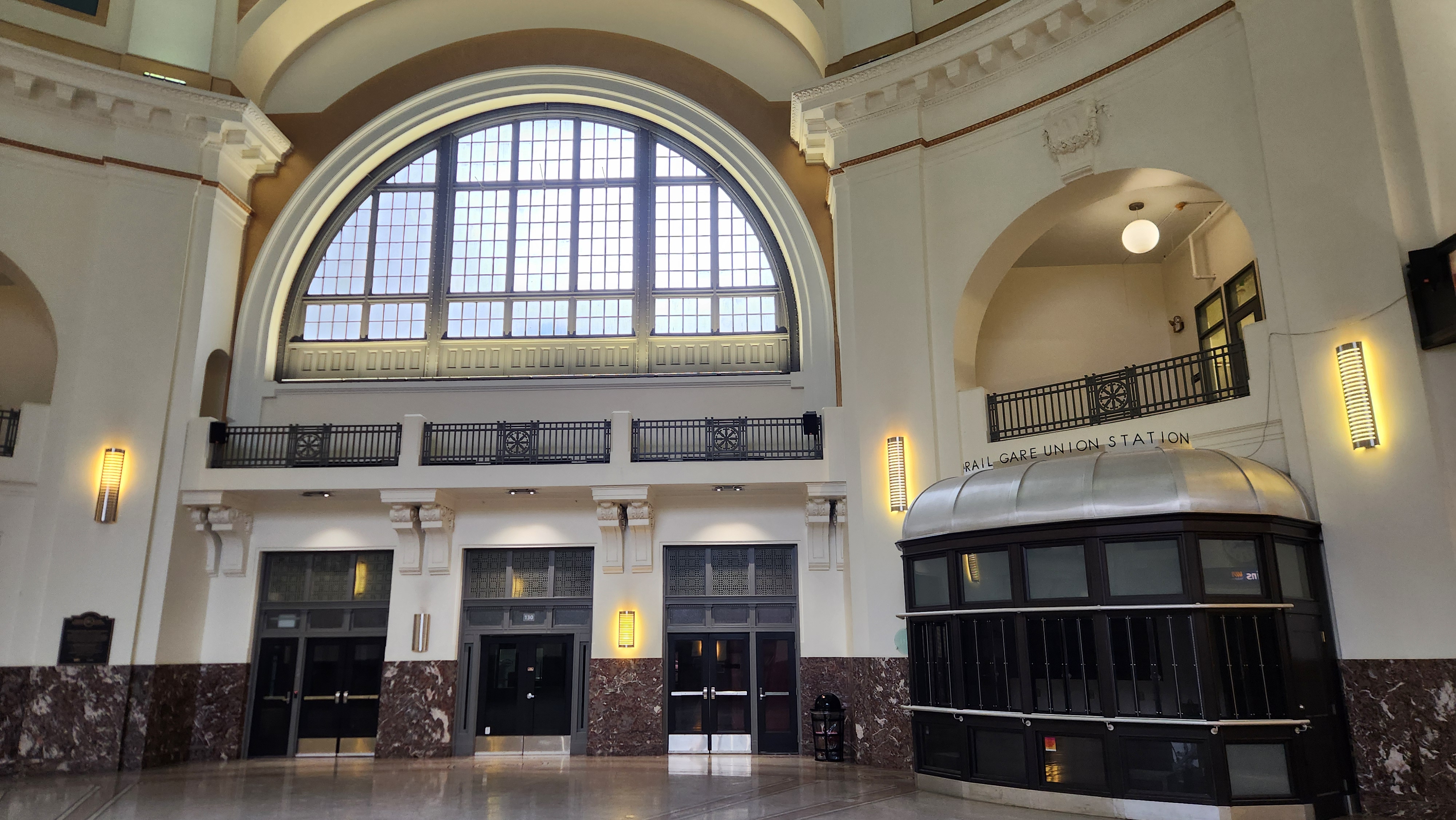
Wow, that was confusing! Sorry I couldn’t condense all that to a more cogent description, but the point of it all was to explain how Winnipeg’s history has resulted in a fascinating collection of various ethnic groups and interesting historical sites. In the two days we spent exploring Winnipeg by foot, we visited The Forks Historic Harbor, The Forks National Historic Site, the French Quarter, the Upper Fort Garry National Historic Site, the Forks Market, the CN Stage and Field, and the Winnipeg Railroad Station, all of which are shown in the photos below.
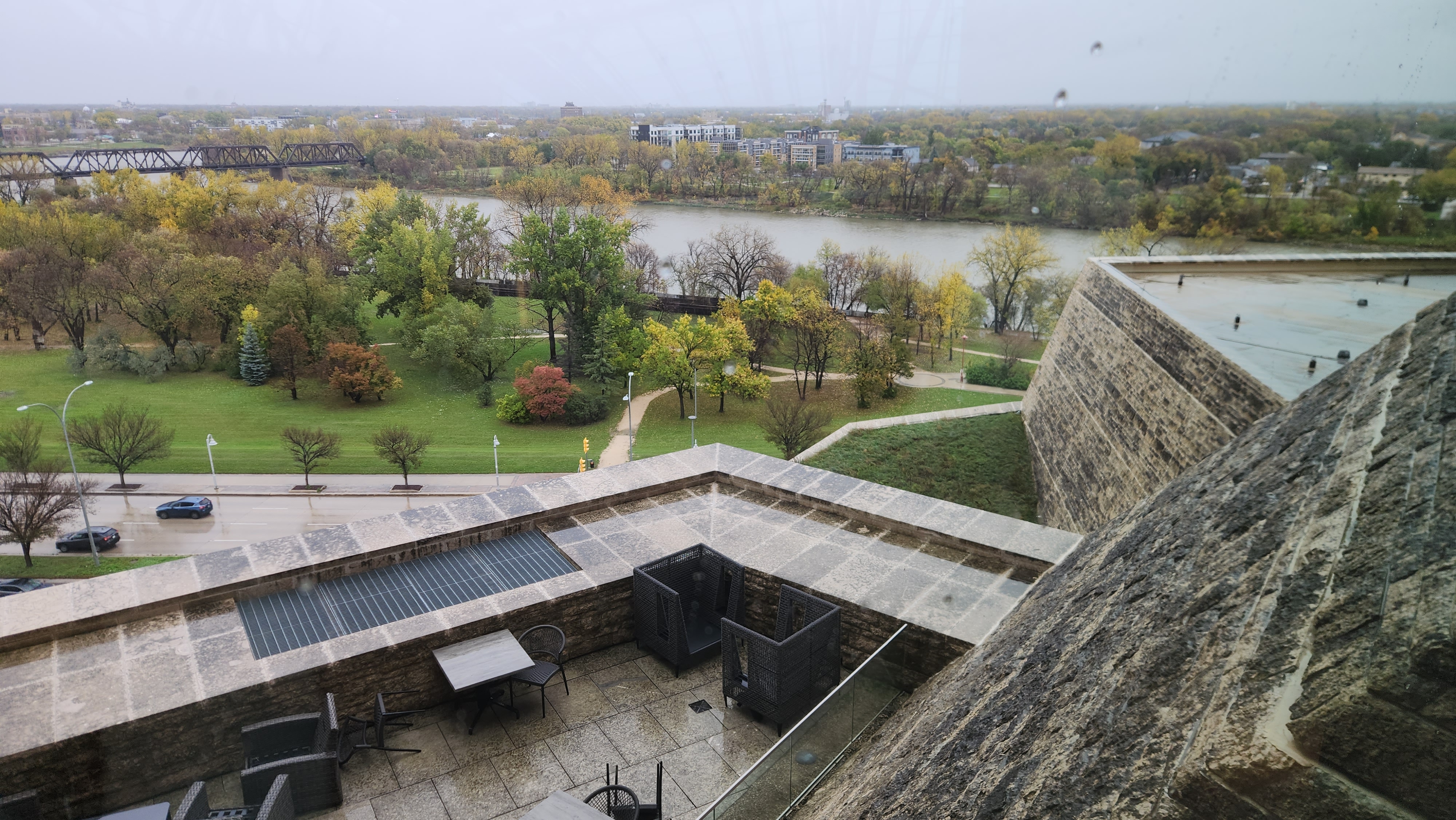
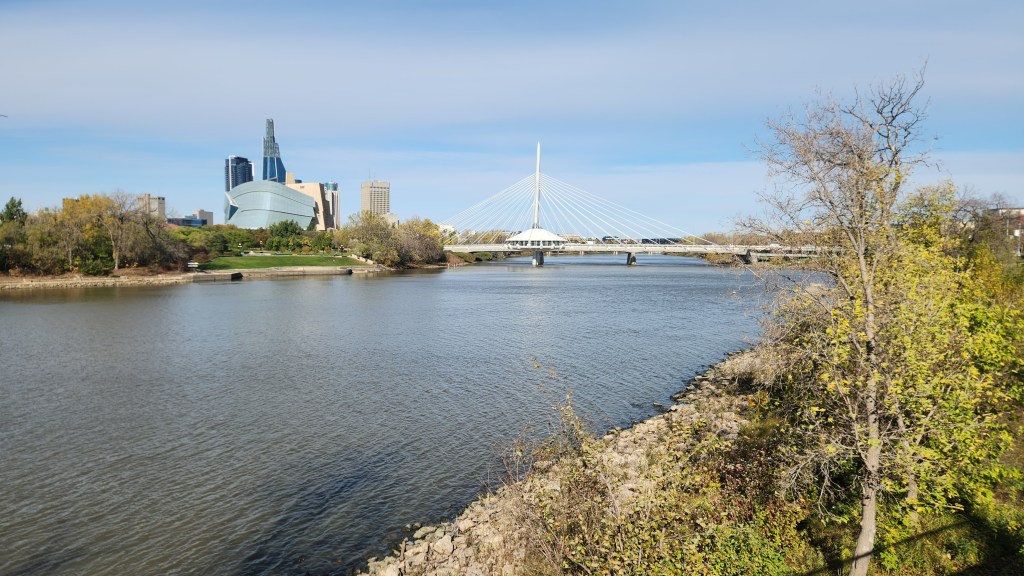
The Fork: Red River on Left and Assiniboine River on Right
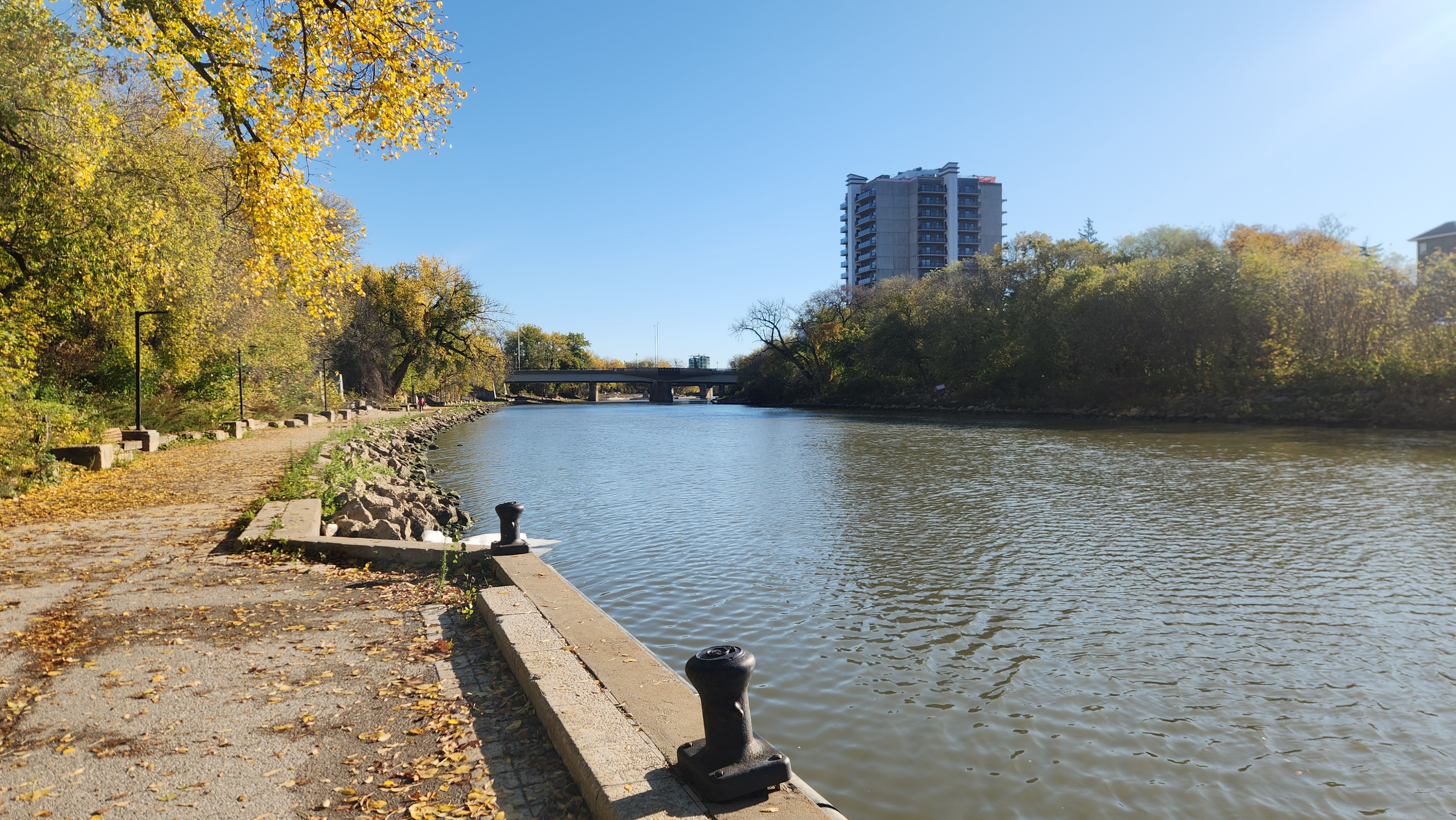
The Forks Historic Harbor
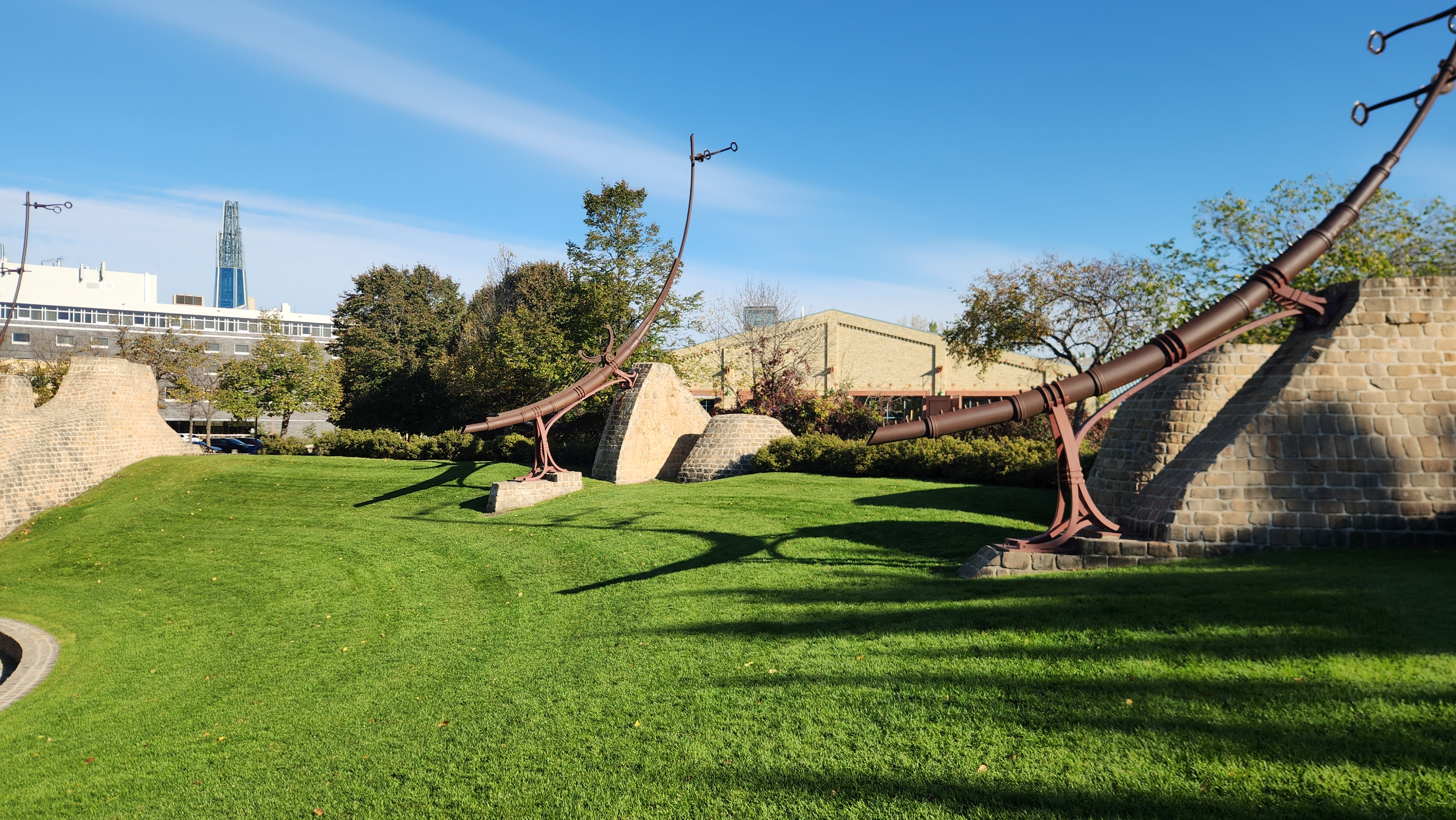
The Forks National Historic Site
The Forks Market
CN Stage and Field
Upper Fort Garry Gate
An Old Map at the Upper Fort Garry National Historic Site
Railroad Station

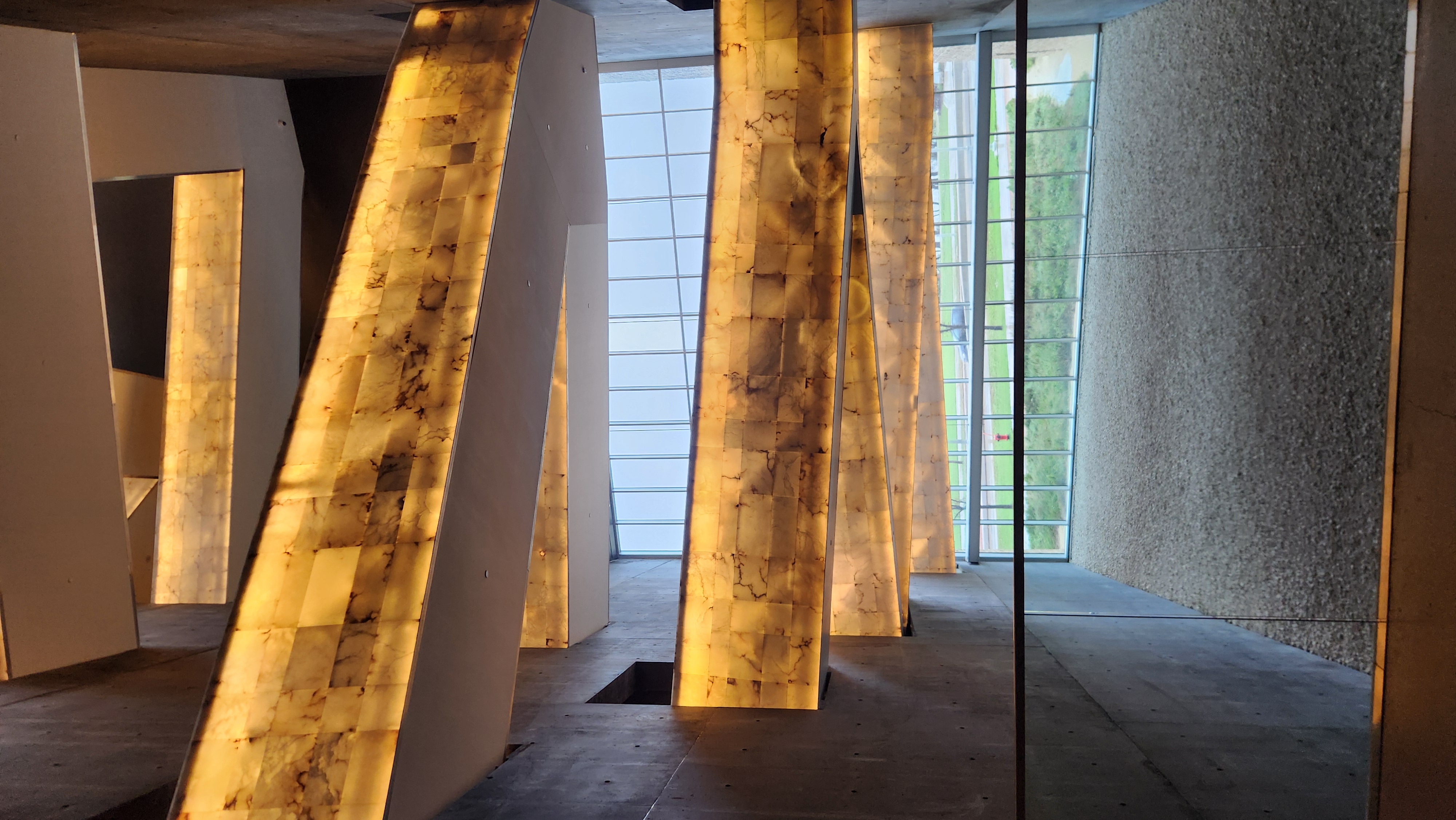
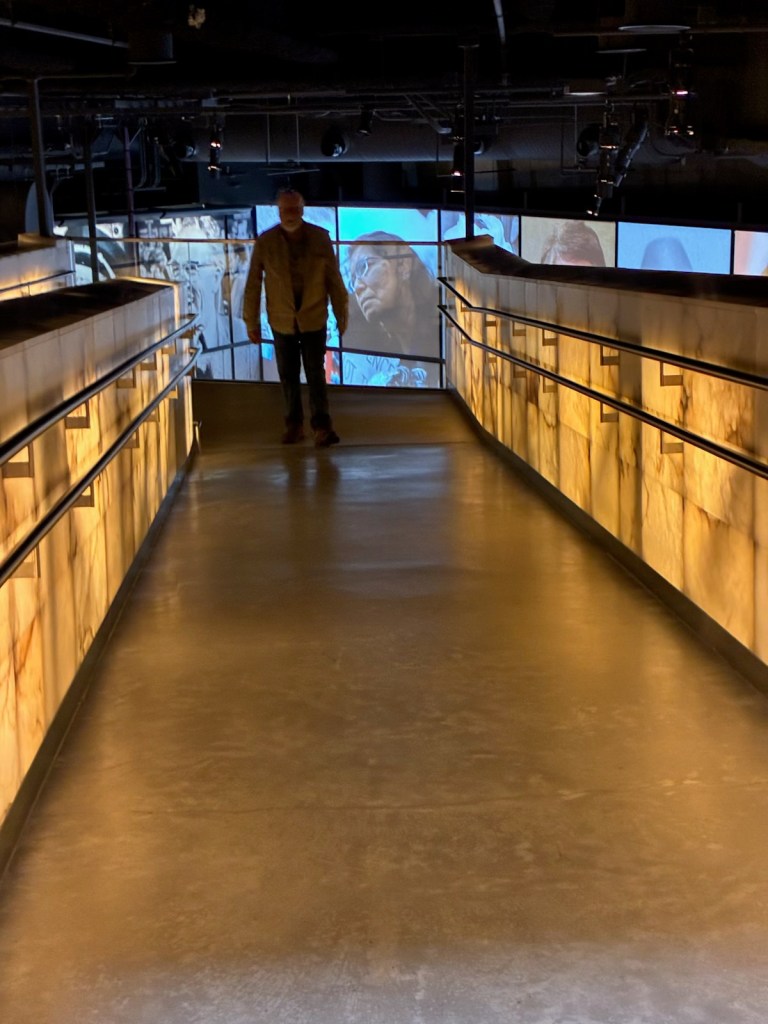
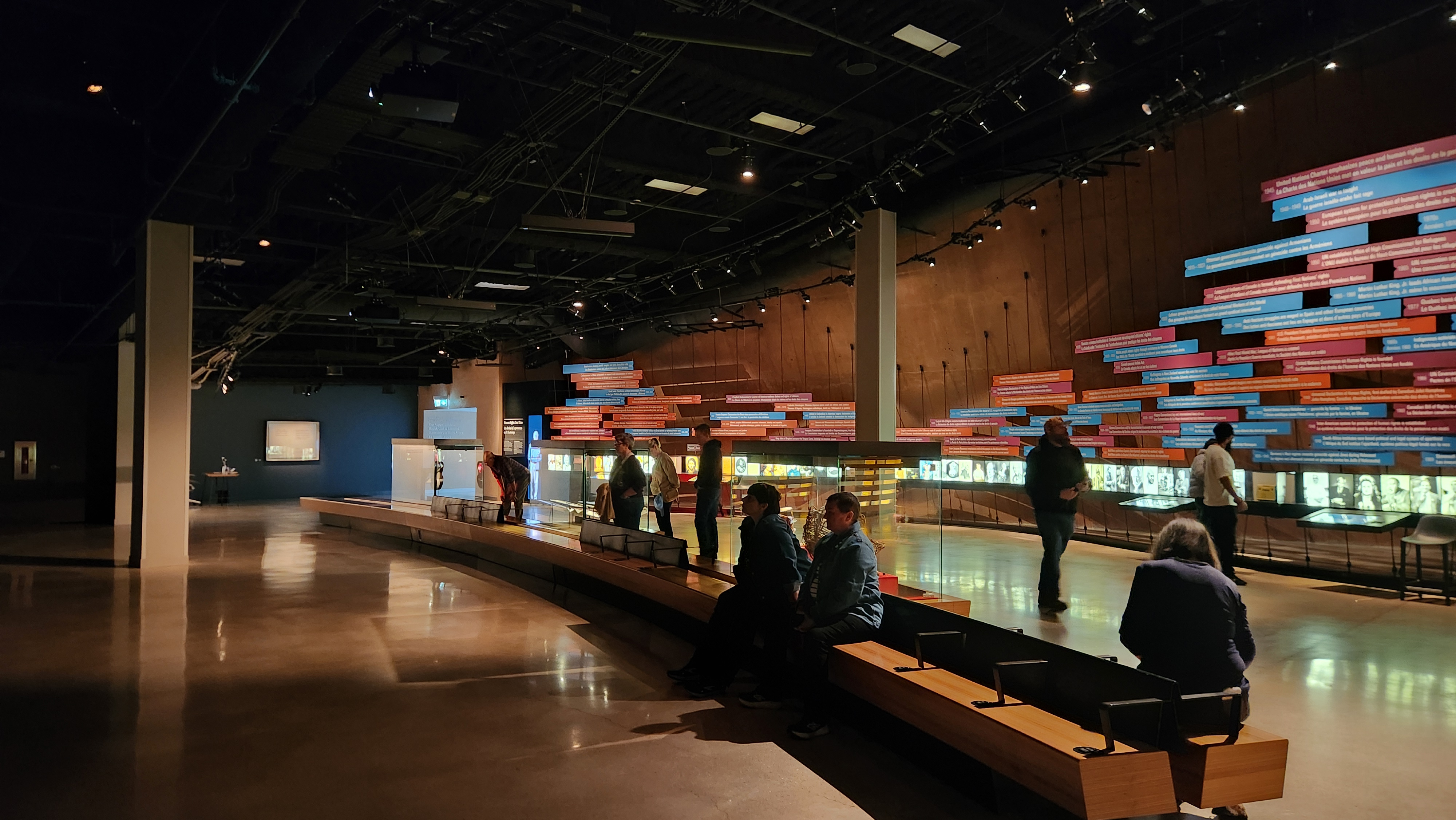
I’ve saved one more Winnipeg site for last – the Canadian Museum for Human Rights. We spent about five hours touring the museum (including lunch at the cafeteria), and if we had stayed another day in Winnipeg we would have gone back again. The building is architecturally stunning, both inside and out, spanning seven floors with multiple display rooms of various shapes and sizes. The floors are linked by angled walkways in a central column. The walkways have translucent alabaster walls. One of the docents told me the idea was that you emerge from the darkness into the light. At the time, I took that to mean from the metaphorical darkness of human wrongs into the light of understanding. The displays documented some of the worst episodes in history – such as the Holocaust and antisemitism in Canada and elsewhere, the forced internment of Japanese Canadian citizens during World War II, discrimination against indigenous Canadians – while highlighting the important steps that have been taken to advance human rights throughout history.

Canadian Museum for Human Rights and Peace Park — View from Across Red River
Walkways in the Museum
Passing from Darkness into Light
Main Floor Gallery with Human Rights Timeline
View from Seventh Floor of Museum

The museum’s Visitor Guide includes this statement:

“This national museum invites you to reflect on human rights in Canada and around the world. It’s a place for people to explore the idea that respect and understanding of human rights can serve as a positive force for change in the world.”

And we certainly did reflect, for a long time after we left the site. I was reminded of the famous quotation paraphrased by Martin Luther King: “The arc of the moral universe is long, but it bends toward justice.” The museum showed that to be true, and in these times when so-called populists are doing their utmost to bend it back the other way, it gave me some hope to cling to.

On that note, that’s it for this blog installment. Thanks for reading, and stay tuned for our upcoming Viking Ocean Cruise, which I’ll hopefully post by the end of November.

The Saaris’ Summer Sanctuary – PART 1

Readers of this travel blog series may recall that it was born back in 2018 when, at the urging of family members, I began documenting a 10,200-mile RV trip. Since then, I’ve documented a total of thirteen domestic and international trips. Next up will be our fourth trip with Viking Cruise Lines, this time starting at Lake Como, Italy, and ending in Athens, Greece. As I was looking over the list recently, it dawned on me that I have neglected a major aspect of our travel experiences. We are most fortunate to be able to spend most of our summers at our cabin on Minnesota’s beautiful North Shore of Lake Superior, and we regularly visit various points of interest along and near the magnificent lake. So, purely in the interest of furthering readers’ knowledge of excellent travel destinations, I decided to write a travel blog installment describing some of the places we visited during the summer and early fall of 2025. Which I will now proceed to do …

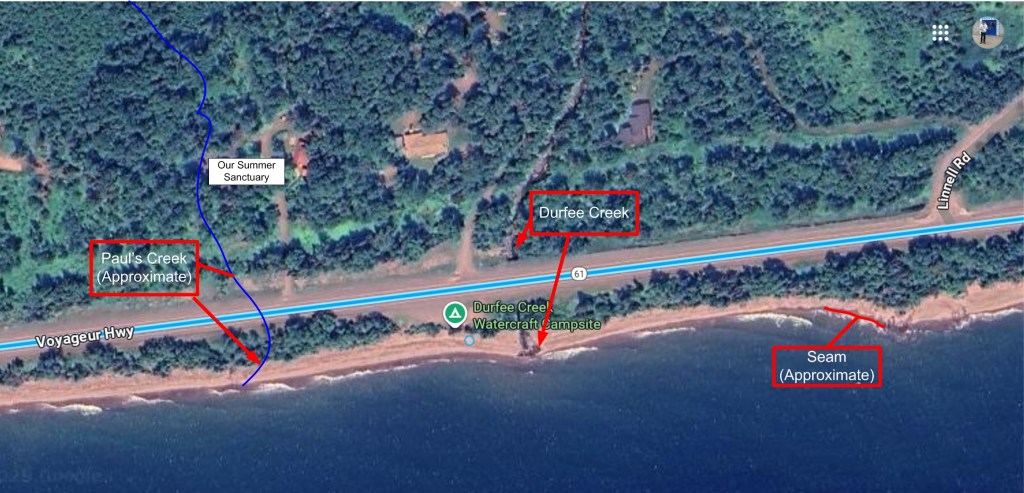
Sites Near the Cabin: Our peaceful cabin (which I’ve now dubbed The Saaris’ Summer Sanctuary) is located on Minnesota Highway 61, also known as the Voyageur Highway, some 5.6 miles east of the harbor in Grand Marais, MN. I’ll describe three nearby features that we frequently visit by strolling down a path from the cabin and crossing the highway. Readers interested in checking out these features can travel by car or kayak to a public access point denoted on the satellite image below as the Durfee Creek Watercraft Campsite. (I may seem friendly on these blog posts, but I will not be charitable to anyone dropping in at the cabin for an unannounced look-see.)

Features Near our Summer Sanctuary

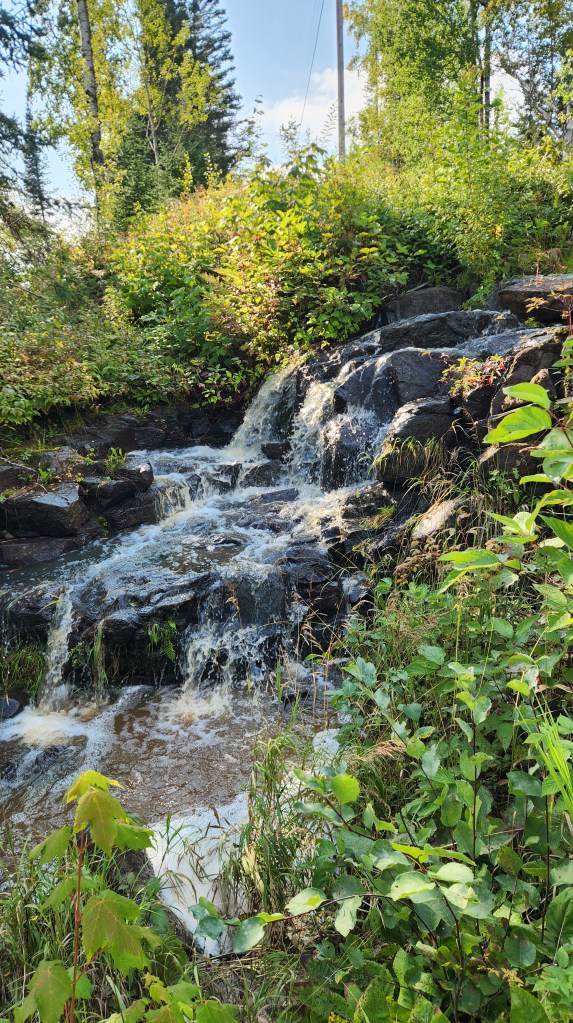
On the satellite image, I’ve hand sketched a line labeled Paul’s Creek. You won’t find such a creek on any map, although Google Maps indicates a nonexistent, unnamed creek that supposedly flows into Lake Superior somewhat to the east of the actual, unnamed creek. I gave it the unofficial name of Paul’s Creek in honor of my late father, who enjoyed constructing makeshift footbridges across the creek bed. For most of the year, this little stream is barely a trickle, but after a significant rainfall it can look quite impressive. Here are some photos of the waterfall on the north side of Highway 61 and its subsequent discharge point into Lake Superior.

Paul’s Creek on June 21, 2025
Paul’s Creek Waterfall on September 13, 2025
Paul’s Creek Discharge on September 13, 2025
Paul’s Creek Discharge on September 16, 2025

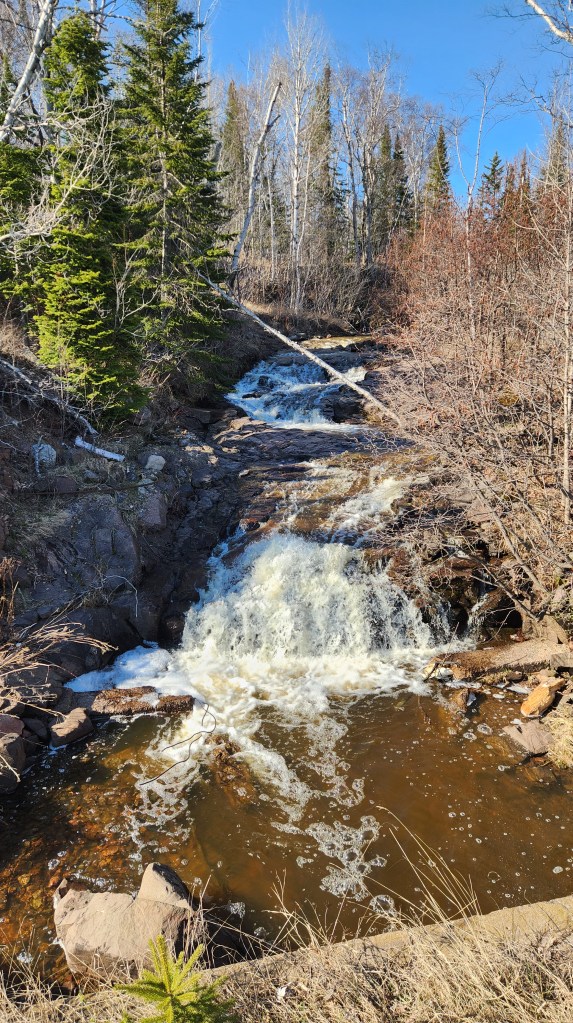
A few hundred yards to the east there is a much larger stream known as Durfee Creek, which flows steadily year-round but also becomes engorged after a rainfall. The most interesting aspect of Durfee Creek is its discharge into Lake Superior, which can change dramatically from day to day depending on the volume of water flow in the creek as well as a particular day’s wave action on the Lake.

Durfee Creek Waterfall on May 10, 2025
Durfee Creek Discharge on May 7, 2025

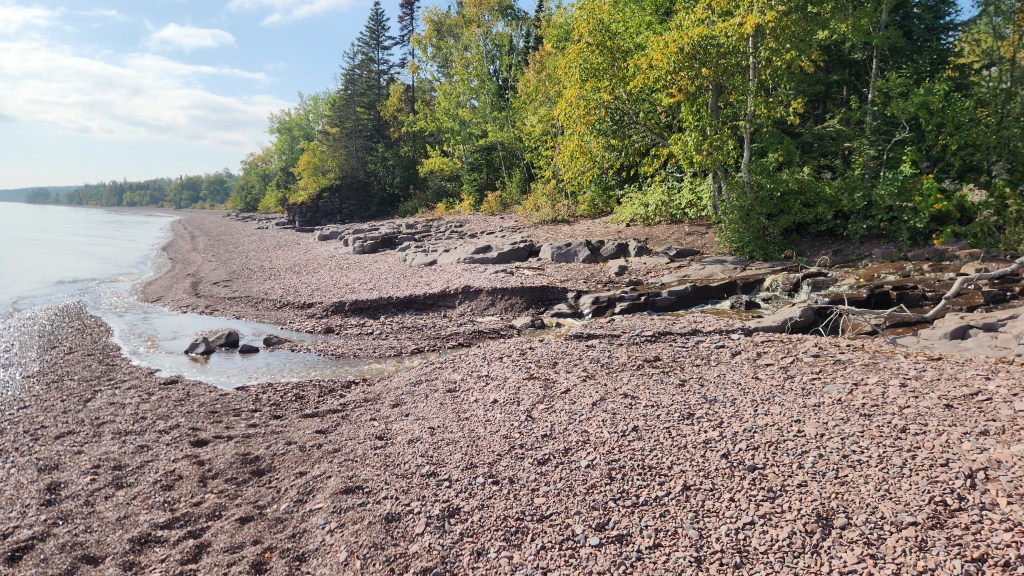
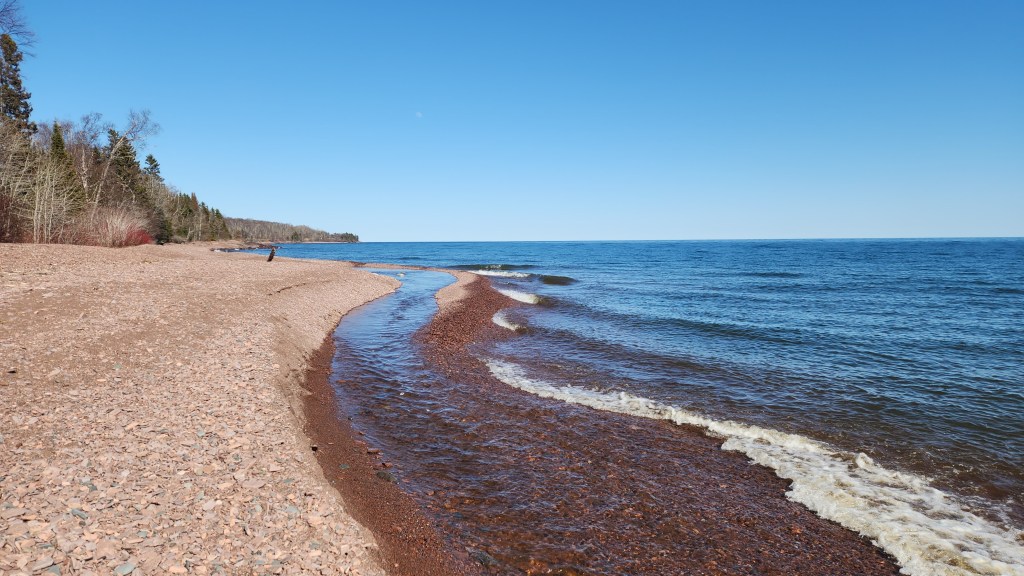
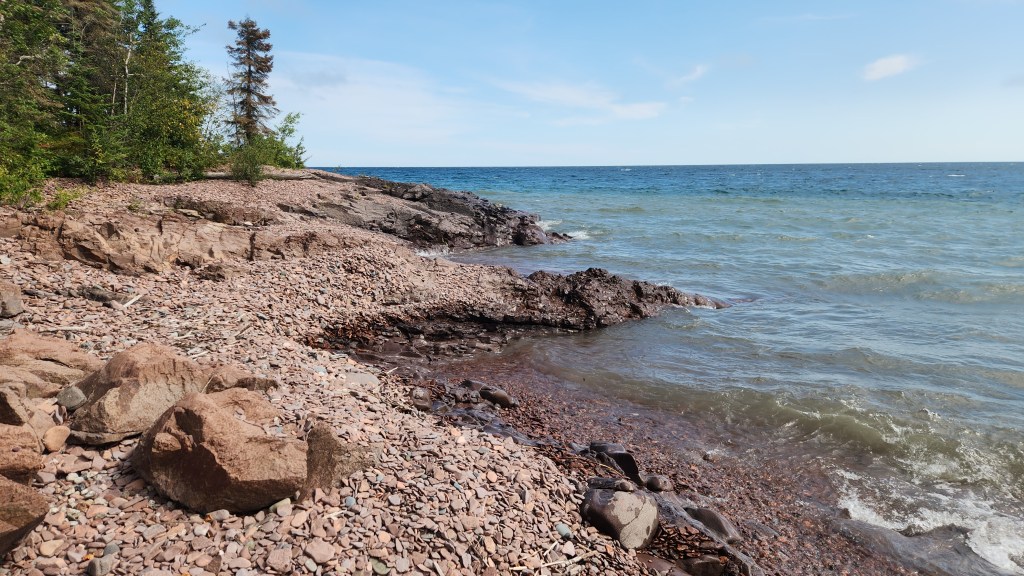
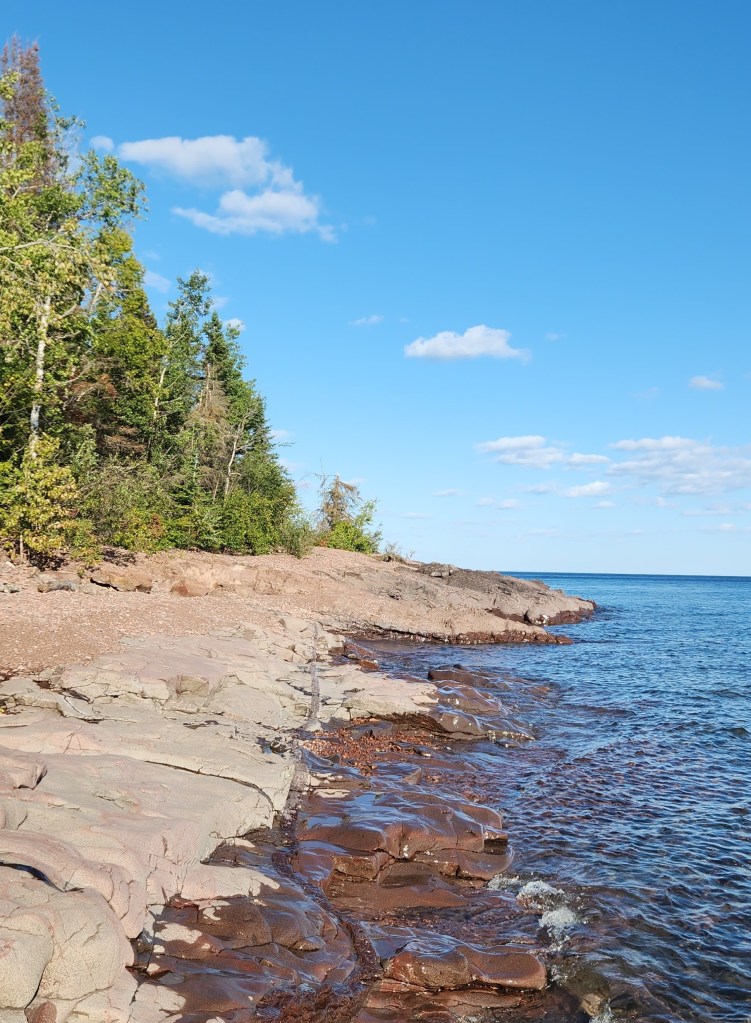
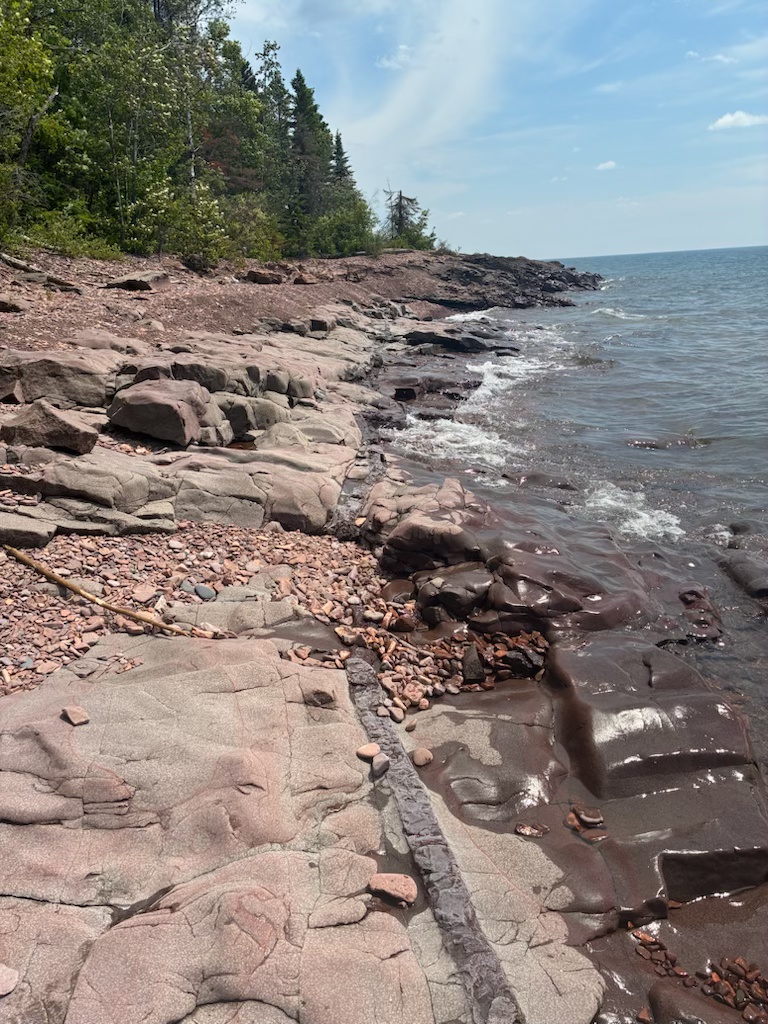
I’ve sketched in another interesting feature to the east of Durfee Creek, which I call “The Seam.” Along this stretch of Lake Superior, the billion-year-old bedrock which forms the shoreline is generally covered over with stones, most of which are flat and really fun to skip along the surface of the Lake on calm days. Here’s a photo looking eastward showing a typical configuration of these stones. However, the wave action routinely spreads the rocks around in many different ways, so that the shoreline can look completely different from one day to the next.

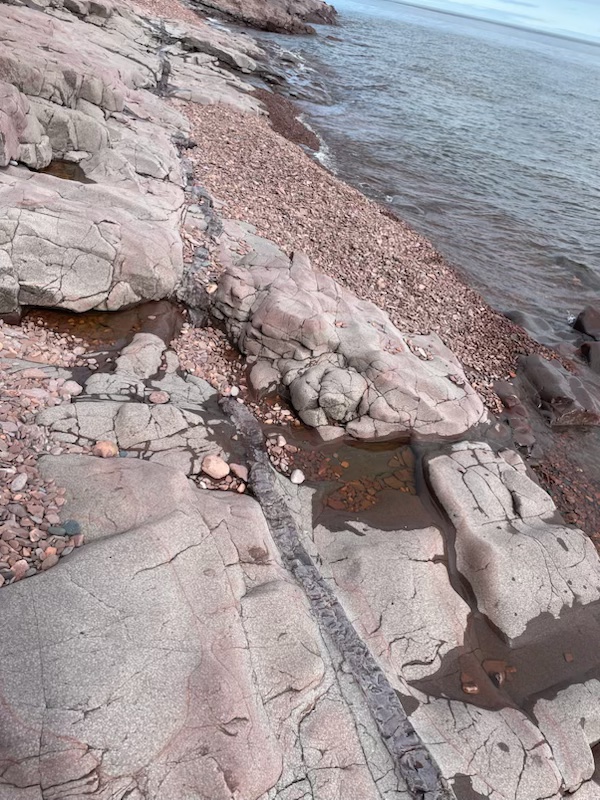
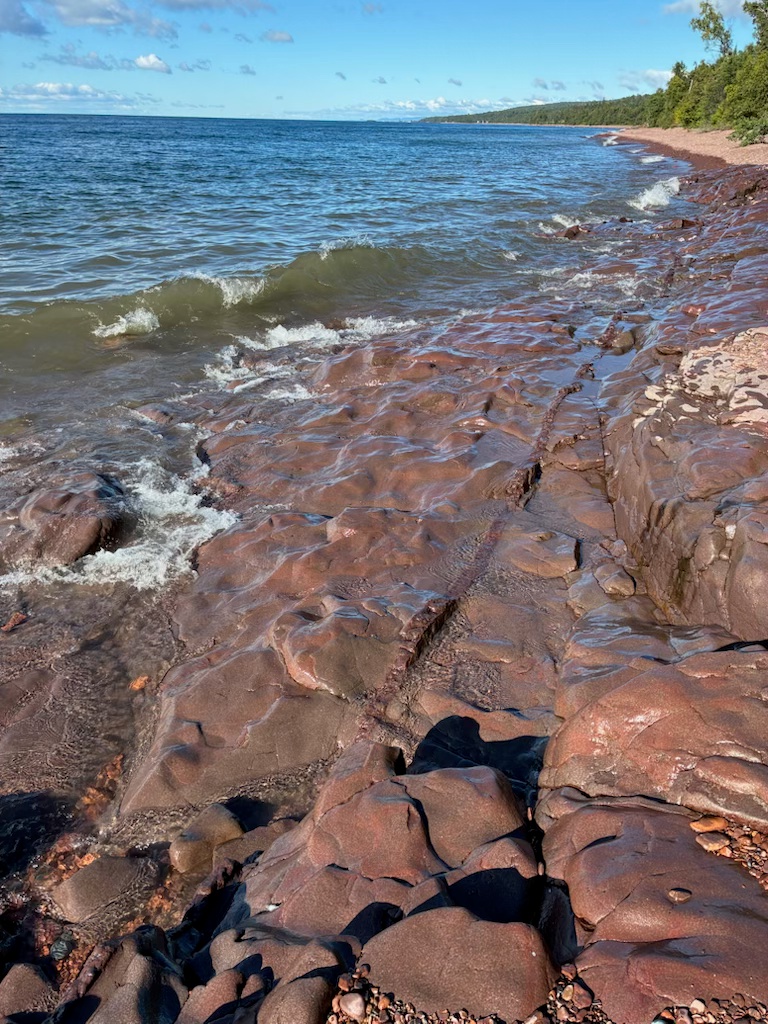
Sometimes, the waves remove most or all of the covering stones to reveal the bedrock. When that happens, you can see The Seam. I’m not a geologist, but to me it looks like a place where the rock cracked open in ancient times, and lava flowed from below to fill in the gap. I absolutely love the days when The Seam reveals itself for my enjoyment.

Stones Covering Bedrock on August 29, 2024
Bedrock and Seam Exposed, August 25, 2025
The Seam on May 23, 2025
The Seam on July 2, 2025
The Seam on August 23, 2025

These three features of the ever-changing Lake Superior shoreline near our Summer Sanctuary have thrilled me for nearly fifty years and never fail to make the summer months especially rewarding.

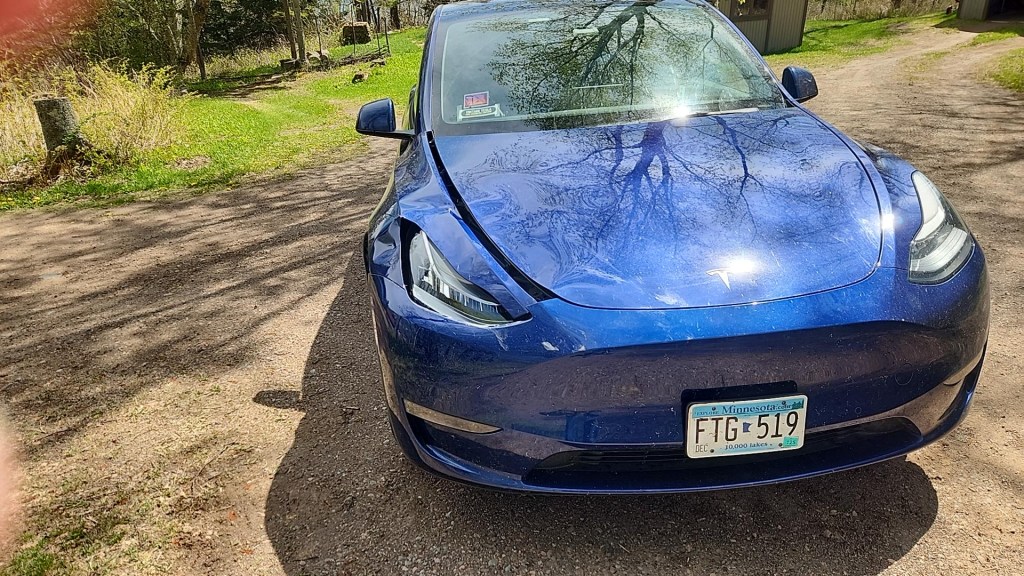
A Lapse in Attentiveness: Unfortunately, there was one aspect of the summer that was not a positive. For the first time in nearly sixty years of driving back and forth on Highway 61, I hit a deer. It was all my own fault. It was a sunny afternoon in May and I was returning from a trip to Duluth with son Brian. As we neared Two Harbors, he began yelling “Whoa! Whoa!” Not expecting to see deer at that time of day, I had failed to notice four of the critters ambling across the highway. I slammed on the brakes and almost managed to stop in time, but I caught the lead deer’s hindquarters with the right front bumper of the car. I imagined him laughing at me as he loped off into the woods.

Damaged by Deer, but Still Drivable

While the damage appeared minimal, it still required a trip to the Tesla Repair Center in Eden Prairie. I dropped it off there on May 29 and had to leave it there until June 12, leaving us with only one car for a couple of weeks. As a big promoter of electric vehicles, I have to admit that the paucity of repair facilities is one downside of Tesla ownership. (I guess that’s an example of what Brian calls a first world problem.)

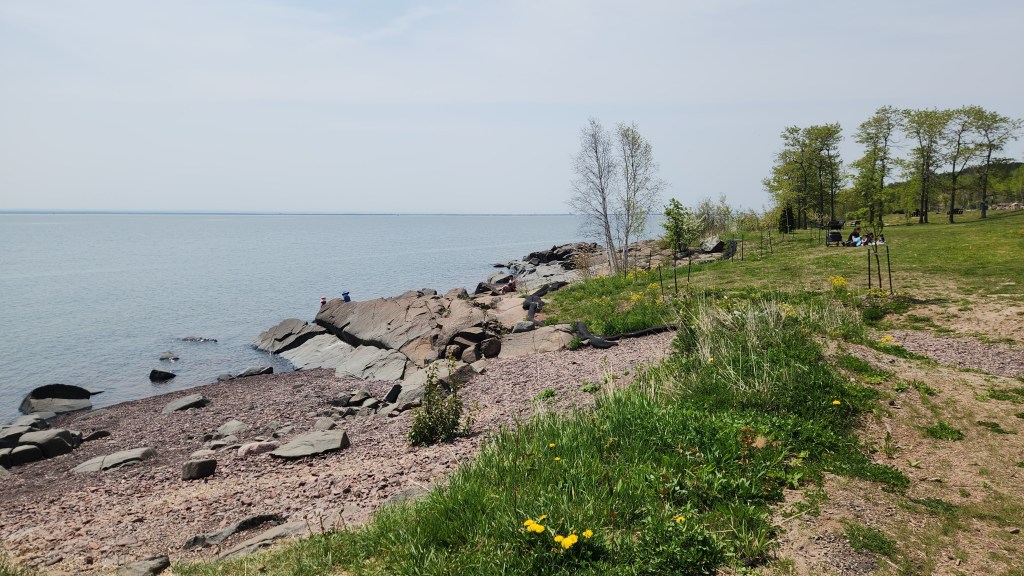
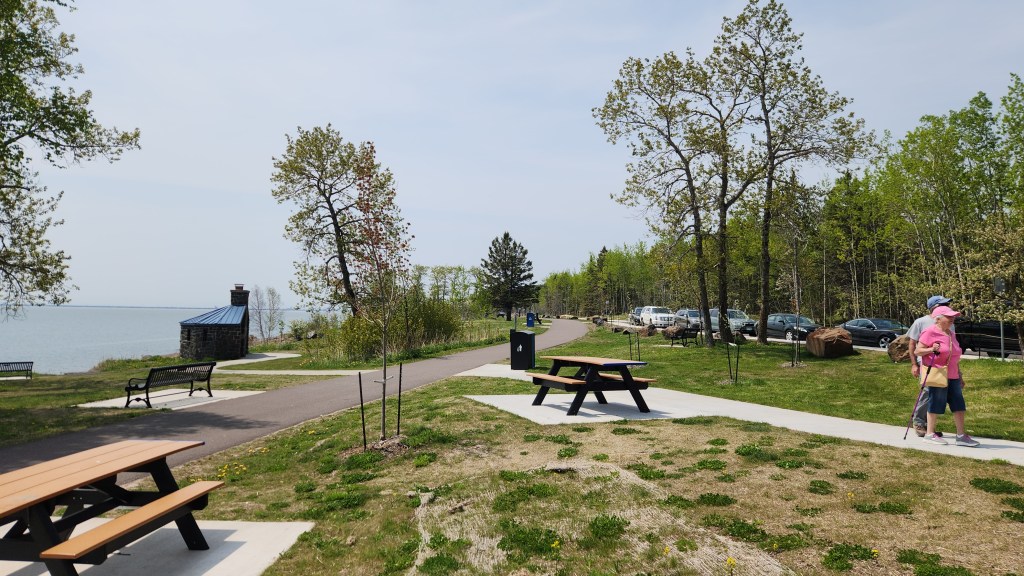
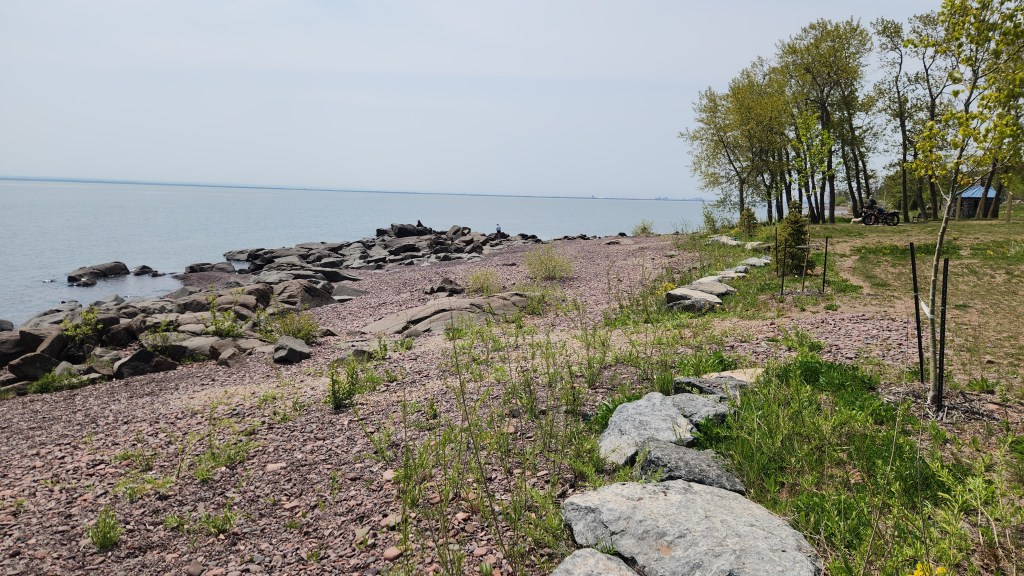
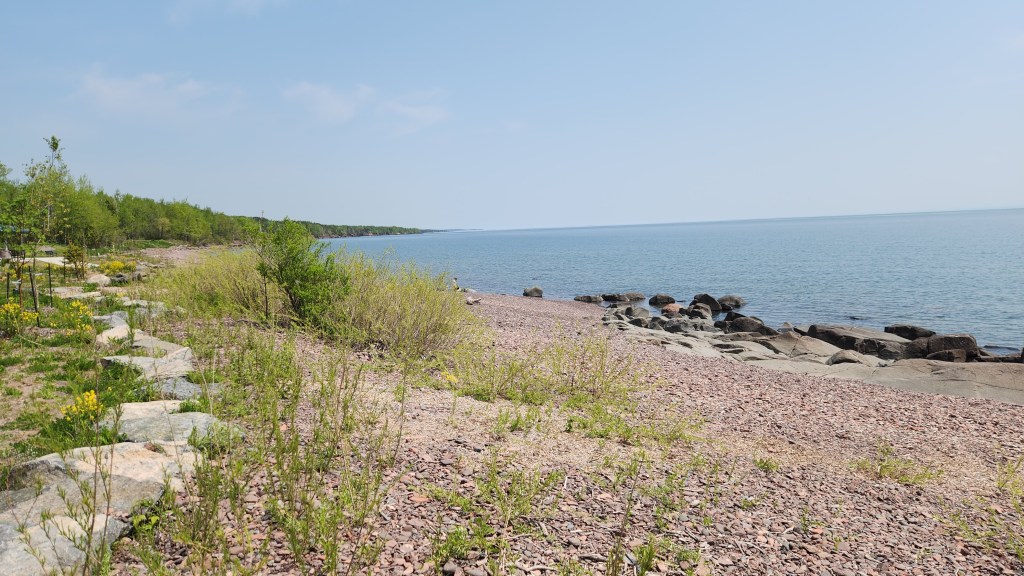
Kitchi Gammi Park: Pat and I stopped at this nice park on the east end of Duluth on our way back to the Summer Sanctuary on June 2, after dropping the damaged car at the repair shop. The park was recently renovated, improving the access drive and adding rest rooms, picnic tables, and children’s play areas. Here are a few photos.

Kitchi Gammi Park
Kitchi Gammi Park
Kitchi Gammi Park
Kitchi Gammi Park

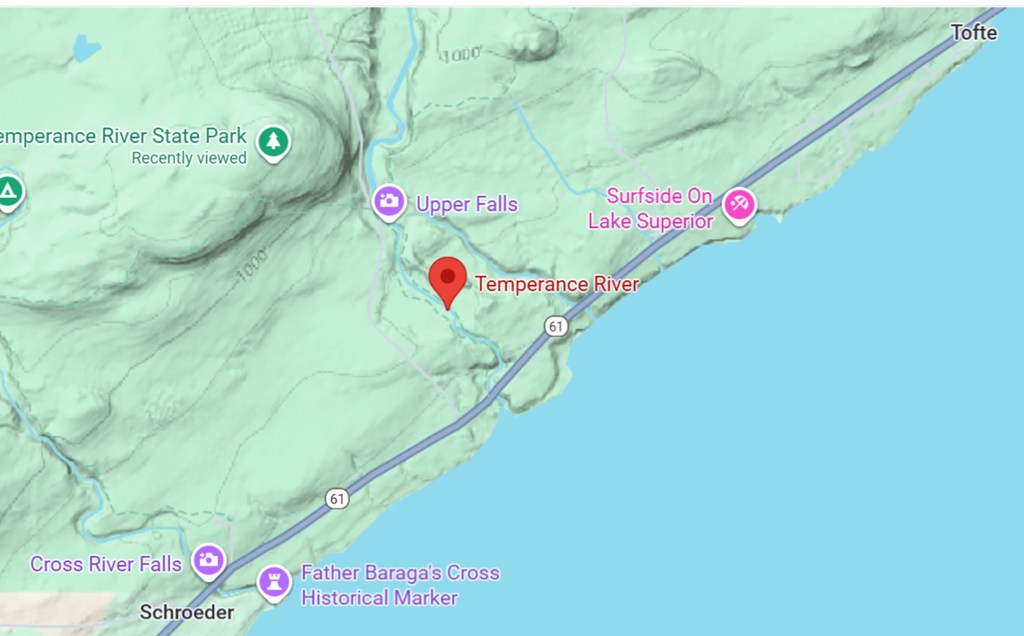
Temperance River: Temperance River State Park, located along Highway 61 between Schroeder and Tofte, is one of eight state parks along the North Shore.

The river owes its name to the fact that it is the only river on Minnesota’s North Shore that has no bar at its mouth. We stopped there on June 2 and spent an hour or so on the hiking trails both upstream and downstream of the highway. The upstream part of the river canyon is extremely rugged, with multiple potholes initially gouged out of the bedrock some 10,000 years ago by powerful torrents of glacial meltwater.

Temperance River Upstream of Highway 61
Pothole in Temperance River

The downstream portion becomes more serene as rapids give way to the gentle river mouth, with no bar as promised by the river’s name.

Temperance River Downstream of Highway 61
Hiking Path Near Mouth of Temperance River
Temperate Mouth of the Temperance River

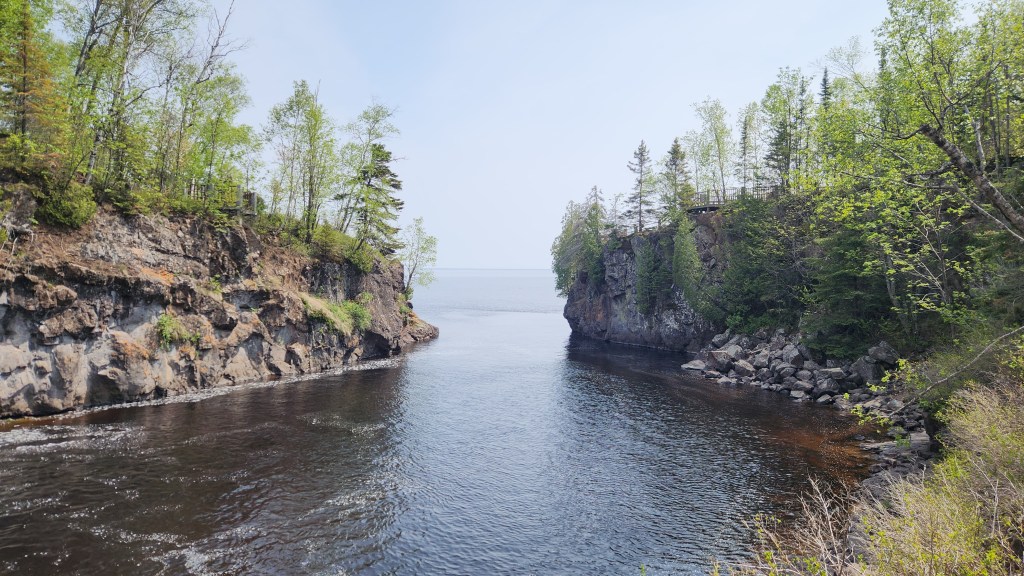
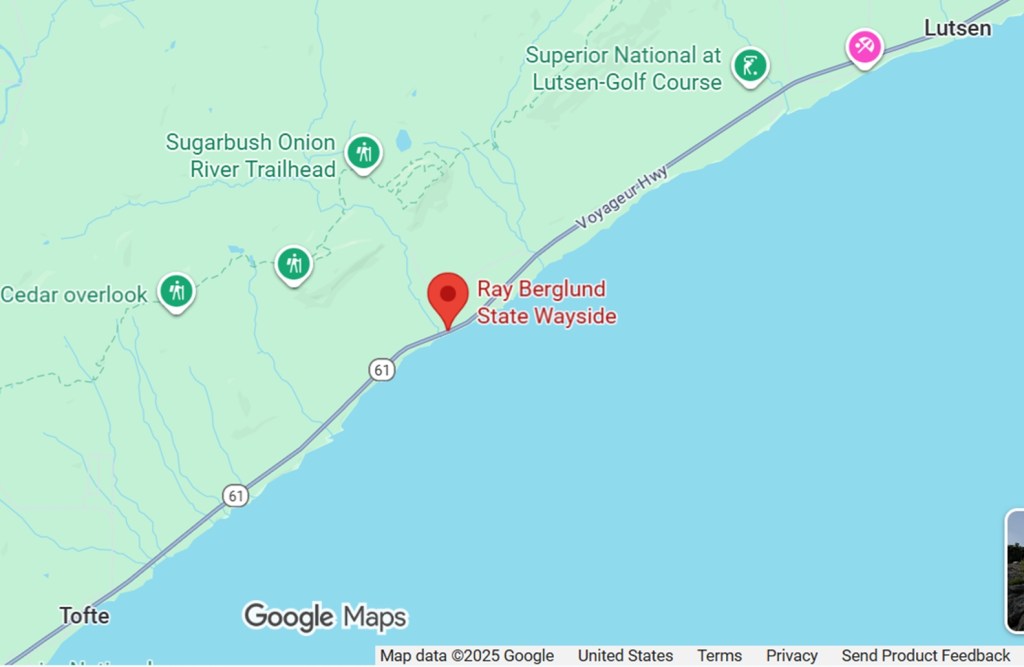
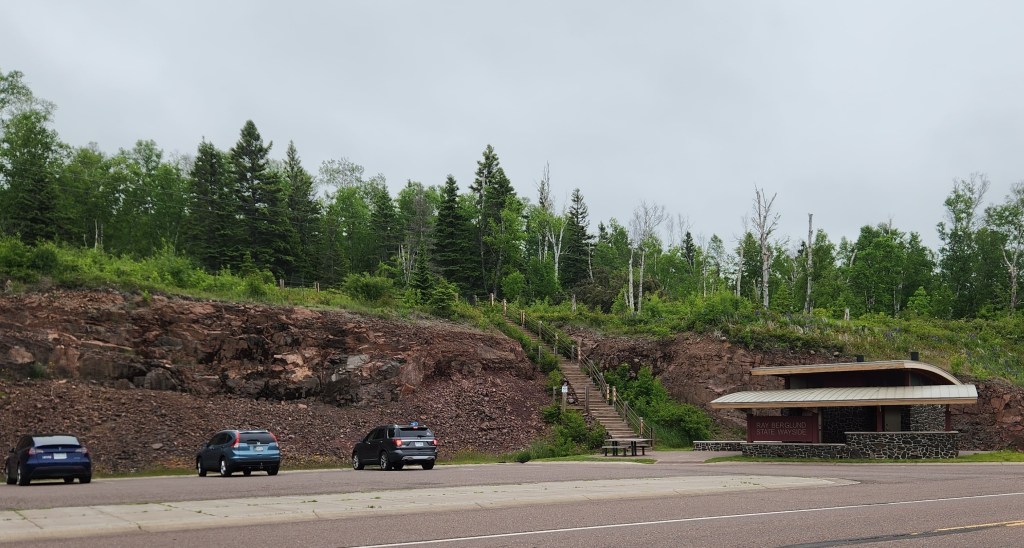
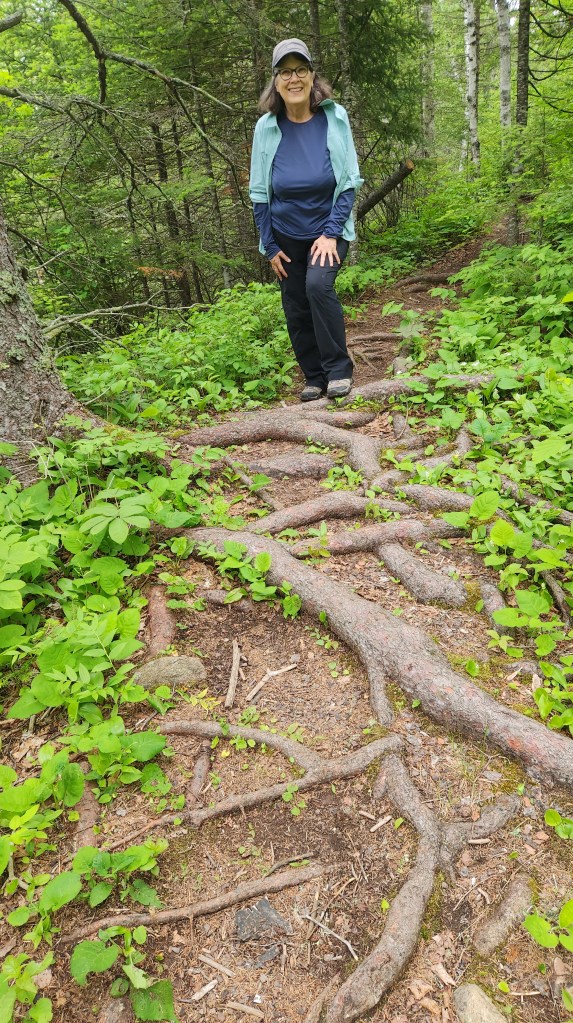
Onion River: The Onion River Trailhead starts at the Ray Berglund State Wayside, located along Highway 61 between Tofte and Lutsen. We drove there from the Summer Sanctuary on June 22 and walked alongside the Onion River for about three quarters of a mile to a bridge where the Gitchi-Gami State Snowmobile Trail crosses the river. The walk through the forest is peaceful and scenic, with limited views of river, until reaching the Onion River Falls, which were flowing very nicely on the day of our visit.

Ray Berglund State Wayside
Roots on the Onion River Trail
View from Onion River Trail
Onion River Waterfall
Onion River Seen from State Trail Bridge

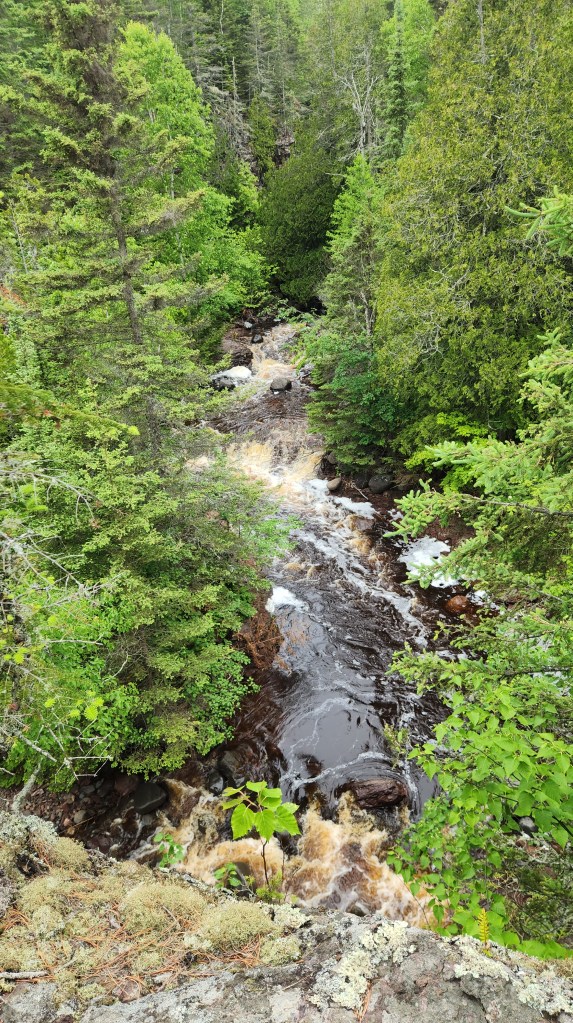
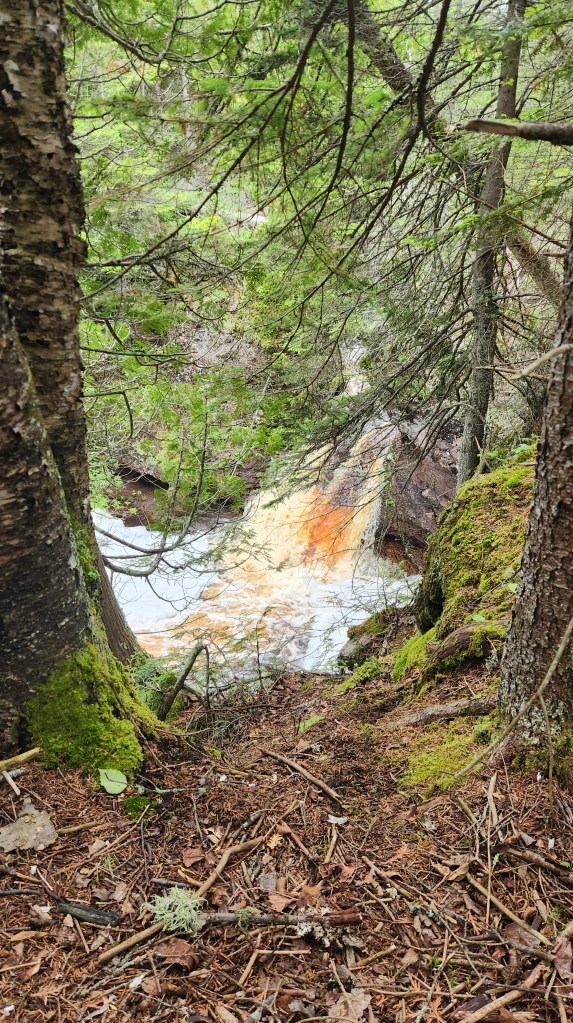
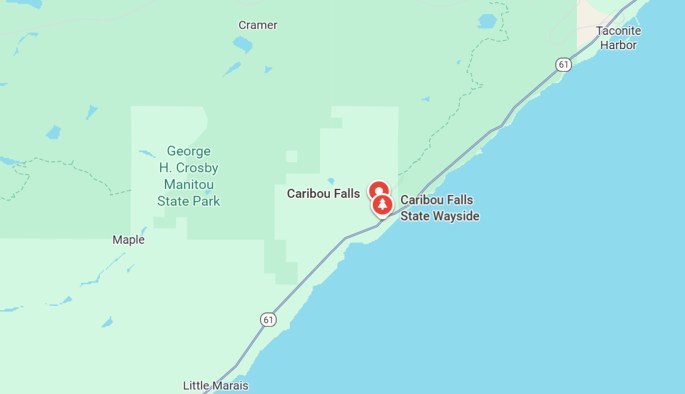
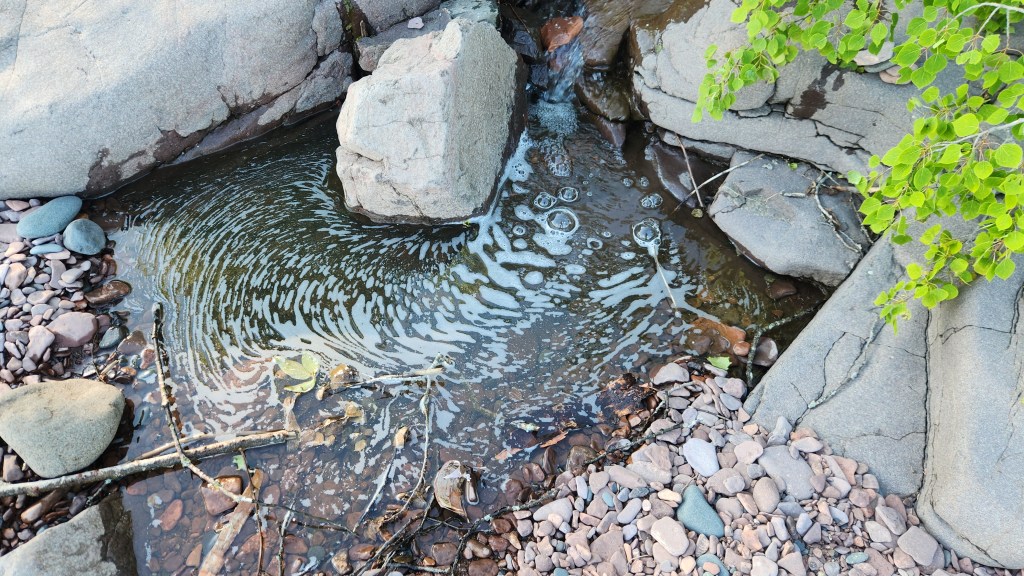
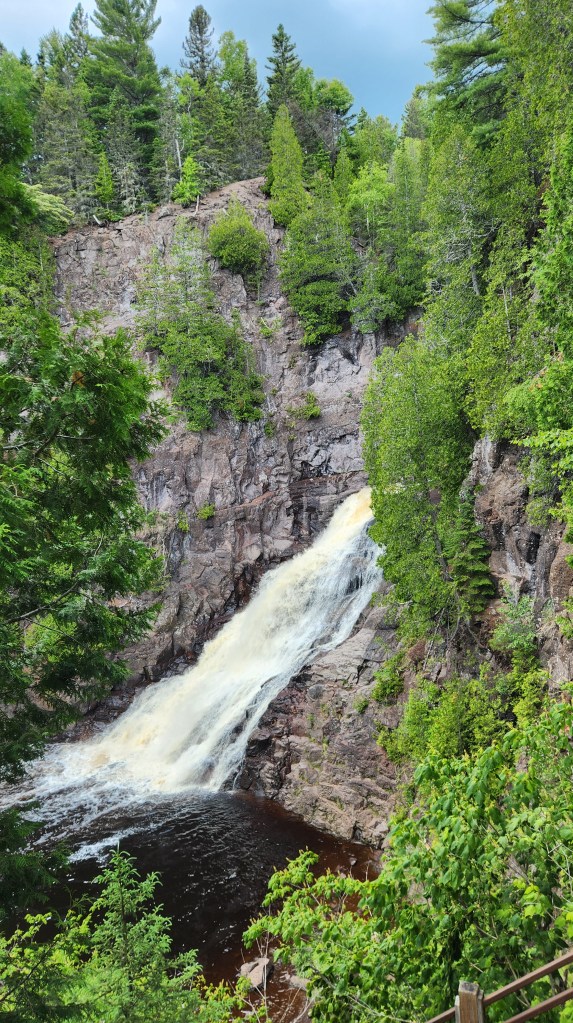
Caribou Falls: This is another nice place to stop when driving to or from the Summer Sanctuary, located between Little Marais and Taconite Harbor along Highway 61. The State Wayside has a nicely paved parking lot and a rest room (handy for those days when too much Dr. Pepper is causing a bloated bladder). A trail heads north from the parking lot to the Caribou Falls. Here are some photos from June 30, when Pat and I stopped for the 1.3-mile hike and were rewarded with a spectacular view of the falls from an excellent access stairway.

Caribou Falls Trail
A Gentle Pool in the Caribou River
The Caribou Falls
The Caribou Falls

OK, that’s it for Part 1. Thanks for reading, and stay tuned for Part 2, in which I’ll cover several more highlights from the summer season.

Pat and Dave’s Winter Warmup – PART 1: Overview and Starting Out

While we truly love our homes in the great state of Minnesota, a condominium in Minneapolis and a cabin in Grand Marais, we love them a lot less during the winter than the other three seasons. By the time February rolls around, we’re usually tired of the snow and ice and cold weather, so we start looking for a getaway to someplace a bit more hospitable to human habitation. This year, we hit on the idea of trying an extended stay in one place as well as a bit of a road trip. In fact, the extended stay idea was implanted in our brains by some friendly upstairs condo neighbors who have taken to spending time every February and March at a resort in Green Valley, AZ. This implantation occurred in April of last year as they regaled us with tales of the lovely accommodations and the many fun things to do in the area. They explained that a long-term stay (more than 30 days) qualifies a guest for a reduced rate, as the short-term hospitality taxes and fees are waived. Pat was sold on the idea rather quickly, and suggested that I take charge of getting us a reservation for February and March of 2025.

“So, what’s this place called?” I asked. “The Canoa Ranch Golf Resort,” our neighbors replied, and provided me with the contact information I’d need to make said reservation. Upon hearing the word “Golf,” I immediately agreed to take charge. “I’ll get right on it, dear,” I told Pat.

Fast forward to September 20. I was at the cabin in Grand Marais while Pat was back at the condo, and I suddenly realized that I had not yet “gotten right on it,” having forgotten to call for the promised reservation. After a bit of telephone tag, I finally managed to complete my assigned task, although due to my procrastination no rooms were available until February 21. Better late than never, I told myself, while trying to craft the proper words to gently break the news to Pat.

Luckily, we had a great fall travel season, as documented in my earlier blog posts, Pat and Dave’s Nifty National Park Lark and Pat and Dave’s Intrepid Iberian Interlude, which helped us to forgive my less-than-stellar performance in securing the Canoa Ranch Resort reservation.

First off, here’s a map of our overall journey, to set the stage for this narrative:

We had planned to depart on February 18 and spend four days driving to Green Valley, but a big snowstorm hit the Midwest, causing us to delay our departure and shorten our travel time to three days. Fittingly, as we rolled out of the condo parking garage in our EV on Wednesday, February 19, it was a bone-chilling negative 4 degrees Fahrenheit.

It felt good to be heading to warmer climes, as the high temperature hadn’t reached positive figures for two solid days. However, as we drove south to our first overnight in Olathe, KS, in suburban Kansas City, it didn’t warm up at all. When we resumed our journey on Thursday morning, we had to scrape snow and ice off the car and the thermometer read negative nine. We passed a herd of about 100 cows standing in groups on both sides of the highway as we departed Olathe. “Are those cows even moving?” I asked Pat. “I don’t think so,” she said, studying the miserable-looking, immobile beasts. “Maybe they’re all frozen solid.”

It didn’t get much warmer until we passed through the Texas panhandle, and when we reached our second night’s hotel in Tucumcari, NM, it was still only about 20 degrees. During the second day of driving, it finally began to warm up, reaching into the 50’s by the time we reached Willcox, AZ, and finally into the 70’s as we rolled into the Canoa Ranch Golf Resort at 7:30 PM. I won’t say much about the drive to Green Valley, since all we did was drive, charge the EV, eat, and sleep, but I will offer this photo of the lovely sunset we encountered near Amarillo, TX, on Thursday evening.

Sunset Near Amarillo, TX

I’ll be writing two more installments for this adventure. Part 2 will cover the five weeks we spent in the Green Valley area, and Part 3 will describe the beautiful places we visited on our way back to Minneapolis. But first, I want to say a few words about our EV. (Those readers who are tired of my EV proselytizing can just skip the rest of this installment and come back for Part 2 in a few days.)

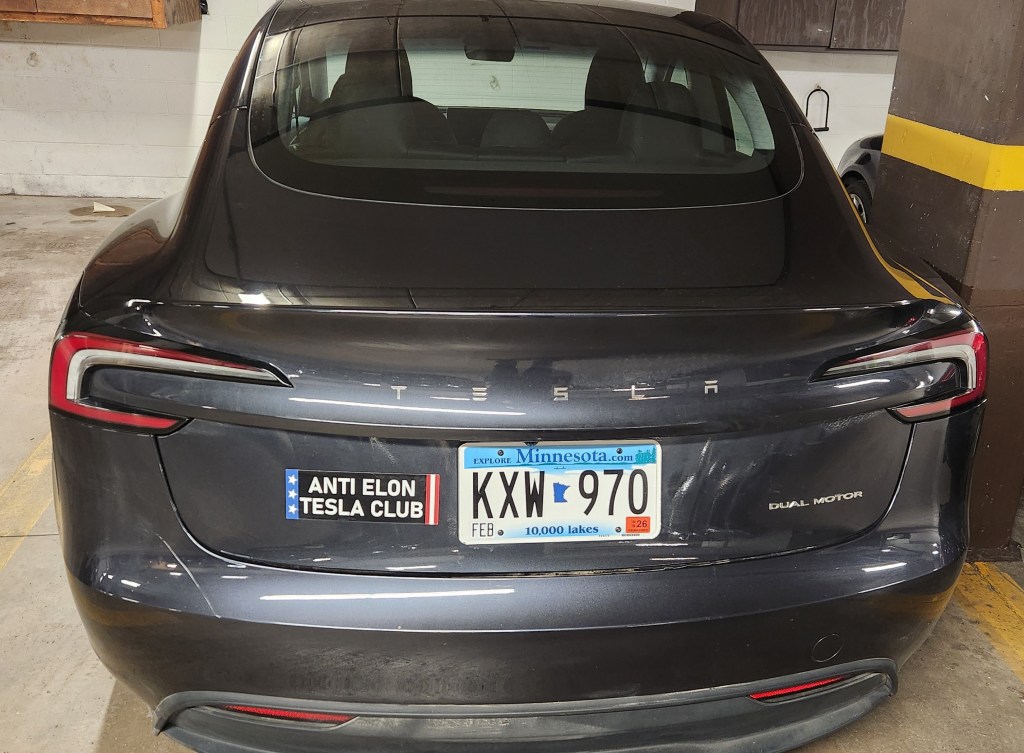
Some of my prior posts have provided detailed information about traveling with an electric car, because I want to help readers to understand the real-world aspects of joining what I like to call the EV Universe. In those posts, I have been effusive in my praise of the specific brand of car that we drive, but for now I’m merely calling it an EV. Why? The overriding reason that we have purchased two EVs and no longer drive a gasoline powered car at all is our desire to do something to help stem the tide of global climate change. Electric cars are the future, and I have tried to provide useful information to readers based on our real-world experience. Unfortunately, one individual (whose name I shall not mention), after becoming the world’s richest man by successfully developing the US electric car industry, has now revealed himself to be an unspeakably disgusting, corrupt man who doesn’t even believe in the mission of the EV Universe – he merely exploited a market opportunity to amass enormous wealth and power which he is now using in an attempt to destroy the very soul of our great nation. Many people now say we should get rid of our EVs as a protest against this man. But as a fervent believer in the goal of the EV Universe, I urge readers not to abandon your EVs. Fellow owners of American-made EVs, please keep driving your zero-emission vehicles. Join the mass protests against the man, put a protest sign on your car, urge your members of Congress to send him packing, but don’t let him destroy both the EV dream and the US Government.

Love the Car, but not the Man

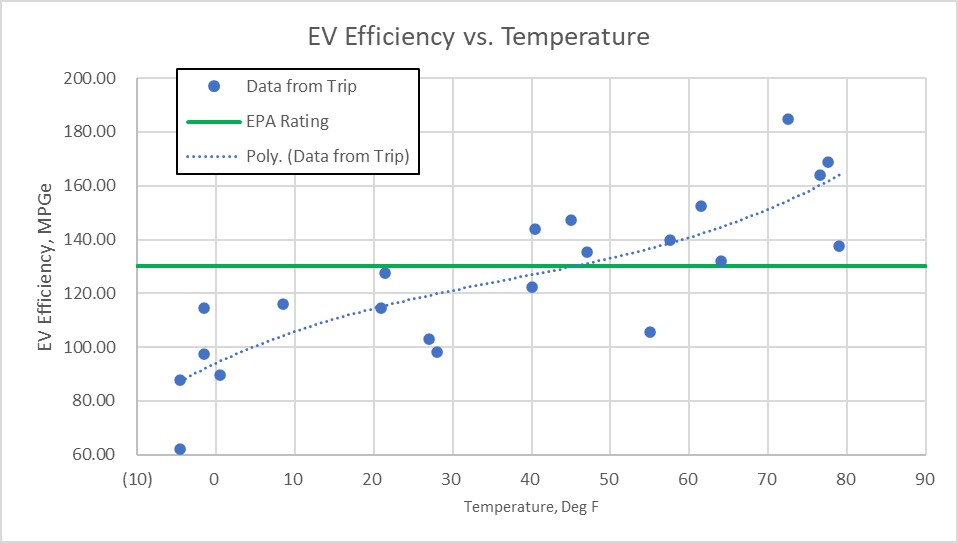
Okay, I’ll calm down now and provide some information about our EV that will hopefully be of interest. It was quite obvious during our drive from Minneapolis to Green Valley and back again that the performance of the car was noticeably reduced when the temperature was low and was very good when the temperature was high. So, I decided to compare the car’s efficiency during the drives between our charging stops (based on my records of actual miles driven and energy added during each charging session) with the air temperatures at the various charging locations as documented by the Weather Underground website. Here’s what I came up with:

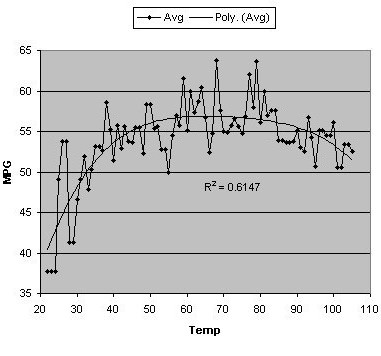
Although there is significant scatter in the data due to other variables that affect performance (terrain, wind, driving speed, heating or air conditioning usage, etc.), it is clear that the actual efficiency was lower than the EPA rating at low temperatures and higher than the EPA rating at high temperatures. This bears out the general wisdom I have heard that EVs are good warm-weather cars and not-so-good cold weather cars. To put this data in perspective, I also spent a little time trying to find a comparable analysis for a gasoline-powered car. For the most part, I could only find general statements about the temperature impact, but I did find this interesting chart posted on the Fuelly.com website by the owner of a 2009 Honda Fit 1.5 RS CVT:

The Honda owner is clearly one who takes measures to maximize fuel economy, since his calculated 55 MPG vastly exceeds the 31 MPG EPA rating for that car, but the interesting aspect of the above chart is that is shows a decrease in efficiency for the gas-powered car at lower temperatures that is comparable to what I found for our EV. It also shows a decrease in efficiency at elevated temperatures, which the EV data does not show. While a comparison of calculations by two individuals for two cars is not in any way a sound scientific analysis, this interesting anecdotal data shows that the temperature impact for the EV efficiency is no greater than that for the gas-powered car.

Okay, that’s enough for Part 1. Stay tuned for Parts 2 and 3, which will feature more pictures and less pontificating.