Pat and Dave’s (Almost) Redundant Road Trip Redo – PART 3: New Visits

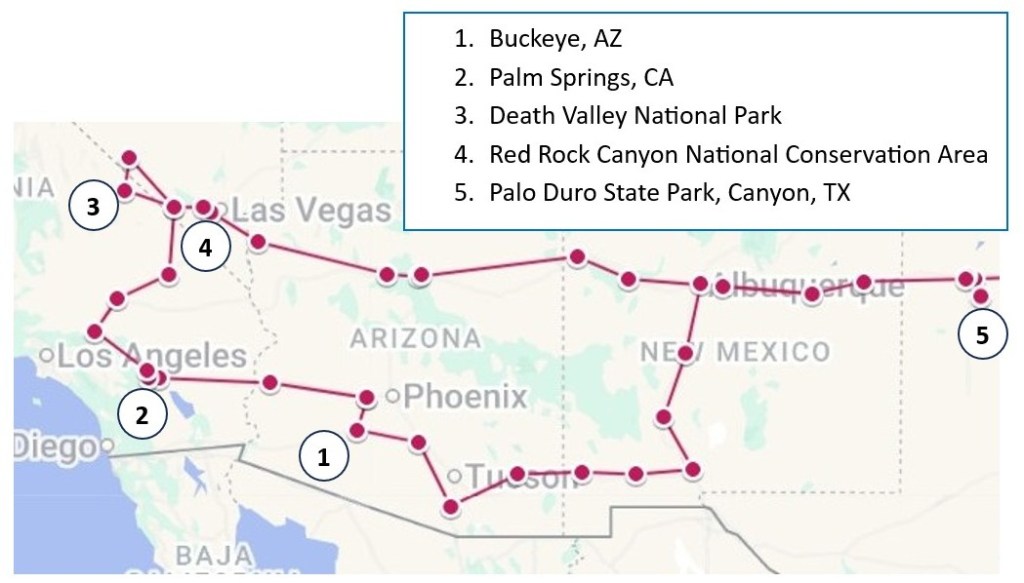
Part 1 of this travelogue covered our 6-week stay in Green Valley, AZ, which was essentially a repeat of last year’s Winter Warmup enlivened with a few new places we discovered this time around. Part 2 covered our travel to several more repeat sites as we began our circuitous trip back home. In this installment, as promised, I’ll finally cover some places we visited on our way back home that were new to us.  Here’s a map showing the places mentioned in this post.
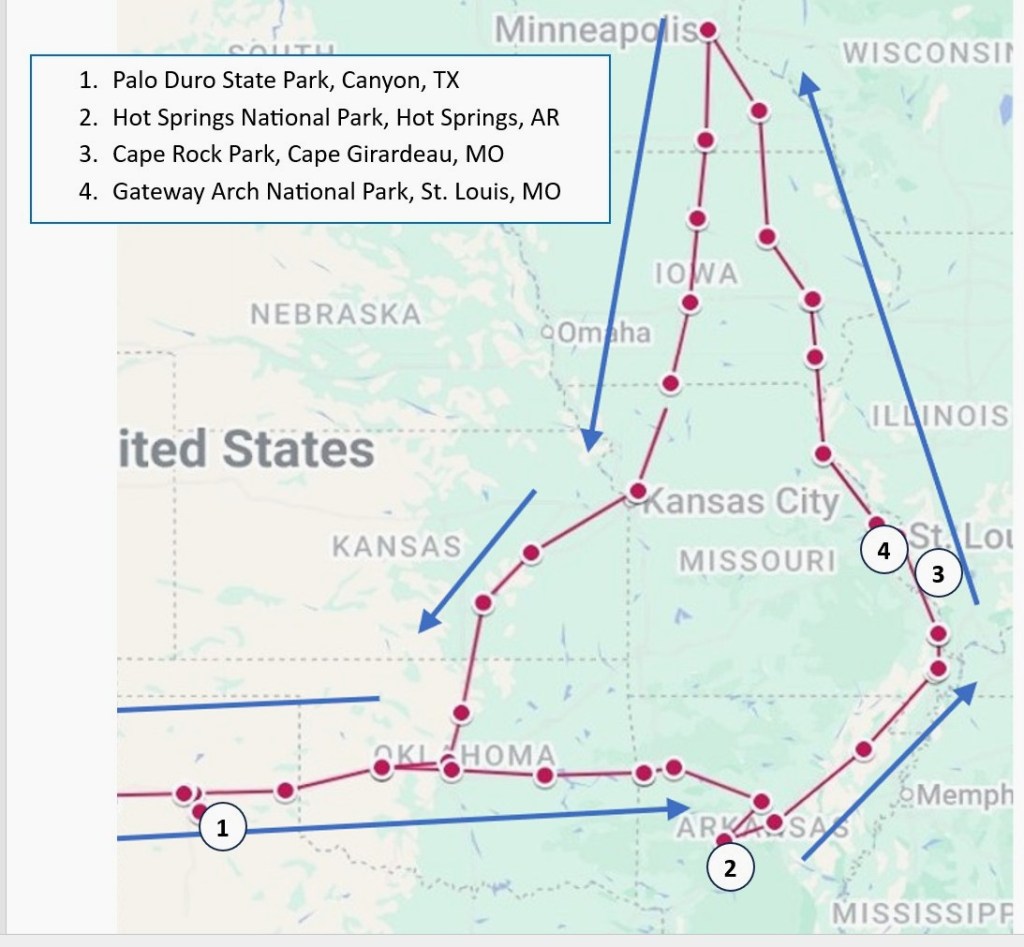
I already covered Palo Duro Canyon, which we visited for the third time on this trip, in Part 2, but I included it on the map simply to indicate how we got to our next destination. We left Amarillo, TX, after visiting Palo Duro, on Tuesday, March 17, and spent two days driving to Hot Springs for our next visit. I’ll pick up the narrative there.

Hot Springs National Park, Hot Springs, AR: We arrived in Hot Springs on Wednesday afternoon and checked into the Arlington Resort Hotel and Spa, a historic landmark opened in its current form in 1924, replacing two previous structures from 1875 and 1893. To quote from the Google AI overview: “Located at the end of Bathhouse Row, it has hosted notable figures like Al Capone, Babe Ruth, and multiple U.S. presidents, offering thermal baths and a storied, luxurious past.” Pat and I decided to describe the hotel as “charming,” though it was very well-worn more than 100 years after its founding. The adjacent parking garage cost $20 a day, but that cost was offset somewhat by free EV chargers – even though three of the six spots were occupied by gasoline vehicles (grrrr!!), we were able to charge our car during our stay. The best thing about the hotel was its ideal location for visiting the National Park.
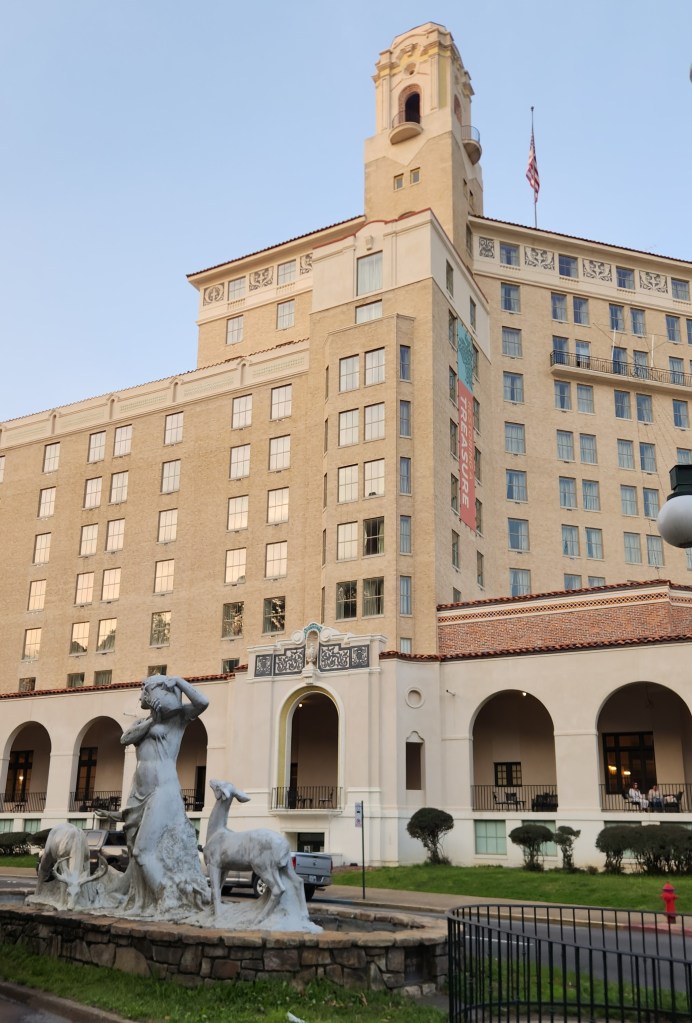
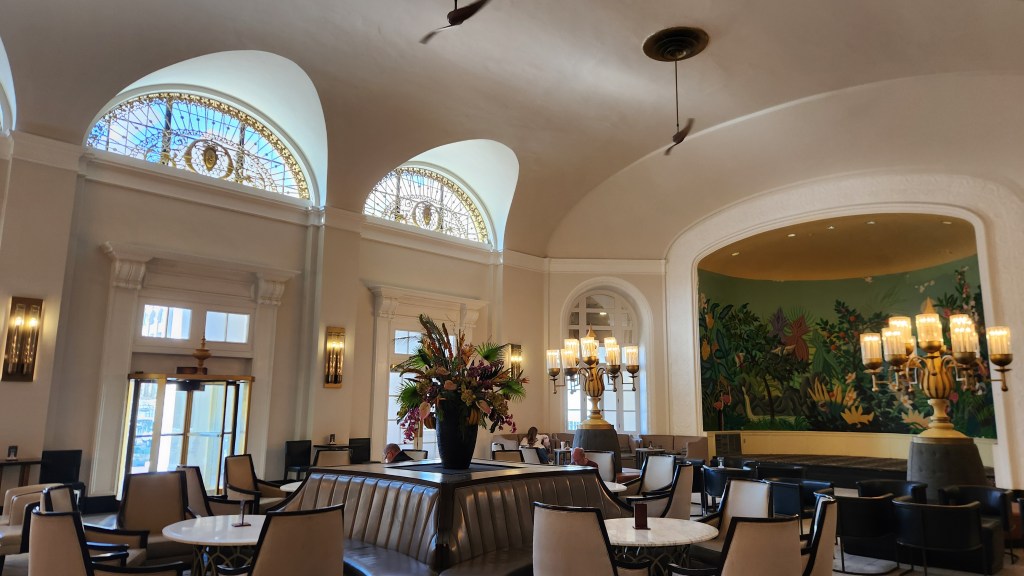
The Arlington Hotel Resort and Spa
The Arlington Hotel Lobby

Hot Springs National Park was the 19th National Park, designated as such on March 4, 1921. However, in a way it is the oldest National Park. The Hot Springs Reservation was initially created by an act of Congress on April 20, 1832, to be preserved for future recreation, becoming the first area to be designated for federal government protection forty years before establishment of Yellowstone as the first National Park in 1872. The Hot Springs Reservation came under the management of the US Department of the Interior after that was created by Congress in 1849 and under the National Park Service when that was created in 1916.

There are 37 springs located within the park, in a valley among the Ouachita Mountains. They have been created by a natural, non-volcanic process whereby rainfall on the surrounding mountains infiltrates the ground and seeps deep into the earth (roughly 2,000 to 8,000 feet) through faults and fractures in sandstone and shale for some 4,000 years or more. The water is heated by the Earth’s natural internal heat (geothermal gradient) before rapidly rising back to the surface. The hot water then rises quickly back to the surface along other fault lines, taking only a few years to return, which prevents it from cooling down, resulting in water in the surface wells at an average temperature of 143°F (62°C).

The springs were enjoyed for their healing properties by many native tribes who settled in the valley (the “Valley of the Vapors”) for 8,000 years before their discovery by Spaniard Hernando de Soto in 1541. Around the 18th century the Caddo settled in the area, followed by the Choctaw, Cherokee, and other tribes from the Southeast across the Mississippi River. Ther tribes agreed to put aside their weapons and partake of the healing waters in peace while in the valley. Unfortunately, little detail is known about the native experiences since the remaining Quapaw Indians were forced onto a reservation south of the valley in 1818 and subsequently removed to reservations in Oklahoma in the 1830s, and the oral history has been mostly lost.

The city of Hot Springs grew up around the park area in a somewhat haphazard way with various competing entrepreneurs establishing cabins for visitors to the springs. Ownership disputes were often settled by violence before the city was incorporated in 1851. In the early 20th century, the city was known as the home to Major League Baseball spring training, illegal gambling, speakeasies during the Prohibition era, gangsters such as Al Capone, horse racing at Oaklawn Park, and the Army and Navy Hospital. Horseracing and the National Park seem to be the major draws today.

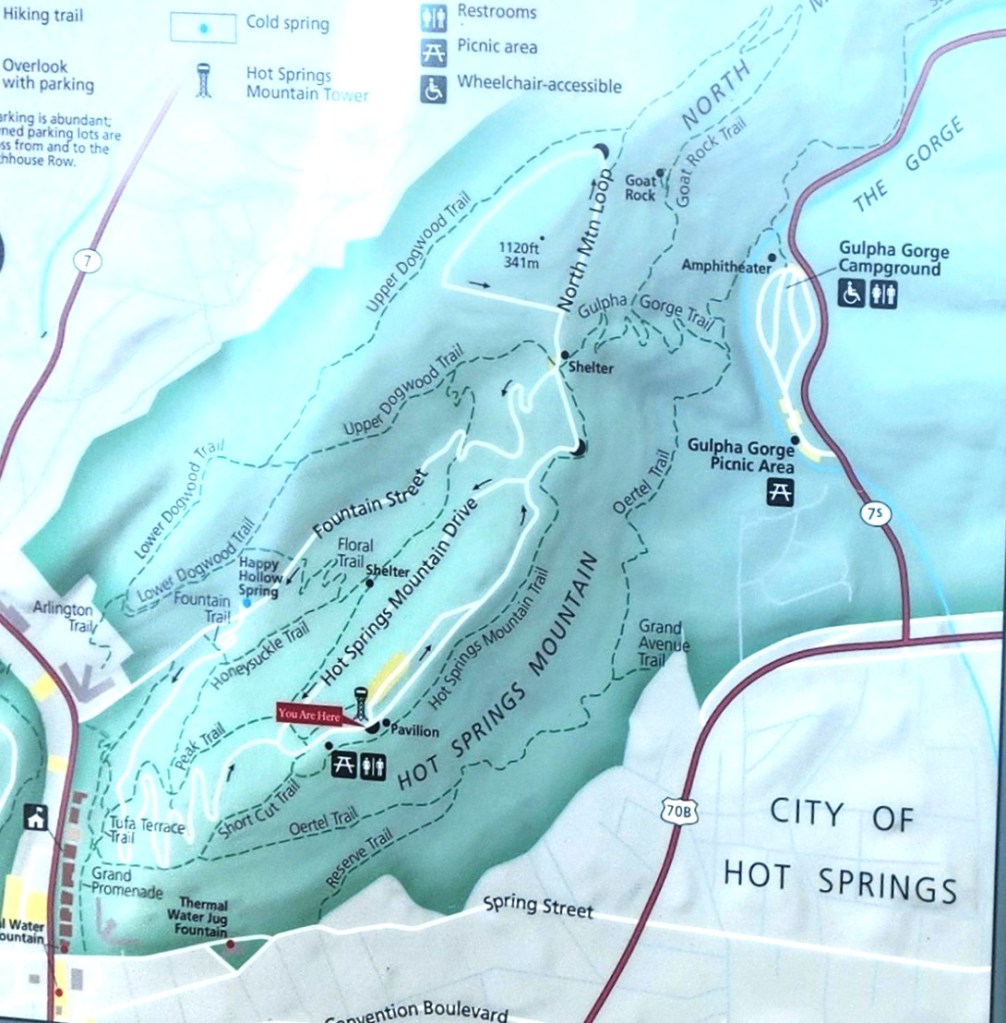
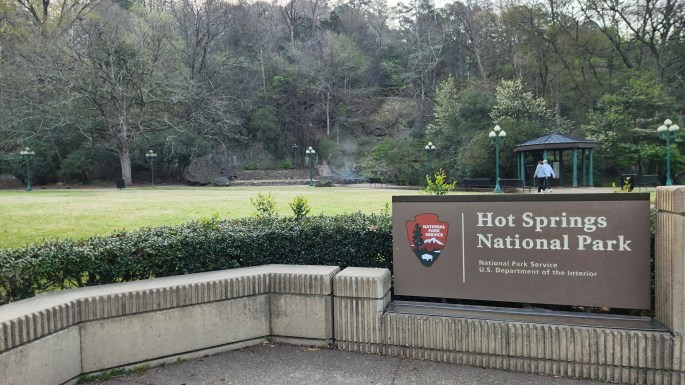
Hot Springs is the second smallest National Park, comprising only 5,500 acres within and around the city of Hot Springs. It is very accessible, with multiple hiking trails and several roads providing access to the main attractions. The Arlington is located literally across the street from a large lawn area featuring a National Park sign and one of the open hot springs. The others springs are located in the various bathhouses, most of which are no longer active and none of which we visited.
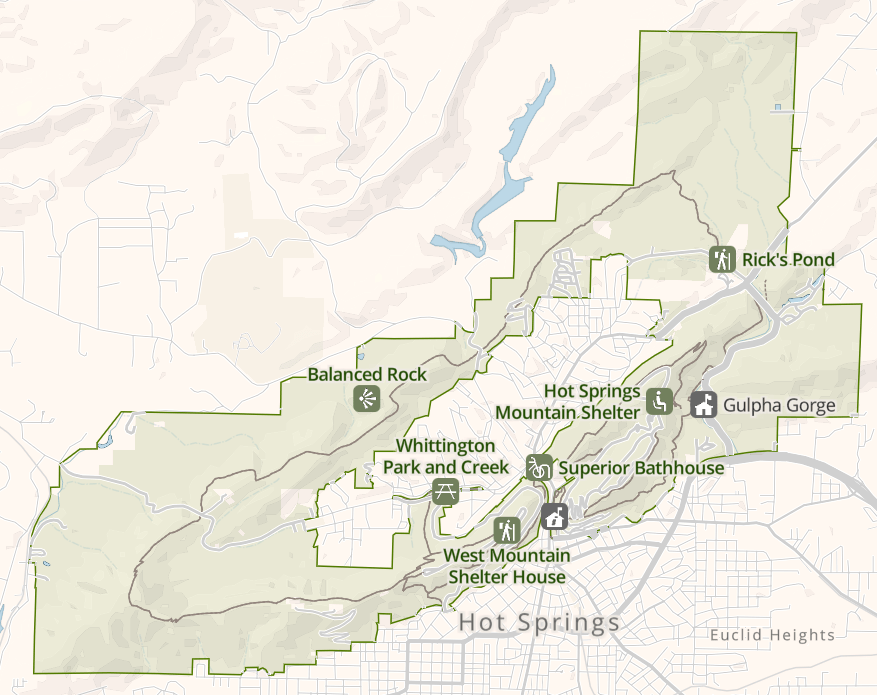
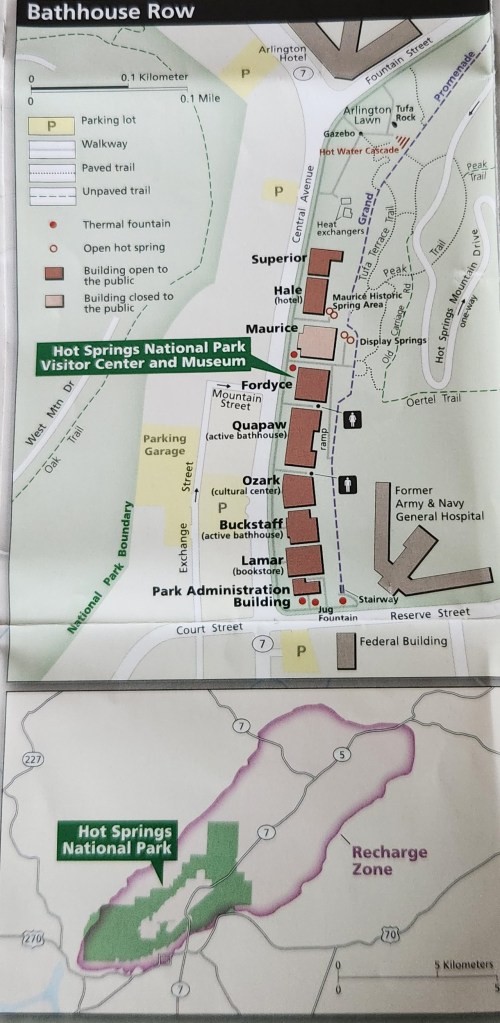
National Park Service On-Line Map
Inset from National Park Service Map
On-site Trail Map Sign

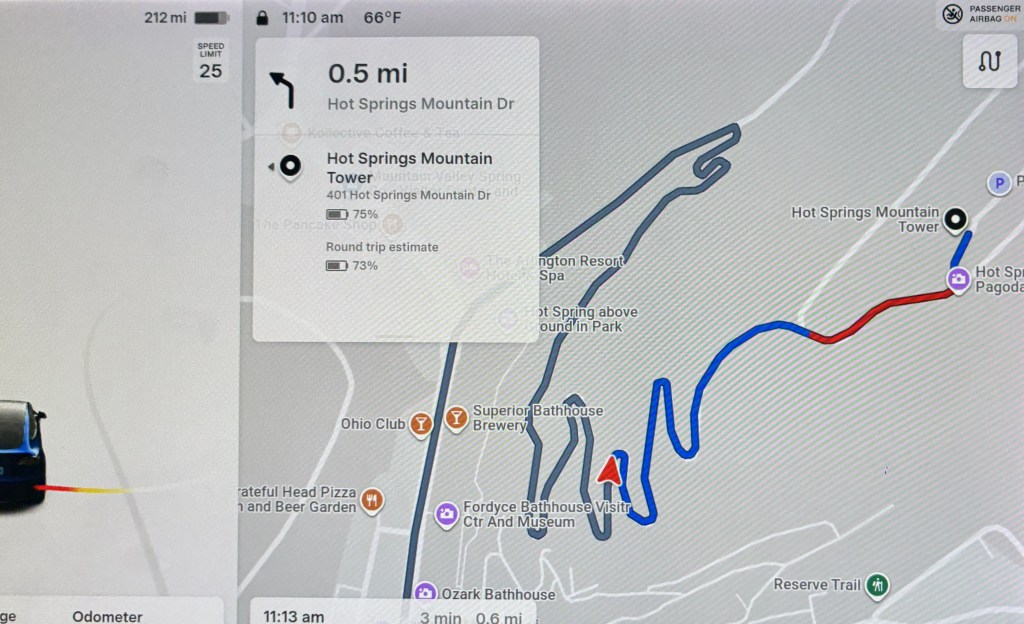
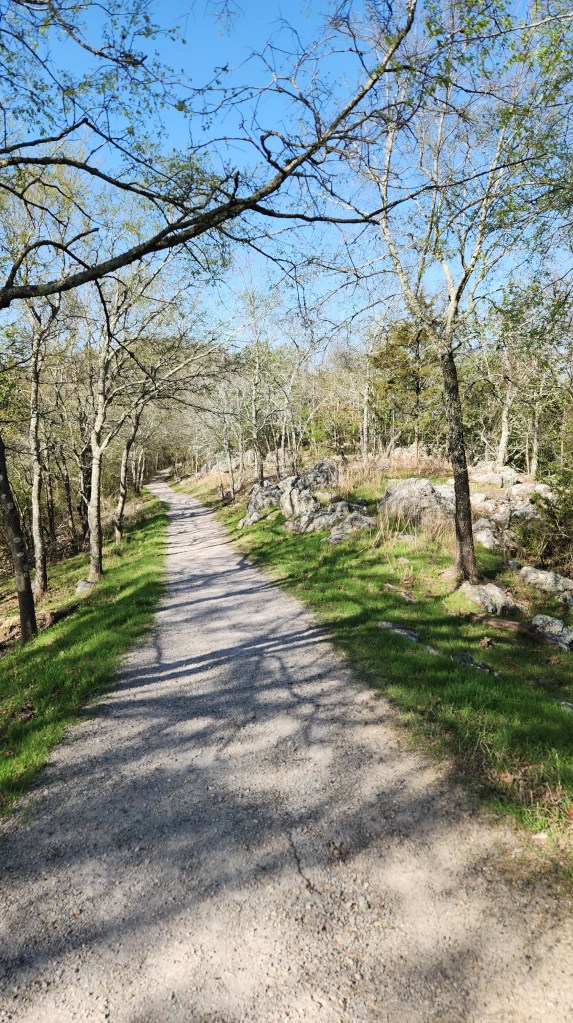
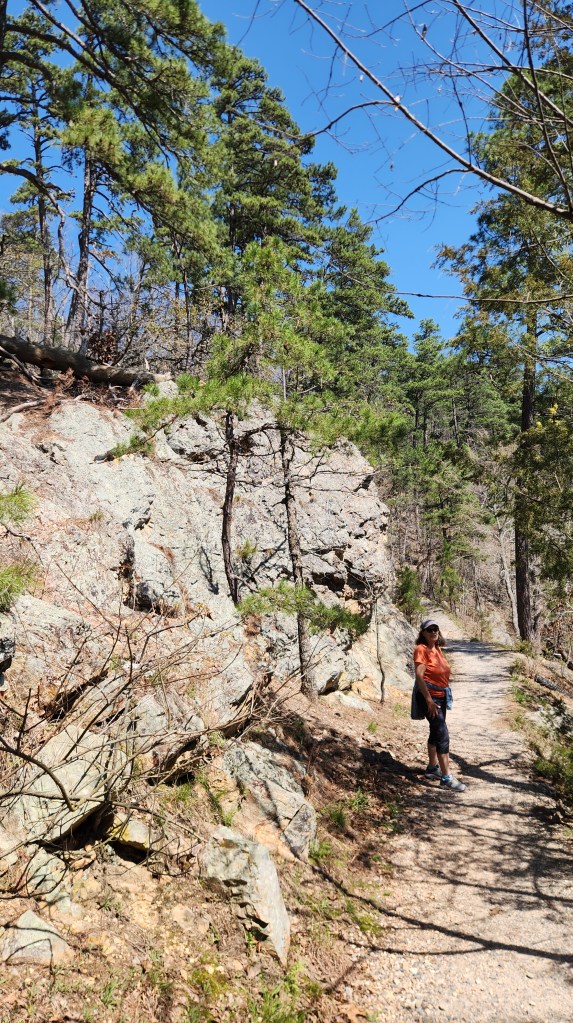
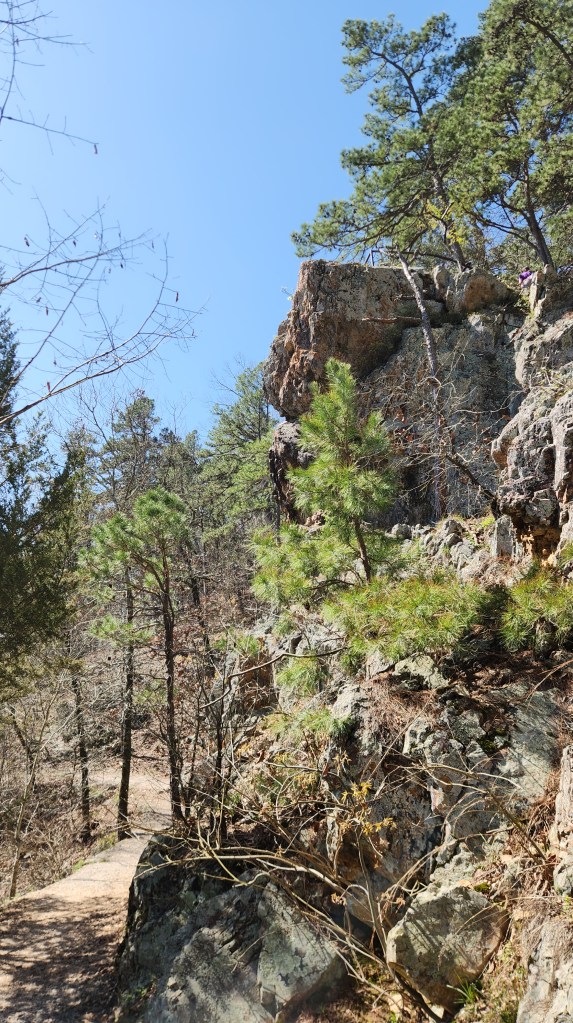
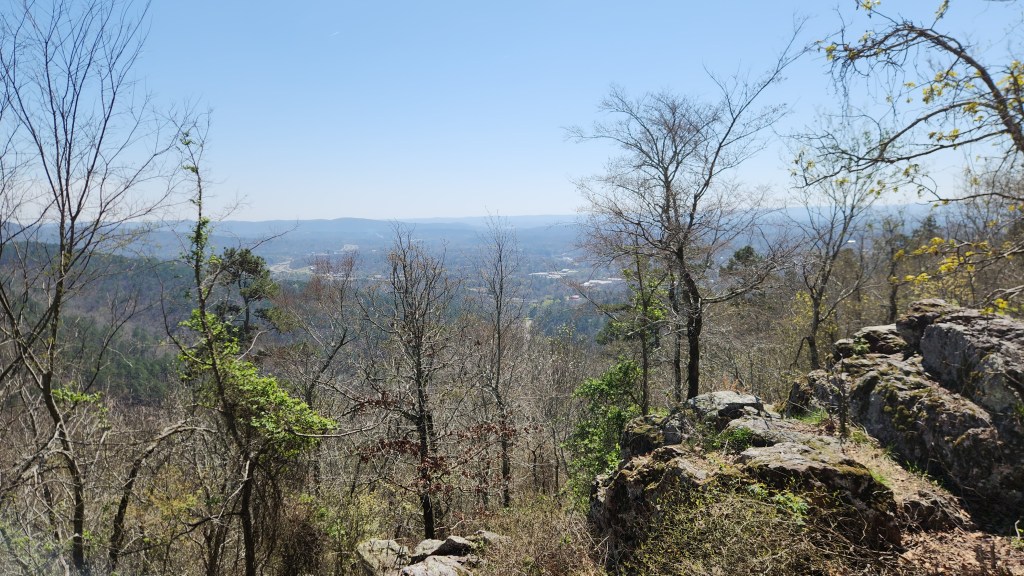
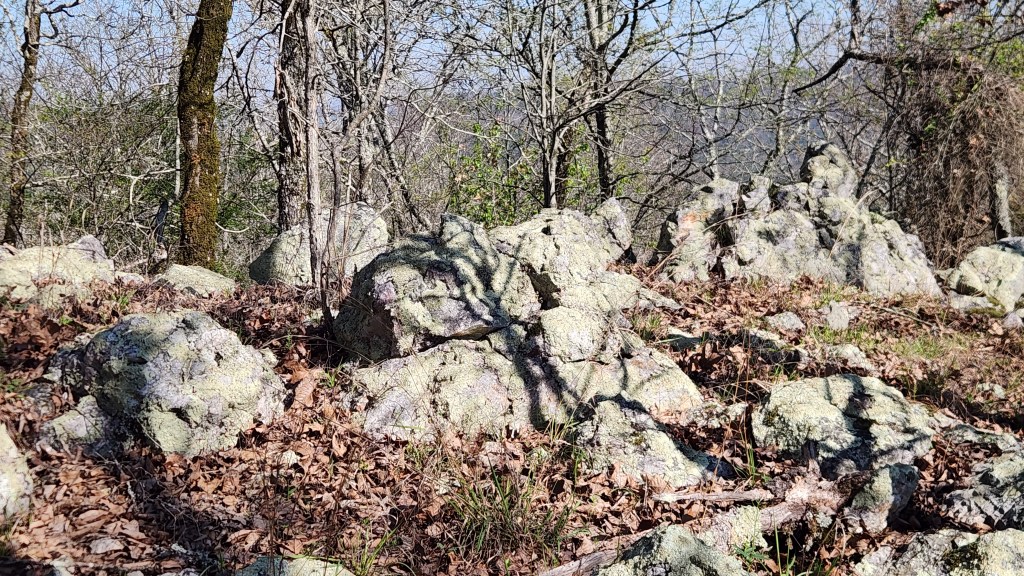
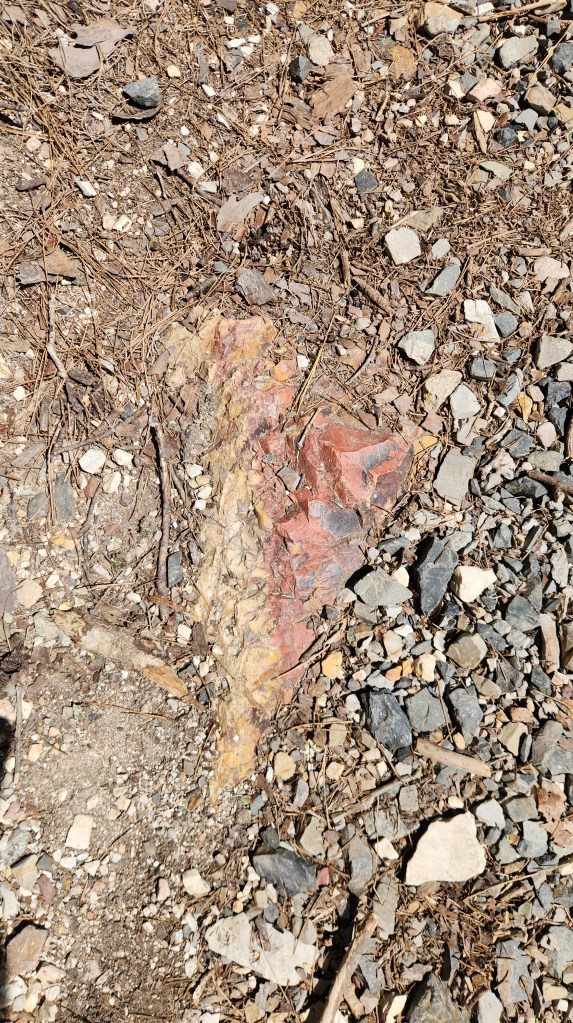
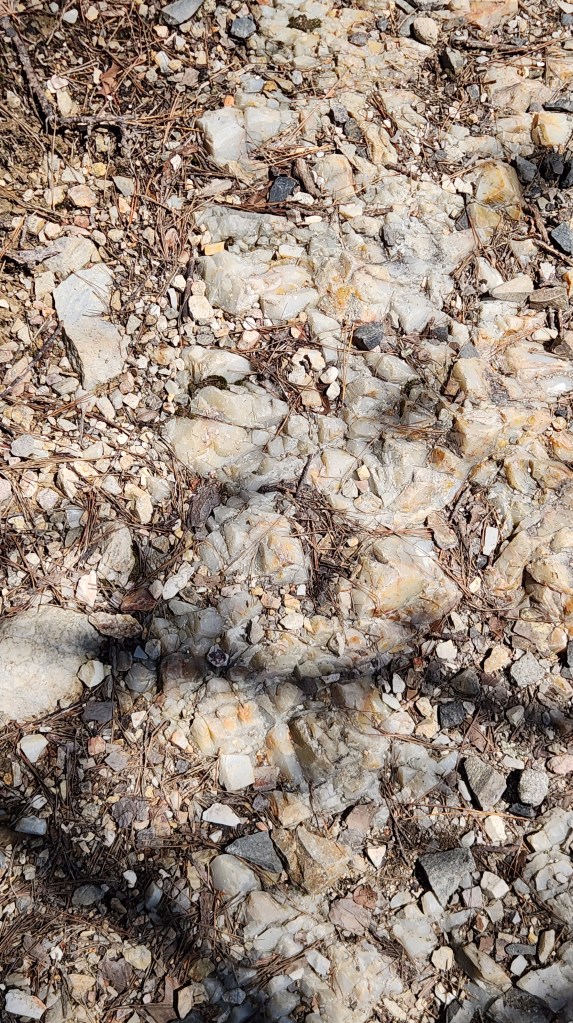
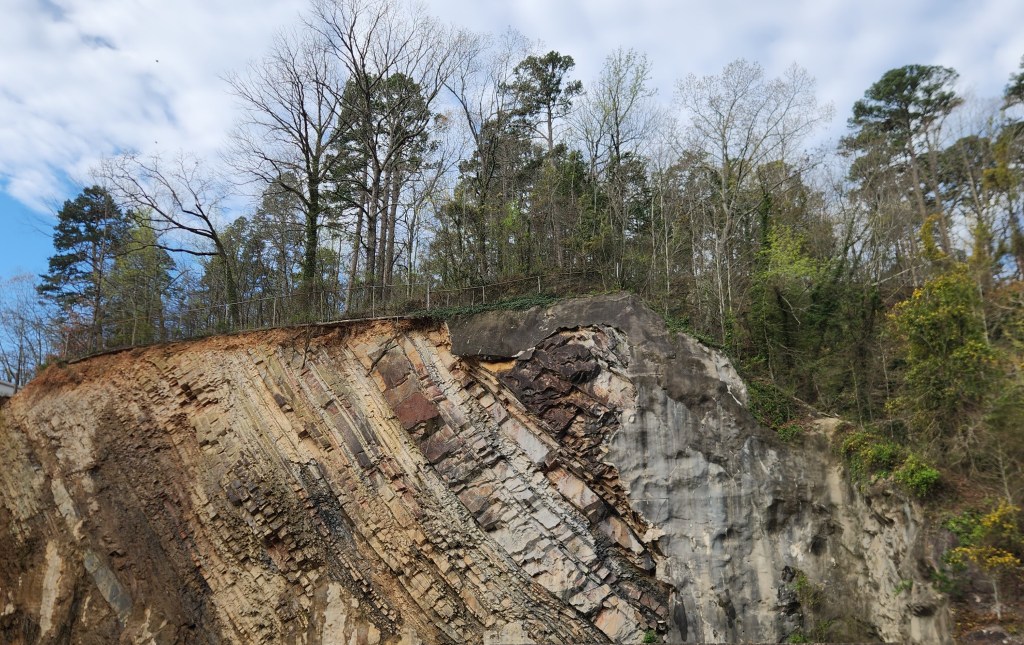
On Wednesday afternoon after checking into the hotel we walked to the park and then uphill along the Peak Trail for a quick look at the Mountain Tower before heading back into town for dinner. On Thursday morning, we took the car out of the garage and drove along two winding park roads, first the West Mountain Loop and then the North Mountain Loop. We made frequent stops for photos on both loops, stopped for a short hike along the Honeysuckle Trail followed by a visit inside the Mountain Tower (I bought a ticket to ride up to the top, but Pat stayed on terra firma while I did so), and finally went for a longer hike along the Goat Rock Trail. I was particularly interested in the diverse types of rock we saw along the way. The dominant rock is something called Arkansas Novaculite, a very hard, dense, fine-grained rock formed from silica, colored white, gray, or black, and there are also significant amounts of shale and sandstone, formed from deep marine deposits. There is also a spongy, soft rock formed at the surface when hot water cools and deposits minerals, called Calcareous Tufa, which is often found around the spring areas.
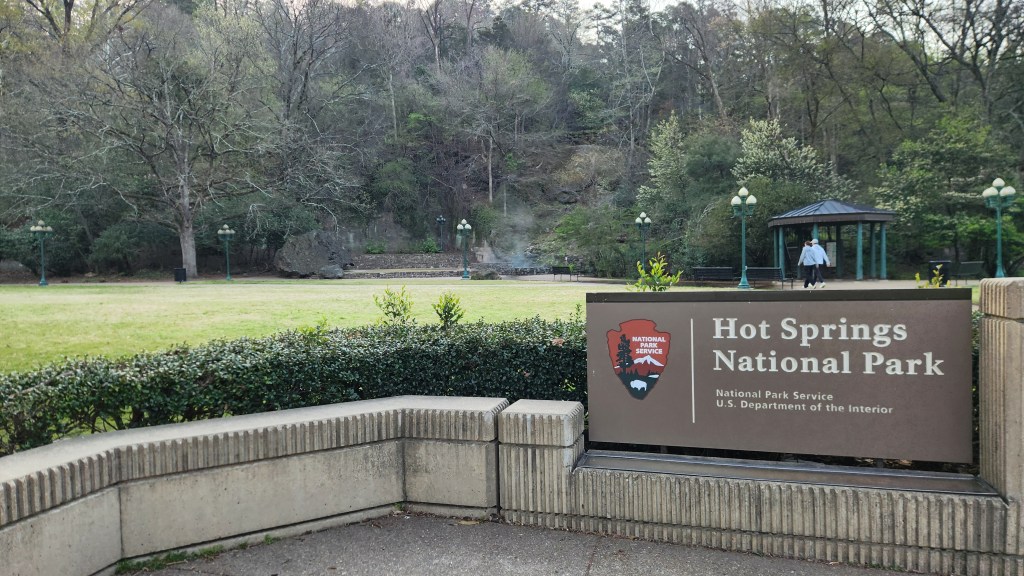
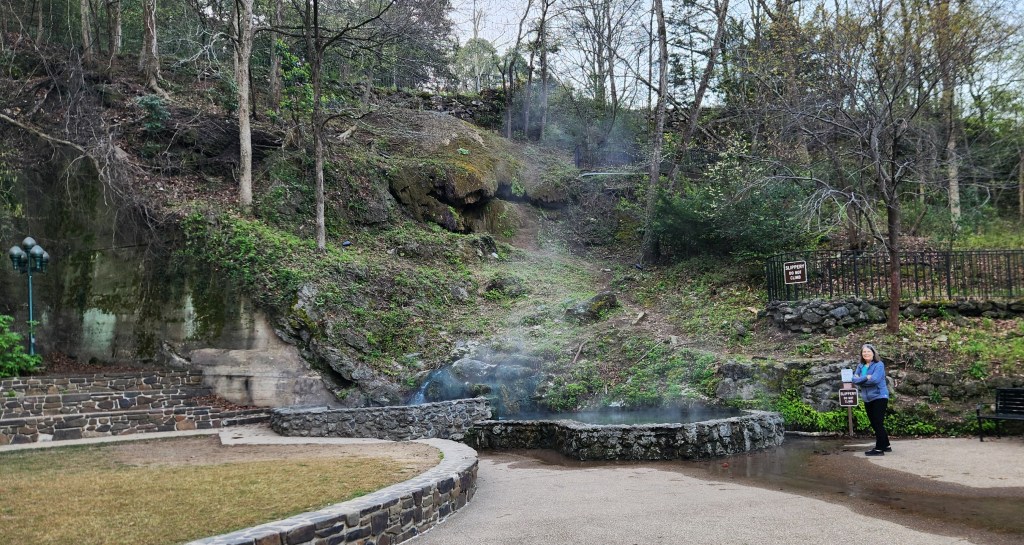
Arlington Lawn and one of many Hot Springs
Pat by the Hot Spring
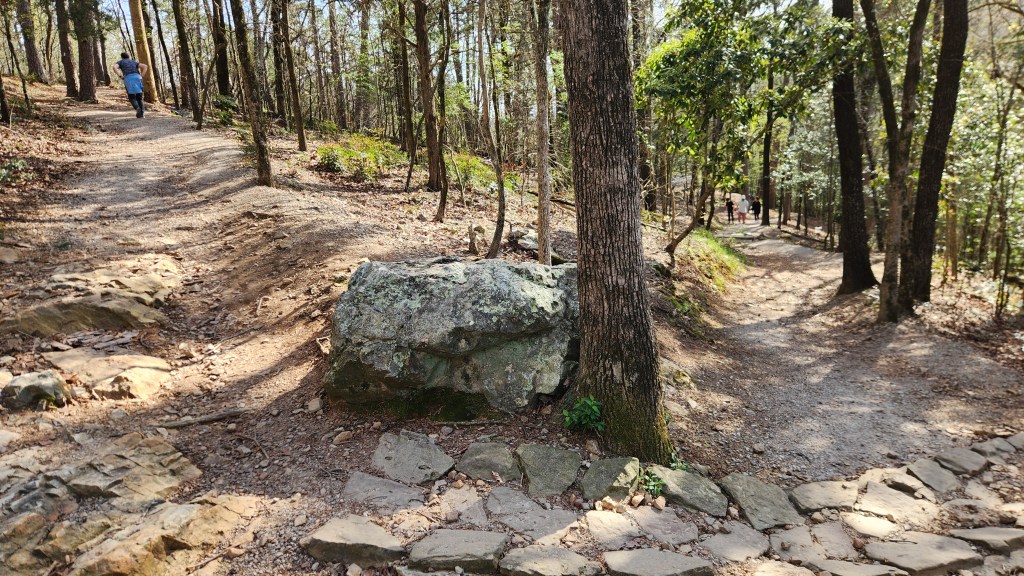
Peak Trail
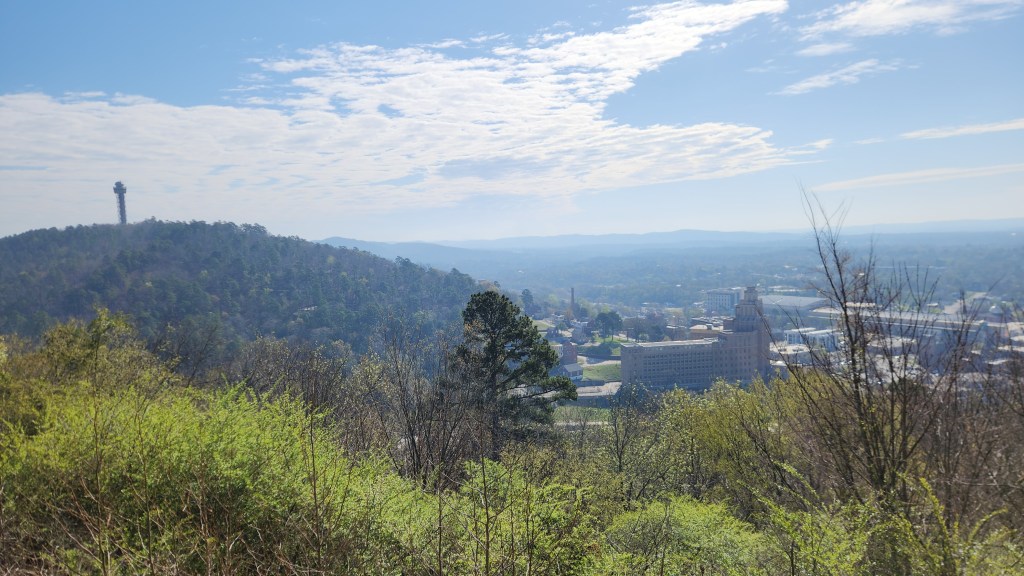
View from South Mountain Loop (Mountain Tower is on the left)
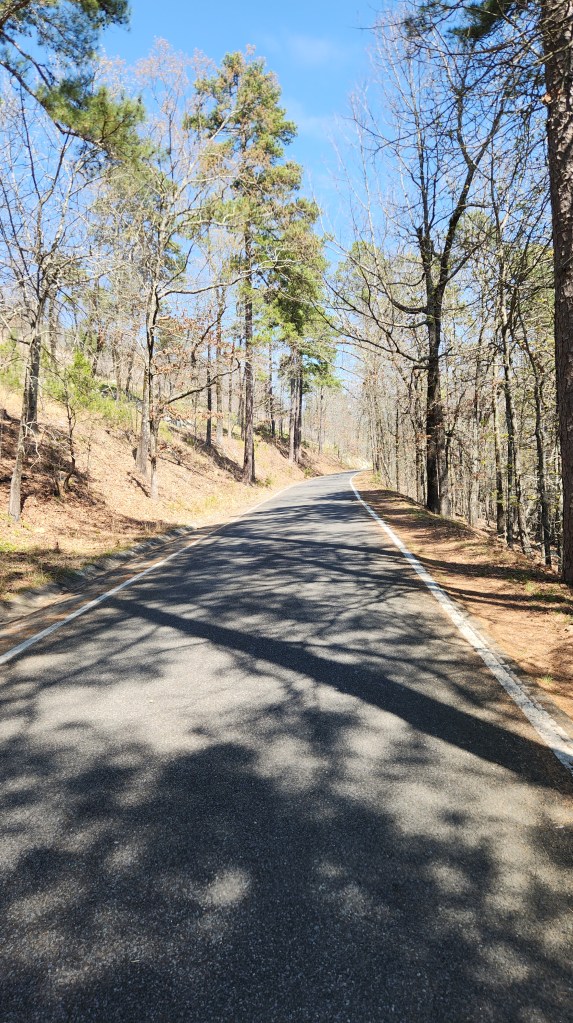
Portion of the Winding North Mountain Loop Road
North Mountain Loop Road
Honeysuckle Trail
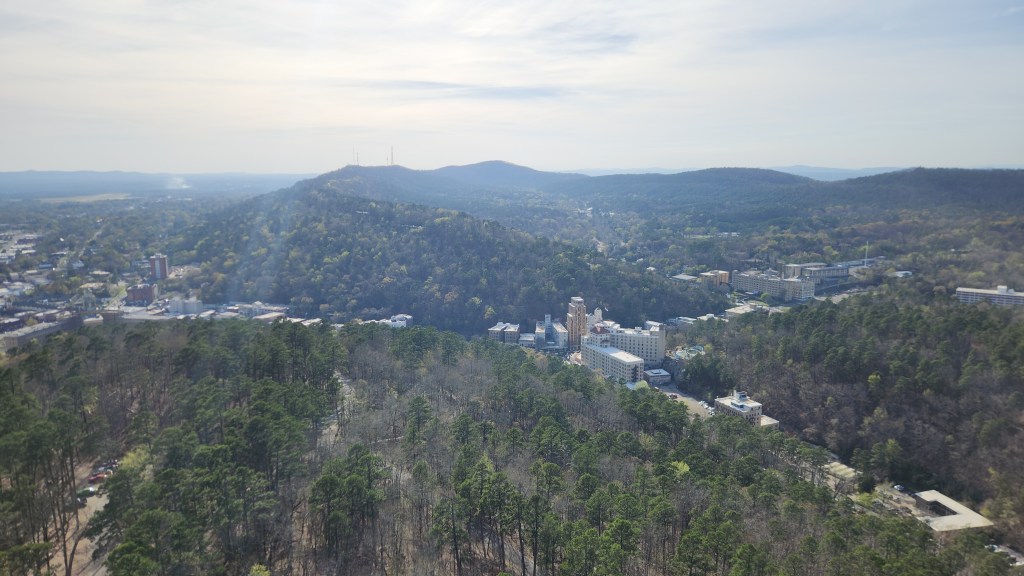
View from Mountain Tower looking South (Arlington Hotel is in the center)
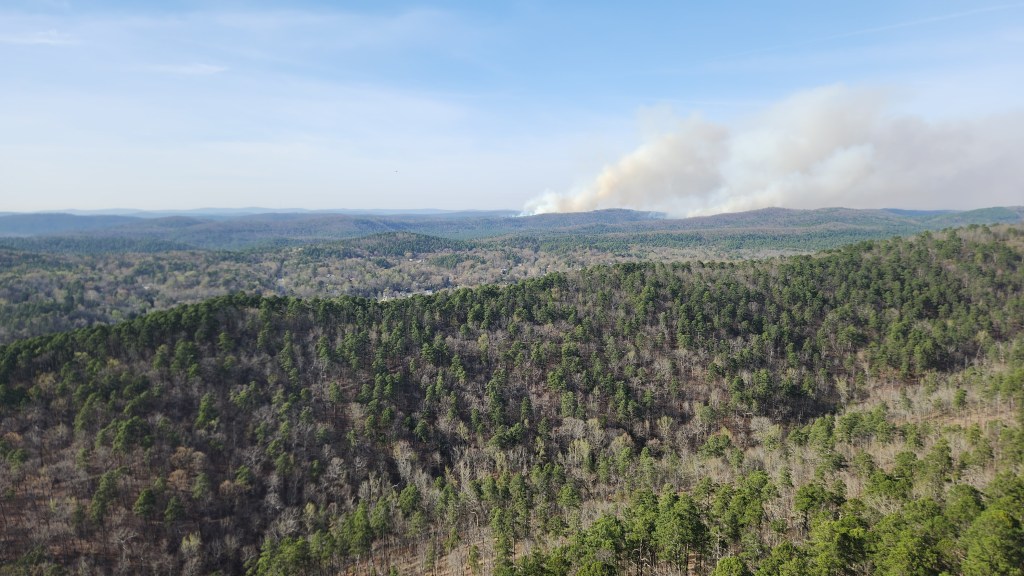
View from Mountain Tower looking North
Goat Rock Trail
Goat Rock Overlook
View from Goat Rock Overlook
Interesting Rocks …
… and More Rocks …
… and MORE Rocks …
… and EVEN MORE, this one taken in the city of Hot Springs … (Okay, enough already!)

We drove back to the hotel in the afternoon, plugged in the car again, and then walked back to the park for lunch at the Superior Bathhouse Brewery. After another stroll around the Arlington Lawn, we returned to the hotel in the late afternoon and vegged out for the evening. We thoroughly enjoyed our visit to the (sort of) oldest and second smallest National Park and felt that the two-day stopover was sufficient to get a thorough look at the place. We were also able to tick off one more National Park visited, our 30th of the 63 total in the US.

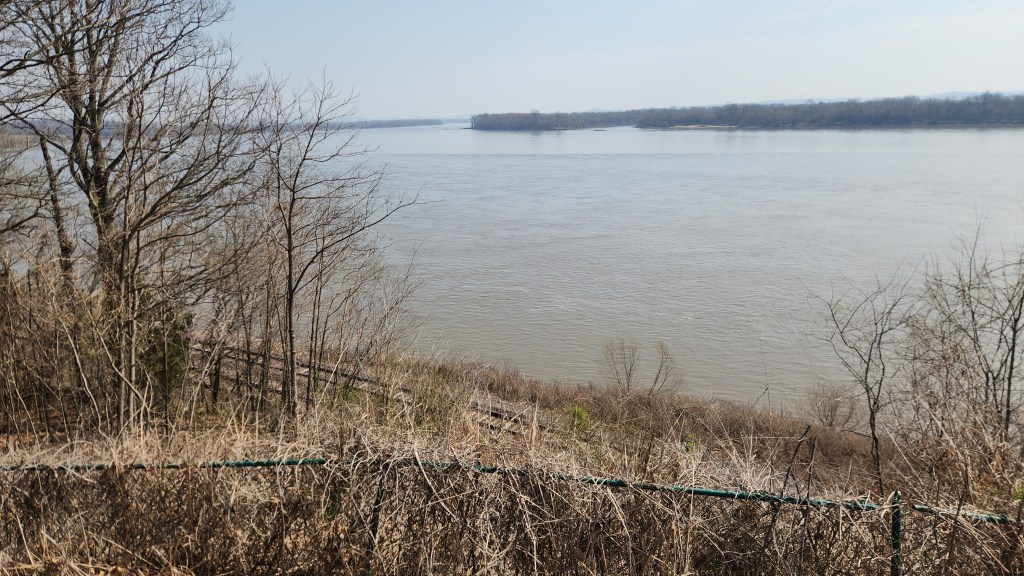
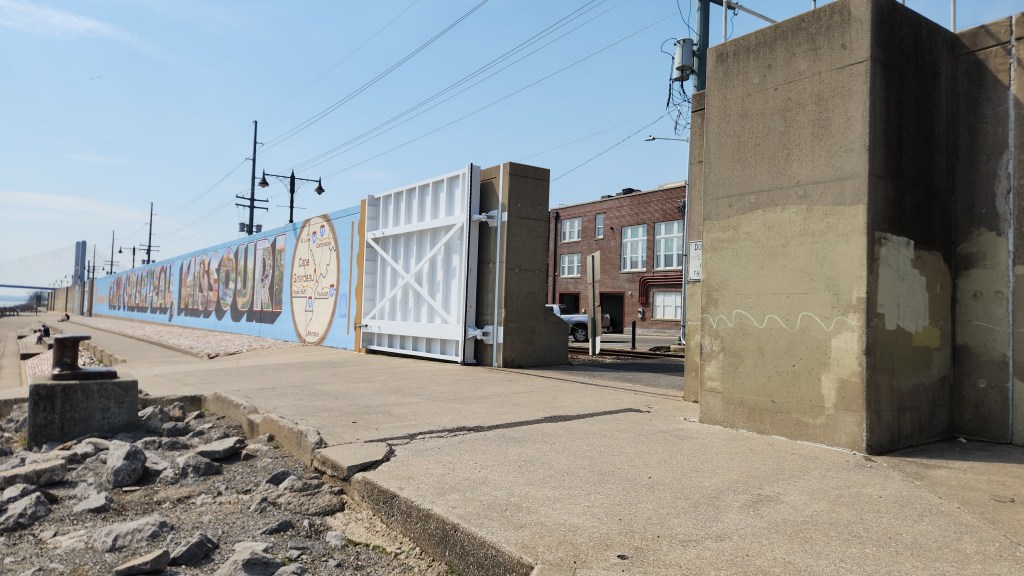
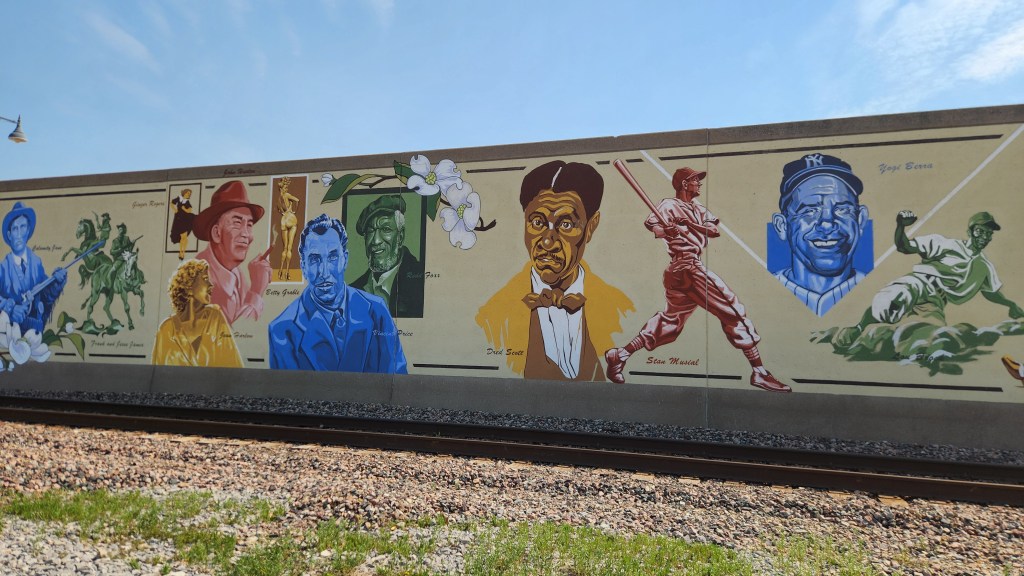
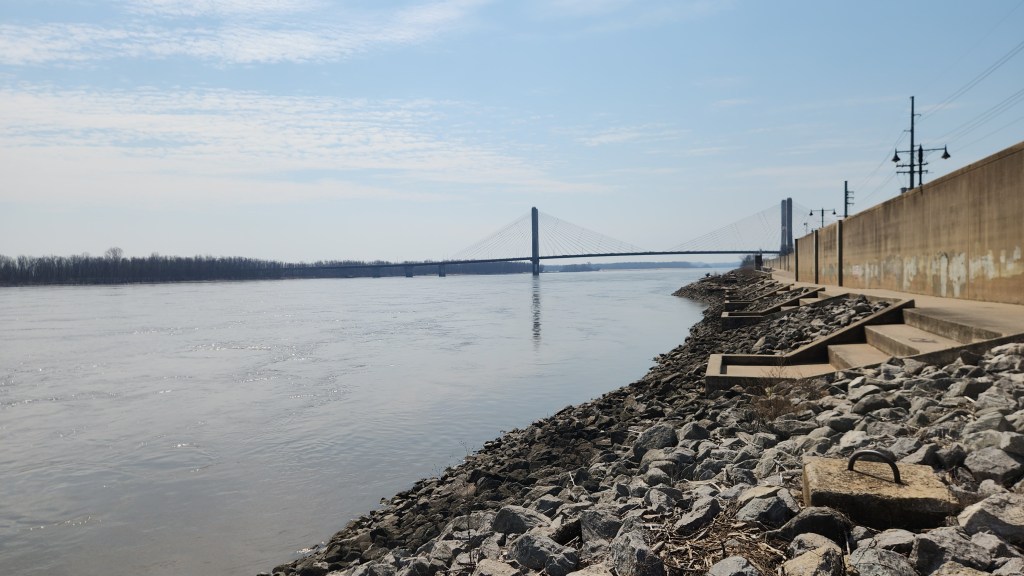
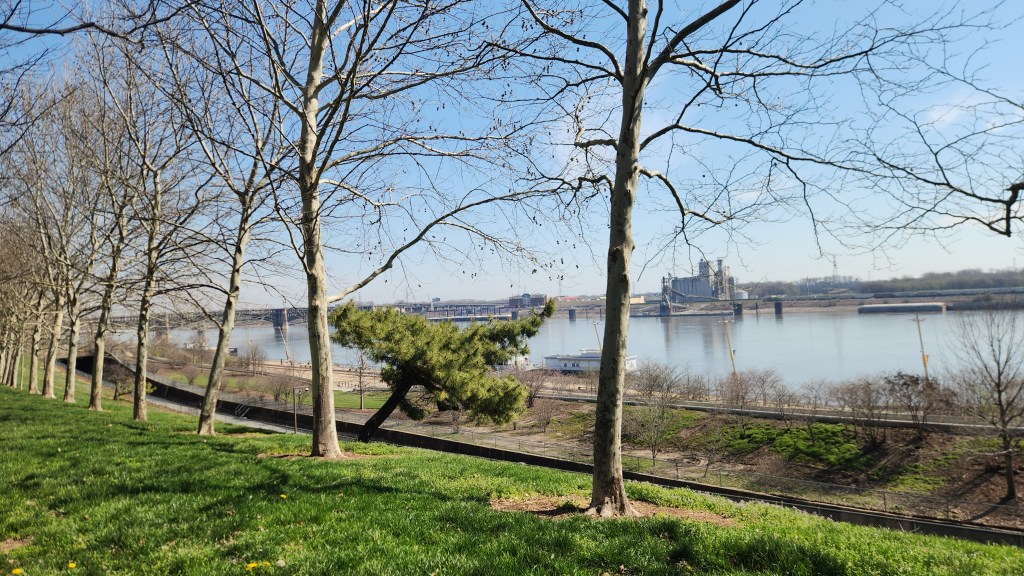
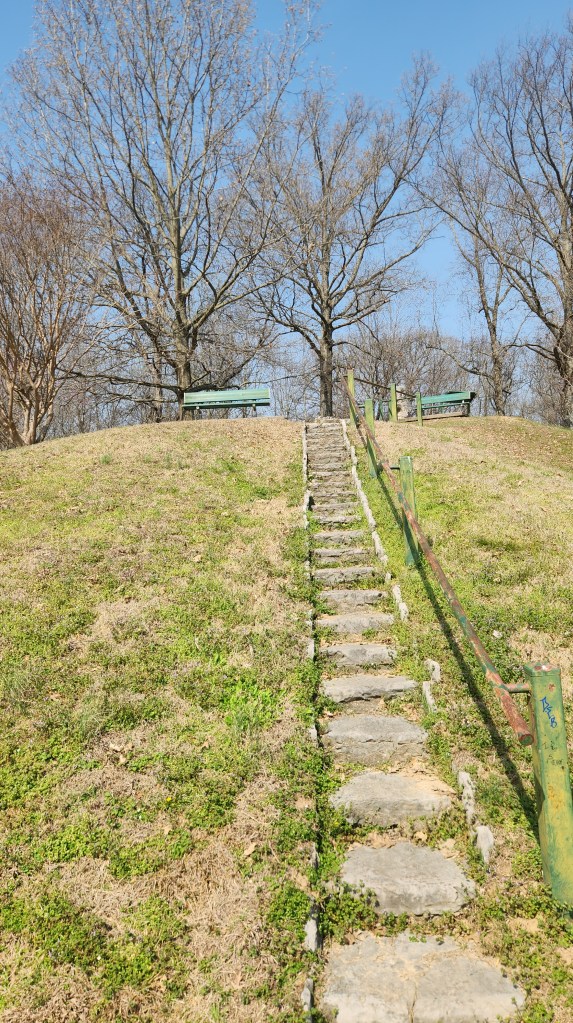
Cape Girardeau, MO: On Friday, we had a nice breakfast at a pancake house across the street from the hotel before heading north toward our next stopover in Sikeston, MO. We had reservations for Saturday and Sunday in St. Louis, but it was only a two-hour drive. As we continued northward, I couldn’t help but notice the mighty Mississippi showing up on the car’s navigation map, and I was surprised by how many bends it has. Since we had plenty of time, we decided to stop at Cape Girardeau along the way, where we could get a close-up look at the river. We found a fun little place called Cape Rock Park, located on a hill with a nice overlook, where I could easily imagine Huck Finn and Jim floating by on their raft. After that, we stopped in the town for a stroll next to the 16-ft high, 1.2-mile-long flood wall completed in 1964. The wall is designed to protect against a 54-ft high flood stage and demonstrated its value by defending against the 2016 record 48.86 ft crest. The wall also features an 1100-ft-long mural depicting the history of Missouri.
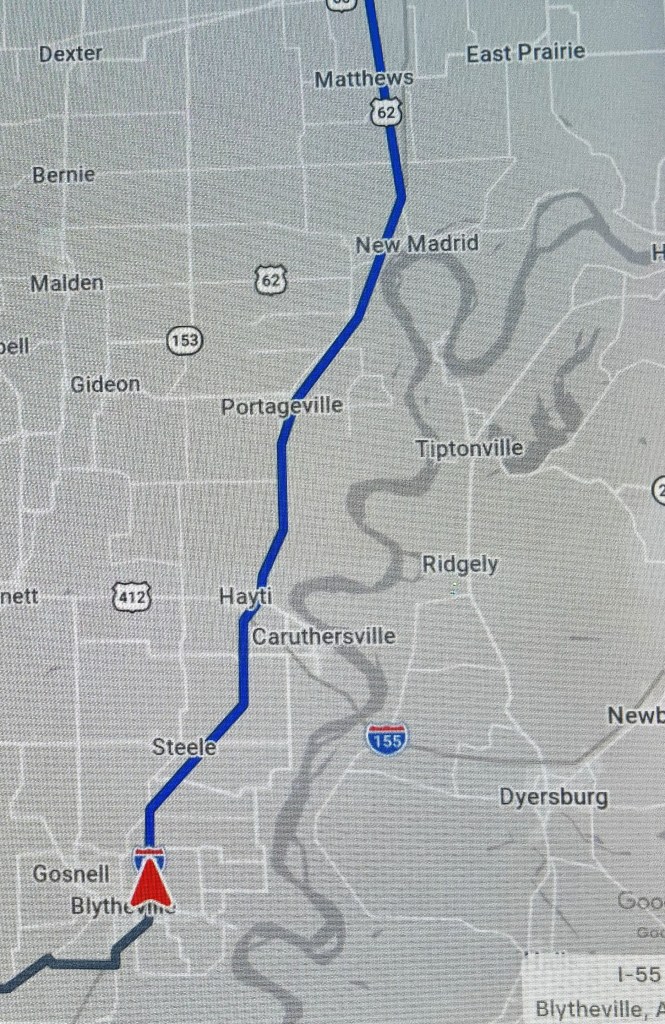
Mississippi River to the East of our Navigation Route
Steps up to Overlook at Cape Rock Park
View from Mississippi River Overlook at Cape Rock Park
Flood Wall at Cape Girardeau
Mississippi River by Cape Girardeau Flood Wall

Gateway Arch National Park, St. Louis, MO: We left Cape Girardeau around 12:30 PM and resumed our drive to St. Louis, where we checked into a hotel called the Hampton Inn St. Louis Downtown at the Gateway Arch (not exactly a pithy name, but quite descriptive) for another two-night stay. This hotel also charged $20 per night to park in their garage, the cost again offset a bit by access to free EV chargers, but the main attraction was its close proximity to the Gateway Arch National Park, which we visited on Saturday afternoon for an hour or so and for several hours on Sunday.

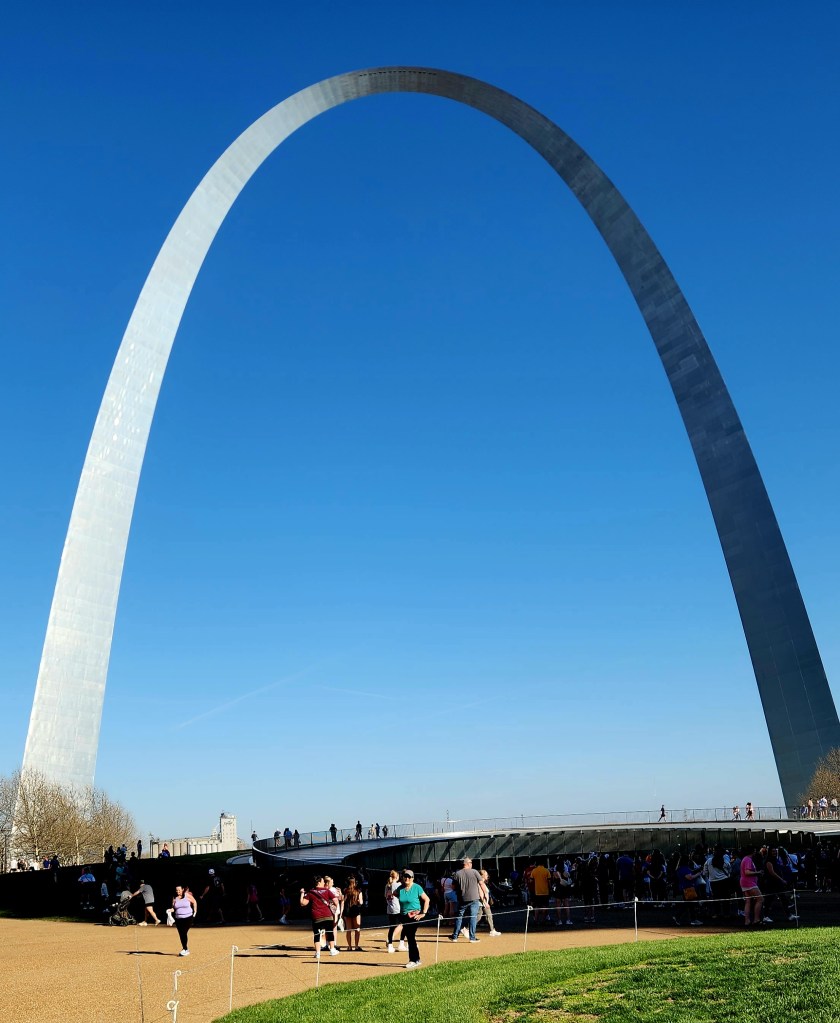
Gateway Arch is the fourth newest National Park, so designated on February 22, 2018. This designation was somewhat controversial, as opponents of the designation believed it was basically just a means for increasing tourism in St. Louis. In fact, the Department of the Interior recommended that it should remain a National Monument. However, Congress was swayed by the pro National Park arguments. It may have been a bold tourism promotion, but I for one was quite impressed with it and do not begrudge the name. Besides, this way we have added National Park number 31 to our growing list of parks visited. Gateway Arch is also by far the smallest of the parks at only 91 acres, less than 2% of the area at Hot Springs, previously the smallest, and minuscule in comparison with Death Valley’s 3.2 million acres and the even bigger parks in Alaska. While the tiny size is perhaps disappointing in a way, it is also great since every single bit of the place can be seen in just a few hours.

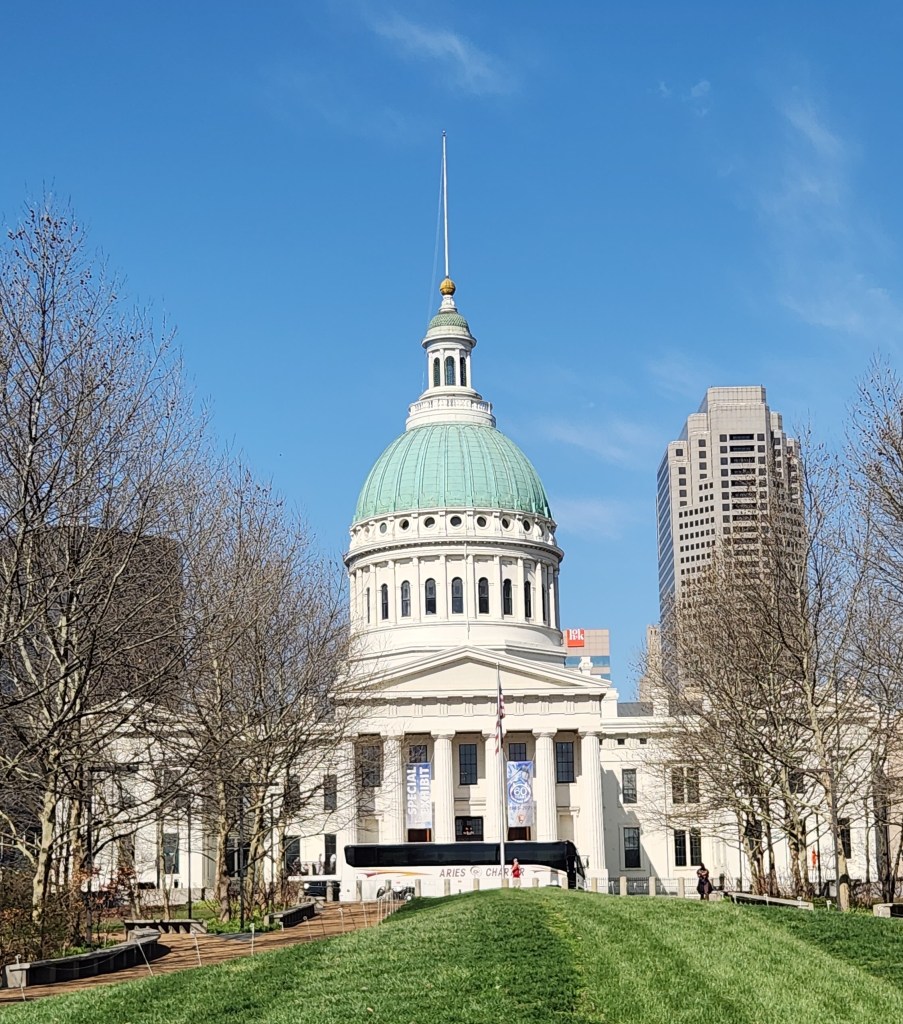
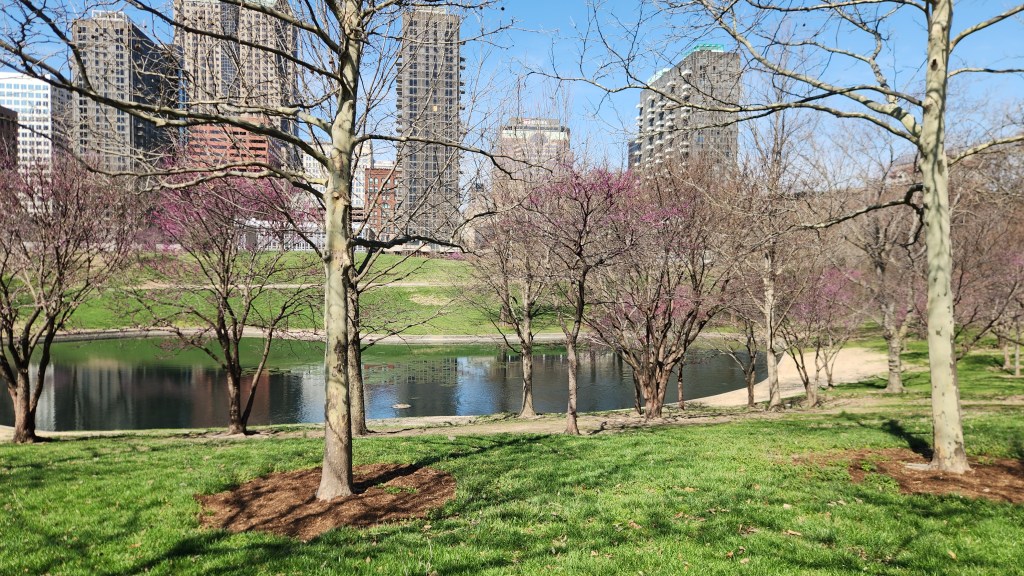
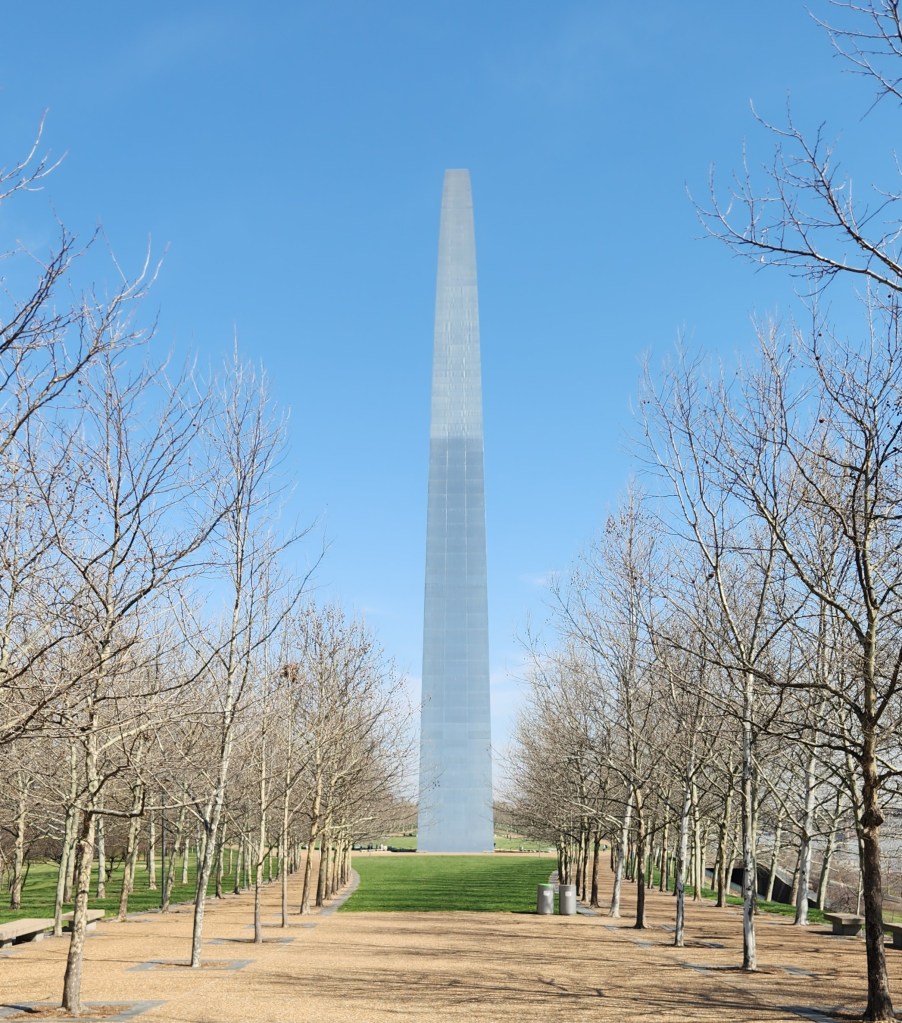
As to its history, the site was initially established as a National Monument to 1935 to commemorate: a) the Louisiana Purchase and subsequent westward movement of American explorers and pioneers, due to its location near the start of the Lewis and Clark expedition, b) the first civil government west of the Mississippi River, and c) the debate over slavery, as the park includes the preserved 1839 Old Courthouse where the infamous Dred Scott case originated. The dominant feature is the huge and well-known catenary arch. An international competition was held to select a design for the main monument, which was won by Finnish-American architect Eero Saarinen and German-American structural engineer Hannskarl Bandel in 1947. Construction of the arch took place from 1963 to 1965. It stands 630 feet tall and 630 feet wide at its base. The legs are 54 feet wide at the base, narrowing to 17 feet at the top. A unique tram system was built inside the structure to carry passengers to the observation room at the top of the arch, and a large underground museum was constructed beneath it. The arch sits in the middle of a large, grassy park crisscrossed by tree-lined walking paths and featuring two ponds populated by ducks,.

On Saturday, we strolled along several of the paths taking photos and getting oriented, and we returned Sunday morning to ride the tram and watch a well-made documentary movie about how Saarinen’s fanciful design was actually turned into something buildable by engineers and construction workers. One interesting fact we learned: while the original plans anticipated that up to thirteen construction workers might die due to the risky undertaking, there were no casualties at all.
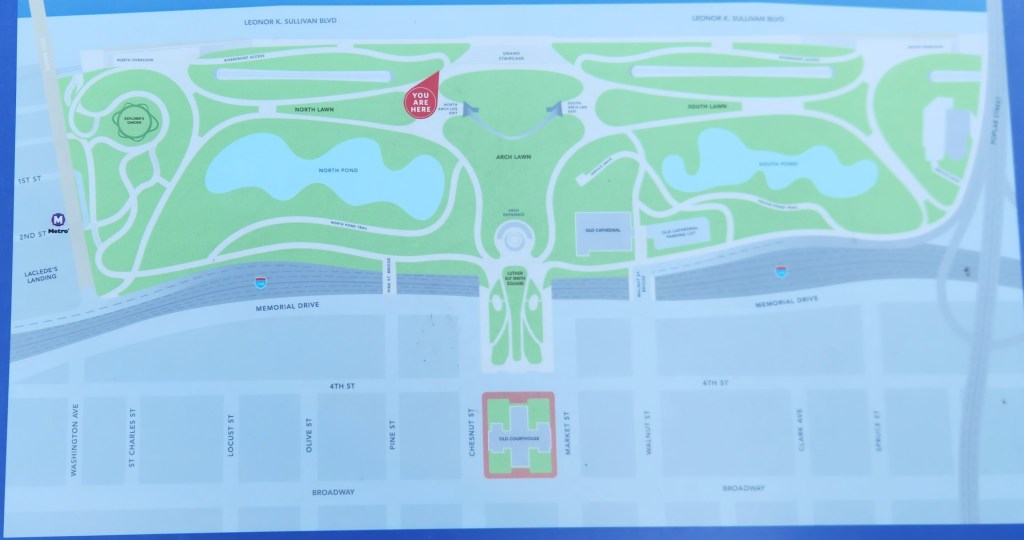
On-site Map of Gateway Arch National Park
Pat and a few close friends by the Gateway Arch
The Old Courthouse, built in 1839
Mississippi River from Walking Path at Gateway Arch National Park
Pond at Gateway Arch National Park
End View of Gateway Arch
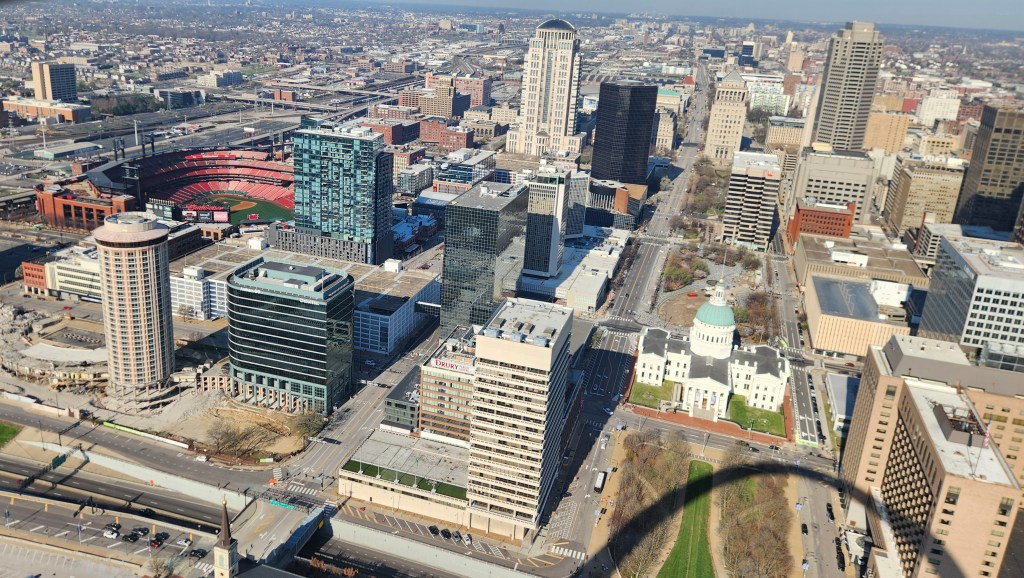
Downtown St. Louis from top of Arch (Busch Stadium at Left, Old Courthouse above Arch Shadow)
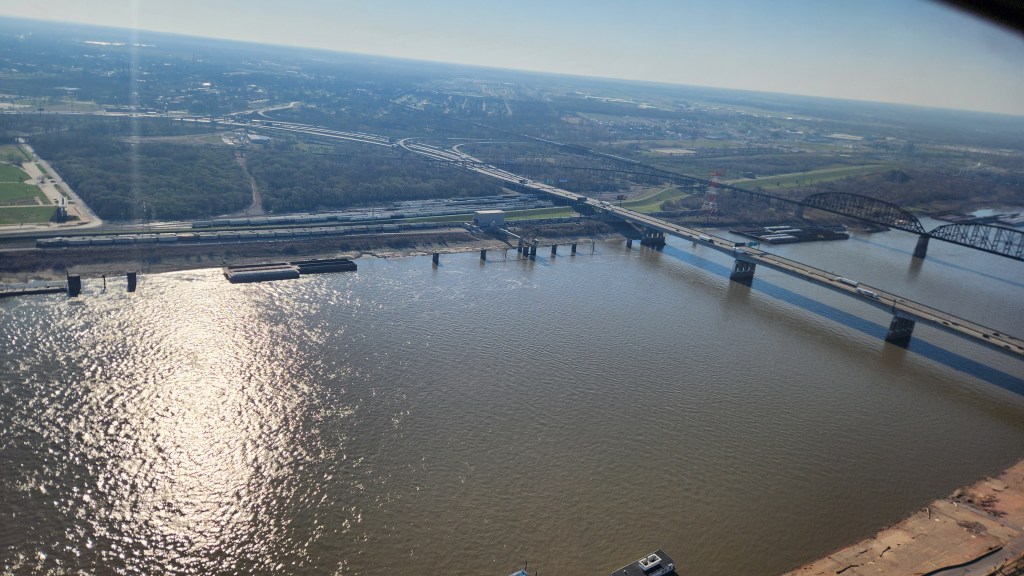
Mississippi River from Top of Arch

All in all, our visit to St. Louis and the Gateway Arch was very rewarding. We parked our car and plugged it in on Saturday afternoon and didn’t drive again until we left on Monday due to the easily walkable neighborhood with multiple nearby restaurants. Speaking of which, we had the best barbeque dinner ever on Saturday at a family-owned place called Five Aces Smokestaq Lightning.

I won’t report on the remainder of the trip as we returned uneventfully to our condo in Minneapolis, arriving at 4 PM on Tuesday, March 24th. I was originally intending to add a discussion with some fascinating data regarding road tripping with an EV, but I have since had second thoughts as to whether it might be fascinating to anyone other than me. If I do eventually decide to write that installment, it will come out as PART 4: A Tale of Two Teslas and a Dissertation on Drag. Don’t hold your breath, but either popular demand or my irrepressible nerdiness may yet prevail.

At any rate, thanks for reading, and I hope you enjoyed this travelogue!
Pat and Dave’s (Almost) Redundant Road Trip Redo – PART 2: More Repeat Visits

Part 1 of this travelogue covered our 6-week stay in Green Valley, AZ, which was essentially a repeat of last year’s Winter Warmup enlivened with a few new places we discovered this time around. While we very much enjoyed the warm weather and the relaxation associated with a long-term stay, we were eager to move on as we packed up the car on Friday, March 6, and headed westward. This installment covers several of the stops we made during our circuitous return to Minneapolis, all of which we’d done during previous road trips. (As Steely Dan put it back in the 1970’s, “You go back, Jack, do it again …,” although I’d say our repeat choices were much better than those of the unfortunate subject of that song.)

Here’s a map showing the interesting places we visited during the stretch from March 6 through March 16 followed by brief descriptions of those visits.

Buckeye, AZ: Since we’d allowed for three travel days to make the relatively short drive from Green Valley to our next booked destination in Palm Springs, we decided to stop for a couple of days in Buckeye along the way. This was based primarily on our great memories from Pat and Dave’s Excellent Adventure (Part 4) in 2018 as well as The Saaris’ (Sorta) Safe Sojourn (Part 8) in the Covid times of 2021. During both of those trips, we stayed at an RV park in Buckeye and went hiking at the Skyline Regional Park.

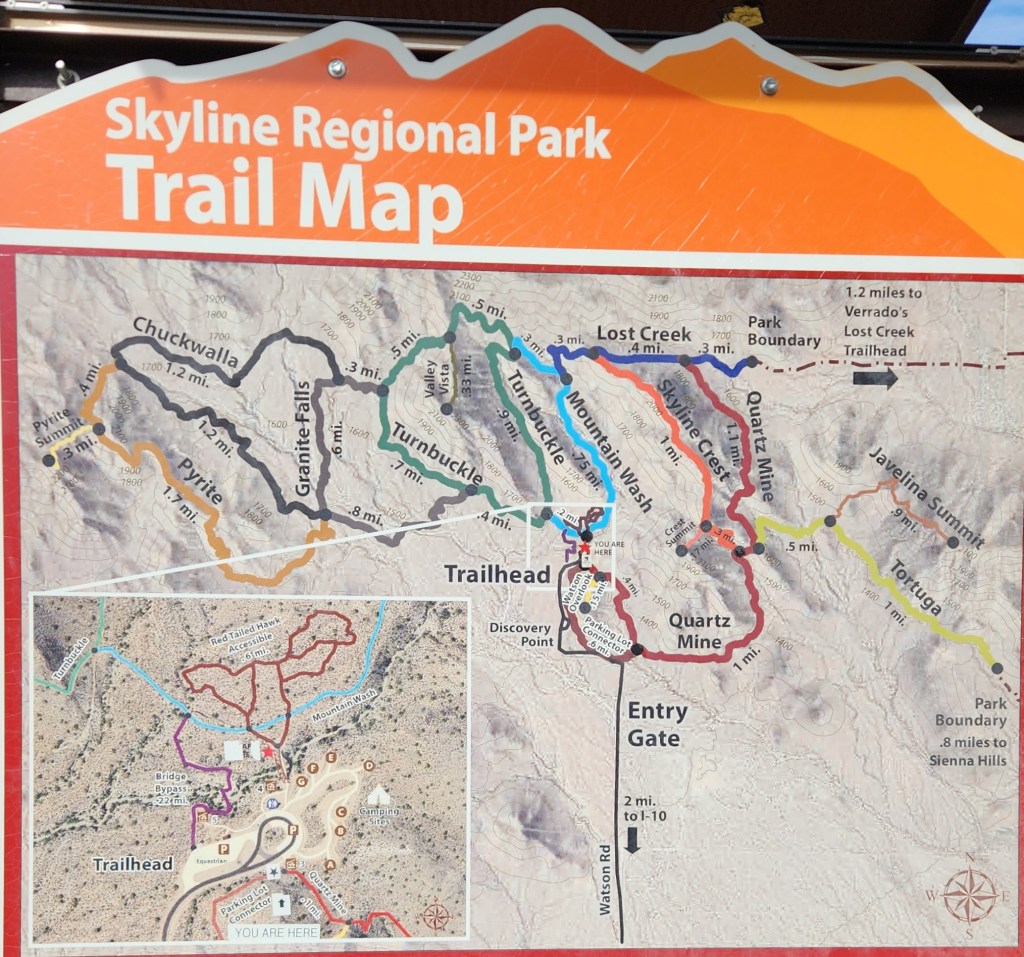
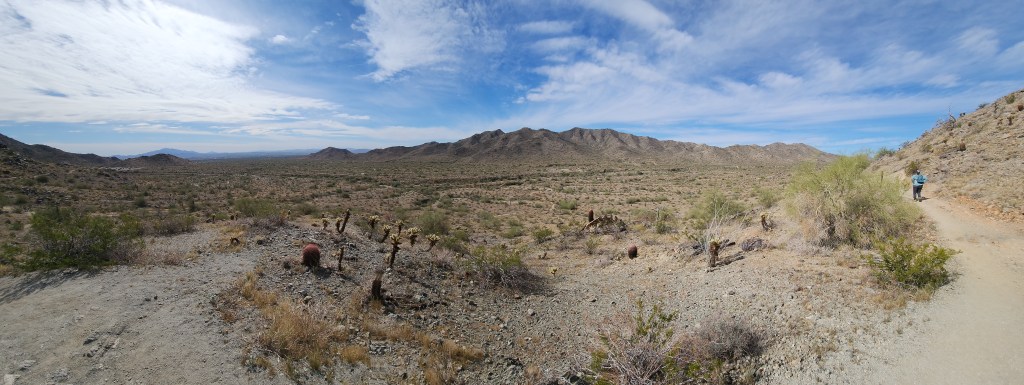
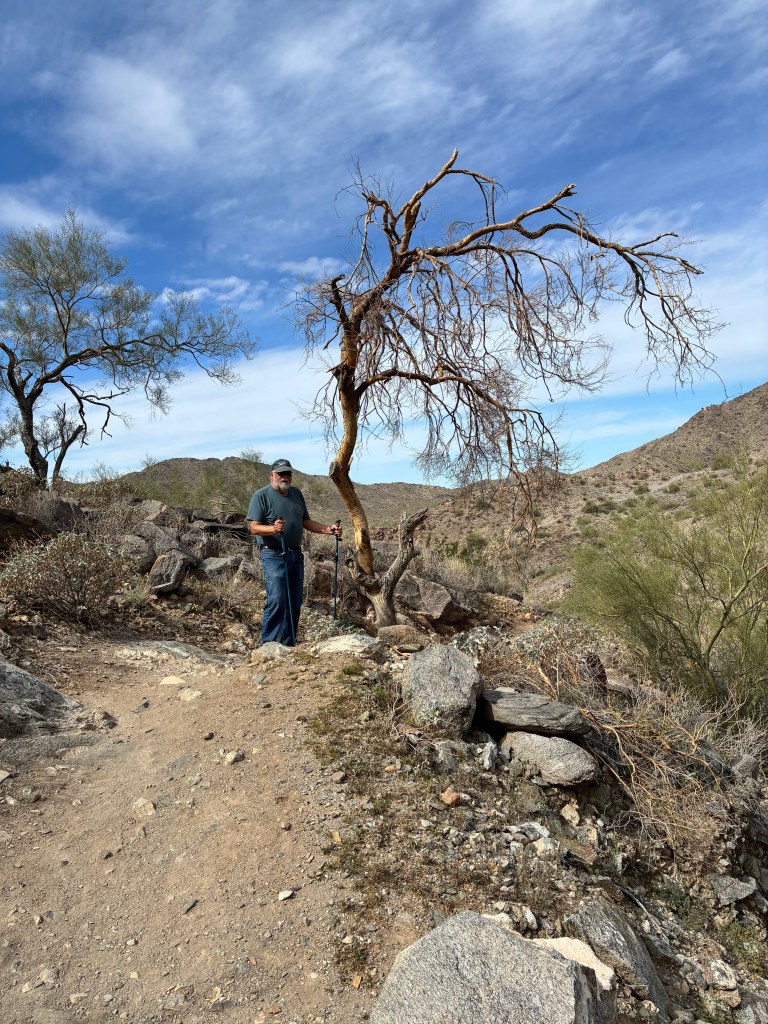
This time around, we stayed in a hotel, but on Saturday, we again hiked the Turnbuckle Trail at Skyline, a 3-mile loop which we also covered in 2018. The views were spectacular and the hike was demanding enough to get our hearts pumping, even though its difficulty was only rated as “Moderate.” While the intervening six years didn’t seem to have slowed me down too much on the uphill portions, I definitely needed my walking sticks to navigate the rocky portions on the final downhill leg.

Map of Hiking Trails at Skyline Regional Park
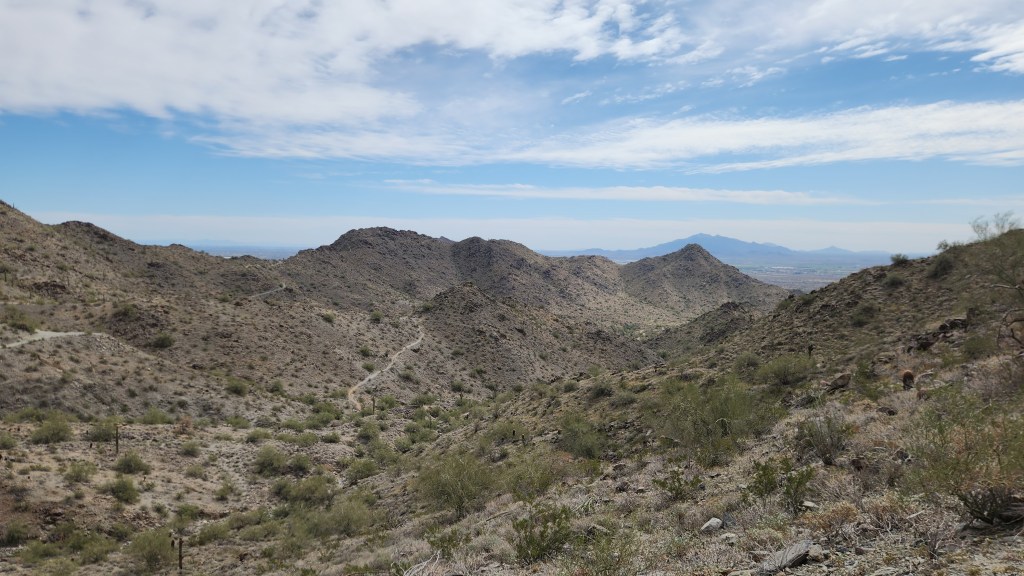
Panorama Picture on the Turnbuckle Trail
View from Turnbuckle Trail
Going up was fairly smooth …
Coming down, not so much

Loyal readers may recall that on both of our previous visits to Buckeye, we dined at a terrific pizza place called Ciao Grazie, so naturally in the “do-it-again” spirit, we had to go there again after our Skyline hike. We had shown a tiny bit of independent spirit, however, on Friday night, when we dined at a nice Indian restaurant called Punjabi Dhaba that was quirkily located inside a large truck wash.

Palm Springs, CA: On Sunday, we drove to the Omni Rancho Las Palmas Resort and Spa near Palm Springs. I would call it the most upscale place we’ve ever stayed at in our lives – a sprawling place with multiple buildings, swimming pools, tennis courts, and a golf course – although our hotel room did show some signs of wear. The reason we had booked such an un-Saari-like place to stay was simple: Pat wanted to go see some matches at the BNP Paribas Open tennis tournament in Indian Wells, and I wanted to play some golf in the Palm Springs area. So, we decided to splurge on a tennis travel package offered through the official tournament site that included a 3-night stay at a fancy hotel, reserved seats for two all-day sessions at the tournament, and a shuttle service to take her to and from the tournament site.

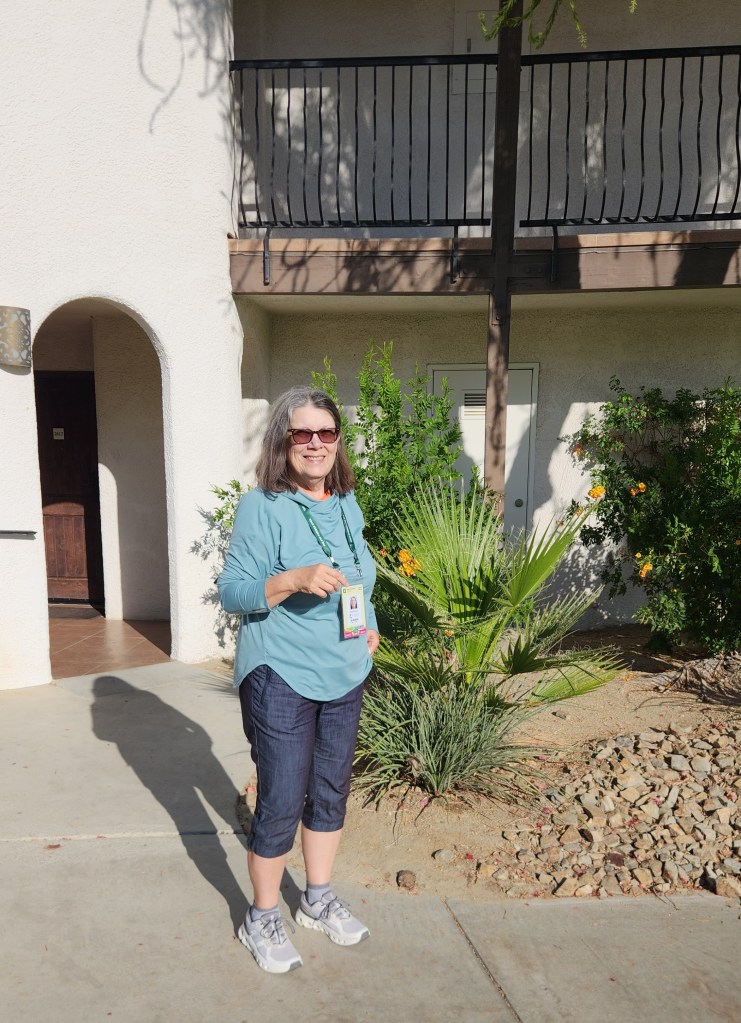
Pat with her Tournament Pass outside our Room at Omni Rancho Las Palmas Resort
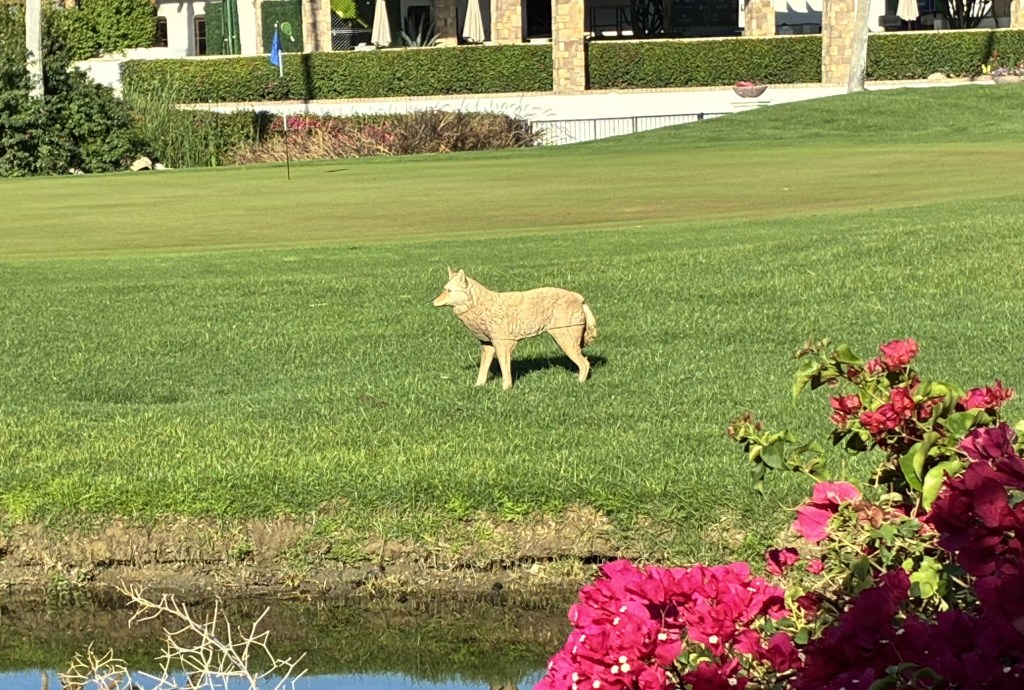
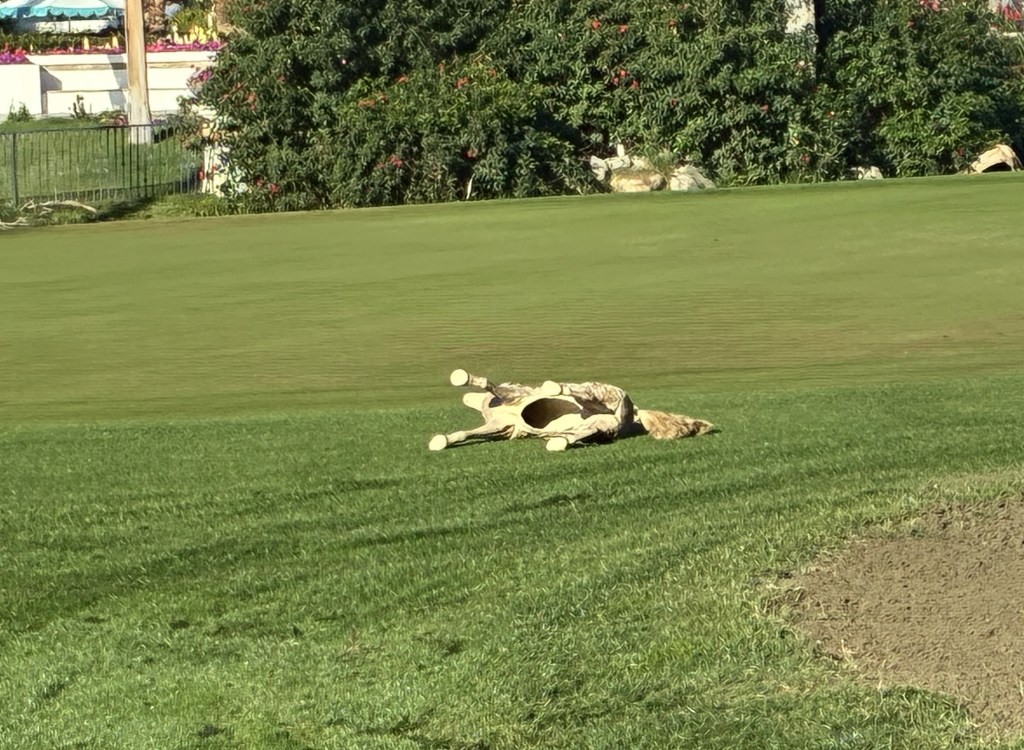
Wildlife at Rancho Las Palmas Resort
Oops … done in by the greenskeeper!
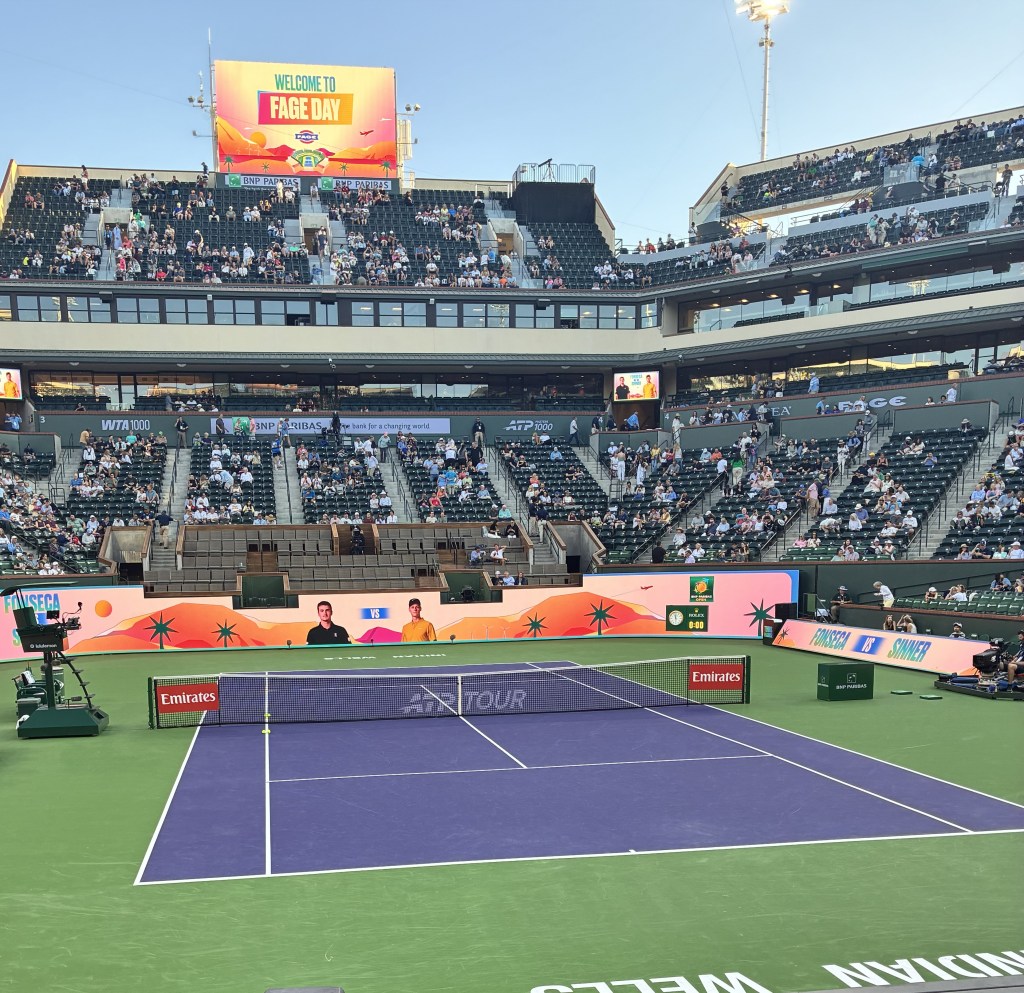
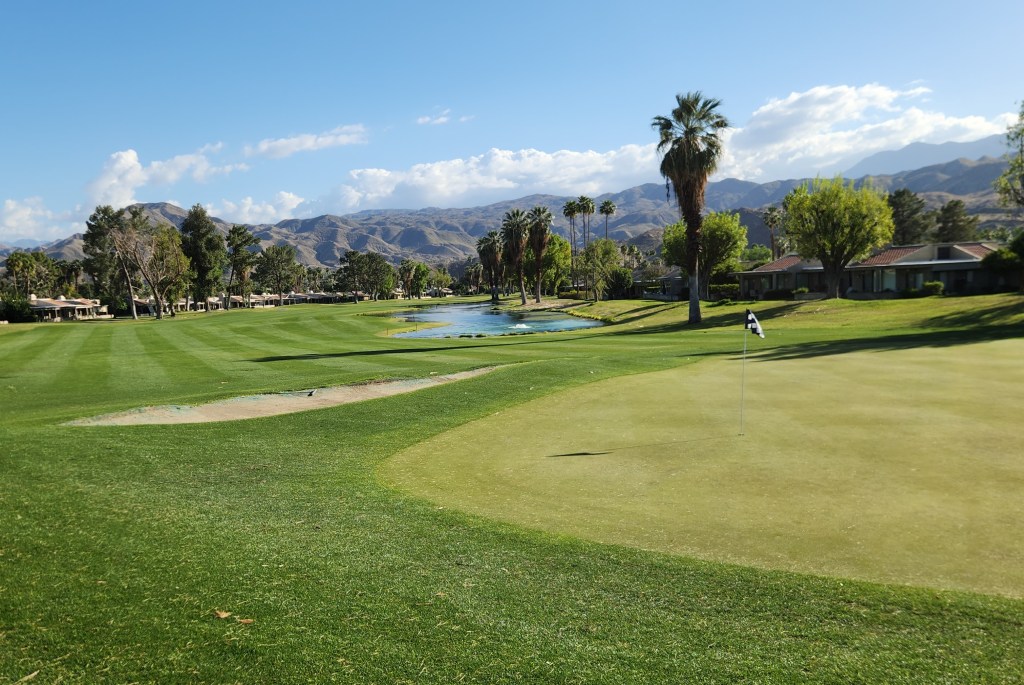
We both thoroughly enjoyed our separate activities. Pat saw a total of eight tennis matches on Monday and Tuesday during the middle rounds of the tournament, with top players including Jannik Sinner and Aryna Sabalenka, the eventual tournament winners, while I played golf at the Cathedral Canyon Golf Club on Monday and at the Rancho Las Palmas course on Tuesday.

The Indian Wells Tennis Stadium
Great View from Pat’s Seat on Tuesday
Aryna Sabalenka at BNP Paribas Open
Jannik Sinner at BNP Paribas Open
18th Hole at Cathedral Canyon Golf Club

I should point out that these activities also were repeats of things we did during previous visits in 2019 and 2021, although the fancy hotel was quite an upgrade from our earlier stays in a nearby RV park. Also, I must add that while I chafed in the non-denim pants I brought along expressly to play at the pretentious Coachella Valley courses, I did try to salve my blue-collar sympathies by booking half-price greens fees through GolfNow and dining at McDonald’s on Tuesday evening.

Death Valley National Park, CA: My original hope when we set off on this trip was that we could visit Yosemite National Park after the stay in Palm Springs, though we hadn’t booked anything as we wanted to see how things developed with weather conditions. That would have been something new for us, a real departure from the redundant aspects of the trip. However, as our stay in Green Valley was ending, the reports we saw online indicated that much of the park was still inaccessible due to snow. As a result, we shifted our sights to Death Valley, another familiar site from our earlier RV trips that we knew would be warm and snowless. As a result, we reserved a 2-night stay in Pahrump, NV, yet another place where we had stayed on our previous trips, and drove there on Wednesday.

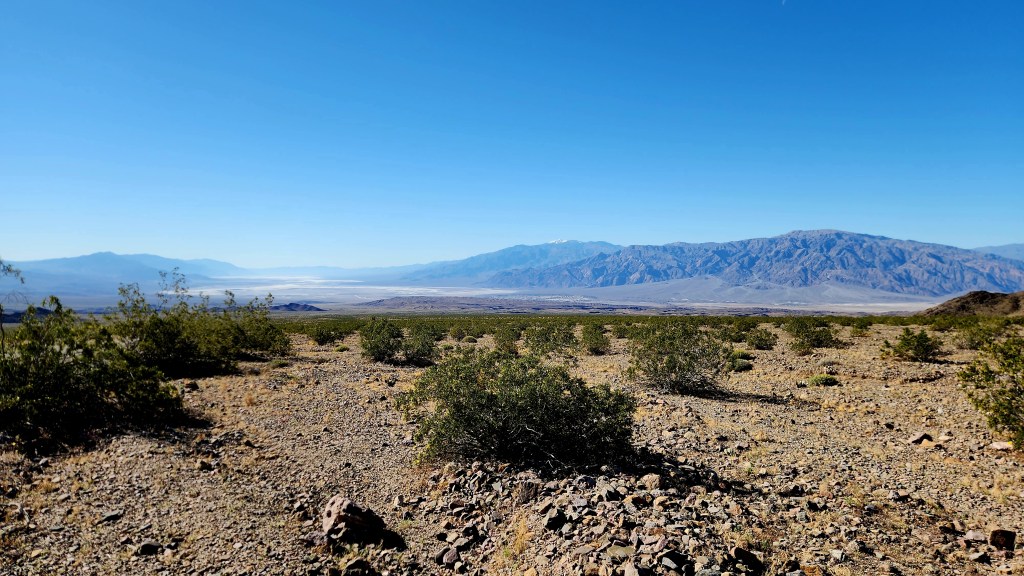
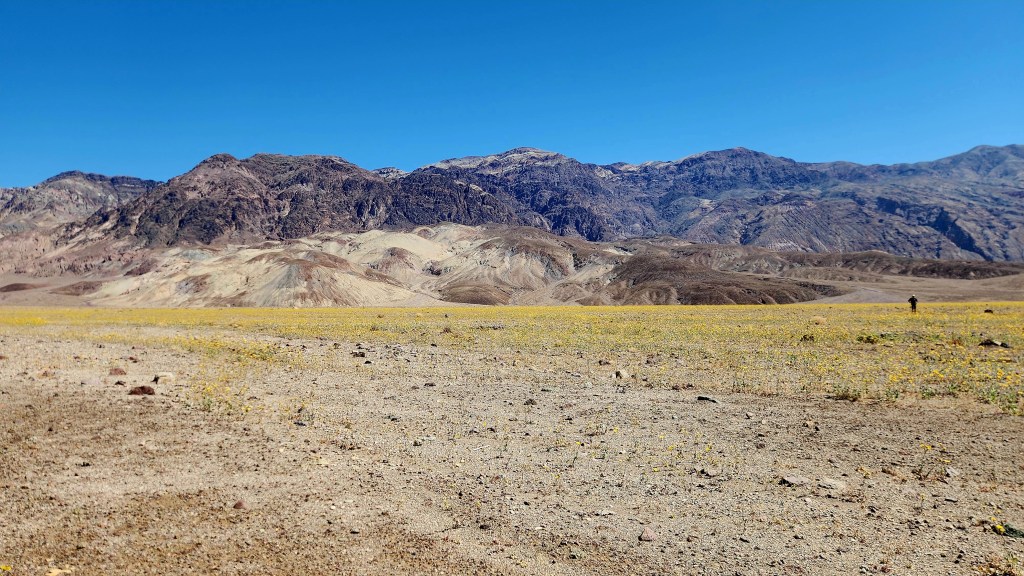
We drove from our hotel in Pahrump to the Death Valley National Park on Thursday morning and spent several hours exploring the park. One difference from our previous visits was that we entered the park from the north this time, rather than from the west as we had during our two previous visits, and were rewarded by the beautiful view from that direction.

View of Death Valley from North Entrance Road

Death Valley is famous for being the hottest, driest, and lowest National Park. Here’s a quote from the National Parks website:

“In this below-sea-level basin, steady drought and record summer heat make Death Valley a land of extremes. Yet, each extreme has a striking contrast. Towering peaks are frosted with winter snow. Rare rainstorms bring vast fields of wildflowers. Lush oases harbor tiny fish and refuge for wildlife and humans. Despite its morbid name, a great diversity of life thrives in Death Valley.”

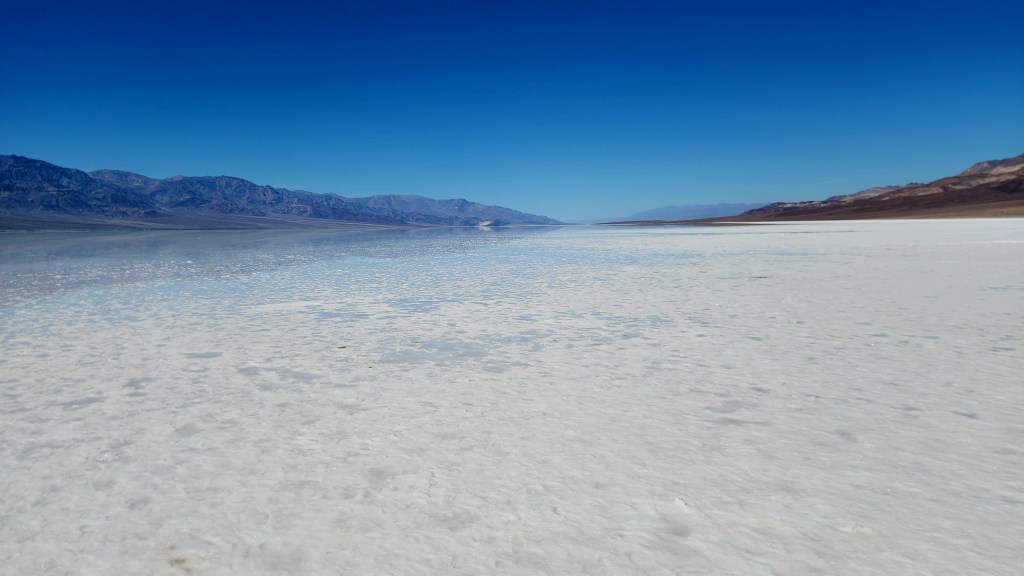
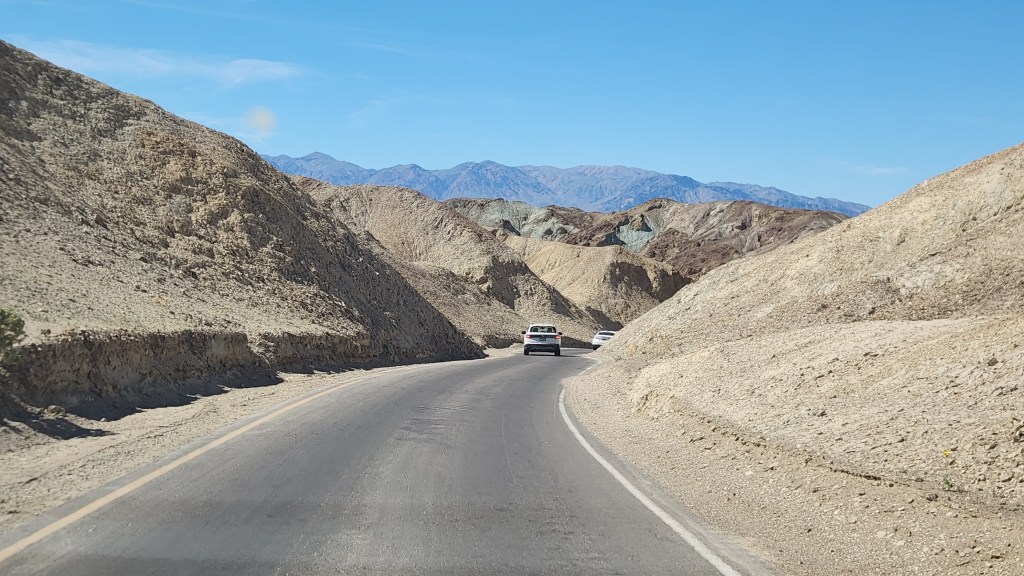
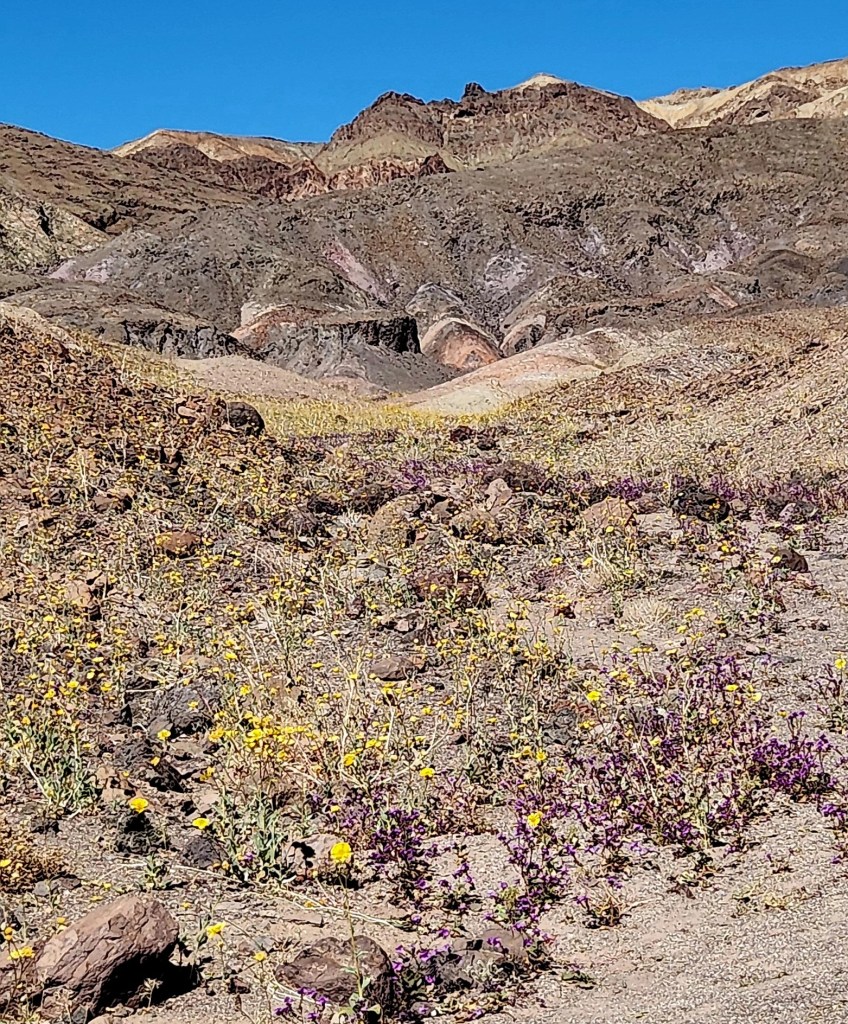
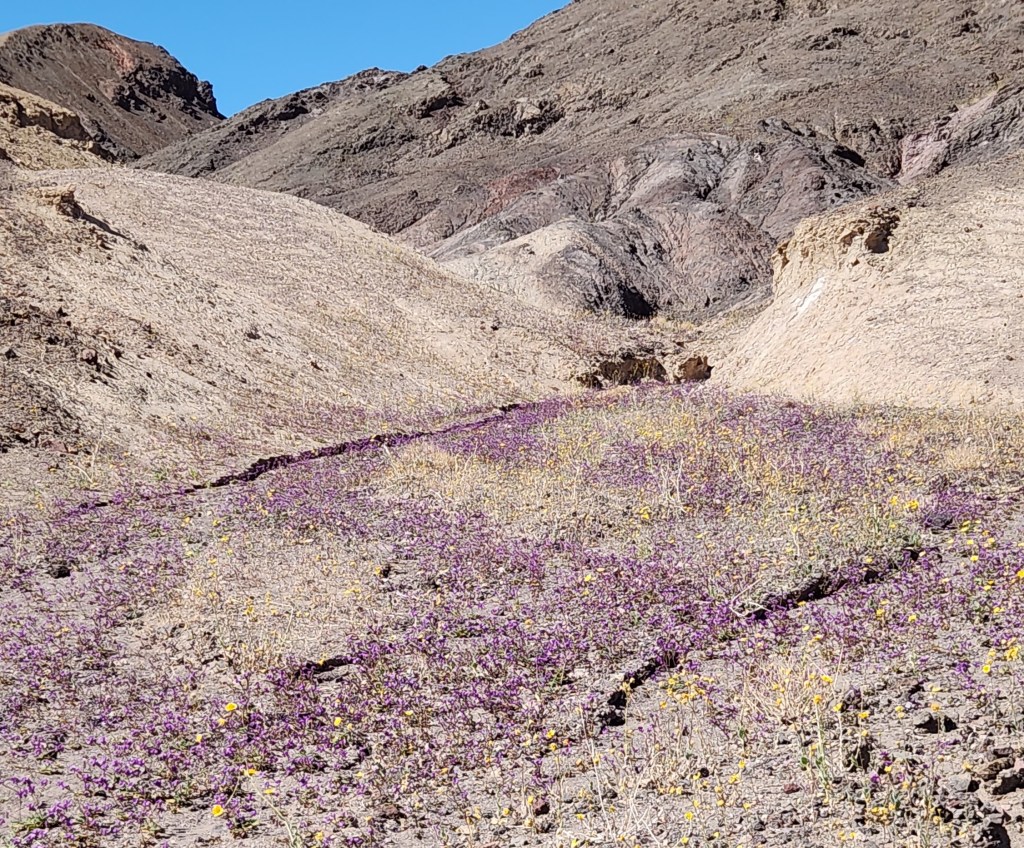
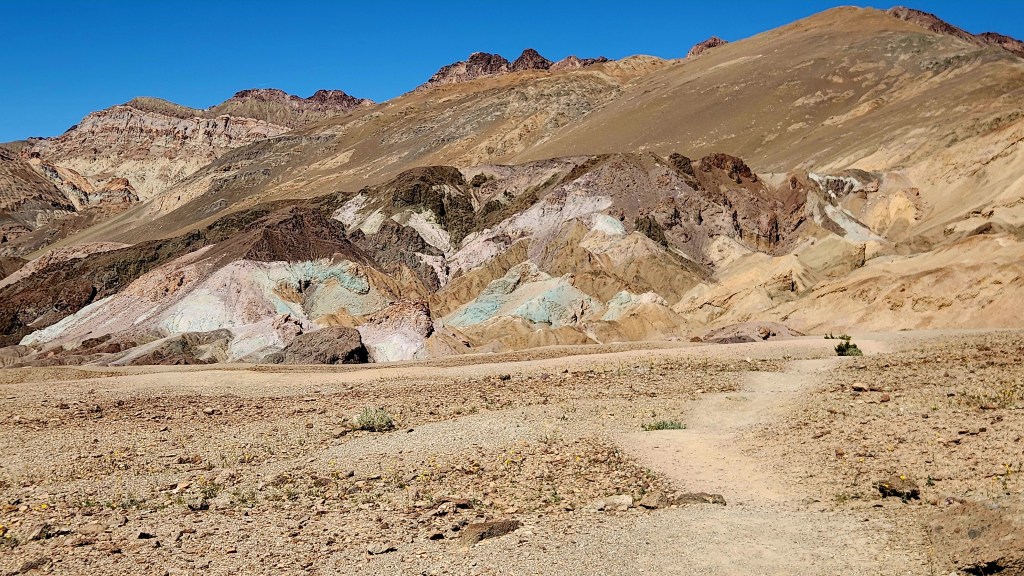
True to these words, we enjoyed the great diversity evident in the park. The yellow and purple wildflowers were blooming to a much greater degree than during our previous visits, and we again enjoyed visiting the Badwater Basin salt flats and driving the stunning Artist Drive loop. We enjoyed lunch and ice cream in two of the eateries in Furnace Creek and strolled on a path that meandered through a portion of the golf course as well as the on-site hotel buildings while we recharged the Tesla at a conveniently located – and free – EV charger before heading back to Pahrump.

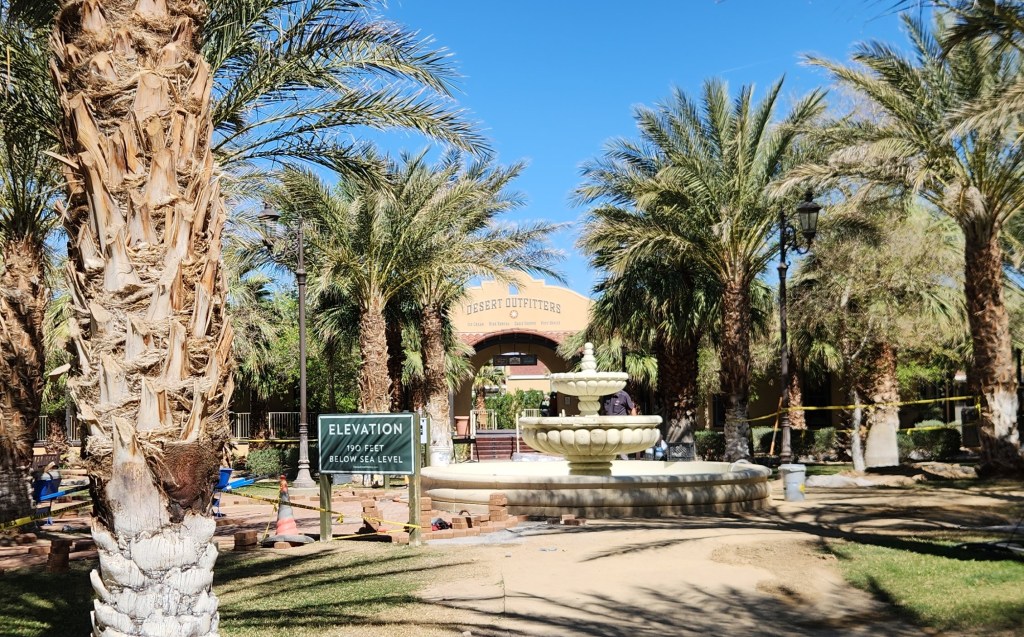
Central Plaza in the Oasis at Furnace Creek, Death Valley National Park
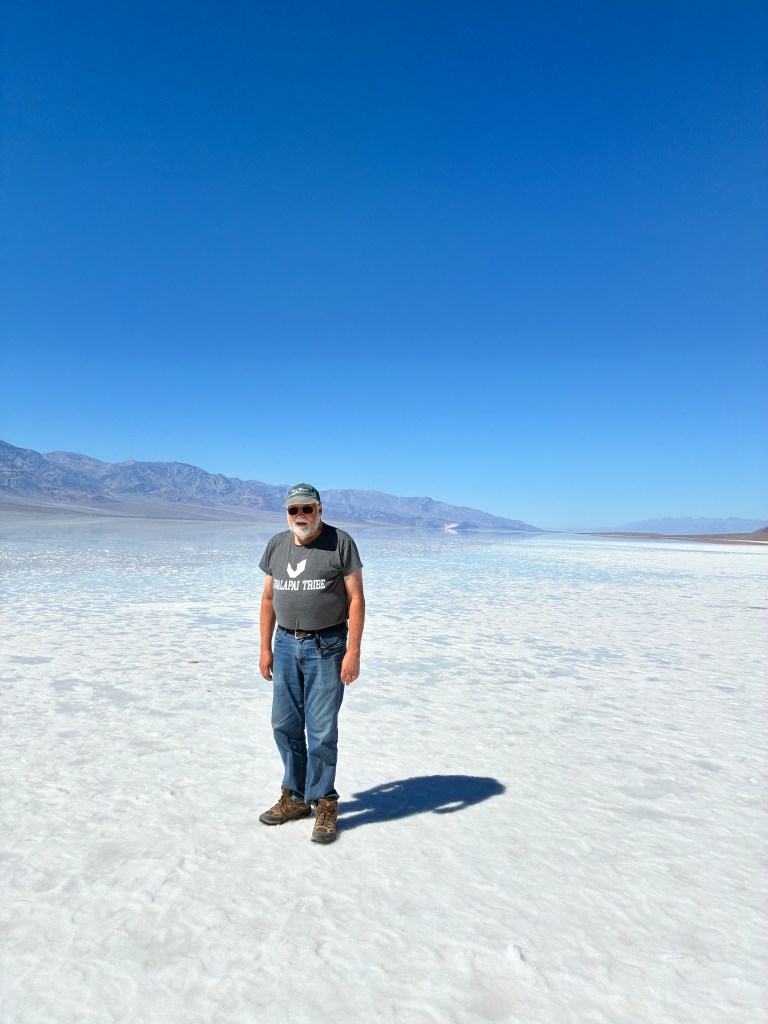
Salt Flats at Badwater Basin, Death Valley National Park
No need for walking sticks here …
View from Death Valley Wilderness Road
Artist Drive Loop
View from Artist Drive Loop
View from Death Valley Wilderness Road

As an added highlight to this visit – and something new as well! – we went to a local winery, the Artesian Cellars, and enjoyed a nice meal along with tastings of five different local wines. This was something we had tried to do back in 2021, but the restaurant was closed at that time due to Covid.

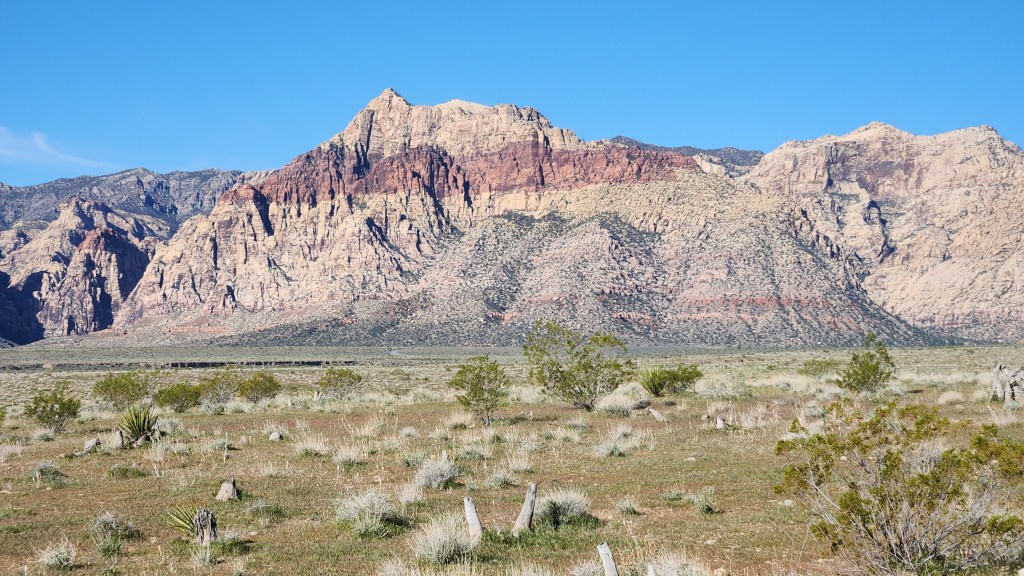
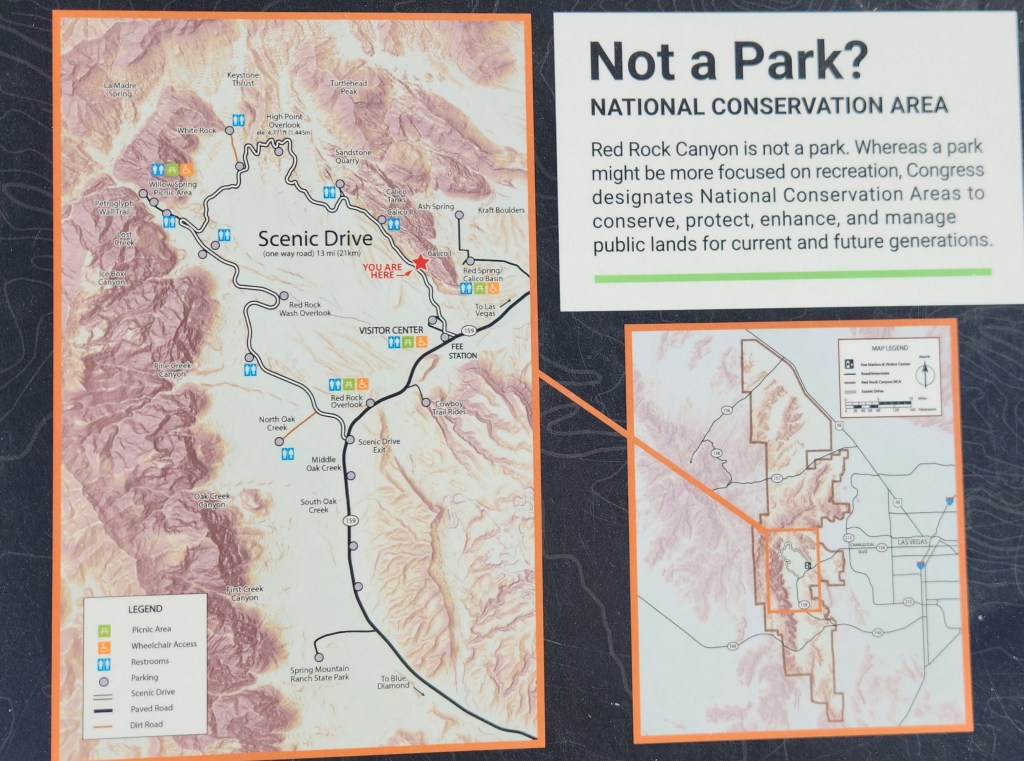
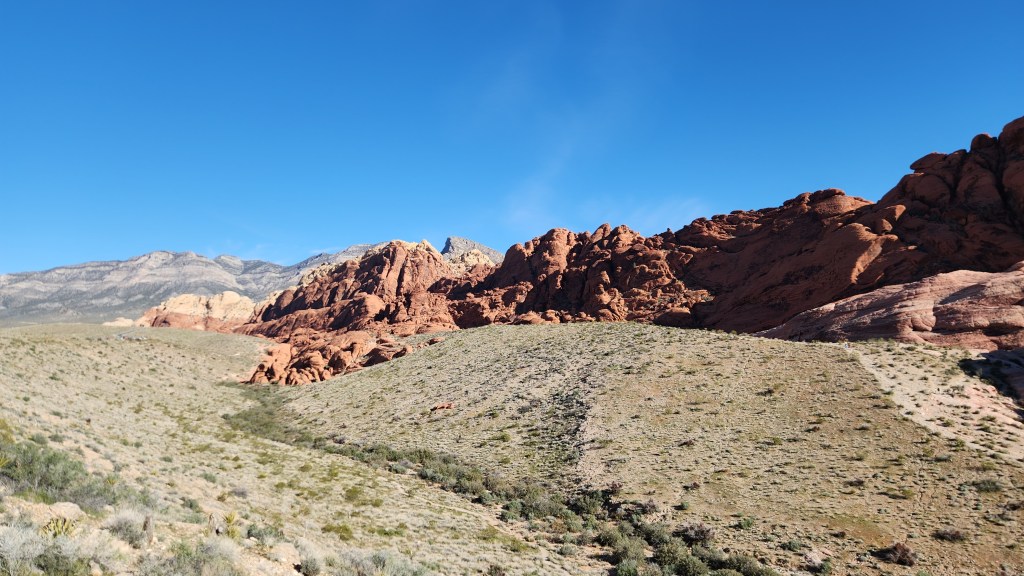
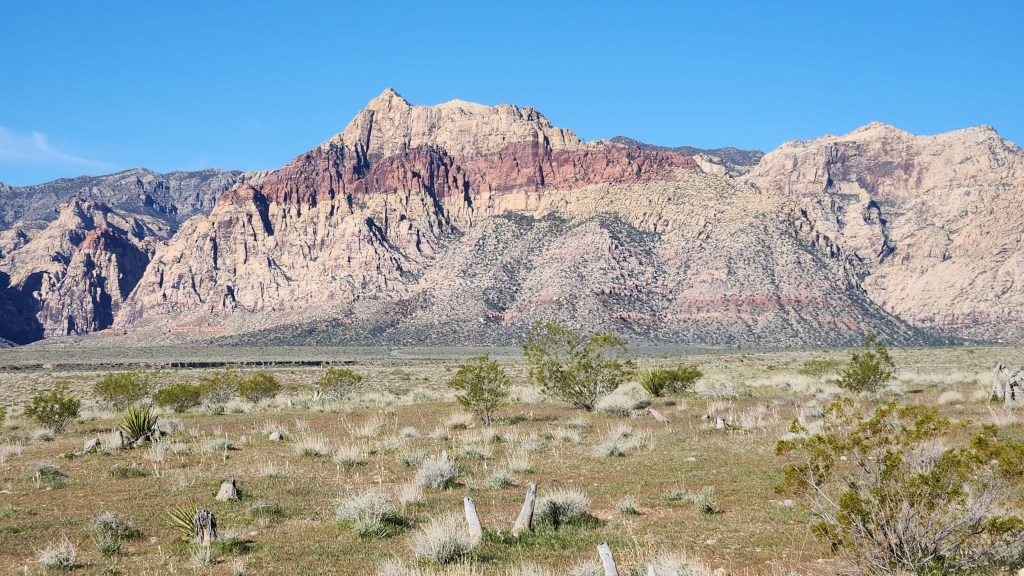
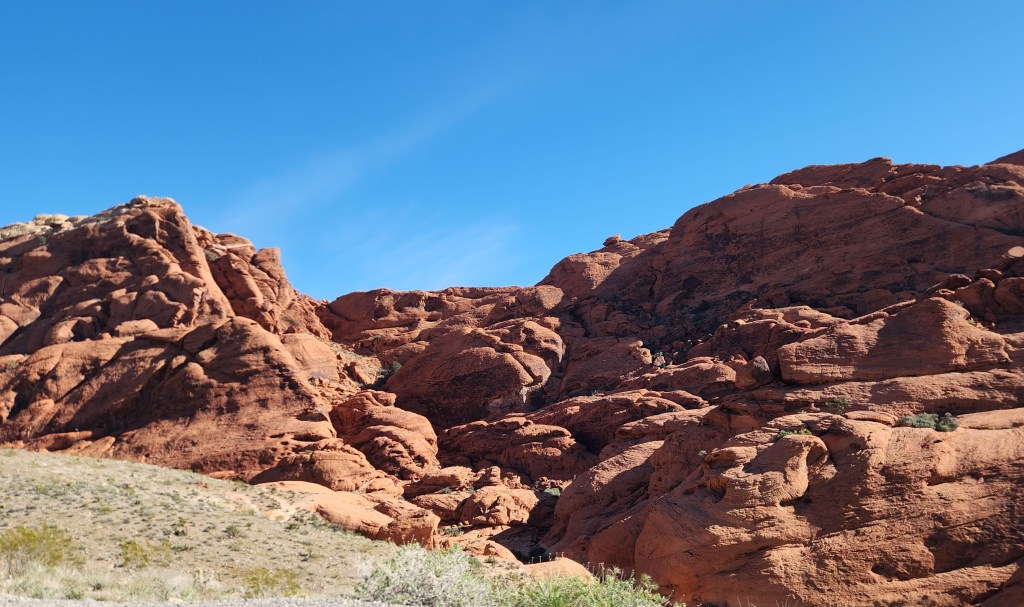
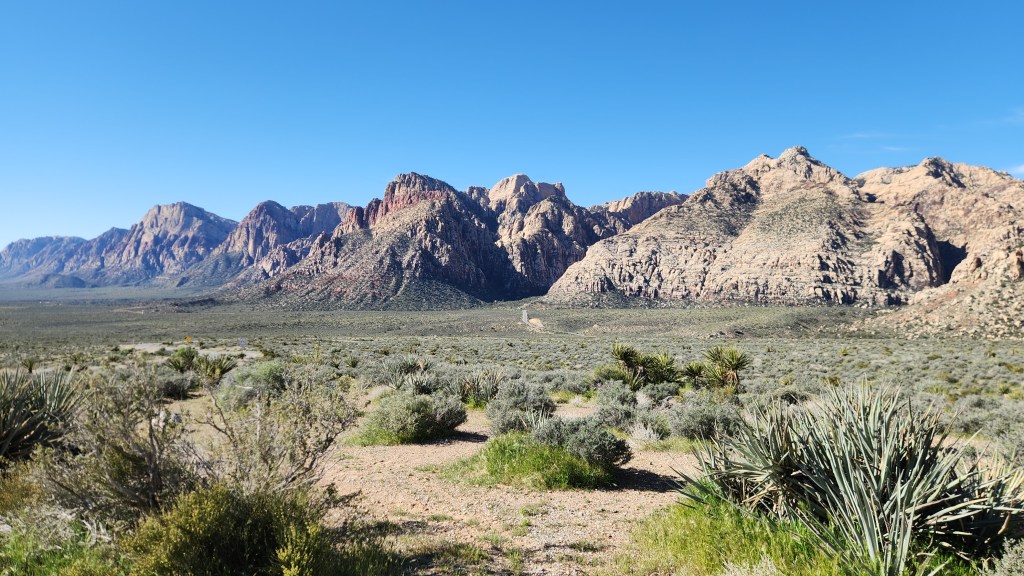
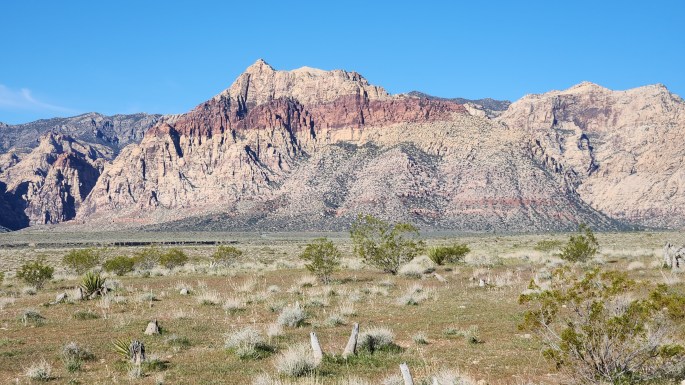
Red Rock Canyon National Conservation Area, Clark County, NV: As we sat in our hotel room in Pahrump the night before departing, we realized that our subsequent travels would take us directly past the National Conservation Area that we had visited back in 2021. Naturally, in the “do-it-again” spirit, we decided we should visit there again on this trip. So, I reserved a timed-entry slot on the Recreation.gov site for 9 AM on Friday, March 13. We arrived at the entry gate shortly after nine and spent an hour motoring around the 13-mile Scenic Drive loop, stopping frequently to ogle at the stunning scenery.

Map of Scenic Drive at Red Rock Canyon National Conservation Area
View from Scenic Drive

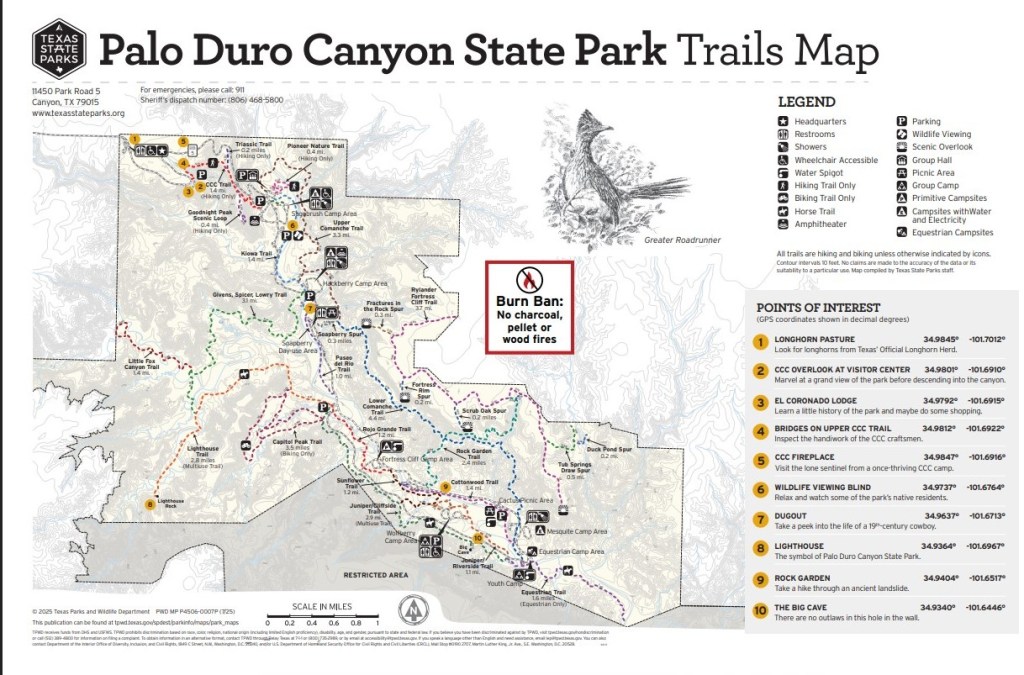
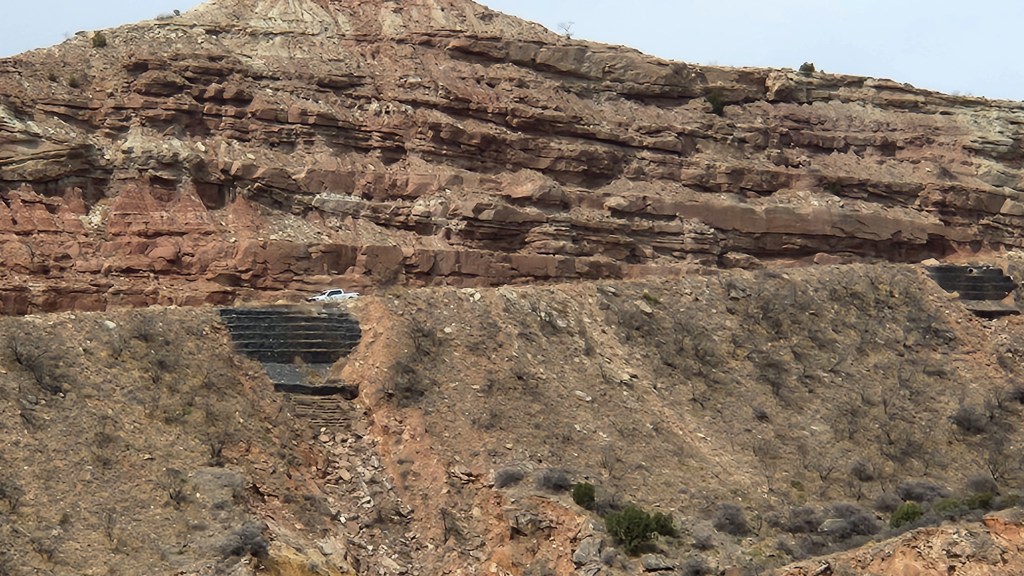
Palo Duro Canyon State Park, Canyon, TX: After our Red Rock Canyon visit, we spent two days travelling east to Amarillo, TX, where we stopped for a 2-night stay and another “do-it-again” visit, this time to the nearby Palo Duro Canyon State Park. Not to sound like a broken record, but yes, we had visited this place during both of our previous RV adventures and had very fond memories of the place. Palo Duro is known as the “Grand Canyon of Texas” and definitely lives up to the name. The visitor center is located on the rim of the 120-mile-long, 20-mile-wide canyon. After passing the visitor center, we descended on an amazing, scenic road with multiple hairpin turns and switchbacks that winds down some 800 feet to the canyon floor. The well-maintained, 16-mile loop road continues through the portion of the canyon that is open to the public, with access to over 30 miles of hiking trails and multiple campgrounds. On our previous visits, we stayed in the RV at the Hackberry Campground, located about halfway along the loop road, and the Mesquite Campground at the westernmost end. We drove past both of these sites on our trip around the loop, eliciting a raft of fond memories.

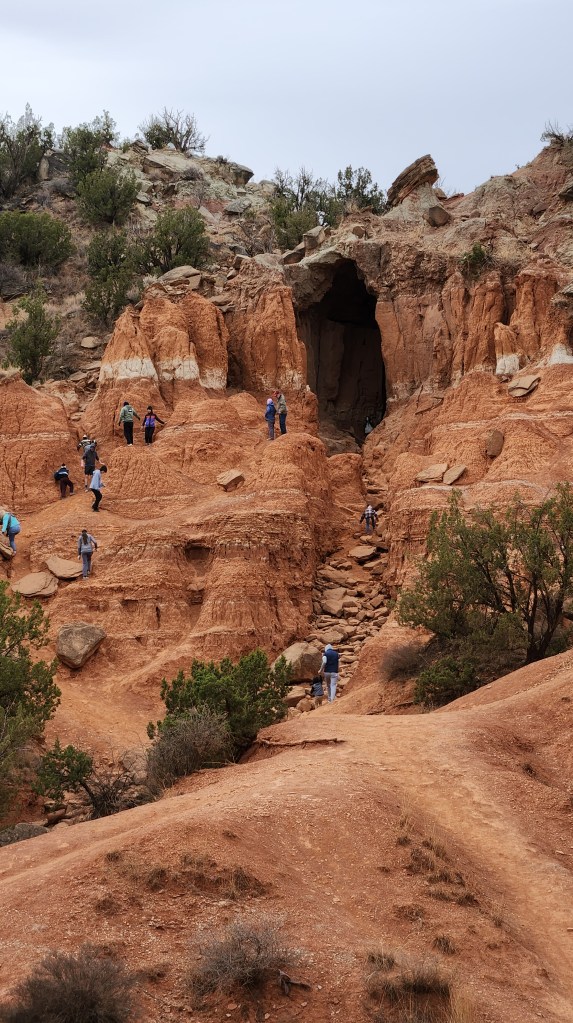
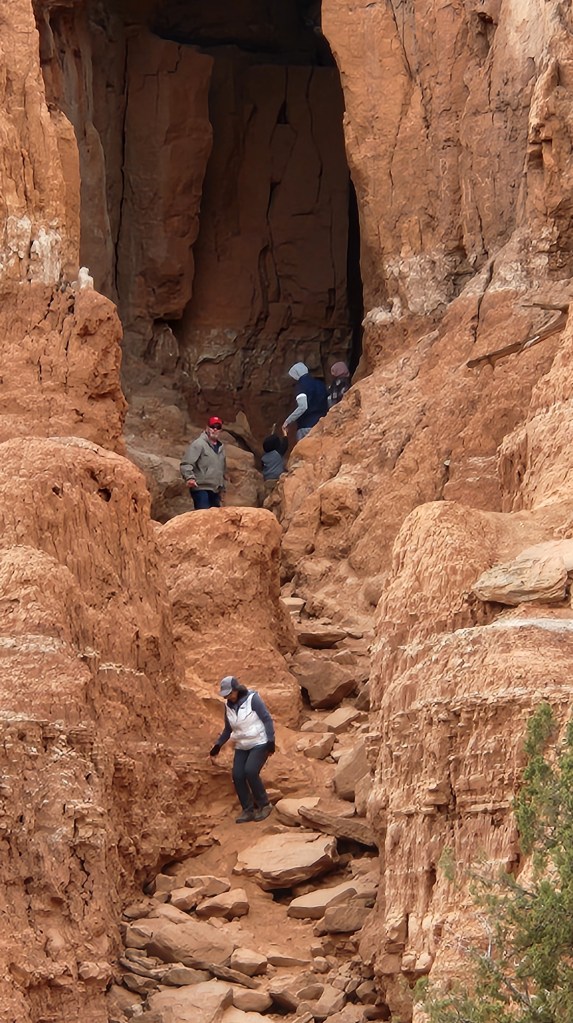
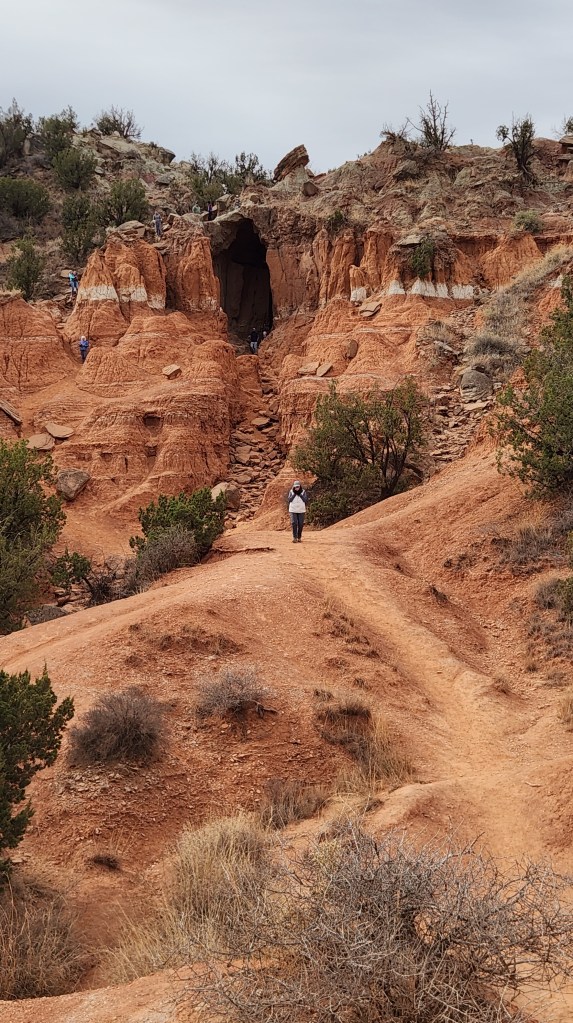
As we traversed the loop road, we stopped at a number of turnouts to take photos and took a short hike to a point of interest called the Big Cave (number 10 on the map above). I ventured partway up the steep climb to the cave, but even with my walking sticks I felt too wobbly to go the whole way. Pat was more adventurous, but I decided discretion was the better part of valor and instead documented her exploits from afar. She went inside the cave before returning to the base where I was waiting.

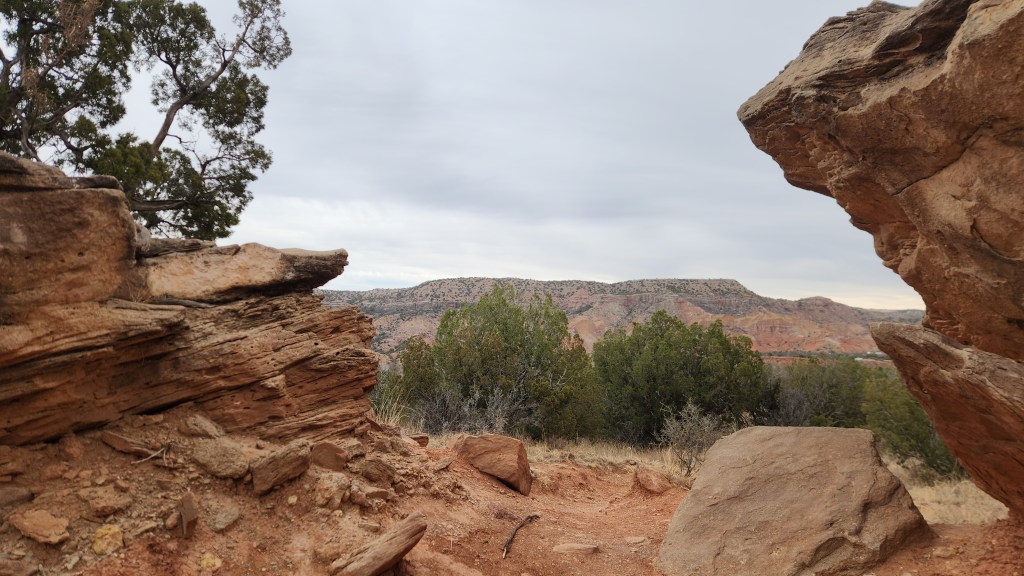
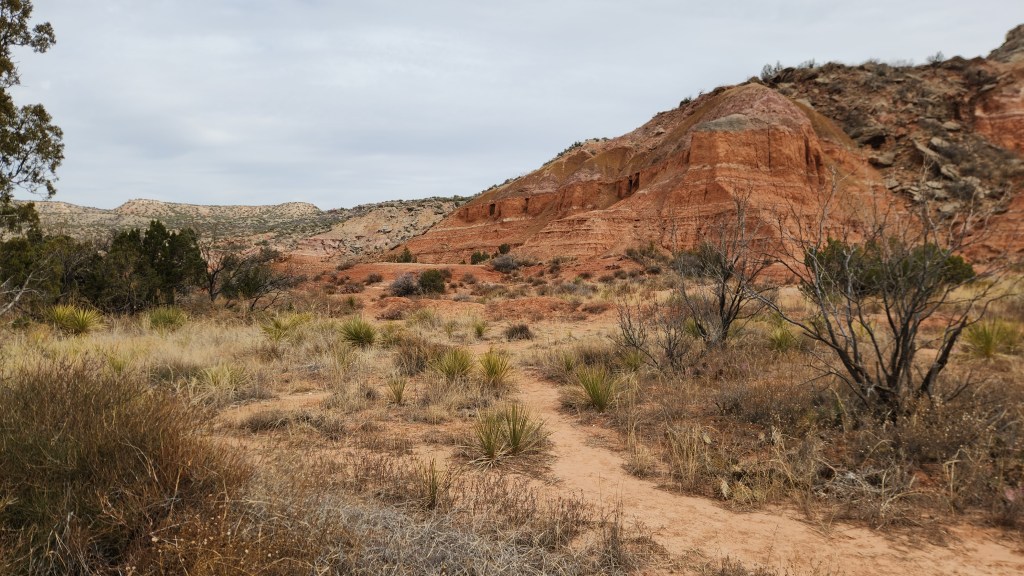
View from Trail at Palo Duro Canyon State Park
The Big Cave at Palo Duro Canyon State Park
Pat Returning from the Big Cave
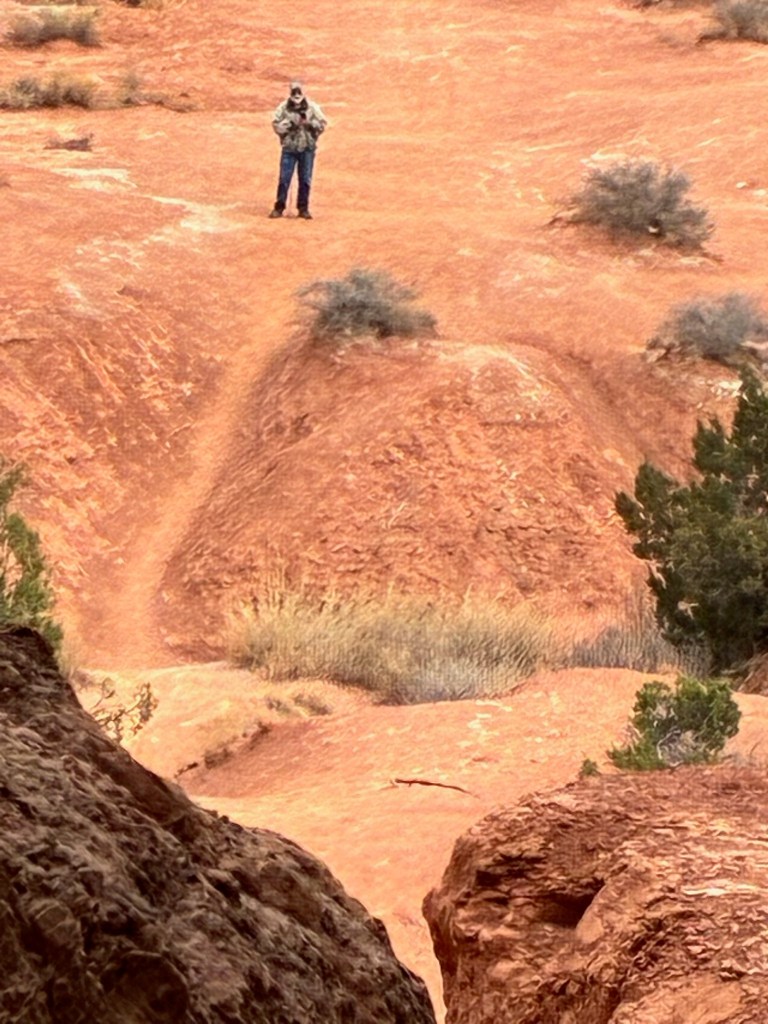
Pat decided to take a picture of me on her way back …
… while I was photographing her
View from Trail at Palo Duro Canyon
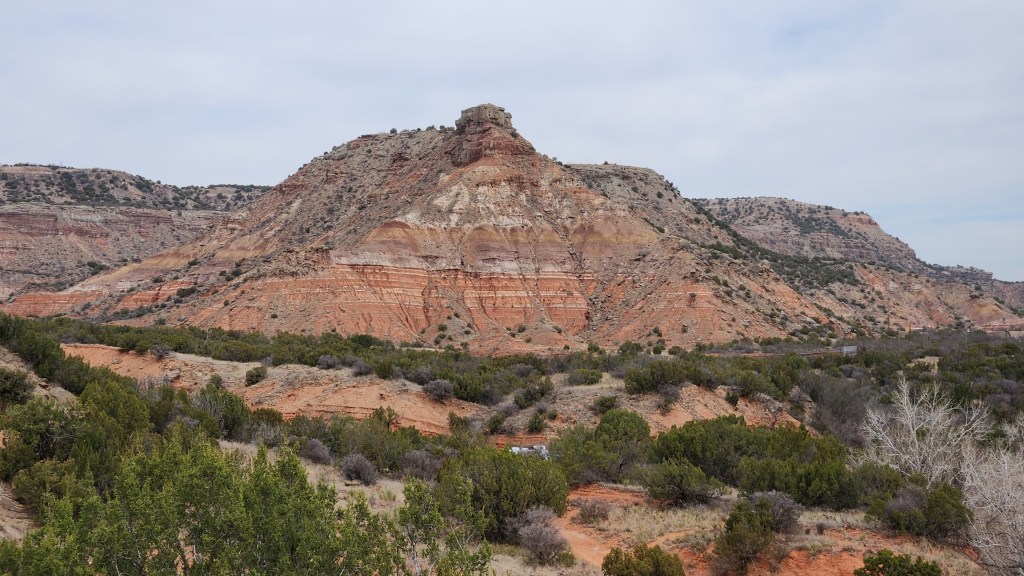
Capitol Peak at Palo Duro Canyon
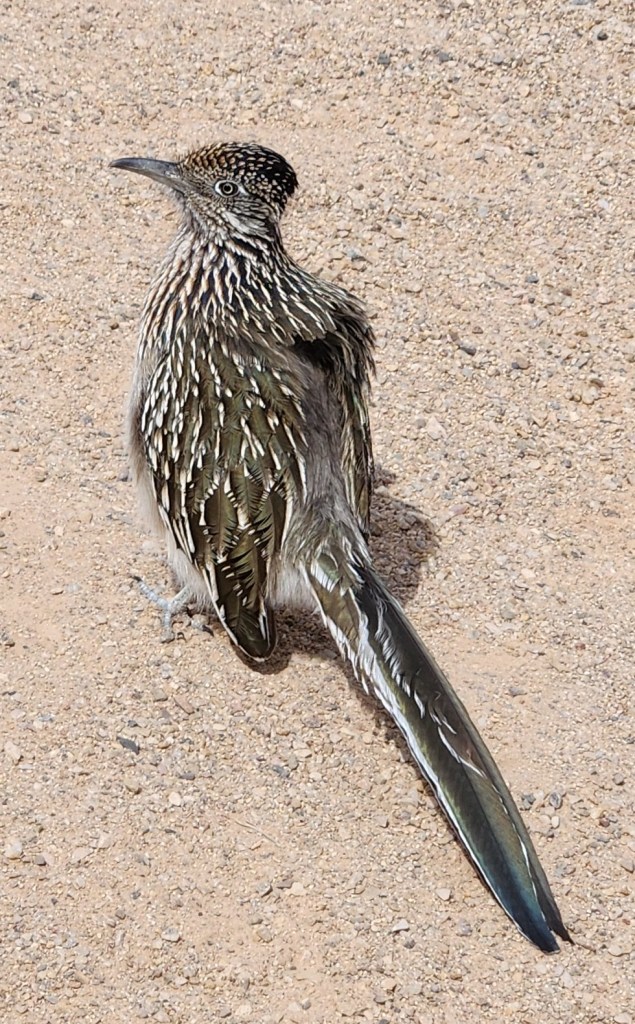
Unfortunately, we ruffled some of this Road Runner’s feathers

After that, we walked a short way along the Capitol Peak trail before heading to the Trading Post for a lunch of their “world-famous” burgers. We then took another short hike on the Pioneer Nature Trail before heading back up to the rim for a final stop at the visitor center with its spectacular overlooks into the canyon.

Palo Duro Canyon Access Road
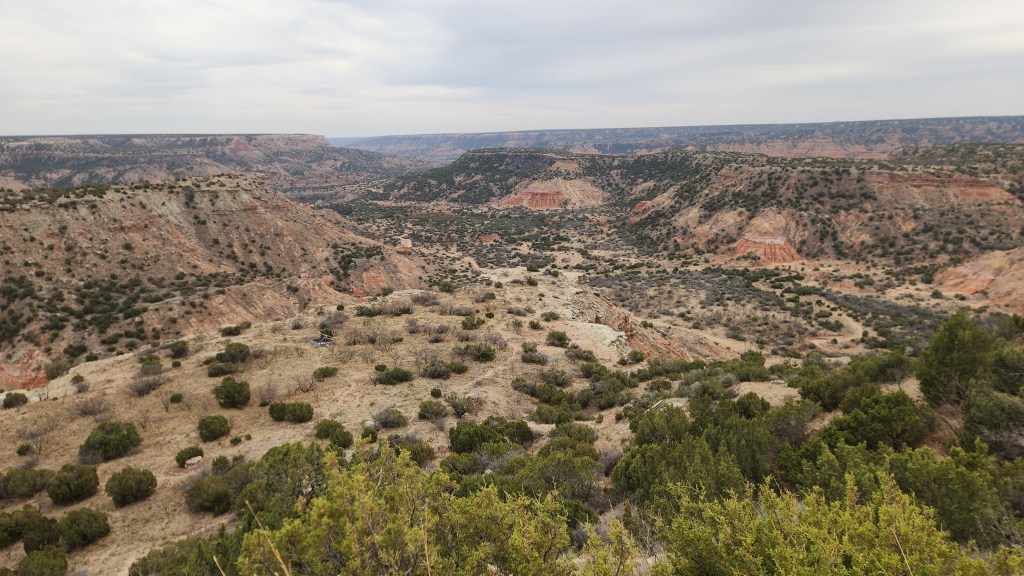
View from Visitor Center Overlook

I’ll wrap up this episode here, as we depart from Palo Duro Canyon. Stay tuned for the next installment, in which we actually visit some places we’d never been to before!